This morning I’m in Great Falls at the Montana University System 2026 Mental Health and Wellbeing Summit. I am grateful to be invited.
I’ll be covering a ton of info in 50 min, so it will be sort of like the speed-dating or caffeinated version of the Pursuit of Happiness. The ppts are linked below. Will I get through them? Your guess–as my mother liked to say–is as good as mine.
I saw the sunrise over the Missouri River on my drive from Helena this morning. Spectacular! I wish I had a photo to share. But instead, you have to use your imagination.
Hello from beautiful Albuquerque, NM where I just landed and am patiently awaiting the availability of my hotel room so I can begin taking a substantial nap.
I was looking for fellow conference attendees on my flight from Denver to Albuquerque and, of course, found them. Given that my faith in humanity is teetering on the brink right now, it was so cool (and reassuring) to meet fellow counselor educators and feel their vibes–vibes that distinctly vibrate to the frequency of big motivation to help others lead happy, meaningful, and healthy lives. Thanks, Sharon, for initiating a conversation using your extraversion skills!
This is a small conference populated with people who have big and empathic hearts. Let’s savor that for a moment.
Speaking of savoring, I have two presentations tomorrow. The first is with Dr. Ümüt Arslan of the University of Nebraska–Kearney. Dr. Arslan is a former doc student at UM, who used to refer to himself as “the only male feminist in Turkey.” He is a magnificent person and counselor and professor and I am honored to co-present with him. Our ppts:
Tomorrow afternoon, I’m flying solo and offering a presentation titled: “The Future of Counseling is Counseling for Happiness.” To save on paper, I’m posting the ppts here:
I hope we can all grow our hearts so they metaphorically become as large as the hot air balloons floating around Albuquerque this weekend, but may they be full of empathy instead of hot air.
The chapter linked below is from the book, Tough Kids, Cool Counseling: User-Friendly Strategies for Working with Challenging Youth. The book was published in 2007, so the language is outdated and some ways we talk about youth have changed. For example, we’re no longer comfortable with the term “Tough Kids” because referring to youth as “tough” centers the problem in them, which isn’t fair and can make change more difficult. We have a different philosophy now (please excuse the language as I make my point):
In the beginning, we thought our “tough kids” book title was clever. Sometimes Rita and I argued about who came up with our ingeniously clever title. But now we’re uncomfortable with message embedded in the title. We believe we were wrong to label youth as “tough.” There are no tough kids. There are only kids in tough situations. And one, among many tough situations young people face, is counseling. When they roll their eyes, tell us to fuck off, or refuse to talk, we shouldn’t blame them; we shouldn’t call them difficult, disturbed, or tough. Blaming young people for behaving in ways that appear defensive, obnoxious, or resistant contributes to the problem. Too often we make the mistake of thinking we’re special (we’re not) and that young people should automatically respect us (they won’t) or that they should bow to the alter of our guidance (which is as flawed as we are). Working with youth requires humility, acceptance, creativity, and compassion. We should seek to communicate to all young people who enter our space that there is no other place we’d rather be than in the room with them—without ever directly saying that there is no other place we’d rather be than in the room with them. We call that radical interest. But we’re not talking about radical interest in helping or radical interest in being competent or radical interest in social justice (all of which are great things). We’re talking about radical interest in another living, breathing, person who in this present moment, is experiencing a challenging life, part of which involves being in the room with a fucking counselor.
Not long ago, a friend called me and wanted to read me a quote from the book, “My Friends” by Fredrik Backman. He said the quote made him think of me. He read it. I loved it.
Louisa is a teenager, the best kind of human. The evidence for this is very simple: little children think teenagers are the best humans, and teenagers think teenagers are the best humans, the only people who don’t think that teenagers are the best humans are adults. Which is obviously because adults are the worst kind of humans (p. 1).
I’m honored my friend thought of me when he read this passage. I wish all teens could automatically sense that I think they’re the best humans. But unfortunately, adults are so often so dismissive and demeaning of teenagers that teenagers typically assume the opposite is true. That translates into the sad fact that if we’re going to convince teenagers we think they’re the best humans, we must do the direct and indirect work, which is not easy because we’ve been so effective—as individuals and as a society—to make teenagers think they’re the worst humans.
Here’s a link to the chapter. I hope it helps you convince teenagers they’re the best humans.
At the poetry retreat with Pádraig Ó Tuama, we experienced numerous prompts and poetry forms on Tuesday and Wednesday. One prompt was extraordinarily simple: This I Believe. So, while on my Wednesday morning slow run, I came up with the following poem. . .which is mostly about my mother and what she taught me to believe.
Dead End Street
Contrary to the sign, our street wasn’t dead.
And it did not end.
Maybe it was the confusing and tangled mass of Mormon, Italian, Catholic, Levite, Austrian roots that led to that rainy morning when, delayed by my longstanding personal relationship with toilets, I burst into the living room in my underwear, shouting.
I got it!
My gaze met the neighborhood. Darrell, Rosa, Matt.
My Mother’s explanation was weak.
“Now you’ve all missed the bus. I can drive you to school.”
I might’ve known sooner when my Catholic mother growled about wanting to shout down Matt’s Evangelical mother for wondering whether my father, the only Jew on the dead-end street, could make his way past Saint Peter.
I might have known in 1973, when I stumbled upon evidence of her infidelity.
She confessed. Yes, she had been repeatedly having coffee and cookies with Mario, Darrell’s younger brother—the only gay, black, teenager on our street, and probably the only gay, black teenager in our county.
I was justifiably concerned. “Why did you let Mario eat all the cookies?”
Years later, Darrell explained, “You were okay. But we really loved your mom. Some days we didn’t have food. Your mom fed us.”
Everyone was welcome at her table.
Everyone.
Even White Christian neighbors.
Even her son, who mistakenly thought he owned the cookies.
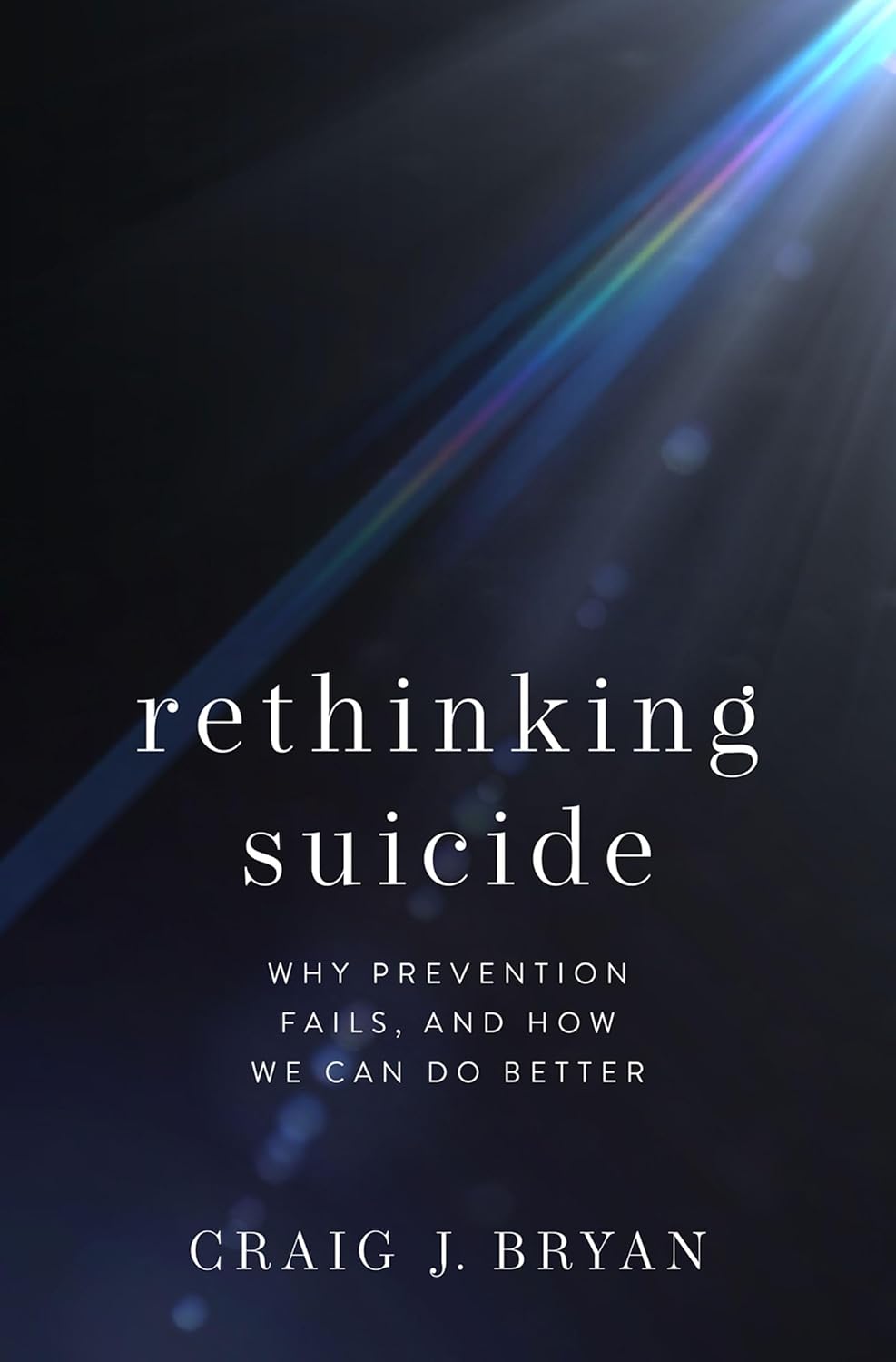
Below, I’ve a pasted LinkedIn post from Dr. Craig Bryan, author of “Rethinking Suicide” and a leading suicide researcher. At the bottom of his comments there’s a link to the article of which he speaks.
Enjoy!
*****************
From Craig Bryan, LinkedIn – 6/29/2026
We keep trying to predict who will attempt suicide. A 15-year study suggests we’re asking the wrong question.
Researchers followed 2,060 Brazilian children from age 10 into their mid-twenties—one of the longest prospective suicide studies ever conducted outside a high-income country. They measured genetics, perinatal history, family psychiatric illness, childhood adversity, cognition, and clinical symptoms, then tested all of it together against who later attempted suicide.
The result: even with multiple domains of risk factors combined, prediction accuracy stayed modest (AUC 0.665), barely above the ceiling seen across 50 years of suicide research. More sophisticated machine learning models didn’t do any better than simple logistic regression.
Three factors stood out as consistent, actionable, and population-relevant: childhood threat exposure (especially bullying), caregiver history of suicide attempts, and childhood externalizing disorders. Bullying alone accounted for the largest share of preventable risk in the entire study.
The authors’ conclusion is blunt: distal childhood risk factors will likely never predict individual suicide attempts with precision, because suicide is driven by acute, fast-moving processes that a baseline assessment can’t capture. Trying to screen our way to safety has a ceiling. We hit it decades ago.
The better investment may not be sharper prediction. It may be quieter, structural prevention like anti-bullying programs, supporting parents with histories of suicidal behavior, and early identification of behavioral disorders, the kind of intervention that helps a population, whether or not we ever know which child needed it most.
I’m excited about Dr. Bryan’s post not because of the difficulties with prediction (which we’ve long know), but because of the idea of moving upstream toward structural prevention. I also feel this fits really well with what we’re trying to do with CAPE.
Obviously, I love this quotation: “Trying to screen our way to safety has a ceiling. We hit it decades ago.”
I’m at the Office of Public Instruction Summer Institute in Bozeman today (and tomorrow), along with the Pirate and the Pusher. The Summer Institute is an annual four days of training for Montana educators.
Shortly after arriving, two women sitting at a table stared at me, looked away, and then stopped me as I walked by, saying, with enthusiasm, “We just took your class!”
They were, of course, referring to our Happiness for Educators course. Although completely online, I’m presenting in many of the videos, sometimes in my pajamas. We were all excited to meet in person.
They also got to meet Dylan Wright (who plays the role of a pirate in our Happiness for Educators course). I mean, how can you have a Happiness for Educators course without a pirate? They also met Tammy Tolleson Knee, the new and fabulous director of the Phyllis J. Washington Center for the Advancement of Positive Education at the University of Montana and high leverage “Pusher” of all things positive.
Tomorrow will be even more excitement. I have the honor of delivering the morning keynote. I’ll be opening with a make-believe scenario, with me as a candidate for governor. I’ve done this a few times previously during presentations for educators. It’s a method I use for emphasizing the central and foundational role that educators and education play in society.
My platform as a candidate for governor of Montana is education . . . education . . . and education . . . because. . .
The road to a good economy goes through education.
The road to a healthy enviroment goes through education.
The road to a civil society goes through education.
The road to excellence in health care goes through education.
The road to justice goes through education.
I could go on, but I think you get the point. As John Adams, founding father and our 2nd president once said (I’m paraphrasing), “It’s impossible to spend too much money on public education.”
And so, yes, there will be more excitement tomorrow because it doesn’t get much better than spending a day with 400 Montana educators who are dedicated to helping young people become educated citizens.
I’m posting ppts of my two presentations (keynote and workshop) below.
From Wikipedia: Sonja Lyubomirsky is a Russian-born American professor in the Department of Psychology at the University of California, Riverside and author of The How of Happiness: A Scientific Approach to Getting the Life You Want.
And there’s so much more.
Not long ago, Tammy Tolleson Knee, the new Director of the Phyllis J. Washington Center for the Advancement of Positive Education, asked me if I thought she should attend the Western Positive Psychology Conference at Claremont Graduate University. I saw that Sonja Lyubomirsky was the featured keynote speaker and immediately said “Hell, Yes!” [I didn’t really swear at the time, but it sounded cooler for this blog post].
I also looked at my calendar and was bummed that I couldn’t attend. But then I said to Tammy that we should reach out to Dr. Sonja for a possible short meet-up at the conference.
So I did.
She responded within hours.
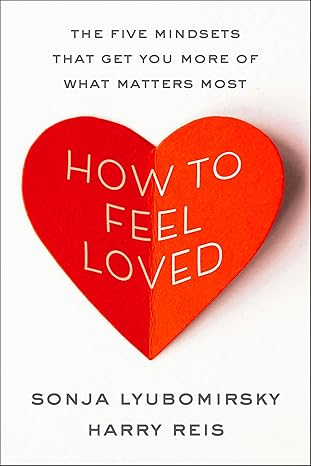
At the conference, Tammy got to meet her and talk–despite the fact that Dr. Sonja also was busily signing her new book for the masses. How cool!
And then, Tammy shared the following email with our whole CAPE staff upon her return.
Happy Friday, ,
In honor of my Sonja Lyubomirsky buzz, I thought I’d share some fun tidbits and resources from the WPPA conference!
Her last name is pronounced Lou – Boe – Mere – Ski
Here is a recent chapter she co-authored in the Handbook of Social Psychology(6th ed.) titled “Well-being” (though she prefers the term “happiness”). It’s long but comprehensive.
Here is a 5-minute Ted Talk teaser on her new book.
Fun fact: She has been cited in academic publications more than 90,000 times.
She said the Big 3 PPIs are Gratitude, Kindness, and Social Interventions (or Acting Extraverted).
Among the many fascinating findings she shared was a study fromBrain, Behavior, and Immunity suggesting that intentionally engaging in more extroverted behavior can improve patterns of gene expression.
She joked that part of her wishes they had never introduced the happiness pie. More on that later.
Her final advice: Share deeply, listen and be curious.
My overall takeaway: There is no end to what we can learn in positive psychology, and CAPE is very much on the right track.
In conclusion: Who is Dr. Sonja Lyubomirsky? She’s a bad-ass academic researcher who’s also incredibly personable and who, in her spare time, writes books designed to help people live better lives. You can learn more about her here: https://sonjalyubomirsky.com/
Think about it. Can you name a single mental disorder that, in your lifetime, has decreased in significance?
Depression? Anxiety? ADHD? Bipolar? As a mental health professional for the past 45 years, I’ve watched mental disorders in America stubbornly increase, despite more national, state, and local mental health awareness and prevention programs than ever before.
Mental health awareness and prevention are failing for multiple reasons, none of which are the fault of all the compassionate, hard-working, and well-intended people involved with mental health prevention. More likely, our collective failure begins with confusion over how to define mental health. Most Americans use “mental health” to describe mental health problems, mental disorders, or mental illness. Mental health is supposed to be positive and include joy, happiness, meaning, and mutually supportive relationships.
Instead, even the term “mental health prevention” is awkwardly phrased. Wait. Does mental health prevention mean we’re preventing mental health? Ironically, that might be exactly what we’re doing.
Pretend for a moment that you’re a young person. You have two options. You can enroll in a program designed to reduce your anxiety and depression. Or you can enroll in a program designed to help you strive toward happiness, meaning, and realizing your abilities. Of course, this is a false dichotomy, but which direction do you find more hopeful and inspiring?
We also need to stop using unidimensional slogans to bludgeon community mental health from bad to better. Mental health awareness is a great example. Too much awareness of negative symptoms is not a good thing. More on this soon.
Contemporary prevention programs also ignore several basic psychological principles.
When young people begin learning about mental disorders, a natural and powerful process begins. First, they learn about psychiatric symptoms. Then, they’re told these symptoms represent mental illnesses. Inevitably, they see these symptoms in themselves (or their friends) and begin self-diagnosing. Sometimes, the labels help explain their experiences and youth experience temporary relief. Who’s not reassured to learn that social anxiety is a thing? But, when the label gets too closely linked to identity, diagnosis becomes self-limiting. Students think: “I can’t pay attention because I have ADHD” or “My anxiety stops me from having fun and being around people.” And, because labels are sticky, it becomes difficult for young people (and adults) to shake the label and pursue their potential.
As you read these words, thousands of American youth are learning about their so-called mental disorders in at least two ways: on social media (via Tik-Tok, in particular) and through school-based mental health literacy/awareness workshops. More awareness and more information can make mental health worse—especially if the information is inaccurate or not applied with sensitivity and nuance.
Another psychological principle operates to sustain and deepen negative labeling. Like everyone, young people are inclined toward “confirmation bias.” They easily find evidence for their pre-existing beliefs while discarding evidence inconsistent with their pre-existing beliefs. If I believe I have anxiety and my anxiety limits my ability to participate in social activities, I will become skilled at noticing when my anxiety is adversely affecting me, while dismissing evidence that I’m strong and resilient enough to socialize with my peers.
What we pay attention to grows. Although my teenage clients would respond to this statement with “duh,” prevention programs ignore this concept by paying far too much attention to what’s wrong. We will not shrink problems by paying more attention to them. This is fundamental brain science. The more we focus on and talk about our problems, the better we become at focusing on and talking about our problems. The famous neuroscientist Donald Hebb put it this way: “Neurons that fire together, wire together.” The more we think about our problems, the more we’re teaching our brain to think about our problems. Soon, it becomes automatic, and you’ll be thinking about your problems all day long.
For 2027, let’s reboot mental health. Let’s redefine mental health as a positive emotional, psychological, and relational state. Then, let’s help young (and older) people develop strengths, skills, empathic relationships, positive experiences, and resources to successfully pursue positive mental health.
Together, we can turn Mental Health Awareness Month into a collective experience of joy and wellbeing for everyone.
********************************************
John Sommers-Flanagan, Ph.D. is a clinical psychologist and founding director of the Phyllis J. Washington Center for the Advancement of Positive Education at the University of Montana. He is coauthor of 10 books and many professional articles. The opinion expressed here is solely that of John Sommers-Flanagan and does not represent his current or former employers. You can email your thoughts to: john.sf@mso.umt.edu. For more information, go to https://johnsommersflanagan.com/ or https://www.umt.edu/education/cape
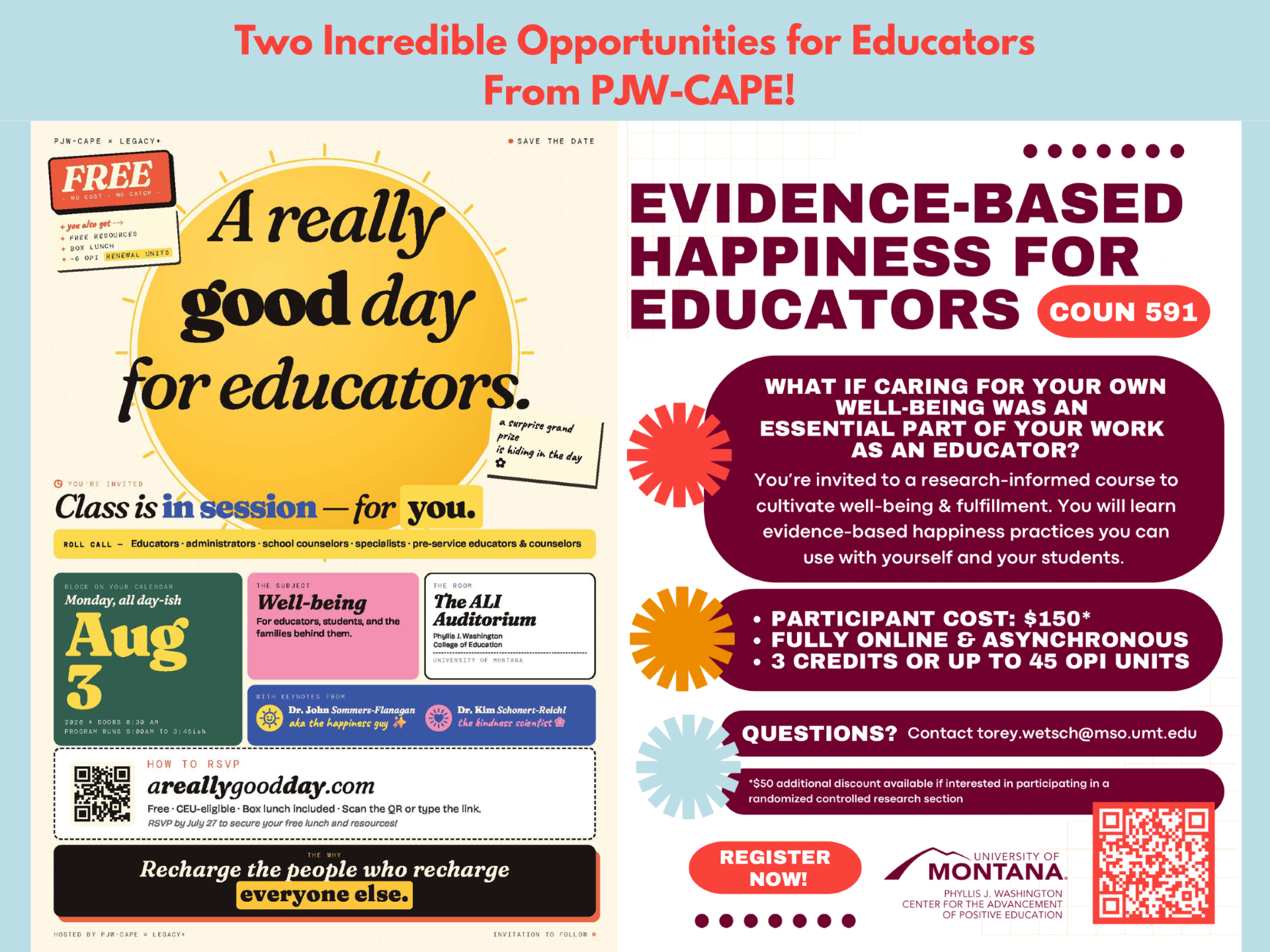
At the Phyllis J. Washington Center for the Advancement of Positive Education at the University of Montana we have two big and exciting activities happening this summer.
The first one is called “A Really Good Day for Educators.” We’re offering this FREE, live and in-person day of training for educators on August 3 in Missoula in collaboration with a fabulous organization called Legacy+. Legacy+ is a Toronto-based organization that helps bring purpose to life. They’re also fun and amazing collaborative partners. As one example, they immediately claimed the site https://areallygoodday.com/ for our event landing page. Go there now (if you’re interested). You can learn more about Legacy+ here: https://legacyplus.org/about-us/
The second activity is our usual Evidence-Based Happiness for Educators course. We still have openings and the price is an absolute bargain for 3 UM grad credits or 45 OPI license renewal units.
Last thing. I wrote an Op-Ed piece on Mental Health Awareness Month and sent it to the New York Times. I do that sort of thing once in a while when I want to have sort of a lonely-rejection experience. However, the NYT may be ignoring me, but I’m not ignoring myself, because, I have now submitted the Op-Ed to @johnsommersflanagan.com. . .and the johnsommersflanagan website monitor is much kinder and has let me put a link to a pdf of the lightly edited Op-Ed piece here!