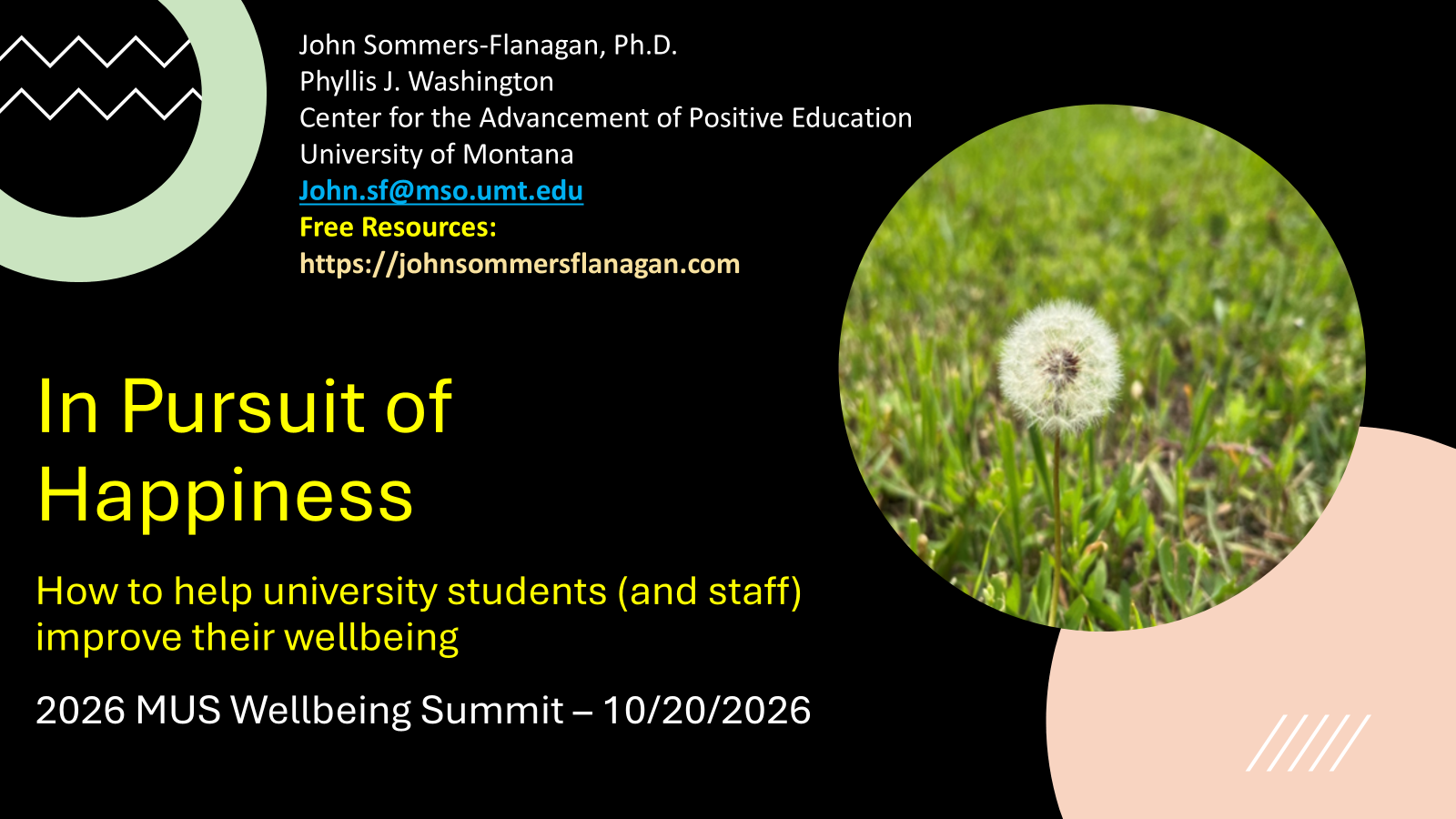
This morning I’m in Great Falls at the Montana University System 2026 Mental Health and Wellbeing Summit. I am grateful to be invited.
I’ll be covering a ton of info in 50 min, so it will be sort of like the speed-dating or caffeinated version of the Pursuit of Happiness. The ppts are linked below. Will I get through them? Your guess–as my mother liked to say–is as good as mine.
I saw the sunrise over the Missouri River on my drive from Helena this morning. Spectacular! I wish I had a photo to share. But instead, you have to use your imagination.
This morning I’ll be spending over three hours with the educators and staff at Frenchtown High School. Frenchtown (Go Broncs) is a small and cool community just west of the big city of Missoula.
A big thanks to the Principal, Shane Bartschi for inviting me. And a big thanks the Frenchtown educators and staff for helping young people learn and embrace their futures.
At the poetry retreat with Pádraig Ó Tuama, we experienced numerous prompts and poetry forms on Tuesday and Wednesday. One prompt was extraordinarily simple: This I Believe. So, while on my Wednesday morning slow run, I came up with the following poem. . .which is mostly about my mother and what she taught me to believe.
Dead End Street
Contrary to the sign, our street wasn’t dead.
And it did not end.
Maybe it was the confusing and tangled mass of Mormon, Italian, Catholic, Levite, Austrian roots that led to that rainy morning when, delayed by my longstanding personal relationship with toilets, I burst into the living room in my underwear, shouting.
I got it!
My gaze met the neighborhood. Darrell, Rosa, Matt.
My Mother’s explanation was weak.
“Now you’ve all missed the bus. I can drive you to school.”
I might’ve known sooner when my Catholic mother growled about wanting to shout down Matt’s Evangelical mother for wondering whether my father, the only Jew on the dead-end street, could make his way past Saint Peter.
I might have known in 1973, when I stumbled upon evidence of her infidelity.
She confessed. Yes, she had been repeatedly having coffee and cookies with Mario, Darrell’s younger brother—the only gay, black, teenager on our street, and probably the only gay, black teenager in our county.
I was justifiably concerned. “Why did you let Mario eat all the cookies?”
Years later, Darrell explained, “You were okay. But we really loved your mom. Some days we didn’t have food. Your mom fed us.”
Everyone was welcome at her table.
Everyone.
Even White Christian neighbors.
Even her son, who mistakenly thought he owned the cookies.
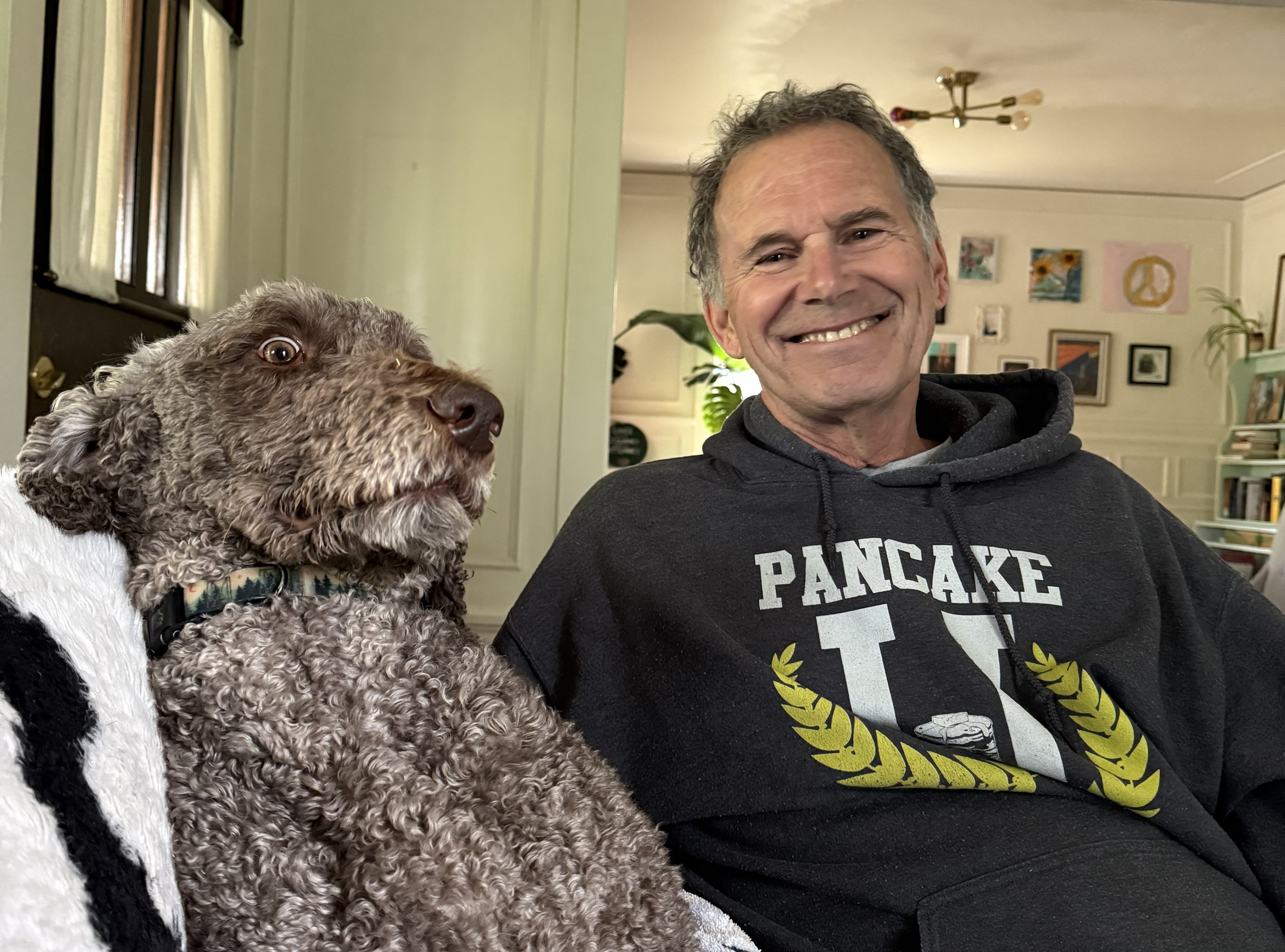
I’m on Day Two of our poetry retreat with Pádraig Ó Tuama (see photo above). He is truly a genius. With a background in theology, conflict mediation, group facilitation, and poetry his knowledge and experience is immense. He is host of Poetry Unbound on NPR. I have found his comments crystal clear and illuminating.
We wrote several poems today. The one I’m sharing came to me while on a slow morning jog. The others may not be ready for prime time. . .or even for blogging. Oddly, the one I’m sharing is the one that took the least time to write.
Running Away
I forgot to dance today.
I think it was the bombs
or the laser surgery.
Either way
I had to stay in and hold the baby.
I forgot to sing today.
My inner voice was hoarse from yelling at me for things
Think about it. Can you name a single mental disorder that, in your lifetime, has decreased in significance?
Depression? Anxiety? ADHD? Bipolar? As a mental health professional for the past 45 years, I’ve watched mental disorders in America stubbornly increase, despite more national, state, and local mental health awareness and prevention programs than ever before.
Mental health awareness and prevention are failing for multiple reasons, none of which are the fault of all the compassionate, hard-working, and well-intended people involved with mental health prevention. More likely, our collective failure begins with confusion over how to define mental health. Most Americans use “mental health” to describe mental health problems, mental disorders, or mental illness. Mental health is supposed to be positive and include joy, happiness, meaning, and mutually supportive relationships.
Instead, even the term “mental health prevention” is awkwardly phrased. Wait. Does mental health prevention mean we’re preventing mental health? Ironically, that might be exactly what we’re doing.
Pretend for a moment that you’re a young person. You have two options. You can enroll in a program designed to reduce your anxiety and depression. Or you can enroll in a program designed to help you strive toward happiness, meaning, and realizing your abilities. Of course, this is a false dichotomy, but which direction do you find more hopeful and inspiring?
We also need to stop using unidimensional slogans to bludgeon community mental health from bad to better. Mental health awareness is a great example. Too much awareness of negative symptoms is not a good thing. More on this soon.
Contemporary prevention programs also ignore several basic psychological principles.
When young people begin learning about mental disorders, a natural and powerful process begins. First, they learn about psychiatric symptoms. Then, they’re told these symptoms represent mental illnesses. Inevitably, they see these symptoms in themselves (or their friends) and begin self-diagnosing. Sometimes, the labels help explain their experiences and youth experience temporary relief. Who’s not reassured to learn that social anxiety is a thing? But, when the label gets too closely linked to identity, diagnosis becomes self-limiting. Students think: “I can’t pay attention because I have ADHD” or “My anxiety stops me from having fun and being around people.” And, because labels are sticky, it becomes difficult for young people (and adults) to shake the label and pursue their potential.
As you read these words, thousands of American youth are learning about their so-called mental disorders in at least two ways: on social media (via Tik-Tok, in particular) and through school-based mental health literacy/awareness workshops. More awareness and more information can make mental health worse—especially if the information is inaccurate or not applied with sensitivity and nuance.
Another psychological principle operates to sustain and deepen negative labeling. Like everyone, young people are inclined toward “confirmation bias.” They easily find evidence for their pre-existing beliefs while discarding evidence inconsistent with their pre-existing beliefs. If I believe I have anxiety and my anxiety limits my ability to participate in social activities, I will become skilled at noticing when my anxiety is adversely affecting me, while dismissing evidence that I’m strong and resilient enough to socialize with my peers.
What we pay attention to grows. Although my teenage clients would respond to this statement with “duh,” prevention programs ignore this concept by paying far too much attention to what’s wrong. We will not shrink problems by paying more attention to them. This is fundamental brain science. The more we focus on and talk about our problems, the better we become at focusing on and talking about our problems. The famous neuroscientist Donald Hebb put it this way: “Neurons that fire together, wire together.” The more we think about our problems, the more we’re teaching our brain to think about our problems. Soon, it becomes automatic, and you’ll be thinking about your problems all day long.
For 2027, let’s reboot mental health. Let’s redefine mental health as a positive emotional, psychological, and relational state. Then, let’s help young (and older) people develop strengths, skills, empathic relationships, positive experiences, and resources to successfully pursue positive mental health.
Together, we can turn Mental Health Awareness Month into a collective experience of joy and wellbeing for everyone.
********************************************
John Sommers-Flanagan, Ph.D. is a clinical psychologist and founding director of the Phyllis J. Washington Center for the Advancement of Positive Education at the University of Montana. He is coauthor of 10 books and many professional articles. The opinion expressed here is solely that of John Sommers-Flanagan and does not represent his current or former employers. You can email your thoughts to: john.sf@mso.umt.edu. For more information, go to https://johnsommersflanagan.com/ or https://www.umt.edu/education/cape
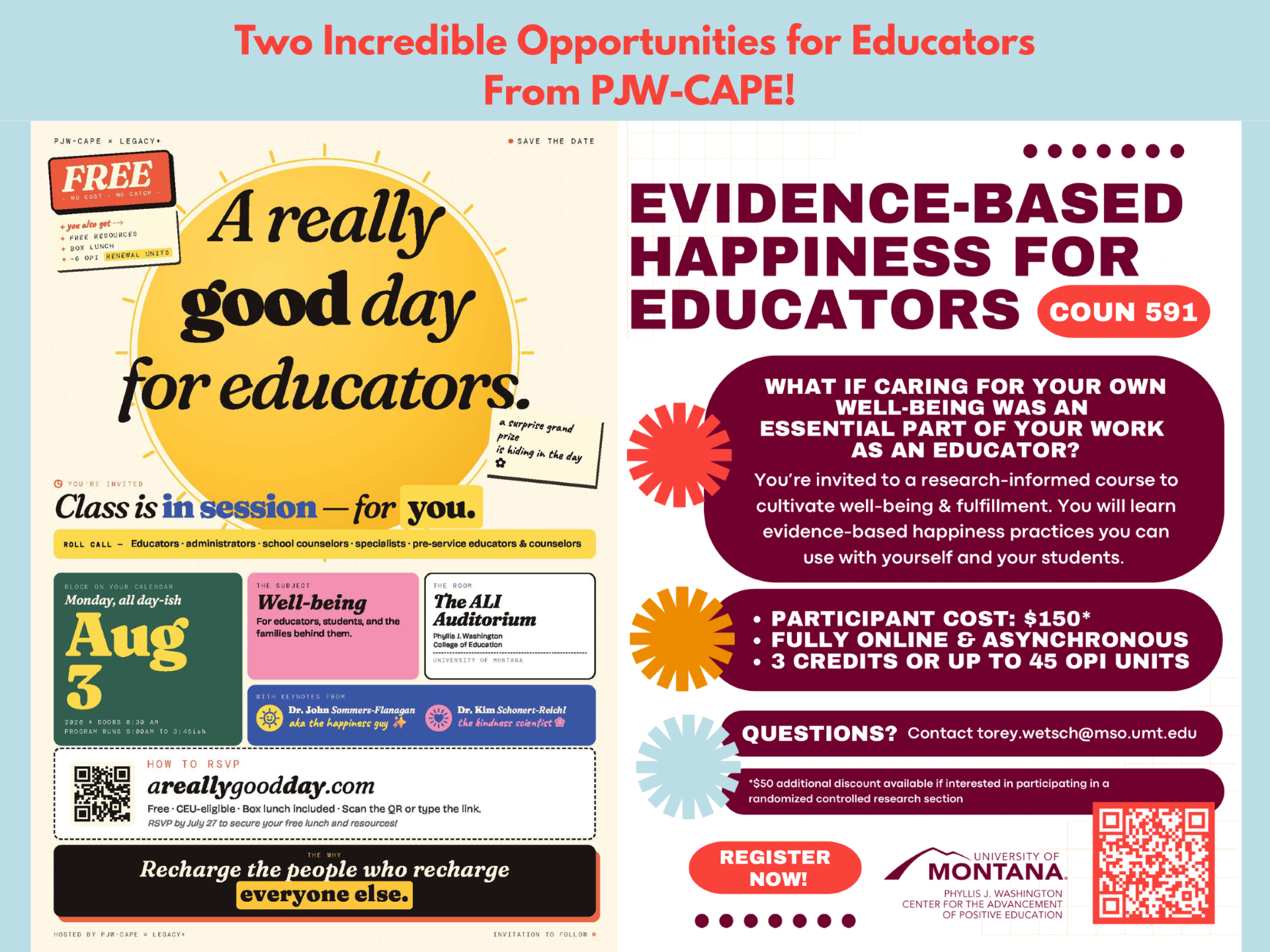
At the Phyllis J. Washington Center for the Advancement of Positive Education at the University of Montana we have two big and exciting activities happening this summer.
The first one is called “A Really Good Day for Educators.” We’re offering this FREE, live and in-person day of training for educators on August 3 in Missoula in collaboration with a fabulous organization called Legacy+. Legacy+ is a Toronto-based organization that helps bring purpose to life. They’re also fun and amazing collaborative partners. As one example, they immediately claimed the site https://areallygoodday.com/ for our event landing page. Go there now (if you’re interested). You can learn more about Legacy+ here: https://legacyplus.org/about-us/
The second activity is our usual Evidence-Based Happiness for Educators course. We still have openings and the price is an absolute bargain for 3 UM grad credits or 45 OPI license renewal units.
Last thing. I wrote an Op-Ed piece on Mental Health Awareness Month and sent it to the New York Times. I do that sort of thing once in a while when I want to have sort of a lonely-rejection experience. However, the NYT may be ignoring me, but I’m not ignoring myself, because, I have now submitted the Op-Ed to @johnsommersflanagan.com. . .and the johnsommersflanagan website monitor is much kinder and has let me put a link to a pdf of the lightly edited Op-Ed piece here!
Yesterday, Tammy Tolleson Knee (the new director of the Phyllis J. Washington Center for the Advancement of Positive Education) and I arrived in Kalispell, Montana for a 2+ day retreat with staff from the Nate Chute Foundation (NCF). Their mission: The Nate Chute Foundationsupports, educates and empowers our community to promote mental wellness and reduce suicide. You can learn more about NCF’s fabulous work and staff right here: https://www.natechutefoundation.org/
Our retreat is top secret, but I’ll share it here anyway because I don’t like secrets.
Having grown weary with traditional, pathology-oriented approaches to “suicide prevention” we’re working together to create a new curriculum tentatively titled “Strengths-Based Suicide Education for Concerned Adults.” Our plan is to use this new curriculum to replace all the unhelpful and sometimes traumatizing approaches to suicide prevention.
Yes, we have big goals.
Today we’re breaking away from our retreat for a short presentation/consult with Immanuel Living of Kalispell.
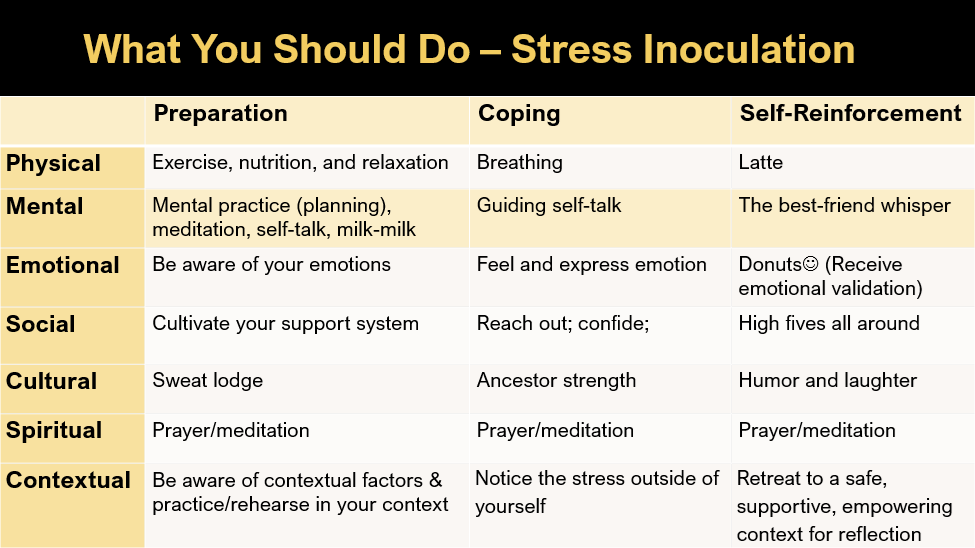
In preparation for this short conversation, I pulled out an old slide about a thing called Stress Inoculation Training (thanks Don Meichenbaum!).
The point of SIT is to prepare for stressors or provocations in life that adversely affect us. For example, let’s say that you find ___________ stressful. (You can put anything in the blank. It could be exercise, talking with your boss, going to church, not going to church, speaking in public meetings, etc.). Then you create your own personalized stress inoculation plan.
Meichenbaum’s therapy approach is designed to prep or inoculate us from our usual and predictable stressors. He described three steps: (1) preparation for provocation, (2) coping with the provocative situation, and (3) reflection and self-reinforcement. Here’s a visual, with our stressors and responses organized into 7 dimensions:
If we all had rational brains and lived in a rational world, SIT would work perfectly for everyone. But like everything, it doesn’t always work. During today’s talk, I’m revealing the secrets of why our best laid plans often fail. Newsflash: it has to do with our quirky brains, which, although amazing, also automatically and regularly take us down into negative thinking rabbit holes.
TBH, IMHO, dipping into a negative thinking rabbit hole every once in a while can be fun, but if your intention was to avoid negative thinking rabbit holes, they’re considerably less fun.
Unfortunately, due to time limits and the need for mystery in marketing, this blog is ending without me sharing the five secrets of why our pesky brains often derail us from our positive intentions. Sorry about that. They’re in the pdf of the ppts linked below, and although you can find them there, it’s much more fun for us to talk about these in person . . . so I hope to see you at a presentation in the future.
As a senior in high school, I had a chance to say a few words at the annual football awards banquet. Apparently, my stammering and stuttering through two whole minutes were so inspiring that afterward, an assistant coach took me aside and offered seven words of feedback, “You need to take a speech class.”
His words sunk in. I was a terrible and inarticulate speaker. But did I take his advice? Nope. I was too scared to even try to get better at public speaking.
Fast forward 51 years. Now I speak all the time. In one of my most recent speaking gigs, David Shepard and Erica Liebman had me on their very cool podcast called, “Therapy with Men and Boys.”
On the podcast, we talked about men and boys and therapy and suicide. We talked so much they made my appearance into two episodes. And David, whose work I respect a ton, told me, “Your comfort in front of a mic is really impressive. I can imagine how much your students liked your classes in your teaching days.”
Thanks David! What a difference 51 years makes.
I share this story because things change with time. . .and I’m hoping (in the sociocultural-political realms) that time will change some things (for the better).
If you’re interested in therapy in general and therapy with men and boys in particular, I’m sharing links to part 1 and 2 of the podcast; they’re about 35 minutes each.
Hello from Montana where we continue to offer and collect data on our evidence-based “Happiness for Educators” course.
Although we’re in the process of updating the following abstract (see below) with fancier stats, for now, it’s a solid summary of our outcomes to date. You’ll notice our depression outcomes (g = 0.59) are not far from worldwide estimates of counseling and psychotherapy outcomes for depression (see Harrer et al., 2025; estimated effect size for depression treatment is g = 0.73)
I’m writing today with expansion and collaboration on my mind.
If any of you academics, educators, or practitioners out there are interested in offering the Happiness for Educators course in your state, or if you happen to be interested in research collaboration, please email me: john.sf@mso.umt.edu. We’ve got a good thing going (who’s against having happier and healthier educators?) and would love to begin scaling up (within our capacity).
Abstract
Purpose: Using an approach grounded in happiness research, this study contributes to the literature on strategies for supporting educator well-being. Educators deserve good health; when educators have better health, students benefit. We developed and evaluated the effectiveness of a three-credit, graduate-level, online and asynchronous evidence-based “Happiness for Educators” course on educator well-being, mental health, and physical health.
Research Methods/Approach: Using a pre-experimental design with five repeated cohorts, we evaluated pre-post course changes on six different well-being, mental health, and physical health questionnaires with 17 end-point outcomes. Across five cohorts, 266 of 293 (90.8%) educators completed the course. We evaluated outcomes using paired t-tests.
Findings: After using a Bonferroni adjustment for multiple comparisons, educators completing the course reported statistically significant improvements (p < .002) on all 17 outcomes. These outcomes included measures of positive and negative affect, hope, depression, mindfulness, and physical health. Large to medium effect sizes (using Hedge’s g) were obtained on the following outcomes:
Positive affect, (g = .802)
Total health, (g = .719)
Negative affect, (g = .705)
Depression (g = 590)
Total hope (g = .568)
Sleep (g = .556)
Mindfulness, (g = .542).
Overall, course participation was linked to a 60.8% reduction in depression rates.
Implications: Implications that can be drawn from a pre-experimental exploratory study are limited. However, these outcomes suggest that an asynchronous, online graduate-level course on positive psychology (aka happiness) has potential for improving educators’ well-being, mental health, and physical health. Future research on this approach is recommended.
My apologies for the late notice, but I’m doing a free, online, one-hour talk tomorrow, 3/4/2026 at 2-3pm Mountain time. Sponsored by the Center for Children, Families, and Workforce Development and MAPP-Net, the talk is titled, “Ten things Everyone Should Know about Suicide, Mental Health, and Happiness.” Here’s the link:
Warning: this is not my most uplifting talk. the first half focuses mostly on the “Wicked Problem” of suicide. The good news is that I do end on Happiness!
Whether you attend or not (it’s free!), thanks for being someone who’s working to make the world a better, kinder, and more eudaimonically happy place.
John
The place to click if you want to learn about psychotherapy, counseling, or whatever John SF is thinking about.