
Category Archives: Happiness

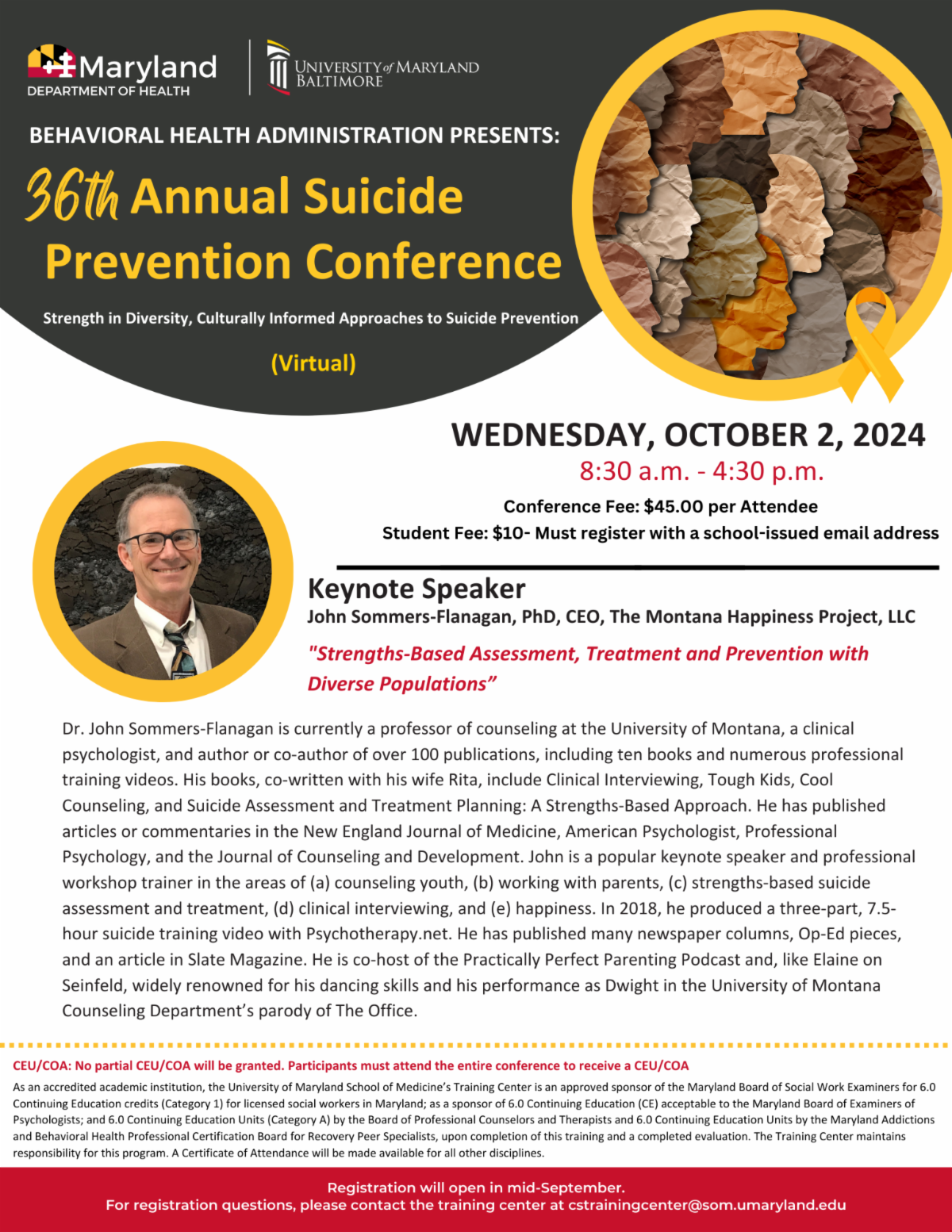
Coming Soon: Maryland’s 36th Annual Suicide Prevention Conference

Why Do We Need a Strengths-Based Approach to Suicide Assessment and Treatment?

Imagine this: You’re living in a world that seems like it would just as soon forget you exist. Maybe your skin color is different than the dominant people who hold power. Maybe you have a disability. Whatever the case, the message you hear from the culture is that you’re not important and not worthy. You feel oppressed, marginalized, unsupported, and as if much of society would just as soon have you become invisible or go away.

In response, you intermittently feel depressed and suicidal. Then, when you enter the office of a health or mental health professional, the professional asks you about depression and suicide. Even if the professional is well-intended, judgment leaks through. If you admit to feeling depressed and having suicidal thoughts, you’ll get a diagnosis that implies you’re to blame for having depressing and suicidal thoughts.  

The medical model overfocuses on trying to determine: “Are you suicidal?” The medical model is also based on the assumption that the presence of suicidality indicates there’s something seriously wrong with you. But if we’re working with someone who has been or is currently being marginalized, a rational response from the patient might be:

“As it turns out, I’ve internalized systemic and intergenerational racism, sexism, ableism, and other dehumanizing messages from society. I’ve been devalued for so long and so often that now, I’ve internalized societal messages: I devalue myself and wonder if life is worth living. And now, you’re blaming me with a label that implies I’m the problem!”

No wonder most people who are feeling suicidal don’t bother telling their health professionals.

When I think of this preceding scenario, I want to add profanity into my response, so I can adequately convey that it’s completely unjust to BLAME patients for absorbing repeated negative messages about people who look like or sound like or act like them. WTH else do you think should happen?

This is why we need to integrate strengths-based principles into traditional suicide assessment and prevention models. Of course, we shouldn’t use strengths-based ideas in ways that are toxically positive. We ALWAYS need to start by coming alongside and feeling with our patients and clients. As it turns out, if we do a good job of coming alongside patients/clients who are in emotional pain, natural opportunities for focus on strengths and resources, including cultural, racial, sexual, and other identities that give the person meaning.

I’m reminded of an interview I did with an Alaskan Native person from the Yupik tribe. She talked at length about her depression, about feeling like a zombie, and past and current suicidal thoughts. Eventually, I inquired: “What’s happening when you’re not having thoughts about suicide?” She seemed surprised. Then she said, “I’d be singing or writing poetry.” I instantly had a sense that expressing herself held meaning for her. In particular, her singing Native songs and contemporary pop songs became important in our collaborative efforts to build her a safety plan.

This coming Wednesday morning I have the honor of presenting as the keynote speaker for the Maryland Department of Health 36th Annual Suicide Prevention Conference. During this keynote, I’ll share more ideas about why a strengths-based model is a good fit when working with diverse clients who are experiencing suicidal thoughts and impulses.

With all that said, here’s the title and abstract of my upcoming presentation.

Strengths-Based Assessment, Treatment, and Prevention with Diverse Populations

Traditional suicide assessment tends to be a top-down information-gathering process wherein healthcare or prevention professionals use questionnaires and clinical interviews to determine patient or client suicide risk. This approach may not be the best fit for people from populations with historical trauma, or for people who continue to experience oppression or marginalization. In this presentation, John Sommers-Flanagan will review principles of a strengths-based approach to suicide prevention, assessment, and treatment. He will also discuss how to be more sensitive, empowering, collaborative, and how to leverage cultural strengths when working with people who are potentially suicidal. You will learn at least three practical strengths-based strategies for initiating conversations about suicide, conducting culturally-sensitive assessments, and implementing suicide interventions—that you can immediately use in your prevention work.

Happiness for Montana Educators – The Details

I’ve had several requests for more details about our grant-supported, upcoming fall 2024 version of the “Happiness for Teachers” course, including, the all-important question: How much time will this take?? Here are the details.

Grading Options

Because we want to support teachers, our approach to grading is flexible. Teachers can select from one of three grading options.

  1. Teachers can receive 3 graduate credits from the University of Montana – graded using a Credit/No Credit system. That means you need to complete enough course assignments to obtain 70% (you can do more). Then you will pass the course and receive the credits. Even if you get an NCR in the course, you can qualify for a pro-rated number of OPI credits based on your percentage completion.
  2. Teachers can receive 3 graduate credits from the University of Montana – graded using a traditional “letter” grading system. Some school districts require a letter grade to count the course toward your payscale.
  3. You can receive up to 48 OPI credits. This option is especially useful if you find you’re unable to complete at least 70% of the assignments. You can receive a pro-rated total of OPI hours . . . depending on how many hours of the course you complete.

How Much Work will the Course Be?

This is a graduate-level course, and so there’s a significant workload. If you can take the course for credit/no credit (see above), then you only need to obtain 70%, which makes the workload lighter.

At the ½ point in the course, we will ask all participants to inform us how they want to take the course (for credit/no credit; for a letter grade; for OPI hours). If you get ½ way through the course and you think you’re not going to pass (or get the grade you want), then you can take it for OPI hours. In the end, even if you get an NCR in the course, you can still qualify for a prorated number of OPI hours.

To complete the whole course, teachers need to complete the following assignments:

Initial and Final Happiness Assessments (20 points each; 40 points total): During the first and final days of class you’ll be given a link to a happiness assessment packet via Qualtrics. We’re collecting this data to support the grant we have that enabled us to offer you this course at a steep discount.

Active Learning Assignments (complete 10 of the 14 options available; 10 points each; 100 total points): These are short assignments designed to get you in the habit of incorporating happiness-related activities into your life. These assignments are graded pass (10 points) or not pass (0 points). To get your 10 points you need to complete the bare minimum of a thoughtful response.

Weekly Discussion Board Postings and Comments (30 posts; total 60 points): We want you to engage with each other on how you might apply what you’re learning in this course. To encourage this, you’re assigned to make two posts each week (30 total posts). We’d like you to make one post about the weekly course content (lectures and other assigned content) and one post commenting on the post of someone else.

Development of One Educational Lesson Plan (3-5 pages; 40 points): Pick a topic from class (e.g., savoring, gratitude, acts of kindness, etc.) and then write a lesson plan that you could potentially use in your educational setting. You DO NOT need to implement these lesson plans; the assignment is only to create them.

Live online or recorded final pub quiz (30 points, plus prizes): During the last Unit of class John Sommers-Flanagan will hold a live and synchronous open pub-style happiness trivia quiz. If you participate live you can win prizes. Whether you participate live or watch the recording, you can earn 30 points by turning in the answers to the 30 happiness trivia questions.

Substitute (or Extra) Credit (40 points): You can engage in 5 or more sessions of individual counseling with a Master’s student at the University of Montana. You can use these points to substitute for another assignment, or as extra credit.

How Much Time will This Course Take?

  • The video-recorded lecture component of the course takes about 45 hours to view.
  • If you complete the whole course, assignments outside of class will take approximately an additional 100 hours.
  • For the Fall, 2024 version of the course, there will be 15 weeks—although you’ll be working at your own pace. Assuming you worked at an even pace over the 15 weeks, anticipating about 10 hours a week for the course is a reasonable estimate.

Our Goals

We want to support teachers because we view them as unappreciated, underpaid, and highly stressed by the demands of their jobs. We have three objectives:

  1. Offer a high quality and low-cost course to Montana teachers and other school personnel. The fee is $195 for 3-credits.
  2. Focus the course content on emotional wellness—teachers can apply this content to themselves, and possibly also apply it in their classrooms.
  3. By offering a 3-credit graduate course through the University of Montana, teachers may qualify for a salary bump.

Seats are available. Here’s the link: https://www.campusce.net/umextended/course/course.aspx?C=712&pc=13&mc=&sc=

I hope this information is helpful.

The Department of Redundancy Department

I know this saying dates me, but sometimes I feel like a broken record. However, as I’ve said before (and I’ll say it again), redundancy works.

In this post, I’m sending out yet another call for Montana educators to register for our bargain-priced “Happiness for Teachers” course, offered through the University of Montana’s UMOnline program.

I’ve said it before: We’ve had over 150 educators complete the course and the outcomes have been rather stunningly positive. I could promote this like an advertisement:

“If you want to be less depressed, more hopeful, have better physical health (including better sleep), and experience greater hope and mindfulness . . . you should consider taking this course!”

The cost is $195 for 3 U of Montana graduate credits. Here’s the link to register:

And here’s a memo with more detailed info (and the link).

Enrollment for the Fall “Happiness for Educators” Course is Now Open

The educators enrolled in our asynchronous “Happiness for Teachers” course continue to stun me with the extremely high quality of their responses to the assignments. They go WAY beyond what’s necessary and are clearly and deeply committed to not only their personal growth, but also to the growth of their students, family, and friends. Seriously. When I read their assignments, I immediately have more hope for the world . . . and I think to myself, “I want to be your friend!”

But, teaching an asynchronous course is weird. I feel detached. I want to be more connected and more involved. On the other hand, we’ve got hours of video lectures we’ve produced and so the students might be getting more exposure to me than anyone really should bargain for. Maybe I’m too connected and involved? Funny thing how everything often boils down to a dialectic. Hegel (the philosopher) would be so happy he wouldn’t need a happiness course.

Despite the weirdness, our educator-students keep giving us great feedback. Here are a few anonymous examples that have popped into my email inbox without any solicitation:

“I’ve truly enjoyed the material thus far in the class. . . . I hope your class becomes required for all teachers at the EDU dept for certification. It’s the real deal.” S.S.

“Loving the course! Thanks for providing it!” J.E.

“Thank you so much for sharing this video. Just watching it Brings me joy. I love the contributors and all the great things they are doing in their classes! You guys are amazing for doing this.” J.R.

“Loved this course! I shared it with my school! I will send it to my principal now too! Thanks again!” L.W.

“Thanks again for this enriching class. I needed it more than you know and I have so many tools to carry me into next year!” S.M.

Thanks to the Arthur M. Blank Family Foundation, we’re offering yet another section of the course this fall semester. If you’re a Montana educator, and want a big bargain ($195.00) for 3 Grad Credits or 48 OPI Hours, here’s the link to register:

For you non-Montana educators who may still be reading . . . I’m wondering, if we opened the course to anyone across the U.S. would there be much interest?

Just FYI, here’s a copy of the syllabus for the summer version of the course:

Riddles, Automatic Thoughts, Thinking Errors, Misattribution . . . and a Video Demonstration

Recently, I had the honor of presenting to Camp Mak-A-Dream residents (13-20 year-olds) on “Happiness and You.” To empower the residents—all of whom have experienced brain tumors—and resonate with the challenges of being human and having emotions, I shared the Three Step Emotional Change Technique. Then, I invited a volunteer to help me demonstrate how sometimes our brains can trick us by immediately providing the wrong answer to a question. A marvelous young man named Brandon stepped up and volunteered.

Here’s the video link, as recorded by Alli Bristow, last year’s Montana School Counselor of the Year (you can hear her reactions, which are pretty fun too):

You can watch the video, but I’m also sharing a description and rationale for the activities below.

The Riddle Activity

You’ll see me asking Brandon to respond to three riddles. I manage to trick him with the first one. For the second one, he’s briefly fooled, and then catches himself and gives the right answer. On the third, he pauses and gets the right answer the first time.

Why This Activity

I’ve used riddles like these in individual counseling with youth and in group presentations (as illustrated in the video). The riddle activity is all about a basic cognitive therapy message: If we go with our automatic thoughts, without pausing and evaluating them, we can be wrong. However, if we pause to evaluate the situational context and our reactive thoughts, sometimes we can override our automatic and possibly maladaptive impulses (Aaron and Judy Beck would be proud).

The Next Lesson

In the video, you only see Brandon and me doing the riddles. He’s great. When I’m doing this presentation (or using it in counseling) after the riddles, I immediately give the youth a situational example. I say something like, “Okay. Now let’s say I go to the same high school as Brandon, and I know him, and I’m walking by him in the hall at school. When I see him, I say ‘Hi Brandon!” But he just keeps on walking. What are my first thoughts?”

Whether I’m working with a group or with individuals, the young people are usually very good at suggesting possible immediate thoughts. They say things like: “You’re probably thinking he doesn’t like you.” Or, “Maybe you think he’s mad at you.”

At some point, I ask, “Have you ever said hello to someone and have them say nothing back?” There are always head nods and affirming responses.

Way back in our “Tough Kids, Cool Counseling” book, Rita and I wrote about the typical internalizing and externalizing responses that people tend to have in reaction to a possible social rejection. The internalizing response is depressed, anxious, and self-blaming. Internalizing thoughts usually take people down the track of “What did I do wrong” or “What’s wrong with me?” Alternatively, some youth have externalizing thoughts. Externalizing thoughts push the explanation outward, onto the other person. If you’re thinking externalizing thoughts, you’re thinking, “What’s wrong with him?” or “That jerk!” or “Next time, I’m not saying hi to him.” Back in the day, Kenneth Dodge wrote about externalizing thoughts in adolescents as contributing to aggression; he labeled this cognitive error “the misattribution of hostility.”

In counseling and in group presentations, the next step is to ask for neutral and non-blaming explanations for why Brandon didn’t say hello. The youth at Camp Mak-A-Dream were quick and efficient: “He probably didn’t hear you.” “Maybe he was having a bad day.” “He could have had his earbuds in.” “Maybe he was feeling shy?”  

What’s the Point?

One goal of these activities is to help young people become more reflective and thoughtful. My neuroscience enthralled friends might say I’m working their frontal lobe muscles. I basically agree that whenever we can engage teens with thoughtful and reflective processes, they may benefit.  

But the other goal may be even more important. Although I want to teach young people to be thoughtful, I also want to do that in the context of an engaging, sometimes fun, and interesting relationship. For me. . . it’s not just teaching and it’s not just learning. It’s teaching and learning in the crucible of a therapeutic relationship. As one of my former teen clients once said, “That’s golden.”

Strategies for Listening and Responding to People Who are Suicidal

Yesterday I was at Camp Mak-A-Dream talking with young people about happiness. Today, I’ll be online with 400+ professionals doing a presentation titled: Strategies for Listening and Responding to People Who are Suicidal. Today’s presentation is offered through PacificSource, a health insurance provider in the NW United States.

Below, I’ve linked the ppts for today’s talk.

And here, I’ve linked a short handout that summarizes many, but not all, of the points in the presentation.

Happiness and YOU – At Camp Mak-A-Dream

Tomorrow morning Alli Bristow (recent Montana School Counselor of the Year), Hannah Lewis (awesome elementary HPE teacher), and I will travel eastbound and take the Montana I-90 exit #166 for Gold Creek. We won’t be panning for gold. Instead, we’ll get way richer than we would from finding gold—because we’re offering a couple presentations on “Happiness and You” to the Young Survivors Group at Camp Mak-A-Dream.

The Young Survivors group consists of 13-18-year-olds who have experienced brain tumors. As someone who had the good fortune and great privilege of excellent health during my teen years, I can barely imagine the strength, resilience, persistence, and family support these young people have needed to bear their medical challenges. Although Alli, Hannah, and I have powerpoints and presentation plans, our two presentations will truly be an example of us all learning together.

Here’s a link to our ppts for tomorrow.  

A Conversation on CBT and Happiness with Kyrie Russ

The Practical Psychology Podcast just dropped a new episode titled “On Happiness and a Life with Meaning.” This episode includes Kyrie Russ (the show’s host” and me in conversation about happiness, CBT, life, and other things. This conversation was based, in part, on content from a keynote I gave at a conference in Helena about 2 years ago. The ppts (which is are a bit cryptic. . .) are here:

The link to Kyrie’s excellent podcast website is below:

https://practicalpsychpod.substack.com/p/on-happiness-and-a-life-of-meaning

Last Call for the Summer Happiness Course for Montana Educators

Are you a Montana educator . . . or do you know one?

If so, maybe you—or your friend—would like three (3) bargain-rate University of Montana graduate credits. As you may know, we’ve got an online and asynchronous “Happiness for Teachers” course starting on June 17 for only $195 and the credits (or OPI hours) can contribute to raising teacher salaries. Given all that teachers do for our youth and society, it’s the least we can do. And we can do it thanks to a fantastic grant from the Arthur M. Blank Family Foundation (AMBFF: https://blankfoundation.org/).

Because I’ve written about this opportunity before, this time I want to focus on outcomes. We’ve taught this course to teachers as asynchronous semester-long courses last summer (2023) and this spring (2024). I just finished crunching the numbers for our spring outcomes; I’ve got the summer outcomes in front of me as well.

We’ve pre-post data on 16 different outcome measures. For last summer, we had statistical significance on 12 of the 16 outcomes. For this spring, we had statistical significance on 13 of the 16 outcomes. Even better, based on Cohen’s guidance, many of the effect sizes are in the medium to large range.

For you stats nerds, here’s a Table describing the outcomes:

Outcome MeasureWhat Teachers Reported at Post-TestSummer – 2023 – Statistical Significance (n = 40) and Effect Size (ES is Cohen’s d)Spring – 2024 – Statistical Significance (n = 48) and Effect Size (ES is Cohen’s d)
NAPAS: Negative AffectFewer negative emotional symptoms (e.g., nervousness and sadness)p < .001 ES = .671 (medium)p < .006 ES = .389 (small to medium)
NAPAS: Positive affectMore positive emotions (e.g., “in good spirits”)p < .001 ES = .887 (large)p < .001 ES = .497 (medium)
CES-D: DepressionFewer symptoms of depressionp < .001 ES = .751 (large)p < .013 ES = .346 (small to medium)
SleepBetter sleepp < .001 ES = .644 (med to large)p < .001 ES = .502 (medium)
HeadachesFewer headachesp < .009 ES = .393 (small to med)p < .001 ES = .699 (medium to large)
Gastrointestinal symptomsLess gastrointestinal distressp < .027 ES = .315 (small to med)p < .023 ES = .298 (small)
ColdsFewer and less severe coldsp < .010 ES = .382 (small to med)p < .024 ES = .298 (small)
PHQ: Total HealthBetter total healthp < .001 ES = .589 (medium)p < .001 ES = .625 (medium to large)
Days SickFewer days of physical illnessP < .015 ES = .354 (small to med)N/A
Hope-AgencyGreater goal directed energyp < .001 ES = .704 (med to large)p < .008 ES = .365 (small to medium)
Hope-PathwaysGreater planning to meet goalsp < .001 ES = .545 (medium)p < .013 ES = .341 (small to medium)
AHS: Total HopeHigher agency and pathways hopep < .001 ES = .677 (med to large)p < .004 ES = .416 (small to medium)
Significant Other SupportSupport from a romantic partnerp < .166 ES = .158 (minimal)p < .195 ES = .127 (minimal)
Family SupportSupport from familyp < .114 ES = .194 (minimal)p < .030 ES = .282 (small)
Friendship SupportSupport from friendsp < .165 ES = .156 (minimal)p < .177 ES = .137 (minimal)
MSPSS: Total Social SupportCombined romantic partner, family, and friend supportp < .133 ES = .181 (small)p < .091 ES = .198 (small)
MAAS: MindfulnessLess distracted and more tuned into the here and nowp < .001 ES = .892 (large)p < .001 ES = .597 (medium to large)

 To summarize: If Montana educators want to have less negative affect and depression, more positive emotions, greater hope, better sleep, fewer headaches, less gastrointestinal distress, fewer colds (and days of physical illness), and greater mindfulness . . . they should register and complete this course.

To register, go to: https://www.campusce.net/umextended/course/course.aspx?C=712&pc=13&mc=&sc=

For more info, here’s my memo to educators:

Thanks for reading and be sure to take some time to toast our teachers!

JSF

The Happy Workshop for Graduate Students Pub: Hot off the Digital Press

Good news. Yesterday, I got a mysterious email from ORCID–which stands for: Open Researcher and Contributor ID. ORCID is a global, non-profit organization. Their vision is: “a world where all who participate in research, scholarship, and innovation are uniquely identified and connected to their contributions across disciplines, borders, and time.”

Cool.

Anyway, ORCID was notifying me of a change to my ORCID record. A few minutes later, I received an email from Wiley telling me that our Happy Workshop for Grad Students article was now officially published online.

As some of you know, I’ve complained about the journal publishing process, and, although I still think it’s a pretty broken and disturbing process, working with the editors and reviewers from the Journal of Humanistic Counseling was pretty smooth and pretty fabulous. Check them out: https://onlinelibrary.wiley.com/journal/21611939

And so, without further ado, here’s the Abstract, followed by methods to access the article. . .

Effects of a Single-Session, Online, Experiential Happiness Workshop on

Graduate Student Mental Health and Wellness

John Sommers-Flanagan

Jayna Mumbauer-Pisano

Daniel Salois

Kristen Byrne

Abstract

Graduate students regularly experience anxiety, sleep disturbances, and depression, but little research exists on how to support their mental health. We evaluated the effects of a single-session, online, synchronous, happiness workshop on graduate student well-being, mental health, and physical health. Forty-five students participated in a quasi-experimental study. Students attended a synchronous 2.5-h online happiness workshop, or a no-workshop control condition. After workshop completion and as compared with no-treatment controls, participants reported significant reductions in depression symptoms but no significant changes on seven other measures. At 6 months, participants reported further reductions in depression symptoms. Moreover, across four open-ended questions, 37.0%–48.1% of workshop participants (a) recalled workshop tools, (b) found them useful, (c) had been practicing them regularly, and (d) used them in sessions with clients. Despite study limitations, single-session, synchronous, online, happiness workshops may have salutatory effects on graduate student mental health. Additional research is needed.

K E Y W O R D S: depression, graduate students, mental health, single-session, wellness

Here’s a link to the article online: https://onlinelibrary.wiley.com/share/author/UMKTTSPPECBTVXEQYRKX?target=10.1002/johc.12223

And here’s a pdf copy for your personal (non-commercial) use: