All posts by johnsommersflanagan

The Definition of a Clinical Interview

The following excerpt is from our freshly published textbook, Clinical Interviewing (2024, 7th edition, Wiley).

What Is a Clinical Interview?

Clinical interviewing is a flexible procedure that mental health professionals use to initiate treatment. In 1920, Jean Piaget first used the words “clinical” and “interview” together in a way similar to contemporary practitioners. He believed existing psychiatric interviewing procedures were inadequate for studying cognitive development in children, so he invented a “semi-clinical interview.”

Piaget’s approach was novel. His semi-clinical interview combined tightly standardized interview questions with unstandardized or spontaneous questioning to explore the richness of children’s thinking processes (Elkind, 1964; J. Sommers-Flanagan et al., 2015). Interestingly, the tension between these two different interviewing approaches (i.e., standardized vs. spontaneous) continues today. Psychiatrists and research psychologists primarily use structured, or semi-structured clinical interviewing approaches. Structured clinical interviews involve asking the same questions in the same order with every client. Structured interviews are designed to gather reliable and valid assessment data. Virtually all researchers agree that a structured clinical interview is the best approach for collecting reliable and valid assessment data.

In contrast, clinical practitioners, especially those who embrace post-modern and social justice perspectives, generally use less structure. Unstructured clinical interviews involve a subjective and spontaneous relational experience. These less structured relational experiences are typically used to collaboratively initiate an assessment or counseling process. Murphy and Dillon (2015) articulated the latter (less structured) end of the interviewing spectrum:

We believe that clinical interviewing is—or should be—a conversation that occurs in a relationship characterized by respect and mutuality, by immediacy and warm presence, and by emphasis on strengths and potential. Because clinical interviewing is essentially relational, it requires ongoing attention to how things are said and done, as well as to what is said and done. . . . we believe that clinicians need to work in collaboration with clients . . . (p. 4)

Research-oriented psychologists and psychiatrists who value structured clinical interviews for diagnostic purposes would likely view Murphy and Dillon’s description of this “conversation” as a bane to reliable assessment. In contrast, clinical practitioners often view highly structured diagnostic interviewing procedures as too sterile and impersonal. Perhaps what’s most interesting is that despite these substantial conceptual differences—differences that are sometimes punctuated with passion—structured and unstructured approaches represent legitimate methods for conducting clinical interviews. A clinical interview can be structured, unstructured, or a thoughtful combination of both. (See Chapter 11 for a discussion of clinical interviewing structure.)

Formal definitions of the clinical interview emphasize its two primary functions or goals (J. Sommers-Flanagan, 2016; J. Sommers-Flanagan et al., 2020):

  1. Assessment
  2. Helping (including referrals)

To achieve these goals, all clinical interviews involve the development of a therapeutic relationship or working alliance. Optimally, the therapeutic relationship provides leverage for obtaining valid and reliable assessment data and/or providing effective interventions.

With all this background in mind, we define clinical interviewing as…

a complex, multidimensional, and culturally sensitive interpersonal process that occurs between a professional service provider and client. The primary goals are (a) assessment and (b) helping. To achieve these goals, clinicians may emphasize structured diagnostic questioning, spontaneous talking and listening, or both. Clinicians use information obtained in an initial clinical interview to develop a collaborative case formulation and treatment plan.

Given this definition, students often ask: “What’s the difference between a clinical interview and counseling or psychotherapy?” This is an excellent question that deserves a nuanced response. . . . [to be continued]

*************************************

For MUCH more information about the clinical interview, check out the 7th edition of our textbook, creatively titled, Clinical Interviewing. https://www.wiley.com/en-us/Clinical+Interviewing,+7th+Edition-p-9781119981992

Low Cost Courses for Montana Educators — Beginning January 18

Hello Everyone,

This post is for Montana Educators. Please forward this message to any Montana Educators you know. Due to support from the Arthur M. Blank Family Foundation, we have an opportunity to support Montana Educators with VERY LOW COST graduate credit courses on “Evidence-Based Happiness” through the University of Montana. We’re doing this because we deeply appreciate the work of Montana teachers and we believe this course and the added credits to their payscale is one way for us to support them.

Thanks for your help. Please share. Montana Educators are awesome.

Dear Montana Educators,

In collaboration with the Arthur M. Blank Family Foundation, the Montana Safe Schools Center, UMOnline, and the Montana Happiness Project, the Phyllis J. Washington College of Education at the University of Montana is pleased to offer very low-cost Graduate Credit courses on “Evidence-Based Happiness” exclusively designed for Montana Educators.

We have 3-credit ($195) and 1-credit ($70) options available, beginning January 18.

You can register at this link: https://www.campusce.net/umextended/course/course.aspx?C=712&pc=13&mc=&sc=

If you have questions, contact UMOnline via the preceding link, or John Sommers-Flanagan at john.sf@mso.umt.edu 

I’ve also attached a flyer describing the project and courses here:

Although seats are limited, please forward this information to other potentially interested Montana teachers. We will open as many sections as we can handle.

Thanks for all you do for Montana youth!

Sincerely,

John S-F

What Do You Think of Me?

When I was teaching social skills to elementary school-aged youth, one boy couldn’t stop talking about himself. Because I wanted the students to be interactive with and interested in each other, I intervened.

“Ask a question about her.”

He nodded, in apparent understanding. Returning to the activity, he followed my instructions (sort of), immediately asking,

“What do you think of me?”

The question, “What do you think of me?” is powerful. We all wonder this, at least occasionally, and perhaps constantly. As I just wrote in a previous blog post, being seen and known by others is a profound experience. Having your strengths and positive qualities reflected back to you by others is a gift: https://johnsommersflanagan.com/2023/12/25/the-gift-of-being-seen/

This week, the Montana Happiness Project happiness challenge activity is called the Natural Talent Interview. You can read the details here: https://montanahappinessproject.com/natural-talent-interviews

The Natural Talent Interview requires vulnerability; it’s a challenging and potentially awkward assignment. I recommend it anyway. 😲

Here’s a link to the version of the Natural Talent Interview that we assign in the Happiness Course. Note: It includes a nice description of self-awareness and the Johari Window.

#MHPHappinessChallenge

The Gift of Being Seen

Rylee said there was an internet thing going around about how men should be more like women and start complimenting each other. Then we watched “Rye Lane” (two thumbs up). In the movie, the protagonist male tried out that compliment-another-guy thing; the guy he complimented told him to “Fuck off” and a few other things I won’t repeat.

Maybe compliments don’t translate all that well across genders. But maybe they do.

Years ago, I was doing psychotherapy with a Native American father and his teenage son. To try to help with their strained relationship, I coached the dad on being more authentically positive with his son. During the next session, I had them do a version of the “What’s good about you?” therapy activity.

I asked the son to sit across from his dad and ask, “What’s good about me?” ten times in a row. The only rules were that dad was supposed to give 10 different answers and respond honestly. The boy muttered along with an eye-roll. I felt nervous.

He looked at his dad and asked, “What’s good about me?”

The dad said, “You have a big heart.”

What’s good about me?

“You treat your mom with respect.”

What’s good about me?

“You love your sister.”

What’s good about me?

“You’re my son and I’m proud of you.”

The tears came slowly at first.

What’s good about me?

“You are intelligent”

It was over. They embraced, with the boy sobbing in his father’s arms.

The points: Parents can get so overfocused on providing constructive criticism to their children that their children don’t KNOW the inner strengths their parents see within them. In the preceding example, the teen boy was shocked—in a very positive way—to hear the strengths, skills, and talents that his father saw in him.

This can happen in all relationships. Nearly everyone wants to be seen and known. It’s probably easier to imagine—especially without clear and reassuring evidence—that others see our negative qualities. Our strengths can feel invisible, even to ourselves. It’s often hard to imagine that others notice anything good about us.

Some say that true self-esteem is all about self-evaluation, and not reliant on what others think of us. That’s partly true. But, it’s ridiculous to think that any of us can feel good about ourselves without at least getting occasional feedback about our strengths and positive qualities.

One new thing you can try this holiday season is to give the people you love the gift of seeing their strengths. It can be as simple as noticing and saying something that you think your friend or family member does well, like, “You’re really good at picking out just the right gifts.” Or, “You’re always so much fun to have around.” Or, “You make the best pumpkin pie.”

You can take this deeper if you want by noticing character traits and patterns. “You’re the most honest person I know, and I really value that.” “I love how you pay attention to your grandma. You are such a good person.”

Recognizing and naming the strengths and positive qualities of others is an amazing gift. You’re not just “seeing” people, you’re seeing, acknowledging, and articulating their best qualities. And by naming their best qualities, you’re not just giving them a compliment; you’re nurturing those qualities, and helping them grow.

I’ve taught a different version of this activity for years, and called it the “Natural Talent Interview.” For more on the Natural Talent Interview, which is this week’s Montana Happiness Challenge activity, go to the Montana Happiness Project’s webpage: https://montanahappinessproject.com/natural-talent-interviews

Acts of Kindness . . . in Hawai’i

This is our room with a view.

I’m a little embarrassed to report that Rita and I are on the Big Island of Hawai’i. We’re house-sitting for a friend. I know it’s hard work (insert eye-roll here). I have to wipe up the gecko poop and pee every morning. We’re here and experiencing this great fortune because a friend presented us with a very big act of kindness.

This week’s Montana Happiness Challenge is all about acts of kindness. Turns out, kindness is emotionally and psychologically healthy; this is true whether we engage in the act, receive the act, or observe the act. In a fascinating study titled, “Brief exposure to social media during the COVID-19 pandemic: Doom-scrolling has negative emotional consequences, but kindness-scrolling does not,” the researchers noted that doom scrolling during COVID reduced positive affect and optimism. In contrast, looking for positive stories of kindness on the internet either had no effect, or reduced negative affect.

As someone who has done more doom-scrolling than kindness scrolling, that’s good information to know. Here’s a link to the study: https://journals.plos.org/plosone/article?id=10.1371/journal.pone.0257728

Below, please find the kindness homework for this week. I know it’s Wednesday and the week is growing shorting, but I’ve found that being in Hawai’i is terribly distracting. Who knew?

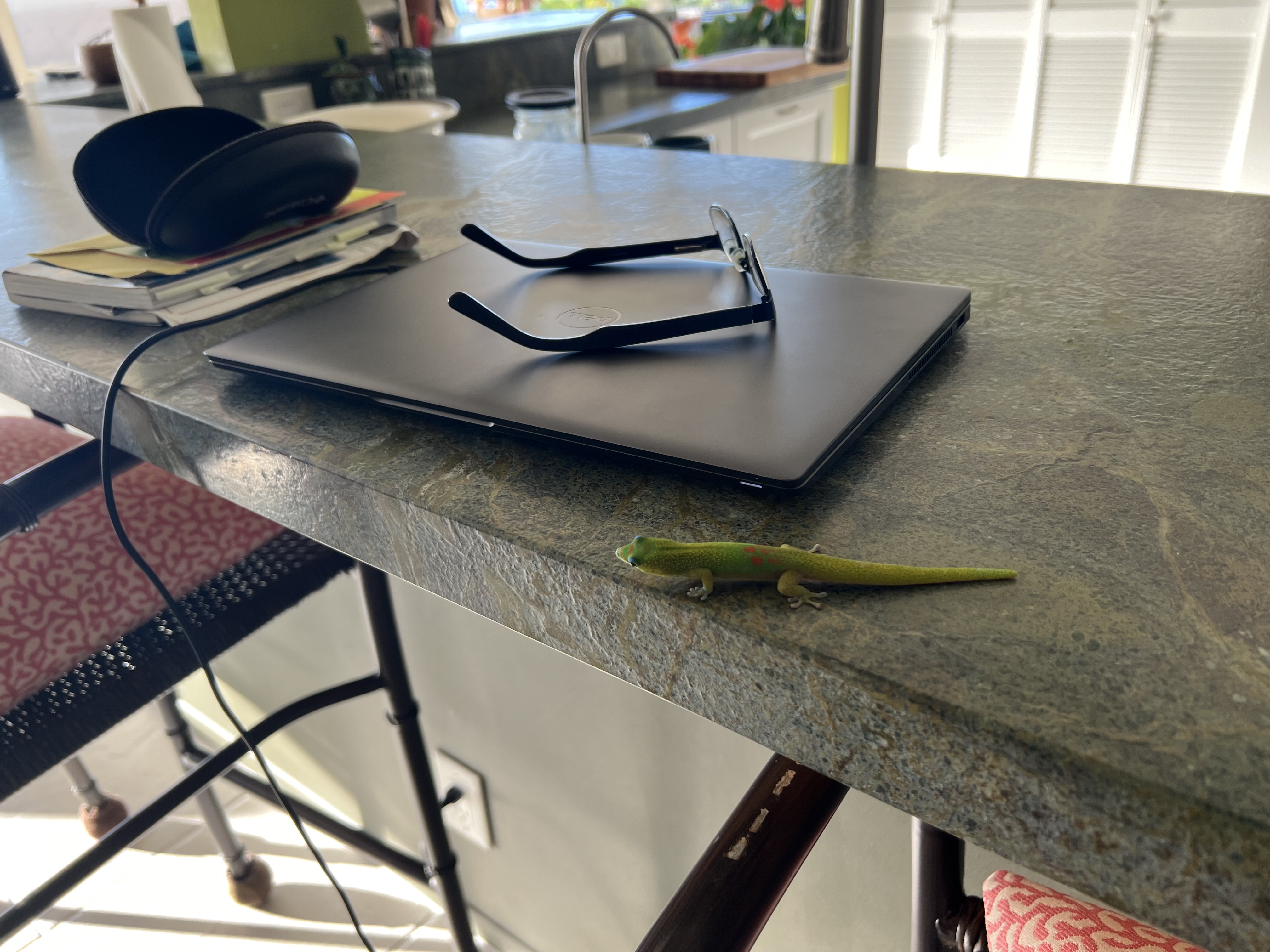
Here’s a gecko trying to either work on or poop on my computer.

*******************************

About a decade or two ago, the concept, “Random acts of kindness” gained traction. Now, about a decade or two later, I’m a little sad that random acts of kindness has become the most common way we talk about kindness. I say this despite the fact that I’m a big fan of randomness and kindness.

For your assignment this week, I’d like all of us to break away from the mentality of randomness and embrace the mentality of intentionality.

Intentional acts give us—as actors in the grand theater of life—greater agency. Instead of being stuck with a script someone else wrote, when we embrace intentionality, we become the author of every scene. Rather than randomly responding to opportunities with kindness, we exert our will. What this means is that when an opportunity for kindness pops up, we already have a plan . . . and that plan involves creatively finding a way to respond with kindness. How cool is that?

Let’s think about this together.

Toward whom would you like to demonstrate kindness? A stranger? If so, it might feel random in that you might act kind in a moment of spontaneity. But your spontaneity—although wonderful—is a moment when your intentionality (to be a person who acts with kindness) meets opportunity. In this way, even acts toward strangers that seem or feel spontaneous, will be acts that reflect your deeper values and character.

Maybe you’d like to intentionally be kind to a friend, a parent, or a sibling. Again, this requires thought and planning and the ability to step outside yourself. Assuming that others want what you want can backfire. You’ll need to step into another person’s world: What would your friend, parent, or sibling appreciate? 

To stay with the theater metaphor, you’re the script-writer and you’ve written yourself into this performance. For this week, the script or plan includes a character who values kindness and who watches for opportunities to share that value with others. You’re that character.

Your job is to translate your character trait of kindness into actions that represent kindness. I don’t what that will look like for you. Maybe you don’t either. That’s the magic—where your character meets opportunity and opportunity meets planned spontaneity.

Your other job is to share about your kindness experiences on social media. You can share your efforts to act with kindness or share your experience of someone acting with kindness toward you.

Have a fabulous and kindness-filled week!

John

Griz Win! Time to Relax

Thanks to BEN ALLAN SMITH of the Missoulian for this fantastic photo!

Now that the University of Montana Grizzly football team won today, and will be going to the FCS Championship game, we can all relax. Of course, I’m joking, but I know some fans (not necessarily me) have lots of trouble relaxing while their favorite team is playing, and many of them (not necessarily me) will be out celebrating, and not at home relaxing. Of course, all that cheering and jeering and beering may not be optimal for our health, but I want to emphasize that just because this week’s happiness challenge activity is “Your favorite relaxation method,” I’m not suggesting that anyone should relax (other than the kickers) when you’re in (or cheering) a double overtime semi-final game.

That said, I hope, at some point during this weekend, everyone takes time to explore and experiment with their favorite relaxation method. As I’ve already noted on social media, relaxation is a viable and evidence-based intervention for several different problems and mental disorders. Indeed, learning relaxation skills—so you can use them when you want to use them—is a very good deal.

In 1975, Herbert Benson of Harvard University published a book titled, The Relaxation Response. Benson wrote that for humans to achieve the relaxation response, they need four components:

  1. A quiet place.
  2. A comfortable position.
  3. A mental device.
  4. A passive attitude.

Benson’s research was pretty phenomenal. When people were able to create a state of relaxation within themselves, they experienced physiological and psychological benefits similar to (but not quite as good as) the benefits of sleep. For this reason, I sometimes refer to the relaxation response as “almost sleep” and recommend it as an in-bed goal for those of us who suffer from insomnia.

The relaxation response involves slowing your respiration and heart rate, with a concomitant reduction of blood pressure. People can achieve the relaxation response via different pathways. . .  including, but not limited to methods like deep breathing, visualization, meditation, and self-hypnosis.

For this assignment, your job is to identify and practice your favorite pathway for reducing your heart rated and breathing (aka your relaxation method). The good news is that you don’t really need a quiet place and a comfortable position (although they help, they’re not essential). But you do need a mental device and a passive attitude.

Unfortunately, as it turns out, for some people, the act of trying to relax creates anxiety. This is a puzzling paradox. Why would trying to relax trigger anxiety?

The intent to relax can trigger anxiety in several different ways. For some, if you try to relax, you can also trigger worries about not being able to relax. This is a relatively natural byproduct of self-consciousness. If this is the case for you, take it slowly. Self-awareness can trigger self-consciousness and self-consciousness can trigger anxiety . . . but time and practice can overcome these obstacles.

For others, a history of trauma or physical discomfort can be activated. This is similar to self-consciousness because the turning of your attention to your body inevitably makes you more aware of your body and this awareness can draw you into old, emotionally or physically painful memories. If this is the case for you, again, take it slowly. Also, manage your expectations, and get support as needed. Support could come in the form of specific comforting and soothing cues (even physical cues), an outside support person, or a professional counselor or psychotherapist.

Trauma and anxiety are common human challenges. Although trauma and anxiety can be terribly emotionally disturbing and disruptive, the core treatment for these problems usually involves one or more forms of exposure and can be traced back to Mary Cover Jones. You can read more about Mary Cover Jones and her amazing work on my blog: https://johnsommersflanagan.com/2018/06/04/the-secret-self-regulation-cure-seriously-this-time/

Okay, that’s enough of my jibber-jabbering. Here’s the activity:

  1. Try integrating your favorite relaxation method (no drugs please) into your daily life. You can do it for a minute here and there, or 20 minutes all at once.
  2. Experiment! Try different methods for helping your body achieve a relaxed state.
  3. If you feel inspired, share about your relaxation experiences here, or on social media, or with your friends and family,

I hope you all become fantastic at relaxing . . . at least until the Grizzlies face South Dakota State for the national championship on January 7.

To Hospitalize or Not to Hospitalize? A Suicide Assessment Conundrum

Yesterday I had a chance to do a 3-hour online workshop with a very cool group of about 22 smart, skilled, and dedicated professionals. They engaged with the content and consequently, we had some great discussions. One of the discussions has kept percolating for me today. The topic: How do we handle situations where clients are clearly suicidal, but are reluctant or unwilling to develop and agree to a collaborative safety plan.  

We talked about how, often, the knee-jerk impulse is to pursue hospitalization. While that’s a viable and reasonable option, the problem is that hospitalization and discharge is a notable risk factor for death by suicide. The other problem is that it’s pretty much impossible for us to know if the client’s resistance to a safety plan indicates increased risk, or just resistance to what s/he/they view as a coercive mandate.

There’s no perfect clinician response to this dilemma. Hospitalization helps some clients, and causes demoralization and regression in others. Not hospitalizing can feel too risky for practitioners.

We talked about a few guidelines in dealing with this conundrum. They include: (a) consulting with colleagues, (b) reflecting on the client’s engagement in other aspects of treatment (increased engagement in treatment is a protective factor), (c) evaluating client intent and client impulsivity, and (d) documenting your decision-making process (including citations indicating that psychiatric hospitalization may not be the best alternative). But again, there’s no perfect guideline.

Below is an excerpt from a CEU course I wrote about a year ago. For the whole CEU (actually there are two different CE courses), you can check out this link: https://www.continuingedcourses.net/active/courses/course114.php

Similar content is also in our brand new Clinical Interviewing textbook: https://www.wiley.com/en-cn/Clinical+Interviewing%2C+7th+Edition-p-9781119981992

Here’s the CEU excerpt:

Decision-Making Dilemmas

When discussing Kate’s situation and other scenarios that involve outpatient work with highly suicidal clients, the following question usually comes up, “What if your judgment is wrong and she either makes a suicide attempt, or she kills herself before your next session?” This is a great question and gets to the core of practitioner anxiety.

The answer is that, yes, she could kill herself, and if she does, I’ll feel terrible about my clinical judgment. Also, I might get sued. And, if I’m inclined toward suicidal thoughts myself, Kate killing herself might precipitate a suicidal crisis in me. Sometimes suicide tragedies happen, and sometimes we will feel like the tragedy was our fault and that we should have or could have prevented it. That said, most suicides are more or less unpredictable. Even if you think you’re correct in categorizing someone as high or low risk, chances are you’ll be wrong; many high-risk clients don’t die by suicide and some low-risk clients do (see Sommers-Flanagan, 2021, for a personal essay on coping with the death of a client to suicide; https://www.psychotherapynetworker.org/magazine/article/2565/the-myth-of-infallibility).

More depressing is the reality that hospitalization – the main therapeutic option we turn to when clients are highly suicidal – isn’t very effective at treating suicidality and preventing suicide (Large & Kapur, 2018). Hospitalization sometimes causes clients to regress and destabilize, and suicide risk is often higher after hospitalization (Kessler et al., 2020). Because hospitalization isn’t a good fit for many clients who are suicidal and because we can’t predict suicide very well anyway, some cutting edge suicide researchers recommend intensive safety planning as a viable (and often preferred) alternative to hospitalization. In the case of Kate, as long as she’s willing to collaborate, and I’m able to contact her husband, and we can construct a plan that provides safety, then I’m on solid professional ground (or at least as solid as professional ground gets when working with highly suicidal clients).

Kessler, R. C., Bossarte, R. M., Luedtke, A., Zaslavsky, A. M., & Zubizarreta, J. R. (2020). Suicide prediction models: A critical review of recent research with recommendations for the way forward. Molecular Psychiatry, 25(1), 168-179. doi:http://dx.doi.org/10.1038/s41380-019-0531-0

Large, M. M., & Kapur, N. (2018). Psychiatric hospitalisation and the risk of suicide. The British Journal of Psychiatry, 212(5), 269-273.

Sommers-Flanagan, J. (2021, July/August). The myth of infallibility: A therapist comes to terms with a client suicide. Psychotherapy Networker. https://www.psychotherapynetworker.org/magazine/article/2565/the-myth-of-infallibility

And here’s an excerpt from Clinical Interviewing.

Collaborate with Clients Who Are Suicidal

The idea that healthcare professionals must take an authoritarian role when evaluating and treating suicidal clients has proven problematic (Konrad & Jobes, 2011). Authoritarian clinicians can activate oppositional or resistant behaviors (Miller & Rollnick, 2013). If you try arguing clients out of suicidal thoughts and impulses, they may shut down and become less open.

For decades, no-suicide contracts were a standard practice for suicide prevention and intervention (Drye et al., 1973). These contracts consisted of signed statements such as: “I promise not to commit suicide between my medical appointments.” In a fascinating turn of events, during the 1990s, no-suicide contracts came under fire as (a) coercive and (b) as focusing more on practitioner liability than client well-being (Edwards & Sachmann, 2010; Rudd et al., 2006). Suicide experts no longer advocate using no-suicide contracts.

Instead, collaborative approaches to working with suicidal clients are strongly recommended. One such approach is the collaborative assessment and management of suicide (CAMS; Jobes, 2016). CAMS emphasizes suicide assessment and intervention as a humane encounter honoring clients as experts regarding their suicidal thoughts, feelings, and situation. Jobes and colleagues (2007) wrote:

CAMS emphasizes an intentional move away from the directive “counselor as expert” approach that can lead to adversarial power struggles about hospitalization and the routine and unfortunate use of coercive “safety contracts.” (p. 285)

Traditional and Strengths-Based Suicide Assessment: The Workshop Handout

Tomorrow evening I’ll be doing an online, 3-hour workshop titled, “Blending Traditional and Strengths-Based Approaches to Suicide Assessment.”

You can still sign up (until noon Mountain time tomorrow) here: https://secure.qgiv.com/for/socialworktrainingseries/event/suicideassesment/

And, if you’re taking the workshop, or you’re just curious and want to see the ppts, click here:

Exploring Irritability with CBT

Irritability is a fascinating experience. It’s hard to perfectly describe, so I looked up the definition online. Dictionary says: “The quality or state of being irritable.” Hahaha. This is the sort of helpfulness I’ve been experiencing from the pesky universe lately. . . with the exception of the IT guy who helped me for 45 minutes a couple weeks ago. He was nice and tried to help, but sadly, I’m the guy who was once told by IT person at UM that maybe I had swallowed a magnet because of how well electronics work in my presence. Maybe it’s my magnetic personality? Even more hahaha.

Let’s get back to irritability. Lately, I’ve been beset with intermittent bouts of irritability, which, I understand is the quality or state of being irritable. The definition of irritable is more illuminating: “having or showing a tendency to be easily annoyed or made angry.”

Yes, I’ve got that. In my defense, there are SO MANY irritating things in the world.

But there’s really no good excuse for my irritability. I feel it burble up, usually in response to something psychologically, emotionally, or physically painful. I’ve had some chronic pain for the past three months, which makes it easier for my irritability button to get pushed. I’ve also had more than my share of tech problems.

After working out at the gym, a particular Dean whom I saw on campus, asked me, “Did you have a good workout?” I muttered something about never having good workouts anymore. Not surprisingly, he noticed my irritability. Then he shared a few Buddhist thoughts about “All is suffering” with me. Despite my internal lean toward being “easily annoyed” (even with my friend the Dean) I listened and immediately glimpsed my lifelong nemesis peeking at me from around the corner. No . . . it wasn’t the Dean, or Lee Jeffries the red-headed bully who tormented me in junior high. Strangely, my lifelong nemesis happens to be the nemesis of many. I’m betting it may be yours as well.

Given that our nemesis has multitudes, let’s give it the pronoun they. They have a name. Expectations.

My expectations are routinely laughably unrealistic. I know that about myself. I also know that when I set myself up with expectations for an hour or a day, the hour or the day includes more irritability. My friend the Dean was commenting on the All-American tendency to expect happiness, whereas the Buddhists embrace that “all is suffering.” 

Several weeks ago, the focus of the Happiness Challenge was on goal-setting. I didn’t do much goal-setting back then, which is okay, because goal-setting should happen when we’re ready for goal-setting. I also know that this week’s Happiness Challenge is about cognitive behavior therapy (CBT). And so this week I’ve been working on a goal to be more immediately self-aware of my expectations and irritability triggers, and to make a concerted effort to manage my irritability in ways I feel good about.

To enhance my self-awareness, I completed the “column technique” for myself and my relationship with irritability. Although I’m not a natural fan of CBT, I found the process helpful, if not illuminating. What was most helpful was to fill out the columns—like a journal—and then read through what I had written. My response was to feel a little embarrassed at the triviality of my irritability triggers. And . . . as Alfred Adler wrote about a century ago, insight (aka self-awareness) is a natural motivator.

For anyone interested, here’s my completed column log activity.

In the end, glimpsing my process and experiences through the column technique this week has made me more motivated that ever to address my irritability in a positive and constructive way.