We’re in the throes of editing our Theories text, meaning I’m so deep into existential, feminist, and third wave counseling and psychotherapy theories that I may have lost myself. If any of you find me somewhere on the street babbling about Judith Jordan and Frantz Fanon and Bryan Cochran, please guide me home.
This brings me to a big ask.
As part of 4th wave feminism, we’re more deeply integrating intersectionality into the practice of feminist therapy. Among other things, intersectionality is about identity. I’m interested in using a variation of Irvin Yalom’s “Who are you?” group technique to explore identity in anyone willing to respond to this post.
To participate, follow these instructions.
Clear a space for thinking, writing, and exploring your identity.
Ask yourself the question: “Who am I?” and write down the response as it flows into your brain/psyche.
Repeat this process nine more times, for a total of 10 responses, numbering each response. One rule about this: You can’t use the same response twice.
After you finish your list of 10, write a paragraph or two about how you were affected by this activity.
If you’re comfortable sharing, send me your list of 10 identities along with your reflections (email: john.sf@mso.umt.edu). If you prefer the more public route, you can post your responses here on my blog. Either way, because I’m in 24/7 theories mode, you may not hear back from me until middle November!
There’s a chance I might want to quote one or more of you in the theories text, instructor’s manual, student guide, or in this blog. If that’s the case, I will email you and request permission.
Thanks for considering this activity and request. Identity and identity development are fascinating. Whether we’re talking about multiple identities (intersectionality), emotions and behaviors (Blake), or the “microbes within us” (Yong), we all contain multitudes.
Lately, when presenting, I find myself naturally saying, “I’m a university professor. That means I can talk all day long.”
But because I know that me talking too much is a bad idea, I complement my university professor disclosure with, “I’d rather have a conversation, so please interrupt me with comments, questions, and reactions.” I also try to offer an experiential learning or reflection activity.
In group class, I have so many stories to tell that I can feel my already prodigious talking urges escalate. I could unleash my breathless wordy-self for three straight hours. The students would leave having been entertained (I am funny), and with a bit of knowledge, but without skills for running counseling groups.
All this circles back to my plan to make the course as experiential as possible. I want students to feel the feelings of being in the group facilitator chair. Some of those feelings will be nerves, but it’s better for students to feel more nerves in group class, and fewer nerves when they’re leading real groups.
We recently hit Day 1 of the transformative experiential chaos.
I know from the takeaways that students write me every week that there were nerves. In a fishbowl group, I asked members to share one positive interpersonal quality. As a second and optional prompt, I suggested they could also share one less positive interpersonal quality.
My goal was for us to briefly look at and talk about Yalom’s concept of interpersonal learning.
I shared first (to demo leader self-disclosure and modeling); I intentionally described a positive and less positive interpersonal quality. The first student to disclose felt instant awareness of the past, present, and future. Afterward, she described feeling a burden to follow my lead, anxiety in the moment, along with instant recognition that she was about to become a role model. She shared both (a positive and less positive interpersonal quality). Everyone followed her lead. Some members felt more anxiety when sharing the positive qualities; for others, it was the opposite.
One takeaway involved the speed and power of norm-setting. I’m reminded of the social psych compliance research. More or less, people consciously or less consciously feel the “norm” and comply. The corollary takeaway is that when leaders set the norm, we need to do so carefully so as to not imply everyone needs to fall in line.
Jumping ahead, the next week I discussed Kelman’s theory of group cohesion. Although I absolutely love Yalom’s definition (“Cohesion is the attraction of the group for its members”), Kelman’s theory is complementary, and was introduced to my be my 1975 Mount Hood Community College football coach. Kelman (and my coach) identified three phases: Compliance, Identification, and Internalization. After talking about Kelman’s theory, several students reflected in their email takeaways about the nature of cult groups. . . and how compliance can become leader-driven. Wow. So good.
In response to one student’s takeaway, part of my email included the following:
“For groups to be safe, IMHO, that also means freedom; freedom to have dissenting beliefs and different experiences and different values. The “internalization” shouldn’t be too tight, or it does feel like a cult. I’m not sure I have great answers about safeguards to the abuse of group processes, and so you’ve given me things to chew on as well.”
Maybe the right recipe is for there to be leader-guided modeling, combined with clear rules and norms that support independent thinking and personal freedom. This is a VERY tricky balance. It’s easy for leaders (including me) to get too enamored with the sound of our own voices and the rightness of our own values.
This brings me back to reflecting on how much leaders should talk and how much leaders should listen. Of course, this depends on the type of group: psychoeducational groups involve more group leader talking. In contrast, counseling groups—even discussion-based groups or support groups—benefit from the group talking more and the leader talking less. This has been a repeated epiphany for students and for me: being aware of the need to balance leader-talk and leader modeling with group member talk and group member modeling.
For the next class, I gave everyone an electronic copy of a long list of 23 group counseling skills to integrate into one of their experiential groups. Here’s the list:
Group class is rolling downstream so fast that I feel I’m riding down Niagara Falls in a barrel. Well, that might be me being dramatic. My personal drama partly explains why I’m so late blogging about week 2 of group class.
Much of the focus of week 2 was on Yalom’s 11 therapeutic factors. I think they’re subtle, powerful, and sneaky insightful. When I teach the 11 factors, I try to give as many concrete examples as possible. Here’s one:
I got asked to run two in-school groups for 5th graders. I had twins in group (one in each group). These were difficult groups. I had let the principal assign the members. I know, bad idea, especially because I knew better; pre-group screening was both optimal and ethical. I share this story because it’s a good one, but also because I can acknowledge that I make mistakes and am still a work in progress.
The twins identified themselves as evil and good. They seemed to be living up to their self-proclaimed identities. The evil twin (let’s call her Zoey) got “removed” from the first three group meetings. My rule was to remove students and send them back to class if they violated the group rules. Zoey was intermittently making aggressive physical contact. She ripped up some “Disney cards” I had given all the students, and threw them at me. In each case, I just said, “Zoey, you’ve broken a rule and you need to go back to your class.” There were small protests, but she would eventually stand up, leave group and go back to class.
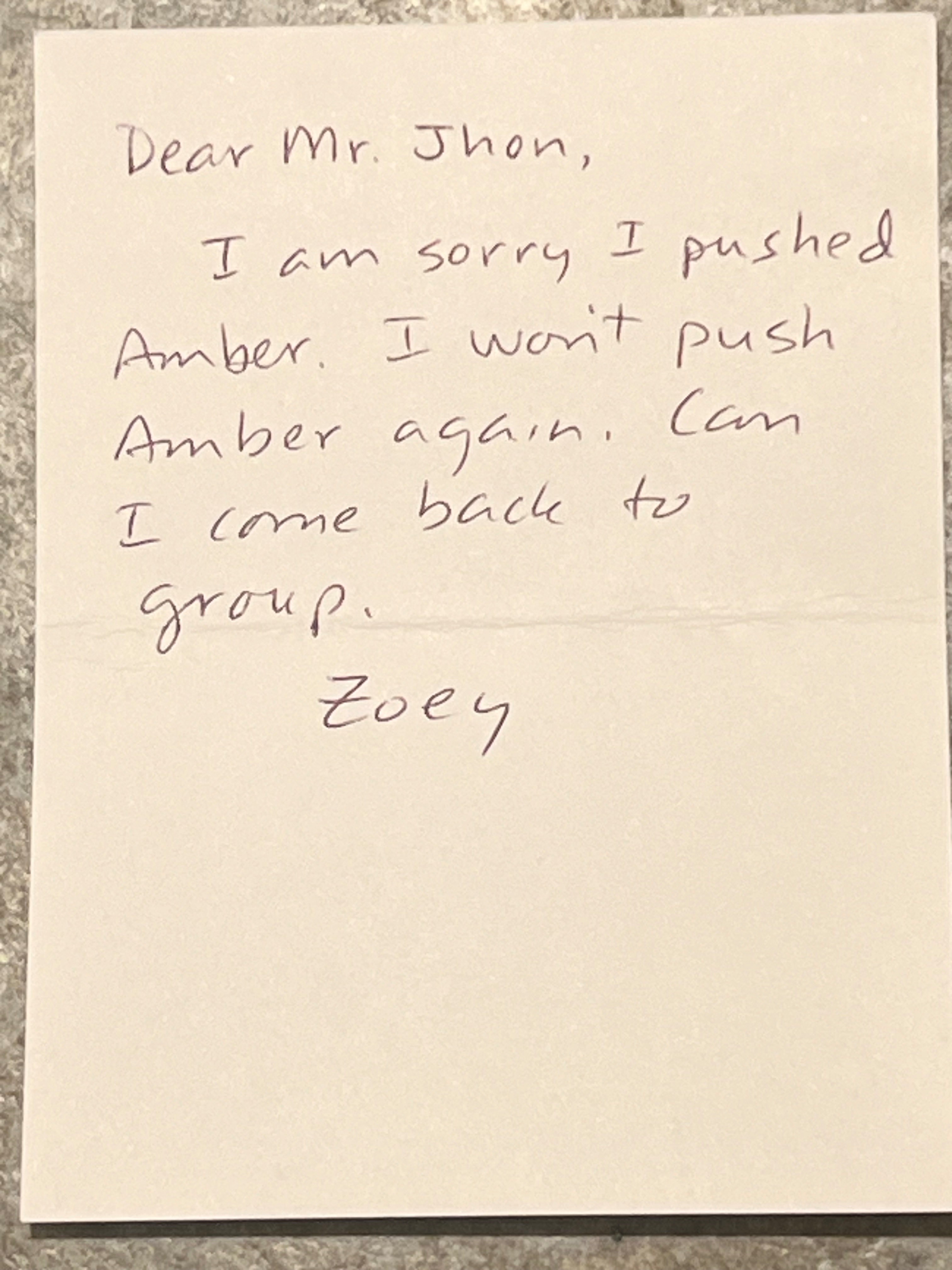
The other part of the rule was to let anyone who had been removed from group back in group if they presented me with an apology note. Zoey became an efficient apology note writer.
Dear Mr. Jhon,
I am sorry I pushed Amber. I won’t push Amber again. Can I come back to group?
Zoey
At the beginning of session 4, as Zoey walking into group, I impulsively said something like, “Zoey! You are in so much trouble. You are in so much trouble that you have to serve our group treats today.” Zoey stared at me, sat down, and began her new journey to becoming a very nice, polite, and wonderful group member.
I repeated my “You’re in so much trouble Zoey” opening the next week. And the next. Zoey never again pushed anyone, she didn’t argue, she became shockingly pleasant and cooperative.
At the end of group, Zoey wrote me a “Good bye” note. It read:
Dr. Mr. Jhon,
I had fun in group. Thank you for coming to our school. I will miss you.
Zoey
With this story (and many others), we get a chance to glimpse the complexities of human behavior. Zoey’s story also gives us a chance to apply counseling theory to group dynamics. The theory that comes to mind for Zoey is related to Dreikurs’ and Adler’s ideas about the 4 psychological goals of children’s misbehavior. You can read about why children (and adults) misbehave here: https://johnsommersflanagan.com/2017/06/10/why-children-misbehave-the-adlerian-perspective/. But in group, the focus is less on the 4 goals, and more on the two overarching factors that will, most of the time, mitigate and sometimes eliminate the misbehavior. What are these overarching factors?
A sense of belonging
Feeling useful
With Zoey, I think she suddenly felt useful. She also got proactive attention in a sort of sarcastic message of her being in trouble. I thought the “You’re in big trouble” part was pretty clever. But the more important part was to give her a job. . . to help her feel useful . . . and along with that came belonging.
In some ways, the Zoey intervention was an individual intervention that helped her function in a group. That was important because Zoey had never been successful in any group. She hadn’t been on a team, in a choir, and she rarely succeeded in making it through the school day without an interpersonal incident. “Graduating” from our group, was a big deal for Zoey.
Beyond the Adlerian principles, the evil twin scenario includes glimpses of Yalom’s therapeutic factors. Can you identify which ones? Here’s the list:
Instillation of hope
Universality
Imparting information
Altruism
The corrective recapitulation of the family group
Development of socializing techniques
Imitative behavior
Interpersonal learning
Group cohesiveness
Catharsis
Existential factors
I’m heading into class momentarily, and so I’ll add the following observation quickly.
At this point, my group students still think I know what I’m doing. We’ve engaged in several whole group and subgroup (fishbowl) group activities where I’m the leader. One student referred to me as “smooth.” As much as I like that compliment, I also recognize that me being smooth is completely related to the students being engaged and cooperative. Maybe we’re still in the honeymoon phase of our group class. Maybe the storming is yet to come? Maybe everyone feels they belong, and that they’re useful. I do work at helping everyone feel belonging and usefulness.
As the instructor, I know that referencing that storming can happen and articulating, in advance, how I usually address storming, can make storming less likely. None of the students are especially keen to be the first stormers. Everyone (probably) knows that no matter the nature and content of the storming, I will try to meet it with acceptance and an opportunity for the stormer to “tell us more” while taking responsibility for their feelings. Nevertheless, sooner or later, I will want to prompt them to storm, rather than hold in feelings of discontent.
One last thought. I am not always smooth. I am not always competent. I am not always emotionally centered and ready to be a good group counselor. Given those realities, I’m also aware that it will be even more important (than being smooth) for me to acknowledge my mistakes and be vulnerable enough for students to accept me as a role model who isn’t just interested in being smooth, but is also interested in being vulnerable.
Thanks for reading! More to come soon. Here are the Week 2 powerpoints:
I forgot how much I love teaching group counseling.
Maybe I forgot because I haven’t taught Group Counseling at the University of Montana since 2017. Whatever the reason, last week, I remembered.
I remembered because I got to provide a group-oriented counseling training to seven very cool program managers and staff of the Big Sky Youth Empowerment program in Bozeman. We started with a structured question and answer opening, followed with a self-reflective debrief, and then re-started with a different version of the same opening so we could engage in a second self-reflective debrief. I’ve used this opening several times when teaching group; it’s getting better every time.
I love the experiential part where I get to flit back and forth between process facilitator and contributor. I love the opportunity to quote Irvin Yalom about the “self-reflective loop” and “The group leader is the norm-setter and role model.” Then I love getting to quote Yalom again, “Cohesion is the attraction of the group for its members.” And again, “I have a dilemma . . .” Boom. When teaching group counseling, the Yalom quotes never stop!
Groups are about individuals and groups and individuals’ learning from the power of groups. I get to learn and re-learn about strong openings, monopolizers, closing for consolidation, and the natural temptation of everyone in the group to fix other group members’ problems—and the need for group facilitators to tightly manage the problem-solving process. We get to “go vertical” and back out through linking and then “go horizontal.”
Tomorrow I head back to Bozeman for more training with the fabulous BYEP staff. Part of the day we’ll focus on specific group facilitation techniques, which reminded me of a handout I created back in 2017. The handout lists and provides examples for 18 different group counseling techniques/strategies. For anyone interested, the group techniques handout is here:
I hope you’re all having a great Memorial Day and engaging in something that feels like just the right amount of meaningful or remembrance for you on this important holiday when we recognize individuals who made huge sacrifices for the sake of the greater and common good of the group.
Yesterday I submitted a manuscript for publication in a professional journal. The journal portal insisted that the telephone number linked to the University of Montana began with a 770 prefix. For us Montanans, that’s blasphemy. We are 406.
The automated message from the journal portal arrived instantaneously. That was amazing. The fact that the automated message was also copied to a former doc student from Pakistan who wasn’t listed as an author was less amazing. That’s the point now, I suppose. We live in a world where we’re pummeled by glitches and errors into desensitized or over-sensitized submission. Every time I start up my Outlook program it drones on about “Profile error. Something went wrong.” At this point, even Microsoft has given up on figuring out what went wrong with its own programming.
My high school friend who has an answer to everything tells me this is a universal experience wherein our expectations that things will work are repeatedly and systematically crushed. That could be a Buddhist outcome, because we’re forced to let go of our expectations. Unless, of course, we have the anti-Buddhist experience of outrage over our overattachment to things working.
This morning I’m checking in for my flight to Atlanta for the American Counseling Association conference. I’m worried by a message in the fine print from ACA implying that I may need a special adaptor to connect my computer to the conference center sound system. I’m also worried about why Delta has decided to charge me to check a bag, even though I have their coveted American Express Skymiles card.
Good news. My worries are mostly small. If there’s no sound system at the conference center, I can yell and mime the video clips I’m planning to show. I can easily (albeit resentfully) pay to check a bag, or I can reduce my packing into a carry-on. If my doc student from 10-years past gets the email, she’ll be glad to hear from me.
Delta is now telling me that the card I downgraded to a couple years ago—because of minimal travel during pandemic lockdowns—doesn’t include a free checked bag. In response, I have to check my emotional response to my overattachment to not paying a baggage fee. Easy-peasy (maybe).
On a brighter note, if you’re planning to be at ACA, I hope to see you from behind our masks. I’m presenting three times. Here they are:
Friday, April 8 at 11am to noon: The Way of the Humanist: Illuminating the Path from Suicide to Wellness in the Georgia World Congress Center, Room B302-B303.
Friday, April 8 at 3:30pm to 4:30pm: Using a Strengths-Based Approach to Suicide Assessment and Treatment in Your Counseling Practice in the Georgia World Congress Center, Room B207-B208
Saturday, April 9 at 10am to 11:30am: Being Seen, Being Heard: Strategies for Working with Adolescents in the Age of TikTok (with Chinwe Uwah Williams) in the Georgia World Congress Center, Room B406.
There’s a button on the Delta page saying “Talk with us?” I click on it and am directed to pre-prepared answers to common questions. Sadly, none of the common questions are my uncommon question. Like Moodle and Quicken and Microsoft and Qualtrics and Apple and Verizon and Grubhub and Tevera and Garmin and Xfinity and Chase and the many other corporate entities in my life, Delta doesn’t really want to talk with me. I suppose I could get into the weeds here and complain that pre-prepped answers aren’t exactly the same as talking, but we all know how this ends. My high school friend’s hypothesis would be affirmed. My expectations would be crushed, only to rise again, in the form of a rising blood pressure event not worthy of my time.
Speaking of time, as I get older, the decisions over how to spend time get pluckier. Do I write something silly like this, or do I go out to the garden, or do I set up another speaking event, or do I work on our Montana Happiness Project website, or do I volunteer somewhere, or do I wash it all away with family time?
This afternoon, I’ll fly to Georgia, where, on Thursday, I’ll teach my happiness class and engage in various consultations from a hotel, before giving three presentations at the American Counseling Association World Conference on Friday and Saturday, before I fly to Portland to see my ailing father in Vancouver, WA, before I fly back to Billings to get back to gardening. I’ll miss my 8-year-old granddaughter’s play in Missoula . . . and many (I was tempted to say “countless” but as a scientist, I’m philosophically opposed to the words countless and tireless) other possible events.
Irvin Yalom likes to point out that one choice represents the death of all others. Truth. There is no multitasking, there’s only the rush to sequentially tasking as much or as many life permutations as possible to fight Yalom’s existential dilemma of choosing and freedom and the angst and weight of our decisions.
My internal editor is complaining about how many “ands” I’ve used in this speedy essay. Even more sadly, the last editor-friend who told me about my penchant for too many “ands” and too many “quotes” has passed away. I miss him.
As a consistent voice and source of support, Rita is recommending I let go of my rigid hopes and expectations and pay the extra $120 to check my bag. At the same time, I’m resisting the death of multitasking, which is why I’m downsizing my packing for seven days into a carry-on bag.
I suppose that’s what the 1970’s band Kansas might say.
Carry on my wayward son
There’ll be peace when you are done
Lay your weary head to rest
Don’t you cry no more
At the risk of worrying you all more than I’m worrying myself (I’m doing fine; this is just creative expression or long form slam poetry), I’m in disagreement with that last line from the Kansas band. Don’t you cry no more is terrible advice.
Maybe the lyrics from that old Leslie Gore song fit better.
It’s my party, and I’ll cry if I want to . . .
That’s not quite right either. It’s more like,
I’ll cry when I’m moved to . . . for Ukraine, for the forgotten children, for the marginalized and oppressed, for my father, for the hungry.
We all have many good reasons we to cry. Grief, whether from the death of friends or ideas or choices, is a process; it comes and goes and comes and goes.
It’s easy to forget that grief is what’s happening in between our times of being happy. Happiness begets grief. And . . . that sounds like something my friend who has an answer for everything might just agree with.
My family of origin had its own mythical creation story.
In the beginning, we (my two sisters and me), were playing cards in my mother’s stomach. Somehow Gayle won (I suspect she cheated), and got to be born first. Peggy won the second round (more cheating) and was thereafter dubbed first loser. Being lonely for about 33 months, I finally managed to win a game of solitaire, and was officially born second loser (aka Pokey II).
My parents named Gayle, Gale Caren. Being smart, independent, and convinced she knew better than anyone, at about age 12, Gale protested. She convinced my parents to take legal action to spell her name correctly. Who does that? From then on, she was and is Gayle Karen. I will always remember her spelling it, loud and clear, G-A-Y-L-E. Whenever the speech-to-text function on my phone misspells her name, I immediately change it. From early on, Gayle knew what was right. As it turns out, according to the Freakonomics dudes, children who grow up with oddly spelled names experience worse educational and achievement outcomes. Duh! G-A-Y-L-E knew that back in 1964, took matters into her own hands, and changed the arc of her destiny.
As we know from developmental research, girls who grow up with a clear sense of identity and an assertive (I know what I want) style, do well in life. Gayle knew what she wanted. She became known as the “bossy” one. But Gayle was much more than bossy; she was a leader.
The famous existential group psychotherapist, Irvin Yalom (who, by the way, at age 88 will be keynoting again for the American Counseling Association in San Diego in April), says that group leaders are, by default, role-models and norm setters. Whoever takes the lead, implicitly and explicitly sets behavioral standards for everyone else. As group members, we cannot help but be influenced by the leader’s norms and behaviors. Group leaders show us the way.
In my family, more often than not, Gayle showed us the way.
In her early teens, Gayle designed and produced a neighborhood newspaper. Who does that? At age nine, I got to be the neighborhood sports reporter. Gayle mentored me as I wrote my very first publication. How many nine-year-old boys get big sisters who publish their first article?
Gayle organized backyard carnivals. Among the many backyard activities, we had fishing booths; fishing booth are like portable walls that carnival attendees sling ropes over. Then, two people behind the wall who are running the booth, grab the rope, and use clothes pins to clip on the “fishing” prize. These were big events. Gayle was a legacy in the neighborhood; she was a genius at organizing events and willing them to happen. Gayle was often the force that led us to organize ourselves into a family team that made things happen.
Not only did I learn skills of leadership from Gayle, I also learned skills of followership. Put in terms used by the famous psychological theorist Alfred Adler, Gayle taught me how to be in a community and how to cooperate. Gayle didn’t (and still doesn’t) know Adler or Yalom or any other famous names in psychology, but sometimes when I study them, I think to myself, ah . . . I started learning about these things before I turned 10, from Gayle.
Sometimes Gayle made mistakes and taught us things we shouldn’t do. Older siblings are great for that. I remember and tease Gayle for some of her quirks. But I think the only reason I get so much delight in remembering a few of Gayle’s neurotic behaviors is because they were exceptions. Most of the time (and I’m talking directly to you now Gayle), you weren’t just the bossy one; you were the smart one, the organized one, the relentlessly focused one, and the one who helped your subordinates (Peggy and me) learn how to be smarter and how to contribute to the good of the family and neighborhood.
Later in life when you experienced challenges and sadness, you modeled for me how people can cope with unplanned hardships and come out stronger on the other side. You were (and are still) a role model for me for that, and for so many other things. But in particular, your ability to sift the wheat from the chaff and focus like a laser on what’s important in the moment is illuminating.
Somehow, despite no college education, you took yourself from waitressing at Earl Kelley’s buffet diner, to being a bank teller, to being a bank vice president, and on to becoming an IT leader with AT&T and Blue Shield of Oregon. You are the epitome of American success. You worked your way to the top.
I hope you know that I know, despite me having a Ph.D., and Peggy (who bit me) having a Master’s degree, in our family, you were always the smart one. You were always the leader. You could discern the right and moral direction without a compass or a Bible. I am amazed and humbled at your success. I am happy and grateful to have been led by you, to follow you, and to learn from you. I am forever grateful that you cheated in our first card game, because, really I was the winner; I won the prize of having you as my big sister.
G is for Gratitude. G is for Gayle. G is for a tie (with Peggy, even though she bit me), for the Greatest sister of all time.
Happy late birthday from your brother, who, as you know, is usually late in all things.
The place to click if you want to learn about psychotherapy, counseling, or whatever John SF is thinking about.




 John Sommers-Flanagan