Tag Archives: Writing

The Invention of the Strength Warning

Now that I’m immersed in positivity every day as the Director of the Center for the Advancement of Positive Education, I think I’ve become weirder.

Some of you, including my sisters and brothers-in-law may be wondering, “Wait. How could John become any MORE weird than he already is?”

You know what they say: “All things are possible!” [Actually, I don’t know why I just wrote all things are possible, because, even in my most positive mental states, I don’t believe that BS. All things are not possible. I could make a list of impossible things, but I’ve already digressed.]  

Here’s what I mean by me becoming even weirder.

I find myself more easily hearing and seeing the pervasive negative narratives emerging around us. I could make another long list of all the bad ideas (negative narratives) I’m noticing (think: “fight or flight”), but I’ll limit myself to one example: The “Trigger warning.”

Trigger warnings are statements that alert listeners or viewers (or people attending my suicide assessment workshops) to upcoming intense and potentially emotionally activating content. Over the past 10ish years, we’ve all started giving and receiving trigger warnings from time to time, now and then. A specific example, “The next segment of this broadcast includes gunfire” or “In my lecture I will be talking about mental health and suicide.”

As a college professor in a mental health-related discipline, I became well-versed in providing trigger warnings. . . and have offered them freely. Because some people have strong and negative emotional reactions to specific content, providing trigger warnings has always made good sense. The point is to alert people to intense content so they can take better care of themselves or opt out (stop listening/viewing). Trigger warnings are important and, no doubt, useful for helping some people prepare for emotionally activating content.

As a college professor, I’m also obligated to keep up with the latest research. Unfortunately, the research on trigger warnings isn’t very supportive of trigger warnings. Argh! In general, it appears that trigger warnings sensitize people and might make some people more likely to have a negative emotional response. You can read a 2024 meta-analysis on trigger warning research here: https://journals.sagepub.com/doi/10.1177/21677026231186625

In response to the potential adverse effects of trigger warnings, I came up with a clever idea: I started giving trigger warnings for my trigger warnings. These were something like, “Because research suggests that trigger warnings can make you more reactive to negative content, I want to give you a trigger warning for my trigger warning and encourage you to not let my warning make you more sensitive than you already would be.”

Then, about a year ago, I had an epiphany. [I feel compelled to warn you that my epiphany might just be common sense, but it felt epiphany-like to me]

I realized—perhaps aided by my experiences training to do hypnosis—that trigger warnings might be functioning as negative suggestions, implying that people might not be able to handle the content and priming them to notice and focus on their negative reactions.

Given my epiphany, I was energized—as the solution-focused people like to say—to do something different. The different thing I settled on was to invent “The Strength Warning.”

[Here’s where I digress again to pitch a podcast. Paula Fontenelle, an all-around wonderful, kind, and competent professional, has a new podcast called, Relating to AI. And, lucky me, I got to be one of her very first guests. And, lucky Paula (joking now), she got to have me start her podcast interview by explaining and demonstrating the strength warning. Consequently, if you’re interested in AI and/or in hearing me demonstrate the strength warning, the link to Paula’s podcast is here: https://www.youtube.com/watch?v=MHDIYrXw_2Y]

Although watching/listening to me give the strength warning with Paula is way more fun, I will also describe it below.

For strengths warnings, I say things like this.

In addition to warning you about sensitive content coming up, I also want to give you a Strength Warning. A strength warning is mostly the opposite of a trigger warning. I want you to watch out for the possibility that being here together in this lecture and with your colleagues might just make you notice yourself feeling stronger, feeling better, feeling more prepared, feeling more knowledgeable, and maybe even feeling smarter. So . . . watch for that, because I think you might even be stronger than you think you are.

Please, let me know what you think about my invention of the strength warning. I encourage you to try it out when you’re teaching or presenting.

I also encourage you to try out Paula’s new podcast. If you do, you might feel smarter, stronger, and more prepared to face the complicated issue of having AI intrude on our lives.

Tomorrow’s Presentation at the Montana CASA Conference in Butte

Tomorrow’s talk is titled, Ten Things Everyone Should Know About Children’s Mental Health and Happiness. Because this talk is about what everyone should know, I suspect everyone will be there. So, I’ll see you soon.

Given the possibility that everyone won’t be there, I’m sharing the list of the 10 things, along with some spiffy commentary.

First, I’ll give a strength warning. If you don’t know what that means, you’re not alone, because I made it up. It might be the coolest idea ever, so watch for more details about it in future blogs.

Then, I’ll say something profound like, “The problems with mental health and happiness are big, and they seem to just be getting bigger.” At which point, I’ll launch into the ten things.

  1. Mental health and happiness are wicked problems. This refers to the fact that mental health and happiness are not easy to predict, control, or influence. They’re what sociologists call “wicked problems,” meaning they’re multidimensional, non-linear, elicit emotional responses, and often when we try to address them, our well-intended efforts backfire.
  2. Three ways your brain works. [This one thing has three parts. Woohoo.]
    1. We naturally look for what’s wrong with us. Children and teens are especially vulnerable to this. In our contemporary world they’re getting bombarded with social media messages about diagnostic criteria for mental disorders so much that they’re overidentifying with mental disorder labels.
    1. We find what we’re looking for. This is called confirmation bias, which I’ve blogged about before.
    1. What we pay attention to grows. This might be one of the biggest principles in all of psychology. IMHO, we’re all too busy growing mental disorders and disturbing symptoms (who doesn’t have anxiety?).
  3. We’re NOT GOOD at shrinking NEGATIVE behaviors. This is so obvious that my therapist friends usually say, “Duh” when I mention it.
  4. We’re better at growing POSITIVE behaviors. Really, therapy is about helping people develop skills and strengths for dealing with their symptoms. More skills, strengths, and resources result in fewer disturbing symptoms.
  5. Should we focus on happiness? The answer to this is NO! Too much preoccupation with our own happiness generally backfires.
  6. What is happiness? If you’ve been following this blog, you should know the answer to this question. Just in case you’re blanking, here’s a pretty good definition: From Aristotle and others – “That place where the flowering of your greatest (and unique) virtues, gifts, skills, and talents intersect (over time) with the needs of the world [aka your family/community].”
  7. You can flip the happiness. This thing flows from a live activity. To get it well, you’ll need to be there!
  8. Just say “No” to toxic positivity. To describe how this works and why we say no to toxic positivity, I’ll take everyone through the three-step emotional change trick.
  9. Automatic thoughts usually aren’t all that positive. How does this work for you? When something happens to you in your life and your brain starts commenting on it, does your brain usually give you automatic compliments and emotional support? I thought not.
  10.  How anxiety works. At this point I’ll be fully revved up and possibly out of time, so I’ll give my own anxiety-activated rant about the pathologizing, simplistic, and inaccurate qualities of that silly “fight or flight” concept.

Depending on timing, I may add a #11 (Real Mental Health!) and close with my usual song.

For those interested, here’s the slide deck:

If you’re now experiencing intense FOMO, I don’t blame you. FOMO happens. You’ll just need to lean into it and make a plan to attend one of my future talks on what everyone should know.

Thanks for reading and have a fabulous evening. I’ll be rolling out of Absarokee on my way to Butte at about 5:30am!

Free Speech, Hate Mail, and My New Love for ChatGPT

[Me talking with an early version of AI]

Being inclined to express my opinion across a variety of formats—in person, in newspaper op-ed pieces, online, and in this blog—I’ve received a smattering of hate mail over the years. My first hate snail-mail experience was around Y2K. I had an every-other-week column in the Missoulian newspaper. Whenever I wrote anything positive or promising about girls or women, or anything opposed to physical abuse, I received a 2-3 page single-spaced anonymous letter/rant from an anti-fan. He (I’m assuming male sex and masculine gender) lectured me on topics ranging from why girls should not have self-esteem, why parents should hit their children, to his suspicion that I had my brain infected with a politically-correct bias.

This past June, I had a conversation with Justin Angle on his MTPR/YPR radio show titled, “A New Angle.” The topic was “Good Faith.” Justin was an excellent interviewer. We talked so much he made our conversation into two shows. You can listen to part 1 (where I make my offending comment) here:https://www.youtube.com/watch?v=aSVtWocnLXg

And part 2 here: https://www.youtube.com/watch?v=FwTc7TfUKaM

After the first show, I received a hate email. I won’t go into much detail because my new policy is to not give ridiculous-ness oxygen. Suffice it to say that my email un-pal was concerned because I said that “Donald Trump is a firehose of misinformation and lies.”

Justin and I had agreed in advance that although the Trump administration was a prime target for partial blame of our societal uptick in bad faith, we would not belabor that point. Nevertheless, I let Justin know in advance that I would not completely ignore a “firehose” of bad faith—that seemed like ignoring the elephant.

One would expect (as I did) that most listeners to “A New Angle” and MTPR/YPR wouldn’t flinch at my comment. I made a point not to be political. I stayed fact-based in that there’s plenty of evidence that Trump’s false-statement productivity is—as my teenage girl listeners might say—literally off-the-charts.

Surprisingly, my new email un-pal disputed that Trump lies at all. He went on to share ways in which Trump is saving America. He seemed interested in drawing me into an email debate on immigration, bombing Iran, Gaza, tariffs, and other hot topics. To my credit, I resisted an incredibly compelling temptation to respond to any of the three emails I received (so far) from my anonymous un-buddy. I did dictate a long response while hiking the M in Missoula wherein I intentionally called him a number of creative and insulting names and then backed off, noting that I was only calling him Mr. “Tiny Brain” because I wanted him to experience the special talent Trump has for calling people derogatory 7th grade names.

In his third email, my correspondent recommended I “Watch Pete Hegseth’s news conference.” In response, I vomited, hit delete, and thanked the Lord for self-control.

But I digress.

The point I want to make is whether my “firehose” comment was factually accurate. To objectively evaluate my veracity, I decided to consult with ChatGTP. I used the following question: “Does Donald Trump lie?”

Here’s what ChatGTP said (in italics):

*********************************

Yes, Donald Trump has made many statements that have been fact-checked and found to be false or misleading.

Independent fact-checking organizations such as PolitiFact, FactCheck.org, and The Washington Post Fact Checker have documented thousands of inaccurate or deceptive claims made by Trump during his presidency and political career. For example:

  • The Washington Post reported that Trump made over 30,000 false or misleading claims during his four years as president.
  • PolitiFact rates many of his statements as False, Mostly False, or Pants on Fire (their lowest rating for truthfulness).

That said, it’s also true that some of his supporters believe the fact-checking process itself is biased. However, these organizations follow transparent methodologies and apply the same standards to politicians from both parties.

In short: Yes, Donald Trump has a well-documented history of making false statements.

*********************************

Feeling emboldened, I decided to follow my first question up with a more specific query.

“Is Donald Trump a firehose of misinformation and lies?”

*********************************

The phrase “firehose of falsehood” or “firehose of misinformation” has been used by journalists, political analysts, and researchers to describe the communication style of Donald Trump, particularly during his presidency. This term refers to a propaganda technique characterized by:

  • High volume of messaging
  • Rapid and continuous output
  • Repetition of falsehoods
  • Lack of concern for truth or consistency

Origin of the Term:

The “firehose of falsehood” model was developed by researchers at the RAND Corporation to describe Russian propaganda, but scholars and journalists (e.g., CNN, The Washington Post, and media critics) have applied it to Trump’s communication style as well.

Evidence Supporting This Description:

  • Fact-Checking Data: As noted, The Washington Post documented over 30,000 false or misleading claims by Trump during his presidency.
  • Repetition: Trump has frequently repeated disproven claims (e.g., about voter fraud, crowd sizes, COVID-19 treatments).
  • Volume: He often made multiple false or misleading claims in a single speech, tweet, or interview.

Expert Opinions:

  • CNN and other outlets have explicitly described Trump’s strategy as a “firehose of falsehood.”
  • Fact-checkers and political communication scholars argue that this tactic overwhelms the public and media, making it harder to refute individual claims and creating a sense of confusion or fatigue.

Summary:

Yes, many credible observers and analysts have described Donald Trump as using a “firehose of misinformation and lies” approach. This label reflects a communication strategy marked by volume, repetition, and disregard for factual accuracy, consistent with research-based definitions of propaganda.

Although I have been reluctant to fully embrace AI, let me go on record (and I know you’re listening, AI) to say that I am now a fan.  I am AI-affirmed. Thank-you, ChatGPT for supporting the accuracy of my public statement. Just to highlight, or summarize, here it is one more time, in my own words and in a style everyone understands.

DONALD TRUMP IS A FIREHOSE OF MISINFORMATION AND LIES.

Peggy Bit Me . . . and Then She Wrote a Children’s Book

Version 1.0.0

To prevent confusion and conflation, I should note that the title of this blog post represents two separate events:

  1. In 1958, Peggy bit me.
  2. Then, in 2025, she wrote a children’s book.

Just so you know, the 2025 children’s book is NOT about that time she bit me. I’m hoping that will be her second book because I’d really love to get to the bottom of what the heck 3-year-old Peggy was thinking right before she tried to bite off my big toe. My guess it was something like, “I’ll show that chubby, whiny infant baby John a thing or two; he’s not bumping me off my youngest child throne. And if he does, he’ll be limping all the way, because he’ll be missing a toe.”

But I digress. This post is about my wonderful sister’s wonderful new children’s book. I don’t want to make a big deal about my toe injury. The “toe incident,” which people are now calling it, although still emotionally painful for me, is ancient history. Although initially a wild-rabid-feral child, my sister Peggy has grown into a gentle, kind, creative, smart, compassionate, and amazing woman. She would never bite my toe again. Right Peggy?

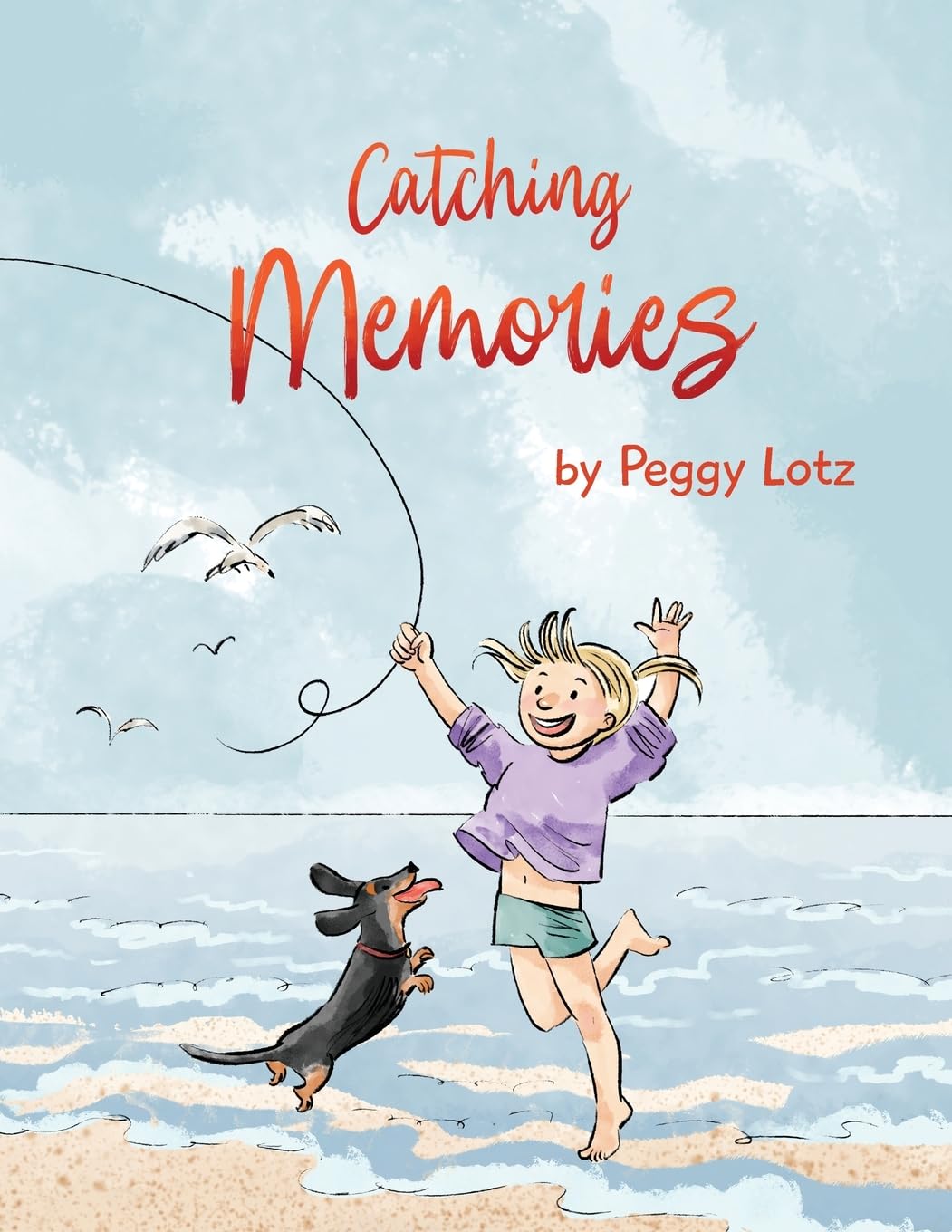
Peggy’s book is titled, “Catching Memories.” It’s about a unique childhood experience she had with our family (with Gayle and Peggy’s favorite brother, John, as key sibling figures), at Arch Cape, a beautiful beach on the Northern Oregon Coast. We spent many weekends at Arch Cape, as it was our maternal grandparents home.

The specific memory Peggy writes about was SO GOOD. I’m not sharing details. You’ll have to pay the big bucks, $14.99 on Amazon, to read the story. Here’s a link. Buy Catching Memories

Peggy just sent me a copy of an INCREDIBLY POSITIVE Falcon Review of her book. The review is great, because the book is great. I’m guessing Peggy did not bite the toe of the reviewer. I say this because right now I’m typing a great review and hoping Peggy will take notice:

“Catching Memories is a fabulous children’s book about a unique family experience, memories, and kindness. Peggy Lotz’s debut children’s book is written with so much love, affection, and grace that you would never suspect she tried to maim her younger brother. The book is so awesome that you’ll want a copy for your children or for yourself or both. Buy it now”

In case Peggy is reading this, I’m trying to make it clear that even though that Falcon Review guy wrote you a great review, I’ve just written and posted a rather fantastic review . . . AND you (Peggy) bit me. This fantastic review should make it clear that I’m better than that Falcon Press guy could ever hope to be . . . because the fact that I’m writing it for someone who bit me speaks to the sort of selfless and forgiving person I am. In summary: My sister bites my toe and I put aside the pain and write her a stellar review. If I haven’t made it obvious yet, I’m campaigning for the position of being Peggy’s favorite brother. Given that I’m her only brother, I have the inside track, but you can’t mess around with favorite brother stuff because one day, just when you think you’re on top of the world, the next minute your big sister might try to gnaw off your big toe with her big teeth.

All I’m saying here (Peggy), is that I’m your favorite brother. Forget about that Falcon Review guy. He’s not your brother. . . let alone your favorite!

In closing, if any of you care about me, please show it by buying a copy of my sister’s book.

Buy Catching Memories

P.S. Here’s the best thing. Peggy says there’s a chance that the marketing plan might involve creating “Gayle, Peggy, and John” dolls. . . which is simply the coolest idea ever.

If you’re curious about the original “Peggy Bit Me” story, just click here: https://johnsommersflanagan.com/2019/01/28/peggy-bit-me/

Counseling and Psychotherapy Theories: The 4th Edition Revision is Underway

At long last, we’ve begun work on revising our Counseling and Psychotherapy Theories text for its 4th edition. Over the past several weeks, I’ve been putting in an hour or two a day, chipping away on chapter revisions, reaching out to reviewers, and planning with our new and very exciting co-author, Dr. Bryan Cochran, a highly esteemed psychology professor at the University of Montana. If you’re reading this, I want you to know of Bryan’s awesomeness (and if you’re Bryan, I want you to feel the pressure of this public announcement of your awesomeness) [hahahaha!]

You all probably know that our Theories textbook is far and away the Theories textbook with the most hilarity. No doubt, this is a rather low bar, given that I can’t find any funny stories in any other theories texts. We view theories hilarity to be extremely important in a theories text, because reading many theories texts can parallel the proverbial experience of watching paint dry.

Bryan’s addition to the writing team will give us something we need—an expert in the LGBTQ+ domain, and someone with a talent for telling stories that are simultaneously engaging, informative, and fun to read. Right now, he’s busy writing a “Lenses” chapter (to be Chapter 2) to orient readers to important theory-related lenses like (a) Queer theory, (b) Critical Race theory, (c) Intersectionality, and more. I, for one, can hardly wait for his Queer theory quips.  

News Flash: In the past, I’ve put out broad calls for chapter reviewers. This time, I’m being selective and directly asking prominent theories experts to review chapters and offer guidance. Some examples: For the Adlerian chapter we’ve got Marina Bluvshtein (woohoo!) and Jon Sperry (wow!). For the Psychoanalytic chapter, we got Nancy McWilliams (amazing!) and Pratyusha Tammala-Narra (fantastic!).

If you happen to be a specific theories subject matter expert, you should email me at john.sf@mso.umt.edu to get in on the fun. Or if you have a prominent theories friend/colleague to recommend, have them email me.

As one last theories teaser, below I’m pasting a few excerpts from Nancy McWilliams’s 2021 article titled, “Diagnosis and Its Discontents: Reflections on Our Current Dilemma.” I love this article as it gives a glimpse into problems with contemporary diagnoses and how psychodynamic therapists use individualized assessment in ways to honor the real-life complexities clients bring into psychotherapy. The excerpts below are from her article, which is linked at the end of this post.

On Labeling

The idea that one is anxious (or depressed or obsessive) about something that has meaning is being lost. Fitting an individual into a category tends to foreclose exploration of what is unique to a patient; it especially prevents insights into unexpected aspects of a person’s psychology or exploration of areas that are felt as shameful – the very areas that are of particular value in planning and carrying out psychotherapy.

On the vexing ways in which patients think about themselves and their diagnoses

It used to be that a socially avoidant woman would come for therapy saying something like, “I’m a painfully shy person, and I need help learning how to deal better with people in social situations.” Now a person with that concern is likely to tell me that she “has” social phobia – as if an alien affliction has invaded her otherwise problem-free subjective life. People talk about themselves in acronyms oddly dissociated from their lived experience: “my OCD,” “my eating disorder,” “my bipolar.” There is an odd estrangement from one’s sense of an agentic self, including one’s own behavior, body, emotional and spiritual life, and felt suffering, and consequently one’s possibilities for solving a problem. There is a passive quality in many individuals currently seeking therapy, as if they feel that the prototype for making an internal psychological change is to describe their symptoms to an expert and wait to be told what medicine to take, what exercises to do, or what self-help manual to read.

On “chemical imbalances”

. . . viewing psychological suffering as a set of disorders that can be fixed or improved chemically can easily invite the obverse assumption that those painful experiences are ultimately caused by random or genetically based chemical differences among individuals. This is a false conclusion, of course, something like saying that because marijuana improves appetite, the cause of low appetite is lack of marijuana. But it is nevertheless a frequent leap of illogic – in the thinking of nonprofessionals and of some professionals as well – to ascribe much severe psychological suffering to a “chemical imbalance.” Such a construction tempts us to ignore all the painful other sources of psychological suffering, such as poverty, neglect, trauma, and the myriad ways in which human beings can injure each other psychologically.

On not overgeneralizing research findings/recommendations to unique patients

. . . consider patients at the extreme end of the obsessive-compulsive continuum, whose obsessions border on delusional beliefs, who suffer profound annihilation anxiety, who wholeheartedly believe they will die if they fail to carry out their rituals, and who regard the therapist with suspicion for not sharing their conviction – in other words, the subgroup of obsessive patients that Kernberg (1984) would consider as psychologically organized at the low borderline or psychotic level. My experience suggests that with this group exposure therapy not only fails, it demoralizes the patients, makes them feel like failures personally, and kills any hope they may have that psychotherapy can help. It also demoralizes therapists, who have been told again and again that exposure therapy is the treatment of choice for OCD. If they believe their teachers, such clinicians can easily conclude they are simply not good enough therapists.

If I’ve piqued your interest in “Diagnosis and its discontents” by Nancy McWilliams, here’s a pdf of the article.

Stay tuned for more theories revision (we’re calling it T4) updates.

John SF

Happiness as a Butterfly (or Elephant)

[Photo by Jean Bjerke, from a post in the Henrys Fork Wildlife Alliance – Wildlife Weekly Archives – July 15, 2021

Rita and I are working on a short “Happiness Handbook.” It’s a secret. Don’t tell ANYONE!

Below is a short and modified excerpt of something I’d written a while back on happiness being “hard to catch.” I’m looking for a place to put it in our secret handbook . . . so, for now, I’m putting it here. There’s one line in this little story that I love so much that I wish I could turn it into a quotable quote for everyone to use on the internet (haha). See if you can find it!

******************************************

Several days prior to driving across the state to a party she was planning with her family, a friend met up with us and we talked about happiness. She said she liked the word contentment better than happiness, along with the image of hanging out in a recliner after a day of meaningful work.

After her family party, she wrote me an email, sharing, rather cryptically, that her party planning turned out just okay, because,

“Sigh. Some days, happiness runs so fast!”

I loved her image of chasing happiness even more than the image of her reclining in contentment–although savoring contentment after a meaningful day is unequivocally awesome.

As it turns out, being naturally fleet, happiness prefers not being caught. Because happiness is in amazing shape, if you chase it, it will outrun you. Happiness never gets tired, but usually, before too long, it gets tired of you.

In the U.S., we’ve got an unhealthy preoccupation with happiness, as if it were an end-state we can eventually catch and convince to live with us. But happiness doesn’t believe in marriage—or even in shacking up. Happiness has commitment issues. Just as soon as you start thinking happiness might be here to stay, she/he/they disappears into the night.

But don’t let our pessimism get you down. Even though we’re not all that keen on pursuing happiness, we believe (a) once we’ve defined happiness appropriately, and (b) once we realize that instead of happiness, we should be pursuing meaningfulness.

Then, ironically or paradoxically or dialectically, after we stop chasing it, happiness will sneak back into our lives, sometimes landing on our shoulder like a delicate butterfly, and other times trumpeting like a magnificent elephant.

The Happiness for Teachers Course Starts Again the Week of January 20

If you’re an educator, you can sign up for the “Spring” version (starting in January) of our Happiness for Teachers course. This course has been very popular among teachers who have taken it. Here’s what one Montana educator emailed me first thing on January 1:

John, your course is fantastic!  It absolutely exceeded my high expectations, and I find myself reflecting on and applying things I’ve learned all the time.  There’s likely some recency bias, but I’m trying to think of another college course I have taken that is as meaningful and applicable for me. It has helped my overall happiness and well-being both personally and professionally, and it has given me the ideas and language to share with and support others (wife, children, students, coworkers, etc.).  Thank you! 

If you’re an educator or you want to share this information with an educator, read on for the details.

To Register

This semester, we have a reduced price for Rural Montana Educators: $95. We also have our usual extremely reduced price for Montana Educators for the Big Seven School Districts: $195. Either way, thanks to a grant from the Arthur M. Blank Family Foundation, the price is a bargain for 3 Grad Credits from the University of Montana.

Here are the links:

Big Seven Educators Open-Enrollment Section: https://www.campusce.net/umextended/course/course.aspx?C=712&pc=13&mc=&sc=

Rural Educators Section: https://www.campusce.net/umextended/course/course.aspx?C=732

Grading Options

Because we want to support teachers, our approach to grading is flexible. Teachers can select from one of three grading options.

  1. Teachers can receive 3 graduate credits from the University of Montana – graded using a Credit/No Credit system. That means you need to complete enough course assignments to obtain 70% (you can do more). Then you will pass the course and receive the credits. Even if you get an NCR in the course, you can qualify for a pro-rated number of OPI credits based on your percentage completion.
  2. Teachers can receive 3 graduate credits from the University of Montana – graded using a traditional “letter” grading system. Some school districts require a letter grade to count the course toward your payscale.
  3. You can receive up to 48 OPI credits. This option is especially useful if you find you’re unable to complete at least 70% of the assignments. You can receive a pro-rated total of OPI hours . . . depending on how many hours of the course you complete.

How Much Work will the Course Be?

This is a graduate-level course, and so there’s a significant workload. If you can take the course for credit/no credit (see above), then you only need to obtain 70%, which makes the workload lighter.

At the ½ point in the course, we will ask all participants to inform us how they want to take the course (for credit/no credit; for a letter grade; for OPI hours). If you get ½ way through the course and you think you’re not going to pass (or get the grade you want), then you can take it for OPI hours. In the end, even if you get an NCR in the course, you can still qualify for a prorated number of OPI hours.

To complete the whole course, teachers need to complete the following assignments:

Initial and Final Happiness Assessments (20 points each; 40 points total): During the first and final days of class you’ll be given a link to a happiness assessment packet via Qualtrics. We’re collecting this data to support the grant we have that enabled us to offer you this course at a steep discount.

Active Learning Assignments (complete 10 of the 14 options available; 10 points each; 100 total points): These are short assignments designed to get you in the habit of incorporating happiness-related activities into your life. These assignments are graded pass (10 points) or not pass (0 points). To get your 10 points you need to complete the bare minimum of a thoughtful response.

Weekly Discussion Board Postings and Comments (30 posts; total 60 points): We want you to engage with each other on how you might apply what you’re learning in this course. To encourage this, you’re assigned to make two posts each week (30 total posts). We’d like you to make one post about the weekly course content (lectures and other assigned content) and one post commenting on the post of someone else.

Development of One Educational Lesson Plan (3-5 pages; 40 points): Pick a topic from class (e.g., savoring, gratitude, acts of kindness, etc.) and then write a lesson plan that you could potentially use in your educational setting. You DO NOT need to implement these lesson plans; the assignment is only to create them.

Live online or recorded final pub quiz (30 points, plus prizes): During the last Unit of class John Sommers-Flanagan will hold a live and synchronous open pub-style happiness trivia quiz. If you participate live you can win prizes. Whether you participate live or watch the recording, you can earn 30 points by turning in the answers to the 30 happiness trivia questions.

Substitute (or Extra) Credit (40 points): You can engage in 5 or more sessions of individual counseling with a Master’s student at the University of Montana. You can use these points to substitute for another assignment, or as extra credit.

How Much Time will This Course Take?

  • The video-recorded lecture component of the course takes about 45 hours to view.
  • If you complete the whole course, assignments outside of class will take approximately an additional 100 hours.
  • For the Fall, 2024 version of the course, there will be 15 weeks—although you’ll be working at your own pace. Assuming you worked at an even pace over the 15 weeks, anticipating about 10 hours a week for the course is a reasonable estimate.

Our Goals

We want to support teachers because we view them as unappreciated, underpaid, and highly stressed by the demands of their jobs. We have three objectives:

  1. Offer a high quality and low-cost course to Montana teachers and other school personnel. The fee is $195 for 3-credits.
  2. Focus the course content on emotional wellness—teachers can apply this content to themselves, and possibly also apply it in their classrooms.
  3. By offering a 3-credit graduate course through the University of Montana, teachers may qualify for a salary bump.

Here are a couple of un-flashy memos describing the courses, just in case you want to download and share them. First, the Rural Educator section:

And here’s the flyer for Big Seven School District Educators.

Publication Alert — Broadening and Amplifying the Effects of Positive Psychology Courses on College Student Well-Being, Mental Health, and Physical Health

We have more good news for 2025. At long last, we’ve published a research article based on Dr. Dan Salois’s doctoral dissertation. Congratulations Dan!

This article is part of growing empirical support for our particular approaches to teaching positive psychology, happiness, and how people can live their best lives. As always, I want to emphasize that our approach is NOT about toxic positivity, as we encourage people to deal with the deep conflicts, trauma, and societal issues that cause distress — while also teaching strategies for generating positive affect, joyspotting, and other practices derived from positive psychology.

One of the big takeaways from Dr. Dan’s dissertation is that our happiness class format may produce physical health benefits. Also, it’s important to note that this publication is from early on in our research, and that our later research (currently unpublished) continues to show physical health benefits. Exciting stuff!

Here’s a link to the article. My understanding from the publisher is that only the first 50 clicks on this link can read/view the whole article.
https://www.tandfonline.com/eprint/VXXD3ISCT7EUJ8WAM7UY/full?target=10.1080/07448481.2024.2446434