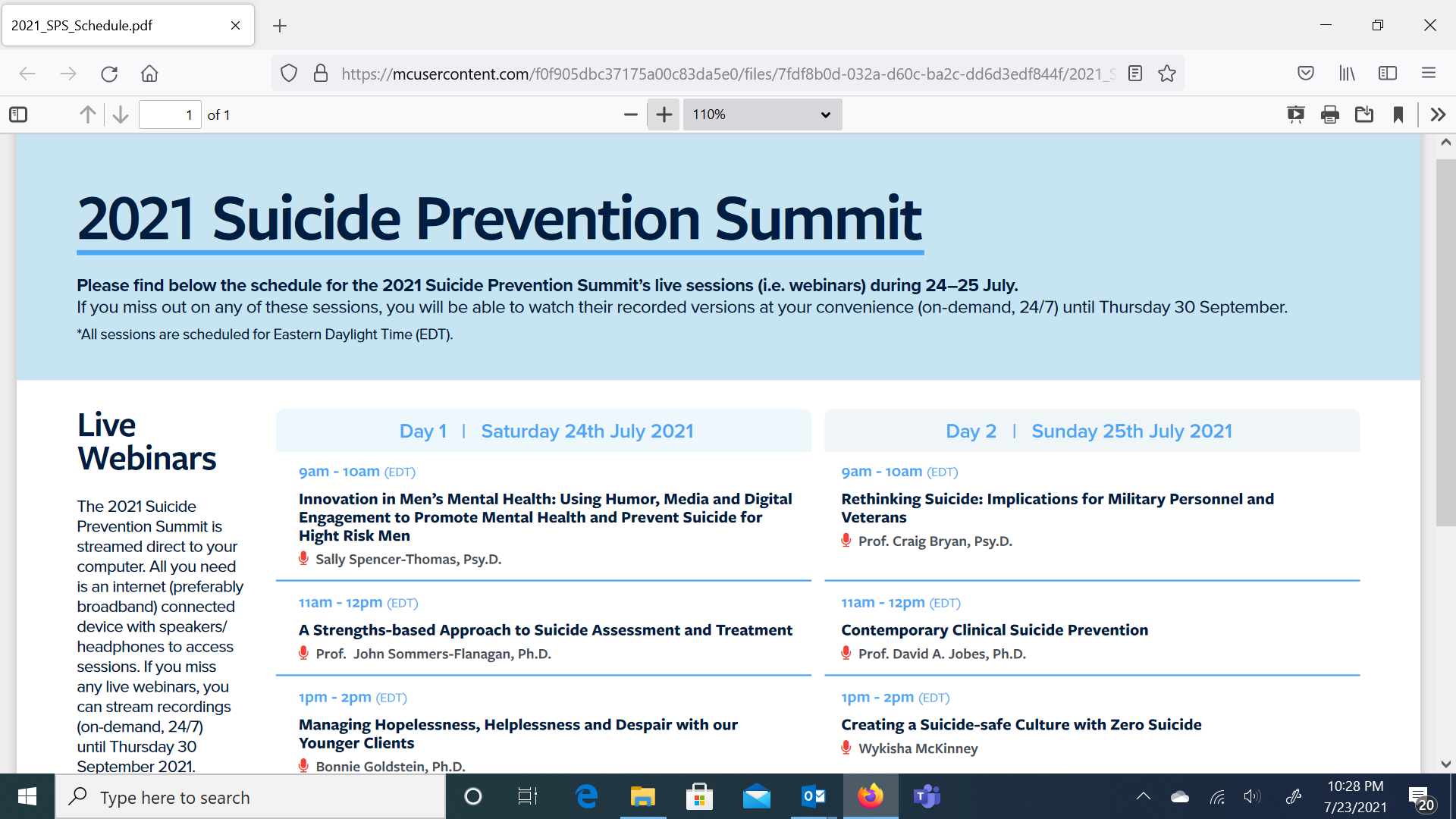
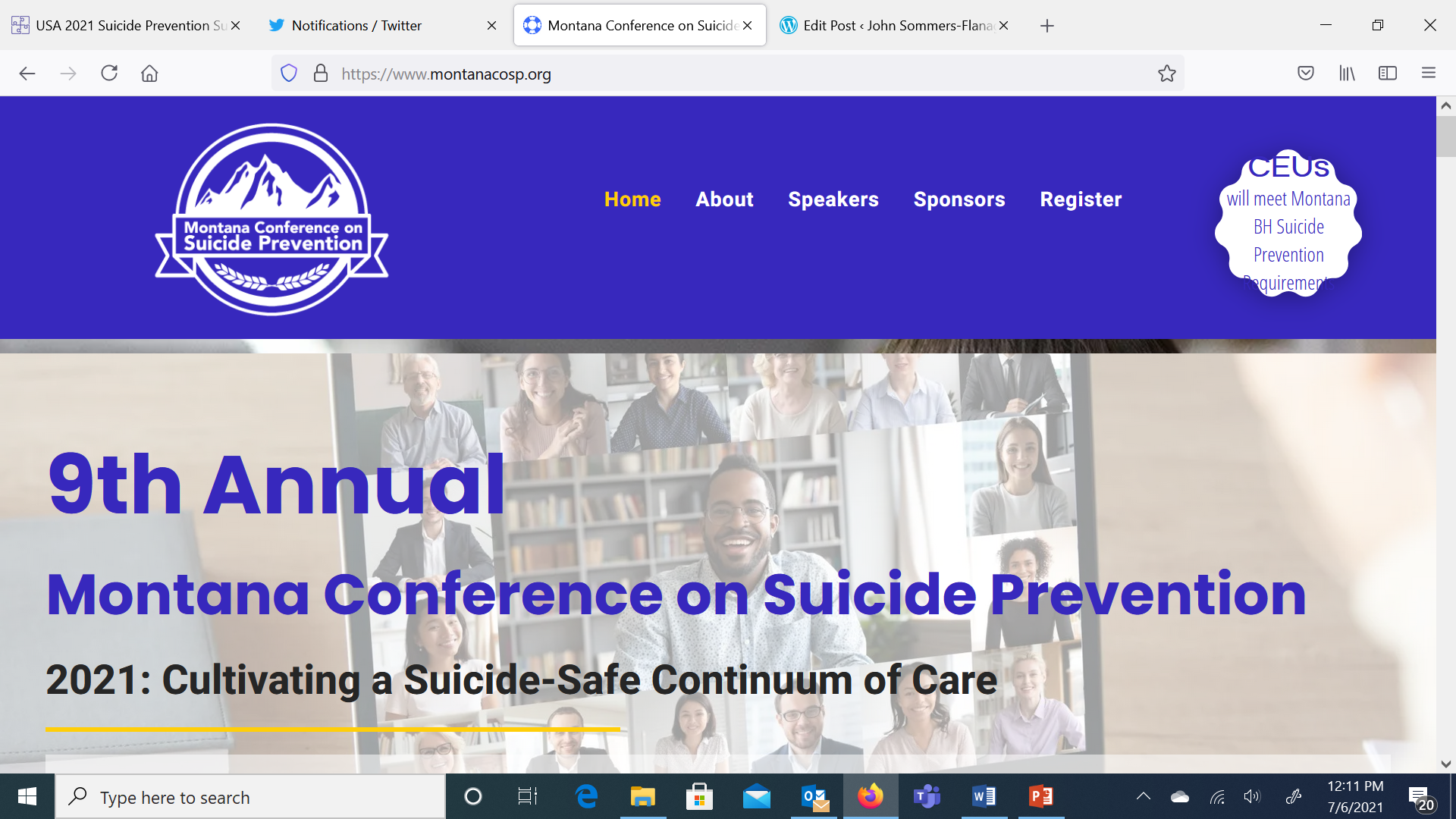
The second of two consecutive suicide prevention conferences with free CEUs is tomorrow! Just in case you didn’t know, this conference, the Montana Conference on Suicide Prevention, has two full hours of David Jobes–the creator of CAMS–in the afternoon. How often do you get to listen to Dr. Jobes for two hours, for free, and get CEUs? Not often, I suspect.
In related news, I just got an email from the Association for Humanistic Counseling about an upcoming all-day conference on Strengths-Based Suicide Assessment and Treatment (with me presenting!). The date is: 9.24.21. This one has a small fee for CEUs . . . but it’s cheaper if you become an AHC member. Here’s the registration link for that one: https://events.r20.constantcontact.com/register/eventReg?oeidk=a07eibjc7x5afb40bd4&oseq=&c=&ch=
Have a great evening and I hope to “see” you tomorrow at the Montana conference.
Good morning! The 2021 MHA Suicide Summit has started (see below) and I’ll be up in less than an hour.
Sometimes I think the hardest part about doing workshops is writing the workshop blurb. My problem-and maybe it’s just my problem—is that the process of writing workshop blurbs nearly always impairs my judgment. I start out writing like a sensible and rational person, but eventually I decompensate into displaying delusions of grandeur. For the Mental Health Academy Suicide Summit, I completely lost touch with reality and claimed that I would,
Describe strengths-based principles for suicide assessment and treatment
Be able to implement three strengths-based assessment tools (and recognize the limits of risk and protective factor assessment)
Identify suicide drivers (and goals) linked to seven common life dimensions
Describe at least one wellness and mood management positive psychology strategy for patients and practitioners.
Of course, all of this is great, but, here’s the catch. I’m only presenting for 45 minutes!
If anyone out there can help me become more realistic, I would appreciate the input.
In the meantime, here are the ppts for the presentation today.
In this post I’m sharing a link to an article I just had published in Psychotherapy Networker. Although I had hoped it would be the Networker’s “lead article,” instead, they put Shankar Vedantam first? And then a bunch of other people, like David Burns and Martha Manning? Seriously? All jokes aside, the truth is, I’m humbled to be included.
The article—titled “The Myth of Infallibility”—is about my immediate and ongoing emotional reactions to the loss of a client to suicide. I hope the article provides useful information and emotional support for counselors and psychotherapists who have experienced—or will experience—a similar loss.
You can use the following link to bypass the paywall and read the article for free.
Thanks for reading this. Please share the link if you feel so moved. One of my counseling colleagues shared it with all her students, which seemed great to me, mostly because IMHO, we don’t talk much or get formal training on how to cope when or if we have a client who dies by suicide.
Today, I’m especially grateful for all the people in my life who have supported me in one way or another, over so many years.
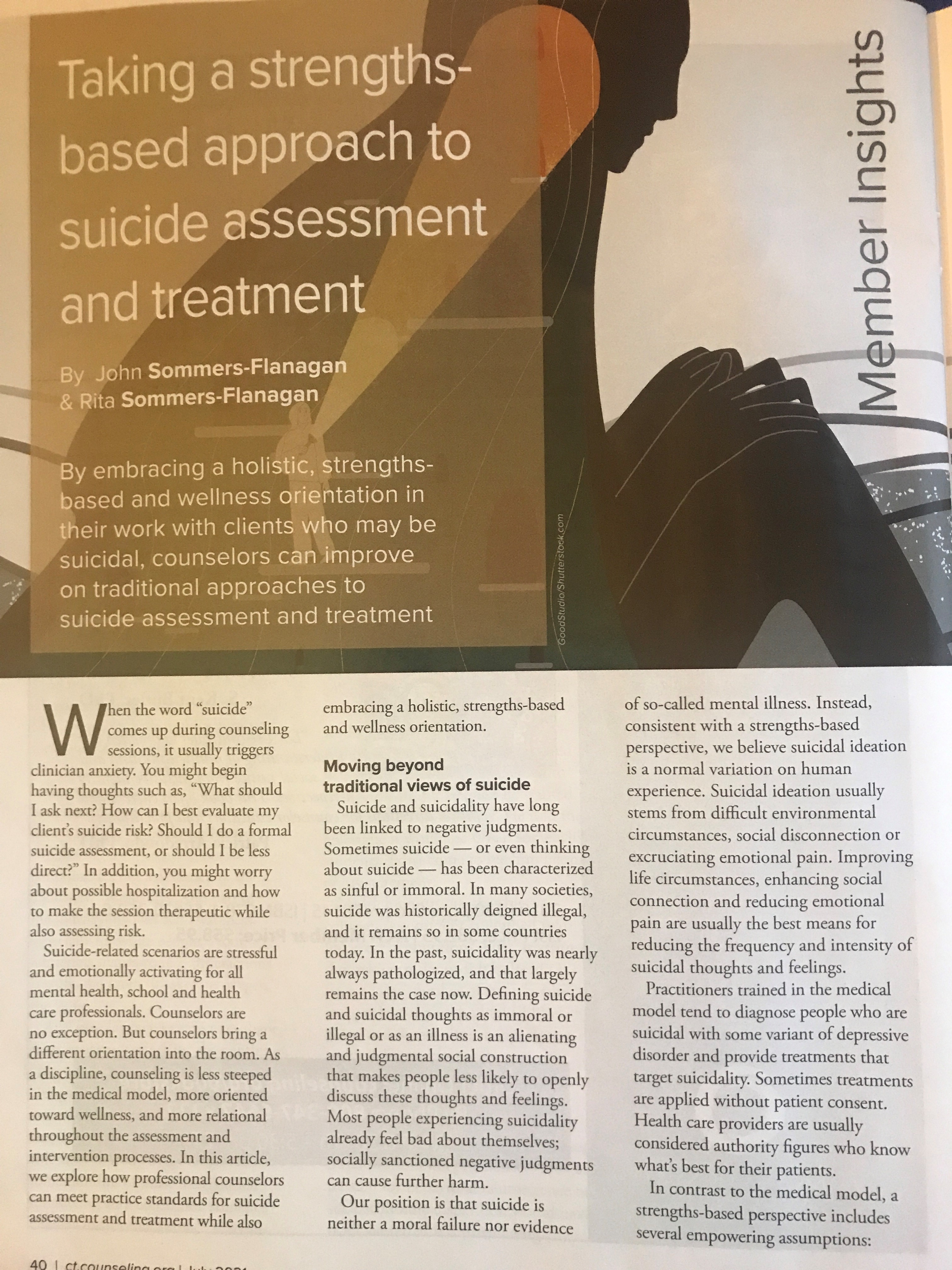
By embracing a holistic, strengths-based and wellness orientation in their work with clients who may be suicidal, counselors can improve on traditional approaches to suicide assessment and treatment
By John and Rita Sommers-Flanagan
When the word “suicide” comes up during counseling sessions, it usually triggers clinician anxiety. You might begin having thoughts such as, “What should I ask next? How can I best evaluate my client’s suicide risk? Should I do a formal suicide assessment, or should I be less direct?” In addition, you might worry about possible hospitalization and how to make the session therapeutic while also assessing risk.
Suicide-related scenarios are stressful and emotionally activating for all mental health, school and health care professionals. Counselors are no exception. But counselors bring a different orientation into the room. As a discipline, counseling is less steeped in the medical model, more oriented toward wellness, and more relational throughout the assessment and intervention processes. In this article, we explore how professional counselors can meet practice standards for suicide assessment and treatment while also embracing a holistic, strengths-based and wellness orientation.
Moving beyond traditional views of suicide
Suicide and suicidality have long been linked to negative judgments. Sometimes suicide — or even thinking about suicide — has been characterized as sinful or immoral. In many societies, suicide was historically deigned illegal, and it remains so in some countries today. In the past, suicidality was nearly always pathologized, and that largely remains the case now. Defining suicide and suicidal thoughts as immoral, illegal or as an illness is an alienating and judgmental social construction that makes people less likely to openly discuss these thoughts and feelings. Most people experiencing suicidality already feel bad about themselves;socially sanctioned negative judgments can cause further harm.
Our position is that suicide is neither a moral failure nor evidence of so-called mental illness. Instead, consistent with a strengths-based perspective, we believe that suicidal ideation is a normal variation on human experience. Suicidal ideation usually stems from difficult environmental circumstances, social disconnection or excruciating emotional pain. Improving life circumstances, enhancing social connection and reducing emotional pain are usually the best means for reducing the frequency and intensity of suicidal thoughts and feelings.
Practitioners trained in the medical model tend to diagnose people who are suicidal with some variant of depressive disorder and provide treatments that target suicidality. Sometimes treatments are applied without patient consent. Health care providers are usually considered authority figures who know what’s best for their patients.
In contrast to the medical model, a strengths-based perspective includes several empowering assumptions:
• When painful psychological distress escalates, strengths-based counselors view the emergence of suicidal ideation as a normal and natural human response. Suicidal ideation is a reaction to life circumstances and may represent a method for coping with relentless psychological pain.
• Because suicidal ideation is viewed as a normal response to psychological pain, client disclosures of suicidality are framed as expressions of distress, rather than evidence of illness. Consequently, if clients disclose suicidality, counselors don’t react with fear and judgment, but instead welcome suicide-related disclosures. Strengths-based counselors recognize that when clients openly share suicidal thoughts, they are showing trust, thus creating opportunities for interpersonal and emotional connection.
• Many people who are suicidal want to preserve their right to die by suicide. If they feel judged by health care or school professionals and coerced to receive treatment, they may shut down and resist. Instead of insisting that clients and students “need treatment,” strengths-based counselors recognize that clients are the best experts on their own lived experiences. Strengths-based counselors provide empathic, collaborative assessment and treatment when clients and students who are suicidal.
• Instead of relying on mental health diagnoses or asking symptom-based questions from a standard form such as the Patient Health Questionnaire-9, strengths-based counselors weave in assessment questions and observations pertaining to client strengths, hope and coping resources. Using principles of solution-focused counseling and positive psychology, strengths-based counselors balance symptom questions with wellness-oriented content.
We believe these preceding assumptions can be woven into counseling in ways that improve traditional suicide assessment and treatment approaches. In fact, over the past two decades, evidence-based treatments for suicide, such as collaborative assessment and management of suicide, have increasingly emphasized empathy, normalization of suicidality and counselor-client collaboration. An objectivist philosophy and medical attitude is no longer required to work with clients or students who are suicidal. Newer approaches, including the strengths-based approach discussed here, flow from postmodern, social constructionist philosophy in which conversation and collaboration are fundamental to decreasing distress and increasing hope.
A holistic approach
When clients disclose suicidal ideation, it’s not unusual for counselors to overfocus on assessment. In reaction to suicidality, counselors may begin asking too many closed questions about the presence or absence of suicide risk and protective factors. This shift away from an empathic focus on what’s hurting and toward analytic assessment protocols is unwarranted for two primary reasons. First, based on a meta-analysis of 50 years of risk and protective factors studies, a research group from Vanderbilt, Harvard and Columbia universities concluded that no factors provide much statistical advantage over chance suicide predictions. In other words, even if mental health or school professionals conduct an extensive assessment of client risk and protective factors, that assessment is unlikely to offer clinical or predictive value. Second, focusing too much on suicide risk assessment usually detracts from important relationship-building interactions that are necessary for positive counseling outcomes.
Instead of overemphasizing risk factor assessment, counselors should identify client distress and respond empathically. Recognizing and responding supportively to emotional pain and distress will help individualize your understanding of the client’s unique risk and protective factors. From a practical perspective, rather than using a generic risk factor checklist, counselors are better off directly asking clients questions such as, “What’s happening that makes you feel suicidal?” and “What one thing, if it changed, would take away your suicidal feelings?”
Additionally, as strengths-based practitioners, we should be scanning for, identifying and providing clients feedback on their unique positive qualities. Statements such as “Thank you so much for being brave enough to tell me about your suicidal thoughts” communicate acceptance and a reflection of client strengths. Although counselors may work in settings that use traditional suicide risk assessment protocols, they can still complement that procedure with a more holistic, positive and interpersonally supportive assessment and treatment planning process.
To help counselors tend to the whole person — instead of overfocusing on suicidality — we recommend using a dimensional assessment and treatment model. Our particular dimensional model tracks and organizes client distress into seven categories. Here, we describe each dimension, offer examples of how distress manifests differently within each dimension, and identify evidence-based or theoretically robust interventions that address dimension-specific distress.
The emotional dimension: Clients who are suicidal often experience agonizing levels of sadness, anxiety, guilt, shame, anger and other painful emotions. Other times, clients feel numb or emotionally drained. Focusing on and showing empathy for core emotional distress or numbness is foundational to working with these clients. Clients also may experience emotional dysregulation. Interventions to address emotional issues in counseling include traditional cognitive behavioral therapies for depression and anxiety, existential exploration of the meaning of emotions, and dialectical behavior therapy to aid clients in emotional regulation skill development.
The cognitive dimension: Humans often react to emotional pain with maladaptive cognitions that further increase their distress. Hopelessness, problem-solving impairments and core negative beliefs are linked to suicide. Depending upon each client’s unique cognitive symptoms and distress, strengths-based counselors will begin by responding with empathy and then, if needed, work with hopelessness in the here and now as it emerges in session. Counselors also may initiate problem-solving strategies, emphasize solution-focused exceptions and teach clients how to notice, track and modify maladaptive thoughts.
The interpersonal dimension: Substantial research points to social and interpersonal difficulties as factors that drive people toward suicide. Common interpersonal themes that trigger suicidal distress include social disconnection, interpersonal grief and loss, social skills deficits, and repetitive dysfunctional relationship patterns. Interventions in the interpersonal dimension include couple or family counseling, grief counseling, social skills training, and other strategies for enhancing social and romantic relationships.
The physical dimension: Physical symptoms trigger and exacerbate suicidal states. Common physical symptoms linked to suicide include agitation/arousal, physical illness, physical symptoms related to trauma, and insomnia. Using a strengths-based model, counselors can collaboratively develop treatment plans that directly address physical symptoms. Specific interventions include physical exercise, evidence-based trauma treatments, and cognitive behavior therapy for insomnia.
The cultural-spiritual dimension: Cultural practices and beliefs alleviate or contribute to client distress and suicidality. Religion, spirituality and a sense of purpose or meaning (or a lack thereof) powerfully mediate suicidality. Specific cultural-spiritual themes that trigger distress include disconnection from a community, higher power or faith system. A sense of meaninglessness or acculturative distress may also be present. Strengths-oriented counselors explore the cultural-spiritual and existential issues present in clients’ lives and develop individualized approaches to addressing these deeply personal sources of distress and potential sources of support or relief.
The behavioral dimension: Clients and students sometimes engage in specific behaviors that increase suicide risk. These may include alcohol/drug use, impulsivity and repeated self-injury. Having easy access to guns or other lethal means is another factor that increases risk. Helping clients recognize destructive behavior patterns, develop alternative coping behaviors and decrease their access to lethal means can be central to a holistic treatment plan. Additionally, collaborative safety planning is an evidence-based suicide intervention that focuses on positive coping behaviors.
Contextual dimension: Many larger contextual, environmental or situational factors contribute to distress in the other six dimensions and thus heighten suicidality. These factors include poverty, neighborhood or relationship safety, racism, sexual harassment and unemployment. Helping clients recognize and change contextual life factors — if they have control over those factors — can be very empowering. Clients also need support coping with uncontrollable stressors. Developing an action plan and discerning when to use mindful acceptance may be an important part of the counseling process. Advocacy can be particularly useful for supporting clients as they face systemic barriers and oppression.
Suicide competencies
Regardless of theoretical orientation or professional discipline, mental health and school professionals must meet or exceed foundational competency standards. In this article, we recommend integrating strengths-based principles, holistic assessment and treatment planning, and wellness activities into your work with individuals who are suicidal. Our recommendation isn’t intended to completely replace traditional suicide-related practices, but rather to add strengths-based skills and holistic case formulation to your counseling repertoire.
When adding a strengths-based perspective into your counseling repertoire, it is critical to remain cognizant of the usual and customary professional standards for working with suicide. The American Counseling Association’s current ethics code doesn’t provide specific guidance for suicide assessment and treatment. However, suicide-related competencies are available in the professional literature. For example, Robert Cramer of the University of North Carolina Charlotte distilled 10 essential suicide competencies from several different health care and mental health publications, including guidelines from the American Association of Suicidology.
Cramer’s 10 suicide competencies are listed below, along with short statements describing how strengths-based counselors can address each competency.
1) Be aware of and manage your attitude and reactions to suicide. Strengths-based counselors strive for individual, cultural, interpersonal and spiritual self-awareness. Self-care also helps counselors stay balanced in their emotional responses to clients who are suicidal.
2) Develop and maintain a collaborative, empathic stance with clients. Strengths-based counselors are relational, collaborative and empathic, while also consistently orienting toward clients’ strengths and resources.
3) Know and elicit evidence-based risk and protective factors. Strengths-based counselors understand how to individualize risk and protective factors to fit each client’s unique risk and protective dynamics.
4) Focus on the current plan and intent of suicidal ideation. Strengths-based counselors not only explore client plans and intentions but also actively engage in conversations about alternatives to suicide plans and ask clients about individual factors that reduce intent.
5) Determine the level of risk. Strengths-based counselors engage clients to obtain information about self-perceived risk and collaborate with clients to better understand factors that increase or decrease individual risk.
6) Develop and enact a collaborative evidence-based treatment plan. Strengths-based counselors engage clients in establishing an individualized safety plan that includes positive coping behaviors and collaboratively develop holistic treatment plans that address emotional, cognitive, interpersonal, cultural-spiritual, physical, behavioral and contextual life dimensions.
7) Notify and involve other people. Strengths-based counselors recognize the core importance of interpersonal connection to suicide prevention and involve significant others for safety and treatment purposes.
8) Document risk assessment, the treatment plan and the rationale for clinical decisions. Strengths-based counselors follow accepted practices for documenting their assessment, treatment and decision-making protocols.
9) Know the law concerning suicide. Strengths-based counselors are aware of local and national ethical and legal considerations when working with clients who are suicidal.
10) Engage in debriefing and self-care. Strengths-based counselors regularly consult with colleagues and supervisors and engage in suicide postvention as needed.
The strengths-based approach in action
Liam was a 20-year-old cisgender, heterosexual male with a biracial (white and Latino) cultural identity. At the time of the referral, Liam had just started a vocational training program in the diesel mechanics trade through a local community college. He was referred to counseling by his trade instructor. About a week previously, Liam had experienced a relationship breakup. Subsequently, he punched a wall while in class (breaking one of his fingers), talked about killing himself, threatened his former girlfriend’s new boyfriend, and impulsively walked off the job at his internship placement.
Liam started his first session by bragging about punching the wall. He stated, “I don’t need counseling. I know how to take care of myself.”
Rather than countering Liam’s opening comments, the counselor maintained a positive and accepting stance, saying, “You might be right. Counseling isn’t for everyone. You look like you’re quite good at taking care of yourself.”
Liam shrugged and asked, “What am I supposed to talk about in here anyway?”
Many clients who are feeling suicidal immediately begin talking about their distress. Others, like Liam, deny suicidality. When clients lead with distress, the counselor’s first task is to empathically explore the distress and highlight unique factors in the client’s life that trigger suicidal thoughts and impulses. In contrast, with Liam, the counselor mirrored Liam’s opening attitude, accepted Liam’s explanation and explicitly focused on Liam’s strengths: his employment goals, his initiative to start vocational training immediately after graduating high school, his ability to care deeply for others (such as his ex-girlfriend), and his pride at being physically fit.
After about 15 minutes, the conversation shifted to how Liam made decisions in his life. Instead of questioning Liam’s judgment, the counselor continued a positive focus, saying, “As I think about your situation, in some ways, hitting the wall was a good idea. It’s definitely better than hitting a person.” The counselor then added, “I don’t blame you for being pissed off about breaking up. Nobody likes a breakup.”
The counselor asked Liam to tell the story of his relationship and the events leading to the breakup. Liam was able to talk about his sense of betrayal and loneliness and his underlying worries that he’d never accomplish anything in life. He admitted to occasional thoughts of “doing something stupid, like offing myself.” He agreed to continue with counseling, mostly because it would look good to his vocational training instructor. Before the session ended, the counselor explained that counselors always need to do a thing called “a safety plan.” During safety planning, Liam admitted to owning two firearms, and even though he “didn’t need to,” he agreed to store his guns at his mom’s house for the next month.
After the first session, the counselor documented the assessment, the intervention and Liam’s treatment plan. The counselor’s documentation included problems and strengths, organized with the holistic dimensional model:
1) Emotional: Liam experienced acute emotional distress and emerging suicidal ideation related to a relationship breakup. Although he minimized his distress, Liam also was able to articulate feelings of betrayal and loneliness.
2) Cognitive: Liam felt hopeless about finding another girlfriend. He was somewhat evasive when asked about suicidal ideation. Eventually, he acknowledged thinking about it and that if he ever decided to die (which he said he “wouldn’t”), he would shoot himself. Liam was able to participate in problem-solving during the session.
3) Interpersonal: Although Liam was distressed about the breakup of his romantic relationship, he agreed to consult with his counselor about relationships during future sessions. He collaboratively brainstormed positive and supportive people to contact in case he began feeling lonely or suicidal. Liam reported a positive relationship with his mother.
4) Physical: Liam reported difficulty sleeping. He said, “I’ve been drinking more than I need to.” During safety planning, Liam agreed to specific steps for dealing with his insomnia and alcohol consumption. Liam was in good physical shape and was invested in his physical well-being.
5) Cultural-spiritual: Liam said that “it won’t hurt me any” to attend church with his mom on Sundays. He reported a good relationship with his mother. He said that going to church with her was something she enjoyed and something he felt good about.
6) Behavioral: Liam contributed to writing up his safety plan. He agreed to follow the plan and take good care of himself over the coming week. Liam identified specific behavioral alternatives to drinking alcohol and suicidal actions. He agreed to store his firearms at his mother’s home.
7) Contextual: Other than high unemployment rates in his community, Liam didn’t report problems in the contextual dimension. He said that he currently had an apartment and believed he had a good employment future.
Concluding comments
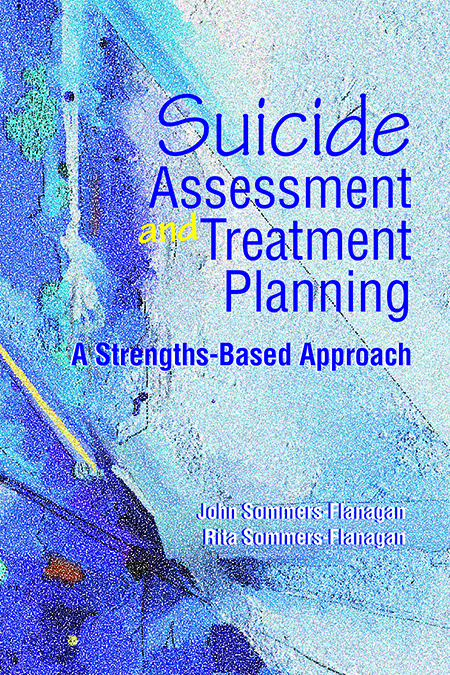
A holistic, strengths-based and wellness-oriented model for working with clients and students who are suicidal is a good fit for the counseling profession. In tandem with knowledge and expertise in traditional suicide assessment and treatments, the strengths-based model provides a foundation for suicide assessment and treatment planning. A detailed description of the strengths-based model is available in our book, Suicide Assessment and Treatment Planning: A Strengths-Based Approach, which was published earlier this year by the American Counseling Association.
BIO BOX
John Sommers-Flanagan is professor of counseling at the University of Montana with over 100 professional publications, including Clinical Interviewing, Suicide Assessment and Treatment Planning, and seven other books coauthored with Rita. You can contact him via email (john.sf@mso.umt.edu) or through his blog, where you can also access free counseling-related resources (https://johnsommersflanagan.com/)
Rita Sommers-Flanagan is professor emerita of counseling at the University of Montana. After retiring, Rita has shifted her interests toward suicide prevention, positive psychology, creative writing and passive solar design. She blogs at: https://godcomesby.com/author/ritasf13/ and her email address is rita.sf@mso.umt.edu.
Counseling Today reviews unsolicited articles written by American Counseling Association members. To access writing guidelines and tips for having an article accepted for publication, visit ct.counseling.org/feedback.
For those of you interested in gathering FREE professional continuing education hours AND because I’m terrible at updating my blog upcoming events calendar, here’s a quick preview of two talks I’m giving later this month.
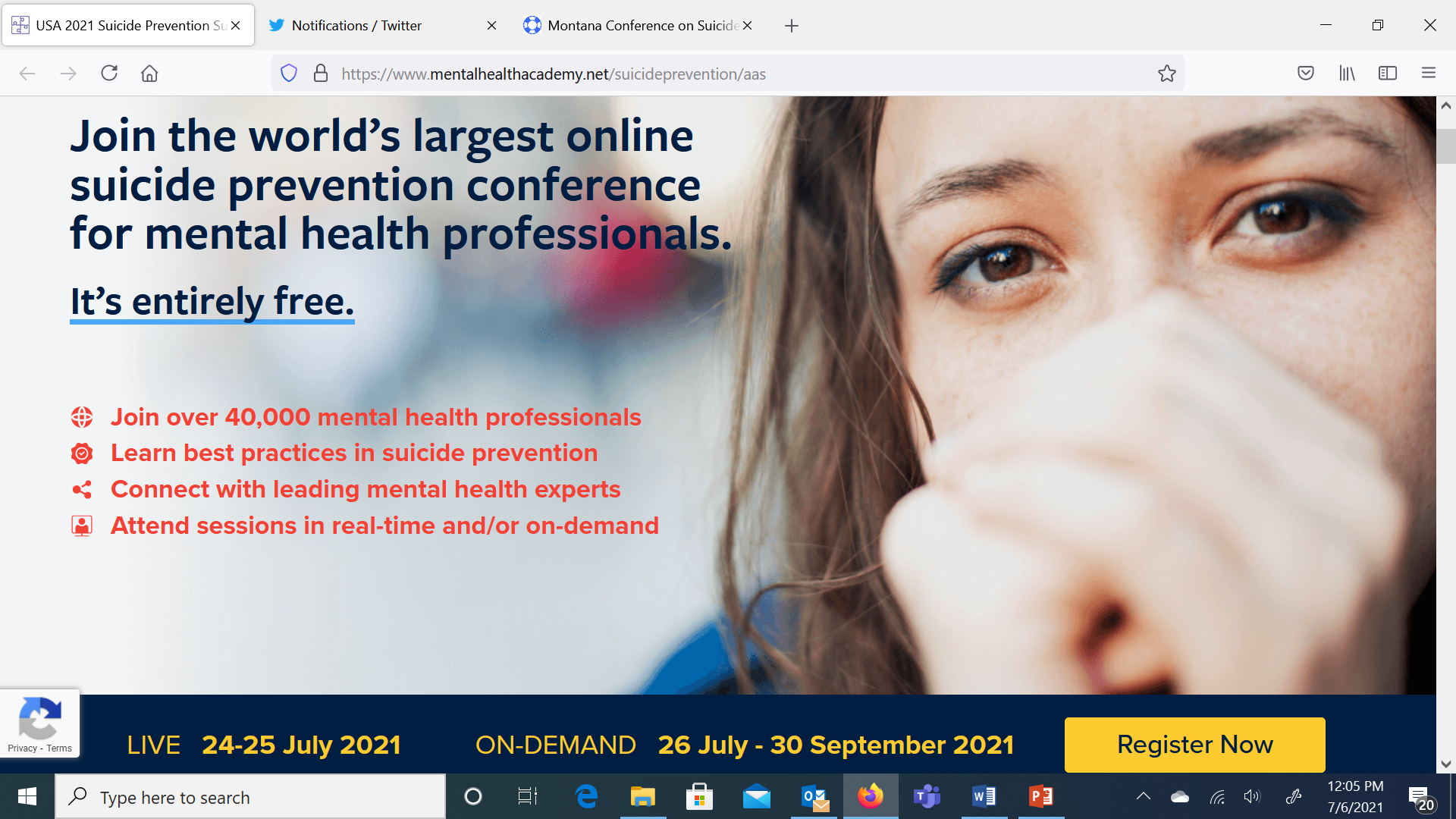
On Saturday, July 24, I’ll be doing an hour-long live, online presentation and Q & A for the Mental Health Academy’s 2021 Suicide Prevention Summit. The cool thing (among many cool things) about this summit is that it’s completely free. . . and you can get up to 10 CEUs. You can tune in live, or register and then watch recorded versions of the presentations (that’s what I did last year and getting my 10 CEUs was smooth as butter). You can learn more about the event and how to register here: https://www.mentalhealthacademy.net/suicideprevention/aas
On Friday, July 30, I’m providing a short (30 minute) presentation on the Montana Happiness Project and strengths-based approaches, and then participating on a panel for the 9th Annual Montana Conference on Suicide Prevention. As with the Mental Health Academy Summit, this event is free, although you must register in advance. For information on speakers, registration, and the conference schedule, click on this link: https://www.montanacosp.org/
Let me know if you have questions and I hope you’re staying as safe and as cool as you can . . .
Here’s a glimpse of what the garden looks like this morning.
In most of life, most of the time, there’s not much completely new or original. People tend to gather inspiration from others and build on or rediscover old ideas. This my way of acknowledging that, although I wish I always had a boatload of original ideas to share in the blog, more often than not, I’m embracing the green new deal and . . . re-using, recycling, and repurposing old ideas.
The following Table describes the seven dimension model that Rita and I use to aid clinicians in conducting assessments and interventions with clients or patients who are suicidal. These seven dimensions aren’t original, but the idea that suicide drivers (and risk/protective factors) can emerge and influence people from any or all of these dimensions is helpful in a more or less original way. Check out the Table to see if it’s useful for you.
Dimension:In this column, we define the dimensions
Evidence-Based Suicide Drivers: In this column, we identify risk factors or suicide drivers that can push or pull individuals toward suicidality. The key to this model is to identify and treat the main sources of distress (aka psychache). In the next columns (not included here), you would find wellness goals and specific interventions.
Emotional: all human emotions.
Excruciating emotional distress
Specific disturbing emotions (guilt, shame, anger, sadness)
Emotional dysregulation
Cognitive: All forms of human thought, including imagery.
Hopelessness
Problem-solving impairments
Maladaptive thoughts
Negative core beliefs
Interpersonal: All human relationships.
Social disconnection and perceived burdensomeness
Interpersonal loss and grief
Social skill deficits
Repeating dysfunctional relationship patterns
Physical: All human biogenetics and physiology.
Biogenetic predispositions and physical illness
Sedentary lifestyle; poor nutrition
Agitation, arousal, anxiety
Trauma, nightmares, insomnia
Spiritual-Cultural: All religious, spiritual, cultural values that provide meaning and purpose.
Religious or spiritual disconnection
Cultural disconnection or dislocation
Meaninglessness
Behavioral: All human action and activity.
Using substances or self-harm for desensitization
Suicide planning, intent, and preparation
Impulsivity
Contextual: All factors outside of the individual that influence human behavior.
No connection to place or nature
Chronic exposure to unhealthy environmental conditions
Socioeconomic oppression or resource scarcity (e.g., poverty)
You may have a form to screen clients for a trauma history. However, more often than not, you’ll need to ask directly about trauma, just like you need to ask directly about suicidality. In many cases, as discussed in Chapter 3, it may be beneficial to wait and ask about trauma until the second or third session, or until there’s a logical opportunity. Although insomnia and nightmares don’t always signal trauma, when they co-exist, they provide an avenue to ask about trauma.
Counselor: Miguel, I’d like to ask a personal question. Would that be okay?
Miguel: Okay.
Counselor: Almost always, when people have nightmares about guns and death, it means they’ve been through some bad, traumatic experiences. When you’ve been through something bad or terrible, nightmares get stuck in your head and get on a sort of repeating cycle. Is that true for you?
Miguel: Yeah. I went through some bad shit back in Denver.
Counselor: I’m guessing that bad shit is stuck in your brain and one ways it comes out is through nightmares.
Miguel: Yeah. Probably.
Even when clients know their trauma experiences are causing their nightmares, they can still be reluctant to talk about the details. Physical and emotional discomfort associated with trauma is something clients often want to avoid. To reassure clients, you can tell them about specific evidence-based approaches—approaches that don’t require detailed recounting of trauma or nightmare experiences. Two examples include eye movement desensitization reprocessing (EMDR; Shapiro, 2001) and imagery rehearsal therapy (Krakow & Zadra, 2010).
Miguel: If I talk about the nightmares, they get more real. I have enough trouble keeping them out of my head now.
Counselor: That’s a good point. But right now your dreams are so bad that you’re barely sleeping. It’s worth trying to work through them. How about this? I’ve got a simple protocol for working with nightmares. You don’t even have to talk about the details of your nightmares. I think we should try it and watch to see if your dreams get better, worse, or stay the same? What do you think?
Miguel: I guess maybe my nightmares can’t get much worse.
Evidence-Based Trauma Treatments
In Miguel’s case, the first step was to get him to talk about his insomnia, nightmares, and trauma. Without details about his experiences, there was no chance to dig in and start treatment. The scenario with Miguel illustrates one method for getting clients to open up about trauma. Other clinical situations may be different. We’ve had Native American clients who were having dreams (or not having dreams, but wishing for them), and we needed to begin counseling by seeking better understanding of the role and meaning of dreams in their particular tribal culture.
Counselors who work with clients who are suicidal should obtain training for treating insomnia, nightmares, and trauma. Depending on your clients’ age, symptoms, culture, the treatment setting, and your preference, several different evidence-based treatments may be effective for treating trauma. The following bulleted list includes treatments recommended by the American Psychological Association (2017) or the VA/DoD Clinical Practice Guideline Working Group (2017), or both (Watkins et al., 2018).
Cognitive Processing Therapy (Resick et al., 2017).
Trauma-Focused Cognitive Behavioral Treatment (Cohen et al., 2012).
Although the preceding list includes the scientifically supported approaches to treating trauma, you may prefer other approaches, many of which are suitable for treating trauma (e.g., body-centered therapies, narrative exposure therapy for children [KID-NET], etc.).
Specific treatments for insomnia and nightmares are also essential for reducing arousal/agitation. Evidence-based treatments for insomnia and nightmares include:
Cognitive-Behavioral Therapy for Insomnia (CBT-I; Cunningham & Shapiro, 2018).
Targeting trauma symptoms in general, and physical symptoms in particular (e.g., arousal, insomnia, nightmares) can be crucial to your treatment plan. Addressing physical symptoms in your treatment instills hope and provides near-term symptom relief.
What follows is an excerpt from, Suicide Assessment and Treatment Planning: A Strengths-Based Approach (American Counseling Association, 2021). We address insomnia and nightmares in Chapter 7 (the Physical Dimension). This is just a glimpse into the cool content of this book.
Insomnia and nightmares directly contribute to client distress in general and suicidal distress in particular. In this section, we use a case example to illustrate how counselors can begin with a less personal issue (insomnia), use empathy, psychoeducation, and curiosity to track insomnia symptoms, eventually arrive at nightmares, and then inquire about trauma. Focusing first on insomnia, then on nightmares, and later on trauma can help counselors form an alliance with clients who are initially reluctant to talk about death images and trauma experiences.
Focusing on Insomnia
Miguel was a 19-year-old cisgender heterosexual Latino male working on vocational skills at a Job Corps program. He arrived for his first session in dusty work clothes, staring at the counselor through squinted eyes; it was difficult to tell if Miguel was squinting to protect his eyes from masonry dust or to communicate distrust. However, because the client was referred by a physician for insomnia, he also might have just been sleepy.
Counselor: Hey Miguel. Thanks for coming in. The doctor sent me a note. She said you’re having trouble sleeping.
Miguel: Yeah. I don’t sleep.
Counselor: That sucks. Working all day when you’re not sleeping well must be rough.
Miguel: Yeah. But I’m fine. That’s how it is.
To start, Miguel minimizes distress. Whether you’re working with Alzheimer’s patients covering their memory deficits or five-year-olds who get caught lying, minimizing is a common strategy. When clients say, “I’m fine” or “It is what it is” they may be minimizing.
But Miguel was not fine. For many reasons (e.g., pride, shame, or age and ethnicity differences), he was reluctant to open up. However, given Miguel’s history of being in a gang and his estranged relationship with his parents, the expectation that he should quickly trust and confide in a white male adult stranger is not appropriate.
Rather than pursuing anything personal, the counselor communicated empathy and interest in Miguel’s insomnia experiences.
Counselor: Not being able to sleep can make for very long nights. What do you think makes it so hard for you sleep?
Miguel: I don’t know. I just don’t sleep.
When asked directly, Miguel declines to describe his sleep problems. Rather than continue with questioning, the counselor fills the room with words (i.e., psychoeducation). Psychoeducation is a good option because sitting in silence is socially painful and because multicultural experts recommend that counselors speak openly when working with clients from historically oppressed cultural groups (Sue & Sue, 2016). The reasoning goes: If counselors are open and transparent, culturally diverse clients can evaluate their counselor before sharing more about themselves. As Miguel’s counselor talks, Miguel can decide, based on what he hears, whether his counselor is safe, trustworthy, and credible.
Counselor: Miguel, there are three main types of insomnia. There’s initial insomnia—that’s when it takes a long time, maybe an hour or more, to get to sleep. They call that difficulty falling asleep. There’s terminal insomnia—that’s when you fall asleep pretty well and sleep until maybe 3am and then wake up and can’t get back to sleep. They call that early morning awakening. Then there’s intermittent insomnia—that’s like being a light sleeper who wakes up over and over all night. They call that choppy sleep. Which of those fits for you?”
Miguel: I got all three. I can’t get to sleep. I can’t stay asleep. I can’t get back to sleep.
Counselor: That’s sounds terrible. It’s like a triple dose of bad sleep.
As Miguel begins opening up, he says “I haven’t slept in a week.” Although it’s obvious that zero minutes of sleep over a week isn’t accurate, for Miguel, it feels like he hasn’t slept in a week, and that’s what’s important.
Exploring Nightmares
After Miguel yawns, the counselor asks permission to share his thoughts.
Counselor: Miguel, if you don’t mind, I’d like to tell you what I’m thinking. Is that okay?
Miguel: Sure. Fine.
Counselor: When someone says they’re having as much trouble sleeping as you’re having, there are usually two main reasons. The first is nightmares. Have you been having nightmares?
Miguel: Shit yeah. Like every night. When I fall asleep, nightmares start.
Counselor: Okay. Thanks. I’m pretty sure I can help you with nightmares. We can probably make them happen less often and be less bad in just a few meetings.
The counselor’s confidence is based on previous successful experiences, including using a nightmare treatment protocol that has empirical support (Imagery Rehearsal Therapy; Krakow & Zadra, 2010). Although evidence-based treatments aren’t effective for all clients, they can establish credibility and instill hope. Nevertheless, Miguel doesn’t immediately experience hope.
Miguel: Yeah. But these aren’t normal nightmares.
Counselor: What’s been happening?
Miguel: I keep having this dream where I’m sticking a gun in my mouth. People are all around me with their voices and shit telling me, “pull the trigger.” Then I wake up, but I can’t get it out of my head all day? What the hell is that all about?”
Counselor: That’s a great question.
When the counselor says, “That’s a great question,” his goal is to start a discussion about all the reasons why someone (Miguel in this case), might have a “gun in the mouth” dream. If Miguel and his counselor can brainstorm different explanations and possible meanings for the dream images, it’s less likely for Miguel to interpret his dream as a sign that he should die by suicide. What’s important, we tell our clients, is to look at many different possible meanings the unconscious or God or the Great Spirit or the universe or indigestion might be sending to the dreamer. To help clients expand their thinking and loosen up on their conclusions about their dream’s meaning, we’ve used statements like the following:
You may be right. Your dream might be about you dying or killing yourself. But our goal is to listen to the message your brain sent you and be open to what it might mean. It’s perfectly normal to think your dream was about you dying by suicide—but that’s not necessarily true. That’s not the way the brain and dreams usually work. Some counselors use self-disclosure about dreams or nightmares they’ve had themselves. Others offer hypothetical or historical dream examples. Either way, normalizing nightmares helps clients become more comfortable talking about their bad dreams and nightmares.
To be continued . . . NEXT TIME . . . we ask about trauma.
Today I’ve been putting together my powerpoints for the upcoming Nate Chute Foundation workshop. The NCF workshop is on two consecutive Tuesday evenings, starting this coming Tuesday.
While reviewing content for the ppts, I tried to pull all the intervention strategies from my brain, and failed. My excuse is that there are too many possible interventions for my small brain to memorize. As a consequence, I was forced to check out the “Practitioner Guidance and Key Points to Remember” sections at the end of all the intervention chapters. To give you a taste, here’s a photo of the “summary” page at the end of the cognitive chapter.
The Cognitive Dimension – Chapter Summary
Each of these bulleted items represents a potential method or strategy for intervening in the cognitive dimension with clients or students who are experiencing suicidality. I’m looking forward to talking about these strategies at the Nate Chute workshop, but rather than trying to commit them to memory (like Ebbinghaus would have), I’ll be using my powerpoint slides as a memory aid.
In partnership with Montana Pediatrics and the Nate Chute Suicide Prevention Foundation, the Montana Happiness Project is launching its “Geographically Exclusive” strengths-based suicide assessment and treatment planning workshop series. The purpose of this workshop series is to work with mental health and school counselors from specific geographic regions to further develop community-based professional competence in suicide assessment, treatment planning, and intervention. Our goal is to train professionals to provide excellent care to students, clients, and patients who are experiencing suicidality. At the same time, similar to Dr. Marsha Linehan’s dialectical behavior therapy model, we hope to build professional communities that will support one another in facing this challenging and stressful professional activity. We believe that if practitioners within a single community feel more competent AND more supported, they’ll be able to be more effective, more available, and better able to handle the stress associated with suicide assessment and intervention work.
Our first geographically exclusive workshop is scheduled for two consecutive Tuesday evenings: April 13 and 20 from 4:15pm-7:15pm. Here’s the description:
Interested in learning a new approach to suicide assessment and treatment? John Sommers-Flanagan, professor of counseling at the University of Montana, will be leading an innovative professional development opportunity on strengths-based suicide prevention.
Founded on current research and national best-practices, this workshop will help you: Understand the limits of suicide risk factor assessment
Use creative approaches to connect with distressed clients, while collecting useful assessment information
Respond compassionately and effectively to client hopelessness, irritability, passive suicidality, and more
Initiate collaborative safety and treatment planning protocols
If you’re interested in hosting a geographically exclusive suicide workshop in your region (via Zoom or in-person), please email me at john.sf@mso.umt.edu
The place to click if you want to learn about psychotherapy, counseling, or whatever John SF is thinking about.