
Today I’m spending all day with the Youth Homes staff in Missoula . . . talking about strengths-based approaches to suicide. Should be fun, or at least as fun as a day of talking about suicide can be . . . Happy Friday, and here are the ppts!
Tag Archives: suicide
2/22/22: A Penchant for Redundancy: My Re-description of Four Suicide Myths

Back in the days when video recording involved film rather than digits, editors would talk about leaving excellent footage “on the floor.” How do I know this? I was alive back in the day.
Today I’ve been working on revising a continuing education “course” for ContinuingEdCourses.net. The course has been popular and so the ContinuingEdCourses.net owners asked for a revision. I stalled until they recognized my stalling for what it was essentially told me I was overdue and late, which made me decide it would feel better to finish the revision than it would to keep procrastinating. I’m guessing maybe others of you out there can relate to that particular moment in time.
While editing and revising I discovered (actually I rediscovered) my penchant for redundancy. Sometimes that penchant is intentional and other times the penchant is an annoying rediscovery. This paragraph that you’re reading in the here-and-now includes an intentional penchant. The CE course included an unintentional penchant. Are you familiar with the research on the overuse of words? If you repeat a word over and over, after only a few seconds you can become desensitized to the meaning of the word and the word will just sound like a sound. I’m feeling a penchant for that too.
Bottom line: I had to cut some nice content. It ended up on the metaphorical floor, until I picked it up, dusted it off, and put it in this blog. Here you go. . .
Editor’s note [BTW, I’m the editor here, because it’s my blog, so I own all the mistakes, misspellings, and misplaced commas]: Turns out I edited out the other redundant content, but I’m posting this anyway, because it’s still 2/22/22, which happens to be most redundant date of the year. Now, here you go. . .
Four Suicide Myths
The word “myth” has two primary meanings.:
A myth is a traditional or popular story or legend used to explain current cultural beliefs and practices. This definition emphasizes the positive guidance that myths sometimes provide. For example, the Greek myth of Narcissus warns that excessive preoccupation with one’s own beauty can become dangerous. Whether or not someone named Narcissus ever existed is irrelevant; the story tells us that too much self-love may lead to our own downfall.
The word myth is also used to describe an unfounded idea, or false notion. Typically, the false notion gets spread around and, over time, becomes a generally accepted, but inaccurate, popular belief. One contemporary example is the statement, “Lightning never strikes the same place twice.” In fact, lightning can and does strike the same place twice (or more). During an electrical storm, standing on a spot where lightning has already struck, doesn’t make for a good safety strategy.
The statement “We only use 10% of our brains” is another common myth. Although it’s likely that most of us can and should more fully engage our brains, scientific researchers (along with the Mythbusters television show) have shown that much more than 10% of our brains are active most of the time – and probably even when we’re sleeping.
False myths can stick around for much longer than they should; sometimes they stick around despite truckloads of contradictory evidence. As humans, we tend to like easy explanations, especially if we find them personally meaningful or affirming. Never mind if they’re accurate or true.
Historically, myths were passed from individuals to groups and other individuals via word of mouth. Later, print media was used to more efficiently communicate ideas, both factual and mythical. Today we have the internet and instant mythical messaging.
Suicide myths weren’t and aren’t designed to intentionally mislead; mostly (although there are some exceptions) they’re not about pushing a political agenda or selling specific products. Instead, suicide myths are the product of dedicated, well-intended people whose passion for suicide prevention sometimes outpaces their knowledge of suicide-related facts (Bryan, 2022).
Depending on your perspective, your experiences, and your knowledge base, it’s possible that my upcoming list of suicide myths will push your emotional buttons. Maybe you were taught that “suicide is 100% preventable.” Or, maybe you believe that suicidal thoughts or impulses are inherently signs of deviance or a mental disturbance. If so, as I argue against these myths, you might find yourself resisting my perspective. That’s perfectly fine. The ideas that I’m labeling as unhelpful myths have been floating around in the suicide prevention world for a long time; there’s likely emotional and motivational reasons for that. Also, I don’t expect you to immediately agree with everything in this document. However, I hope you’ll give me a chance to make the case against these myths, mostly because I believe that hanging onto them is unhelpful to suicide assessment and prevention efforts.
Myth #1: Suicidal thoughts are about death and dying.
Most people assume that suicidal thoughts are about death and dying. Someone has thoughts about death, therefore, the thoughts must literally be about death. But the truth isn’t always how it appears from the surface. The human brain is complex. Thoughts about death may not be about death itself.
Let’s look at a parallel example. Couples who come to counseling often have conflicts about money. One partner likes to spend, while the other is serious about saving. From the surface, you might mistakenly assume that when couples have conflicts about money, the conflicts are about money – dollars, cents, spending, and saving. However, romantic relationships are complex, which is why money conflicts are usually about other issues, like love, power, and control. Nearly always there are underlying dynamics bubbling around that fuel couples’ conflicts over money.
Truth #1: Among suicidologists and psychotherapists, the consensus is clear: suicidal thoughts and impulses are less about death and more about a natural human response to intense emotional and psychological distress (aka psychache or excruciating distress). I use the term “excruciating distress” to describe the intense emotional misery that nearly always accompanies the suicidal state of mind. The take-home message from busting this myth should help you feel relief when clients mention suicide. You can feel relief because when clients trust you enough to share their suicidal thoughts and excruciating distress with you, it gives you a chance to help and support them. In contrast, when clients don’t tell you about their suicidal thoughts, then you’re not able to provide them with the services they deserve. Your holding an attitude that welcomes client openness and their sharing of distress and suicidal thoughts is foundational to effective treatment.
Myth #2: Suicide and suicidal thinking are signs of mental illness.
Philosophers and research scientists agree: nearly everyone on the planet thinks about suicide at one time or another – even if briefly. The philosopher Friedrich Nietzsche referred to suicidal thoughts as a coping strategy, writing, “The thought of suicide is a great consolation: by means of it one gets through many a dark night.” Additionally, the rates of suicidal thinking among high school and college students is so high (estimates of 20%-40% annual incidence) that it’s more appropriate to label suicidal thoughts as common, rather than a sign of deviance or illness.
Edwin Shneidman – the American “Father” of suicidology – denied a relationship between suicide and so-called mental illness in the 1973 Encyclopedia Britannica, stating succinctly:
Suicide is not a disease (although there are those who think so); it is not, in the view of the most detached observers, an immorality (although … it has often been so treated in Western and other cultures).
A recent report from the U.S. Centers for Disease Control (CDC) supports Shneidman’s perspective. The CDC noted that 54% of individuals who died by suicide did not have a documented mental disorder (Stone et al., 2018). Keep in mind that the CDC wasn’t focusing on people who only think about or attempt suicide; their study focused only on individuals who completed suicide. If most individuals who die by suicide don’t have a mental disorder, it’s even more unlikely that people who think about suicide (but don’t act on their thoughts), suffer from a mental disorder. As Wollersheim (1974) used to say, “Having the thought of suicide is not dangerous and is not the problem (p. 223).”
Truth #2: Suicidal thoughts are not – in and of themselves – a sign of illness. Instead, suicidal thoughts arise naturally, especially during times of excruciating distress. The take-home message here is that clinicians should avoid judgment. I know that’s a tough message, because most of us are trained in diagnosing mental disorders and as we begin hearing of signs of depression, emotional lability, or other symptoms, it’s difficult not to begin thinking in terms of psychopathology. However, especially during initial encounters with clients who have suicidal ideation, it’s deeply important for us to avoid labeling – because if clients sense clinicians judging them, it can increase client shame and decrease the chances of them sharing openly.
Myth #3: Scientific knowledge about suicide risk factors and warning signs support accurate allows for the prediction and prevention of suicide.
As discussed previously, mMost suicidologists agree: that Ssuicide is extremelyvery difficult to predict (Franklin et al., 2017).
To get perspective on the magnitude of the problem, imagine you’re at the Neyland football stadium at the University of Tennessee. The stadium is filled with 100,000 fans. Your job is to figure out which 13.54 of the 100,000 fans will die by suicide over the next 365 days.
A good first step would be to ask everyone in the stadium the question that many suicide prevention specialists ask, “Have you been thinking about suicide?” Assuming the usual base rates and assuming that every one of theall 100,000 fans answer you honestly, you might rule out 85,000 people (because they say they haven’t been thinking about suicide). Then you ask them to leave the stadium. Now you’re down to identifying which 13.54 of 15,000 will die by suicide.
For your next step you decide to do a quick screen for the diagnosis of clinical depression. Let’s say you’re highly efficient, taking only 20 minutes to screen and diagnose each of the 15,000 remaining fans. Never mind that it would take 5,000 hours. The result: Only 50% of the 15,000 fans meet the diagnostic criteria for clinical depression.
At this point, you’ve reduced your population to 7,500 University of Tennessee fans, all of whom are depressed and thinking about suicide. How will you accurately identify the 13 or 14 fans who will die by suicide? Mostly, based on mathematics and statistics, you won’t. Every effort to do this in the past has failed. Your best bet might be to provide aggressive pharmacological or psychological treatment for the remaining 7,500 people. If you choose antidepressant medications, you might inadvertently make about 200-250 of your “patients” even more suicidal. If you use psychotherapy, the time you need for effective treatment will be substantial. Either way, many of the fans will refuse treatment, including some of those who will later die by suicide. Further, as the year goes by, you’ll discover that several of the 85,000 fans who denied having suicidal thoughts, and whom you immediately ruled out as low risk, will confound your efforts at prediction and die by suicide.
To gain a broader perspective, imagine there are 3,270 stadiums across the U.S., each with 100,000 people, and each with 13 or 14 individuals who will die by suicide over the next year. All this points to the enormity of the problem. Most professionals who try to predict and prevent suicide realize that, at best, they will help some of the people some of the time.
Truth #3: Although there’s always the chance that future research will enable us to predict suicide, decades of scientific research don’t support suicide as a predictable event. Even if you know all the salient suicide predictors and warning signs, in the vast majority of cases you won’t be able to efficiently predict or prevent suicide attempts or suicide deaths. The take-home message from busting this myth is this: Lower your expectations about accurately categorizing client risk. Most of the research suggests you’ll be wrong (Bryan, 2022; Large & Ryan, 2014). Instead, as you explore risk factors with clients, use your understanding of risk factors as a method for deepening your understanding of the individual client with whom you’re working.
Myth #4: Suicide prevention and intervention should focus on eliminating suicidal thoughts.
Logical analysis implies that if psychotherapists or prevention specialists can get people to stop thinking about suicide, then suicide should be prevented. Why then, do the most knowledgeable psychotherapists in the U.S. advise against directly targeting suicidal thoughts in psychotherapy (Linehan, 1993; Sommers-Flanagan & Shaw, 2017)? The first reason is because most people who think about suicide never make a suicide attempt; that means you’re treating a symptom that isn’t necessarily predictive of the problem. But that’s only the tip of the iceberg.
After his son died by suicide, Rick Warren, a famous pastor and author, created a YouTube video titled, “Rick Warren’s Message for Those Considering Suicide.” The video summary reads,
If you have ever struggled with depression or suicide, Pastor Rick has a message for you. The pain you are experiencing will not last forever. There is hope!
Although over 1,000 viewers clicked on the “thumbs up” sign for the video, there were 535 comments; nearly all of these comments pushed back on Pastor Warren’s well-intended video message. Examples included:
- Are you kidding me??? You’ve clearly never been suicidal or really depressed.
- To say “Suicide is a permanent solution to a temporary problem” is like saying: “You couldn’t possibly have suffered long enough, even if you’ve suffered your entire life from many, many issues.”
- This is extremely disheartening. With all due respect. Pastor, you just don’t get it.
Pastor Rick isn’t alone in not getting it. Most of us don’t really get the excruciating distress, deep self-hatred, and chronic shame linked to suicidal thoughts and impulses. And because we don’t get it, sometimes we slip into try toing rationally persuadesion to encourage individuals with suicidal thoughts to regain hope and embrace life. Unfortunately, a nearly universal phenomenon called “psychological reactance” helps explain why rational persuasion – even when well-intended – rarely makes for an effective intervention (Brehm & Brehm, 1981).
While working with chronically suicidal patients for over two decades, Marsha Linehan of the University of Washington made an important discovery: when psychotherapists try to get their patients to stop thinking about suicide, the opposite usually happens – the patients become more suicidal.
Linehan’s discovery has played out in my clinical practice. Nearly every time I’ve actively pushed clients to stop thinking about suicide – using various psychological ploys and techniques – my efforts have backfired.
Truth #4: Most individuals who struggle with thoughts of suicide resist outside efforts to make them stop thinking about suicide. Using direct persuasion to convince people they should cheer up, have hope, and embrace life is rarely effective. The take-home message associated with busting this myth is that the best approaches to working with clients who are suicidal are collaborative. Instead of taking the role of an esteemed authority who knows what’s best for clients, effective counselors and psychotherapists take a step back and seek to activate their client’s expertise as collaborators onagainst the suicidal problem.
Vid-Podding with Francesca on “Normalize the Conversation”

Apparently, video podcasts are the thing. Or maybe they’ve been a thing for a while. . . or at least since early 2020 and the onset of the Zoom age. I think we should call them vid-pods.
Two weeks ago, I promoted a vid-pod with Paula Fontenelle, Stacey Freedenthal, and me. It was Paula’s vid-pod, titled “Understand Suicide.” Paula is very experienced, very knowledgeable and produces great vid-pods. You can check out all her work, including her podcast (aka vid-pod) at: https://www.understandsuicide.com/
Late last year, Victor Yalom of Psychotherapy.net asked if he could connect me for a possible appearance on a vid-pod called “Normalize the Conversation.” Normalize the Conversation is the brain-child of Francesca Reicherter. Francesca is also the Founder and President of “Inspiring My Generation.” I think Victor wanted me to promote our 7.5-hour marathon Suicide Assessment and Treatment video training series with Psychotherapy.net. . . so here’s the link to that: https://www.psychotherapy.net/videos/expert/john-sommers-flanagan
In contrast to Paula, Stacey, Victor, and me, Francesca is very young. . . and she’s a powerhouse. I’m not sure where she finds the time to do all that she’s doing. She’s 23, but started her mental health advocacy work at age 12. She has published a workbook, founded her own organization, and has over 60 vid-pod episodes online. She’s also a graduate student. You can read more about Francesca here: https://inspiringmygeneration.org/2021/05/28/francesca-reicherter-starting-the-conversation-on-mental-health-conditions/
You can also check out all her vid-pods at: https://podcasts.apple.com/us/podcast/normalize-the-conversation/id1587903841 – The vid-pod with me is from February 2, 2022 and here: https://podcasts.apple.com/us/podcast/what-you-should-know-about-the-clinical-interview/id1587903841?i=1000549745008
Francesca and I did a recording together and she did a bunch of editing and promoting and this past week she sent me some video clips of our time together. What you’ll immediately notice in the video clips is that Francesca is an artist at getting people to talk. Throughout the clips, I’m talking and she’s not. Somehow, she got me to talk for about 47 minutes (although she did some nice summaries and commentary here and there). If my experience is at all representative, I suspect Francesca will be a talented therapist and fabulous listener.
You can check out the vid-pod clips below, but more importantly, check out all the amazing work of Paula, Stacey, Victor, and Francesca . . . all of whom are making the world a place where supportive and quality mental health services are more accessible.
Feeling Happy About (and a little jealous of) Craig Bryan’s New Book, “Rethinking Suicide”

While engaged in a little late-night Twitter scrolling, I came across a fascinating post and thread questioning the utility of suicide screening for low risk populations (e.g., schools). Having been mildly opposed (along with the UK and Canada), to general population suicide screenings, I felt validated, especially upon discovering that Craig Bryan was author of the Twitter thread. Dr. Bryan is one of the best and most authoritative resources on suicide in the world. As of two nights ago, I was only familiar with his professional book with David Rudd (Brief cognitive-behavior therapy for suicide prevention) and his excellent work with military veterans, suicide, and lethal means management. I also knew he had recently published a new book titled, “Rethinking Suicide.”
Then, today, I checked out Rethinking Suicide online. I was gob smacked. It’s fantastic.
This post is mostly to pitch Craig Bryan’s book.
Among other gems, Dr. Bryan frames suicide prevention as a “wicked problem” and tells us about the origin of the term, wicked problem. What’s not to love about that.
Here’s a quote from his introduction: “Consistent with the perspective of suicide as a wicked problem, I will argue in this book that we need to replace our solution-based approach to suicide prevention with a process-based approach focused on creating and building lives worth living” (p. 7). Wow. That’s like music to my ears.
Dr. Bryan also weaves in “confirmation bias” (more music) as part of his critique of using so-called “mental illness” as an explanatory mechanism in suicide (I know if you know me and this blog, you know I don’t even use the term mental illness unless I’m explaining why I don’t use the term mental illness, and so I’m destined to love Dr. Bryan’s deconstruction of that concept).
Anyway, you can find Rethinking Suicide through your favorite online bookseller. I recommend it highly. I’ve ordered my copy. It’s about time we all started rethinking suicide.
How on Earth Could Suicide Rates Go Down Along with the Onset of the Pandemic in 2020?

Last week I got to be part of an amazing conversation with Paula Fontenelle and Stacey Freedenthal. Paula and Stacey are experts in suicide prevention, postvention, and treatment. You can easily find them and some of their great work online using your favorite search engine. They both have books out. Paula’s is: Understanding Suicide and Stacey’s is: Helping the Suicidal Person.
Paula invited Stacey and I onto her podcast (which is also a video production). We all sat in separate rooms in three different states (Oregon, Colorado, and Montana) and talked about, “How on earth” it could be that pandemic-related mental health stress and distress is up (the research says so), and yet suicide rates in 2020 dipped, for the first time in two decades? What a great question!
Between the three of us, we had many answers. That’s good, because death by suicide is always influenced by many factors (in the scientific world, we like to say that suicide is multi-determined). Our answers are speculative, but I think it’s good to be speculative, as long as you admit to the fact that you’re being speculative.
The most fascinating of many fascinating explanations for the recent reduction in suicide rates was our “in real time” discovery that the pandemic relief checks went out in April of 2020. That was important because, year-after-year, the CDC reports that April is nearly ALWAYS the month with the highest suicide rates and in 2020, it was the LOWEST. Why is April always linked to high suicide rates? No one knows for sure, but Paula, Stacey, and I talk about potential explanations for that too. As T. S. Eliot wrote:
“April is the cruelest month, breeding lilacs out of the dead land, mixing memory and desire, stirring dull roots with spring rain.”
If you’re interested in suicide-related phenomena—not everyone is—you should listen or watch Paula’s “Understand Suicide” podcast. You can watch any of the episodes for great info, but for our episode, here are the links.
To watch: https://youtu.be/fPrDdQg7G_E
To listen: https://bit.ly/3KrJILO
Have a great weekend.
Who Wants a Two-Day Professional Workshop on Strengths-Based Suicide Assessment and Treatment?

I’ve got a friend who writes to me in acronyms. TBH is “To be honest.” LMK is “Let me know.” IMHO is “In my humble opinion.” FYI is “For your information.” YSKAT is “You should know about this.”
When I read my friend’s emails, there are always more letters than words, if YKWIM (you know what I mean).
This leads me to my PP (promotional point).
TBH signing up for a two-day SBSASTW (strengths-based suicide assessment and treatment workshop) isn’t everyone’s COT (cup of tea). TAI (think about it). That’s like 13 hours of suicide-related content. If you TAI, it CBYD (could bring you down).
That’s why, we will weave some PDC (pretty damn cool) EBHIs (evidence-based happiness interventions) into our 13 hours. This will be the MFE (most fun ever) two days of suicide training on November 19 and 20. YCBOI (you can bet on it).
But IMHO, woohoo. Really YSKAT. IMHO signing up for a two-day strengths-based suicide assessment and treatment workshop is TRTTD (the right thing to do).
YAMBWing (You also may be wondering), when John writes “we” is he going with the singular “we” or is he indicating there will be other presenters. TBH, John doesn’t know, but he’s hoping to recruit some of the amazing participants from this summer MHP (Montana Happiness Project) retreat to join in on the FUN (fricken unbelievably nice).
OK. I’ve had it with all these letters. And so, if you want to sign up, check out “Session three” on this link: https://www.familiesfirstmt.org/umworkshops.html
If that doesn’t help, send me an email (john.sf@mso.umt.edu) and I’ll see if I can help you figure out how to sign up. Just LMK. The session is also Zoomable.
The ACA Town Hall is Tomorrow
Rita and I get to be the guests for tomorrow’s online ACA Town Hall. The topic for the day is suicide, but more generally, the Town Hall, moderated by ACA President Dr. Kent Becker, is designed to be a community event for ACA members. The suicide discussion will be brief and there will be several other break-out groups in the Zoom format.
To participate, you’ll need to be a member of the American Counseling Association (ACA). As ACA members, you can attend for free, but you need to register in advance. Here’s the link: https://imis.counseling.org/store/events/registration.aspx?event=DOH2021SEP
My apologies for the late notice on this.
I hope everyone is well and thriving as much as possible.
John
Early Birds and Two Upcoming Strengths-Based Suicide Trainings
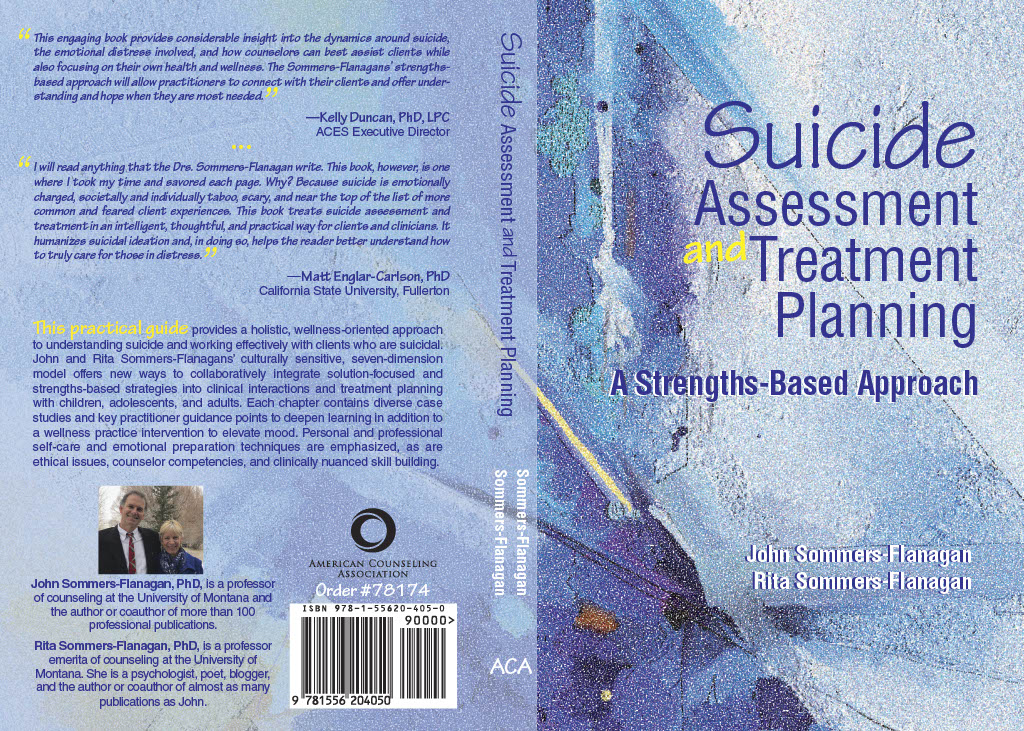
On September 24, I’m doing a full-day online-only Strengths-Based Suicide Assessment and Treatment Planning workshop. The workshop is on behalf of the Association for Humanistic Counselors . . . a cool professional organization if there ever was one.
I’m posting today because today is the last day for the “Early bird rates” for this AHC workshop. Just in case you want to be an early bird, this link will give you that chance . . . at least for a few more hours: https://events.r20.constantcontact.com/register/eventReg?oeidk=a07eibjc7x5afb40bd4&oseq=&c=&ch=&fbclid=IwAR2mwGRA6UgOtrTXBdWlS8ZlQAArlPlQR3LGOZigxdIeyodKcIBtY1yovXs
Just in case you want two-days of Strengths-Based Suicide Training or you want to come to the U of Montana or you need some college credit, we’ve got a full two-day version of the workshop happening in Missoula on November 19 and 20. In addition, if you’re wanting a continuing education smörgåsbord, this link also includes two day trainings with the fabulous Dr. Kirsten Murray (Strong Couples) and the amazing Dr. Bryan Cochran (LGBTQI+ Clients). Here’s that link: https://www.familiesfirstmt.org/umworkshops.html
There’s more happening too . . . but for now, this is probably enough for one post.
Have a fantastic week, and don’t be afraid to be the early bird.
Coping with Suicide Deaths

As most of you know, I recently published an article in Psychotherapy Networker on my long-term experience of coping with the death of a client by suicide. In response to the article, I’ve gotten many supportive responses, some of which included additional published resources on coping with client death by suicide.
This blog post has two parts. First, I’m promoting the Networker article again to get it more widely shared as one resource for counselors and psychotherapists who have lost a client. Below, is an excerpt from the article. . . followed by a link. Please share with friends and colleagues as you see fit.
Second, at the end of this post I’m including additional resource articles that several people have shared with me over the past two weeks.
Here’s the excerpt . . .
The Prevention Myth
I’d worked with Ethan for about 20 sessions. Stocky, socially awkward, and intellectually gifted, he often avoided telling me much of anything, but his unhappiness was palpable. He didn’t fit in with classmates or connect with teachers. Ethan felt like a misfit at home and out of place at school. Nearly always, he experienced the grinding pain of being different, regardless of the context.
But aren’t we all different? Don’t we all suffer grinding pain, at least sometimes? What pushed Ethan to suicide when so many others, with equally difficult life situations and psychodynamics, stay alive?
One truth that reassures me now, and I wish I’d grasped back in the 1990s, is that empirical research generally affirms that suicide is unpredictable. This reality runs counter to much of what we hear from well-meaning suicide-prevention professionals. You may have heard the conventional wisdom: “Suicide is 100 percent preventable!” and, “If you educate yourself about risk factors and warning signs, and ask people directly about suicidal thoughts or plans, you can save lives.”
Although there’s some empirical evidence for these statements (i.e., sometimes suicide is preventable, and sometimes you can save lives), the general idea that knowledge of suicide risk, protective factors, and warning signs will equip clinicians to predict individual suicides is an illusion. In a 2017 large-scale meta-analysis covering 50 years of research on risk and protective factors, Joseph Franklin of Vanderbilt University and nine other prominent suicide researchers conducted an exhaustive analysis of 3,428 empirical studies. They found very little support for risk or protective factors as suicide predictors. In one of many of their sobering conclusions, they wrote, “It may be tempting to interpret some of the small differences across outcomes as having meaningful implications, . . . however, we note here that all risk factors were weak in magnitude and that any differences across outcomes . . . are not likely to be meaningful.”
Franklin and his collaborators were articulating the unpleasant conclusion that we have no good science-based tools for accurately predicting suicide. I hope this changes, but at the moment, I find comfort in the scientific validation of my personal experience. For years, I’ve held onto another suicide quotation for solace. In 1995, renowned suicidologist Robert Litman wrote, “When I am asked why one depressed and suicidal patient dies by suicide while nine other equally depressed and equally suicidal patients do not, I answer, ‘I don’t know.’”
Here’s the link to the full article: https://www.psychotherapynetworker.org/magazine/article/2565/the-myth-of-infallibility
Here are the additional resources people have shared with me:
Ellis, T. E., & Patel, A. B. (2012). Client suicide: what now?. Cognitive and Behavioral Practice, 19(2), 277-287.
Jorgensen, M. F., Bender, S., & McCutchen, A. (2021) “I’m haunted by it:” Experiences of licensed counselors who had a client die by suicide. Journal of Counselor Leadership and Advocacy. DOI: 10.1080/2326716X.2021.1916790
Knox, S., Burkard, A. W., Jackson, J. A., Schaack, A. M., & Hess, S. A. (2006). Therapists-in-training who experience a client suicide: Implications for supervision. Professional Psychology: Research and Practice, 37(5), 547-557.
Ting, L., Jacobson, J. M., & Sanders, S. (2008). Available supports and coping behaviors of mental health social workers following fatal and nonfatal client suicidal behavior. Social work, 53(3), 211-221.
As always, thanks for reading, and have a great day!
Montana Conference on Suicide Prevention — My Powerpoints
Good morning. I’m listening to Dr. David Jobes talk about innovations in approaching suicide assessment and treatment. I’m struck by the breadth and depth of his knowledge . . . and also discouraged by him acknowledging how difficult it is to change people’s mindsets regarding suicidality and its treatment. At this point we ALREADY have many effective psychosocial treatments, but disappointingly, the media and public knowledge still leans toward profiling hospitalization and the potential of medication (both of which show very mixed results).
I’ll stop with my rant here and post my ppts. Thanks for reading . . . and be sure to get the word out on innovations in suicide assessment and treatment (aka psychosocial treatments).

