
Tag Archives: mental health

Here’s a new article published in The Conversation

Happiness class is helping clinically depressed school teachers become emotionally healthy − with a cheery assist from Aristotle

This course is more than just suggesting that you ‘cheer up’ and ‘look on the bright side.’ akinbostanci/E+ via Getty Images

John Sommers-Flanagan, University of Montana

Text saying: Uncommon Courses, from The Conversation

Uncommon Courses is an occasional series from The Conversation U.S. highlighting unconventional approaches to teaching.

Title of Course

Evidence-Based Happiness for Teachers

What prompted the idea for the course?

I was discouraged. For nearly three decades, as a clinical psychologist, I trained mental health professionals on suicide assessment. The work was good but difficult.

All the while, I watched in dismay as U.S. suicide rates relentlessly increased for 20 consecutive years, from 1999 to 2018, followed by a slight dip during the COVID-19 pandemic, and then a rise in 2021 and 2022 – this despite more local, state and national suicide prevention programming than ever.

I consulted my wife, Rita, who also happens to be my favorite clinical psychologist. We decided to explore the science of happiness. Together, we established the Montana Happiness Project and began offering evidence-based happiness workshops to complement our suicide prevention work.

In 2021, the Arthur M. Blank Family Foundation, through the University of Montana, awarded us a US$150,000 grant to support the state’s K-12 public school teachers, counselors and staff. We’re using the funds to offer these educators low-cost, online graduate courses on happiness. In spring 2023, the foundation awarded us another $150,000 so we could extend the program through December 2025.

What does the course explore?

Using the word “happiness” can be off-putting. Sometimes, people associate happiness with recommendations to just smile, cheer up and suppress negative emotions – which can lead to toxic positivity.

As mental health professionals, my wife and I reject that definition. Instead, we embrace Aristotle’s concept of “eudaimonic happiness”: the daily pursuit of meaning, mutually supportive relationships and becoming the best possible version of yourself.

The heart of the course is an academic, personal and experiential exploration of evidence-based positive psychology interventions. These are intentional practices that can improve mood, optimism, relationships and physical wellness and offer a sense of purpose. Examples include gratitude, acts of kindness, savoring, mindfulness, mood music, practicing forgiveness and journaling about your best possible future self.

Students are required to implement at least 10 of 14 positive psychology interventions, and then to talk and write about their experiences on implementing them.

Why is this course relevant now?

Teachers are more distressed than ever before. They’re anxious, depressed and discouraged in ways that adversely affect their ability to teach effectively, which is one reason why so many of them leave the profession after a short period of time. It’s not just the low pay – educators need support, appreciation and coping tools; they also need to know they’re not alone. https://www.youtube.com/embed/ZOGAp9dw8Ac?wmode=transparent&start=0 This exercise helps you focus on what goes right, rather than the things that go wrong.

What’s a critical lesson from the course?

The lesson on sleep is especially powerful for educators. A review of 33 studies from 15 countries reported that 36% to 61% of K-12 teachers suffered from insomnia. Although the rates varied across studies, sleep problems were generally worse when teachers were exposed to classroom violence, had low job satisfaction and were experiencing depressive symptoms.

The sleep lesson includes, along with sleep hygiene strategies, a happiness practice and insomnia intervention called Three Good Things, developed by the renowned positive psychologist Martin Seligman.

I describe the technique, in Seligman’s words: “Write down, for one week, before you go to sleep, three things that went well for you during the day, and then reflect on why they went well.”

Next, I make light of the concept: “I’ve always thought Three Good Things was hokey, simplistic and silly.” I show a video of Seligman saying, “I don’t need to recommend beyond a week, typically … because when you do this, you find you like it so much, most people just keep doing it.” At that point, I roll my eyes and say, “Maybe.”

Then I share that I often awakened for years at 4 a.m. with terribly dark thoughts. Then – funny thing – I tried using Three Good Things in the middle of the night. It wasn’t a perfect solution, but it was a vast improvement over lying helplessly in bed while negative thoughts pummeled me.

The Three Good Things lesson is emblematic of how we encourage teachers in our course – using science, playful cynicism and an open and experimental mindset to apply the evidence-based happiness practices in ways that work for them.

I also encourage students to understand that the strategies I offer are not universally effective. What works for others may not work for them, which is why they should experiment with many different approaches.

What will the course prepare students to do?

The educators leave the course with a written lesson plan they can implement at their school, if they wish. As they deepen their happiness practice, they can also share it with other teachers, their students and their families.

Over the past 16 months, we’ve taught this course to 156 K-12 educators and other school personnel. In a not-yet-published survey that we carried out, more than 30% of the participants scored as clinically depressed prior to starting the class, compared with just under 13% immediately after the class.

This improvement is similar to the results obtained by antidepressant medications and psychotherapy.

The educators also reported overall better health after taking the class. Along with improved sleep, they took fewer sick days, experienced fewer headaches and reported reductions in cold, flu and stomach symptoms.

As resources allow, we plan to tailor these courses to other people with high-stress jobs. Already, we are receiving requests from police officers, health care providers, veterinarians and construction workers.

John Sommers-Flanagan, Clinical Psychologist and Professor of Counseling, University of Montana

This article is republished from The Conversation under a Creative Commons license. Read the original article.

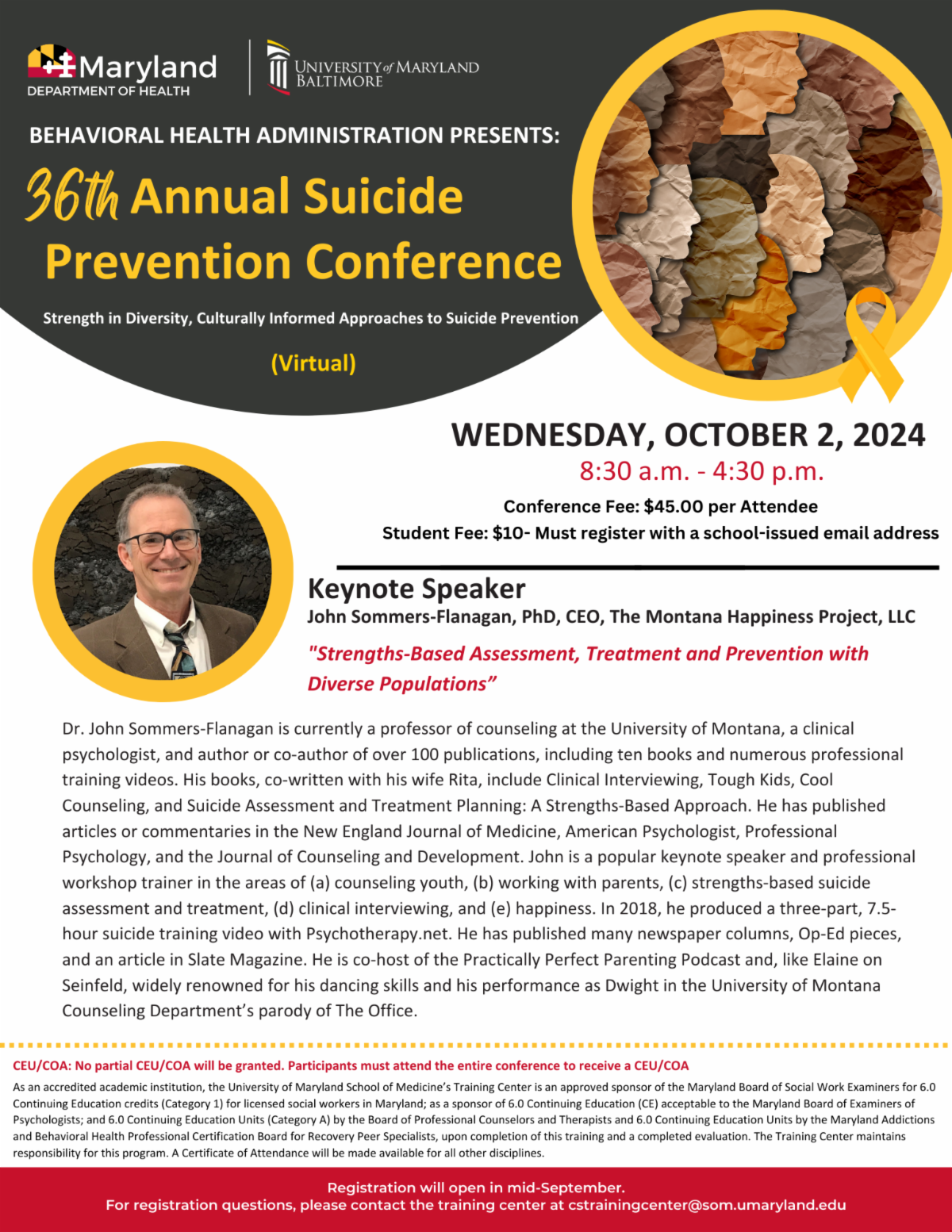
Coming Soon: Maryland’s 36th Annual Suicide Prevention Conference

Why Do We Need a Strengths-Based Approach to Suicide Assessment and Treatment?

Imagine this: You’re living in a world that seems like it would just as soon forget you exist. Maybe your skin color is different than the dominant people who hold power. Maybe you have a disability. Whatever the case, the message you hear from the culture is that you’re not important and not worthy. You feel oppressed, marginalized, unsupported, and as if much of society would just as soon have you become invisible or go away.

In response, you intermittently feel depressed and suicidal. Then, when you enter the office of a health or mental health professional, the professional asks you about depression and suicide. Even if the professional is well-intended, judgment leaks through. If you admit to feeling depressed and having suicidal thoughts, you’ll get a diagnosis that implies you’re to blame for having depressing and suicidal thoughts.  

The medical model overfocuses on trying to determine: “Are you suicidal?” The medical model is also based on the assumption that the presence of suicidality indicates there’s something seriously wrong with you. But if we’re working with someone who has been or is currently being marginalized, a rational response from the patient might be:

“As it turns out, I’ve internalized systemic and intergenerational racism, sexism, ableism, and other dehumanizing messages from society. I’ve been devalued for so long and so often that now, I’ve internalized societal messages: I devalue myself and wonder if life is worth living. And now, you’re blaming me with a label that implies I’m the problem!”

No wonder most people who are feeling suicidal don’t bother telling their health professionals.

When I think of this preceding scenario, I want to add profanity into my response, so I can adequately convey that it’s completely unjust to BLAME patients for absorbing repeated negative messages about people who look like or sound like or act like them. WTH else do you think should happen?

This is why we need to integrate strengths-based principles into traditional suicide assessment and prevention models. Of course, we shouldn’t use strengths-based ideas in ways that are toxically positive. We ALWAYS need to start by coming alongside and feeling with our patients and clients. As it turns out, if we do a good job of coming alongside patients/clients who are in emotional pain, natural opportunities for focus on strengths and resources, including cultural, racial, sexual, and other identities that give the person meaning.

I’m reminded of an interview I did with an Alaskan Native person from the Yupik tribe. She talked at length about her depression, about feeling like a zombie, and past and current suicidal thoughts. Eventually, I inquired: “What’s happening when you’re not having thoughts about suicide?” She seemed surprised. Then she said, “I’d be singing or writing poetry.” I instantly had a sense that expressing herself held meaning for her. In particular, her singing Native songs and contemporary pop songs became important in our collaborative efforts to build her a safety plan.

This coming Wednesday morning I have the honor of presenting as the keynote speaker for the Maryland Department of Health 36th Annual Suicide Prevention Conference. During this keynote, I’ll share more ideas about why a strengths-based model is a good fit when working with diverse clients who are experiencing suicidal thoughts and impulses.

With all that said, here’s the title and abstract of my upcoming presentation.

Strengths-Based Assessment, Treatment, and Prevention with Diverse Populations

Traditional suicide assessment tends to be a top-down information-gathering process wherein healthcare or prevention professionals use questionnaires and clinical interviews to determine patient or client suicide risk. This approach may not be the best fit for people from populations with historical trauma, or for people who continue to experience oppression or marginalization. In this presentation, John Sommers-Flanagan will review principles of a strengths-based approach to suicide prevention, assessment, and treatment. He will also discuss how to be more sensitive, empowering, collaborative, and how to leverage cultural strengths when working with people who are potentially suicidal. You will learn at least three practical strengths-based strategies for initiating conversations about suicide, conducting culturally-sensitive assessments, and implementing suicide interventions—that you can immediately use in your prevention work.

Thoughts on Ethnic Matching From Clinical Interviewing (7th edition)

Every chapter in Clinical Interviewing has several pop-out boxes titled, “Practice and Reflection.” In this–the latest–edition, we added many that include the practice and perspective of diverse counselors and psychotherapists. Here’s an example from Chapter One.

PRACTICE AND REFLECTION 1.3: AM I A GOOD FIT? NAVIGATING ETHNIC MATCHING IN PRIVATE PRACTICE

The effects of ethnic matching on counseling outcomes is mixed. In some cases and settings, and with some individuals, ethnic matching improves treatment frequency, duration, and outcomes; in other cases and settings, ethnic matching appears to have no effects in either direction (Olaniyan et al., 2022; Stice et al., 2021). Overall, counseling with someone who is an ethnic/cultural match is meaningful for some clients, while other clients obtain equal meaning and positive outcomes working with culturally different therapists.

For clients who want to work with therapists who have similar backgrounds and experiences, the availability of ethnically-diverse therapists is required. In the essay below, Galana Chookolingo, Ph.D., HSP-P, a licensed psychologist, writes of personal and professional experiences as a South Asian person in independent practice.

On a personal note, being from a South Asian background in private practice has placed me in a position to connect with other Asians/South Asians in need of culturally-competent counseling. In my two years in solo private practice, I have had many individuals reach out to me specifically because of my ethnicity and/or the fact that I am also an immigrant to the U.S. (which I openly share on my website). These individuals hold an assumption that I would be able to relate to a more collectivistic worldview. Because I offer free consultations prior to meeting with clients for an intake, I have had several clients ask directly about my ability to understand certain family dynamics inherent to Asian cultures. I have responded openly to these questions, sharing the similarities and differences I am aware of, as well as my limitations, since I moved to the U.S. before age 10. For the most part, I have been able to connect with many clients of Asian backgrounds; this tends to be the majority of my caseload at any given time.

As you enter into the multicultural domain of counseling and psychotherapy, reflect on your ethnic, cultural, gender, sexual, religious, and ability identities. As a client, would you prefer working with someone with a background or identity similar to yours? What might be the benefits? Alternatively, as a client, might there be situations when you would prefer working with someone who has a background/identity different than yours? If so, why and why not?

Reflecting on Dr. Chookolingo’s success in attracting and working with other Asian/South Asian people . . . what specific actions did she take to build her caseload? How did she achieve her success?

[End of Practice and Reflection 1.3]

For more info on ethnic matching, see these articles:

Olaniyan, F., & Hayes, G. (2022). Just ethnic matching? Racial and ethnic minority students and culturally appropriate mental health provision at British universities. International Journal of Qualitative Studies on Health and Well-being, 17(1), 16. doi:https://doi.org/10.1080/17482631.2022.2117444

https://www.tandfonline.com/doi/full/10.1080/17482631.2022.2117444

Stice, E., Onipede, Z. A., Shaw, H., Rohde, P., & Gau, J. M. (2021). Effectiveness of the body project eating disorder prevention program for different racial and ethnic groups and an evaluation of the potential benefits of ethnic matching. Journal of Consulting and Clinical Psychology, 89(12), 1007-1019. doi:https://doi.org/10.1037/ccp0000697

https://psycnet.apa.org/doiLanding?doi=10.1037%2Fccp0000697

To Hospitalize or Not to Hospitalize? A Suicide Assessment Conundrum

Yesterday I had a chance to do a 3-hour online workshop with a very cool group of about 22 smart, skilled, and dedicated professionals. They engaged with the content and consequently, we had some great discussions. One of the discussions has kept percolating for me today. The topic: How do we handle situations where clients are clearly suicidal, but are reluctant or unwilling to develop and agree to a collaborative safety plan.  

We talked about how, often, the knee-jerk impulse is to pursue hospitalization. While that’s a viable and reasonable option, the problem is that hospitalization and discharge is a notable risk factor for death by suicide. The other problem is that it’s pretty much impossible for us to know if the client’s resistance to a safety plan indicates increased risk, or just resistance to what s/he/they view as a coercive mandate.

There’s no perfect clinician response to this dilemma. Hospitalization helps some clients, and causes demoralization and regression in others. Not hospitalizing can feel too risky for practitioners.

We talked about a few guidelines in dealing with this conundrum. They include: (a) consulting with colleagues, (b) reflecting on the client’s engagement in other aspects of treatment (increased engagement in treatment is a protective factor), (c) evaluating client intent and client impulsivity, and (d) documenting your decision-making process (including citations indicating that psychiatric hospitalization may not be the best alternative). But again, there’s no perfect guideline.

Below is an excerpt from a CEU course I wrote about a year ago. For the whole CEU (actually there are two different CE courses), you can check out this link: https://www.continuingedcourses.net/active/courses/course114.php

Similar content is also in our brand new Clinical Interviewing textbook: https://www.wiley.com/en-cn/Clinical+Interviewing%2C+7th+Edition-p-9781119981992

Here’s the CEU excerpt:

Decision-Making Dilemmas

When discussing Kate’s situation and other scenarios that involve outpatient work with highly suicidal clients, the following question usually comes up, “What if your judgment is wrong and she either makes a suicide attempt, or she kills herself before your next session?” This is a great question and gets to the core of practitioner anxiety.

The answer is that, yes, she could kill herself, and if she does, I’ll feel terrible about my clinical judgment. Also, I might get sued. And, if I’m inclined toward suicidal thoughts myself, Kate killing herself might precipitate a suicidal crisis in me. Sometimes suicide tragedies happen, and sometimes we will feel like the tragedy was our fault and that we should have or could have prevented it. That said, most suicides are more or less unpredictable. Even if you think you’re correct in categorizing someone as high or low risk, chances are you’ll be wrong; many high-risk clients don’t die by suicide and some low-risk clients do (see Sommers-Flanagan, 2021, for a personal essay on coping with the death of a client to suicide; https://www.psychotherapynetworker.org/magazine/article/2565/the-myth-of-infallibility).

More depressing is the reality that hospitalization – the main therapeutic option we turn to when clients are highly suicidal – isn’t very effective at treating suicidality and preventing suicide (Large & Kapur, 2018). Hospitalization sometimes causes clients to regress and destabilize, and suicide risk is often higher after hospitalization (Kessler et al., 2020). Because hospitalization isn’t a good fit for many clients who are suicidal and because we can’t predict suicide very well anyway, some cutting edge suicide researchers recommend intensive safety planning as a viable (and often preferred) alternative to hospitalization. In the case of Kate, as long as she’s willing to collaborate, and I’m able to contact her husband, and we can construct a plan that provides safety, then I’m on solid professional ground (or at least as solid as professional ground gets when working with highly suicidal clients).

Kessler, R. C., Bossarte, R. M., Luedtke, A., Zaslavsky, A. M., & Zubizarreta, J. R. (2020). Suicide prediction models: A critical review of recent research with recommendations for the way forward. Molecular Psychiatry, 25(1), 168-179. doi:http://dx.doi.org/10.1038/s41380-019-0531-0

Large, M. M., & Kapur, N. (2018). Psychiatric hospitalisation and the risk of suicide. The British Journal of Psychiatry, 212(5), 269-273.

Sommers-Flanagan, J. (2021, July/August). The myth of infallibility: A therapist comes to terms with a client suicide. Psychotherapy Networker. https://www.psychotherapynetworker.org/magazine/article/2565/the-myth-of-infallibility

And here’s an excerpt from Clinical Interviewing.

Collaborate with Clients Who Are Suicidal

The idea that healthcare professionals must take an authoritarian role when evaluating and treating suicidal clients has proven problematic (Konrad & Jobes, 2011). Authoritarian clinicians can activate oppositional or resistant behaviors (Miller & Rollnick, 2013). If you try arguing clients out of suicidal thoughts and impulses, they may shut down and become less open.

For decades, no-suicide contracts were a standard practice for suicide prevention and intervention (Drye et al., 1973). These contracts consisted of signed statements such as: “I promise not to commit suicide between my medical appointments.” In a fascinating turn of events, during the 1990s, no-suicide contracts came under fire as (a) coercive and (b) as focusing more on practitioner liability than client well-being (Edwards & Sachmann, 2010; Rudd et al., 2006). Suicide experts no longer advocate using no-suicide contracts.

Instead, collaborative approaches to working with suicidal clients are strongly recommended. One such approach is the collaborative assessment and management of suicide (CAMS; Jobes, 2016). CAMS emphasizes suicide assessment and intervention as a humane encounter honoring clients as experts regarding their suicidal thoughts, feelings, and situation. Jobes and colleagues (2007) wrote:

CAMS emphasizes an intentional move away from the directive “counselor as expert” approach that can lead to adversarial power struggles about hospitalization and the routine and unfortunate use of coercive “safety contracts.” (p. 285)

One Word to Describe Two Days at the Arthur M. Blank Family Foundation (AMBFF) Home Office

Shortly after Beth Brown, Managing Director of Mental Health and Well Being at The Arthur M. Blank Family Foundation (https://blankfoundation.org/) called the meeting to order, she asked us to introduce ourselves and share one word to represent how we were feeling in that moment. 

Having taught my fair share of group counseling and psychotherapy courses at the University of Montana, I immediately recognized Ms. Brown’s icebreaking trickery. The trickery is, while ostensibly asking about the emotional tone of participants, the “one word” question simultaneously evaluates participants’ ability and willingness to comply with group leader requests.

It was a raucous group. People immediately began bending, breaking, and straying from Ms. Brown’s one-word rule. Some participants took 30 words to introduce themselves; others took 50 words to frame the rationale for their one-word choice. One participant (who spoke second, and may or may not have been me), immediately displayed annoying attention-seeking behavior by interjecting an anecdote about the worst icebreaker activity ever in the history of time.

Had Sigmund Freud been a Mental Health and Wellness grantee (and therefore invited to the two-day event), he might have used the word delighted. Not only was the one-word activity intrinsically projective, Freud also once famously quipped,

Words were originally magic, and . . . retain much magical power, even today. With words people can make others blessed, or drive them to despair; by words the teacher transfers . . . knowledge to the pupil; by words the speaker sweeps away the audience and determines its judgments and decisions. Words call forth affects and are the universal means of influencing human beings [n.b., this is not a perfect quote because I engaged in minor editing to make Freud more quippy and less sexist].

I have some magic words to describe the participants. They were smart, fun, funny, dedicated, committed, clever, brilliant, generous, compassionate, empathic, connected, passionate, and cool. During Lyft rides, some of them even engaged with each other as if they were live podcasters. My particular program officer is so kind and generous that I now just think of her as Saint Natalie.

Words were the theme and the tool. On the afternoon of Day One Michael Susong, PR Lead at Intrepid, taught us how to use asset-based, instead of deficit-based words on our websites. His presentation was complemented by a gallery-walk through an adjacent room where life-sized word cloud posters of the words in our websites were set up and numbered; we perused the clouds, absorbing the language and seeking to discern which cloud belonged to which organization. I, of course, quickly found the Montana Happiness Project (MHP) word cloud, primarily because the biggest word was SUICIDE, which may or may not have implied that we (the MHP) have a bit of work to do on using more asset-based language on our website. I also felt jealousy because other organizations had way cooler words, like “Nintendo” and “LBGTQ+” and “Youth of color” and “Belonging.” 

At the close of Day 1, the prevailing descriptive words were “Tired” and “Exhausted” not principally, but partly because this was a group of people who had likely added this retreat into their already too busy lives and consequently were emailing and doing business-related calls during breaks and lunch and on the airplane the day before and possibly into the night.

Looking back at the previous paragraph, I notice I used the word “business” which connotes a particular entrepreneurial feel, which requires a particular explanation. All of the organizations and people in attendance had a shared passion for the business of helping others achieve greater well-being, mental health, and happiness. IMHO, that’s good business. . . which leads me to sharing a few words about the man behind the curtain.

We all convened at the Arthur M. Blank Foundation headquarters for two days because of one man’s business. That man is Arthur M. Blank, co-founder of Home Depot and owner of the Atlanta Falcons, the Atlanta United professional soccer club, and PGA Superstores. But along with his businesses, Arthur Blank has expanded his service mentality into the business of philanthropy. On the evening of the first day, Arthur Blank joined us as we listened to renowned Harvard researcher Robert Waldinger talk about the world’s longest study of Happiness [n.b., in his usual buoyantly optimistic style, Freud once noted that a main goal of psychotherapy is to move patients from neurotic misery, to common unhappiness].

Although I didn’t get a chance to meet Mr. Blank and impress him with my witty repartee, knowledge of icebreakers, or arcane Freudian quotes (I wish I could have told him, “Where id was, there shall ego be!), I did hear him speak. In one long, hyphenated word, I’d describe his message as gracious-supportive-humble-encouraging-empowering. Had Freud been there, he might have just said, “Arthur Blank’s words were magic.”

The Arthur Blank Foundation has given well over $500 million to philanthropic causes. None of this is required. Arthur Blank could take his money and keep it to himself and his family. Instead, he has embraced philanthropy. Arthur Blank also has a book titled “Good Company.” In a word (or maybe 20 words), if I were offering a New York Times Book Review (which will never happen because the NYT always rejects my editorial pieces, and yes, I’m clearly hanging on too tightly to my resentment toward the NYT), I’d describe his book as: A rather surprising treatise on companies doing values-based good work in the world as a part of a larger philosophy/vision of service-oriented capitalism paradoxically infused with egalitarianism in the workplace. In other (or additional) words, I enjoyed, appreciated, and valued the book and its philosophy WAY more than I expected. Now I want to become as wealthy as Arthur Blank so I can join him in contributing to the culture and welfare of places like West Atlanta, South Chicago, North Philly, Livingston Montana, and East Missoula.

In the end, Beth Brown asked us for a final, departing single word. I cleverly used my hyphenated last name as an excuse to say “overwhelmed-hopeful” but I might have just as easily used “connected-inspired” or “challenged-to-do-more-good” or “I’m-on-a-rocket-ship-headed-to-a-city-called-mental-health-and-wellbeing” or, given the fire of inspiration lit under my feet, I could have decided to demonstrate the worst icebreaker of all time, and just spell out my name and feelings with my hip movements.

Thank you, Arthur Blank, thank you to the AMBFF team, and thank you to the grantees. I am humbled by your generosity and vision of greater mental health and wellbeing for all.

Advanced Mental Health for the Jackson Construction Group

Three years ago (2019) I had the honor and privilege to be the first outside person to speak at a Jackson Construction retreat. The topic was suicide prevention. During our time at the Jackson retreat at Big Sky, Rita and I were touched by the kindness, authenticity, and engagement of the Jackson community.

On this rather frigid Montana day, I’m back with 130 Jackson employees at Fairmont Hot Springs. Once again, I’m honored and humbled to have the chance to speak. Knowing how hard it is to gain and maintain positive mental health, I deeply appreciate the chance to speak, and I hope the words and experiences I share are of use to the Jackson community.

Here is a one-page summary handout:

Here are the ppts:

Advocating for Children’s Mental Health

Hi All,

This letter is primarily directed to Montana residents, although concerned out-of-state individuals may also participate or use this information to advocate for children’s mental health in your state or province.

As many of you may know, Montana State Superintendent of Schools Elsie Arntzen has recommended the elimination of the state requirement that Montana Public Schools have a required minimum number of 1 school counselor for every 400 students. Obviously, this number is already too high; the national recommendation is for 1 school counselor for every 250 students. During this time of urgent student mental health needs, we need more school counselors, not fewer.

I just wrote and sent my letter to the Montana Board of Public Education in support of retaining the school counselor to student ratio in Montana Public Schools. Please join me. Email your letter to support retaining (or increasing) the current school counselor to student ratio to: bpe@mt.gov.

The public comment period ends on November 4th, so please launch your emails soon!

If you’re not sure what to write, but you believe school counselors are important for supporting student mental health, then just write something simple like, “Please support Montana students and their mental health by retaining or increasing the current school counselor to student ratio in Montana Schools.”

If you want to write something longer, the Montana School Counselor Association has provided the following bullet points to guide public comment.

  • Keep your talking points clear and concise. Make sure to state that you are in support of keeping the school counselor to student ratio 
  • It’s ok to provide a few talking points, less may be more. If you’re not sure what to write, you could simply send a statement asking them to retain the School Counselor to Student ratio 
  • Professional and polite messages are received better
  • Provide examples as to why the ratio is important. Share your experiences within your school (maintain confidentiality), about your program, the multiple hats that you wear, any changes you have experienced over recent years, data that supports increased student needs, etc 
  • We acknowledge that there is a shortage of school counselors in Montana. Eliminating the ratio will not solve the shortage of school counselors, but could exacerbate the shortage, especially when tough budget decisions need to be made
  • Students could miss out on the proactive and responsive services our communities have come to expect from us including A) attendance and graduation rates, B) school climate and bullying prevention, C) social and emotional learning, and D) students having a professionally trained safe person to talk with

Thanks for considering this and for doing all you can to support children’s mental health and well-being.

Sincerely,

John Sommers-Flanagan

Spanking and Mental Health

Visual from the Good Men Project. . .

Several years ago, doc students in our Counseling and Supervision program started teasing me for being preoccupied with corporal punishment in general and spanking in particular. Somehow they found my concerns about adverse mental health outcomes linked to spanking as entertaining. They were very funny about it, and so although I was somewhat puzzled, mostly I was entertained by their response, and so it was, as they say . . . all good.

Despite their occasional heckling about spanking and despite my BIG concerns about the adverse outcomes of corporal punishment, I haven’t really done any direct research on the effects of spanking. Maybe one reason I haven’t done any spanking research is because Elizabeth Gershoff of UT-Austin has already done so much amazing work. In an effort to help make her work more mainstream, today I published an article with the Good Men Project titled, “How to Discipline Children Better Without Spanking.” The article begins . . .

“As children across the country headed back to school, some students in Missouri returned to find corporal punishment, with parental approval, reinstated in their district. They joined students in 19 other states where corporal punishment is still legal in schools. At home, most American parents—an estimated 52%—agree or strongly agree that “it is sometimes necessary to discipline a child with a good, hard spanking” Parents hold this opinion despite overwhelming scientific evidence that spanking is linked to mental, emotional, and behavioral problems. In a well-known and highly regarded study of over 1,000 twins, Elizabeth Gershoff of the University of Texas at Austin found that spanking was linked to lying, stealing, fighting, vandalism, and other delinquent behaviors. Gershoff’s findings are not new.”

You can check out the full article here: https://goodmenproject.com/families/how-to-discipline-children-better-without-spanking-kpkn/

Also, a big thanks to Kristine Maloney of TVP Communications for her edits and for helping get this piece published.

Happy Tuesday!

John SF

Evidence-Based Happiness for Belgrade Schools: Advice is Cheap, but Knowledge is Power

Tomorrow I’ll be in Belgrade, Montana.

Back in May I received an email from a Belgrade High School AP Biology teacher asking if I could present to Belgrade teachers on mental health. The details have worked out. I’m super-excited to do this for several reasons:

  • I’m very passionate about supporting teacher mental health and well-being. For as long as I can remember (but especially during these past three years), teachers have been over-stressed, over-worked, under-paid, and under-appreciated. I even happen to have a grant proposal submitted that would give teachers access to very low-cost graduate credit on an Evidence-Based Happiness course. Happiness knowledge and mental health support for teachers is essential.
  • Education is the central “plank” on my personal political platform. IMHO, to quote myself, “The road to economic vitality, the road to environmental sustainability, the road to excellence in health care and social programs, and the road to good government always has and always will run through education.” We need excellent teachers and we need excellent public education. We need it now more than ever.
  • Belgrade is conveniently located just off I-90, a freeway that I regularly drive on my way from Missoula to Absarokee and back again.
  • And best of all, I’ll get to see the famous Nick Jones. Nick is a cool Aussie transplant, a former Carroll College basketball player, and a graduate of our M.A. program at the University of Montana. He also happens to be a school counselor at Belgrade High School.  

The ppts for tomorrow’s presentation are here:

And here’s a one-page handout/summary:

My big theme will be that although advice is cheap, knowledge is power. We all benefit from knowing more about mental health and happiness. One of my main topics will involve information on understanding sleep. . . because we all have better mental health when we sleep well.

See you in Belgrade tomorrow!