As a part of my presentations for ACA last week, I prepared a couple of short video clips. These clips are part of a much, much longer, three-volume (7.5 hour) video series produced and published by psychotherapy.net. Victor Yalom of psychotherapy.net gave me permission to occasionally share a few short clips like these. If you’re interested in purchasing the whole video series (or having your library do so), you can check out the series here: https://www.psychotherapy.net/videos/expert/john-sommers-flanagan
IMHO, although the whole video series is excellent and obviously I recommend it, these clips can be used all by themselves to stimulate class discussions. Check them out if you’re interested.
Kennedy is a 15-year-old cisgender female referred by her parents for suicidal ideation. Although a case could be made for using a family systems approach, this opening is of me working 1-1 with Kennedy. When I show this video, I like to emphasize that I’m using a “Strengths-based Approach” AND I’m also asking a series of questions that pull for Kennedy to talk about her distress. This is because clients generally need to talk about their distress before they can focus on strengths or solutions. Instead of practicing “toxic positivity” this approach emphasizes the need to come alongside and be empathic with client pain and distress.
Chase is a 35-year-old cisgender Gay male. In this brief excerpt, I try (somewhat poorly) to use a pattern interpretation to facilitate insight into his history of social relationships. Chase’s response is to dismiss my interpretation. Back in my psychoanalytic days, we talked about and used trial interpretations to gauge whether an abstract-oriented psychodynamic approach was a good fit for clients. Chase’s response is so dismissive that I immediately shift to using a very concrete approach to analyzing his social universe. Then, when Chase isn’t able to identify anyone who is validating, I use a strategy I call “Building hope from the bottom up” to help him start the brainstorming process.
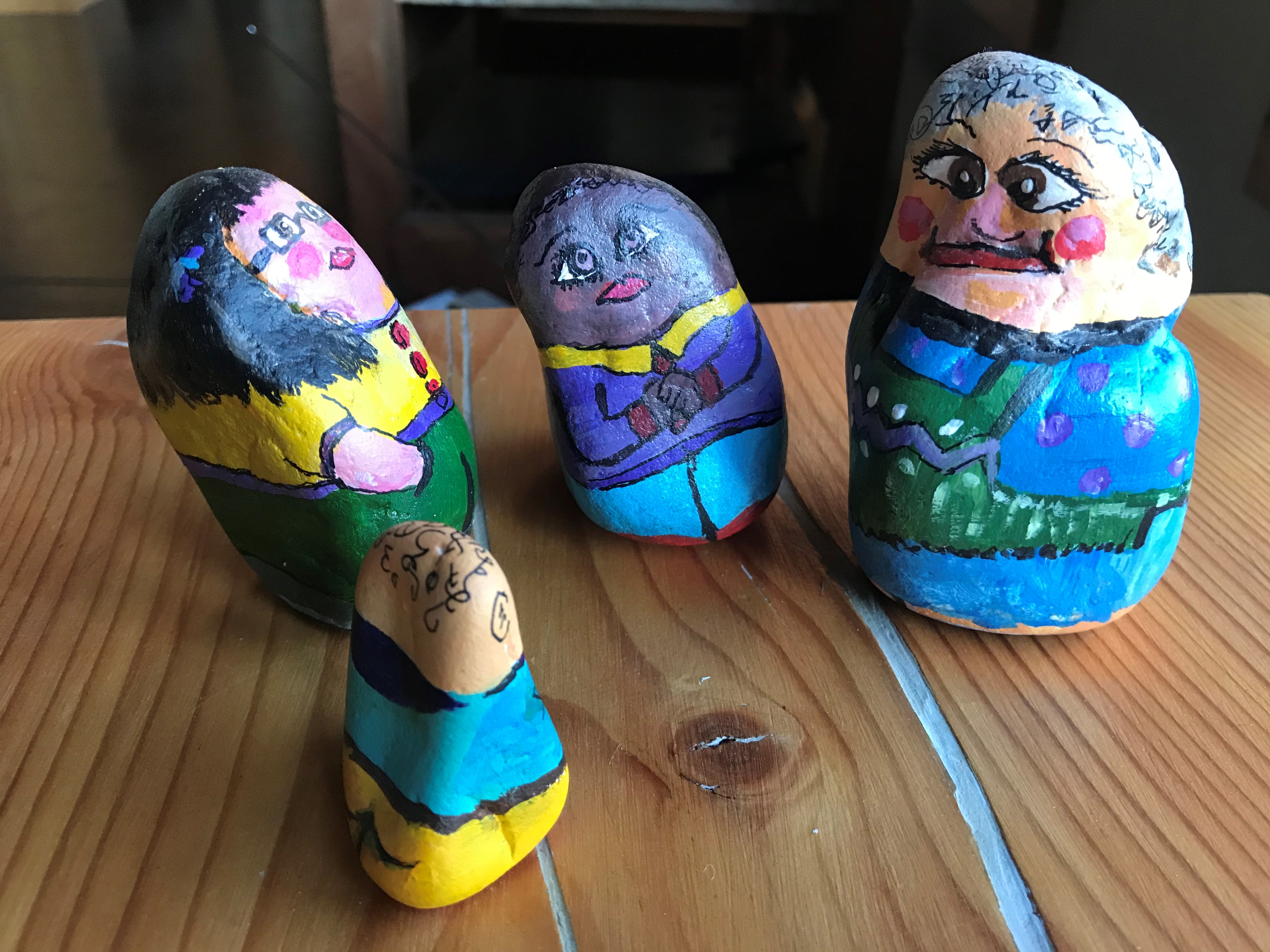
A Visual of Chase’s Social Universe
A big thanks to psychotherapy.net and Victor Yalom for their support of this work.
As always, if you have thoughts or feedback on these clips or life in general, please feel free to share.
Last week I had the honor of presenting three times at the American Counseling Association meeting in Atlanta. Today, I’m posting the Abstracts and Powerpoints from those presentations, just in case someone might find the information useful.
On Friday, April 8: The way of the humanist: Illuminating the path from suicide to wellness. Invited presentation on behalf of the Association for Humanistic Counseling.
At this moment, counselors are hearing more distress, anxiety, and suicidal ideation than ever before. In response, we are called to resonate with our clients’ distress. On behalf of the Association for Humanistic Counseling, John Sommers-Flanagan will describe how humanistic principles of acceptance and empathy can paradoxically prepare clients to embrace wellness interventions. Participants will learn five evidence-based happiness strategies to use with their clients and with themselves.
Also, on Friday, April 8: Using a strengths-based approach to suicide assessment and treatment in your counseling practice. Invited presentation on behalf of ACA Publications.
Most counselors agree: no clinical task is more stressful than suicide assessment and treatment planning. When working with people who are suicidal, it’s all-too-easy for counselors to over-focus on psychopathology and experience feelings of hopelessness and helplessness. However, framing suicidal ideation as an unparalleled opportunity to help alleviate your client’s deep psychological pain, and embracing a strengths-based orientation, you can relieve some of your own anxiety. This practice-oriented education session includes an overview of strengths-based principles for suicide assessment and treatment.
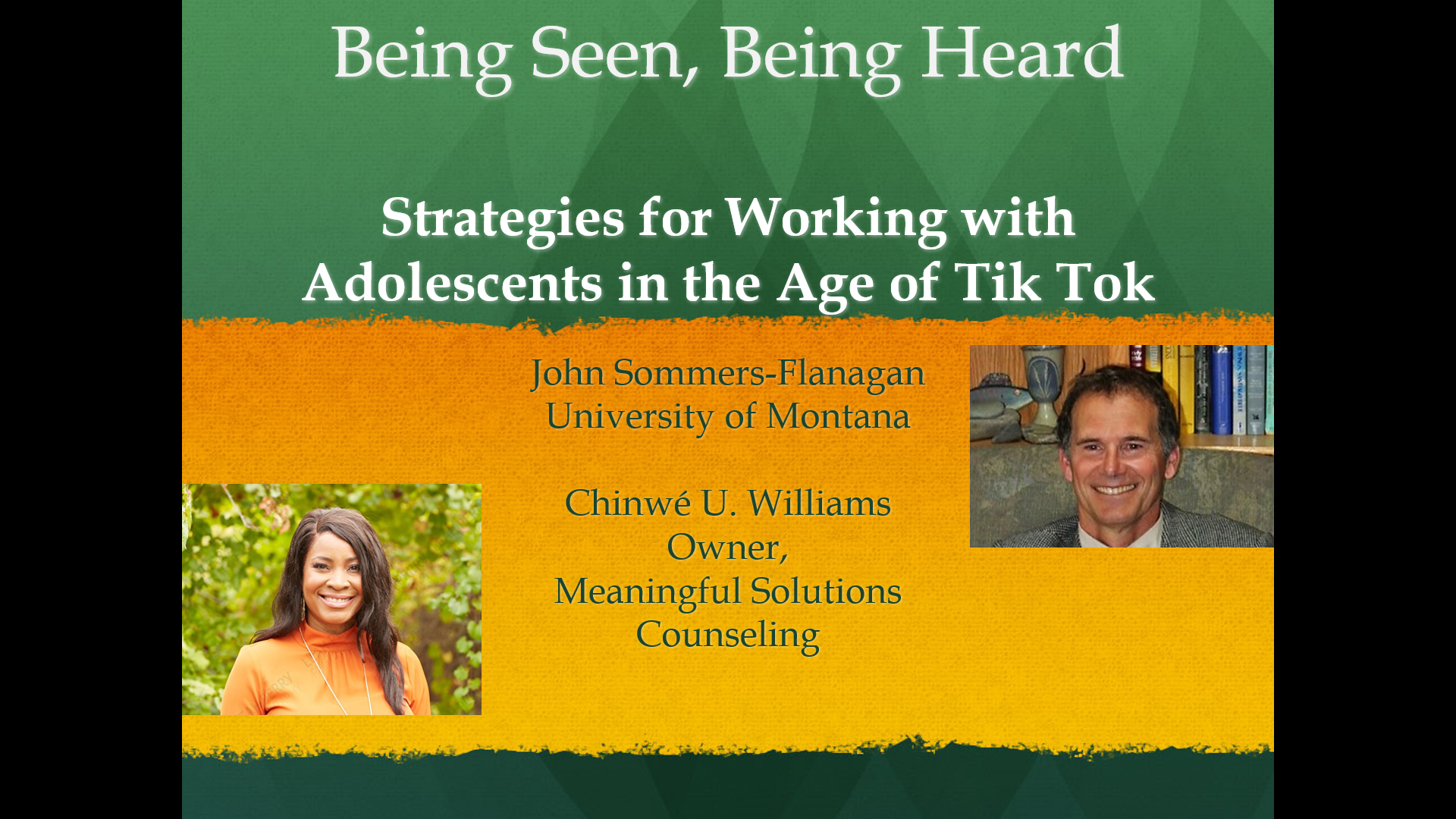
On Saturday, April 9, Being seen, being heard: Strategies for working with adolescents in the age of Tik Tok. Educational presentation (with Chinwe Williams).
Counseling and connecting with adolescents can be difficult. In this educational session, we will present six strategies for connecting with and facilitating change among adolescents. For each strategy, the co‐presenters, coming from different cultural and generational perspectives, will engage each other and participants in a discussion of challenges likely to emerge when counseling adolescents. Social media influences, self‐disclosure, and handling adolescents’ questions will be emphasized.
Yesterday I submitted a manuscript for publication in a professional journal. The journal portal insisted that the telephone number linked to the University of Montana began with a 770 prefix. For us Montanans, that’s blasphemy. We are 406.
The automated message from the journal portal arrived instantaneously. That was amazing. The fact that the automated message was also copied to a former doc student from Pakistan who wasn’t listed as an author was less amazing. That’s the point now, I suppose. We live in a world where we’re pummeled by glitches and errors into desensitized or over-sensitized submission. Every time I start up my Outlook program it drones on about “Profile error. Something went wrong.” At this point, even Microsoft has given up on figuring out what went wrong with its own programming.
My high school friend who has an answer to everything tells me this is a universal experience wherein our expectations that things will work are repeatedly and systematically crushed. That could be a Buddhist outcome, because we’re forced to let go of our expectations. Unless, of course, we have the anti-Buddhist experience of outrage over our overattachment to things working.
This morning I’m checking in for my flight to Atlanta for the American Counseling Association conference. I’m worried by a message in the fine print from ACA implying that I may need a special adaptor to connect my computer to the conference center sound system. I’m also worried about why Delta has decided to charge me to check a bag, even though I have their coveted American Express Skymiles card.
Good news. My worries are mostly small. If there’s no sound system at the conference center, I can yell and mime the video clips I’m planning to show. I can easily (albeit resentfully) pay to check a bag, or I can reduce my packing into a carry-on. If my doc student from 10-years past gets the email, she’ll be glad to hear from me.
Delta is now telling me that the card I downgraded to a couple years ago—because of minimal travel during pandemic lockdowns—doesn’t include a free checked bag. In response, I have to check my emotional response to my overattachment to not paying a baggage fee. Easy-peasy (maybe).
On a brighter note, if you’re planning to be at ACA, I hope to see you from behind our masks. I’m presenting three times. Here they are:
Friday, April 8 at 11am to noon: The Way of the Humanist: Illuminating the Path from Suicide to Wellness in the Georgia World Congress Center, Room B302-B303.
Friday, April 8 at 3:30pm to 4:30pm: Using a Strengths-Based Approach to Suicide Assessment and Treatment in Your Counseling Practice in the Georgia World Congress Center, Room B207-B208
Saturday, April 9 at 10am to 11:30am: Being Seen, Being Heard: Strategies for Working with Adolescents in the Age of TikTok (with Chinwe Uwah Williams) in the Georgia World Congress Center, Room B406.
There’s a button on the Delta page saying “Talk with us?” I click on it and am directed to pre-prepared answers to common questions. Sadly, none of the common questions are my uncommon question. Like Moodle and Quicken and Microsoft and Qualtrics and Apple and Verizon and Grubhub and Tevera and Garmin and Xfinity and Chase and the many other corporate entities in my life, Delta doesn’t really want to talk with me. I suppose I could get into the weeds here and complain that pre-prepped answers aren’t exactly the same as talking, but we all know how this ends. My high school friend’s hypothesis would be affirmed. My expectations would be crushed, only to rise again, in the form of a rising blood pressure event not worthy of my time.
Speaking of time, as I get older, the decisions over how to spend time get pluckier. Do I write something silly like this, or do I go out to the garden, or do I set up another speaking event, or do I work on our Montana Happiness Project website, or do I volunteer somewhere, or do I wash it all away with family time?
This afternoon, I’ll fly to Georgia, where, on Thursday, I’ll teach my happiness class and engage in various consultations from a hotel, before giving three presentations at the American Counseling Association World Conference on Friday and Saturday, before I fly to Portland to see my ailing father in Vancouver, WA, before I fly back to Billings to get back to gardening. I’ll miss my 8-year-old granddaughter’s play in Missoula . . . and many (I was tempted to say “countless” but as a scientist, I’m philosophically opposed to the words countless and tireless) other possible events.
Irvin Yalom likes to point out that one choice represents the death of all others. Truth. There is no multitasking, there’s only the rush to sequentially tasking as much or as many life permutations as possible to fight Yalom’s existential dilemma of choosing and freedom and the angst and weight of our decisions.
My internal editor is complaining about how many “ands” I’ve used in this speedy essay. Even more sadly, the last editor-friend who told me about my penchant for too many “ands” and too many “quotes” has passed away. I miss him.
As a consistent voice and source of support, Rita is recommending I let go of my rigid hopes and expectations and pay the extra $120 to check my bag. At the same time, I’m resisting the death of multitasking, which is why I’m downsizing my packing for seven days into a carry-on bag.
I suppose that’s what the 1970’s band Kansas might say.
Carry on my wayward son
There’ll be peace when you are done
Lay your weary head to rest
Don’t you cry no more
At the risk of worrying you all more than I’m worrying myself (I’m doing fine; this is just creative expression or long form slam poetry), I’m in disagreement with that last line from the Kansas band. Don’t you cry no more is terrible advice.
Maybe the lyrics from that old Leslie Gore song fit better.
It’s my party, and I’ll cry if I want to . . .
That’s not quite right either. It’s more like,
I’ll cry when I’m moved to . . . for Ukraine, for the forgotten children, for the marginalized and oppressed, for my father, for the hungry.
We all have many good reasons we to cry. Grief, whether from the death of friends or ideas or choices, is a process; it comes and goes and comes and goes.
It’s easy to forget that grief is what’s happening in between our times of being happy. Happiness begets grief. And . . . that sounds like something my friend who has an answer for everything might just agree with.
Several months ago, Renee’ Parker Schoening, executive director of the Montana School Counselor Association, all-around master-organizer, and unstoppable inspirational force, asked me if I could provide a closing keynote speech for the MSCA spring conference that was evidence-based, uplifting, and funny. Channeling my internal family systems (IFS) inner scientist and entertainer selves (while ignoring my own good judgment), I quickly said, “Yes. Sure. Of course, I can do that.”
This exchange is an example of saying yes to ambitiously unattainable ideas, and then needing to find people to help me accomplish whatever it is I’ve agreed to do. In honor of my disdain for pithy, rhyming, oversimplification (think of trite things like, ugh, “fight or flight”), I’ve decided to enhance my influencer legacy by delivering profound wisdom using pithy, rhyming, oversimplifications. In the case of today’s description of last week’s questionably unattainable commitment to providing an evidence-based, uplifting, and funny closing keynote speech, I’m saying (and you may want to write this down), “If you’re running out of steam, it helps to have a good team.”
For the potential MSCA debacle, I asked two talented graduate students in Counseling at the University of Montana to help me create closing keynote magic. I suspect, because I’m a faculty member and technically one of their supervisors, the grad students may have experienced my “ask” as an offer they couldn’t refuse. Regardless of (or despite) their internal lamentations, they accepted the offer they couldn’t refuse . . . and planning started happening.
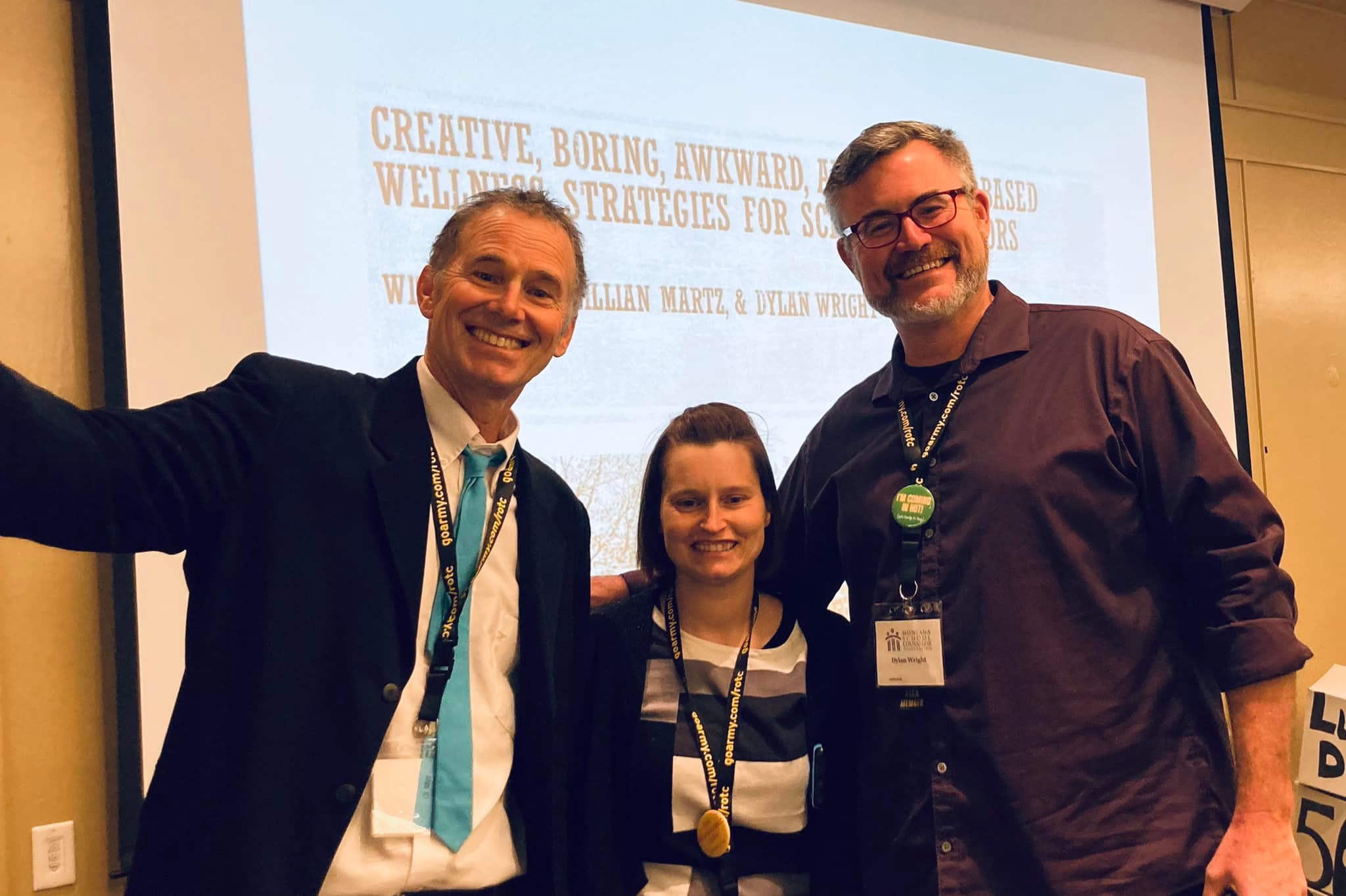
Turns out that Lillian Martz, one of the grad students, has a history of competitive Karaoke. She’s a current doc student, former M.A. student, and former school counselor. In honor of her expertise, I may or may not have suggested we infuse Karaoke into our keynote. You know how it is. With three people together generating bad ideas, it’s hard to discern where the blame belongs. Anyhow, Lillian agreed, later noting in an email that she felt “regret” for having made said agreement. But it was too late to back out; she selected a song, transforming it into a school counseling narrative (apparently that’s what competitive Karaoke people do), and suggested that the other grad student and I provide choreography.
Turns out the other grad student, Dylan Wright, has a strong theatre background, having worked a couple decades for Missoula Children’s Theatre, which is my way of saying Dylan thought him and me teaming to supply choreography for Lillian’s crooning was a fabulous idea, which is my way of admitting to, once again, saying yes to something that I might have had the good judgment to decline. All I remember is hearing Rita’s voice in the back of my brain saying, “Don’t hurt yourself.”
Dylan’s presence on our “closing keynote” team is why, somehow, we decided to weave in a brief improv experience. As many of you already know, I co-invented Karaoke, along with Mike Bevill, Neil Balholm, and Greg Hopkins, back in Mike’s basement back in 1974, and so saying yes to a Karaoke performance felt right. But, I’ve never done improv. Dylan was all-in on the improv, down with the Karaoke, and loved my terrible idea that we should open the keynote by spontaneously breaking into inappropriate songs.
Lest you worry, we did have content. Our main themes were savoring and gratitude, both being evidence-based practices popular in the positive psychology movement.
One of the lessons I’ve learned over the years is that it’s not unusual to end up receiving the gift you’re trying to give others. What I mean is that, at the conclusion of our phrenetic, non-traditional keynote speech, I experienced big doses of savoring and gratitude. Lillian and Dylan were marvelous planners and co-presenters and Renee’ was moved to tears by the video Dylan and Lillian created for the ending. Thanks to being on a great team and thanks to presenting to a generous and amazing audience of nothing-less-than-fantastic Montana school counselors, my savoring and gratitude cup were full all weekend.
Although there may be concrete evidence of the magnificence of this event in the form of video clips and photos, I’ll leave you with two short testimonials.
So much FOMO. I can’t make out any of the audio, but the visuals are very impressive. At one point it seems as though they become Zumba instructors. – UM faculty member, watching via social media video clips
I feel like I’m in a fever dream! – UM M.A. student
One of my biggest delights this semester has been reading my happiness students’ homework assignments. They’ve embraced each assignment with what Zen masters might call “Shoshin.”
Shoshin is a Japanese word referring to beginner’s mind. Beginner’s mind involves approaching experiences with an attitude of “not knowing” and maximum openness to learning. If you already know about something (say meditation), your natural inclination will be to close your mind, because you already have knowledge and lived experience about meditation and so there’s less openness to learning. Shifting from an expert (closed) mind to a beginner’s (open) mind requires intent and effort.
For many of my happiness students, some of the assignments have been old hat. Like when I ask someone with a degree in divinity and an active meditation practice to meditate for six minutes a day . . . or when I ask someone who is a faculty in counseling or a psychiatrist to try a little cognitive therapy on themselves . . . or when I ask university athletes to exercise, breathe, and consider the concept of flow . . . or when I ask a bartender to focus in on listening to others.
Despite me offering up some “old hat” assignments, my students have responded as if they were encountering everything for the first time. So. Very. Cool.
Those of you who aren’t enrolled at the University of Montana may not realize that today is the very end of spring break. Although spring is often about new beginnings, the end of a university semester is often about time management and emotional survival. Tomorrow, after a week or so of a “break” my students and I return to our studies to finish the semester. My hope is that we all return refreshed and with a renewed passion for learning, so we can Shoshin through our next six weeks.
This hope isn’t just for my happiness class students. Far too many painful events and situations are out there happening in the world. On top of that, everyone on the planet is facing unique and personal challenges that I don’t and probably can’t fully comprehend. We have these global and personal challenges AND in the Northern hemisphere, we’re experiencing spring. Even though there will be distractions and we will be imperfect, let’s do our best Shoshin and approach all of spring like a sponge, soaking up all the learning we can.
In 1970, Shunryu Suzuki wrote: “In the beginner’s mind there are many possibilities, but in the expert’s, there are few” (from, Zen Mind, Beginner’s Mind).
Let’s stay watchful and open with a beginner’s mind. This is a new spring, a never before spring, with new opportunities. As James Garbarino once wrote: “Stress accumulates; opportunity ameliorates.” Amelioration. What a great word for today . . . and tomorrow.
As we begin the revision process for Clinical Interviewing, I’m discovering content here and there that I want to share. Below is a short excerpt from the Intake Interviewing chapter where we’re discussing the process of evaluating clients’ interpersonal behavior patterns. Please email me your reactions and recommendations if you have some.
*********************
Evaluating Interpersonal Behavior
Interpersonal behavior is central in the development and maintenance of client problems. Some theorists claim that all client problems have their roots in relationship problems (Glasser, 1998). Evaluating client interpersonal behavior is an essential part of an intake interview.
Intake interviewers have five potential data sources pertaining to client interpersonal behavior.
Client self-report. This includes self-report of (a) past relationship interactions (e.g., childhood) and (b) contemporary relationship interactions.
Clinician observations of client interpersonal behavior during the interview.
Formal psychological assessment data.
Information from past psychological records/reports.
Information from collateral informants.
Although some behaviorists and in-home family therapists also observe clients outside the office (e.g., in school, home, and work environments), it’s unusual to have those data available prior to an intake.
Evaluating interpersonal behavior is difficult. Each of the preceding data sources can be suspect. For example, client self-report may be distorted or biased; often clients cast their interpersonal behaviors in a favorable light, or they may excessively blame themselves for negative interpersonal experiences. Clinician observations are also subjective. When you’re evaluating client interpersonal behavior, it’s wise to use several basic assessment principles to temper your conclusions:
Single observations are often unreliable. This is partly because interpersonal behavior can shift dramatically from situation to situation. Multiple observations of behavior patterns (e.g., interpersonal aggression or interpersonal isolation) are more reliable.
Just as construct validity is established through multimethod, multitrait assessments (Campbell & Fiske, 1959), interpersonal assessments are more valid when you have converging data from more than one source (e.g., self-report plus clinician observation).
The literature is replete with theory-based models for interpersonal assessment. When clinicians hold strong theoretical beliefs, confirmation bias is more likely (in other words, you will make observations that confirm your theoretical stance or hypothesis). Therefore, you should regularly question conclusions about client interpersonal behavior based on your preexisting ideas.
One of the most popular models for conceptualizing interpersonal behavior is attachment theory. Adherents to this perspective believe that early caregiver-child relationship interactions create internal working models about how relationships work. Essentially, this leaves clients with consistent (and sometimes rigid) interpersonal expectations and reactions. For example, clients with insecure attachment styles may expect or anticipate rejection or abandonment, while clients with ambivalent attachment styles alternate between pushing others away and clinging to them. Typically, maladaptive components of client internal working models are activated during the early stages of new relationships or during times of significant stress, when support and reassurance are needed (O’Shea, Spence, & Donovan, 2014).
Interpersonal assessment based on attachment theory is a psychodynamic approach and involves a depth-oriented assessment process. However, the idea that individuals have internal working models that guide their interpersonal behaviors is consistent across many different theoretical perspectives. Specifically,
Cognitive therapists emphasize client schema or schemata that shape what clients expect in interpersonal relationships (Young, Klosko, & Weishaar, 2003).
Adlerian therapists use the term lifestyle assessment to refer to the evaluation of client expectations about the self, the world, and others (Carlson, Watts, & Maniacci, 2006).
Psychoanalytic therapists refer to the client’s core conflictual relational theme (CCRT) as a target for treatment (Luborsky, 1984).
The whole emphasis of the empirically supported interpersonal psychotherapy for depression is based on addressing problematic interpersonal relationship dynamics (Markowitz & Weissman, 2012).
It’s always advisable to attend to feelings and reactions that clients elicit in you (Teyber & McClure, 2011). For example, some clients may trigger boredom, arousal, sadness, or annoyance. These personal and emotional reactions can be viewed as countertransference (Luborsky & Barrett, 2006). However, if there’s convergent evidence that reactions the client is evoking in you are also evoked in others, it’s likely that the client’s interpersonal behavior is the culprit. If your reactions are unique, then your countertransference reaction may be more about you and less about the client.
Evaluating a client’s personal history and interpersonal behaviors is a formidable task that could easily take several sessions. Expecting that you should have a precise sense of your client’s interpersonal style after a single interview is unrealistic. A better goal is to have a few working hypotheses about your client’s interpersonal behavior patterns (see Case Example 8.2).
CASE EXAMPLE 8.2: DESCRIBING INTERPERSONAL OBSERVATIONS
The following intake note focuses on interpersonal observations and, consistent with a collaborative/therapeutic assessment model, uses a descriptive rather than a labeling approach.
Miriam, a 36-year-old White, married female, described herself as suffering from tension and stress in her marital relationship. She reported, “My husband always calls me controlling, and I hate that, but sometimes he’s right.” During our session, Miriam repeatedly (about five times) asked for more information, complaining that she “really needed” to understand exactly what counseling was about before she could be sure she wanted to proceed. As we discussed her husband’s comments in greater detail, Miriam noted that she believed her “need for control” was related to anxiety. Together we identified several triggers that elicit anxiety and are then followed by self-identified controlling behaviors. These comprised (a) new situations (like counseling), (b) her husband leaving the house without telling her his plans, and (c) when she feels neglected by her husband. Overall, these triggers may be related to an internal working model where Miriam’s sense of relational security is threatened. Consequently, one of our first therapy tasks is for Miriam to engage in a self-monitoring homework assignment to help further refine our understanding of the interpersonal triggers that activate her “controlling” behaviors.
Rita and I are signing a contract with John Wiley & Sons to update our Clinical Interviewing text to the 7th edition. Clinical Interviewing was first published in 1993 under the title, Foundations of Therapeutic Interviewing with Allyn & Bacon publishers. As one of my academic friends once said, it was a good book, but it fell apart in the end. I was instantly worried that we hadn’t handled the final chapter very well. Turns out, he was referring to the binding.
After Allyn & Bacon let go of the copyright in 1996, we shopped the book and got great offers from Norton, Guilford, and Wiley. We went with Wiley, received excellent editorial guidance, and Clinical Interviewing was born; the text has been very popular in the graduate textbook market in psychology, counseling, and social work.
Along with the great news that we’re headed for another edition comes a rather large chunk of planning and work.
First, the planning . . .
Clinical Interviewing became popular and has remained popular because it’s a practical and accessible text that focuses on clinician competencies. We will continue that focus—we want students to not only read the text, but to return to it, keep it, and use it to remind themselves of the foundations that underlie the clinical encounter.
Another reason the book has been popular is because of the fabulous feedback and ideas we’ve gotten from people like you. We want to continue that emphasis too. If you’re familiar with Clinical Interviewing—as a professor or as a student—I’d love to hear your ideas about what we should change or add. Please, email me with any and all your ideas: john.sf@mso.umt.edu. We’ve already have some feedback, including:
Update the text to sync with DSM-5-TR
Add more content, and a video demonstration, of online (remote) interviewing (tele-mental health)
Add more specific content pertaining to interviewing special populations in general, and working across cultures and sexualities in particular
Add more (and updated) video demonstrations
Consider stronger and more traditional diagnostic assessment content (I’m mixed on this)
Second, the work . . .
During the past two revisions, I asked people to volunteer to read and review specific chapters. This is extra work for you, but it’s also a good academic process. Everyone who provides a chapter review will be listed in the acknowledgements. And so, if any of you would like to review a chapter (or more) and provide us with feedback and guidance for the 7th edition, please email me at john.sf@mso.umt.edu
As always, thanks for reading this and thanks for considering the opportunity to share your clinical interviewing expertise.
Last week I got a press query to answer a few questions for an upcoming article in Parents magazine. The questions were sent to a broad spectrum of media reps and professionals. There was understandably no guarantee I would be quoted in the magazine.
No surprise, I wasn’t quoted. But my media connection was thoughtful enough to send me the article (it came out a couple days ago). IMHO commentary in the article was really good, and so I’m including a link to the article below.
Although I like the article, I have one objection. The authors immediately pathologize children’s anxiety. In the second sentence of the article, they write, “Both conditions (separation anxiety and social anxiety) are treatable with the proper diagnosis.” Using words like “conditions” and “treatable” and “diagnosis” deeply medicalizes children’s anxiety and is a bad idea. Separation anxiety and social anxiety are NOT necessarily mental disorders. It would have been better to start the article by noting that given our current global situation of uncertainty–with COVID, and other sources of angst all around us–it’s normal and natural for children to feel anxiety.
This blog post has three parts. First, I’m including a link to the article. Second, I’m including my responses to the media query. Third—and I think the best part—is a old handout I wrote for helping parents deal with children’s anxiety and fear.
Here are my responses to the magazine’s questions:
What is anxiety, in a nutshell?
Anxiety is a natural human emotional response to stress, danger, or threat. One thing that makes anxiety especially distinctive and problematic is that it comes with strong physiological components. Other words used to describe anxiety states include, nervous, worried, jittery, jumpy, scared, and afraid.
Anxiety usually has a trigger or is linked to an activating situation, thought, or physical sensation. Hearing about COVID in the news or seeing someone fall ill can activate anxiety in children (and adults too!).
Anxiety is often, but not always, about the future because people tend to worry about what will happen or what is unfolding in the present. Even when children feel anxious about the past, they tend to worry about how the past will play out in the future.
How has COVID-19 affected children mentally? Has there been an uptick in anxiety-related conditions?
COVID-19 is a stressor or threat because of its implications (it can kill you and your loved ones) and because of how it affects children situationally. During my 30+ years as a professional psychologist, anxiety in children, teens, and adults has done nothing but increase. COVID-19 is another factor in contemporary life that has increased anxiety.
In some ways, the fact that more children are feeling anxious can be a positive thing. I know that sounds weird, but anxiety is mostly normal. A professor of mine used to say that the old saying “Misery loves company” isn’t quite true. What is true (and supported by data) is that misery loves miserable company. In other word, people feel a little better when their problems are more universal. When it comes to COVID-related anxiety, we should all recognize we’re in good company.
What are the symptoms of social anxiety in kids?
Social anxiety is defined as fear of being scrutinized or negatively evaluated by others. Symptoms can be physical (headaches, stomach aches, shaking, etc.), emotional (feeling scared), mental (thinking something terrible will happen), and behavioral (running away). Social anxiety is usually most intense in anticipation and during exposure to potential social evaluation. Of course, almost always, anxiety will make us imagine that everyone is staring at us—even though many other kids are also feeling anxious and as if everyone is staring at them.
What are the symptoms of separation anxiety in kids?
Separation anxiety occurs when children leave or part from a safe person or a safe place. Leaving the home or leaving mom or dad or grandma or grandpa will often trigger anxiety. The symptoms—because it’s anxiety—are the same as above (physical, emotional, mental, behavioral); they’re just triggered by a different situation.
How can you help children cope with anxiety–both in general and specific to each condition?
Children should be assured that anxiety is a message from your brain and your body. When anxiety spikes, there may be a good reason for it, just like when a fire alarm goes off and there’s really a fire and there’s physical danger and getting to a safe place is important. Children should be encouraged to identify their safe places and their safe people.
However, sometimes anxiety spikes and instead of a real fire alarm, the body and the brain are experiencing a false alarm. When there’s no immediate danger and the anxiety builds up anyway, it’s crucial for children to have a plan for how they’ll handle the anxiety. Having a plan to approach and deal with anxiety is nearly always preferable to letting the anxiety be the boss. Leaning into, facing, and embracing anxiety as a normal part of life is very important. We should all avoid taking actions designed to run away from or avoid anxiety. Developing a personal plan (along with parents, teachers, and counselors) for dealing with anxiety is the best strategy.
And, finally, here’s my tip sheet for helping with children’s anxiety
How to Help Children Deal with Fears and Anxiety
Manage Your Own Anxiety and Negative Expectations: If you don’t have and display confidence in your own preparation and skills, YOUR WORRIES and negative expectations will leak into the child. Additionally, if you don’t show confidence in your child’s coping abilities, that lack of confidence will leak into them too!
Use Storytelling for Preparation and to Teach Coping Strategies: “Let’s read, Where the Wild Things Are.” Afterwards, launch into a discussion of how people deal with fears.
Focus on Problem-Solving and Coping (especially as preparation): “How do you suppose people manage or get over their fears?”
Instead of Dismissing Feelings, Use Soothing Empathy: “It’s no fun to be feeling so scared.”
Show Gentle Curiosity: “You seem scared. Want to talk about it?”
Provide Comforting Reassurance or Universality (after using empathy and listening with interest): “Lots of people get afraid of things. I remember being really afraid of dogs.”
Offer Positive (Optimistic) Encouragement: “I know it’s hard to be brave, but I know you can do it.”
Have and Show Enormous Patience (connection—and holding hands—reduces anxiety): “Yes, I’ll help you walk by Mr. Johnson’s dog again. I think we’re both getting better at it, though.”
Set Reasonable Limits: “Even though you’re scared of monsters sometimes, you still have to be brave and go to bed.”
Model how to Sit with and through Fear (No negative reinforcement!): One thing that’s always true is when fear is big, it always gets smaller, eventually. “Hey. Let’s sit here together and watch our fear go away. Let’s pay attention to what makes it get smaller.” (This might include direct coping skill work . . . or simple distraction and funny stories).
Plan and Model Anxiety Management Skills: Specific skills, like deep breathing, aid with coping. Once you find some techniques or skills that are better than nothing, start to practice and rehearse using them. This can be for preparation, coping during the anxiety, or afterwards. “Let’s sit together and count our breaths. Just count one and then another. And we’ll try to find our sweet spot.”
As I type, Steven Hayes, the creator of acceptance and commitment therapy (ACT), is talking in a variety of voices about mindful acceptance. Earlier, he mentioned something about the whole human genome. In case you don’t already know, Steve is an older white guy. His writing about psychotherapy is fantastic. I really like his Ted talk. I’ve found his question, “What shall we do with our difficult thoughts?” an excellent prompt to reflect on.
Steve and I have a history. I’m glad to say that I’ve mindfully accepted that he missed his supervision appointment with me at AABT (now ABCT) back in 1987 in Los Angeles. Really. I’ve let go Steve standing me up, not because I’m all that good at forgiveness, but because him skipping out on our chance to meet makes for a better story. In fact, in this mindful moment, I’ve accepted him missing our meeting so completely that I have no urge to try to meet him today.
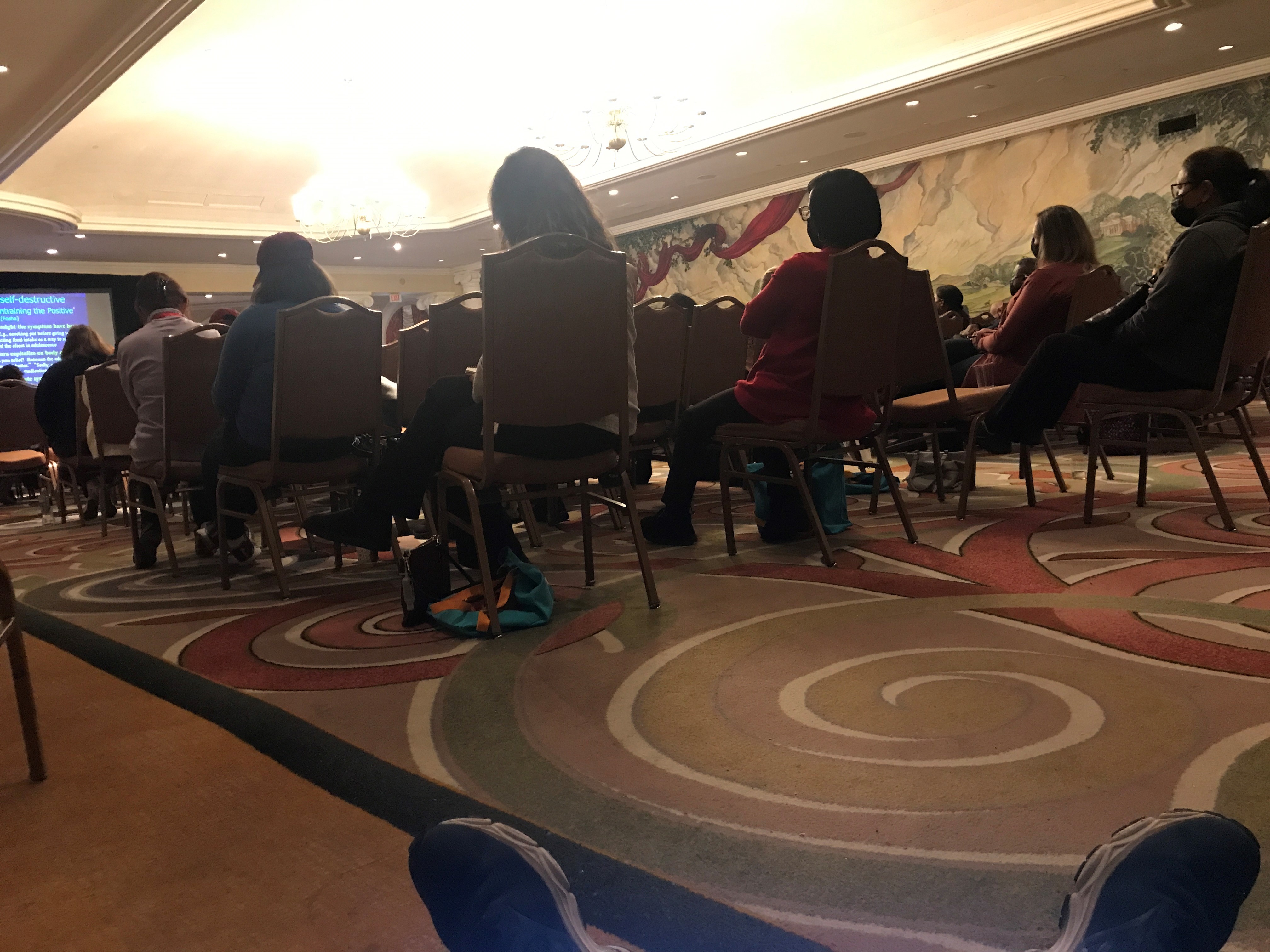
This is my first Networker “Symposium.” I hadn’t realized it was quite the distinctive thing. They’ve got numbers you can put on your badges to represent how many times you’ve attended the Symposium. Although it’s just a conference, it does have a particular flair and feel. From the beginning, there was movement, talk about love and sex-tech, dancing, singing, and learning. The breadth of content and diversity of attendees has been marvelous.
I started the first day with a workshop on Love and the Therapeutic relationship with Sabrina N’Diaye. Later, I took in a workshop on Tech-Sex with Tammy Nelson, author of Getting the Sex you Want. Nelson basically blew my mind. Did you know there are “devices” you can use to remotely vibrate your romantic partner’s genitalia? I didn’t . . . and maybe I didn’t want to. Did you know someone commented in the session that “Dominants” use that vibrating device to issue “commands?” I was sitting next to a professional cuddler and sexual surrogate. She was delightful. Steve Hayes (and Ram Dass) would be proud of the fact that I managed my difficult thoughts by staying in the here and now instead of trying to imagine her work or think about what the dominatrix had shared. Just saying. My mind remained as pure as the water of the Stillwater River.
There’s been lots of talk about racism at the Symposium. That’s a good thing. I’m better for it. The more we can all be less racist or anti-racist and aware of our biases, the better. Of course, while I’m typing this, my almost erstwhile buddy Steve continues to talk (and sometimes mumble). I’m aware (somewhat painfully) that I’m more “like” him in age and gender and ethnicity and can’t help but lament that (sorry Steve). Being an old white guy brings privilege (or advantage, as our first keynote speaker preferred). At the same time, looking in the mirror and seeing myself as just another old white guy also brings along gut-level unpleasantness.
Yesterday’s highlights were listening to Ester Perel (very smart, very articulate, very impressive) and learning more about Susan Johnson and her personal history of growing up in a Pub. We also listened to three young women talk about the couple therapy experiences that changed them. Fabulous.
One of my (many) take-aways from the past two days is for me to NOT be THAT old WHITE guy. I want to be a different white guy. How does that work? Among other things, I will try not to think too much of myself . . . or mumble.
Steve is now trying to get us all to love ourselves. That’s a nice idea. Someday, Steve, I hope to get there. But, to channel our Saturday morning Symposium keynote speaker, Emily Nagoski, most of the time, things just don’t fucking work.
Wait. I know that sounds negative. Among many of her excellent points about coping with burnout, Emily played a cool song (of her twin sister’s), a song liberally infused with the F-word. If you’ve ever experienced technology frustration (which I suppose even happens with sex-tech), you should listen. Here’s the link: https://www.youtube.com/watch?v=eottd9Lw8l4 If you listen, don’t think about sex-tech at the same time. There’s no need to thank me for this great advice.
I’ve now abandoned Steve, in favor of one of the darling presenters of the Symposium and PESI. Sorry Steve . . . but I know you’ll mindfully accept your experience of me abandoning you. . . partly because you’ve never acknowledged my existence anyway (see, I’m totally over that 1987 incident).
There’s a woman talking . . . softly . . . without the changing voice routines of Steve Hayes. As she drones on, she mentions that therapy and therapists can be triggering. . . which is interesting given that I can’t find any affect in her voice. I’ve taken a seat on the floor in the back corner of the room and quickly recognized she’s right. She’s right because she instantly triggered me as I walked in the door with her monotone statement that talk therapy doesn’t work for trauma (what about CPT . . . or?). She continued to trigger me with her statement that PTSD was only identified in the 1970s (what about the diagnosis of war neurosis or battle fatigue or the many other earlier versions of PTSD?). And she finished triggering me with her laudatory comments on narrative therapy (does she NOT think of narrative therapy as “talk therapy?”).
I know my job here. Mindful acceptance. Learn what I can. Maybe the learning is about my own triggers or my own internal lament over being an increasingly irrelevant old white guy. Maybe the learning is about how to stay calm and embrace both ends of the constant dialectics and polarities of life.
On the whole, I’m so glad to be here at the Symposium, with Rita, and so grateful to continue learning. The fact that the conference has stimulated some of what Steve would call “difficult thoughts” is a blessing to be mindfully accepted. How else do we learn? How else do we grow? Should we expect to be constantly confronted with easy, comfortable, and affirming thoughts?
I think not. And I accept that . . . in my whole human genome.
Even a happy life cannot be without a measure of darkness, and the word happy would lose its meaning if it were not balanced by sadness. — Carl G. Jung
This opening quotation from Jung is a good start to a discussion of happiness. As many others have said, a “happy” life is a process and it includes the ability to embrace and experience darkness and sadness. I like the quote because it reminds us to not take happiness in the direction of toxic positivity. We don’t need that. At the same time, we need skills and attitudes to extend and prolong positive experiences and cope with our emotional challenges.
I’ve shared a bit about the Montana Happiness Project before, but it’s time for an update.
The Montana Happiness Project has four BIG initiatives.
Happy Schools
Happy Families
Happy Colleges
Happy Media
We’ve gotten started on all these initiatives, but in particular, Dylan Wright and Lillian Martz have us rolling forward on the Happy Schools initiative. This past Friday, Dylan and Lillian presented their work in Frenchtown School at the “GradCon” event at the University of Montana. They didn’t win the grand prize, but they were in the running. Their work is amazing and I’m proud to have them as a part of the Montana Happiness Project. Given their hard and smart work, it’s only a matter of time until they win some sort of grand prize. To give you a taste of their work and all that’s going on with the project, here are a couple of video clips.
And here’s a link to the Dylan and Lillian’s presentation at GradCon. It’s under 15 minutes and will give you a great taste of the potential of integrating happiness into the lives of high school students: https://www.youtube.com/watch?v=cZvHqIMQNGg
Just in case you’re as inspired as I am, after you watch those videos, you’ll want to follow the new Montana Happiness Project YouTube site . . . and then you’ll probably want to go to Facebook where you can follow our new Facebook page: https://www.facebook.com/profile.php?id=100073966896370
Thanks, in advance, for your interest in and support of infusing happiness skills into Montana and beyond.
John SF
The place to click if you want to learn about psychotherapy, counseling, or whatever John SF is thinking about.







 John Sommers-Flanagan