Several years ago, doc students in our Counseling and Supervision program started teasing me for being preoccupied with corporal punishment in general and spanking in particular. Somehow they found my concerns about adverse mental health outcomes linked to spanking as entertaining. They were very funny about it, and so although I was somewhat puzzled, mostly I was entertained by their response, and so it was, as they say . . . all good.
Despite their occasional heckling about spanking and despite my BIG concerns about the adverse outcomes of corporal punishment, I haven’t really done any direct research on the effects of spanking. Maybe one reason I haven’t done any spanking research is because Elizabeth Gershoff of UT-Austin has already done so much amazing work. In an effort to help make her work more mainstream, today I published an article with the Good Men Project titled, “How to Discipline Children Better Without Spanking.” The article begins . . .
“As children across the country headed back to school, some students in Missouri returned to find corporal punishment, with parental approval, reinstated in their district. They joined students in 19 other states where corporal punishment is still legal in schools. At home, most American parents—an estimated 52%—agree or strongly agree that “it is sometimes necessary to discipline a child with a good, hard spanking” Parents hold this opinion despite overwhelming scientific evidence that spanking is linked to mental, emotional, and behavioral problems. In a well-known and highly regarded study of over 1,000 twins, Elizabeth Gershoff of the University of Texas at Austin found that spanking was linked to lying, stealing, fighting, vandalism, and other delinquent behaviors. Gershoff’s findings are not new.”
While searching for updated guidance on cross-cultural eye contact in counseling and psychotherapy (for the 7th edition revision of Clinical Interviewing), I came across a young therapist with over 1 million YouTube subscribers. She was perky, articulate, and very impressive in her delivery of almost-true information about the meaning of eye contact in counseling (from about 5 years ago). There were so many public comments on her video . . . I couldn’t possibly read or track them all. Sadly, although she waxed eloquent about trauma and eye contact, she never once mentioned culture, or how the meaning of eye contact varies based on cultural, familial, and individual factors. Part of my takeaway was her retelling a version of a John Wayne-esq sort of message wherein we should all strive to look the other person in the eye. Ugh. I’m sad we have so many perky, articulate influencers who share information that’s NOT inclusive or deep or particularly accurate. Oh well.
Curious, and TBH, perhaps a bit jealous of this therapist’s YouTube fame, I clicked on her most recent video. I discovered her in tears, describing how she needs a break, and detailing a range of symptoms that fit pretty well with major depressive disorder. Oh my. This time I felt sad for her and her life because it must have turned into a runaway train of influencer-related opportunities and demands. My jealousy of her particular type of fame evaporated.
Many therapists—including me—aren’t as good at practicing as we are preaching. Every day I try to get better and fail a little and succeed a little. Life is a marathon. Small changes can make their way into our lives and become bigger changes.
Because of our Clinical Interviewing revision, I’m saying “No” to presentation opportunities more often than usual. That’s a good thing. Setting limits and taking care of business at home is essential. However, in about one month, I’ve set aside a week for a gamut of presentations and appearances. These presentations and appearances all include some content related to positive psychology, positive coping, and how we can all live better lives in the face of challenging work. Here they are:
On Friday, November 4 at 8:30am, I’ll be doing an opening keynote address for the Montana CBT conference. The keynote is titled, “Exploring the Potential of Evidence-Based Happiness.” The whole conference looks great (12.75 CEs available). I’ve also got a break-out session from 1:15pm to 3:15pm, titled, “Using a Strengths-Based Approach to Suicide Assessment and Treatment in Your Counseling Practice.” You can register for the two-day Montana CBT conference here: https://www.eventbrite.com/e/montana-cbt-conference-registration-367811452957Helena
On Monday, November 7 at 11am in Missoula I’ll be presenting for the University of Montana Molli Program. Although in-person seats are sold-out, people can still register to attend online. https://www.missoulaevents.net/11/07/2022/the-art-science-and-practice-of-meaningful-happiness/ The presentation title is: The Art, Science, and Practice of Meaningful Happiness. Molli is the Osher Lifelong Learning Institute at UM – which focuses on educational offerings for folks 50+ years-old.
One more freebie in honor of suicide prevention month.
Building hope from the bottom up is one of the strengths-based suicide assessment and treatment techniques clinicians like best. I may be forgetting that I’ve already posted this here, but the approach is so popular that I’ll take that risk. Here’s the section for our Strengths-Based Suicide book . . .
Working from the Bottom Up to Build a Continuum ofHope
When clients are depressed and suicidal, they often think and talk about depressing thoughts and feelings. We shouldn’t expect otherwise. Even so, when clients ruminate on the negative, it fogs the window through which positive feelings and experiences are viewed. Within counseling, a potential conflict emerges: although clinicians want clients to problem-solve, focus on their strengths, and have hope for the future, clients are unable to generate solutions, can’t focus on their strengths or positive attributes, and seem unable to shake their hopelessness.
As discussed earlier in the case of Sophia, after an initial discussion of suicidality, there may come a natural time to pivot to the positive. One common strength-based tool for exploring what helps clients overcome their suicidality is a solution-focused question (Sommers-Flanagan, 2018a). If you’re working with a client who has made a previous attempt, you might ask something like “You’ve tried suicide before, but you’re here with me now, so there’s still a chance for a better life. What helped in the past?”
Although this is a perfectly reasonable question, the question may fall flat, and your client might respond with a hopelessness statement, “Nothing really ever helps.” This puts you in a predicament. Should you use Socratic questioning to identify a cognitive distortion? Should you interpret the distorted thinking in the here-and-now? Or should you retreat to empathy?
No matter what theoretical model you’re using, the predicament of how to deal with client non-responsiveness, negativity, or cognitive distortions remains. Let’s say you’re operating from a solution-focused or strength-based model and you ask the miracle question:
I’m going to ask you a strange question. What if, after we get done talking, you go back to doing your usual things at home, go to bed, and get some sleep. But in the middle of the night, a miracle happens, and your feelings of depression and suicide go away. You were asleep, and so you don’t know about the miracle. When you wake up, what will be the first thing you notice that will make you say to yourself, “Wow. Something amazing happened. I’m no longer depressed and suicidal.” (adapted from Berg & Dolan, 2001, p. 7).
Although the miracle question might do its magic and your client will respond with something positive, it’s equally possible that your client will say something like, “Not possible” or “The only way that would happen would be if I died in the night.” When clients are pervasively negative and hopeless, one error clinicians often make is to get into a yes-no questioning process that looks something like this:
Counselor: I’m sure there must be something that helps you feel more positive.
Client: I can’t think of anything.
Counselor: How about time with friends, does that help?
Client: No. I don’t have any real friends left.
Counselor: How about exercise?
Client: I can’t even get myself to exercise.
Counselor: Being in the outdoors helps with depression. Does that help?
Client: Nope.
Counselor: Have you tried medications?
Client: I hate medications. They made me feel like a zombie.
Entering into this exchange is unhelpful. In the end, both you and your client will be more depressed. Rather than continuing to ask what helps, try changing the focus to what doesn’t help. This shift is useful because when clients are experiencing suicidal depression, they’re more likely to resonate with negativity, and connecting with your client at the negative bottom is better than not connecting at all. The goal is to collaboratively build a continuum from the bottom up. By starting at the bottom, you’re simultaneously assessing hopelessness and intervening on the “Black-black” (as opposed to black-white) distorted thinking that you’re witnessing in session. Here’s an example:
Counselor: You’ve tried lots of different strategies to deal with your suicidal thoughts, without success. You’ve tried medications, exercise, and you’ve talked to your rabbi. Let’s list these and other things you’ve tried, and see which strategies were the worst. Of all the things you’ve tried, what was worst?
Client: I really hated exercising. It felt like I was being coerced to do something I’ve always hated. And it made me sore.
Counselor: Okay then. Exercise was the worst. You hated that. Of the other things you’ve tried, what was a little less bad than exercising?
Client: The medications. I just didn’t feel like myself.
Counselor: So that didn’t work either. So, of those three things, talking with your rabbi was the least bad?
Client: Yeah. It didn’t help much. But she was nice and supportive. I felt a little better, but I didn’t want to keep talking because she’s busy and I was a burden.
Focusing on the worst option resonates with a negative emotional state. For clients who are unhappy with the results of previous therapeutic efforts, beginning with the most worthless strategy of all is an easier therapeutic and assessment task, provides useful information, and is usually answered quickly. Subsequently, clinicians can move upward toward strategies that are “just a little less bad.” Building a unique continuum of what’s more and less helpful is the goal. Later, you can add new ideas that you or your client identify, and put them in their place on the continuum. If this approach works well, together with your client you will have generated several ideas (some new and some old) that are worth experimenting with in the future.
Beginning from the bottom puts a different spin on the problem-solving process. Even extremely depressed clients can acknowledge that every attempt to address their symptoms isn’t equally bad. Using a continuum is a useful tool for working with hopelessness and is consistent with the CBT technique, “Thinking in shades of grey.”
I’m in Enterprise, Oregon today and tomorrow morning. I got here Sunday evening after a winding ride through forests and mountains. Yes, I’m in Eastern Oregon. Even I, having attended Mount Hood Community College and Oregon State University, had no idea there were forests and mountains in Enterprise.
The scenes are seriously amazing, but the people at the Wallowa Valley Center for Wellness-where I’m doing a series of presentations on suicide assessment and prevention-are no less amazing. I’ve been VERY pleasantly surprised at the quality, competence, and kindness of the staff and community.
Just in case you’re interested, below I’m posting ppts for my three different presentations. They overlap, but are somewhat distinct.
Earlier this year I was asked by a school district to create and record a one-hour training on strengths-based suicide assessment. I made the recording, shipped it off, got paid, and mostly forgot about it. However, because I have the recording and sometimes I think it’s good to give things away, I’m sharing the link here: https://youtu.be/kLlkh8nJ2pI
The video is about 62 minutes, recorded on Zoom, and slightly oriented toward school counselors and school psychologists. I’m sharing this video just in case it might be useful to you in your teaching or for your clinical group or personal knowledge, etc. Feel free to share the link.
If you feel you benefit from this video, I hope you’ll consider the “pay it forward” concept. No need to pay me . . . just notice opportunities where you can share your gifts and talents and resources with others and pay it forward.
In honor of National Suicide Prevention Month, I’m offering another chunk of information about suicide assessment and treatment. This information is an excerpt from our book, Suicide Assessment and Treatment Planning: A Strengths-Based Approach. In the book, we discuss assessment and treatment planning using a dimensional approach. The first (and central) dimension for suicide assessment and treatment is the emotional dimension.
When clients are depressed and suicidal, everyone—including family, friends, co-workers, counselors, and clients—wish for an improved emotional state. But often the process is slow, and as a result, the very people upon whom the client relies for support may lose patience. Supportive people, even counselors, may feel urges to say things that are emotionally dismissive, like, “Cheer up” or “Come on, you need to exercise!” or “Why can’t you do something to make your life better?”
Moving clients out of despair and into the light is difficult; if it were otherwise, clients would resolve suicidality on their own. Directly or indirectly suggesting to clients in suicidal pain to “cheer up” often backfires, creating anger, hostility, and resistance to treatment; this resistance is a powerful phenomenon called, psychological reactance(Brehm & Brehm, 1981).
Psychological reactance occurs when clients perceive their ultimate freedoms as threatened. If clients sense that clinicians want to coerce them to stay alive, in response, they may dig in their heels and engage in behaviors designed to restore feelings of autonomy. Psychological reactance is one explanation for why clients who are suicidal sometimes vehemently resist help, insisting on their right to think about and act on suicidal impulses. Repeated empathic acceptance of the client’s emotional pain is one way to avoid activating reactance; empathic acceptance also allows clients to begin exploring and addressing key emotional issues in counseling.
Key Emotional Issues to Address
Many emotional issues are relevant to suicide treatment planning. These include: (a) excruciating distress, (b) specific disturbing emotions, such as, acute or chronic shame and guilt, anger, or sadness, and (c) emotional dysregulation. In this next section, we briefly review core emotional issues that you may guide your treatment planning. Later in the chapter we provide case examples and vignettes illustrating methods for working in the emotional dimension.
Excruciating Distress
Shneidman referred to the emotional state surrounding suicide as “psychache” or unbearable distress. He wrote: “The suicidal drama is almost always driven by psychological pain, the pain of negative emotions—what I call psychache. Psychache is at the dark heart of suicide; no psychache, no suicide.” (2001, p. 200, italics added).
Even when using a strength-based or wellness model, exploring the “pain of negative emotions” or excruciating distress is usually your first focus. Sometimes, to avoid activating reactance or resistance, you’ll need to stay with your client’s emotional pain longer than you’d prefer. Staying with your clients’ pain not only helps bypass resistance, it also models that facing negative affective states without fear, avoidance, or dissociation requires personal strength. Even so, as you focus on suicidal pain, you might wish the client would immediately adopt a more positive mindset, or find the process difficult to bear. You also might need to turn to colleagues or your self-care plan for support. Nevertheless, job one in the emotional dimension is to recognize and resonate with your client’s emotional pain.
Acute or Chronic Shame and Guilt
Shame and guilt are non-primary emotions because they involve significant self-reflection. Shame connotes beliefs of being unworthy, defective, or bad. Shame is often directly linked to core beliefs about the self, and activated by particular life situations. In contrast, guilt is more specific, often associated with certain actions or lack of actions (e.g., “I should be doing more to fight racism” or “I shouldn’t have been so critical of my professor”). Generally, guilt can lead to shame, and shame is more likely to ignite suicidality. Reducing or resolving shame or guilt may be a crucial therapeutic goal.
Suicidal thoughts are often accompanied by shame. Cultures around the world have historically judged death by suicide as a shameful or sinful event, and many still do. Your client’s experience may be something like, “Not only do I have suicidal thoughts—which are terrible in their own right—but the fact that these thoughts exist in my mind also make me a bad person.” This double dose of negative judgment, emotional pain plus self-condemnation, often needs to be addressed in counseling. One strategy that may fit into your treatment plan is to help clients develop greater self-compassion as a method for countering their self-condemnation.
Anger
In graduate school, we had a professor who suggested we consider this question: “Who is this client planning to commit suicide at?” Often, people who are suicidal carry great anger toward one or more friends, lovers, or family members and thus think of suicide as an act of revenge. Counselors should listen for underlying themes that involve using suicide as a behavioral goal for getting even or intentionally hurting others (Marvasti & Wank, 2013).
Thoughts of dying by suicide sometimes emerge as a revenge fantasy. Thoughts like, “I’ll show them” or “they’ll suffer forever” represent anger, along with the desire to punish others. It can be tempting to point out to clients that death is an irrationally high price for fulfilling revenge fantasies. However, helping clients express, accept, and understand the depth of their anger will usually reduce suicidality more efficiently than pointing out that death is a maladaptive revenge strategy. If revenge is central and forgiveness isn’t a viable option, then an apt philosophy to gently infuse into your clients is that the best revenge is a well-lived life.
Sadness
Major depression is the psychiatric diagnosis most commonly linked with suicide attempts, especially among older adults (Melhem et al., 2019). Clients who present with sadness as a dominant emotion may or may not meet diagnostic criteria for major depression. However, when sadness and the associated emotions and cognitions of irritability, regret, discouragement, and disappointment are central sources of distress, we recommend targeting those symptoms with evidence-based counseling interventions. Weaving positive psychology or happiness interventions into treatment planning is especially appropriate for clients struggling with sadness and depression (Seligman, 2018; Rashid & Seligman, 2018). More information about evidence-based approaches and positive psychology interventions is provided later in this chapter and in upcoming chapters.
Emotional Dysregulation
Clients who are suicidal may exhibit emotional dysregulation during counseling sessions and in their everyday lives. Clients may be emotionally labile, shifting from expressing anger to feelings of affection, appreciation, and deep connection. Clients may share stories of repeated maladaptive emotional overreactions to life’s challenges. Although unstable relationships, emotional swings, and explosive anger fit with the diagnostic criteria for borderline personality disorder, when clients are experiencing excruciating distress, they may behave in ways that resemble borderline personality disorder. However, instead of pathologizing clients with a personality disorder diagnosis, we recommend framing client behaviors using a social constructionist strength-based orientation, such as: Given enough situationally-based stress, including, as Linehan (1993) noted—emotionally invalidating environments—nearly everyone becomes dysregulated and appears unstable. Normalizing dysregulation as a natural response to intense distress helps maintain a strength-based perspective.
Treatment plans for clients who are suicidal often include teaching emotional regulation skills; this translates to helping clients become more capable of regulating themselves in the face of emotionally activating circumstances. Linehan’s (1993, 2015) protocols for working with clients with borderline personality characteristics are recommended for emotional regulation skill development. However, alternative approaches exist, some of which come from positive psychology, happiness, and well-being literature (Hays, 2014; Lyubomirsky, 2007, 2013; see Wellness Practice 4.1).
Rita has slipped away with a friend to go to a Tippet Rise (https://tippetrise.org/events/36201) concert. IMHO, Tippet Rise has amazing concerts. As a means to cope with my jealousy, I’ve decided to pass along a couple of freebies I found in my email inbox. Given that most of the freebies I receive in my inbox are related to someone who wants to trick me into becoming a few hundred million bucks richer, rest assured, I’ve screened out the fake-freebies, and have vetted these.
First, from Dr, Thomas McMahon of Yale University. He wrote about a free eBook:
Youth Suicide Prevention and Intervention offers a comprehensive review of current research on the public health crisis and best practices to prevent youth suicide. The volume was edited by John P. Ackerman, PhD from the Center for Suicide Prevention and Research at Nationwide Children’s Hospital and Lisa M. Horowitz, PhD, MPH from the National Institute of Mental Health. It includes 18 chapters organized into five sections on (a) foundations for suicide prevention, (b) prevention and postvention in school settings, (c) screening and intervention with suicidal teens, (d) prevention and intervention for special populations, and (e) the development of more effective systems of prevention.
With support provided by Nationwide Children’s Hospital Foundation and Big Lots Behavioral Health Services, the volume is available in an open access format. An electronic copy of specific chapters or the entire volume can be downloaded free of charge here.
Second, Amanda DiLorenzo-Garcia, Ph.D, of the University of Central Florida shared info about a free virtual symposium. Here’s what she wrote:
In honor of suicide prevention month, the Alachua County Crisis Center hosts a free mental health symposium. It is an incredible resource for counseling students, counselors, parents/guardians, teachers, first responders, etc. Therefore, it is open to the community at large.
This year the symposium is titled Holding Space Together: Addressing the Mental Health Needs of 2022. Topics vary and include suicide prevention, parenting, mindfulness, black mental health, burnout, tapping skills, ADHD, etc. The sessions will take place September 12-15th, 2022 between 5:30-8:30pm EST virtually. Sessions are facilitated by Alachua County Crisis Center staff, community agency mental health providers, and Counselor Education faculty from various institutions. The information is geared toward the general community; however, there are sessions that counselors and counseling students may benefit from attending as well.
That’s all for now. The book section is below. Have a great holiday weekend . . .
John S-F
Working in the Behavioral Dimension
When times are difficult and life feels intolerable, many people think about suicide as an alternative to life. But most individuals, despite intense emotional and psychological pain, don’t act on their suicidal thoughts. In fact, people often cling to life even in the face of great pain. Philosophers, suicidologists, and evolutionary biologists all point to the likelihood that humans are genetically predisposed toward survival (Glasser, 1998).
For a variety of biological, psychological, and environmental reasons, it’s usually easier to get people to experiment with new behaviors than it is to get them to stop engaging in their old, habitual behaviors. As children, you may have been repeatedly told “don’t smoke, don’t drink, don’t date that person, and don’t you dare miss your curfew again.” But often, those admonitions didn’t stick. Given how difficult it is to successfully get people to comply with prohibitions makes the “don’t act on suicide impulses” goal of this chapter an arduous task.
This chapter isn’t so much about telling people what not to do, as it is on helping them identify and act on alternative behaviors. Our aim is to stay primarily strength-based, helping clients flood their personal lives with positive behaviors. We’ll review and describe methods for building healthy behavior patterns, developing positive safety plans, and more.
Key Behavioral Issues to Address
The empirical research is thin, but several near-term predictors of suicidal behavior have been identified. These include: (a) active suicide planning or intent, (b) dispositional pain insensitivity and acquired suicide capability, (c) impulsivity, and (d) access to lethal means (Joiner, 2005; Klonsky & May, 2015; O’Connor, 2011).
Suicide Planning or Intent
Suicide ideation is common—especially among clients and students who are experiencing depressive symptom. But early everyone who thinks about suicide, chooses not to act on their thoughts.
Suicide planning is a step closer to action. When clients have suicide plans, their ideas have taken shape into potential behaviors. Typically, clients who have plans that include greater specificity, higher lethality, more accessibility, and less chance of being prevented are at higher risk. Nevertheless, most clients who have suicide plans don’t act on them.
Suicide intent—although still in the realm of thought—implies enactment of a plan. Suicide intent is especially disturbing when associated with repeated suicide attempts or rehearsal of specific suicide methods. Mentally rehearsing or physically practicing suicide behaviors makes the manifestation of those behaviors more likely. However, when intent is high, planning and rehearsing may not be required; given an opportunity, clients with extremely high intent may spontaneously and impulsively jump from moving cars, dash into heavy traffic, throw themselves into bodies of water, or find whatever means they can to end their lives.
Clients with high suicide intent sometimes require hospitalization and may need to be on safety watch. Pulling clients back from the suicidal edge and modifying their intent is frightening, but potentially gratifying. If you work with clients who have extremely high intent, remember to focus on your own safety and find support for potential vicarious traumatization.
Suicide Desensitization or Acquired Capability
Some individuals are unusually fearless and sensation-seeking from birth. O’Connor (2011) refers to this as dispositional pain insensitivity. In contrast, other individuals, born with normal pain sensitivity and a normal aversion to death can, over time, achieve what Joiner (2005) called acquired capability; this process is also called suicide desensitization. Joiner wrote: “The capability to act on (suicidal) desire is acquired over time through exposure to painful and provocative events” (2005, p. 3).
The predisposition to fearlessness and high pain tolerance likely has biogenetic roots (Klonsky & May, 2015). In such cases, psychosocial therapeutic strategies are limited. Identifying high-risk and high-vulnerability situations and activities and then working collaboratively with clients on appropriate coping strategies may be the best treatment option.
Clients who have acquired capability have become desensitized to suicide over time (Joiner, 2005). Desensitization can be unintentional or intentional. Repeated trauma or exposure to chronic physical pain can produce desensitization. Alternatively, self-mutilation and substance abuse and dependence are intentional behaviors that produce numbness and can reduce fear of pain and suicide.
Impulsivity
Clients who are highly impulsive tend to act suddenly, without planning, and without reflective contemplation. Impulsivity can be examined as a trait—individuals who display a pattern of acting without planning and do so across time and different circumstances have trait impulsivity. Impulsivity can also be situationally triggered; ingesting alcohol, being around certain people, or being in particular situations can magnify impulsivity.
Clients diagnosed with bipolar disorder, borderline personality disorder, and substance use disorders are more inclined toward impulsive behavior patterns and suicide. Effective treatments of impulsivity are limited. Some possibilities include (a) dialectical behavior therapy (Linehan, 1993), (b) lithium (Cipriani et al., 2013), and (c) individual or group treatment for substance abuse (López-Goñi et al., 2018).
Access to Lethal Means
Easy availability of lethal means increases suicide risk. Firearms are far and away the most lethal suicide method. Although firearms can quickly become a politicized issue, access to firearms unarguably magnifies suicide risk (Anestis & Houtsma, 2018). Other common and lethal suicide methods include poisoning (using pills or carbon monoxide) and suffocation/asphyxiation. Reducing access to lethal means or enhancing firearms safety are common strategies that reduce immediate suicide potential.
One of my long-time friends from graduate school in the 1980s had lots of corny, pithy, and funny commentary on life. He was adept at noticing when professors repeated themselves, often snarking that particular professors had graduated from the “Department of Redundancy Department.” I enjoyed his commentary so much that I forgot to snarkily notice the redundancy of his jokes.
Somewhat later, another colleague told me of his educational motto: “Redundancy works!” After years of counseling and doing presentations, he decided that most people aren’t listening very well and so saying things over and over gives teachers and counselors a better chance of being heard and remembered.
Back when we lived in Great Britain for several fortnights, we learned that the Brits used the term redundant to refer to employee layoffs. For example, when employers cut staff, they referred to staff as having become redundant (or unneeded), and consequently, unemployed.
I bring up redundancy today because I’m posting two things here that are almost exactly the same as what I posted earlier this week. Yesterday and today, I had and have the honor of presenting to STEM graduate students from Montana Tech (yesterday) and the University of Montana (today) on how to integrate a few happiness skills into their lives. The handouts (below) are virtually identical to those I provided on Monday (for the Belgrade Teacher presentation) . . . and so you should bear in mind that I’m clearly a graduate of the Department of Redundancy Department because I’ve learned that Redundancy Works! . . . and I’m hoping I’ve not quite become redundant myself.
Back in May I received an email from a Belgrade High School AP Biology teacher asking if I could present to Belgrade teachers on mental health. The details have worked out. I’m super-excited to do this for several reasons:
I’m very passionate about supporting teacher mental health and well-being. For as long as I can remember (but especially during these past three years), teachers have been over-stressed, over-worked, under-paid, and under-appreciated. I even happen to have a grant proposal submitted that would give teachers access to very low-cost graduate credit on an Evidence-Based Happiness course. Happiness knowledge and mental health support for teachers is essential.
Education is the central “plank” on my personal political platform. IMHO, to quote myself, “The road to economic vitality, the road to environmental sustainability, the road to excellence in health care and social programs, and the road to good government always has and always will run through education.” We need excellent teachers and we need excellent public education. We need it now more than ever.
Belgrade is conveniently located just off I-90, a freeway that I regularly drive on my way from Missoula to Absarokee and back again.
And best of all, I’ll get to see the famous Nick Jones. Nick is a cool Aussie transplant, a former Carroll College basketball player, and a graduate of our M.A. program at the University of Montana. He also happens to be a school counselor at Belgrade High School.
My big theme will be that although advice is cheap, knowledge is power. We all benefit from knowing more about mental health and happiness. One of my main topics will involve information on understanding sleep. . . because we all have better mental health when we sleep well.
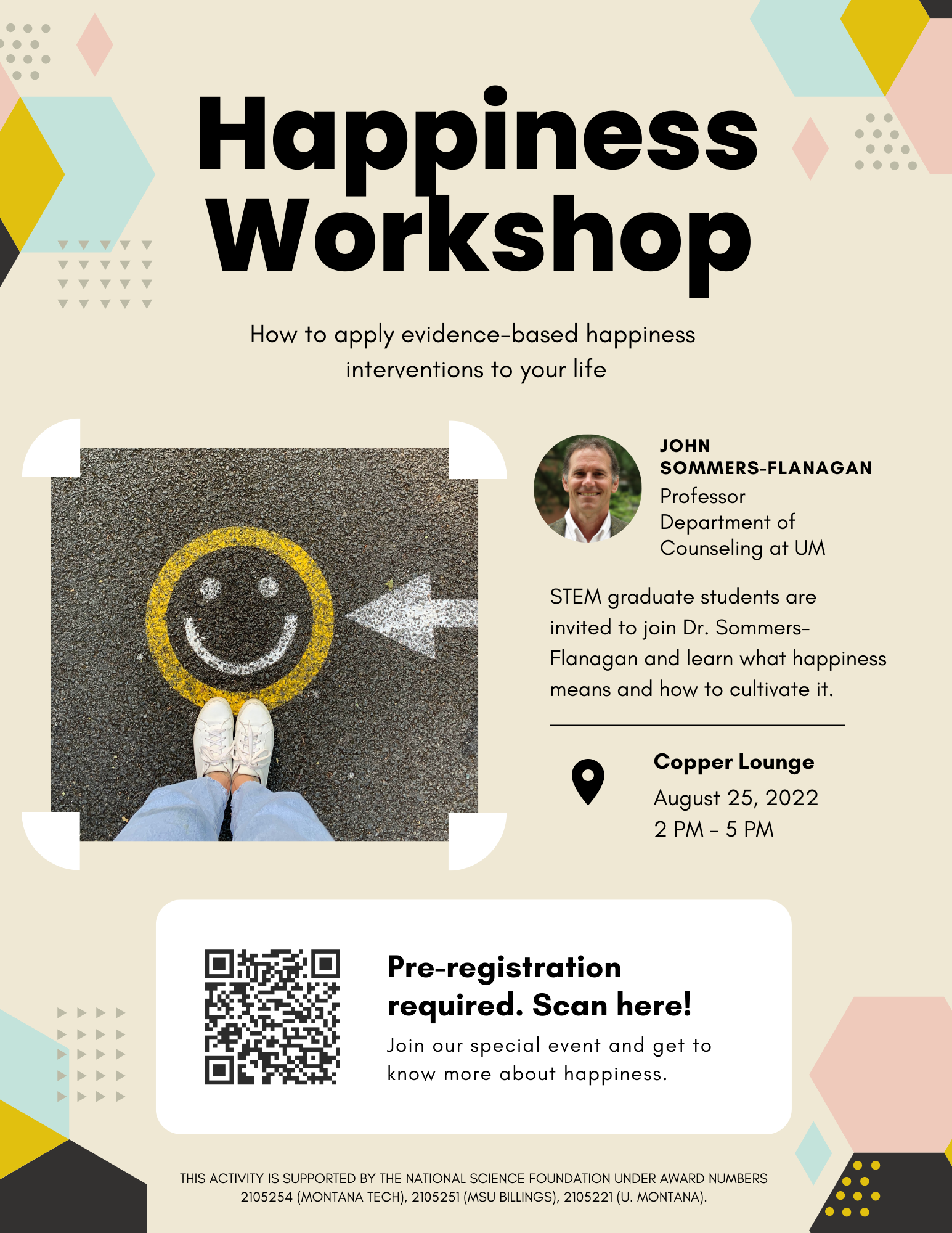
This is the flyer/registration form for Montana Tech in Butte. The link for the UM – Missoula workshop is below in the blog post.
Next week, the Montana Happiness Project and the Families First Learning Lab have a variety of educational offerings. I’ve listed them below, along with links that can provide additional information.
If you’re a STEM grad student at the University of Montana, and you want to attend a short (2.5 hour) evidence-based happiness workshop on Friday, August 26 (and get a free lunch), click on this link for more information and to register. https://umt.co1.qualtrics.com/jfe/form/SV_3yjFgwKqfmE7Qt8
As you can see below, I’m doing the same workshop for Montana Tech in Butte on Aug 25.
If you’re working with an organization that might want a speaker on happiness or strengths-based suicide assessment and treatment, you should check out the Montana Happiness Project “Speaker” page: https://montanahappinessproject.com/speakers . . . and contact us to let us know of your interest.
Okay. Here’s the list of events for Aug and Sept.
August 23, 2022 – John Sommers-Flanagan presents on “The art and science of happy teachers” to the Belgrade School staff. Belgrade, MT.
August 25, 2022 – Dylan Wright presents on “Parent Engagement” to the Youth Dynamics staff. Webinar.
August 25, 2022 – John Sommers-Flanagan presents on “Evidence-based happiness skills” to the Montana HOPES Project at Montana Tech. Butte, MT.
August 26, 2022 – John Sommers-Flanagan presents on “Evidence-based happiness skills” to the Montana HOPES Project at University of Montana. Missoula, MT.
September 1, 2022 – Dylan Wright presents on “The Art, Science, and Practice of Meaningful Happiness” for Mountain Home staff. Missoula, MT.
September 20, 2022 – John Sommers-Flanagan presents on “Suicide assessment and treatment: A strengths-based approach” for the Wallowa Valley Center for Wellness. Enterprise, OR.
The place to click if you want to learn about psychotherapy, counseling, or whatever John SF is thinking about.