Storming: My Favorite Group Stage (at least for today)

In group class, we’re covering content related to group stage called “Storming.” The Coreys’, who’ve written about and led many groups, call this the “Transition” stage. During the storming or transition stage, group members start to push against or question group norms and/or the group leader’s authority. Not to be trite, but like roses, no matter what name it, the smell and tension of storming feels the same.

I’ve been waiting and watching for storming to emerge within my class. I know group process unfolds during class groups, just as it unfolds in psychoeducational, counseling, and psychotherapy groups. I thought I might ignite storming, by asking my counseling graduate students to focus on positive psychology. I did get a little push-back from students who emailed me about their “mixed” feelings about positive psychology. My response was to share that I also hold mixed feelings about positive psychology, along with mixed feelings about psychoanalytic theory, behavioral theory, CBT, feminist theory, acceptance and commitment therapy, and every other theory or approach I can think of.

This past week an ever-so-minor edge of a storm found its way into class. After class started, one student expressed negative feelings about a reading I’d assigned, noting that she thought the article was “shaming” to mandated clients. As often occurs with storming, I had an immediate and complex emotional and impulse-ridden response. Rather than acting on my emotions or defending the reading, I managed to welcome the critique. When I say “managed” I mean to communicate that IMHO, welcoming critiques is not easy, and maybe not natural. A few minutes later, I acknowledged that although I wished everyone would love all the class readings, I also wanted people to feel they had permission to not love the readings and speak openly about their opinions. Later that evening, I received an email takeaway from the student who didn’t like the reading. As you may recall, one of my group class assignments is for students to email me two takeaways in the days following class. Because she expressed what I want to communicate better than I can, here’s her email (shared with her permission).

Hey John,

My biggest takeaway from today was watching your modeling of working with storming, both with myself and [with another student]. The way that you allowed for expression of our feelings, were vulnerable with your own, and then used the material to create more conversations, norms, etc., was really helpful to see. I also want to share on this topic that when my oldest kiddo and I were talking this morning about what our days were looking like, I was talking to her about my feelings about an article we read for class that I didn’t agree with, and that I was going to bring it up in class. And her response was, “You’re going to tell your professor that?!?!” She was shocked that I felt like I could say that in class, and I wanted to thank you for creating a space where I felt like that was alright.

My other takeaway is your quote from class today, “We want to give people the chance to be interesting.” I think there are so few opportunities that people have to be seen and heard by others in a way that is meaningful. Coupled with the big, sort of inherent opportunity as a group leader to take up ‘too much space,’ your advice feels like a really important nugget that I want to take with me into leading groups in the future.

What I love best about this email (and I love a lot of it) is my student’s anecdote about her daughter’s reaction: “You’re going to tell your professor that?!?!” And what I love best about that is—consistent with other conversations we’ve been having in class—we should not run groups like cults. As leaders, professors, administrators, clergy, and politicians, we need to be open to independence of thought and listen to unique perspectives. What I think is not the truth and what I value is not necessarily the correct moral philosophy for everyone.

Today. . . I am very happy to have handled a little storming with acceptance and openness. Tomorrow may be different. But for today, I get to feel the good feelings of being able to live my best group leader values—even if it didn’t involve me being right about anything.  

Group Leadership: Talking More and Talking Less

Teaching Group: Talking More and Talking Less

Lately, when presenting, I find myself naturally saying, “I’m a university professor. That means I can talk all day long.”

But because I know that me talking too much is a bad idea, I complement my university professor disclosure with, “I’d rather have a conversation, so please interrupt me with comments, questions, and reactions.” I also try to offer an experiential learning or reflection activity.

In group class, I have so many stories to tell that I can feel my already prodigious talking urges escalate. I could unleash my breathless wordy-self for three straight hours. The students would leave having been entertained (I am funny), and with a bit of knowledge, but without skills for running counseling groups.

All this circles back to my plan to make the course as experiential as possible. I want students to feel the feelings of being in the group facilitator chair. Some of those feelings will be nerves, but it’s better for students to feel more nerves in group class, and fewer nerves when they’re leading real groups.

We recently hit Day 1 of the transformative experiential chaos.  

I know from the takeaways that students write me every week that there were nerves. In a fishbowl group, I asked members to share one positive interpersonal quality. As a second and optional prompt, I suggested they could also share one less positive interpersonal quality.

My goal was for us to briefly look at and talk about Yalom’s concept of interpersonal learning.

I shared first (to demo leader self-disclosure and modeling); I intentionally described a positive and less positive interpersonal quality. The first student to disclose felt instant awareness of the past, present, and future. Afterward, she described feeling a burden to follow my lead, anxiety in the moment, along with instant recognition that she was about to become a role model. She shared both (a positive and less positive interpersonal quality). Everyone followed her lead. Some members felt more anxiety when sharing the positive qualities; for others, it was the opposite.

One takeaway involved the speed and power of norm-setting. I’m reminded of the social psych compliance research. More or less, people consciously or less consciously feel the “norm” and comply. The corollary takeaway is that when leaders set the norm, we need to do so carefully so as to not imply everyone needs to fall in line.

Jumping ahead, the next week I discussed Kelman’s theory of group cohesion. Although I absolutely love Yalom’s definition (“Cohesion is the attraction of the group for its members”), Kelman’s theory is complementary, and was introduced to my be my 1975 Mount Hood Community College football coach. Kelman (and my coach) identified three phases: Compliance, Identification, and Internalization. After talking about Kelman’s theory, several students reflected in their email takeaways about the nature of cult groups. . . and how compliance can become leader-driven. Wow. So good.

In response to one student’s takeaway, part of my email included the following:

“For groups to be safe, IMHO, that also means freedom; freedom to have dissenting beliefs and different experiences and different values. The “internalization” shouldn’t be too tight, or it does feel like a cult. I’m not sure I have great answers about safeguards to the abuse of group processes, and so you’ve given me things to chew on as well.”

Maybe the right recipe is for there to be leader-guided modeling, combined with clear rules and norms that support independent thinking and personal freedom. This is a VERY tricky balance. It’s easy for leaders (including me) to get too enamored with the sound of our own voices and the rightness of our own values.

This brings me back to reflecting on how much leaders should talk and how much leaders should listen. Of course, this depends on the type of group: psychoeducational groups involve more group leader talking. In contrast, counseling groups—even discussion-based groups or support groups—benefit from the group talking more and the leader talking less. This has been a repeated epiphany for students and for me: being aware of the need to balance leader-talk and leader modeling with group member talk and group member modeling.

For the next class, I gave everyone an electronic copy of a long list of 23 group counseling skills to integrate into one of their experiential groups. Here’s the list:

Teaching Group: The Case of Zoey and Adlerian Theory

Group class is rolling downstream so fast that I feel I’m riding down Niagara Falls in a barrel. Well, that might be me being dramatic. My personal drama partly explains why I’m so late blogging about week 2 of group class.

Much of the focus of week 2 was on Yalom’s 11 therapeutic factors. I think they’re subtle, powerful, and sneaky insightful. When I teach the 11 factors, I try to give as many concrete examples as possible. Here’s one:

I got asked to run two in-school groups for 5th graders. I had twins in group (one in each group). These were difficult groups. I had let the principal assign the members. I know, bad idea, especially because I knew better; pre-group screening was both optimal and ethical. I share this story because it’s a good one, but also because I can acknowledge that I make mistakes and am still a work in progress.

The twins identified themselves as evil and good. They seemed to be living up to their self-proclaimed identities. The evil twin (let’s call her Zoey) got “removed” from the first three group meetings. My rule was to remove students and send them back to class if they violated the group rules. Zoey was intermittently making aggressive physical contact. She ripped up some “Disney cards” I had given all the students, and threw them at me. In each case, I just said, “Zoey, you’ve broken a rule and you need to go back to your class.” There were small protests, but she would eventually stand up, leave group and go back to class.

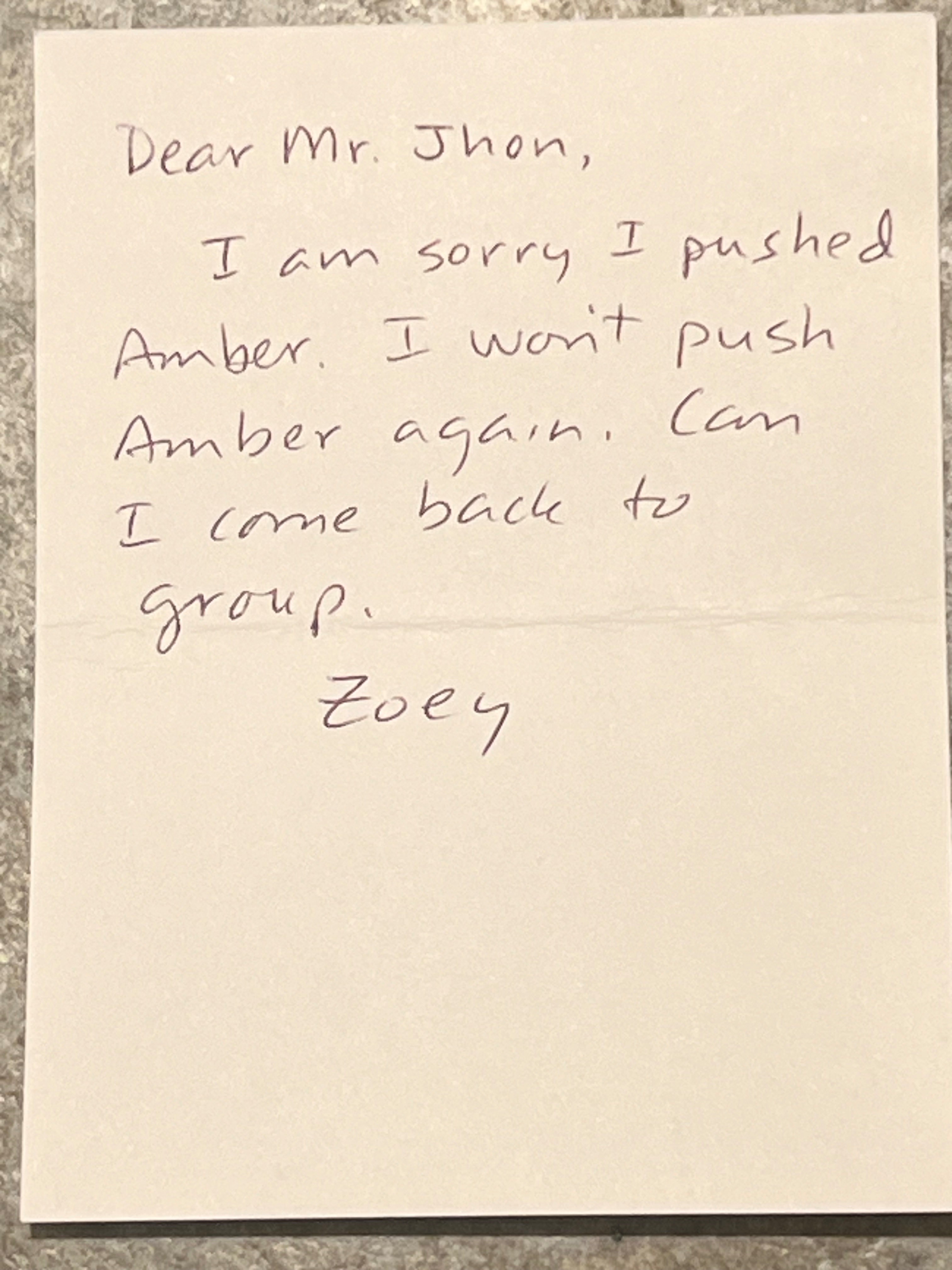
The other part of the rule was to let anyone who had been removed from group back in group if they presented me with an apology note. Zoey became an efficient apology note writer.

Dear Mr. Jhon,

I am sorry I pushed Amber. I won’t push Amber again. Can I come back to group?

Zoey

At the beginning of session 4, as Zoey walking into group, I impulsively said something like, “Zoey! You are in so much trouble. You are in so much trouble that you have to serve our group treats today.” Zoey stared at me, sat down, and began her new journey to becoming a very nice, polite, and wonderful group member.

I repeated my “You’re in so much trouble Zoey” opening the next week. And the next. Zoey never again pushed anyone, she didn’t argue, she became shockingly pleasant and cooperative.

At the end of group, Zoey wrote me a “Good bye” note. It read:

Dr. Mr. Jhon,

I had fun in group. Thank you for coming to our school. I will miss you.

Zoey

With this story (and many others), we get a chance to glimpse the complexities of human behavior. Zoey’s story also gives us a chance to apply counseling theory to group dynamics. The theory that comes to mind for Zoey is related to Dreikurs’ and Adler’s ideas about the 4 psychological goals of children’s misbehavior. You can read about why children (and adults) misbehave here: https://johnsommersflanagan.com/2017/06/10/why-children-misbehave-the-adlerian-perspective/. But in group, the focus is less on the 4 goals, and more on the two overarching factors that will, most of the time, mitigate and sometimes eliminate the misbehavior. What are these overarching factors?

A sense of belonging

Feeling useful

With Zoey, I think she suddenly felt useful. She also got proactive attention in a sort of sarcastic message of her being in trouble. I thought the “You’re in big trouble” part was pretty clever. But the more important part was to give her a job. . . to help her feel useful . . . and along with that came belonging.

In some ways, the Zoey intervention was an individual intervention that helped her function in a group. That was important because Zoey had never been successful in any group. She hadn’t been on a team, in a choir, and she rarely succeeded in making it through the school day without an interpersonal incident. “Graduating” from our group, was a big deal for Zoey.

Beyond the Adlerian principles, the evil twin scenario includes glimpses of Yalom’s therapeutic factors. Can you identify which ones? Here’s the list:

  1. Instillation of hope
  2. Universality
  3. Imparting information
  4. Altruism
  5. The corrective recapitulation of the family group
  6. Development of socializing techniques
  7. Imitative behavior
  8. Interpersonal learning
  9. Group cohesiveness
  10. Catharsis
  11. Existential factors

I’m heading into class momentarily, and so I’ll add the following observation quickly.

At this point, my group students still think I know what I’m doing. We’ve engaged in several whole group and subgroup (fishbowl) group activities where I’m the leader. One student referred to me as “smooth.” As much as I like that compliment, I also recognize that me being smooth is completely related to the students being engaged and cooperative. Maybe we’re still in the honeymoon phase of our group class. Maybe the storming is yet to come? Maybe everyone feels they belong, and that they’re useful. I do work at helping everyone feel belonging and usefulness.

As the instructor, I know that referencing that storming can happen and articulating, in advance, how I usually address storming, can make storming less likely. None of the students are especially keen to be the first stormers. Everyone (probably) knows that no matter the nature and content of the storming, I will try to meet it with acceptance and an opportunity for the stormer to “tell us more” while taking responsibility for their feelings. Nevertheless, sooner or later, I will want to prompt them to storm, rather than hold in feelings of discontent.

One last thought. I am not always smooth. I am not always competent. I am not always emotionally centered and ready to be a good group counselor. Given those realities, I’m also aware that it will be even more important (than being smooth) for me to acknowledge my mistakes and be vulnerable enough for students to accept me as a role model who isn’t just interested in being smooth, but is also interested in being vulnerable.

Thanks for reading! More to come soon. Here are the Week 2 powerpoints:

John

Practicing Forgiveness – In Theory

Last summer, when I taught our Happiness for Teachers course along with Lillian Martz, one of the most powerful assignments involved forgiveness. Even though we emphasized that the teachers taking our class didn’t need to actually engage in a forgiveness process, they shared incredibly deep and profound stories of betrayal, forgiveness, and the struggles in between. Here’s the assignment. Again, we’re not saying you need to engage in a forgiveness process. All we’re suggesting is for you to read this and think about forgiveness. Here’s the assignment:

Whether we’re talking self-forgiveness, forgiving others, or spiritual forgiveness, forgiveness is a big deal and a big ask.

For this learning activity, we don’t expect you to purge yourself of all personal guilt or become free from all resentments. Nevertheless, for this assignment, your job is to explore what forgiving yourself, forgiving others, and being forgiven might look like AND how forgiving yourself, forgiving others, and being forgiven might feel to you.

To do this activity, you’re not expected to actually do the forgiveness work; instead, you get to think about doing the forgiveness work and speculate on its effects. . . FOR YOU. Although forgiveness is probably the biggest issue we’ve tackled in this Happiness Challenge, the plan is for you to just take a small sip from the very large cup of potential forgiveness issues that we all have. If you want to go deeper and take a bigger drink, that’s perfectly fine, but that’s all up to you.

To get yourself oriented toward forgiveness you could (if you want) consider and access some of the following ideas and online resources:

Consider that forgiving others can improve your physical health. As Anne Lamott wrote in Traveling Mercies: “Not forgiving is like drinking rat poison and then waiting for the rat to die.” Is there anyone other there toward whom you might offer forgiveness? You don’t even have to talk with them (although you can, if that works for you). You can just bring yourself to a place where you’ve let go of any lingering anger or resentment that you’re holding.

Listen to the Hidden Brain episode: The Power of Mercy. https://hiddenbrain.org/podcast/the-power-of-mercy/

Listen to or read a short NPR piece on forgiveness: https://www.wvtf.org/2014-12-03/reach-forgiveness#stream/0  

Listen to Greater Good magazine’s podcast Episode 124: Nine Steps to Forgiveness https://greatergood.berkeley.edu/podcasts/item/anoosha_syed_forgiveness_self-compassion_virtues  

Watch Oprah’s “Aha” moment on forgiveness. https://www.findcenter.com/video/24318/oprahs-forgiveness-aha-moment/everything-else

Forgiveness is a multidimensional and dynamic process. It’s also very hard. We wish you well as you consider this big issue.

Teaching Group Counseling: Class 1

I feel sorry for Mick Jagger. In that one song he lamented over and over about not getting no satisfaction. If he would just have asked me, I could have helped. I would have told him exactly how to get satisfaction. I’d have said, “Hey Mick. All you have to do to get satisfaction is to teach a course on group counseling to about 34 fantastic counseling students from the University of Montana, along with having a couple of teaching assistants.”

That’s it, Mick. Even you can achieve satisfaction. Getting satisfaction from teaching group counseling might even inspire you to write a new song titled “So Much Satisfaction.” Here are some lyrics for you to consider (no need to thank me Mick):

I can’t stop getting, satisfaction,

cause I tried, and I tried, and I tried, and I tried

I keep getting so, much satisfaction. . . satisfaction. . . satisfaction.

No doubt all you readers are now on the edges of your seats and experiencing bated breath while waiting to hear how group class #1 went. Well, here’s the answer. Great. Awesome. Exciting. Fun. And satisfying. . . so satisfying.

During our introduction activities, everyone was engaged, funny, profound, humble, and always interesting. During my lecture time, I talked about group types and made my “we need to stretch ourselves to listen with acceptance to everyone” speech. One response to my little speech was genuine concern about being able to be accepting with clients who, in their presentation, are harsh, judgmental, and politically and socially extreme in their values. This was a challenging comment/question, because of how incredibly hard it is to listen with compassion and empathy when someone is expressing extremely unkind and judgmental thoughts and beliefs.

Had I been a better group counselor in the moment, what I might have done was to push the question/comment out to the group. On the other hand, I knew that I was probably the one in the room with the most experiences of this type. I was immediately (in Class #1) thrown into an Irv Yalom-esque group leader dilemma. Should I respond with my thoughts. . . or should I deflect the question/scenario to the group.

Yalom also emphasizes that group leaders are, by default, the group role-models and norm-setters. That being the case (and given that this is a graduate course with 36 “group participants”), I chose to throw myself and a couple stories into my response.

The stories—working with parents who insisted on not accepting their child’s sexuality/gender and working with fathers who, not infrequently, would call me variations on the theme of “pansy-ass”—emphasized the strategy of listening first, of thanking parents, clients, students, for their openness, and then highlighting the truth that we cannot lead with education (no matter how much we think it’s needed). Instead, we listen with acceptance and empathy until there’s an opportunity to “broaden” the parent/client/student’s perspective.

I’ve put the word “broaden” in quotations because it’s related to what I want to share next: The Weekly Class Takeaway Email Assignment.

The Takeaway Assignment

This past year, I’ve been using the weekly takeaways assignment to give me a clearer sense of what the students are experiencing in our classes together. For this assignment, students send me, within 5 days of the lecture/class time, an email describing their top two class takeaways. The takeaways assignment also allows me to evade the possibility of an AI generated response.

Typically, and this was the case with week one of the group class, student responses are consistent with what I thought they would takeaway. However, the most exciting part of reading the takeaways is when students weave their own personalized perceptions into their responses; this gives me a glimpse not only of what they’re thinking, but how the content I’m presenting on is being received and interpreted by students. I especially like it when students have reflections that surprise me, or include content that I had not expected, because . . . that’s when the learning goes both directions. 

In their takeaways, a couple students used the word “broaden” to discuss their perceptions of my response to the “How can we handle very judgmental clients?” question. I hadn’t remembered using the word, but it felt perfect—especially in the context of group counseling. One of the big goals of group counseling—again, I’m channeling Yalom—is to hear, see, feel, and experience the reflected appraisals of ourselves that come from other group members. Because we cannot always (or maybe ever) see ourselves as others see us, experiencing how other group members experience us is gold. When it’s working, the group offers us other perspectives that can broaden or expand our own narrow views of ourselves and the world.

Among many of my takeaways is that I loved the use of the word “broaden” to describe what good group counseling can give us. With broadened perspectives we can grow the depth, breadth, and accuracy of our perceptions of ourselves and others.

Here’s the ppt deck for last Tuesday’s class:

Until next week,

JSF   

Teaching Group Counseling: Preparation

For the first time in seven years, I’m teaching group counseling this semester. This forces me to think about, “What’s the latest scoop on teaching group counseling?” I’ve been reading and talking and gaining information, but if anyone out there has particular insights to share with me, please do.

In my prep, I’ve decided that there’s tons of content out there, in professional journals, books, book chapters, and everywhere else I look. Nevertheless, to break free from the oppression of content, one of my first decisions is to go experiential. This isn’t much different from seven years ago, but my plan is to be even MORE experiential.

Based on previous experiences teaching group, talking with faculty, and talking with students, the Group course is a place with a complex mix of anxiety, vulnerability, and potential conflict. To manage this exciting and challenging mix, I’ve got several plans.

  1. After my infamous “Group is open” anecdote, I will share my philosophy on brain development and counselor skill development. In the Moodle shell, I wrote: “Hey Everybody, Welcome to our group counseling course at U of M. I love group counseling and I love teaching group counseling. More than any other approach, group work requires that we maintain an attitude of acceptance and hold the statements and disclosures that others make with sensitivity and grace. One big goal in this class is for all of us to continue to grow those parts of our brain that makes us excellent listeners. Mostly, we need to let go of other parts of our brain that wants to debate, argue, and express our opinions. I look forward to this adventure and journey with you. See you Tuesday, John SF”
  2. TBH, I’m not sure how my philosophy will fly with students . . . but sharing it fits with Irvin Yalom’s mantra that the group leader is instantly the primary norm setter and role model. Along with my philosophy, I will also disclose some of my anxieties and insecurities. Yes . . . even after 40+ years as a mental health professional, I still feel the creep of imposter anxiety.
  3. Then we’ll circle up and jump into two rounds of experiential introductions. I do two rounds of experiential introductions to give students a chance to “feel” the difference between more structured and less structured group process. I’ve done this before; it feels like a relatively safe, fun, and process-oriented opening.
  4. Then, in the spirit of Yalom’s “self-reflective loop,” we will debrief and debrief some more.
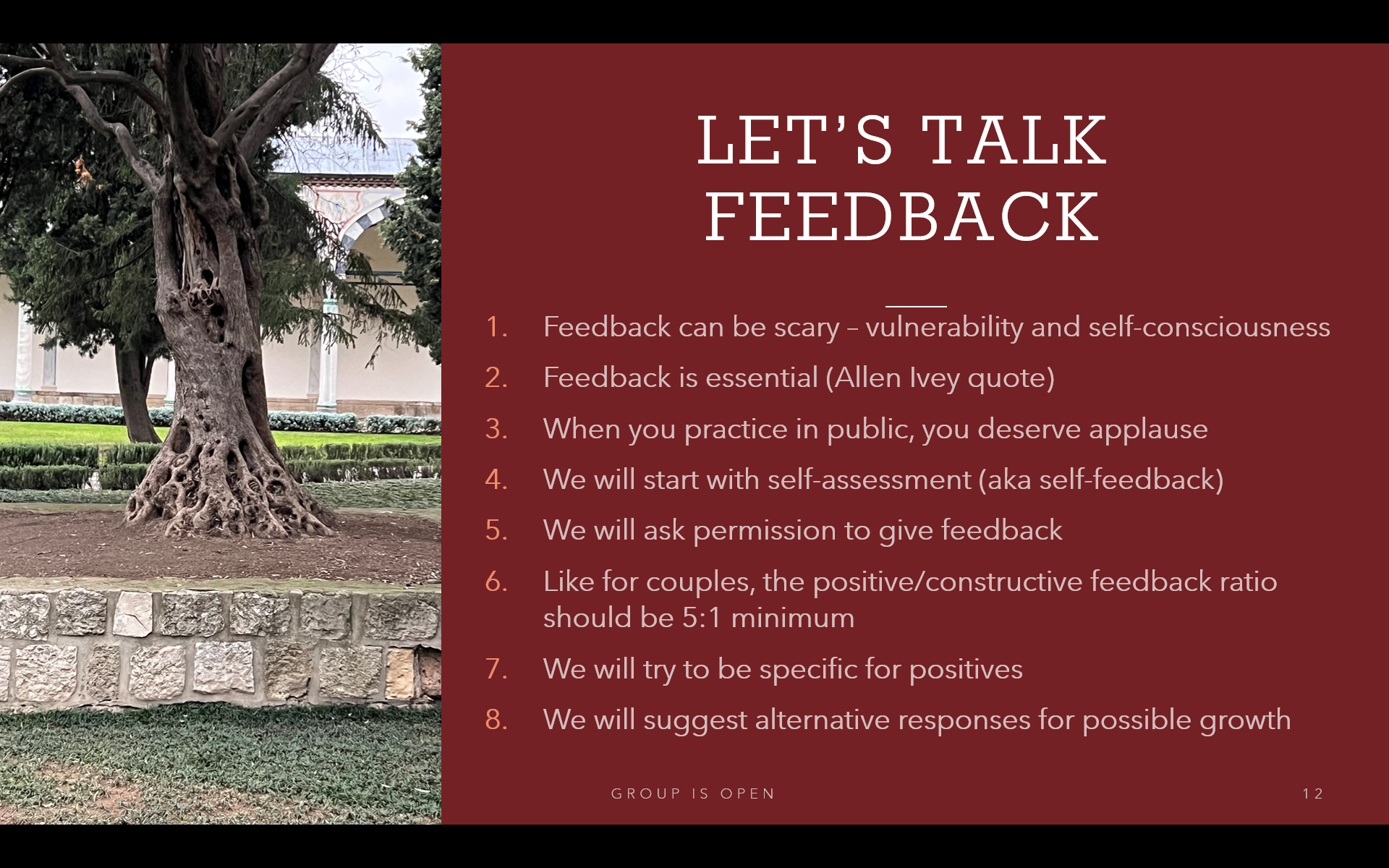
  5. After exiting the experiential introductions, we’ll stay in the circle, review the course syllabus (assignments), and then talk about our planned feedback process. Once, when I asked Allen Ivey for his best advice on learning counseling skills, he said he could summarize his advice in six words: “Practice, practice, practice, feedback, feedback, feedback.” I thought that was a pretty cool answer. You can check out my ideas about feedback on a previous blog post: https://johnsommersflanagan.com/2020/08/18/guidelines-for-giving-and-receiving-feedback/
  6. The last part of class #1 (time permitting) will be me reviewing a few group counseling basics (e.g., group types, group stages, cultural humility, under-confidence, overconfidence, and the wonder and narrowness of the dialectic of lived experience. Should be a blast.

I’m hoping to blog every week about my Group Counseling class and the teaching and learning experience. Of course, that will depend on my time management skills. I’m thinking maybe I’ll coax one of my students into running a psychoeducational group on time management—and then maybe I’ll actually achieve my weekly Group Counseling goals.

Here’s a screenshot of my feedback prompt (aka ppt slide).

More Therapeutic Writing: The Best Possible Self

Last week was about emotional journaling. This week, we stick with the power of words and writing and take a dive into an evidence-based therapeutic writing activity called the Best Possible Self.

You all already know about optimism and pessimism.

Some people see the glass half full. Others see the glass half empty. Still others, just drink and savor the water, without getting hung up on how much is in the glass. Obviously, there are many other responses, because some people spill the water, others find a permanent water source, and others skip the water and drink the wine or pop open a beer.

Reducing people to two personality types never works, but that doesn’t stop people from labeling themselves or others as optimists or pessimists. This week’s activity—The Best Possible Self—is an optimism activity. You don’t have to be a so-called optimist to use it. And the good news is, regardless of your labels, the Best Possible Self writing activity is supposed to crank up your sense of optimism. That’s cool, because generally speaking, optimism is a good thing. Here’s what the researchers say about the Best Possible Self (BPS) activity.

[The following is summarized from Layous, Nelson, and Lyubomirsky, 2012]. Writing about your Best Possible Self (also seen as a representation of your goals) shows long-term health benefits, increases life satisfaction, increases positive affect, increases optimism, and improves overall sense of well-being. Laura King, a professor at U of Missouri-Columbia developed the BPS activity.

King’s original BPS study involved college students writing about their Best Possible Selves for 15 minutes a day for two weeks. The process has been validated with populations other than college students. If you want to jump in that deep, go for it. On the other hand, if you want a lighter version, here’s a less committed alternative:

  • Spend 10 minutes a day for four consecutive days writing a narrative description of your “best possible future self.”
  • Pick a point in the future – write about what you’ll be doing/thinking then – and these things need to capture a vision of you being “your best” successful self or of having accomplished your life goals.
  • As with all these activities, monitor your reactions. Maybe you’ll love it and want to keep doing it. Maybe you won’t.
  • If you feel like it, you can share some of your #writing on social media.

Berkeley’s Greater Good website includes a nice summary of the BPS activity. Here’s a pdf from their website: 

Being a counseling and psychotherapy theories buff, I should mention that this fantastic assignment is very similar to the Adlerian “Future Autobiography.” Adler was way ahead of everyone on everything, so I’m not surprised that he was thinking of this first. Undoubtedly, Adler saw the glass half full, sipped and savored his share, and then shared it with his community. We should all be more like Adler.

Writing Your Way to Better Health

Nothing works for everyone. Not everyone is comfortable writing about their experiences and not everyone can benefit from therapeutic writing. But, for those keen on the expressive writing modality, you can get out your pen or laptop and make a little therapeutic magic.

For this week’s Montana Happiness Challenge, I phrased it this way: What if, by engaging in a simple procedure for three consecutive days, you could obtain the following benefits?

  • A reduced need to go see a physician
  • Improved immune functioning
  • Fewer physical ailments or symptoms
  • Less distress
  • Less negative affect
  • Less depression
  • Improved GPA
  • Less absenteeism from work

As it turns out, according to social psychologist and prominent researcher, James Pennebaker, there is a simple procedure for accomplishing all of the above, right at your fingertips. Literally. At. Your. Fingertips. All you have to do is write about hard, difficult, or traumatic experiences. Here’s an example (summarized) of his instructions:

For the next three days write about your very deepest thoughts and feelings about an extremely important emotional issue that has affected you and your life. When writing, really let go and explore your deepest emotions and thoughts. You might want to tie your writing into your relationships with others or to your past/present/future, or to who you’ve been, who you are, and who you’d like to be in the future. You can write about the same topic every day or a new one every day. Keep your writing confidential. Don’t worry about spelling, grammar, etc., just write for 15-30 minutes straight. (adapted from Pennebaker, 1997) 

I’ve been gobsmacked (aka astounded) by Pennebaker’s research for three decades. So much so that I remember where I was when I first read his 1986 article. Despite my gob-smacked-ness, I think it’s important to remember that Pennebaker is a social psychologist; he isn’t a clinical or counseling psychologist, a clinical mental health counselor, or a clinical social worker. As a consequence, I’m not asking you to leap right into his assignment without support. In fact, most researchers, including Pennebaker, believe you can gain the same benefits by talking about painful emotional experiences with a counselor or psychotherapist. One additional caveat: Pennebaker has also found that when writing or talking about traumatic experiences, often people feel distressed or emotionally worse to start, but over time they begin feeling better than they did in the beginning.

To do this activity, just think about Pennebaker’s method and his claims, and notice: (a) what you think of his idea, (b) whether you would ever like to try his technique, and (c) if you chose to try to process some deeper emotional issues, whether you would prefer writing or talking about them.

If you decide to really try Pennebaker’s method (that’s up to you), remember that your first reaction might be to feel worse. Therefore, having someone you trust to confide in about how you’re feeling through the process might be a good idea.

For me–and I know I’m weird–I like to go back and read some of the early research on these “therapeutic techniques.” Sometimes there’s no research to be found (think: somatic approaches or polyvagal theory); other times, the gaps between what was studied and what the media and popular psychology reports is huge (think: adverse childhood experiences and the research on predicting divorce); but on occasion, the original research is stunningly good. Here’s one of Pennebaker’s early studies. It’s really worth a read:

If you want to dive into Pennebaker’s method, you could use one of his books as a guide. Here’s one example: https://www.abebooks.com/Opening-Writing-Down-Expressive-Improves-Health/22531442075/bd?cm_mmc=ggl-_-US_Shopp_Trade-_-new-_-naa&gclid=CjwKCAjw4pT1BRBUEiwAm5QuR4ZmBWoiw2FhWHexwZiPtAnyDc9frTptZr9dimZhEWcsE4HUl70gzxoCd60QAvD_BwE

John S-F

The Effectiveness and Potential of Single-Session Therapeutic Interventions

Imagine the possibility of a scalable single-session intervention that has been shown to be effective with a wide range of mental health issues. In these days of widespread mental health crisis and overwhelmed healthcare and mental health providers, you might think that effective single-session interventions are a fantasy. But maybe not.

This morning, my older daughter emailed me a link to two videos from the lab of Dr. Jessica Schleider of Northwestern University. Dr. Schleider’s focus is on single-session therapeutic interventions. Although I hadn’t seen the website and videos, I was familiar with Dr. Schleider’s work and am already a big fan. Just to give you a feel for the range and potential of single-session interventions, below I’m sharing a bulleted list of titles and dates of a few of Dr. Schleider’s recent publications:

  • Realizing the untapped promise of single‐session interventions for eating disorders – 2023
  • In-person 1-day cognitive behavioral therapy-based workshops for postpartum depression: A randomized controlled trial – 2023
  • A randomized trial of online single-session interventions for adolescent depression during COVID-19 – 2022
  • An online, single-session intervention for adolescent self-injurious thoughts and behaviors: Results from a randomized trial – 2021
  • A single‐session growth mindset intervention for adolescent anxiety and depression: 9‐month outcomes of a randomized trial – 2018
  • Reducing risk for anxiety and depression in adolescents: Effects of a single-session intervention teaching that personality can change – 2016

Single-session therapy or interventions aren’t for everyone. Many people need more. However, given the current mental health crisis and shortage of available counselors and psychotherapists, having a single-session option is a great thing. As you can see from the preceding list, single-session interventions have excellent potential for effectively treating a wide range of mental health issues. Given this good news about single-session interventions, I’m now sharing with you that link my daughter shared with me: https://www.schleiderlab.org/labdirector.html

I’ve been interested in single-session interventions for many years. Just in case you’re interested, here’s a copy of my first venture into single-session research (it’s an empirical evaluation of a single-session parenting consultation intervention, published in 2007).

I hope you all have an inspiring Martin Luther King, Jr. weekend.

JSF

Thoughts on Ethnic Matching From Clinical Interviewing (7th edition)

Every chapter in Clinical Interviewing has several pop-out boxes titled, “Practice and Reflection.” In this–the latest–edition, we added many that include the practice and perspective of diverse counselors and psychotherapists. Here’s an example from Chapter One.

PRACTICE AND REFLECTION 1.3: AM I A GOOD FIT? NAVIGATING ETHNIC MATCHING IN PRIVATE PRACTICE

The effects of ethnic matching on counseling outcomes is mixed. In some cases and settings, and with some individuals, ethnic matching improves treatment frequency, duration, and outcomes; in other cases and settings, ethnic matching appears to have no effects in either direction (Olaniyan et al., 2022; Stice et al., 2021). Overall, counseling with someone who is an ethnic/cultural match is meaningful for some clients, while other clients obtain equal meaning and positive outcomes working with culturally different therapists.

For clients who want to work with therapists who have similar backgrounds and experiences, the availability of ethnically-diverse therapists is required. In the essay below, Galana Chookolingo, Ph.D., HSP-P, a licensed psychologist, writes of personal and professional experiences as a South Asian person in independent practice.

On a personal note, being from a South Asian background in private practice has placed me in a position to connect with other Asians/South Asians in need of culturally-competent counseling. In my two years in solo private practice, I have had many individuals reach out to me specifically because of my ethnicity and/or the fact that I am also an immigrant to the U.S. (which I openly share on my website). These individuals hold an assumption that I would be able to relate to a more collectivistic worldview. Because I offer free consultations prior to meeting with clients for an intake, I have had several clients ask directly about my ability to understand certain family dynamics inherent to Asian cultures. I have responded openly to these questions, sharing the similarities and differences I am aware of, as well as my limitations, since I moved to the U.S. before age 10. For the most part, I have been able to connect with many clients of Asian backgrounds; this tends to be the majority of my caseload at any given time.

As you enter into the multicultural domain of counseling and psychotherapy, reflect on your ethnic, cultural, gender, sexual, religious, and ability identities. As a client, would you prefer working with someone with a background or identity similar to yours? What might be the benefits? Alternatively, as a client, might there be situations when you would prefer working with someone who has a background/identity different than yours? If so, why and why not?

Reflecting on Dr. Chookolingo’s success in attracting and working with other Asian/South Asian people . . . what specific actions did she take to build her caseload? How did she achieve her success?

[End of Practice and Reflection 1.3]

For more info on ethnic matching, see these articles:

Olaniyan, F., & Hayes, G. (2022). Just ethnic matching? Racial and ethnic minority students and culturally appropriate mental health provision at British universities. International Journal of Qualitative Studies on Health and Well-being, 17(1), 16. doi:https://doi.org/10.1080/17482631.2022.2117444

https://www.tandfonline.com/doi/full/10.1080/17482631.2022.2117444

Stice, E., Onipede, Z. A., Shaw, H., Rohde, P., & Gau, J. M. (2021). Effectiveness of the body project eating disorder prevention program for different racial and ethnic groups and an evaluation of the potential benefits of ethnic matching. Journal of Consulting and Clinical Psychology, 89(12), 1007-1019. doi:https://doi.org/10.1037/ccp0000697

https://psycnet.apa.org/doiLanding?doi=10.1037%2Fccp0000697

The place to click if you want to learn about psychotherapy, counseling, or whatever John SF is thinking about.