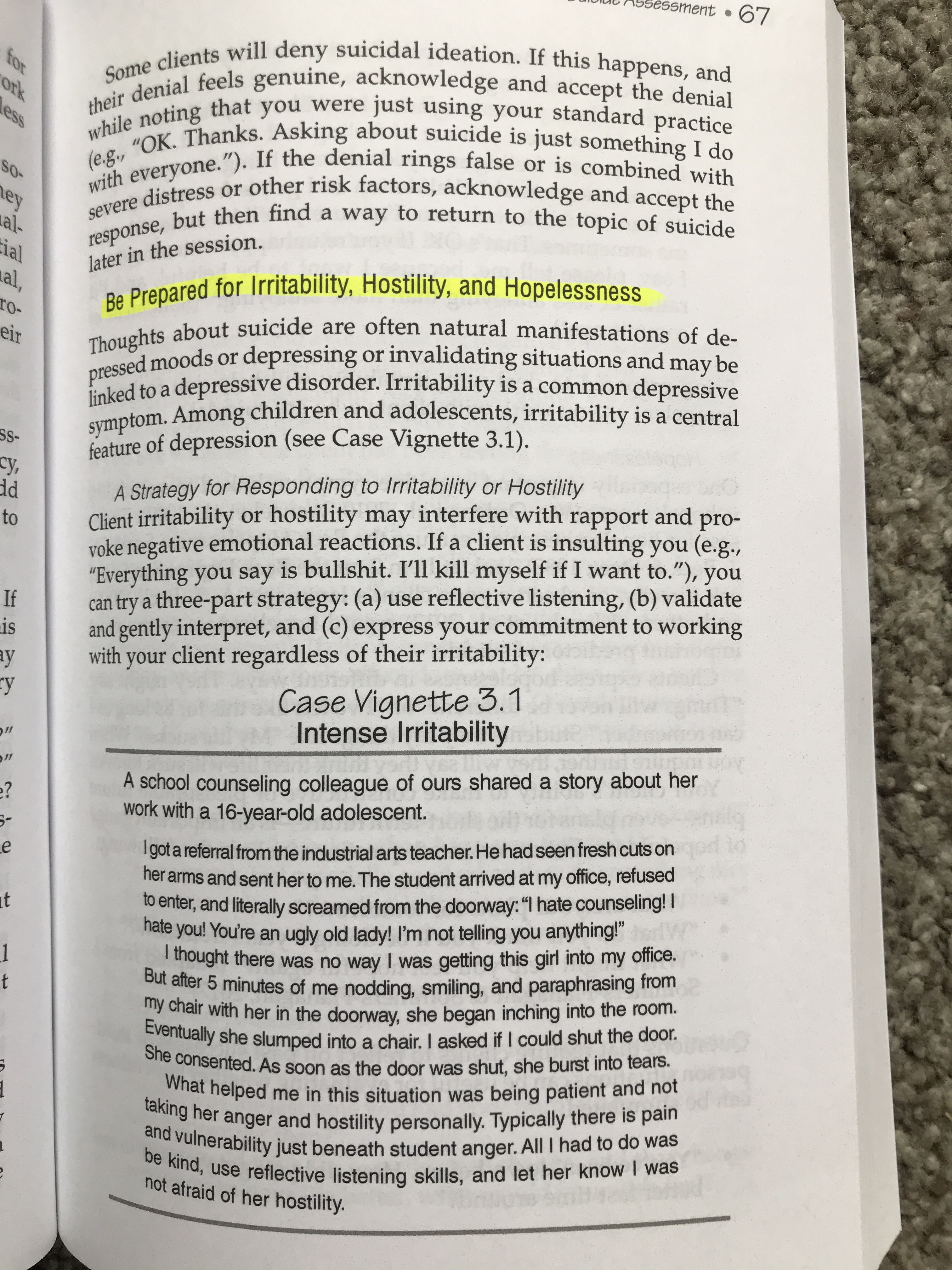
Just for fun, here’s a photo of a page from our Suicide Assessment and Treatment Planning book. This page is the lead in to a section that focuses in on how to work with clients who are suicidal, but whom also may be naturally also experiencing irritability, hostility, and hopelessness. For info, go to the publisher, ACA: https://imis.counseling.org/store/detail.aspx?id=78174
Just a heads up. I’ll be writing several posts about our new book this week. Be forewarned, these posts may be annoying. Annoying can happen when people feel enthusiastic. My apologies in advance.
In response to these upcoming posts from me (or annoying posts from others), you can apply one of three strategies.
You can respond with positive affirmation, sharing, and by empathically matching my enthusiasm. Keep in mind that positive affirmation may make me happy. The downside is you risk reinforcing my “new book posting” behavior.
You can respond with no response. That was a favored B.F. Skinner and Ivan Pavlov strategy. Think of it as putting me on a pain-free extinction schedule.
You can respond with negativity or punishment. Skinner, Adler, and child advocates oppose punishment, because punishment can backfire, causing undesired behavior to increase, or triggering erratic behaviors.
True confession: When reading offensive or annoying posts, sometimes, even though I know better, I give into temptation, and respond with negativity. That’s nearly always a bad idea, mostly because option #3 of the preceding list is a poor extinction strategy. In one recent study, when social media posts received highere numbers of negative responses, the original social media posters responded back with even more posts. In other words, attention—even negative attention—acts as positive reinforcement and often increases the behavior toward which it was aimed. The take-home message is that, generally speaking, if you want to extinguish annoying blog posting behavior, following Skinner’s and Pavlov’s advice makes for good behavioral strategy.
Although I’m wary of the possibility of you all putting me on an extinction schedule, below is an excerpt from the Preface of our fancy new book. Right now the book is only available on the publisher’s website (https://imis.counseling.org/store/detail.aspx?id=78174), but I suspect it will soon make its way over to Amazon and the rest of the booksellers.
Preface
Writing a book about suicide may not have been our best idea ever. Rita made the point more than once that reading and writing about suicide at the depth necessary to write a helpful book can affect one’s mood in a downward direction. She was right, of course. Her rightness inspired us to pay attention to the other side of the coin, so we decided to integrate positive psychology and the happiness literature into this book. As is often the case when grappling with matters of humanity, focusing on suicide led us to a deeper understanding of suicide’s complementary dialectic, a meaningful and fully-lived life, and that has been a very good thing.
Before diving into these pages, please consider the following.
Do the Self-Care Thing
In the first chapter, we strongly emphasize how important it is to practice self-care when working with clients who are suicidal. Immersing ourselves in the suicide literature required a balancing focus on positive psychology and wellness. While you’re reading this book and exploring suicide, you cannot help but be emotionally impacted, and we cannot overstate the importance of you taking care of yourself throughout this process and into the future. You are the instrument through which you provide care for others . . . and so we highly encourage you to repeatedly do the self-care thing.
What is the Strengths-Based Approach?
Many people have asked, “What on earth do you mean by a strengths-based approach to suicide assessment and treatment planning?” In response, we usually meander in and out of various bullet points, relational dynamics, assessment procedures, and try to emphasize that the approach is more than just strengths-based, it’s also wellness-oriented and holistic. By strengths-based, we mean that we recognize and nurture the existing and potential strengths of our clients. By wellness-oriented we mean that we believe in incorporating wellness activities into counseling and life. By holistic we mean that we focus on emotional, cognitive, interpersonal, physical, cultural-spiritual, behavioral, and contextual dimensions of living.
You will find the following strengths-based, wellness-oriented, and holistic principles woven into every chapter of this book.
Historically, suicide ideation has been socially constructed as sinful, illegal, or a terribly frightening and bad illness. In contrast, we believe suicide ideation is a normal variation on human experience that typically stems from difficult environmental circumstances and excruciating emotional pain. Rather than fear client disclosures of suicidality, we welcome these disclosures because they offer an opportunity to connect deeply with distressed clients and provide therapeutic support.
Although we believe risk factors, warning signs, protective factors, and suicide assessment instruments are important, we value relationship connections with clients over predictive formulae and technical procedures.
We believe trust, empathy, collaboration, and rapport will improve the reliability, validity, and utility of data gathered during assessments. Consequently, we embrace the principles of therapeutic assessment.
We believe that counseling practitioners need to ask directly about and explore suicide ideation using a normalizing frame or other sophisticated and empathic interviewing strategies.
We believe traditional approaches to suicide assessment and treatment are excessively oriented toward psychopathology. To compensate for this pathology-orientation, we explicitly value and ask about clients’ positive experiences, personal strengths, and coping strategies.
We believe the narrow pursuit of psychopathology causes clinicians to neglect a more complete assessment and case formulation of the whole person. To compensate, we use a holistic, seven-dimensional model to create a broader understanding of what’s hurting and what’s helping in each individual client’s life.
We value the positive emphasis of safety planning and coping skills development over the negative components of no-suicide contracts and efforts to eliminate suicidal thoughts.
As a method for putting 2020 behind me and focusing on a hopeful 2021, I engaged in some forward thinking (rather unusual for me) and wrote an op-ed piece for the Missoulian newspaper to be published TODAY! Below, I’ve pasted the beginning of the article, along with a link to the whole darn thing in the Missoulian. If you feel so moved, please share and like this. . . and I hope you experience the return of happiness in 2021.
*********************************
The Return of Happiness: Your 2021 Guide
Usually a great source of snarky humor, the Urban Dictionary lists its top definition for 2020 as, “The worst year ever.” Sadly, even the Urban Dictionary couldn’t find creative inspiration from the horrors of 2020. Goodbye, 2020; you will not be missed.
As we approach the end of 2020, many of us are looking forward–like never before in the history of time–to turning that calendar to a new page and a new year. Readers of the Washington Post were recently surveyed and wrote, 2020 has been exhausting, relentless, and heartbreaking. Let’s put 2020 behind us and never look back (other than to remind ourselves of mistakes we shouldn’t make again).
In honor of turning the calendar to 2021, I’m working on an Op-Ed piece titled “The Return to Happiness.” The point of the piece is to acknowledge how good it is to move on, but also discuss the nature of New Year’s resolutions and how to make resolutions that have a reasonable chance of being accomplished. In the end, I’ll be making a pitch for everyone to sign up for my University of Montana course “The Art & Science of Happiness.” Well, not everyone, but anyone who wants to have a cool online “university” experience that provides an opportunity to test out the best, evidence-based, approaches to happiness on planet earth.
The course starts in January, and, for the first time ever, will be offered to “community” participants as a non-credit experience. This means EVERYONE can sign up. The catch is that it costs $150. But if you do the math, that’s only $10/week or about $3.50 an hour to discuss, learn, experiment with, and establish new happiness habits for 2021.
Here’s a description of the course:
Over the past 20 years, research on happiness has flourished. Due to the natural interest that most Americans have for happiness, research findings (and unfounded rumors) have been distributed worldwide. Every day, happiness is promoted via online blogs, newspaper and magazine articles, Twitter posts, Instagram videos, TikTok, and through many other media and social media venues. Ironically, instead of increases in national happiness, most epidemiological research indicates that all across the U.S., children, adolescents, adults, and seniors are experiencing less happiness, more depression, and higher suicide rates. To help sort out scientific reality from unsubstantiated rumors, in this course, we will describe, discuss, and experience the art and science of happiness. We will define happiness, read a popular happiness book, examine scientific research studies, try out research experiments in class, engage in extended happiness lab assignments, and use published instruments to measure our own happiness and well-being. Overall, we will focus on how happiness and well-being are manifest in the physical, cognitive, emotional, interpersonal, spiritual/cultural, behavioral, and contextual dimensions of our lives.
Other things to know: If you take the course as a community, non-credit, participant, you won’t take the quizzes, or get graded, and assignments will be optional. However, you will be asked to participate in small group lab sessions designed to give you (and others) a chance to talk and listen to each other as you experience and experiment with specific happiness assignments.
As many of you know, Rita and I have been working on a suicide assessment and treatment planning manuscript to be published by the American Counseling Association. Today, we received a photo of the full (front and back) cover. Although we know you’re not nearly as excited about this book (coming in mid-January!) as we are, below, I’ve pasted the photo of the cover and the first part of the Preface.
Preface
Writing a book about suicide may not have been our best idea ever. Rita made the point more than once that reading and writing about suicide at the depth necessary to write a helpful book can affect one’s mood in a downward direction. She was right, of course. Her rightness inspired us to pay attention to the other side of the coin, so we decided to integrate positive psychology and the happiness literature into this book. As is often the case when grappling with matters of humanity, focusing on suicide led us to a deeper understanding of suicide’s complementary dialectic—a meaningful and fully-lived life–and that has been a very good thing.
Before diving into these pages, please consider the following.
Do the Self-Care Thing
In the first chapter, we emphasize how important it is to practice self-care when working with clients who are suicidal. Immersing ourselves in the suicide literature required a balancing focus on positive psychology and wellness. While you’re reading this book and exploring suicide, you cannot help but be emotionally impacted, and we cannot overstate the importance of you taking care of yourself throughout this process and into the future. You are the instrument through which you provide care for others . . . and so we highly encourage you to repeatedly do the self-care thing.
What is the Strengths-Based Approach?
Many people have asked, “What on earth do you mean by a strengths-based approach to suicide assessment and treatment planning?” In response, we usually meander in and out of various bullet points, relational dynamics, assessment procedures, and try to emphasize that the approach is more than just strength-based, it’s also wellness-oriented and holistic. By strengths-based, we mean that we recognize and nurture the existing and potential strengths of our clients. By wellness-oriented we mean that we believe in incorporating wellness activities into counseling and life. By holistic we mean that we focus on emotional, cognitive, interpersonal, physical, cultural-spiritual, behavioral, and contextual dimensions of living.
You will find the following strengths-based, wellness-oriented, and holistic principles woven into every chapter of this book.
Historically, suicide ideation has been socially constructed as sinful, illegal, or a terribly frightening and bad illness. In contrast, we believe suicide ideation is a normal variation on human experience that typically stems from difficult environmental circumstances and excruciating emotional pain. Rather than fear client disclosures of suicidality, we welcome these disclosures because they offer an opportunity to connect deeply with distressed clients and provide therapeutic support.
Although we believe risk factors, warning signs, protective factors, and suicide assessment instruments are important, we value relationship connections with clients over predictive formulae and technical procedures.
We believe trust, empathy, collaboration, and rapport will improve the reliability, validity, and utility of data gathered during assessments. Consequently, we embrace the principles of therapeutic assessment.
We believe that counseling practitioners need to ask directly about and explore suicide ideation using a normalizing frame or other sophisticated and empathic interviewing strategies.
We believe traditional approaches to suicide assessment and treatment are excessively oriented toward psychopathology. To compensate for this pathology-orientation, we explicitly value and ask about clients’ positive experiences, personal strengths, and coping strategies.
We believe the narrow pursuit of psychopathology causes clinicians to neglect a more complete assessment and case formulation of the whole person. To compensate, we use a holistic, seven-dimensional model to create a broader understanding of what’s hurting and what’s helping in each individual client’s life.
We value the positive emphasis of safety planning and coping skills development over the negative components of no-suicide contracts and efforts to eliminate suicidal thoughts.
Last week I received a comment on this blog. Getting a comment is always very exciting, partly because I don’t get all that many and partly because the comments are usually positive and affirming. In this case the comment was neither positive nor affirming.
Although getting critical comments isn’t nearly as fun and ego-boosting as affirming comments, receiving criticism is important to self-examination and growth. The person who commented last Thursday was upset about my “politics.” As many of you know, I’ve occasionally written about Mr. Trump and lamented his behavior. Sometimes, I’ve felt nervous posting critiques of Mr. Trump, worrying that I may have been behaving in ways that were less that professional and worrying that perhaps I shouldn’t openly express my negative opinions about his behavior. However, in the end, I’ve often ended up deciding that my critiques of Mr. Trump aren’t really about politics anyway.
Digesting Thursday’s comment has helped me clarify my position on political commentary. Here’s a version of what I wrote back to my blog commenter.
********************************************
Dear Karen,
Thanks for your message.
Many years ago when I interviewed Natalie Rogers, I recall her telling me something very compelling about her father, Carl Rogers. She said, in her family, all feelings were accepted, but not all behaviors.
Although some of my judgments about Mr. Trump have political components, most of my judgments about him focus on his personality and behavior. Politics aside, I wouldn’t care if he was a democrat, an independent, a republican, a corporate mogul, a teacher, a coach, or a rock star. I find his behavior to be an unacceptable example for children. From my perspective it’s clear that Mr. Trump is much more focused on using and abusing power than he is on empowering others. To return to Carl Rogers: Rogers believed the best use of power was to empower others. My perception of Mr. Trump is that he’s invested in accumulating power, and not on empowering others.
I could make a list of video evidence of Mr. Trump mocking disabled people, calling women “fat pigs,” disrespecting war veterans (including John McCain, whom I’ve never written a negative judgmental word about, despite his politics), paying off prostitutes, saying positive and supportive things about dictators and racists, and his continuous flow of lies. If Mr. Trump was my neighbor or a colleague at my University, it would be wrong for me to let his behavior pass without making it clear that I find his behaviors to be a potentially destructive and negative influence on children in the neighborhood or the culture at the University. Not only do I have a responsibility to be non-judgmentally accepting in therapeutic contexts, I also have a responsibility to speak up and speak out against racism and the promotion of violence. I believe there’s ample evidence that Mr. Trump has promoted racism and incited violence. My rejection of those behaviors isn’t particularly political; I simply believe that it’s morally wrong to promote racism and foment violence.
I can see we have different views of Mr. Trump. You may not see the evidence that I see, or you may find his behaviors less offensive and less dangerous. Although it’s challenging for me to understand your perspective, I know you’re not alone, and I know you must have reasons for believing the ways you believe. I can accept that.
But to articulate my perspective further, here’s a therapy example. If I was working with a client who exhibited no empathy or said things to others that were likely to incite violence, as a psychotherapist, I would work toward a greater understanding of the client’s emotions. In addition, I would consider it my professional responsibility to question those behaviors . . . for both the good of the client and the good of people in the client’s world.
Again, thanks for your message. It’s important to hear other perspectives and to have a chance to question myself and my own motives. I appreciate you providing me with that opportunity.
We put the following quote into our forthcoming book on Suicide Assessment and Treatment.
The quote is from 20th century Philosopher W. W. Bartley. Bartley took a break from writing about philosophical rationalism, to put the message of Neibuhr’s Serenity Prayer into a Mother Goose nursery rhyme format.
“For every ailment under the sun
There is a remedy, or there is none;
If there be one, try to find it;
If there be none, never mind it.”
Good advice.
I wish everyone peace and serenity for the weekend and beyond.
Yesterday, for Halloween, I dressed up as agitation. I wasn’t alone. Everywhere I went, everyone I saw, and around every corner, I encountered agitation. Maybe it was herd mentality. But no one developed immunity.
This too shall pass, and it did. Last night I took a deep breath and exhaled, slowly. And then like all the best Yogis, I lingered on the outbreath. My costume, all the layers of agitation, melted away onto the floor, into the carpet, down through the flooring, seeping back to the earth where agitation can rest.
Today is my favorite day; a day to throw myself into the gift of an extra, socially constructed, sacred hour. In stark contrast to all my previous years on the planet, today I plan to stay here—in this sacred hour—all day.
Having fallen back, no matter how long in coming, this particular hour arrives with surprise. What shall I do in this dark hour before dawn? Shall I spend it now, or wait and spend it with Rita on a walk up the river. Which hour of this 24 will be my sacred, extravagant, unexpected hour?
Every year, I’ve rushed into this gift. Anticipating its disappearance even before it appears, I’ve tried squeezing enough productivity into one arbitrary hour to compensate for my perpetual time management problems. But this is a new year, a new day, and a new hour, and, after shedding my agitation costume, I now see peace. It’s a bumpy peace, much like the washboard road to East Rosebud Lake. We may get rattled, but we shall arrive.
What I’d never discerned before is that the sacred hour is an illusion. Like many things, the sacred hour was created out of nothing but time for someone’s convenience and instead of recognizing its nothingness, I’ve tried to grab it, wrestle it to the ground, and suck out its imaginary nutrients. Year after year, I’ve mulled its significance and then experienced angst over how to spend it. As I do with Mary Oliver’s query, “Tell me, what is it you plan to do. With your one wild and precious life?” I’ve demurred. The question is too big. Everything will eventually vanish, and if I choose one thing I’ll be left with only one companion: my own judgmental vengeance.
Peaceful, deep breathing is almost always about the outbreath. Fancy meditators and Yoga practitioners coach us to pace our breathing, and then to extend the outbreath into the place of no-breath. Oddly, the place of no-breath is the place of life and peace, if only for snippets at a time. While being still, without breathing, for a second or three or six before the in-breath comes again, the body’s physiology slows down, nearly halting in parasympathetic bliss. In the sacred space of the outbreath, peace happens in the body, and when peace happens in the body it can—with practice—transfer little seedlings of peace to the mind. The common admonishment, “Remember to breathe” is less profound than its uncommon sister: “Remember to not breathe.” Remember to let yourself extend your peace for a bit longer than usual today. Remember to be with peace tomorrow. Especially, remember to mingle with peace on Tuesday. You know why.
Today’s brief illumination is that there’s nothing special and nothing especially sacred about this extra hour. But also, like all hours, there’s everything special and sacred about this extra hour. It’s just another hour that, along with its pesky minutes and seconds, was simply created for the convenience of counting.
I’ll probably forget all this by Tuesday, but for today, I see every hour is a collaborative creation. Every hour we get to return to the beginning, resetting our intentions, and refocusing on the mystery of what is and what might be.
Tuesday, Wednesday, and beyond will bring as many sacred hours as we can count. How shall we spend those hours? For me, I hope we can collectively linger with our outbreaths on Tuesday as we begin, together and again, to build peace, reclaim justice, embrace empathy, and restore democracy . . . one bumpy and sacred hour at a time.
Yesterday, in anticipation of my 63rd trip around the sun, I started feeling a slow creep of melancholia. At my age, because all movements are slower than frozen molasses, I now have the luxury of spotting doom early on, as its ambling my way. Last night’s gloominess was mostly about aging, but amplified by my nightly dose of watching the evening news. As usual, the news inevitably featured Donald J. Trump being Donald J. Trump, and saying things that can’t—without the aid of a delusional disorder—be framed as anything other than mean, nasty, and dangerous. After yet again witnessing Mr. Trump’s malevolence, I turned to Rita and murmured, “I think he might be evil.”
As soon as the word evil escaped my mouth, I immediately thought of Carl Rogers. Rogers was an amazing American psychologist who, from the 1930s to the 1960s, developed a profoundly empathic way of working with people. Rogers was raised in a rigid fundamental conservative Christian family. He wasn’t allowed to dance or play cards. During college, at age 20 (the year was 1922), Rogers took a sharp ideological left turn while on a slow boat to China. He stepped away from his fundamentalist roots, and began embracing a broad and encompassing belief in the goodness of all people. Rogers stepped so far away from judgmentalism, and believed so deeply and persistently in the innate goodness of all humans, that many philosophers and psychologists in the 1950s and 1960s (like Rollo May and Martin Buber), viewed Rogers as dangerously naïve.
After realizing back in the 20th century that I would never be “Like Mike” (Michael Jordan), I started fancying myself as being like Carl Rogers instead. The match seemed perfect. Just like Rogers, I believe in everyone’s positive potential. Also like Rogers, I don’t really believe in evil. However, after four years of listening to someone with immense power mock the disabled, disparage the military, demean women, remorselessly lock migrant children in cages, stoke hate, division, and conspiracies, and threaten to blow up our democratic process . . . I’ve begun reconsidering my naïve Rogerian perspective on evil. Last night’s news snippet included Mr. Trump’s continued attack on the Michigan governor. As far as I can tell, the only times Mr. Trump manages to use his words to show empathy is when he’s reading—rather haltingly—off of a teleprompter.
Rogers might blanch at my judgment of Trump, but I think not. He wrote a book “On Personal Power” and his bottom line was that you should give it away. And when I interviewed his daughter, Natalie Rogers, in 2006, she made it clear that her dad was in favor of accepting and prizing all human feelings, but that he could be quite firm when people (and his children) behaved in unacceptable ways. I’m pretty sure that Carl Rogers, one of the most profoundly influential psychologists of all time, would be horrified by Mr. Trump’s behavior, and he would use his power to bring back civility, decency, and empathy.
A couple years ago I had the honor of meeting Joe Biden, face-to-face. He greeted me with flourish and enthusiasm. He oozed empathy, compassion, kindness, and a commitment to service. He spoke and acted without a whiff of arrogance. I’m convinced that he’s the sort of person who will use his power for good.
Here’s my birthday wish (and request). Instead of sending me all the lavish gifts you had planned to send me, just go out and spread the word that decency, empathy, respect, kindness, and love are making a HUGE comeback. And if you know someone whom you think isn’t voting, consider this: reach out with respect and kindness and ask them to vote for Joe Biden. That would be amazing . . . a little frosting on my birthday wish.
Thanks for reading this and for helping make my birthday wish come true.
A good summary is a beautiful thing. But summaries are always unfair and limited representations of that which is bigger. Nevertheless, below, I’ve tried to summarize the primary listening focus and the primary change mechanisms for each of 13 theoretical orientations included in our textbook, Counseling and Psychotherapy Theories in Context and Practice (John Wiley & Sons, 2018). In addition, yesterday I filmed myself using a memory-palace strategy while describing all 13 perspectives below. You can read the summary below and/or watch me try to pull off this 15 minute theories overview on YouTube: https://youtu.be/VJFK6cCHCU8
Theory
What to Listen For. . .
Change Mechanisms
PsychoanalyticPsychodynamic
Old maladaptive intrapersonal conflicts and repetitive, unconscious, and dysfunctional interpersonal patterns.
Make unconscious conscious, catharsis, and working through new intra- and interpersonal dynamics.
Adlerian
Basic mistakes imbedded in the style of life, including excess self-interest and inferiority/superiority.
Awareness, insight, and encouragement (courage) to face the tasks of life.
Existential
Anxiety over and avoidance of core existential life dynamics like death, isolation, meaninglessness, and freedom.
Feedback and confrontation to help clients gain awareness and face life’s ultimate existential demands.
Person-Centered
Emotional distress, incongruence (discrepancies between real and ideal selves), and conditions of worth.
A relationship characterized by congruence, unconditional positive regard, and empathic understanding.
Gestalt
Unfinished emotional and behavioral baggage from the past that blocks awareness or disturbs self-other boundaries.
Guidance on using here-and-now experiments to deal with unfinished emotional and behavioral experiences.
Behavioral
Disturbing emotions (e.g., anxiety), maladaptive behavior patterns, and environmental contingencies.
New learning or re-learning via operant, classical, and social processes.