I’ve spent the better part of the past two weeks doing presentations in various locations and venues. I did five presentations in Nebraska, and found myself surprisingly fond of Lincoln and Kearney Nebraska. On Thursday I was at a Wellness “Reason to Live” conference with CSKT Tribal Services at Kwataqnuk in Polson. Just now I finished an online talk with the Tex-Chip program. One common topic among these talks was the title of this blog post. I have found myself interestingly passionate about the content of this particular. . . so much so that I actually feel energized–rather than depleted–after talking for two hours.
Not surprisingly, I’ve had amazingly positive experiences throughout these talks. All the participants have been engaged, interesting, and working hard to be the best people they can be. Beginning with the Mourning Hope’s annual breakfast fundraiser, extending into my time with Union Bank employees, and then being with the wonderful indigenous people in Polson, and finally the past two hours Zooming with counseling students in Texas . . . I have felt hope and inspiration for the good things people are doing despite the challenges they face in the current socio-political environment.
If you were at one of these talks (or are reading this post), thanks for being you, and thanks for contributing your unique gifts to the world.
For your viewing pleasure, the ppts for this talk are linked here.
For fans of Strengths-Based suicide workshops, this Friday I’m doing a three hour online workshop for the Western Oregon Mental Health Assocation.
The workshop is happening this Friday from 9-noon (PDT). It’s a pretty reasonable deal: $60 for licensed WOMHA members, $75 for licensed non-members, $35 for pre-licensed people, and $5 for students.
Sorry for the late notice, but here’s the link to register:
This past week I had the honor and privilege of offering four presentations, one each on Monday, Tuesday, Wednesday, and Thursday.
Monday was a Zoom date with a counseling class at West Virginia University.
Tuesday was an exciting in-person presentation for the University of Montana MOLLI program, kicking off our small group experiential Evidence-Based Happiness course for older adults. It was phenomenal. The older adults always bring it. One–among many–highlights was an 88 -year-old guy who, in the midst of the Three-Step Emotional Change Trick, shared about how he “Honored” his emotions by joining a grief group after his wife died (3 years ago). His sharing was beautiful and perfect.
Wednesday was my annual visit to Dr. Timothy Nichols’s Honors College course on LOVE. Dr. Nichols happens to be the Dean of the Honors College and one of the coolest and kindest and most enthused people on the planet. Mostly I go every year just to hear him introduce me. In truth, I also go because the topic and the students are INCREDIBLE. I think it may have been the best LOVE lecture EVER. I’d post the ppts here, but my computer crashed yesterday, and the U of M IT people (who are always very nice) are now attempting “data recovery.” Argh!
Thursday I got to hang out for two hours with the Graduate Students of the University of Montana Psychology Club. This was yet another fun experience with a group of students who are all simply brilliant. To top it off, a couple of my favorite people (and Psych faculty), Bryan Cochran and Greg Machek also attended. . . providing the precise level of sarcasm and humor that made the experience practically perfect. Here are the Psych Club’s ppts, which I happened to have on a flash drive:
I’ve been in repeated conversations with numerous concerned people about the risks and benefits of suicide screenings for youth in schools. Several years ago, I was in a one-on-one coffee shop discussion of suicide prevention with a local suicide prevention coordinator. She said, more as a statement than a question, “Who could be against school-based depression and suicide screenings?”
I slowly raised my hand, forced a smile, and confessed my position.
The question of how and why I’m not in favor of school-based mental health and suicide screenings is a complex one. On occasion, screenings will work, students at high-risk will be identified, and tragedy is averted. That’s obviously a great outcome. But I believe the mental health casualties from broad, school-based screenings tend to outweigh the benefits. Here’s why.
Early identification of depression and suicide in youth will result in early labeling in school systems; even worse, young people will begin labeling themselves as being “ill” or “defective.” Those labels are sticky and won’t support positive outcomes.
Most youth who experience depressive symptoms and suicide ideation are NOT likely to die by suicide. Odds are that students who don’t report suicidal ideation are just as likely to die by suicide. As the scientists put it, suicidal ideation is not a good predictor of suicide. Also, depression symptoms generally come and go among teenagers. Most teens will recover from depressive symptoms without intensive interventions.
After a year or two of school-based screenings, the students will know the drill. They will realize that if they endorse depression symptoms and suicidal items that they’ll have to experience a pretty horrible assessment and referral process. When I talk to school personnel, they tell me that, (a) they already know the students who are struggling, and (b) in year 2 of screenings, the rates of depression and suicidality plummet—because students are smart and they want to avoid the consequences of being open about their emotional state.
About 10-15% of people who complete suicide screenings feel worse afterward. We don’t really want that outcome.
There’s no evidence that school-based screenings are linked to reductions in suicide rates.
For more info on this, you can check out a brief commentary I published in the American Psychologist with my University of Montana colleague, Maegan Rides At The Door. The commentary focuses on suicide assessment with youth of color, but our points work for all youth. And, citations supporting our perspective are included.
Here are a few excerpts from the commentary:
Standardized questionnaires, although well-intended and sometimes helpful, can be emotionally activating and their use is not without risk (Bryan, 2022; de Beurs et al., 2016).
In their most recent recommendations, the United States Preventive Services Task Force (2022) concluded that the evidence supporting screening for suicide risk among children and adolescents was “insufficient” (p. 1534). Even screening proponents acknowledge, “There is currently little to no data to show that screening decreases suicide attempt or death rates” (Cwik et al., 2020, p. 255). . . . Across settings, little to no empirical evidence indicates that screening assessments provide accurate, predictive, or useful information for categorizing risk (Bryan, 2022).
This week I had a chance to do a couple presentations for a couple awesome groups.
On Monday, along with Victor Yapuncich, I presented a talk at Fairmont titled “Why We Should Be in Pursuit of Eudaimonia (Not just “Happiness”)” to the Rural Medical Training Collaborative of the Family Medicine Residency of Western Montana. The group was amazing, and we even got Evelyn and Shilo to sing with us at the end. Here are the ppts for the Fairmont talk:
Today, I had the honor to deliver the closing talk for Tamarack Grief Resource Center’s annual Grief Institute. Thanks Tina . . . for the amazing opportunity. It was fabulous to be with such an incredibly dedicated and compassionate group of professionals who are using their gifts to help people through the journey of grief. Here are the ppts for the Grief Institute:
I’ve got two events coming up, one sooner and one later.
This Friday, I’m doing the closing talk for Tamarack’s Grief Institute (which is on Thursday and Friday in Missoula, and available online too!).
This is late notice, as the end of day tomorrow (March 3) is the registration deadline. The whole Institute is worth attending. The fantastic Dr. Joyce Mphande-Finn kicks things off on Thursday morning. Then, the amazing Dr. Micki Burns takes over . . . and I’ll be bringing it home Friday afternoon. Check it out. Here’s a registration link:
This June, I have the incredible fortune of joining Dr. Jeff Linkenbach and the renowned Montana Summer Institute in Big Sky, Montana (and Livestream) from June 17-20. Here’s a description of what’s happening!
Reimagining Community Health:
Uncovering Positive Norms and & Activating Hidden
Protective Factors
In Big Sky, Montana and via Livestream: June 17-20, 2025
Join us at the 2025 Montana Summer Institute for three and a half transformative days dedicated to advancing community well-being. Through thought-provoking keynotes, interactive workshops, and engaging discussions, you’ll explore innovative strategies that leverage positive norms and amplify protective factors.
Learn to uncover hidden community strengths, identify untapped opportunities, and craft impactful communications that drive meaningful change. With insights from leading experts and experienced practitioners, you’ll gain practical tools to reimagine your approach to data, messaging, and the people you serve—all through a positive, effective frame.
Don’t miss this opportunity to expand your expertise, deepen your impact, and shape healthier, more resilient communities. For more information, visit www.montanainstitute.com
Is there any chance you will join us in June? It would be wonderful to have you there! Here is the Montana Discount Code to give $100 off the price: MSIMONT which would give $100 off registration
***********************
And here’s a fancy flyer for the Montana Summer Institute:
Sorry for all the posts, but apparently there’s lots happening in early 2025.
The big NEWS post won’t be until tomorrow.
As you know, on this Friday, January 10, I’ll be doing an online, two-hour workshop on Strategies for Integrating Traditional and Strengths-Based Approaches to Suicide for the Cognitive Behavior Institute.
I’m posting the workshop handouts here, in advance, for anyone interested.
Last week I shared my 2025 predictions with you. This week, I’ve got another prediction . On Friday, January 10, I’ll be doing an online, two-hour workshop (title listed above) for the Cognitive Behavior Institute. I predict that if you sign up, you’ll be happy you did.
The other good news about this workshop is that it’s ALMOST FREE. Only $25. Here’s the link to register:
If you’re interested in this topic and can’t make it (or even if you can make it), here’s a pdf of an article I wrote about suicide assessment for a Psych journal in 2018:
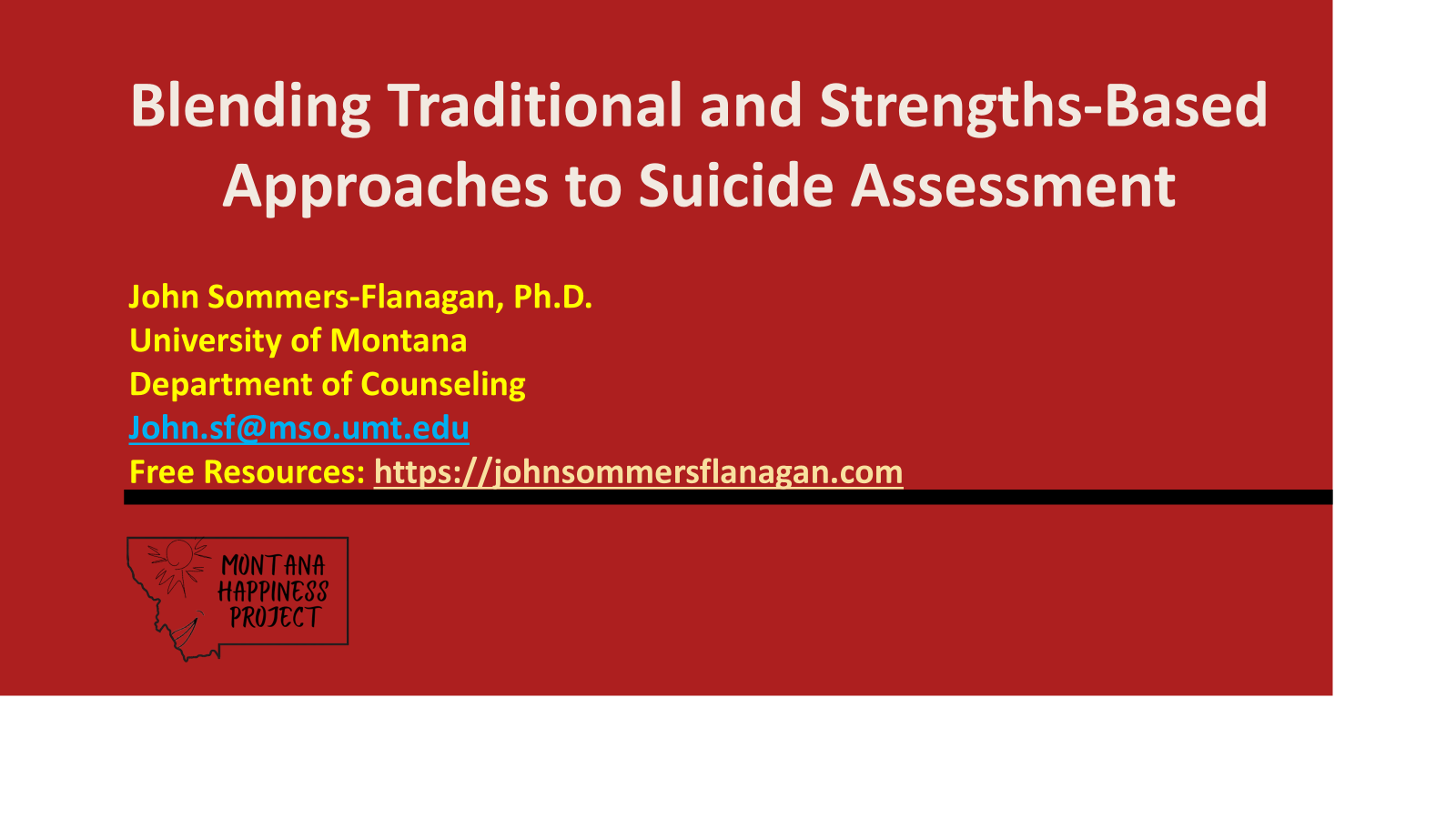
Tomorrow, December 4, I’m doing a quick one-hour version of my “Integration” workshop. Obviously, my leaning is toward the strengths-based, constructive approach to suicide assessment and treatment, but sometimes we need to integrate strengths-based approaches with the traditional medical model. That’s what this workshop is all about.
The workshop is presented on behalf of the Professional Counseling Association of Montana — the brainchild of Cynthia Boyle, a Ph.D. student in the University of Montana’s counseling and supervision program. Here’s a link to their website: https://pcamontana.org/
In case you’re attending . . . or interested . . . here are the slides:
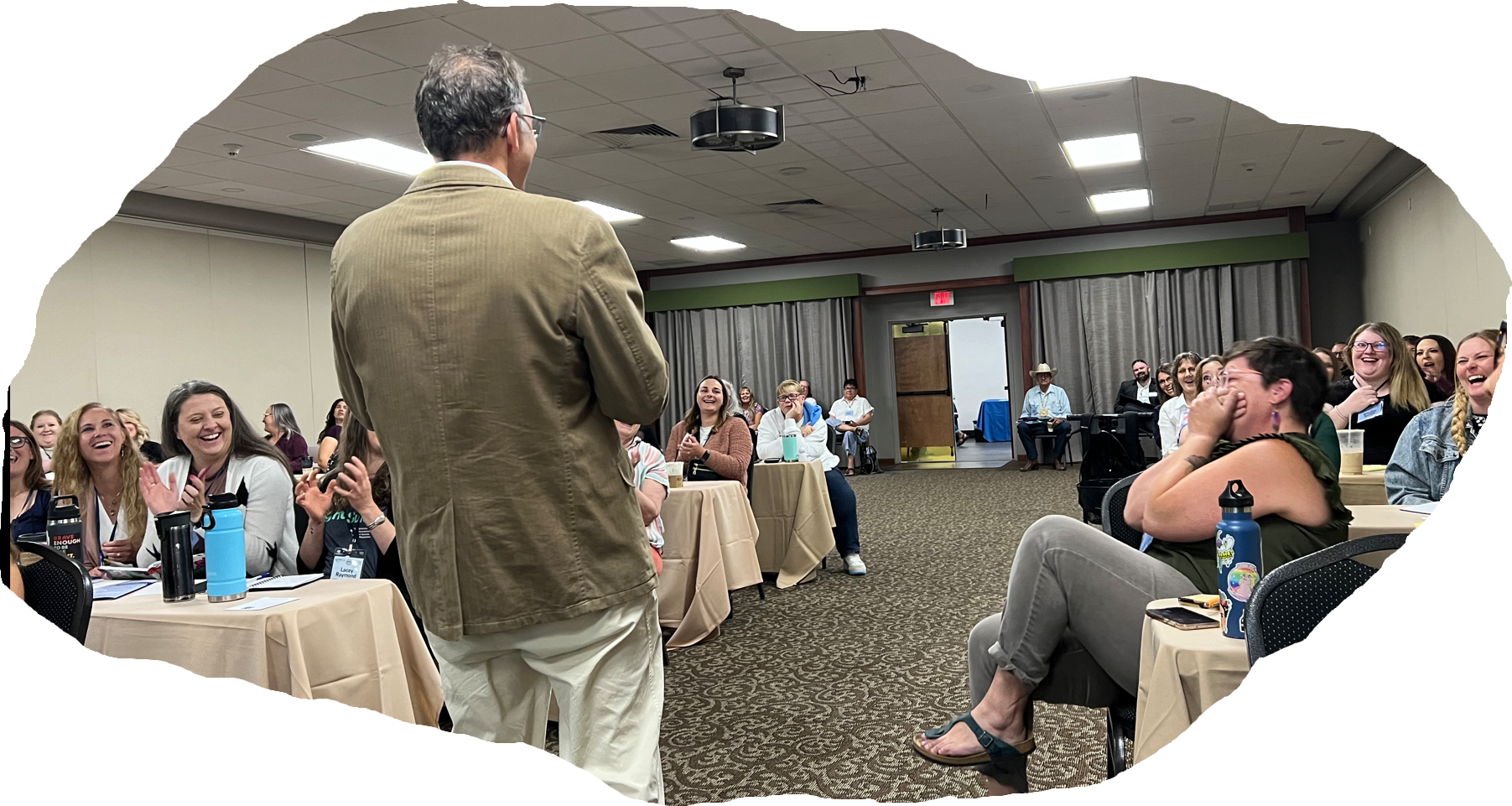
[I love the preceding photo because I’m doing a workshop on suicide in Billings, Montana, and despite the content, the participants are clearly having a good time]
Sometimes people ask me if I have presentations coming up. Other times they ask me about recent presentations. For reasons related to my own inability to be more organized and behave responsibly, I haven’t been very good at inserting “upcoming events” into my schedule, or at sharing links with readers about recent content that’s available online. Today’s post is my effort to address my irresponsibility.
September 11, 2024 – JSF presented a day-long ONLINE workshop, Conducting Parenting Consultations on behalf of Families First. Missoula, MT. Here are the ppts for the Parenting Consultation workshop:
September 26, 2024 – JSF presented a day-long IN-PERSON workshop, Tough Kids, Cool Counseling on behalf of Families First. Missoula, MT.
October 10, 2024 – JSF presented a day-long IN-PERSON workshop, Strengths-Based Suicide Assessment and Treatment on behalf of Tribal Health, Ronan, MT.
October 24, 2024 – JSF did an on-air guest interview on Evidence-Based Happiness for Teachers on a South Korean radio station. https://youtu.be/xYdJOInpAkE
November 6, 2024 – JSF presented on Let’s Pursue Happiness . . . Together (with our children) to the Washington Middle School Parent Teacher Association (PTA)
November 7, 2024 – JSF presented IN-PERSON on Why We Should Be in Pursuit of Eudaimonia (Not “Happiness”) for the University of Montana Alumni Association. Missoula, MT.
UPCOMING ACTIVITIES AND EVENTS
November 13 – JSF is presenting Let’s Pursue Happiness Together [In our schools . . . with our teachers . . . and for our children]ONLINE to the Montana Office of Public Instruction Montana Student Wellness Advisory Committee.
November 14 – JSF is presenting Happiness and You: Methods for Managing Your MoodsIN PERSON at the annual statewide Future Farmers of America (FFA) conference at MSU in Bozeman, MT.
December 4 – JSF is presenting a one-hour workshop on Strengths-Based Integrating Strengths-Based and Traditional (Medical Model) Approaches to Suicide AssessmentONLINE to the Professional Counseling Association of Montana. Link unavailable for now.
December 6 John Sommers-Flanagan is presenting an all-day ONLINE workshop for mental health professionals titled, Tough Kids, Cool Counseling, on behalf of the Vermont Psychological Association. Info is here: https://twinstates.ce21.com/speaker/john-sommersflanagan-2295709
January 10 – JSF is doing a 2-hour ONLINE workshop titled, Strategies for Integrating Traditional and Strengths-Based Approaches to Suicide, through the Cognitive Behavior Institute. You can register here for $25.00: https://www.pathlms.com/cbi/courses/77936#
The place to click if you want to learn about psychotherapy, counseling, or whatever John SF is thinking about.


 John Sommers-Flanagan