Yesterday I was at Camp Mak-A-Dream talking with young people about happiness. Today, I’ll be online with 400+ professionals doing a presentation titled: Strategies for Listening and Responding to People Who are Suicidal. Today’s presentation is offered through PacificSource, a health insurance provider in the NW United States.
I’m continuing with the theme of featuring diverse identities from the Clinical Interviewing (7th edition) textbook with a case example written by Dr. Umit Arslan. Dr. Arslan is writing about his experience as an international graduate student in counseling, when he was at the University of Montana. Currently, he’s a faculty member at the University of Nebraska-Kearney.
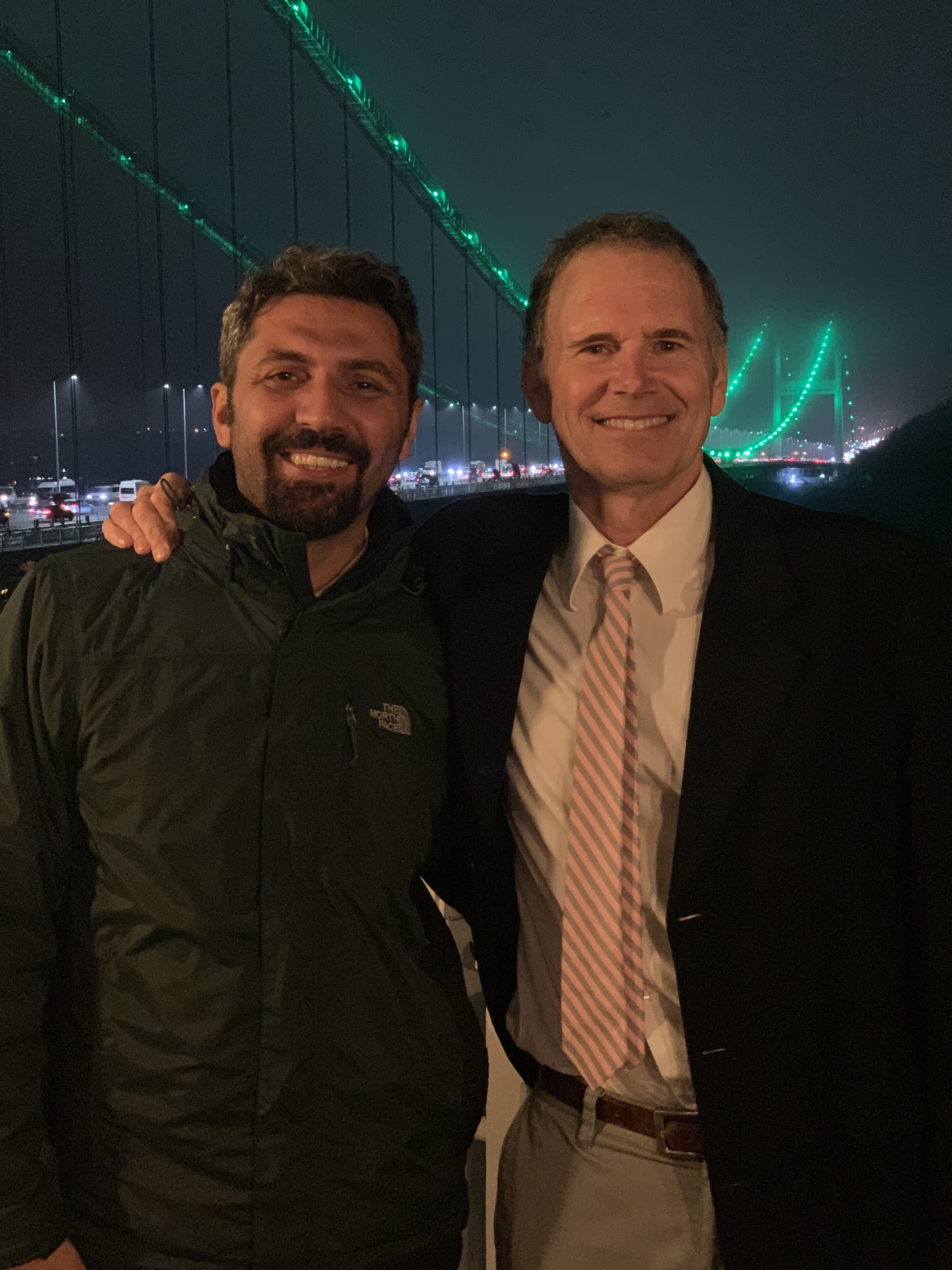
The photo is from when I visited him in Istanbul in January, 2023.
Enjoy!
As you’ll see below, Umit’s experience was unique. Given his Turkish heritage and cultural background, he needed to reflect and engage in a self-awareness process to experiment with finding a better way to introduce himself to clients. What I love most about this essay is Umit’s authentic description of his own experience. His answer to a better way to introduce himself won’t be the right answer for everyone. But his process is open and admirable.
CASE EXAMPLE 2.2: BEING A COUNSELOR FIRST . . . AND TURKISH SECOND, WORKED BETTER THAN BEING TURKISH FIRST . . . AND A COUNSELOR SECOND
Finding the right words and ways to introduce yourself is important. In this essay, Ümüt Arslan, Ph.D., an associate professor of counseling at İzmir Democracy University (Turkey), writes about challenges he faced as an international doctoral student in counseling at the University of Montana. Put yourself in Dr. Arslan’s shoes as he discovers (for him) a better way of introducing himself.
While pursuing my doctoral degree in the U.S., my supervisor and I discussed how to share my cultural identity and accent to clients. When I shared, my clients were not only interested in my appearance and accent, but also about my diet, coffee preferences, job, and of course, about my native country, Turkey. But they were reluctant to talk about themselves.
Clients assumed I was Muslim and against alcohol. Their assumptions were especially challenging because they were inaccurate. I was not religious, and like many Americans, I enjoyed having a beer after work. I wanted to challenge clients’ assumptions about my identity, but worried about countertransference and focusing too much on myself.
One cisgender female client came for an intake interview. She saw me, grabbed her bag (almost the size of a camping tent), and put it on her knees. I couldn’t see her face. I told her she could put the bag down if she wanted to. She declined.
When I re-watched this and other sessions, the striking thing was that my clients (mostly White) appeared stressed at the sight of me, a bearded Turkish man with dark skin. They didn’t even talk about the problems they had written on their intake form. My identity as a Turkish man overshadowed everything else. I needed a path forward.
In class, my supervisor discussed alternative ways to open sessions. I tried asking clients: “If you were the counselor today, what question would you ask yourself?” Clients suddenly engaged with me, giving deep and enthusiastic answers to their own questions. I stopped opening sessions by emphasizing cultural differences. Instead, I focused on my counselor identity, saying: “I completed my master’s degree and am currently a doctoral student. What do you think is the best question for me to ask you for us to have a good start here today?”The message, “I am here with my counselor identity” instead of “I’m a Turkish man in the U.S., and desperate to explain my culture to you,” had an amazing effect. Using a less cultural opening was more culturally sensitive. Clients could naturally introduce their own cultural identities, with fewer assumptions about me. Although I could still talk about culture, emphasizing my counselor identity enabled me to focus on counseling goals, the therapeutic relationship, and evidence-based counseling interventions.
To continue with my plan to feature culturally diverse case examples from the latest edition of Clinical Interviewing, the following excerpt is from Chapter One and focuses on cultural self-awareness. In particular, I LOVE the quotation on intersectionality from Kimberlé Crenshaw.
Cultural Self-Awareness
Those who have power appear to have no culture, whereas those without power are seen as cultural beings, or “ethnic.” (Fontes, 2008, p. 25)
Culture and self-awareness interface in many ways. As Fontes (2008) implied, individuals from dominant cultures tend to be unaware of and often resistant to becoming aware of their invisible and unearned culturally-based advantages (Sue et al., 2020). In the U.S., these “unearned assets” are often referred to as privilege in general, and White privilege in particular (McIntosh, 1998).
Privilege and oppression are best understood in the context of intersectionality. Intersectionality is the idea that overlapping or intersecting social identities within individuals create whole persons that are different from the sum of their parts (Crenshaw, 1989). Social identities that intersect include, but are not limited to: Gender, sexual orientation, sexual identity, race, ethnicity, religion, nationality, mental disorder, physical disability/illness, citizenship, and social class (Hays, 2022). Understanding multiple social identities helps clinicians understand how feelings of oppression can multiply, be activated under distinct circumstances, and be moderated under other circumstances.
Kimberlé Crenshaw (1989, 1991) introduced intersectionality as a lens to facilitate cultural awareness and understanding, but ideas about intersectionality date back at least to Black female abolitionists. In the 1860s, Sojourner Truth articulated Black women’s simultaneous oppression through classism, racism, and sexism (aka “Triple oppression”; Boyce Davies, 2008). Thirty years after she defined intersectionality, Time Magazine asked Crenshaw, “You introduced intersectionality more than 30 years ago. How do you explain what it means today?” (Steinmetz, 2020). She said,
These days, I start with what it’s not, because there has been distortion. It’s not identity politics on steroids. It is not a mechanism to turn white men into the new pariahs. It’s basically a lens, a prism, for seeing the way in which various forms of inequality often operate together and exacerbate each other. We tend to talk about race inequality as separate from inequality based on gender, class, sexuality or immigrant status. What’s often missing is how some people are subject to all of these, and the experience is not just the sum of its parts.
Through the lens of intersectionality, we can develop nuanced ways to have empathy for clients. For example, sometimes clients simultaneously feel privilege and oppression. Thinking and feeling from an intersectional frame can help clinicians be more prepared to view the world from clients’ perspectives (see Case Example 1.2).
CASE EXAMPLE 1.2: EMPATHY FIRST
Maya, an international student of color was in her first practicum. As was her routine, when introducing herself, she acknowledged her accent, her country of origin, along with her eagerness to be of assistance. Her client, a cisgender male university student, was initially polite, but quickly shifted the conversation to his feelings about White privilege, becoming somewhat agitated in the process. He said, “One thing I think you should know that I don’t believe in that White privilege thing. I just came from a class where that’s all everyone was talking about. I know I’m white, but I didn’t get any privilege. I grew up in a trailer park in West Texas. We were what they call ‘White trash.’ Nobody I grew up with had any privilege. We had poverty, abuse, alcoholism, meth, and government bullshit.”
Maya stayed calm. Even though she was activated by her client’s disclosure and was taking some of what he said personally, she focused on empathy first. She also remembered intersectionality and how common it could be for people to have multiple social identities. She said, “I hear you saying that the White privilege concept really doesn’t fit for you. Being in your very last class before coming here made you realize even more that it doesn’t fit. The idea of trying to make it fit feels annoying.”
Maya’s client simply said, “Damn right,” and continued ranting about White privilege, White fragility, and what he viewed as the politically correct environment at the university. As she continued listening and tried feeling along with him, she was able to see glimpses of his personal perspective. Not surprisingly, Maya’s client had social problems related to his tendency to be angry and abrasive. Eventually, after several sessions, they were able to begin talking about what was underneath his agitated emotional response to multicultural ideas and how his tendency to lead with his anger when in conversations with others might be contributing to him feeling even more isolated and different than everyone else. In the end, the client thanked Maya for “being patient with this dumb ass White boy” and helping him learn to be more aware, softer, and less reactive to triggering cultural conversations.
This case illustrates the importance of intersectionality as a concept that can facilitate counselor and client awareness, while also enhancing empathy. Although Maya’s client may have had even worse oppressive experiences had he been a person of color, he was neither interested nor ready to hear that message (Quarles & Bozarth, 2022). Instead, Maya used her knowledge of intersectionality to have empathy with the part of her client’s social identity that had experienced oppression.
Developing cultural self-awareness is difficult. One way of expressing this is to note, “We don’t know what we don’t know.” When someone tries to help us see and understand something about ourselves that’s outside our awareness, it’s easy to feel defensive. Despite the challenges, we encourage you to be as eager for change and growth as possible, and offer three recommendations:
Be open to exploring your own cultural identity. Gaining greater awareness of your ethnicity is useful.
If you’re from the dominant culture, be open to exploring your privilege (e.g., White privilege, wealth privilege, health privilege) as well as hidden ways that you might judge or have bias toward diverse groups and individuals (e.g., transgender, disabled).
If you’re outside the dominant culture, be open to discovering ways to have empathy not only for members within your group, but also for other diversities and for the struggles that dominant cultural group members might have as they navigate challenges of increasing cultural awareness. Engaging in mutual empathy is a cornerstone of relational cultural psychotherapy (Gómez, 2020).
For the next several weeks I’ll be sharing from our almost new 7th edition of Clinical Interviewing.
One of our goals for the 7th edition of Clinical Interviewing is to move toward greater representation of different ethnic/cultural/sexual identities. We want all potential counseling, psychology, and social work students to be able to identify with counseling, psychology, and social work professionals. To accomplish this goal, we added greater representation by broadening our usual chapter content, as well as including case examples contributed by professionals with diverse identities.
Here’s an excerpt from Chapter 1 on culture-specific expertise
******************************************
Culture-Specific Expertise
Culture-specific expertise speaks to the need for clinicians to learn skills for working effectively with diverse populations. For example, learning the attitudes and skills associated with affirmative therapy is important for clinicians working with diverse sexualities, including lesbian, gay, bisexual, transgender, queer/questioning (sexual or gender identity), intersex, and asexual/aromantic/agender (LGBTQIA+) clients (Heck et al., 2013). Similarly, integrating skills for talking about spiritual constructs into your work with African American, Latinx, Indigenous, and traditionally religious clients is often essential (Mandelkow et al., 2021; Sandage & Strawn, 2022).
Stanley Sue (1998, 2006) described two general skills for working with diverse cultures: (a) scientific mindedness and (b) dynamic sizing.
Scientific mindedness involves forming and testing hypotheses about client culture, rather than coming to premature conclusions. Although many human experiences are universal, it’s risky to assume you know the underlying meaning of your clients’ behavior, especially minoritized clients. As Case Example 1.3 illustrates, culturally sensitive clinicians avoid stereotypic generalizations.
Dynamic sizing is a complex multicultural concept that guides clinicians on when they should and should not generalize based on an individual client’s belonging to a specific cultural group. For example, filial piety is a value associated with certain Asian families and cultures (Ge, 2021). Filial piety involves the honoring and caring for one’s parents and ancestors. However, it would be naïve to assume that all Asian people believe in or have their lives affected by this particular value; making such an assumption can inaccurately influence your expectations of client behavior. At the same time, you would be remiss if you were uninformed about the power of filial piety in some families and the possibility that it might play a large role in relationship and career decisions in many Asians’ lives. When clinicians use dynamic sizing appropriately, they remain open to significant cultural influences, but they minimize the pitfalls of stereotyping clients.
Another facet of dynamic sizing involves therapists’ knowing when to generalize their own experiences to their clients. S. Sue (2006) explained that it’s possible for clinicians who have experienced discrimination and prejudice to use their experiences to more fully understand the discrimination-related struggles of clients. However, having had experiences similar to a client may cause you to project your own thoughts and feelings onto that client—instead of drawing out the client’s emotions and showing empathy. Dynamic sizing requires that you know and understand and not know and not understand at the same time. Not knowing—or at least not presuming you know—is essential to interviewer-client collaboration.
CASE EXAMPLE 1.3: NOT AT HOME ANYWHERE
In this case, Devika Dibya Choudhuri, Ph.D., LPC (CT/MI), a self-described Buddhist, South Asian, cisfemale, middle-aged, middle-class, Queer, disabled counselor and professor at Eastern Michigan University, illustrates sophisticated cultural-specific expertise in cross-cultural work with a bi-cultural college student. Dr. Choudhuri uses self-disclosure, researches her client’s culture, and integrates culturally meaningful symbols into her sessions. Imagine how you can aspire to be like Dr. Choudhuri.
Darla, a 19-year-old Ghanian-American cisfemale college student, felt something was wrong with her. Her mother was from Ghana, while her father, with whom she had little contact, was generationally African American. She was halting in the first session, trying to decide whether she could trust me, and talking about her recent visit to Accra where her mother’s family lived. I said, “I know when I go to India, I’m American, and when I’m here, I’m Indian. Is it a bit like that for you?” She emphatically replied, “Yes! I’m not at home anywhere!” “Or,” I returned, “almost at home everywhere, like the rest of us global nomads.” She laughed, then spoke far more comfortably about her friends and boyfriend. I had, in that brief exchange, told Darla very important things about me. I self-disclosed casually about my ethnicity and international navigation, normalized her sense of homelessness, while reframing it to join a new group identity.
After having done some research, I asked Darla if her Ghanian kin were the majority Akan or a minority group. She said they were minority. I reflected on whether she might have picked up a sense of marginalization, not just from being Black in America, but also from being minority in Ghana. This became a deep and intense conversation. She reflected on how her American status in Ghana protected her from discrimination, but also alienated her from her cousins.
Another use of culture as intervention came when I brought in Adinkra (visual pictograph meaning saturated symbols originating in Ghana) for her use. Darla chose four to represent her aspirations, and then designed ways to use them in her daily life, incorporating her cultural roots into her present. One of them, Sankofa, is a symbol of the wisdom of learning from the past to build for the future; expressed in the proverb, “it is not taboo to go back for what you left behind.” Feeling grounded in multiple cultures, and being able to navigate from one context to another with her whole and complex self, rather than fragmenting, led her to see she wasn’t “wrong.” Sometimes the spaces were too limited; it was ok to fit and not fit, just as leftover food on a Ghanian table represented abundance.
[End of Case Example 1.3]
******************************************
As always, feel free to share your thoughts on and reactions to this content. We’re always looking for practical feedback that will help us continue to become better learners and teachers.
While doing supervision today, I found myself encouraging my supervisee to be more direct, to embrace his knowledge and his good judgment, and to share his knowledge and judgment with his client. This is an interesting (and perhaps surprising) stance for me to take, because, as some of you know very well, I lean hard toward Rogerian theory. I’m a fan of honoring clients’ expertise and of Carl Rogers’s words that it is “the client who knows what hurts and where to go.”
As I age (more like fine wine, and not like moldy bananas, I hope), one truth I keep feeling is that nearly everything is both-and—not either-or. Yes, I believe deeply in the naturally therapeutic process of person-centered theory and therapy; providing clients with that “certain type of environment” will facilitate self-discovery and personal growth. On the other hand, sometimes clients need guidance. In my supervision case earlier today, my point was that the client was a very long way away from deeper personal insights. That meant my supervisee needed to loan the client his good judgment and decision-making skills. As you may recognize, “loaning clients our healthy egos” is psychoanalytic language. Nevertheless, the guidance I offered my supervisee was to engage in some CBT coaching
All this reminded me of a section I updated in the 7th edition of Clinical Interviewing. The section is titled, “Client as Expert” and I’ve excerpted it below. It captures the essence of honoring client wisdom, which, IMHO, should always precede more directive interventions.
************************************
Client as Expert
Clients are the best experts on themselves and their experiences. This is so obvious that it seems odd to mention, but sometimes therapists can get wrapped up in their expertness and usurp the client’s personal authority. Although idiosyncratic and sometimes factually inaccurate, clients’ stories and explanations about themselves and their lives are internally valid and should be respected.
CASE EXAMPLE 1.1: GOOD INTENTIONS
In one case, I (John) became preoccupied about convincing a 19-year-old client—who had been diagnosed years ago with bipolar disorder—that she wasn’t really “bipolar” anymore. Despite my good intentions (I thought the young woman would be better off without a bipolar label), there was something important for her about holding on to a bipolar identity. As a “psychological expert,” I believed it obscured her many strengths with a label that diminished her personhood. Therefore, I encouraged her to change her belief system. I told her that she didn’t meet the diagnostic criteria for bipolar disorder, but I was unsuccessful in convincing her to give up the label.
What’s clear about this case is that, although I was the diagnostic authority in the room, I couldn’t change the client’s viewpoint. She wanted to keep calling herself bipolar. Maybe that was a good thing for her. Maybe that label offered her solace? Perhaps she felt comfort in a label that helped her explain her behavior to herself. Perhaps she never will let go of the bipolar label. Perhaps I’m the one who needed to accept that as a helpful outcome.
[End of Case Example 1.1]
In recent years, practitioners from many theoretical perspectives have become outspoken about the need for expert therapists to take a backseat to their clients’ lived experiences. Whether you’re working online or face-to-face, several evidence-based approaches emphasize respect for the clients’ perspective and collaboration (David et al., 2022). These include progress monitoring, client-informed outcomes, and therapeutic assessment (Martin, 2020; Meier, 2015).
When your expert opinion conflicts with your client’s perspective, it’s good practice to defer to your client, at least initially. Over time, you’ll need your client’s expertise in the room as much as your own. If clients are unwilling to share their expertise and experiences, you’ll lose some of your potency as a helper.
******************************************
So, what’s today’s big takeaway? We start with and maintain great respect for the client’s expertise. . . and then we either stay more person-centered (or psychoanalytic) or collaboratively shift toward providing more direction and guidance. And the big question is: How do we determine whether to stay less directive or become more directive?
If you feel so inclined, let me know your thoughts on that big question.
I’m presenting with one of our esteemed UM Doc students, Kanbi Knippling, M.A. You can see our title in the photo. Should be interesting and excellent content for anyone working with people who have disabilities. Kanbi is taking the lead, and I’m helping, which is fun for me.
The 7th edition of Clinical Interviewing became available earlier this year. As a part of the text revision, we updated the accompanying videos, videos that Victor Yalom of Psychotherapy.net considers to be the best of their kind. And, possibly having watched more professional training videos than anyone on the planet, Victor knows what he’s talking about, and we are humbled by his endorsement.
Videos that accompany the text cover 72 learning objectives and are extensive. The bad news is that they usually, but not always, feature me. The good news is that in our video revision and upgrade, we included numerous counselors/psychotherapists of color. . . so it’s not just all me talking about how to develop your clinical interviewing skills.
If you watch them, I hope you enjoy the videos. And, if you feel so moved, please share your reactions or suggestions with me here or via email: john.sf@mso.umt.edu.
Language is powerful, but sometimes subtle in its influence. Last week in Group class I talked about using psychoeducation to teach people the power of language. As an example, I mentioned the work of Isolina Ricci, and the best post-divorce book ever, Mom’s House, Dad’s House. Ricci tells separated or divorced parents they should change the words they use to refer to their “Ex.” Because “Ex” refers to the former relationship with a romantic partner, it gets to the heart of how people use language to live in the past. Ricci says that we should use “My children’s Mom” or “My child’s Dad” because doing so accurately describes the current relationships. Years ago, I taught her language-based principles in the divorce education courses offered through Families First.
In a class-based group, my students brought up that perhaps we should shift from language that identifies others as “racist” to describing them as “people with racist tendencies.” I was happy my students were grappling with the influence of language. . . and was reminded of my first encounter when I really learned about the power of language and labels.
While in the University of Montana library about 4 decades ago, I recall reading something by Gordon Allport. Given it was so long ago, the memory is surprisingly vivid. Sadly, I can’t conjure up the reference. What I recall is Allport describing something like this:
First, we say, John behaves nervously.
Later, it becomes, John is nervous or anxious.
Eventually, we diagnose John: John has an anxiety disorder.
Then, we diagnose everyone similar to John, and put the disorder first: Anxiety disordered youth, like John, are more likely to. . .
In the end, we’ve inserted a trait-problem in John, without consideration of the context of his initial anxiety or the specific rate of anxiety associated with his so-called “anxiety disorder.” And then we repeat this description until the problem is fully placed inside John (and others) and rarely question that presumption.
This process begs many questions. Is the anxiety really located inside John, as if it were a personality trait or a mental disorder? Where did John’s anxiety originate? If John lived years in a frightening setting, should he be blamed and labeled for having anxiety symptoms? Might it be normal for John to expect that something bad is likely to happen?
The tendency for external observers to see behaviors or symptoms in others, and then insert the behaviors and symptoms inside of those they observe is so ubiquitous that in social/cognitive psychology, they named it the “Fundamental Attribution Error.” But even that language isn’t quite right.
Fundamental attribution error is the tendency to attribute the behaviors of others as representing a “trait” or underlying disposition in them (e.g., racist). Not surprisingly, at the same time, people also tend to attribute their own behaviors to situational factors (e.g., I was more judgmental than usual, because I was a bad mood and hadn’t slept well). To use language more precisely, the fundamental attribution error might be better described as a “common” phenomenon, instead of fundamental. And, of course, that tendency is not always in error. Maybe the better terminology would be “Common misattribution tendency.” Put more simply: We tend to blame others’ behavior on them. How common is that? Very common.
This is all very heady stuff, as is often the case when we dive into constructive language and narrative therapy principles. It tends to be easier for people to change and to believe in the possibility of people changing when we use person-first language and say things like, “engaged in racist behaviors” or “exhibited signs of anxiety,” instead of using firmly constructed attributions.
Lately, in this blog I’ve been riffing with excerpts from our Clinical Interviewing textbook. Below, I’ve inserted another section from Clinical Interviewing. This excerpt is about using bias-free language in psychological reports.
******************************************
Using Bias-Free Language
No matter how careful and sensitive writers try to be, it’s still possible to offend someone. Writing with sensitivity and compassion toward all potential readers is difficult, but mandatory.
Avoiding bias and demeaning attitudes is mostly straightforward. In addition to following the APA’s guidance and writing for a multidimensional audience, the best advice we have is to encourage you to conceptualize and write your intake report transparently and collaboratively. This means:
At the beginning and toward the end of your session, speak directly with your client about the content you plan to include in the report.
Rather than surprising clients with a diagnosis, be explicit about your recommended diagnosis and rationale.
Discuss your treatment plan openly with clients. Doing so serves the dual purpose of providing clients with advance information and getting them invested in treatment.
If you’re not clear about how your client would like to be addressed in the report (Mr., Ms., gender identity, ethnicity, etc.), ask directly. Avoid mis-labeling or mis-gendering clients in a psychological report. If you’re working with clients who have physical disabilities, check to see if person-first or disability-first language is preferred.
****************************
I’ve been trying to keep the word-length of these blogs reasonable, and so if you’re interested in a bit more on this topic, this link will give you Practice and Reflection 8.4: “Person-First or Identity-First Language” from, of course, the Clinical Interviewing text.
Early this morning, I had a chance to Zoom in and present a workshop for Saint Michael’s College in Vermont. This was probably a good thing, because they had more than their share of snow to deal with. I got to be in Vermont virtually from beautiful Missoula Montana, where we’ve had spring most of winter. I wish we could borrow a few feet of that Vermont snow to get us up to something close to normal.
But my point is to share my ppts from this morning, and not talk about the weather. I had a great two hours with the Saint Michael’s professionals . . . as they posed excellent and nuanced questions and made insightful comments. Here’s a link to the ppts:








 John Sommers-Flanagan