All posts by johnsommersflanagan

Thoughts on Forgiveness from My Friend, Dr. Bossypants

I’m taking the opportunity this fine Sunday afternoon to post a blog piece that Rita wrote earlier this week. Oddly, or perhaps not that oddly for those who know her, Rita has an alter-identity that she refers to as “Dr. Bossypants.” In this alternate voice, Rita refers to herself in third person and lets herself be a bit more pedantic than she is in real life.

In this blog post, Dr. Bossypants jumps into the domain of forgiveness and offers up ideas that I found exquisitely interesting and very helpful.

Without further ado, I’d like you to meet, my friend, Dr. Bossypants.

The Happiness Challenge is Coming Soon

Turns out, yesterday was Tuesday, not Friday. I got so disoriented yesterday that by the day’s end, I was emailing people and telling them to have a great Labor Day weekend. My excuse is that I got 17 new stitches in my forehead during a 4.5 hour marathon Mohs surgery on Monday. Sheesh. Now I’m a poster-boy for sun block. See the photo at the bottom of this post for the evidence.

I’m posting today (Wednesday, not Saturday!) to let you know about a unique opportunity, and to ask for your support.

Beginning this September (National Suicide Prevention Month), the Montana Happiness Project, L.L.C., in collaboration with Families First Learning Lab, is launching a 20-week Happiness Activity Challenge. Using various social media platforms, this campaign guides participants through 20 distinct evidence-based positive psychology interventions designed to increase personal happiness and life meaning.

This Campaign will be available for free, online, through social media. Because we’re offering it for free, we’re looking for two levels of support.

  • Collaborator: Being a collaborator costs you nothing. All it means is that you’re publicly saying that you support our efforts at spreading evidence-based happiness and will share our happiness activities with colleagues, friends, and perhaps formally engage your organization to participate. If you’re a collaborator, we’ll put your name or organization name and logo on our website.
  • Sponsor: We’re asking specific organizations to partner with us to sponsor each week. To sponsor a week, we ask for a $500 contribution. In return, we’ll include your Logo and our Thanks in our social media posts for the week. This will include posts on Instagram, Facebook, Youtube, WordPress, and on our Squarespace Montana Happiness Project website. If you’re a sponsor, we’d love for you to encourage your staff to participate in this happiness promotion activity, talk about it with each other, and post about it on social media.

You may wonder, if we can be collaborators and my staff and colleagues can participate for free, why be a sponsor? That’s a great question. We’re doing our Happiness Challenge as an act of kindness for the people of Montana and beyond and acts of kindness are evidence-based happiness strategies. We hope you’ll join us, perform an act of kindness, and sponsor at least one homework week.

Whether you’re a collaborator, sponsor, or evesdropper, we hope you’ll engage with our happiness challenge to see if participation in some or all of our 20-day happiness project helps you (and your staff, friends, family, etc.) feel happier.

Below, I’ve answered a few questions:

Who can participate? – Anyone. Our primary focus is Montana, but our goal is to reach out and promote positivity and happiness to anyone and everyone who is interested.

How much does it cost? – Nothing. Nada. Nil. This is free because we believe life is hard and people need support, skills, and to have hope for greater happiness.

Do I have to commit to all 20 homework assignments? – Nope. We’re doing this on social media. You can participate as much or as little as possible. You can be explicitly active by posting and sharing about your experiences, but you can also keep your experiences to yourselves.

Are the homework assignments really evidence-based? – Yes. Nearly all of the assignments have direct scientific support as “interventions” that increase happiness and decrease depression. That doesn’t mean increased happiness and decreased depression are guaranteed, because even “effective” interventions don’t work for everyone. . . but they’re worth a try. A few of the assignments don’t have direct experimental support, but they’re based on concepts shown to increase happiness and meaningfulness.

What’s the catch? – No catch. We’re offering this experience as an act of kindness because we think it’s a good thing. We also recognize that positive psychology or evidence-based happiness interventions are not a great fit for everyone. Just do what you can when you can if you can.

How can I contribute to the idea of sharing evidence-based happiness knowledge and skills? – We hope you will do this activity with co-workers, friend, and/or family. We hope you’ll share it on social media, or talk with your children about your experiences over dinner. If you’re especially inspired by our 20-week Happiness Challenge, you’re welcome to donate (not required, but appreciated) to Families First Learning Lab. Just let the good people at Families First know that your donation is to support the FFLL Happiness Project.

If you have questions and/or want to become a collaborator or sponsor, please let John (john.sf@mso.umt.edu), Jeanice Robins info@montanahappinessproject.org, or Dylan Wright dylan@familiesfirstmt.org know and we’ll set you up!

I’d end with “Mark your calendars!” but given that I’m still not certain that I’m fully oriented to time, I’ll just say, thanks for reading all this and considering full engagement with our Happiness Challenge.

Sincerely,

John SF

The So-Called “Tough Kids, Cool Counseling” Workshop: PPTs and Handouts for TODAY!

I’ll be online in about 75 minutes to present a workshop for the TexChip folks from TAMU-CC. The title of the workshop is: “Tough Kids, Cool Counseling: Strategies for Engaging and Influencing Youth.”

Here’s the link to the workshop . . . where the CEUs are free!:

Join Zoom Meeting 

https://tamucc.zoom.us/j/96049300393?pwd=V1VDSlVmY1c1RFVFTEhJN3ZFODJKQT09

Meeting ID: 960 4930 0393 

Passcode: 625101 

You may be aware of the irony in the workshop title. . . which is the fact that very soon into the workshop I tell everyone that we should never even “think” the words “Tough kids.” The reason we drop the terminology “Tough kids” is because it blames and labels the young people with whom we’re working, and they may sense that. Instead, all we have are “Kids in tough situations” and one of the tough situations is being in counseling or therapy.

Whether I’ll see you in 75 minutes or not, here are the ppts:

And here is the supplementary handout:

News Flash: Four FREE CEUs Coming Up This Saturday, August 26

As a part of a virtual symposium offered by Texas A&M University – Corpus Christi, this coming Saturday, August 26, I’m doing a 2-hour free continuing education workshop from 12-2pm Mountain time (2pm-4pm Eastern). The cool thing is that the CEUs for this workshop are FREE. The less cool thing is that the workshop is on a Saturday.

My talk is: Tough Kids, Cool Counseling: Strategies for Engaging and Influencing Youth. Even better, I’ll be preceded by Dr. Russ Curtis and Dr. Katie Goetz (9am-11am Mountain time), who are presenting a 2-hour workshop on The Mindset and Clinical Skills Needed to Thrive in Integrated Care. . . and that’s 2 more FREE CEUs.

Below, I’ve pasted the blurbs and Zoom information for these online workshops.

You are invited to join Tex-Chip Virtual Symposium on Saturday, August 26, 2023, at 10am – 3pm (CST). 

Dr. Russ Curtis & Dr. Katie Goetz is scheduled to present from 10am – 12pm CST on “The Mindset and Clinical Skills Needed to Thrive in Integrated Care.” In this interactive presentation, participants will learn how to integrate clinical skills with enlightening philosophical premises to expand their understanding of providing inclusive whole-person care. Attendees will develop their clinical voice through lecture, case examples, and discussions to begin asking the right questions about how to provide next-generation integrated care.

Dr. Sommers-Flanagan is scheduled to present from 1pm – 3pm CST on “Tough Kids, Cool Counseling: Strategies for Engaging and Influencing Youth.” Engaging “tough kids” in behavioral health can be immensely frustrating or splendidly gratifying. The truth of this statement is so obvious that the supportive reference, at least according to many teenagers is “Duh!” In this 2-hour workshop, participants will learn, experience, and practice several strategies for engaging and influencing youth. Several cognitive, emotional, and constructive brief counseling techniques will be described and demonstrated. Examples include acknowledging reality, positive questioning, wishes and goals, the affect bridge, the three-step emotional change trick, what’s good about you?/asset flooding, and more. Essential counseling principles, countertransference, and cultural issues will be included. 

Join Zoom Meeting

https://tamucc.zoom.us/j/96049300393?pwd=V1VDSlVmY1c1RFVFTEhJN3ZFODJKQT09

Meeting ID: 960 4930 0393

Passcode: 625101

For more information, please contact Ada at auzondu@islander.tamucc.edu   

Perfectly Hidden Depression and Viewing Suicidality through a Strengths-Based Lens

Last week I did a little cliff-jumping into the Stillwater River with my twin 13-year-old grandchildren. It was only about 20 feet, but high enough to feel the terror and exhilaration of a brief free-fall.

This week I’m having a different kind of buzz. Dr. Margaret Rutherford reached out to me with a link to her TEDx Boca Raton talk. Previously I was a guest on her video podcast show (here’s the link to her podcast page: https://drmargaretrutherford.com/podcast-2-2/, and a link to her website and book, “Perfectly Hidden Depression” https://drmargaretrutherford.com/perfectlyhiddendepressionbook/). We’ve stayed in touch via email. Along with her link, she apologetically noted that she “barely” got a plug in for my work on strengths-based suicide assessment. I thought it was incredibly nice for her to give a nod, even a brief one, to my work. But then I watched and discovered that she had only mentioned three professionals: Edwin Shneidman (the “Father of Suicidology), Sidney Blatt (a renowned suicide and depression researcher from Yale), and some obscure guy from the University of Montana (that would be me).

Aside from feeling honored, humbled, and flattered to even get a mention, Dr. Margaret’s talk is fantastic. She makes the point–with a couple of articulate cases–for moving away from a strictly medical model perspective and toward working with people who may be suicidal through a lens of no judgment and acceptance. Here’s the link to her talk, which is well-worth a watch: https://www.youtube.com/watch?v=lXZ5Bo5lafA

There are other signs that how professionals (and hopefully the public) view suicidal ideation and behavior may be shifting toward greater acceptance. I’ll go into these other signs in a future post, but right now I want to emphasize that the point is not to replace the medical model, but to move the needle toward less pathologizing and more acceptance of the fact that having suicidal thoughts is often a normal part of life. To the extent that we can approach people who are thinking about suicide with, as Dr. Margaret said, “non-judgment and acceptance,” the more likely they are to be open with us about their pain. . . and . . . when people are open about their pain and suffering, then we have a chance to listen with empathy and a greater opportunity to be of help. . . which, I think, is the main point.

Rita’s Other Co-Author

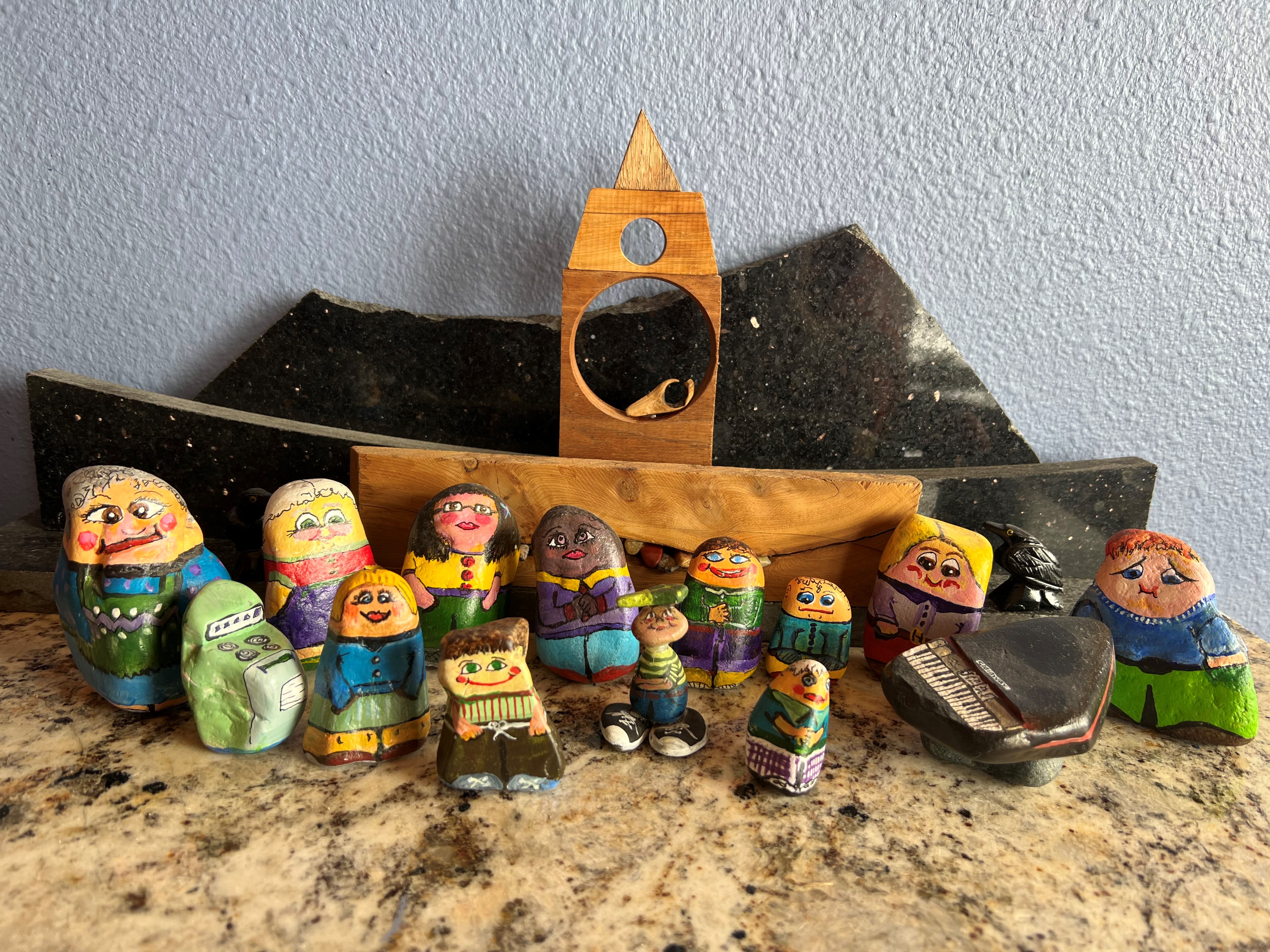
Earlier this summer, as I sifted through page-proofs for the 7th edition of our Clinical Interviewing textbook, my wife and co-author thinned carrots in the garden. Later, while I responded to queries from a Wiley copyeditor in India, she worked on rock art near the river in the July sunshine.

As many of you know, Rita and I have been co-authors for decades. Our first co-written publication appeared as a commentary in the 1986 American Psychologist (volume 41), titled “Ethical considerations for the peace activist psychotherapist.” Cool stuff.

Over the past few years, Rita’s interest in academic writing has waned some, but she’s still helpful, so I don’t mind. I like fresh carrots. The problem is that she’s started a project with a new and far more demanding coauthor. Given the identity of her coauthor, it doesn’t work for me to be jealous. Eight years ago, she started publishing these co-authored works as blogs, posted every Sunday at 9am. When she’s in a good mood, she refers to them as prose poems, prayers, or parables. I won’t mention what she calls them when she’s in a bad mood.

When she and her other co-author are busily writing, I’ve learned it’s best to not interrupt. I’ve also learned—from reading these blogs and listening to her read them to me—about a big omnipresent challenging and empathic entity that changes identities from Black women to dust mites, clouds to cracks in the earth, and flocks of birds to herds of sheep in much less time than the colloquial blink-of-an-eye.

If you’re interested in exploring Rita’s version of The Big Omnipresence, the first volume of Godblogs is now available (speaking of omnipresence) on Amazon  https://www.amazon.com/GODBLOGS-Vernacular-written-Mother-Tongue/dp/B0C9KCGSN9

Many of her readers have noted that these meditative word-art pieces are best taken in small doses. David James Duncan, author of The Brother’s K, the River Why, the forthcoming Sun House, and other amazing novels, wrote a blurb about Rita’s work, featured on the back cover:

From paragraph to paragraph, or sometimes sentence to sentence, or even phrase to phrase, Rita Sommers-Flanagan’s visitations leap—with tireless wit and a welcome downpour of surprises—from trenchant, to despairing, to startlingly funny, to furious, to honest to God divine comforts that just carried me to page 90 when I needed to get to work! As you read, you’ll also ride two pendulums I love, from reverence to irreverence back to reverence, and from deep grief to genuine joy back to grief. Most of all I want to say this: No matter what guise Original Source uses for any particular visit, I believe in Rita’s God. I truly do.

As I mentioned on FB, Rita getting a blurb from DJD makes me flat-out jealous. I still remember reading The Brother’s K on an airplane, and having the flight attendant check on me because I was intermittently laughing and crying. . . which speaks to DJD’s immense writing talents. On the other hand, rather than a bitter jealousy, I can bask in Rita’s reflected glory, right? I mean, after all, I’m her other coauthor.

I hope you’ll check out Rita’s book. I AM one of her biggest fans and one of her biggest coauthors: I’m just not the only one.

Strengths-Based Suicide, with a Little Stuff on Men, for the North Dakota Counseling Association

I just finished a nice session on the strengths-based approach to suicide with the NDCA. They asked for a little extra info/emphasis on working with men, because men are particularly vulnerable to suicide, and so I wove in some of the content from my ACA presentation with Matt Englar-Carlson and Dan Salois (thanks Matt and Dan!).

The ppt below is a big one because it includes an embedded video featuring a young man who articulates a number of potential suicide related drivers, including trauma (be forewarned: the content is intense and potentially triggering).

A big thanks to the NDCA organizers and to the attendees who were very impressive.

Have a great evening!

Attention Montana Educators — Check out this low-cost opportunity to earn 3 graduate credits while studying happiness!

I’ve got great news for Montana educators.

Thanks to the support of the Arthur M. Blank Foundation, we (the Montana Safe Schools Center and the Montana Happiness Project) have funding to support a very low cost 3-credit online graduate course titled, “Evidence-Based Happiness for Educators.”

This course is available very soon – the first class “meeting” is on July 5, from 9:30am-11:30am. I have “meeting” in quotes here because the course can be taken asynchronously, although we recommend synchronous “live” attendance on specific dates. The details follow:

When: The course begins on Wednesday, July 5, 2023. The course consists of 20, 2-hour sessions. The final meeting is on Tuesday, August 1. Live (synchronous) class meetings will be held from 9:30am to 11:30am on the following dates:

Wednesday, July 5

Monday, July 10

Monday, July 17

Monday, July 24

Monday, July 31

Where: Online. After you register, as soon as we have the final course details taken care of, you’ll receive a Zoom link for attending sessions, and accessing course videos and materials.

What: The course, COUN 595 (Evidence-Based Happiness for Educators) is an academic review and experiential practice of evidence-based happiness strategies. Participants will have daily reading/podcast/video assignments, along with experiential practice assignments. The primary purpose of the course is for teachers to learn to apply evidence-based happiness strategies (e.g., gratitude, savoring, etc.) to themselves. The secondary purpose of the course is for teachers to make plans for how they can integrate evidence-based happiness principles and activities into their classrooms. You will not be required to implement these ideas in your classrooms, but we will encourage you to experiment with the ideas on yourself and, to the extent that you desire, to share them with students.

Who can enroll: All Montana teachers are eligible to enroll. There is a class cap at 40.

Who will teach the course: Lillian Martz, M.A., a doctoral student in the Department of Counseling at the University of Montana will be the lead instructor. John Sommers-Flanagan, a professor in the Department of Counseling will be the secondary instructor.  

The cost: Due to a generous grant from the Arthur M. Blank Foundation, we can offer this course at approximately 20% of a usual University of Montana summer course. Instead of over $1,000, the course is $175.00 for 3 graduate credits. You can also take the noncredit version of the course (and qualify for 40 OPI hours), for $75.00.

What else:  Because this course is underwritten by the Arthur M. Blank Foundation, we will ask participants to complete questionnaires before and after the course. You will not be required to complete the questionnaires, but if you do, that will help us to better understand the usefulness of this course content for Montana educators . . . and we would greatly appreciate your participation.

To enroll in COUN 595 – Evidence-Based Happiness for Educators – for 3 graduate credits from the University of Montana, click here: https://www.campusce.net/umextended/course/course.aspx?C=712&pc=13&mc=&sc=

To enroll in COUN 595 for non-credit (you can receive OPI hours), click here: https://www.campusce.net/umextended/course/course.aspx?C=711&pc=13&mc=&sc=

If you have questions, email: john.sf@mso.umt.edu

Reflections on Max

Like many, I woke up this morning thinking about my father (Max Sommers).

When I saw a photo of him, it made me think about how long it has been since I’ve seen him standing up. For the last 3+ years of his life he was in bed, due to an un-repairable broken hip and severe neuropathy.

Despite being stuck in bed every day, Max stayed upbeat. Every visit—until he died—started with a cheerful greeting and ended with him saying, “I love you” and “big hugs.”  

I could never maintain such a sunny disposition. Here’s what I wrote about him back in 2014:

This is the man I can never live up to. But that’s okay. That’s the way it SHOULD be. To have a role model who is really a role model because he is so good and kind and compassionate and smart. Just being around someone like him makes me want to be a better person.

Reflecting on my father’s metaphorical (not literal) big shoes, made me think of Adler’s concept of the inferiority complex. Adler says inferiority is all-natural, because all children experience many years of being inferior to their parents or older siblings. I also had the good luck of having two incredibly competent and capable older sisters. I experienced many years of natural inferiority. That’s probably why, in most situations and most of the time, my first reactions usually involve feeling inferior.

Nowadays, people seem to use the term imposter syndrome instead of inferiority. I like Adler’s terminology and explanations better.

Adler also said the cure to all mental health problems was a thing he called encouragement. Encouragement comes in many forms. When parents and others give their children encouragement, it translates into giving their children the “courage” to face and embrace the challenging tasks of life. Given that Max was and is impossible for me to live up to, I’m especially lucky that he gave me the gift of encouragement. His encouragement (along with my mom’s and sisters’) gave me the courage to face my feelings of inferiority.

Max has been gone for 13 ½ months now. I miss him terribly. I know I’m not the only one feeling sad and grateful on Father’s Day. If you’re feeling the pangs and pains of loss along with me, I wish you as much peace, purpose, and encouragement as you can find.

May we all be more like Max.

Relationship Factors in Counseling and Psychotherapy

Hardly anyone with common sense or social skills ever argues about whether or not relationship factors are crucial to effective counseling and psychotherapy. Nevertheless, some scientists are reluctant to put relationship factors on par with counseling and psychotherapy techniques or procedures. IMHO, relationship factors are every bit as essential as so-called empirically-supported treatments.

This post is a pitch. Or it might be a pitch in a post. Either way, I am honored to share with you a hot-off-the-presses new book, titled Relationship Factors in Counseling, by Dr. Kimberly Parrow. Here’s the publisher’s link: https://titles.cognella.com/relationship-factors-in-counseling-9781793578754. The book is also available on Amazon and other booksellers.

Below, I’m pasting the Foreword to this book. Not only am I jazzed about the book, I’m also jazzed about the Foreword. You should read it. It’s really good. You’ll learn about Kimberly Parrow, as well as a bit of trivia about relationship factors that you should definitely know. I haven’t mentioned who wrote the Foreword, but I’m sure you’ll figure it out.

I first met Kimberly Parrow, before she was Dr. Kimberly Parrow, in a letter of recommendation from a psychology professor at the University of Montana. Having read well over 1,000 letters of recommendation over the years, this one imprinted in my brain. The professor wrote something like, “Kimberly Parrow is the real deal. You should admit her to master’s program in clinical mental health counseling. You will never regret it.”

We did (admit her into our master’s program . . . and our doctoral program). And we didn’t (ever regret it).

Kim Parrow was, is, and continues to be one of the most enthusiastic learners I’ve encountered.  She walked onto our campus at 44-years-old, as a first-generation college student, having waited with bated breath for the money and opportunity to pursue her college degree. Nine years later she strolled off campus with her bachelor’s, master’s, and doctoral degrees. If we were Notre Dame, we’d call her a triple domer (n.b., that’s what you call people with three degrees from Notre Dame). At the University of Montana, we just call her amazing.

In one of her first doctoral classes, I introduced Kim to the concept of evidence-based relationship factors (EBRFs). She was hooked; hooked in the way that only graduate students get hooked. She was hooked by an idea. So hooked that she immediately wanted more; she wanted to write a journal article on EBRFs (so we did). She wanted to do her dissertation on EBRFs (so she did). She wanted to do extra additional trainings for practicum and internship students on EBRFs (and so she did).  Kim’s attraction to EBRFs stemmed from her belief that relationships constitute the core of what’s therapeutic. As we explored EBRFs together, noting all the research supporting the idea that relationships drive counseling and psychotherapy, I came to see that Kim’s judgment was, and continues to be, practically perfect.

I’ve been reading dissertations for 30+ years. I’m embarrassed to say that I find reading most dissertations—even those written by students whom I love—drudgery. But Kim’s dissertation was electric. Page by page, she kept surprising me with new content and new learning; it was more than I expected. Kim had taken the basic knowledge and skills linked to EBRFs, contextualized them within the scientific literature, and then wrote about them in ways that inspired me to keep reading and keep learning. As she wrote more, her writing got better and better, and the content more illuminating.

About a month ago, I was unable to make it to my initial lecture for an advanced counseling theories course. I asked Kim to fill in. She quickly said yes. I offered to pay her. She quickly said no. To stick with the money theme, if I now had a dollar for every time one of my students has, since Kim’s lecture, mentioned Kim Parrow, eyes agog, and referenced the central role of relationship factors in counseling and psychotherapy, I would have many dollars. What I’m trying to say is that Kim is a natural and talented clinician-teacher. That’s a rare version of the real deal her former developmental psychology professor was trying to tell us about.

And now, a few words about this book. Kim has done what most scholars and professionals are unable to do. She has taken theoretical principles, empirical research findings, blended them with her common-sense-salt-of-the-earth style, and created a practical guide for helping counselors and psychotherapists be better. The book is aimed to slide into the educational development of practicum and/or internship students who have learned microskills and are facing their first clients. This particular point in student development is crucial; it’s a time when students sometimes lose their way as they try to make the improbable leap from microskills to counseling and psychotherapy techniques. In making that leap, they often fall prey to the urge to quickly “prove up” and “do something” with clients. In this process, they often abandon their microskills and forget about the therapeutic relationship. Kim’s overall point is this: Don’t forget about the therapeutic relationship because relationship factors are every bit as evidence-based as theory-based or research-based technical strategies. The renowned writer-researcher John C. Norcross put it this way:

Anyone who dispassionately looks at effect sizes can now say that the therapeutic relationship is as powerful, if not more powerful, than the particular treatment method a therapist is using.

The fact that therapeutic relationships are empirically supported makes Kim’s content relevant not only to students early in their clinical development, but also to all of us. Having taught this content with Kim, and to groups of professional counselors, psychologists, and social workers across the United States, I can say without hesitation that the content in this book can and will make all of us better therapists.

Kim covers 10 specific, evidence-based interactive relationship skills. What unique—and possibly the best thing about Kim’s coverage of relationship skills—is that she provides specific, actionable guidance for how to enact these 10 skills. As a preview, the 10 skills include:

  1. Cultural humility
  2. Congruence
  3. Unconditional Positive Regard
  4. Empathic Understanding
  5. The Emotional Bond
  6. Mutual Goal-Setting
  7. Collaborative Therapeutic Tasks
  8. Rupture and Repair
  9. Countertransference Management
  10. Progress Monitoring

In the pages that follow, you will get a taste of Kim Parrow’s relational orientation and a glimpse of the evidence supporting these 10 relationship factors as therapeutic forces that innervate counseling process. You will also experience the magic of a talented clinician-teacher. The magic—or, if you prefer, secret sauce—is Kim’s ability to make these distant intellectual relationship concepts real, practical, and actionable. To help make relationship concepts real, she has engaged several contributers (and herself) to write pedagogical break-out boxes titled, “Developing Your Skills.” Engaging with these skill development activities will, as the neuroscience fans like to say, “Change your brain” and help you develop neural pathways to enhance your relational connections.

As I write about skills and skill development, I’m aware that Carl (and Natalie) Rogers would view the reduction of his core conditions to “skills” as blasphemy. This awareness makes me want to emphasize that Kim “gets” Rogerian core conditions and does not reduce them into simple skills. Instead, she embraces the attitudinal and intentional dimensions of Rogerian core conditions, while simultaneously offering behaviors and words that counselors and psychotherapists can try on in hopes of expressing congruence, unconditional positive regard, and empathy.

I’ve had a few conversations with Derald Wing Sue over the years and he has always emphasized that culture in counseling and psychotherapy shouldn’t be relegated to a separate chapter at the end of the book—as if culture is ever a separate or standalone issue. Reading how Kim handles culture reminded me of Derald Wing Sue’s message. Instead of relegating it to the end, Kim begins with the relationship factor of cultural humility. That makes for a beautiful start.  Cultural humility involves, above all else, the adoption of a non-superiority interpersonal stance. . . which is a simple and excellent anti-racist message. But Kim doesn’t stop talking about culture after Chapter 1. She does what Derald Wing Sue recommends: She integrates cultural awareness, knowledge, and skill development into the whole book. This stance—non-superiority and anti-racist—is consistent with Kim’s interpersonal style and is also the right place to start as counselors set about the journey to collaborate and co-create positive outcomes.

One of Kim’s writing goals is to offer ideas and activities that are likely to increase counselor cognitive complexity. You can see that in the two preceding paragraphs. Instead of reducing Rogerian core conditions into skills, she honors how they can become both attitudes and skills. And instead of putting culture into a silo, she spreads seeds of culture through all her chapters.

This book is a remarkable accomplishment. The language, the examples, the science, the skill development activities, and the tone, welcome readers to engage with this book, and bring the material to life. I believe if you read this book and engage in the activities, your counselor self-efficacy will grow.

For anyone who has gotten this far in reading this foreword, I have some reading tips to share. First, read this book with your heart wide open. I say this because this book is about the heart of the counselor or psychotherapist. Second, as you read, keep yourself in relationship with Kim. The book is about relational factors and the details Kim shares will not only help you in your relationships with clients, but, as she often reminded me and other people whom she cornered so she could talk to us about relational factors, these relationship factors are relevant and applicable to all relationships. 

Obviously, I respect Dr. Kimberly Parrow and believe she has produced an excellent book. Obviously, I think you should read this book and do as so many of us have already done, learn about evidence-based relationship factors from someone who is a remarkably talented clinician-teacher.  To paraphrase what that developmental psychology professor wrote about Kim many years ago, you should accept Kim Parrow into your personal program of learning immediately, and begin learning from her as soon as you can. You will not regret it.

All my best to you in your counseling and psychotherapy work.

John Sommers-Flanagan

Missoula, Montana