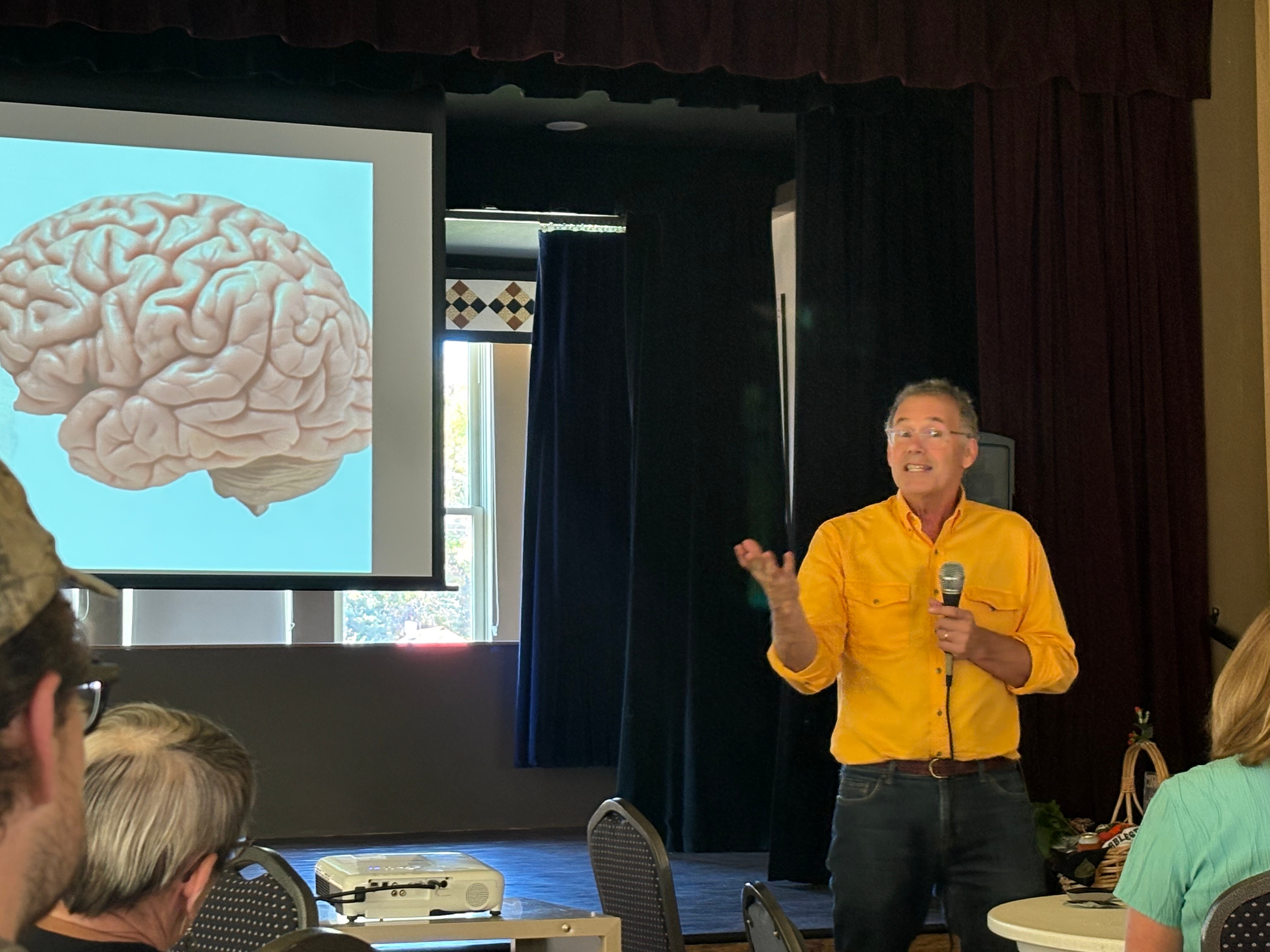
We had a blast on Saturday afternoon in Absarokee doing a 3-hour workshop on “Tools for Living your Best Life: A Happiness Primer.
Why was it a blast? Let me count the ways.
Rita opened the event with a sweet version of the song, “Happiness Runs. . .”
Turnout was awesome with 33 participants packed into the old Cobblestone Schoolhouse.
Rita and the Cobblestone Board orchestrated a “Best Savoring Treat” contest, brought in a judge, and we all applied our savoring skills before, during, and after our designated snack time. There were many deserving entries. I felt for the judge, who had to sample all 14 food options!
The group was a combination of educators and people off the street. I think the person who won the longest travel to attend drove from Jordan, but we also had a teacher from Townsend, and a handful who drove down the hill from Red Lodge.
Questions, comments, and participation was amazing. I was very impressed with the level of engagement.
At the end, I had the honor and opportunity to act as the auctioneer to raise funds for the Cobblestone Building (which needs gutters installed). As an untrained auctioneer who uses his little league “a-batta” skills combined with a complete breakdown of inhibition, it was great fun.
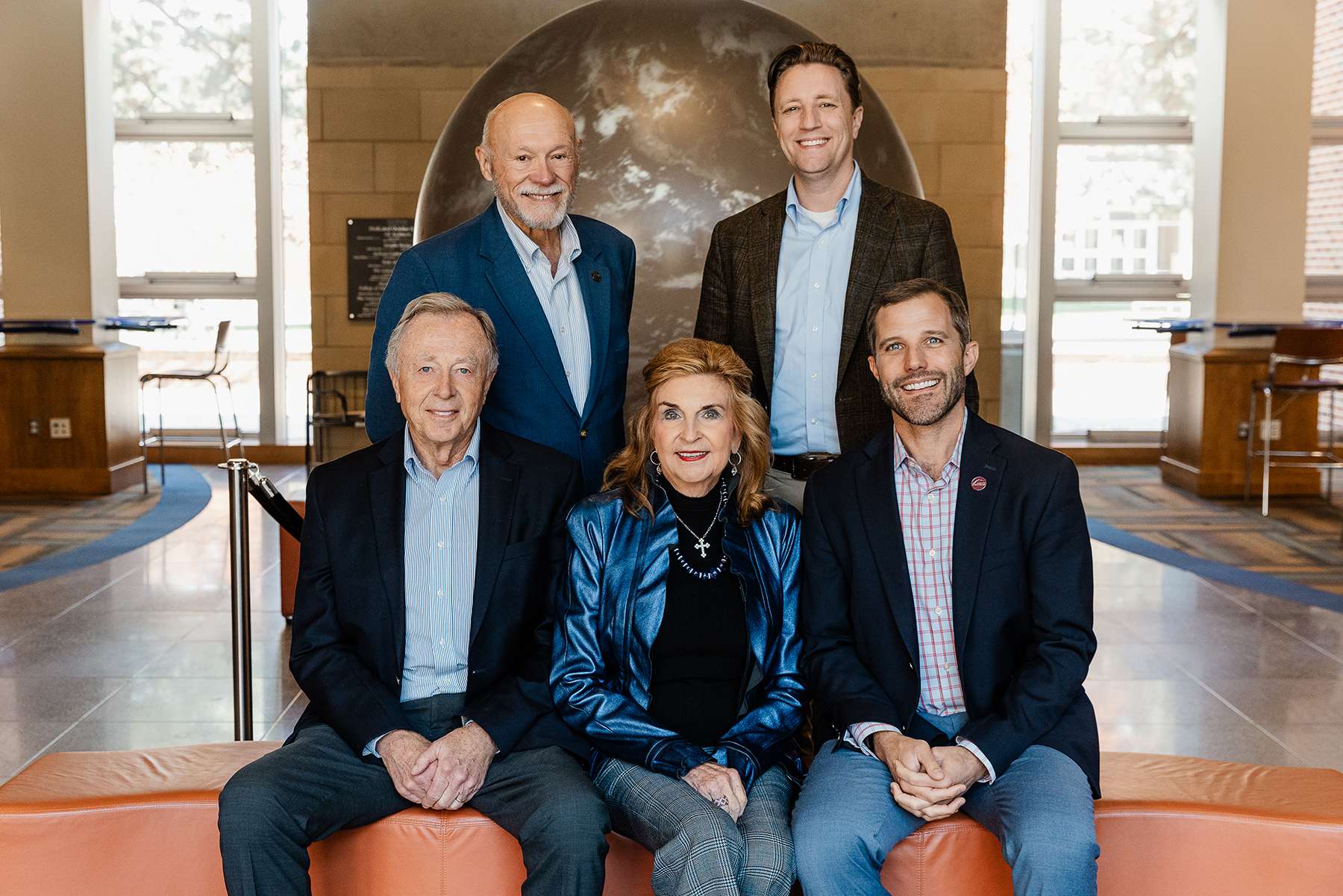
The event was supported by the Cobblestone Board and the Phyllis J. Washington Center for the Advancement of Positive Education (CAPE) at the University of Montana. If your organization would like to host a community event, contact Torey Wetsch at CAPE for information: torey.wetsch@mso.umt.edu.
The University of Montana Foundation and the Phyllis J. Washington College of Education have just issued a press release announcing a $9.4M grant from the Dennis and Phyllis Washington Foundation to support positive education at the University of Montana and throughout the state. I am humbled to hear of this amazing support and immensely grateful to Phyllis Washington and the Washington Foundation for their vision and generosity.
Specifically, these funds will support the educational journey of prospective Montana teachers and school counselors and will grow our efforts to address the emotional and behavioral health of Montana educators and students through positive education. As you may know, thanks to a previous grant from the Arthur M. Blank Family Foundation, I’ve been very involved in promoting the principles of positive psychology and education throughout Montana. I look forward to continuing my work with Montana teachers and administrators. This incredibly generous grant will deepen our support for current and future Montana educators, including professional school counselors. Together, we will work to improve the emotional and behavioral health of young people in Montana and beyond.
If you have questions, please reach out to the names and numbers listed in the official press release.
P.S.: Along with my thanks to the Washington Foundation, in keeping with the principles of positive psychology, I want to emphasize my gratitude to Dr. Dan Lee, Dean of the Phyllis J. Washington College of Education, and the extremely competent and capable team of Erin Keenan, Erin White, and Jason Newcomer from the University of Montana Foundation. Of course, many of you who receive this message are also on my gratitude list. I hope you can feel good feelings deep inside yourselves about your own contributions to creating a better future for Montana youth, educators, and schools. I look forward to working collaboratively with all of you in the future.
I’ve had several requests for more details about our grant-supported, upcoming fall 2024 version of the “Happiness for Teachers” course, including, the all-important question: How much time will this take?? Here are the details.
Grading Options
Because we want to support teachers, our approach to grading is flexible. Teachers can select from one of three grading options.
Teachers can receive 3 graduate credits from the University of Montana – graded using a Credit/No Credit system. That means you need to complete enough course assignments to obtain 70% (you can do more). Then you will pass the course and receive the credits. Even if you get an NCR in the course, you can qualify for a pro-rated number of OPI credits based on your percentage completion.
Teachers can receive 3 graduate credits from the University of Montana – graded using a traditional “letter” grading system. Some school districts require a letter grade to count the course toward your payscale.
You can receive up to 48 OPI credits. This option is especially useful if you find you’re unable to complete at least 70% of the assignments. You can receive a pro-rated total of OPI hours . . . depending on how many hours of the course you complete.
How Much Work will the Course Be?
This is a graduate-level course, and so there’s a significant workload. If you can take the course for credit/no credit (see above), then you only need to obtain 70%, which makes the workload lighter.
At the ½ point in the course, we will ask all participants to inform us how they want to take the course (for credit/no credit; for a letter grade; for OPI hours). If you get ½ way through the course and you think you’re not going to pass (or get the grade you want), then you can take it for OPI hours. In the end, even if you get an NCR in the course, you can still qualify for a prorated number of OPI hours.
To complete the whole course, teachers need to complete the following assignments:
Initial and Final Happiness Assessments (20 points each; 40 points total): During the first and final days of class you’ll be given a link to a happiness assessment packet via Qualtrics. We’re collecting this data to support the grant we have that enabled us to offer you this course at a steep discount.
Active Learning Assignments (complete 10 of the 14 options available; 10 points each; 100 total points): These are short assignments designed to get you in the habit of incorporating happiness-related activities into your life. These assignments are graded pass (10 points) or not pass (0 points). To get your 10 points you need to complete the bare minimum of a thoughtful response.
Weekly Discussion Board Postings and Comments (30 posts; total 60 points): We want you to engage with each other on how you might apply what you’re learning in this course. To encourage this, you’re assigned to make two posts each week (30 total posts). We’d like you to make one post about the weekly course content (lectures and other assigned content) and one post commenting on the post of someone else.
Development of One Educational Lesson Plan (3-5 pages; 40 points): Pick a topic from class (e.g., savoring, gratitude, acts of kindness, etc.) and then write a lesson plan that you could potentially use in your educational setting. You DO NOT need to implement these lesson plans; the assignment is only to create them.
Live online or recorded final pub quiz (30 points, plus prizes): During the last Unit of class John Sommers-Flanagan will hold a live and synchronous open pub-style happiness trivia quiz. If you participate live you can win prizes. Whether you participate live or watch the recording, you can earn 30 points by turning in the answers to the 30 happiness trivia questions.
Substitute (or Extra) Credit (40 points): You can engage in 5 or more sessions of individual counseling with a Master’s student at the University of Montana. You can use these points to substitute for another assignment, or as extra credit.
How Much Time will This Course Take?
The video-recorded lecture component of the course takes about 45 hours to view.
If you complete the whole course, assignments outside of class will take approximately an additional 100 hours.
For the Fall, 2024 version of the course, there will be 15 weeks—although you’ll be working at your own pace. Assuming you worked at an even pace over the 15 weeks, anticipating about 10 hours a week for the course is a reasonable estimate.
Our Goals
We want to support teachers because we view them as unappreciated, underpaid, and highly stressed by the demands of their jobs. We have three objectives:
Offer a high quality and low-cost course to Montana teachers and other school personnel. The fee is $195 for 3-credits.
Focus the course content on emotional wellness—teachers can apply this content to themselves, and possibly also apply it in their classrooms.
By offering a 3-credit graduate course through the University of Montana, teachers may qualify for a salary bump.
Thanks to the support of the Arthur M. Blank Foundation, we (the Montana Safe Schools Center and the Montana Happiness Project) have funding to support a very low cost 3-credit online graduate course titled, “Evidence-Based Happiness for Educators.”
This course is available very soon – the first class “meeting” is on July 5, from 9:30am-11:30am. I have “meeting” in quotes here because the course can be taken asynchronously, although we recommend synchronous “live” attendance on specific dates. The details follow:
When: The course begins on Wednesday, July 5, 2023. The course consists of 20, 2-hour sessions. The final meeting is on Tuesday, August 1. Live (synchronous) class meetings will be held from 9:30am to 11:30am on the following dates:
Wednesday, July 5
Monday, July 10
Monday, July 17
Monday, July 24
Monday, July 31
Where: Online. After you register, as soon as we have the final course details taken care of, you’ll receive a Zoom link for attending sessions, and accessing course videos and materials.
What: The course, COUN 595 (Evidence-Based Happiness for Educators) is an academic review and experiential practice of evidence-based happiness strategies. Participants will have daily reading/podcast/video assignments, along with experiential practice assignments. The primary purpose of the course is for teachers to learn to apply evidence-based happiness strategies (e.g., gratitude, savoring, etc.) to themselves. The secondary purpose of the course is for teachers to make plans for how they can integrate evidence-based happiness principles and activities into their classrooms. You will not be required to implement these ideas in your classrooms, but we will encourage you to experiment with the ideas on yourself and, to the extent that you desire, to share them with students.
Who can enroll: All Montana teachers are eligible to enroll. There is a class cap at 40.
Who will teach the course: Lillian Martz, M.A., a doctoral student in the Department of Counseling at the University of Montana will be the lead instructor. John Sommers-Flanagan, a professor in the Department of Counseling will be the secondary instructor.
The cost: Due to a generous grant from the Arthur M. Blank Foundation, we can offer this course at approximately 20% of a usual University of Montana summer course. Instead of over $1,000, the course is $175.00 for 3 graduate credits. You can also take the noncredit version of the course (and qualify for 40 OPI hours), for $75.00.
What else: Because this course is underwritten by the Arthur M. Blank Foundation, we will ask participants to complete questionnaires before and after the course. You will not be required to complete the questionnaires, but if you do, that will help us to better understand the usefulness of this course content for Montana educators . . . and we would greatly appreciate your participation.
I’ve spent the morning learning. At this point in my life, learning requires simultaneous regulation of my snarky irreverence. Although I intellectually know I don’t know everything, when I discover, as I do ALL. THE. TIME., that I don’t know something, I have to humble myself unto the world.
Okay. I know I’m being a little dramatic.
After pushing “submit” on our latest effort to publish Round 1 of our happiness class data, less than an hour later I received a message from the very efficient editor that our manuscript had been “Unsubmitted.” Argh! The good news is that the editor was just letting us know that we needed to follow the manuscript submission guidelines and include a “Structured Abstract.” Who knew?
The best news is I wrote a structured abstract and discovered that I like structured abstracts way more than I like traditional abstracts. So, that’s cool.
And, here it is!
Abstract
Background: University counseling center services are inadequate to address current student mental health needs. Positive psychology courses may be scalable interventions that address student well-being and mental health.
Objective: The purpose of this study was to evaluate the effects of a multi-component positive psychology course on undergraduate student well-being, mental health, and physical health.
Method: We used a quantitative, quasi-experimental, pretest-posttest design. Participants in a multi-component positive psychology course (n = 38) were compared to a control condition (n = 41). All participants completed pre-post measures of well-being, physical health, and mental health.
Results: Positive psychology students reported significant improved well-being and physical health on eight of 18 outcome measures. Although results on the depression scale were not statistically significant, a post-hoc analysis of positive psychology students who were severely depressed at pretest reported substantial depression symptom reduction at posttest, whereas severely depressed control group students showed no improvement.
Conclusion:Positive psychology courses may produce important salutatory effects on student physical and mental health. Future research should include larger samples, random assignment, and greater diversity.
Teaching Implications: Psychology instructors should collaborate with student affairs to explore how positive psychology courses and interventions can facilitate student well-being, health, and mental health.
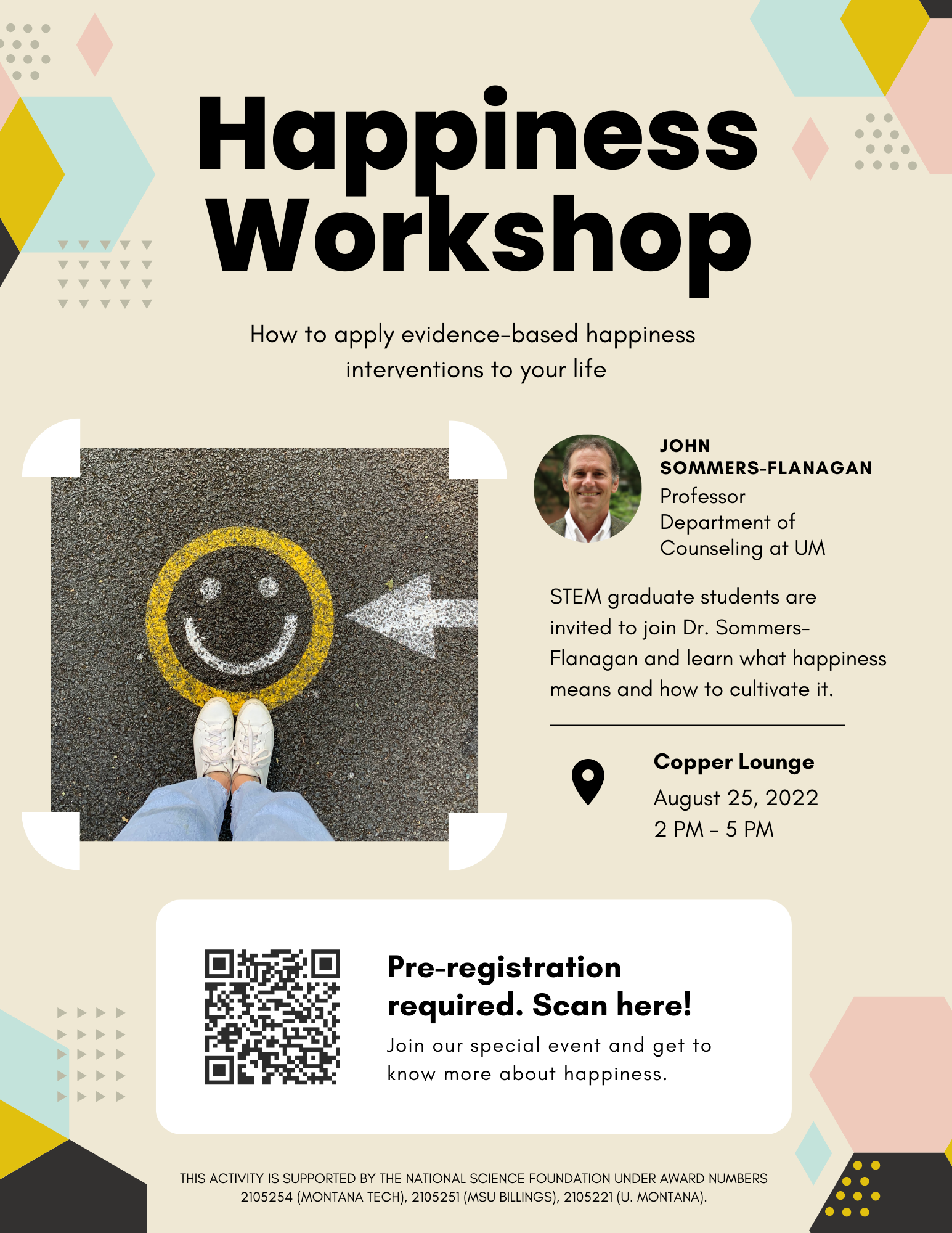
This is the flyer/registration form for Montana Tech in Butte. The link for the UM – Missoula workshop is below in the blog post.
Next week, the Montana Happiness Project and the Families First Learning Lab have a variety of educational offerings. I’ve listed them below, along with links that can provide additional information.
If you’re a STEM grad student at the University of Montana, and you want to attend a short (2.5 hour) evidence-based happiness workshop on Friday, August 26 (and get a free lunch), click on this link for more information and to register. https://umt.co1.qualtrics.com/jfe/form/SV_3yjFgwKqfmE7Qt8
As you can see below, I’m doing the same workshop for Montana Tech in Butte on Aug 25.
If you’re working with an organization that might want a speaker on happiness or strengths-based suicide assessment and treatment, you should check out the Montana Happiness Project “Speaker” page: https://montanahappinessproject.com/speakers . . . and contact us to let us know of your interest.
Okay. Here’s the list of events for Aug and Sept.
August 23, 2022 – John Sommers-Flanagan presents on “The art and science of happy teachers” to the Belgrade School staff. Belgrade, MT.
August 25, 2022 – Dylan Wright presents on “Parent Engagement” to the Youth Dynamics staff. Webinar.
August 25, 2022 – John Sommers-Flanagan presents on “Evidence-based happiness skills” to the Montana HOPES Project at Montana Tech. Butte, MT.
August 26, 2022 – John Sommers-Flanagan presents on “Evidence-based happiness skills” to the Montana HOPES Project at University of Montana. Missoula, MT.
September 1, 2022 – Dylan Wright presents on “The Art, Science, and Practice of Meaningful Happiness” for Mountain Home staff. Missoula, MT.
September 20, 2022 – John Sommers-Flanagan presents on “Suicide assessment and treatment: A strengths-based approach” for the Wallowa Valley Center for Wellness. Enterprise, OR.
I forgot how much I love teaching group counseling.
Maybe I forgot because I haven’t taught Group Counseling at the University of Montana since 2017. Whatever the reason, last week, I remembered.
I remembered because I got to provide a group-oriented counseling training to seven very cool program managers and staff of the Big Sky Youth Empowerment program in Bozeman. We started with a structured question and answer opening, followed with a self-reflective debrief, and then re-started with a different version of the same opening so we could engage in a second self-reflective debrief. I’ve used this opening several times when teaching group; it’s getting better every time.
I love the experiential part where I get to flit back and forth between process facilitator and contributor. I love the opportunity to quote Irvin Yalom about the “self-reflective loop” and “The group leader is the norm-setter and role model.” Then I love getting to quote Yalom again, “Cohesion is the attraction of the group for its members.” And again, “I have a dilemma . . .” Boom. When teaching group counseling, the Yalom quotes never stop!
Groups are about individuals and groups and individuals’ learning from the power of groups. I get to learn and re-learn about strong openings, monopolizers, closing for consolidation, and the natural temptation of everyone in the group to fix other group members’ problems—and the need for group facilitators to tightly manage the problem-solving process. We get to “go vertical” and back out through linking and then “go horizontal.”
Tomorrow I head back to Bozeman for more training with the fabulous BYEP staff. Part of the day we’ll focus on specific group facilitation techniques, which reminded me of a handout I created back in 2017. The handout lists and provides examples for 18 different group counseling techniques/strategies. For anyone interested, the group techniques handout is here:
I hope you’re all having a great Memorial Day and engaging in something that feels like just the right amount of meaningful or remembrance for you on this important holiday when we recognize individuals who made huge sacrifices for the sake of the greater and common good of the group.
Earlier this week Rita and I got to talk about love for 90 minutes with Dr. Tim Nicolls and his Honors class titled “Love” at the University of Montana. It’s a fun gig. We get to tell stories about our own romantic history, weave in Alfred Adler’s many amazing love quotations, and walk though Julie and John Gottman’s six predictors of divorce, along with six strategies for addressing and shrinking those predictors.
Back in our courting days Rita lured me up onto the underside of Orange Street bridge in Missoula. We’re so old that we were courting long before they blocked off the underside to romancing couples. Rita—being a balance-beam genius in a previous life—started walking comfortably along an 18 inch wide steel beam about 40 feet above the shallows of the Clark Fork river. Being naïve and adopting the good constructivist mindset of not knowing, I followed. She just kept on walking as if there were no particular danger. I looked down at the rocks and water. By the time she turned to peek back at me, I was on my hands and knees and crawling very slowly along the beam.
To this day, Rita insists I’m afraid of heights. Of course, that’s not true. I’m not afraid of heights, but I am afraid of falling. I believe I was simply showing good judgment and trying to avoid dying during our courtship.
Our romantic bridge story links well to the classic social psychology bridge study on the misattribution of arousal. You can read the abstract here: https://doi.apa.org/doiLanding?doi=10.1037%2Fh0037031. Rita insists that she didn’t learn about how easily male college students can be manipulated into misattributing their fear-related arousal to romantic arousal until AFTER she led me onto the Orange Street bridge.
We like to call our lecture “Love Skills,” because of our mutual belief that although love usually involves passion, lasting love also includes a generous array of relationship skills. As Adler pointed out, long ago, long-term romantic relationships also require the right attitude. He wrote:
“There are too many people in our society who take, and [who] have great expectations, and too few who give. It seems that too much of human kind is caught in a love and marriage formula that states: Because I love you, you must obey me!”
In case you’re interested, here’s the link to our Love Skills powerpoints.
And here’s my favorite Adler relationship quotation:
“Each partner must be more interested in the other than in himself (sic). This is the only basis on which love and marriage can be successful.” (Ansbacher & Ansbacher, 1956, p. 432)
One of my biggest delights this semester has been reading my happiness students’ homework assignments. They’ve embraced each assignment with what Zen masters might call “Shoshin.”
Shoshin is a Japanese word referring to beginner’s mind. Beginner’s mind involves approaching experiences with an attitude of “not knowing” and maximum openness to learning. If you already know about something (say meditation), your natural inclination will be to close your mind, because you already have knowledge and lived experience about meditation and so there’s less openness to learning. Shifting from an expert (closed) mind to a beginner’s (open) mind requires intent and effort.
For many of my happiness students, some of the assignments have been old hat. Like when I ask someone with a degree in divinity and an active meditation practice to meditate for six minutes a day . . . or when I ask someone who is a faculty in counseling or a psychiatrist to try a little cognitive therapy on themselves . . . or when I ask university athletes to exercise, breathe, and consider the concept of flow . . . or when I ask a bartender to focus in on listening to others.
Despite me offering up some “old hat” assignments, my students have responded as if they were encountering everything for the first time. So. Very. Cool.
Those of you who aren’t enrolled at the University of Montana may not realize that today is the very end of spring break. Although spring is often about new beginnings, the end of a university semester is often about time management and emotional survival. Tomorrow, after a week or so of a “break” my students and I return to our studies to finish the semester. My hope is that we all return refreshed and with a renewed passion for learning, so we can Shoshin through our next six weeks.
This hope isn’t just for my happiness class students. Far too many painful events and situations are out there happening in the world. On top of that, everyone on the planet is facing unique and personal challenges that I don’t and probably can’t fully comprehend. We have these global and personal challenges AND in the Northern hemisphere, we’re experiencing spring. Even though there will be distractions and we will be imperfect, let’s do our best Shoshin and approach all of spring like a sponge, soaking up all the learning we can.
In 1970, Shunryu Suzuki wrote: “In the beginner’s mind there are many possibilities, but in the expert’s, there are few” (from, Zen Mind, Beginner’s Mind).
Let’s stay watchful and open with a beginner’s mind. This is a new spring, a never before spring, with new opportunities. As James Garbarino once wrote: “Stress accumulates; opportunity ameliorates.” Amelioration. What a great word for today . . . and tomorrow.
I was just now finishing up the Moodle (not Poodle) shell for my upcoming Happiness class. While working, I noticed one more person added into the course. . . so there’s still time . . . and I know some of you have been thinking about it.
Whether you take my class or not, you should consider some form of a happiness intervention with yourself. I’m not saying that because I promote toxic positivity. Instead, although I think we should all explore our pain and deepen our understanding of ourselves, we also need tools that will help us feel better on a daily basis and more tools to help us make sure we’re pointed in a direction likely to create meaningful lives.
This leads me to some highlights from happiness class research.
In a small study of 23 undergraduates in a traditional, face-to-face psychology course format, “students reported gains in hope, self-actualization, well-being, agency, and pathway hopefulness, purpose, and mission in life” (Maybury, 2013, p. 62). Note: there was no control group in this study.
In a small study of 18 undergraduates (and 20 control participants who took a social psychology course) in traditional, face-to-face psychology course formats, “the positive psychology students reported higher overall happiness, life satisfaction, routes to happiness, and lower depressive symptoms and stress compared to students in the control course” (Goodmon et al., 2016, p. 232)
In a series of three studies conducted during a COVID-19 lockdown in the U.K., the researchers reported (a) undergraduates in a happiness course had higher mental well-being than a waiting list control; (b) during lockdown, the happiness course did not have significantly positive effects, but participants seemed somewhat buffered from negative effects because they had higher subjective well-being than a control group; (c) a short (4 week), online version of the course used with “university staff and students produced significant benefits across a range of mental and personal well-being measures” (Hood et al., 2021, p. 11). Note: there was no control group in the third study.
In a series of three large studies (n = 500+ for each) of massive open online courses (MOOCs), adult students reported significantly higher subjective well-being than students in an alternative introductory psychology MOOC (Yaden et al., 2021).
We’ve now—at the University of Montana—have collected data on three of our own happiness interventions (one 2.5-hour workshop and two full-semester courses). We have, or will soon, submit these for publication. Our outcomes included:
Study 1 (a 2.5-hour happiness workshop): We had an immediate statistically significant effect on depression symptoms in our workshop group (n = 28) as compared to the waiting list control group (n = 17). At six-months follow-up, over 60% of the workshop participants reported they were still feeling the benefits from the workshop.
Study 2 (Spring 2020 class; half face-to-face and half online, due to COVID-19): We had several positive outcomes for our happiness class members (n = 38) as compared to an alternative course control group (n = 41). Positive outcomes included: (a) greater perceived friendship support, (b) greater hope, (c) fewer/less intense negative emotions, (d) better total health, including better sleep and fewer headaches, and (e) slightly improved mindfulness.
Study 3 (Spring 2021 class; all online): Again, we had several positive outcomes for our happiness class members (n = 36) as compared to an alternative course control group (n = 34). This time, the positive outcomes included: (a) fewer/less intense negative emotions, (b) higher positive emotions, (c) increased hope on both agency and pathways subscales, as well as total hope, and (d) slight increases in perceived friendship support. Unfortunately, we forgot to include the physical health questionnaire.
*In closing, I should mention that I used anthropomorphizing language in this blog’s title. Rest assured, I realize that “research” as a non-sentient activity, is unable to speak, and so if I were to be perfectly honest, I’d say something like “Research says nothing about happiness classes, because research cannot speak.” The reason for my wanton anthropomorphizing is that I’ve noticed this sort of linguistic error in many popular articles that get lots of attention. . . and obviously, I’m trying to attract attention here.
The place to click if you want to learn about psychotherapy, counseling, or whatever John SF is thinking about.






 John Sommers-Flanagan