
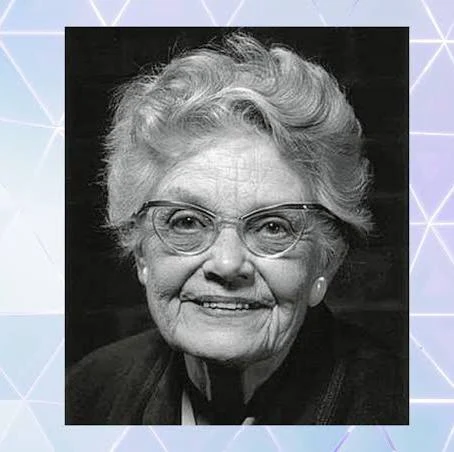
While reviewing and revising the behavior therapy chapter from our Theories textbook, I found myself revisiting my awe of Mary Cover Jones. I think too many contemporary therapists don’t know about Mary Cover Jones and don’t understand the behavioral (classical conditioning) model for understanding and treating anxiety disorders, including OCD and PTSD.
In most chapters, we include a feature called a “Brain Box.” Here’s the box from Chapter 7, Behavior Theory and Therapy.
7.1 Brain Science May be Shiny, but Exposure Therapy is Pure Gold
In honor of Joseph Wolpe, let’s start with mental imagery.
***********
Imagine you’ve travelled back in time to your first week of high school. You look around and see that one of your classmates is named Mary Jones.
Mary is an ordinary girl with an ordinary name. Over the years, you don’t notice her much. She seems like a nice person, a fairly good student, and someone who doesn’t get in trouble or draw attention to herself.
Four years pass. A new student joined your class during senior year. His name is Daniel Tweeter. Toward the end of the year, Daniel does a fantastic Prezi presentation about a remarkable new method for measuring reading outcomes. He includes cool video clips and boomerang Snapchat. When he bows at the end, he gets a standing ovation. Daniel is a good student and a hard worker; he partnered up with a college professor and made a big splash. Daniel deserves recognition.
However, as it turns out, over the whole four years of high school, Mary Jones was quietly working at a homeless shelter; week after week, month after month, year after year, she was teaching homeless children how to read. In fact, based on Daniel’s measure of reading outcomes, Mary had taught over 70 children to read.
Funny thing. Mary doesn’t get much attention. All everybody wants to talk about is Daniel. At graduation, he wins the outstanding graduate award. Everyone cheers.
Let’s stop the visualization and reflect on what we imagined.
***********
Like birds and raccoons, humans tend to like shiny things. Mary did incredible work, but hardly anyone noticed. Daniel did good work, and got a standing ovation and the top graduate award.
The “shiny-thing theory” is my best explanation for why we tend to get overly excited about brain science. It’s important, no doubt, but brain imaging isn’t therapy; it’s just a cool way to measure or validate therapy’s effects.
Beginning from at least 1924, when Mary Cover Jones was deconditioning fear out of little children, behavior therapy has shown not only great promise, but great outcomes. However, when researchers showed that exposure therapy “changes the brain,” most of the excitement and accolades were about the brain images; exposure therapy was like background noise. Obviously, the fact that exposure therapy (and other therapies) change the brain is great news. It’s great news for people who have anxiety and fear, and it’s great news for practitioners who use exposure therapy.
This is all traceable to neuroscience and human evolution. We get distracted by shiny objects and miss the point because our neural networks and perceptual processes are oriented to alert us to novel (new) environmental stimuli. This is probably because change in the form of shiny objects might signal a threat or something new and valuable. We therefore need to exercise self-discipline to focus in and not overlook that behavior therapy in general, and exposure therapy in particular, has been, is, and probably will continue to be, the most effective approach on the planet for helping people overcome anxiety and fear. In addition, you know what, it doesn’t really matter that it changes the brain (although that’s damn cool and affirming news). What matters is that it changes clients’ lives.
Exposure therapy, no matter how you package it, is highly effective for treating anxiety. This statement is true whether we’re talking about Mary Cover Jones and her evidence-based counterconditioning cookies or Francine Shapiro and eye movement desensitization reprocessing (EMDR). It’s also true whether we’re talking about virtual reality exposure, imaginal exposure, massed exposure, spaced exposure, in vivo exposure, interoceptive exposure, response prevention (in obsessive-compulsive disorder), or the type of exposure that acceptance and commitment therapists use (note that they like to say it’s “different” from traditional classical conditioning exposure, but it works, and that’s what counts).
In the end, let’s embrace and love and cheer brain imaging and neuroscience, but not forget the bottom line. The bottom line is that exposure therapy works! Exposure therapy is the genuine article. Exposure therapy is pure gold.
Mary Cover Jones is the graduate of the century; she was amazing. Because of her, exposure therapy has been pure gold for 93+ years, and now we’ve got cool pictures of the brain to prove it.
Mary Cover Jones passed away in 1987. Just minutes before her death, she said to her sister: “I am still learning about what is important in life” (as cited in Reiss, 1990).
We should all be more like Mary.






 This weekend in Missoula is the Annual Montana Book Festival, so I’ve got books on my mind. In a stroke of good fortune (and thanks to Susan O’Connor and Rita), last night I got to meet David James Duncan, the author of my all-time favorite book,
 John Sommers-Flanagan