We’re in the throes of editing our Theories text, meaning I’m so deep into existential, feminist, and third wave counseling and psychotherapy theories that I may have lost myself. If any of you find me somewhere on the street babbling about Judith Jordan and Frantz Fanon and Bryan Cochran, please guide me home.
This brings me to a big ask.
As part of 4th wave feminism, we’re more deeply integrating intersectionality into the practice of feminist therapy. Among other things, intersectionality is about identity. I’m interested in using a variation of Irvin Yalom’s “Who are you?” group technique to explore identity in anyone willing to respond to this post.
To participate, follow these instructions.
Clear a space for thinking, writing, and exploring your identity.
Ask yourself the question: “Who am I?” and write down the response as it flows into your brain/psyche.
Repeat this process nine more times, for a total of 10 responses, numbering each response. One rule about this: You can’t use the same response twice.
After you finish your list of 10, write a paragraph or two about how you were affected by this activity.
If you’re comfortable sharing, send me your list of 10 identities along with your reflections (email: john.sf@mso.umt.edu). If you prefer the more public route, you can post your responses here on my blog. Either way, because I’m in 24/7 theories mode, you may not hear back from me until middle November!
There’s a chance I might want to quote one or more of you in the theories text, instructor’s manual, student guide, or in this blog. If that’s the case, I will email you and request permission.
Thanks for considering this activity and request. Identity and identity development are fascinating. Whether we’re talking about multiple identities (intersectionality), emotions and behaviors (Blake), or the “microbes within us” (Yong), we all contain multitudes.
On July 24, in Helena, I attended a fun and fascinating meeting sponsored by the Carter Center. I spent the day with a group of incredibly smart people dedicated to improving mental health in Montana.
The focus was twofold. How do we promote and establish mental health parity in Montana and how do with improve behavioral health in schools? Two worthy causes. The discussions were enlightening.
We haven’t solved these problems (yet!). In the meantime, we’re cogitating on the issues we discussed, with plans to coalesce around practical strategies for making progress.
During our daylong discussions, the term evidence-based treatments bounced around. I shared with the group that as an academic psychologist/counselor, I could go deep into a rabbit-hole on terminology pertaining to treatment efficacy. Much to everyone’s relief, I exhibited a sort of superhuman inhibition and avoided taking the discussion down a hole lined with history and trivia. But now, much to everyone’s delight (I’m projecting here), I’m sharing part of my trip down that rabbit hole. If exploring the use of terms like, evidence-based, best practice, and empirically supported treatment is your jam, read on!
The following content is excerpted from our forthcoming text, Counseling and Psychotherapy Theories in Context and Practice (4th edition). Our new co-author is Bryan Cochran. I’m reading one of his chapters right now . . . which is so good that you all should read it . . . eventually. This text is most often used with first-year students in graduate programs in counseling, psychology, and social work. Consequently, this is only a modestly deep rabbit hole.
Enjoy the trip.
*************************************
What Constitutes Evidence? Efficacy, Effectiveness, and Other Research Models
We like to think that when clients or patients walk into a mental health clinic or private practice, they will be offered an intervention that has research support. This statement, as bland as it may seem, would generate substantial controversy among academics, scientists, and people on the street. One person’s evidence may or may not meet another person’s standards. For example, several popular contemporary therapy approaches have minimal research support (e.g., polyvagal theory and therapy, somatic experiencing therapy).
Subjectivity is a palpable problem in scientific research. Humans are inherently subjective; humans design the studies, construct and administer assessment instruments, and conduct the statistical analyses. Consequently, measuring treatment outcomes always includes error and subjectivity. Despite this, we support and respect the scientific method and appreciate efforts to measure (as objectively as possible) psychotherapy outcomes.
There are two primary approaches to outcomes research: (1) efficacy research and (2) effectiveness research. These terms flow from the well-known experimental design concepts of internal and external validity (Campbell et al., 1963). Efficacy research employs experimental designs that emphasize internal validity, allowing researchers to comment on causal mechanisms; effectiveness research uses experimental designs that emphasize external validity, allowing researchers to comment on generalizability of their findings.
Efficacy Research
Efficacy research involves tightly controlled experimental trials with high internal validity. Within medicine, psychology, counseling, and social work, randomized controlled trials (RCTs) are the gold standard for determining treatment efficacy. RCTs statistically compare outcomes between randomly assigned treatment and control groups. In medicine and psychiatry, the control group is usually administered an inert placebo (i.e., placebo pill). In the end, treatment is considered efficacious if the active medication relieves symptoms, on average, at a rate significantly higher than placebo. In psychotherapy research, treatment groups are compared with a waiting list, attention-placebo control group, or alternative treatment group.
To maximize researcher control over independent variables, RCTs require that participants meet specific inclusion and exclusion criteria prior to random assignment to a treatment or comparison group. This allows researchers to determine with greater certainty whether the treatment itself directly caused treatment outcomes.
In 1986, Gerald Klerman, then head of the National Institute of Mental Health, gave a keynote address to the Society for Psychotherapy Research. During his speech, he emphasized that psychotherapy should be evaluated through RCTs. He claimed:
We must come to view psychotherapy as we do aspirin. That is, each form of psychotherapy must have known ingredients, we must know what these ingredients are, they must be trainable and replicable across therapists, and they must be administered in a uniform and consistent way within a given study. (Quoted in Beutler, 2009, p. 308)
Klerman’s speech advocated for medicalizing psychotherapy. Klerman’s motivation for medicalizing psychotherapy partly reflected his awareness of heated competition for health care dollars. This is an important contextual factor. Events that ensued were an effort to place psychological interventions on par with medical interventions.
The strategy of using science to compete for health care dollars eventually coalesced into a movement within professional psychology. In 1993, Division 12 (the Society of Clinical Psychology) of the American Psychological Association (APA) formed a “Task Force on Promotion and Dissemination of Psychological Procedures.” This task force published an initial set of empirically validated treatments. To be considered empirically validated, treatments were required to be (a) manualized and (b) shown to be superior to a placebo or other treatment, or equivalent to an already established treatment in at least two “good” group design studies or in a series of single case design experiments conducted by different investigators (Chambless et al., 1998).
Division 12’s empirically validated treatments were instantly controversial. Critics protested that the process favored behavioral and cognitive behavioral treatments. Others complained that manualized treatment protocols destroyed authentic psychotherapy (Silverman, 1996). In response, Division 12 held to their procedures for identifying efficacious treatments but changed the name from empirically validated treatments to empirically supported treatments (ESTs).
Advocates of ESTs don’t view common factors in psychotherapy as “important” (Baker & McFall, 2014, p. 483). They view psychological interventions as medical procedures implemented by trained professionals. However, other researchers and practitioners complain that efficacy research outcomes do not translate well (aka generalize) to real-world clinical settings (Hoertel et al., 2021; Philips & Falkenström, 2021).
Effectiveness Research
Sternberg, Roediger, and Halpern (2007) described effectiveness studies:
An effectiveness study is one that considers the outcome of psychological treatment, as it is delivered in real-world settings. Effectiveness studies can be methodologically rigorous …, but they do not include random assignment to treatment conditions or placebo control groups. (p. 208)
Effectiveness research focuses on collecting data with external validity. This usually involves “real-world” settings. Effectiveness research can be scientifically rigorous but doesn’t involve random assignment to treatment and control conditions. Inclusion and exclusion criteria for clients to participate are less rigid and more like actual clinical practice, where clients come to therapy with a mix of different symptoms or diagnoses. Effectiveness research is sometimes referred to as “real world designs” or “pragmatic RCTs” (Remskar et al., 2024). Effectiveness research evaluates counseling and psychotherapy as practiced in the real world.
Other Research Models
Other research models also inform researchers and practitioners about therapy process and outcome. These models include survey research, single-case designs, and qualitative studies. However, based on current mental health care reimbursement practices and future trends, providers are increasingly expected to provide services consistent with findings from efficacy and effectiveness research (Cuijpers et al., 2023).
In Pursuit of Research-Supported Psychological Treatments
Procedure-oriented researchers and practitioners believe the active mechanism producing positive psychotherapy outcomes is therapy technique. Common factors proponents support the dodo bird declaration. To make matters more complex, prestigious researchers who don’t have allegiance to one side or the other typically conclude that we don’t have enough evidence to answer these difficult questions about what ingredients create change in psychotherapy (Cuijpers et al., 2019). Here’s what we know: Therapy usually works for most people. Here’s what we don’t know: What, exactly, produces positive changes.
For now, the question shouldn’t be, “Techniques or common factors?” Instead, we should be asking “How do techniques and common factors operate together to produce positive therapy outcomes?” We should also be asking, “Which approaches and techniques work most efficiently for which problems and populations?” To be broadly consistent with the research, we should combine principles and techniques from common factors and EST perspectives. We suspect that the best EST providers also use common factors, and the best common factors clinicians sometimes use empirically supported techniques.
Naming and Claiming What Works
When it comes to naming and claiming what works in psychotherapy, we have a naming problem. Every day, more research information about psychotherapy efficacy and effectiveness rolls in. As a budding clinician, you should track as much of this new research information as is reasonable. To help you navigate the language of researchers and practitioners use to describe “What works,” here’s a short roadmap to the naming and claiming of what works in psychotherapy.
When Klerman (1986) stated, “We must come to view psychotherapy as we do aspirin” his analogy was ironic. Aspirin’s mechanisms and range of effects have been and continue to be complex and sometimes mysterious (Sommers-Flanagan, 2015). Such is also the case with counseling and psychotherapy.
Language matters, and researchers and practitioners have created many ways to describe therapy effectiveness.
D12 briefly used the phrase empirically validated psychotherapy. Given that psychotherapy outcomes vary, the word validated is generally avoided.
In the face of criticism, D12 blinked once, renaming their procedures as empirically supported psychotherapy. ESTs are manualized and designed to treat specific mental disorders or specific client problems. If it’s not manualized and doesn’t target a disorder/problem, it’s not an EST.
ESTs have proliferated. As of this moment (August 2025), 89 ESTs for 30 different psychological disorders and behavior problems are listed on the Division 12 website (https://div12.org/psychological-treatments/). You can search the website to find the research status of various treatments.
To become proficient in providing an EST requires professional training. Certification may be necessary. It’s impossible to obtain training to implement all the ESTs available.
In 2006, an APA Presidential Task Force (2006) loosened D12’s definition, shifting to a more flexible term, Evidence-Based Practice (EBP), and defining it as ‘‘the integration of the best available research with clinical expertise in the context of patient characteristics, culture, and preferences’’ (p. 273).
In 2007, the Journal of Counseling and Development, the American Counseling Association’s flagship journal, inaugurated a new journal section, “Best Practices.” As we’ve written elsewhere, best practice has grown subjective and generic and is “often used so inconsistently that it is nearly meaningless” (Sommers-Flanagan, 2015, p. 98).
In 2011, D12 relaunched their website, relabeling ESTs as research-supported psychological treatments (n.b., most researchers and practitioners continue to refer to ESTs instead of research-supported psychological treatments).
As an alternative source of research updates, you can also track the prolific work of Pim Cuijpers and his research team for regular meta-analyses on psychological treatments (Cuijpers et al., 2023; Harrer et al., 2025).
Other naming variations, all designed to convey the message that specific treatments have research support, include evidence-based treatment, evidence-supported treatment, and other phrasings that, in contrast to ESTs and APA’s evidence-based practice definition, have no formal definition.
Manuals, Fidelity, and Creativity
Manualized treatments require therapist fidelity. In psychotherapy, fidelity means exactness or faithfulness to the published procedure—meaning you follow the manual. However, in the real world, when it comes to treatment fidelity, therapist practice varies. Some therapists follow manuals to the letter. Others use the manual as an outline. Still others read the manual, put it aside, and infuse their therapeutic creativity.
A seasoned therapist (Bernard) we know recently provided a short, informal description of his application of exposure therapy to adult and child clients diagnosed with obsessive-compulsive disorder. Bernard described interactions where his adult clients sobbed with relief upon getting a diagnosis. Most manuals don’t specify how to respond to clients sobbing, so he provided empathy, support, and encouragement. Bernard described a therapy scenario where the client’s final exposure trial involved the client standing behind Bernard and holding a sharp kitchen knife at Bernard’s neck. This level of risk-taking and intimacy also isn’t in the manual—but Bernard’s client benefited from Bernard trusting him and his impulse control.
During his presentation, Bernard’s colleagues chimed in, noting that Bernard was known for eliciting boisterous laughter from anxiety-plagued children and teenagers. There’s no manual available on using humor with clients, especially youth with overwhelming obsessional anxiety. Bernard used humor anyway. Although Bernard had read the manuals, his exposure treatments were laced with empathy, creativity, real-world relevance, and humor. Much to his clients’ benefit, Bernard’s approach was far outside the manualized box (B. Balleweg, personal communication, July 14, 2025).
As Norcross and Lambert (2018) wrote: “Treatment methods are relational acts” (p. 5). The reverse is equally applicable, “Relational acts are treatment methods.” As you move into your therapeutic future, we hope you will take the more challenging path, learning how to apply BOTH the techniques AND the common factors. You might think of this—like Bernard—as practicing the science and art of psychotherapy.
**********************************
Note: This is a draft excerpt from Chapter 1 of our 4th edition, coming out in 2026. As a draft, your input is especially helpful. Please share as to whether the rabbit hole was too deep, not deep enough, just right, and anything else you’re inspired to share.
This past week I had the honor and privilege of offering four presentations, one each on Monday, Tuesday, Wednesday, and Thursday.
Monday was a Zoom date with a counseling class at West Virginia University.
Tuesday was an exciting in-person presentation for the University of Montana MOLLI program, kicking off our small group experiential Evidence-Based Happiness course for older adults. It was phenomenal. The older adults always bring it. One–among many–highlights was an 88 -year-old guy who, in the midst of the Three-Step Emotional Change Trick, shared about how he “Honored” his emotions by joining a grief group after his wife died (3 years ago). His sharing was beautiful and perfect.
Wednesday was my annual visit to Dr. Timothy Nichols’s Honors College course on LOVE. Dr. Nichols happens to be the Dean of the Honors College and one of the coolest and kindest and most enthused people on the planet. Mostly I go every year just to hear him introduce me. In truth, I also go because the topic and the students are INCREDIBLE. I think it may have been the best LOVE lecture EVER. I’d post the ppts here, but my computer crashed yesterday, and the U of M IT people (who are always very nice) are now attempting “data recovery.” Argh!
Thursday I got to hang out for two hours with the Graduate Students of the University of Montana Psychology Club. This was yet another fun experience with a group of students who are all simply brilliant. To top it off, a couple of my favorite people (and Psych faculty), Bryan Cochran and Greg Machek also attended. . . providing the precise level of sarcasm and humor that made the experience practically perfect. Here are the Psych Club’s ppts, which I happened to have on a flash drive:
The University of Montana Foundation and the Phyllis J. Washington College of Education have just issued a press release announcing a $9.4M grant from the Dennis and Phyllis Washington Foundation to support positive education at the University of Montana and throughout the state. I am humbled to hear of this amazing support and immensely grateful to Phyllis Washington and the Washington Foundation for their vision and generosity.
Specifically, these funds will support the educational journey of prospective Montana teachers and school counselors and will grow our efforts to address the emotional and behavioral health of Montana educators and students through positive education. As you may know, thanks to a previous grant from the Arthur M. Blank Family Foundation, I’ve been very involved in promoting the principles of positive psychology and education throughout Montana. I look forward to continuing my work with Montana teachers and administrators. This incredibly generous grant will deepen our support for current and future Montana educators, including professional school counselors. Together, we will work to improve the emotional and behavioral health of young people in Montana and beyond.
If you have questions, please reach out to the names and numbers listed in the official press release.
P.S.: Along with my thanks to the Washington Foundation, in keeping with the principles of positive psychology, I want to emphasize my gratitude to Dr. Dan Lee, Dean of the Phyllis J. Washington College of Education, and the extremely competent and capable team of Erin Keenan, Erin White, and Jason Newcomer from the University of Montana Foundation. Of course, many of you who receive this message are also on my gratitude list. I hope you can feel good feelings deep inside yourselves about your own contributions to creating a better future for Montana youth, educators, and schools. I look forward to working collaboratively with all of you in the future.
During my supervision this week, I noticed that the concepts and process of Motivational Interviewing came up several times. When students or professionals don’t know the basics of Motivational Interviewing (MI), I feel compelled to speak up. MI is a method, strategy, or philosophy that’s complex, nuanced, and essential. We should all know about and have MI skills. To feel the centrality of MI to counseling and psychotherapy, it helps to start with MI’s most fundamental organizing principle.
“It is the client who should be voicing the arguments for change” (Miller & Rollnick, 2002, p. 22).
If you contemplate this principle (and you should), then you’ll need to examine your own role in the change process. That’s because, if look at (or listen to) yourself, and YOU’RE the one voicing the arguments for change, you must stop.
If you don’t stop, then you may be contributing to your clients’ resistance to change.
MI ideas are challenging to our natural impulses. We want to tell clients how to be healthier, but our job is not to voice the argument for positive and healthy change; our job is to nurture their argument for positive and healthy change. This is where the nuance comes in. How can we, as interviewers (aka counselors or psychotherapists) create an interaction wherein the client is more likely to take the lead in voicing the arguments for positive and healthy change?
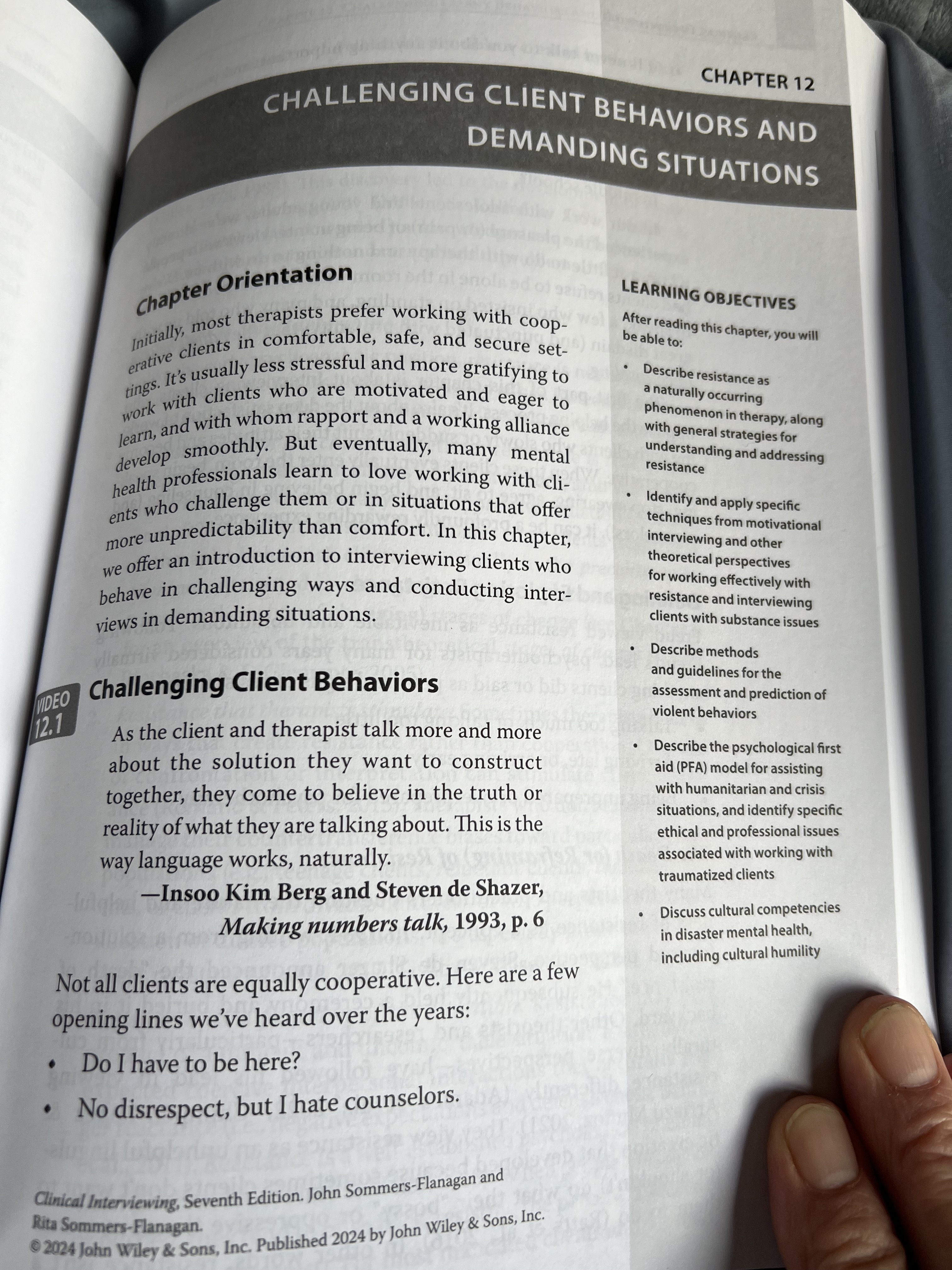
The answer to that question is complex, as it should be. In part, my answer today is to include an excerpt from Chapter 12 (Challenging Client Behaviors and Demanding Situations) of our Clinical Interviewing text. This excerpt starts with the topic of “Challenging Client Behaviors” or behaviors that clients engage in that counselors and psychotherapists often find challenging. The content includes a discussion of the concept of “resistance,” MI strategies, as well other ideas of our own and from the literature.
***************
Challenging Client Behaviors
As the client and therapist talk more and more about the solution they want to construct together, they come to believe in the truth or reality of what they are talking about. This is the way language works, naturally.
—Insoo Kim Berg and Steven de Shazer, Making numbers talk, 1993, p. 6
Not all clients are equally cooperative. Here are a few opening lines we’ve heard over the years:
Do I have to be here?
No disrespect, but I hate counselors.
I’ll never talk to you about anything important, and you can’t make me.
This is a shitty little office; you must be a shitty little therapist.
How long will this take?
How old are you? How are you supposed to help me if you’re still in middle school?
In our work with adolescents and young adults, we’ve directly experienced the pleasure (or pain) of being in interviews with people who want little to do with therapy, and nothing to do with us. We’ve had clients refuse to be alone in the room with us, others who refused to speak, a few who insisted on standing, and many who told us with great disdain (and punctuated with profanity) that they don’t believe in counseling.
The first part of this chapter is about interviewing clients who oppose the helping process. It’s also about the deep satisfaction of working with clients who slowly or suddenly shift their attitudes and become cooperative. When these clients eventually enter the room, begin speaking, stop swearing, agree to sit, and begin believing in counseling (and counselors!), it can be a profoundly rewarding experience.
Defining and Exploring Resistance
Freud viewed resistance as inevitable and ubiquitous. Following Freud’s lead, psychotherapists for many years considered virtually anything clients did or said as potential signs of resistance, such as
Talking too much, or talking too little
Arriving late, or arriving early
Being unprepared or overprepared for psychotherapy
The Death (or Reframing) of Resistance
Many theorists and practitioners question the nature and helpfulness of resistance as a concept. In 1984, writing from a solution-focused perspective, Steven de Shazer announced the “death of resistance.” He subsequently held a ceremony and buried it in his backyard. Other theorists and researchers—particularly from culturally diverse perspectives—have followed his lead in viewing resistance differently (Adames et al., 2022; Chimpén-López, C., 2021). They view resistance as an unhelpful linguistic creation that developed because sometimes clients don’t want to (or shouldn’t) do what their “bossy” or oppressive therapist wants them to do (Ratts et al., 2016). In other words, resistance isn’t a problem centered in the client; it’s a problem created by therapists and the power dynamic this presents.
Around the time de Shazer was burying resistance in his backyard, William R. Miller was discovering that reflective listening, empathy, and encouragement with clients who had substance problems, outperformed confrontation and behavioral interventions (W. Miller, 1978, 1983). This discovery led to the development of motivational interviewing (W. Miller & Rollnick, 1991; Miller & Moyers, 2021). Motivational interviewing (MI) is now widely acknowledged as an effective treatment for health, substance, and mental health problems (McKay, 2021; Romano & Peters, 2015).
Resistance is Multidetermined
Unlike the early psychoanalytic position, resistance is neither inevitable or ubiquitous. But it’s probably not dead either. Instead, resistance (aka ambivalence or reluctance) originates from three main sources:
Resistance from the client. Sometimes resistance is real, palpable, and originates from clients’ beliefs, attitudes, ambivalence, or internalized view of therapy as an oppressive situation (Adames et al., 2022). When resistance emanates from clients (regardless of therapist behavior), clients are usually in the precontemplation (not interested in changing) or contemplation (occasional transient thoughts of changing) stages of change (see Chapter 6 for an overview of the transtheoretical stages of change model; Prochaska & DiClemente, 2005).
Resistance that therapists stimulate. Sometimes therapists behave in ways that create resistance rather than cooperation. Overuse of confrontation or interpretation can stimulate client resistance (Romano & Peters, 2015). Therapists who don’t examine and manage their countertransference biases toward particular client populations (e.g., teenage clients, reluctant clients, mandated clients, or clients from diverse cultures), or who perpetuate marginalization of diverse populations, are especially prone to creating client resistance (Ratts, 2017; Tishby & Wiseman, 2020).
Resistance as a function of the situation. Resistance may be a product of a difficult and uncomfortable situation, a situation or expected coercive interpersonal interactions that naturally trigger reactance (i.e., negative expectations and defensiveness; Beutler et al., 2011). Reactance is a well-established psychological phenomenon (Brehm, 1966; Place & Meloy, 2018): When people feel coerced or pushed, they tend to push back, resisting the perceived source of coercion (e.g., therapist). For most mandated clients and for many ambivalent clients, resistance to therapy is a natural, situationally triggered behavior (J. Sommers-Flanagan et al., 2011). Also, for clients with diverse ethnicities or societally-marginalized identities, therapy can naturally feel like the repetition of power-imbalanced colonization experiences (Gone, 2021; Singh et al., 2020).
We realize that framing resistance as multidetermined and natural (or burying it) doesn’t automatically make it easier to handle (J. Sommers-Flanagan & Bequette, 2013). To therapists, resistance can still feel aggressive, provocative, oppositional, and threatening.
It’s unrealistic to expect all clients—especially adolescents or mandated adults in precontemplation or contemplation stages of change—to immediately speak openly and work productively with an unfamiliar authority figure. It’s also unrealistic to expect clients for whom therapy is a new and uncomfortable experience to immediately begin sharing their innermost thoughts. If you use the word resistance, it’s helpful to add the word “natural.” Doing so offers empathy for the client’s entry into an uncomfortable situation and acknowledges the need for strategies and techniques for dealing with client behaviors that are too easily labeled resistant (Hara et al., 2018; Miller & Moyers, 2021). The central question then becomes: What clinician behaviors reduce natural client resistance and defensiveness?
Motivational Interviewing and Other Strategies
In their groundbreaking text, Motivational Interviewing, W. Miller and Rollnick (1991, 2002, 2013) described a practical approach to recognizing and working with client resistance. They emphasized that most humans are ambivalent about personal change because of competing motivations. For example, a client may simultaneously have two competing motivations about smoking cigarettes:
I should quit because smoking is expensive and unhealthy.
I should keep smoking because it’s pleasurable and gives me a feeling of emotional control.
Imagine yourself in an interview situation. You recognize your client is engaging in a self-destructive behavior (e.g., smoking, cutting, punching walls). In response, you educate your client and make a case for giving up the self-destructive behavior. W. Miller and Rollnick (2002) described this classic scenario:
[The therapist] then proceeds to advise, teach, persuade, counsel or argue for this particular resolution to [the client’s] ambivalence. One does not need a doctorate in psychology to anticipate what [the client’s] response is likely to be in this situation. By virtue of ambivalence, [the client] is apt to argue the opposite, or at least point out problems and shortcomings of the proposed solution. It is natural for [the client] to do so, because [he or she] feels at least two ways about this or almost any prescribed solution. It is the very nature of ambivalence. (pp. 20–21)
In MI, resistance is framed as natural ambivalence about change. Consider this from a physical perspective. If you hold out an open hand and ask someone else to do the same and then push against their hand, the other person usually pushes back, matching your force. During a clinical interview, this process happens verbally. The more you push for healthy change, the more clients push back for staying less healthy (Apodaca et al., 2015).
This leads to the central MI hypothesis for resolving client ambivalence and activating motivation:
This points toward a fundamental dynamic in the resolution of ambivalence: It is the client who should be voicing the arguments for change. (W. Miller & Rollnick, 2002, p. 22, italics added)
But how can clinicians help clients make arguments for change?
MI practitioners refer to clients voicing their own arguments for change as change talk. When clients voice their arguments against change, it’s called sustain talk,because clients are arguing to continue or sustain their unhealthy behaviors. The central hypothesis of MI is that the more clients engage in change talk, positive change is more likely to occur.
MI has relational and technical components. The relational component involves embracing a spirit of collaboration, acceptance, and empathy. Embracing the relational component is crucial, if only because clients who report greater secure attachment to their therapists, also report less resistance (Yotsidi et al., 2019). The technical components include intentional evocation and reinforcement of client change talk (W. Miller & Rose, 2009). In practice, it’s difficult to separate the relational and technical components, and it’s likely more efficacious when they’re delivered together anyway. As you work with reluctant, ambivalent, or so-called resistant clients, you’ll need to make sure your Rogerian person-centered hat is firmly in place, while simultaneously using good behavioral skills to evoke and reinforce change talk.
Using Open Questions, Opening Questions, Evocation, and Goal-Setting Strategies
Open questions are fundamental to MI. However, W. Miller and Rollnick (2013) cautioned asking too many questions, including open questions:
A simple rhythm in MI is to ask an open question and then to reflect what the person says, perhaps two reflections per question, like a waltz. Even with open questions, though, avoid asking several in a row, or you may set up the question-answer trap. (p. 63)
Miller and Rollnick (2013) recommended loosely following their two-to-one waltz metaphor; the point is to do more reflecting than questioning. They offer a stronger warning against repeated closed questions, noting, “Chaining together a series of closed questions can be deadly for engagement” (p. 63).
When opening sessions with clients who may be unenthused to see you, you should use positive, strength-focused, empathic, and non-blaming opening questions:
What brings you here today and how do you hope we might help? (Miller & Moyers, 2021, p. 95)
What would make this a helpful visit?
If we have a great meeting today, what will happen?
What needs to happen in here for our time to be productive?
Open questions and opening questions are especially good tools for evoking clients’ strengths, hope, and solutions (McKay, 2021). Not surprisingly, reluctant clients tend to be more responsive when therapists pursue strengths, rather than pathology. Evocation is a technique used to help clients speak to their resources and strengths. Miller and Moyer (2021) view evocation as inherently containing the message: “You have what you need, and together we’re going to find it (p. 93”). If you’re using open questions to bypass natural resistance, you should aim toward evoking client change talk.
Consider the following example of using a variety of questions to facilitate change talk in an emergency room setting (M. Cheng, 2007, p. 163, parenthetical comments added):
Clinician: What would make today’s … visit helpful? (Clinician asks for goals.)
Patient: I want to kill myself, just let me die… (Patient states unhealthy goal/task.)
Clinician: I’m sure you must have your reasons for feeling that way … What makes you want to hurt yourself? (Clinician searches for underlying healthy goal.)
Patient: I just can’t stand the depression anymore and all the fighting at home. I just can’t take it. (The underlying healthy goals include coping with depression and fighting.)
Clinician: … so we need to find a way to help you cope with the depression and the fighting. You told me yourself that there used to be less fighting at home. What would it be like if we found a way to reduce the fighting, have people getting along more? (Clinician uses past hope to focus on future goal)
Patient: A lot better, I guess. But it’s probably not going to happen. (Client expresses little hope)
Clinician: Okay, I can see why you’re frustrated and I do understand that probably the depression makes it hard to see hope. But I believe that there is a part of you that is stronger and more hopeful, because otherwise you wouldn’t be here talking with me. (Clinician externalizes unhealthy thoughts or behaviors as being part of the depression and tries to help the patient rally against the depression.) That hopeful part of you said that your mood used to be happy. What would it be like if we could get your mood happy again?
Patient: A lot better I guess.
Clinician: Just to help me make sure I’m getting this right then, what would you like to see different with your mood? (The clinician reinforces the client’s goals by having the client articulate them.)
Patient: I want to be happy again.
Clinician: And at home, what would you like to see with how people get along?
Patient: I want us to get along better.
Clinician: Let’s agree then that we will work together on finding a way to help people get along, as well as help your mood get better. How does that sound? (Clinician paraphrases patient’s healthy goals.)
Patient: Sounds good… (Patient agrees with goals.)
In this example, Cheng (2007) illustrated how to help patients articulate goals and potential benefits of positive change (change talk). Although the process began with a negatively worded question—“What makes you want to hurt yourself?”—Cheng listened for positive, health-oriented goals. This is an important principle: Even when exploring emotional pain, you can listen for and resonate with unfulfilled positive goals contributing to that pain.
Using Reflection, Amplified Reflection, and Undershooting
Throughout this text, we’ve emphasized nondirective interviewing skills: paraphrasing, reflection of feeling, and summarizing. Research on MI supports this emphasis, showing that these reflective techniques are powerful tools for working with resistance (McKay, 2021). W. Miller and Rollnick (2002, pp. 100–101) provided examples of simple reflections that reduce resistance:
Client 1: I’m trying! If my probation officer would just get off my back, I could focus on getting my life in order.
Therapist 1: You’re working hard on the changes you need to make. Or,
Therapist 1: It’s frustrating to have a probation officer looking over your shoulder.
Client 2: Who are you to be giving me advice? What do you know about drugs? You’ve probably never even smoked a joint!
Therapist 2: It’s hard to imagine how I could possibly understand.
Client 3: I couldn’t keep the weight off even if I lost it.
Therapist 3: You can’t see any way that would work for you. Or,
Therapist 3: You’re rather discouraged about trying again.
When therapists accurately reflect client efforts, frustration, hostility, and discouragement, the need for clients to defend their positions is reduced.
Reflections also stimulate talk about the constructive side of ambivalence. While supervising graduate students in counseling and psychology as they conducted hundreds of brief interviews with client-volunteers, we noticed that when student therapists made an inaccurate reflection, the volunteer-clients felt compelled to clarify their feelings and beliefs in ways that rebalanced their ambivalence. For example:
Client: I’m pissed at my roommate. She won’t pick up her clothes or do the dishes or anything.
Therapist: You’d like to fire her as a roommate.
Client: No. Not that. There are lots of things I like about her, but her messiness really annoys me.
This exchange shows the interviewer inadvertently overstating the client’s negative view of the roommate. In response, the client immediately clarifies: “There are lots of things I like about her.”
As it turns out, the interviewer accidentally used an MI technique called amplified reflection (W. Miller & Rollnick, 2013). Amplified reflection involves intentionally overstating the client’s main message. W. Miller and Rollnick wrote: “As a general principle, if you overstate the intensity of an expressed emotion, the person will tend to deny and minimize it, backing off from the original statement” (p. 59).
When used intentionally, amplified reflection can feel manipulative. This is why amplified reflection is used along with genuine empathy and never includes sarcasm. Instead of being a manipulative response, it’s the therapist’s effort to deeply empathize with client frustration, anger, and discouragement. The following are amplified reflections. Scenario 1 involves a mother of a child with a disability and her ambivalence over whether she can take any time for self-care:
Client 1: My child has a serious disability, so I have to be home for him.
Therapist 1: You need to be home 24/7 and turn off any needs you might have to get out and take a break.
Client 1: Actually, that’s not totally true. Sometimes, I think I need to take some breaks so I can do a better job when I’m home.
Scenario 2 involves a college student with ambivalence over giving herself the time and space to grieve her grandmother’s death.
Client 2: When my grandmother died last semester, I had to miss classes and it was a total hassle.
Therapist 2: You don’t have much of an emotional response to your grandmother’s death—other than it’s really inconveniencing you.
Client 2: Well, it’s not like I don’t miss her, too.
Amplified reflection is an empathic effort to fully resonate with one side of the client’s ambivalence; it naturally nudges clients the opposite direction.
It’s also possible to use reflection to understate what clients are saying. W. Miller and Rollnick (2013) refer to this as undershooting. They advocate using it to encourage clients to continue exploring their thoughts and feelings:
Client: I can’t stand it when my mom criticizes my friends right in front of me.
Therapist: You find that a little annoying.
Client: It’s way more than annoying. It pisses me off.
Therapist: What exactly pisses you off about your mom criticizing your friends?
Client: It’s because she doesn’t trust me and my judgment.
In this example, the therapist uses an understatement and then an open question to continue exploring what hurts about the mother’s criticism.
Coming Alongside (Using Paradox)
Intentionally undershooting or using amplified reflections are subtle ways to move client talk in particular directions. A less subtle form of this is paradox. Paradox has traditionally involved prescribing the symptom (Frankl, 1967). For example, with a client who is using alcohol excessively, a traditional paradoxical intervention would involve something like, “Maybe you’re not drinking enough.”
Paradox is a high-risk and provocative intervention. We don’t advocate using traditional paradox. Interestingly, Viktor Frankl, who wrote about paradox in the early 1900s, viewed paradox as operating based on humor. It’s as if clients unconsciously or consciously understand the silliness of behaving in a destructive extreme and consequently pull back in the other direction. Frankl’s formulation might be viewed as working with ambivalence in a manner similar to MI.
W. Miller and Rollnick (2013) discuss using paradox to address resistance, but refer to it as coming alongside. Similar to amplified reflection, coming alongside is used with empathy and respect. The difference between amplified reflection and coming alongside is that in the latter the therapist makes a statement instead of a reflection. Here are two examples:
Client 1: I don’t think this is going to work for me, either. I feel pretty hopeless.
Therapist 1: It’s certainly possible that after giving it another try, you still won’t be any better off, so it might be better not to try at all. What’s your inclination?
Client 2: That’s about it, really. I probably drink too much sometimes, and I don’t like the hangovers, but I don’t think it’s that much of a concern, really.
Therapist 2: It may just be worth it to you to keep on drinking as you have, even though it causes some problems. It’s worth the cost.
Using coming alongside requires authentic empathy for the less healthy side of the ambivalence.
W. Miller and Rollnick (2002) commented on the difference between using coming alongside as compared to traditional paradox:
We confess some serious discomfort with the ways in which therapeutic paradox has sometimes been described. There is often the sense of paradox being a clever way of duping people into doing things for their own good. In some writings on paradox, one senses almost a glee in finding innovative ways to trick people without their realizing what is happening. Such cleverness lacks the respectful and collaborative tone that we understand to be fundamental to the dialectical process of motivational interviewing. (p. 107)
Paradoxical techniques should be delivered along with basic person-centered core attitudes of congruence, unconditional positive regard, and empathic understanding. Paradox shouldn’t be used as a clever means to outwit or trick clients, but to explore the alternative outcome out loud with the client and allow them to respond.
Using Emotional Validation, Radical Acceptance, Reframing, and Genuine Feedback
Clients sometimes begin interviews with hostility, anger, or resentment. If clinicians handle these provocations well, clients may open up and cooperate. The key is to keep an accepting attitude and restrain from lecturing, scolding, or retaliating if clients express hostility.
Empathy, emotional validation, acceptance, and concession can elicit cooperation. We often coach graduate students to use concession when power struggles emerge, especially when working with adolescent clients (J. Sommers-Flanagan & Sommers-Flanagan, 2007b). If a young client opens a session with “I’m not talking and you can’t make me,” conceding power and control can shift the dynamic: “You’re absolutely right. I can’t make you talk, and I definitely can’t make you talk about anything you don’t want to talk about.” This statement validates the client’s perspective and concedes an initial victory in what the client might view as a struggle for power. MI therapists refer to this as affirming the client.
Empathic, emotionally validating statements are also important. If clients express anger about you or therapy, a reflection of feeling and/or feeling validation response communicates that you hear their emotional message. In some cases, you can go beyond empathy and emotional validation and join clients with parallel emotional responses:
I don’t blame you for feeling pissed about having to see me.
I hear you saying you don’t trust me, which is totally normal. You don’t know me, and you shouldn’t trust me until you do.
It sucks to have a judge require you to meet with me.
I know we’re being forced to meet, but we’re not being forced to have a bad time together.
Radical acceptance (RA) is a principle and technique based on person-centered theory and dialectical behavior therapy (Görg et al., 2019). RA involves consciously accepting and actively welcoming all client comments—even odd, disturbing, or blatantly provocative comments (J. Sommers-Flanagan & Sommers-Flanagan, 2007a). Here’s a case where a client began a session with angry statements about counseling:
Opening client volley: I don’t need no stupid-ass counseling. I’m only here because my wife is forcing me. This counseling shit is worthless. It’s for pansy-ass wimps like you who need to sit around and talk rather than doing any real work.
RA return: Wow. Thanks for being so honest about what you’re thinking. Lots of people really hate counseling but just sit here and pretend to cooperate. I really appreciate your telling me exactly where you’re coming from.
RA can be combined with reframing to communicate a deeper understanding about why clients have come for therapy. One version of this is the love reframe (J. Sommers-Flanagan & Barr, 2005).
Client: This is total bullshit. I don’t need counseling. The judge required this. Otherwise, I can’t see my daughter for unsupervised visitation. Let’s just get this over with.
Therapist: You must really love your daughter to come to a meeting you think is bullshit.
Client: (softening) Yeah. I do love my daughter.
The magic of the love reframe is that clients nearly always agree with the positive observation about loving someone. The love reframe shifts the interview to a more pleasant and cooperative focus.
Often, when working with angry or hostile clients, there’s no better approach than reflecting and validating feelings … pausing … and then following with honest feedback and a solution-focused question.
I hear you saying you hate the idea of talking with me. I don’t blame you for that. I’d hate to be forced to talk to a stranger about my personal life too. But can I be honest with you for a minute? [Client nods in assent.] You’re in legal trouble. I want to be helpful—even just a little. We’re stuck meeting together. We can either sit and stare at each other and have a miserable hour, or we can talk about how you might dig yourself out of this legal hole. I can go either way. What do you think … if we have a good meeting today, what would we accomplish?
*********************
The chapter goes on and on from here, including content on dealing with clients who may be delusional, as well as substance abuse interviewing.
Also, if you want more info, here’s a nice article, albeit dated, where Miller and Rollnick write about 10 things that MI is NOT.
Every chapter in Clinical Interviewing has several pop-out boxes titled, “Practice and Reflection.” In this–the latest–edition, we added many that include the practice and perspective of diverse counselors and psychotherapists. Here’s an example from Chapter One.
PRACTICE AND REFLECTION 1.3: AM I A GOOD FIT? NAVIGATING ETHNIC MATCHING IN PRIVATE PRACTICE
The effects of ethnic matching on counseling outcomes is mixed. In some cases and settings, and with some individuals, ethnic matching improves treatment frequency, duration, and outcomes; in other cases and settings, ethnic matching appears to have no effects in either direction (Olaniyan et al., 2022; Stice et al., 2021). Overall, counseling with someone who is an ethnic/cultural match is meaningful for some clients, while other clients obtain equal meaning and positive outcomes working with culturally different therapists.
For clients who want to work with therapists who have similar backgrounds and experiences, the availability of ethnically-diverse therapists is required. In the essay below, Galana Chookolingo, Ph.D., HSP-P, a licensed psychologist, writes of personal and professional experiences as a South Asian person in independent practice.
On a personal note, being from a South Asian background in private practice has placed me in a position to connect with other Asians/South Asians in need of culturally-competent counseling. In my two years in solo private practice, I have had many individuals reach out to me specifically because of my ethnicity and/or the fact that I am also an immigrant to the U.S. (which I openly share on my website). These individuals hold an assumption that I would be able to relate to a more collectivistic worldview. Because I offer free consultations prior to meeting with clients for an intake, I have had several clients ask directly about my ability to understand certain family dynamics inherent to Asian cultures. I have responded openly to these questions, sharing the similarities and differences I am aware of, as well as my limitations, since I moved to the U.S. before age 10. For the most part, I have been able to connect with many clients of Asian backgrounds; this tends to be the majority of my caseload at any given time.
As you enter into the multicultural domain of counseling and psychotherapy, reflect on your ethnic, cultural, gender, sexual, religious, and ability identities. As a client, would you prefer working with someone with a background or identity similar to yours? What might be the benefits? Alternatively, as a client, might there be situations when you would prefer working with someone who has a background/identity different than yours? If so, why and why not?
Reflecting on Dr. Chookolingo’s success in attracting and working with other Asian/South Asian people . . . what specific actions did she take to build her caseload? How did she achieve her success?
[End of Practice and Reflection 1.3]
For more info on ethnic matching, see these articles:
Olaniyan, F., & Hayes, G. (2022). Just ethnic matching? Racial and ethnic minority students and culturally appropriate mental health provision at British universities. International Journal of Qualitative Studies on Health and Well-being, 17(1), 16. doi:https://doi.org/10.1080/17482631.2022.2117444
Stice, E., Onipede, Z. A., Shaw, H., Rohde, P., & Gau, J. M. (2021). Effectiveness of the body project eating disorder prevention program for different racial and ethnic groups and an evaluation of the potential benefits of ethnic matching. Journal of Consulting and Clinical Psychology, 89(12), 1007-1019. doi:https://doi.org/10.1037/ccp0000697
Back in the 1950s, at the University of California, a guy named Joseph met a guy named Harrington. They were both psychologists and both interested in self-awareness and interpersonal relationships. Together, combining their knowledge and experiences, they came up with a simple way to integrate their ideas about self-awareness and social awareness. Being cool and creative types (I’m guessing about this, because I never met them), to name their concept they fused or integrated their two first names.
You may have studied the Johari Window in Introductory Psychology. Just in case you didn’t, or just in case you’ve forgotten whatever you learned about it, here are a few facts.
The Johari window is pronounced the Joe-Harry Window. . . because Joe Luft and Harry Ingham named it after themselves.
The Johari window is designed as a tool for helping people (like us!) to expand our self-awareness.
The Johari Window has four quadrants or “rooms” (see the Figure below)
The Open Area. The top-left room represents the part of the self that that’s wide open. It includes parts of you that are known to you (self-awareness) and those same parts that are known to others.
The Hidden Area. The bottom left room is the part of ourselves that we know, but that we hide from others. People who are transparent generally have a small private or “hidden area.” People who consider themselves “private people” probably have bigger hidden areas.
The Blind Spot. The top right area represents the part of ourselves that others see, but that we don’t see (or hear). Maybe you’ve glimpsed some of your blind spot by watching yourself on video, or listening to your recorded voice, or from getting feedback from other people about how they experience you.
The Unknown. The unknown is that mysterious part of ourselves that remains hidden to us and hidden to others.
Mostly, the Johari Window is useful as a tool for enhancing self-awareness and shrinking the Blind Spot and Unknown areas. You can think of it as getting to know the parts of ourselves that are unconscious or outside our awareness. As noted in the figure below (which I copied from this internet site: https://www.communicationtheory.org/the-johari-window-model/), there are methods for expanding self-awareness. The main method for expanding self-awareness is to ask others for feedback. Asking others, “What do you think of me?” is a powerful and straightforward self-awareness tool, but it requires social risk-taking and courage. Asking for feedback is a good, but not perfect method for expanding self-awareness because asking others for feedback may NOT expand your self-awareness if that other person doesn’t know you well or sees you inaccurately. Feedback from others is often, but not always, helpful for expanding self-awareness.
Another method for expanding self-awareness involves, ironically, being more open and transparent to others. If we want accurate feedback from others, it’s best to let others get to know us, otherwise the feedback and information they provide will be necessarily limited. To get good feedback from others, we need to provide others with good data about ourselves. Without good data, others can’t give us good feedback. See below for the Figure illustrating the Johari Window.
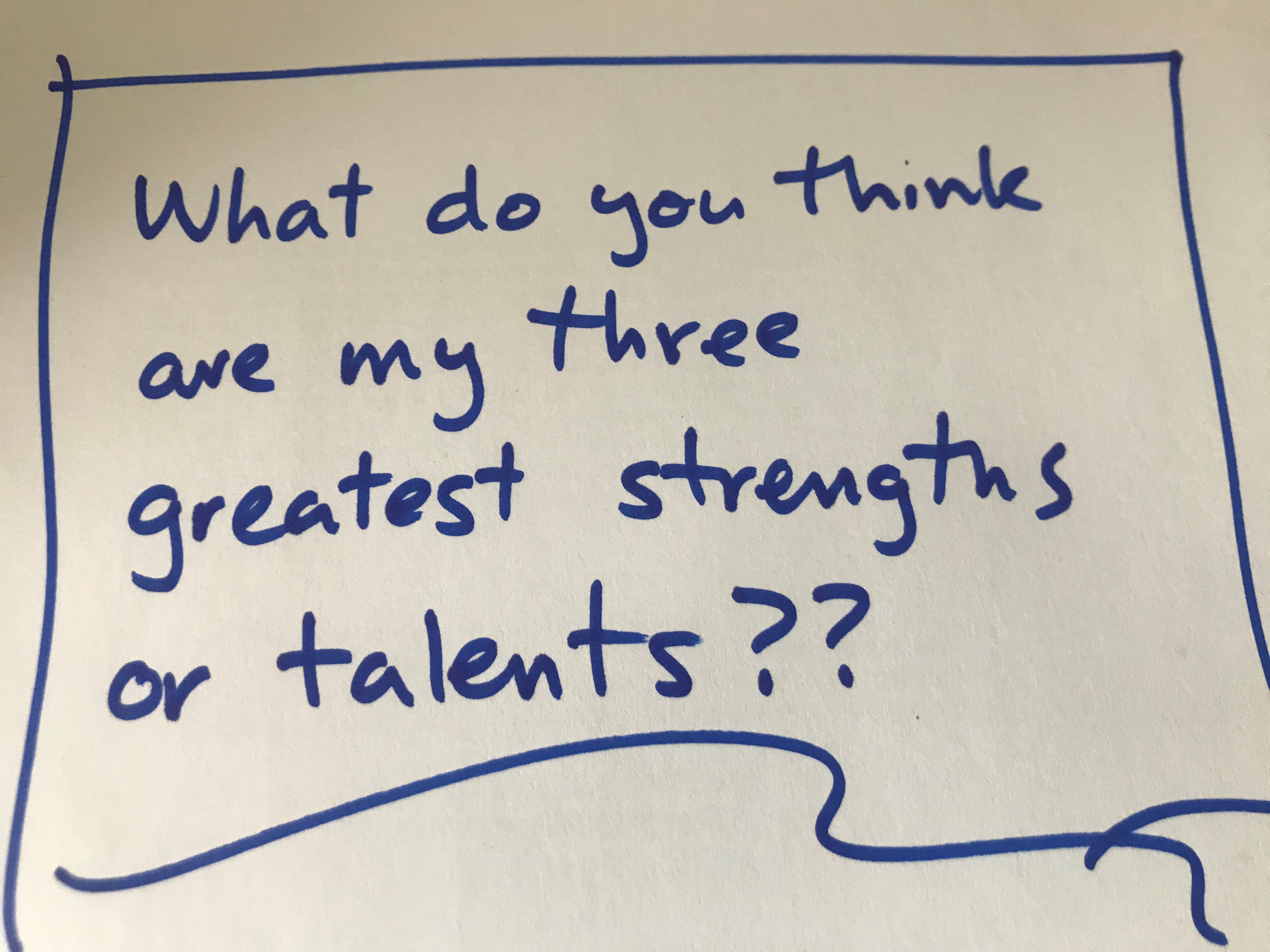
I’m writing about the Johari Window for educational reasons, but also because it’s a great way to introduce your Spring Break happiness assignment. This is an assignment that I made up about six years ago while teaching a career development class. I call it the Natural Talent Interview. Not surprisingly, because I made it up, I think it’s an awesome assignment that everyone will love. On the other hand, you should be the judge of that, AND, you should give me feedback on this assignment so I can expand my self-awareness!
Here’s the assignment:
Conduct Two Natural Talent Interviews: To do this assignment, identify two people whom you respect and trust. Let them know that you have an assignment to get more in touch with your personal strengths and talents. Then, get a note pad (or commit yourself to making mental notes) and ask them the following question:
What do you think are my three greatest strengths or talents?
As you’re listening, be sure to ask the person for specific examples of each talent or strength. You can take notes if you’re comfortable, or just listen and then soon afterwards document what the person said about you—both your natural talents and examples to support them.
The purpose of this assignment is to get to know your personal strengths and talents from the perspective of others. Maybe you’ve done this sort of thing before. But because things change with time, it’s worth updating the feedback you get from others or worth asking new people for feedback.
At the end, write a summary of what you learned about your natural talents and upload it to Moodle for Dan and me to read.
For those of you who might be interested, I just published a new article on suicide assessment and interventions in the Journal of Health Service Psychology. The article title is, “Conversations about suicide: Strategies for detecting and assessing suicide risk.” The article is designed to help practitioners who work or may find themselves working with suicidal clients.
There are so many things in the world I just don’t understand.
One of the biggest mysteries to me is how my 90-year-old father can keep beating me at cards. It happens every time. Often it’s not even close. Yesterday he skunked me in two of three games of Gin. I’d switch to Poker, but I know from experience, it would just be worse.
What’s puzzling is that I have the younger brain. But somehow he still counts and remembers the cards better than I do. I’m also the one with the Ph.D. in psychology. He made it through one semester of college at the University of Portland. Mostly he spent his semester playing football. Despite my eight years of college and graduate school, nine published books, and over 50 professional articles in psychology, he reads me like I’m the book. He knows what’s in my hand better than I do. And then, when he obfuscates and complains that I’ve dealt him a bad hand, my ability to reason fogs over and I don’t know if he’s telling me the truth or setting me up. He’s like a card-playing mystic wrapped in an enigma.
All I can say is that must have been one damn good fall semester at the University of Portland way back in 1945.
When I need a break from repeated stinging defeats, our conversation naturally turns to politics. CNN is on in the background. We complain back and forth about various issues. I tell him that I’m disappointed and don’t understand how and why so many people are planning to vote for Donald Trump. I follow that with an over-analysis of socioeconomic disparities, racial dynamics, and voter motivation.
His eyes meet mine and I know it’s time for me to shut up and listen. As he begins speaking, his analysis—like his card-playing, is simple, incisive, and on-point.
“He’s a cheat and a con man,” my dad says, “and a very good one.”
His words are elegant and precise. As a professor and academic, I’d describe it as parsimonious.
“You can see him do it in every speech. He repeats himself. He says ‘crooked Hillary.’ Then he says it again and the media broadcasts it dozens of times every day. He says our economy is a disaster. He says he’ll make it beautiful. Then he repeats that message. It’s a disaster. It will be beautiful. Even though there’s no evidence for what he’s saying, he’s an actor, he’s convincing, and he’s repetitive. That’s what a good con man does. After a while, the truth doesn’t matter, people believe him. That’s how he’s made money. That’s how he gets votes. He says what some people want to hear. Then he says it again. Truth be damned, people believe him.”
In some ways, I still prefer my intellectual analysis. But part of me knows that my father’s explanation for Trump’s success is better than mine. How can you get people to believe the economy is bad when Obama has successfully cut unemployment in half? How can you get people to believe the country is less safe when overall, crime rates are down? How can you convince people you know more about ISIS than all the generals? How can you get away with saying that if you’re a star you can grab a woman by the pussy? How can you convince people that Hillary Clinton is corrupt and dishonest when your lies outnumber hers five-to-one?
“He’s a cheat and a con man . . . and a very good one.”
This is my father talking. He has 90 years of experience on this planet. I believe him.
Then again, it’s always good to question yourself; maybe I only believe him because he just beat me in Gin again. If I think of him as a psychic superhero it helps comfort my aching ego.
But there’s one other thing. My father is also the most honest man I know. He’s never cheated anyone of anything in his life. He’s a role model and card-playing genius. He reads people like I never could. And so when he says Donald Trump is a cheat and a con man. . . it’s simple.
I believe him.
The place to click if you want to learn about psychotherapy, counseling, or whatever John SF is thinking about.










 John Sommers-Flanagan