Tag Archives: gratitude

Toasting the End of Gratitude (Weekend)

On this weekend, when there is so much wrong in the world, it may be more important than ever for us to gather in small groups, pause, focus on what’s right and good, and express gratitude. 

How’s that going? Are you feeling the gratitude?

Often, focusing on what’s right, on good things, and on strengths and solutions, takes effort. It’s not easy to orient our brains to what’s right, even in the best of times.

As negativity rains down on and around us through news and social media, it’s easy to get judgy. And when I say “judgy” I don’t mean judgy in a nice, positive, “I love your shoes” or “You have such creative views on immigrants” sort of way. Shifting our brains from their natural focus on angst and anger to gratitude feels difficult and sometimes impossible.

First Toast: Let’s hear it for the forces outside and inside ourselves that make it REALLY DIFFICULT to FEEL gratitude, hope, and positivity.

[Editor’s note: When I’m suggesting we push ourselves to experience gratitude and focus on strengths, I’m not endorsing toxic positivity. Sometimes we all need to rant, rave, complain, and roll around in the shit. If that’s what you need, you should find the time, place, and space to do just that. What I’m suggesting here is that opening yourself up to experiencing gratitude and focusing on strengths and solutions is like a muscle. If we intentionally give it a workout, it can get stronger. But, if you’re not ready for or interested in a positivity workout, don’t do it!]

Second Toast: How about some cheer for the EFFORT it takes to push ourselves to focus on gratitude, hope, strengths, and solutions—because that’s how we grow them. Woohoo!

Earlier this year, I attended a medical conference where the presenter did an exquisite job describing the “problem-solving model.” Having taught about problem-solving for three decades, my mind wandered, until the presenter—who was excellent by the way—passionately stated, “Before moving forward, before doing anything, we need to define the problem!”

Maybe it was just me being oppositional, but my wandering mind suddenly became woke and whispered something sweet in my inner ear, like, “This might be bullshit.”

I found myself face-to-face with the BIG problem with problem-solving.

You may be wondering, “What is the BIG problem with problem-solving?” Thanks for wondering. The problem includes:

  • As my colleague Tammy says, maybe we don’t need to gather round and worship the problem.
  • When we drill deeper and more meticulously into what’s wrong, we can grow the problem.
  • As social constructivist theorists would say, “When we center the problem in our collective psyches,” we give it mass, and make it more difficult to change.

What if, instead of relentlessly focusing on the problem, we decided to only discuss what’s going well and possible solutions? What if we decided to grow and celebrate good things?

Adopting a mental set to persistently focus on strengths and solutions is not a new idea. Back in the 1980s, Insoo Kim Berg and Stephen de Shazer pushed as, “Solution-focused brief therapy” (SFBT).

At the time, I found their ideas interesting, but not captivating. One of my friends and a champion for all things strengths-focused (you know who you are Jana), knew the famous Insoo Kim Berg. Once, as Jana and I brainstormed, the possibility of consulting with Insoo came up. Jana said something like, “I could reach out to her, but if we frame this as a problem, Insoo might not even understand what we’re talking about. Insoo only speaks the language of solutions.”

Third Toast: Let’s toast Jana and Insoo Kim Berg for inspiring me to suddenly remember a conversation from 25 years ago. 

The language of problems has deep roots in our psyche. Of course it does. Evolutionary psychology people would say we had to notice and orient toward problems to survive, and so we passed problem-focused genes onto offspring. As our brains evolved, they became excellent at identifying problems, because if we didn’t quickly identify problems, threats, or danger, we would be dead.

[Editor’s note: In contrast to biological evolution theory, evolutionary psychology is incredibly fun, but not very scientific. I know I’m supposed to be orienting myself to the positive right now, but evolutionary psychology mostly involves creating contemporary explanations for observed patterns from the past. As you can imagine, it’s quite entertaining and easy to make up fascinating explanations for human behavior, especially if you don’t need to reconcile your creative ideas with anything resembling fossilized evidence.]

Fourth Toast: Hat’s off and glasses up to evolutionary psychology for aptly demonstrating the power of social constructionism. Boom!

Most of us are naturally well-versed in the language of problems. We see them. We expect them. Even when no problems are present, we worry they’re coming. And they are. Problems and catastrophes are always on their way.

But most of us are not especially well-versed in Insoo Kim Berg’s language of strengths and solutions. Becoming linguistically fluent in strengths and solutions requires effort, discipline, and practice. How could it be any other way? If we WANT to speak the language of the positive, we need to learn and practice it; immersion experiences can be especially helpful.

As our collective gratitude weekend ends, we might benefit from committing ourselves to practicing the language of the positive. We could strive to become so linguistically positive that, at night, we begin dreaming in solution-focused, strengths-based language.

Fifth Toast: Let’s raise our glasses to dreaming in bright, colorful strengths.

We shouldn’t forget our old, natural, first language of problems. Problem-focused language is essential to survival and progress. We just need to stretch ourselves and become bilingual. Imagine the benefits for individuals, families, communities, and nations when we become intentionally bilingual, moving beyond the problem saturated language of our times, and into a solution-saturated future.

Last Toast: Three cheers to you, for making it to the end of this blog. May you have a glorious gratitude-filled holiday weekend. 

John SF

The Montana Healthcare Foundation Summit in Bozeman — Slide decks

I’m looking forward to a morning drive to Bozeman where I’ll meet and talk with healthcare and mental health providers and advocates from all around Montana. In advance of the Summit, I want to say thank you to the Montana Healthcare Foundation and to all the participants for their dedication to the well-being of all Montanans.

I have two talks . . . and the slide decks are linked below:

On This Gratitude Eve

Tomorrow is a celebrated holiday involving gratitude. Given the American history of mistreatment, oppression, and abuse of indigenous peoples, I have trouble saying the holiday name. You may think I’m being over-sensitive or politically correct, or you may find yourself seeking some other label to describe me. No worries, I’m here to help. My current labels (which switch with considerable frequency) are grumpy and discouraged.

I know better than to dwell too long on my grumpy and discouraged thoughts, feelings, and somatic complaints. Those of you who know me well know that it makes me grumpy to even use the word somatic, and so the discouragement is deep. While I’m drilling down into my negativity, I’ll add that it also makes me grumpy to hear the words “fight-or-flight” and “brain shut-down” and “amygdala hijack” and “PHQ-9 or GAD-7” and “mental illness” and the mispronunciation of “Likert” and everything else our culture is using to push us into negative mental and emotional states—and keep us there.

I also know that some of the preceding linguistic pet peeves may seem cryptic. That’s okay. I like being mysterious. I’ll just say that I would prefer “amygdala hijinks” over “hijack,” and leave the mystery unsolved.

Not surprisingly, the bigger laments are what give the smaller laments most of their negative power. My bigger laments are probably obvious, but here are a few: How did we develop into a culture where the voices and opinions of people like Andrew Tate and Joe Rogan shape the psychology, emotions, and behavior of so many young men? How did we become a nation that could elect a convicted felon, rapist, racist, sexist, reality television star as the next president? When did Christianity take a turn and become a narcissistic, nationalist, anti-immigrant movement? How did our mainstream media become an entity that gives voice to social media posts from the president elect? And, because the president elect is a well-known serial and pathological liar, how did the media decide they should center their reporting around his likely dissembling bloviations as potentially truthful statements?

I do have to admit that it makes me a little bit happy to use the word bloviations. That was fun.

Now that I have you (my six faithful readers) grumpy and discouraged along with me, maybe I should pause to take stock of the many things and people toward whom I feel gratitude. If, by chance, you’ve also been feeling your share of doom and gloom, I hope you’ll consider joining me in a gratitude activity.

First in line is Rita. Only minutes ago, while planning a few Turkey Day dishes, I offered up one simple suggestion that may have required only one or two brain cells and could easily have been brought forth during a so-called fight-or-flight brain shut-down. Her response of, “That’s a REALLY good idea!” made me laugh out loud (even amidst my gloomy mood). This small interaction reminded me of the many ways that I am lucky to be supported and inspired by Rita every day.

Our children (and son-in-law) are basically overachieving geniuses who work every day to make the world a better place. I won’t go into details here, but this is more good fortune on a rather magnificent scale.

This past weekend I hung out with my sisters, attending a Bat Mitzvah with my Jewish cousins who welcomed us into their celebration with open arms and hearts. We mercilessly teased each other, laughed together, played games, and did what family does. My sisters and I often marvel at our mutual family experiences . . . as given to us by our amazing parents. More big gratitude.

First thing this morning, I got to lightly supervise a few interns who are facilitating a group for dads, prepping to present to classrooms of 8th graders, and being coached by Dylan Wright, who just might be the most dynamic presentation coach of all time. These young people are smart, capable, and committed to being therapeutic forces in the world. . . and I get to work with them.

Tomorrow Rita and I will have dinner with a long-time friend who, having already made substantial contributions to the mental health of a multitude of Montanans, invited us over to help her eat up a frozen turkey that she surprisingly found in her freezer. We have gratitude to her for the past, present, and future.

Just in case you’re wondering, the empirical research on gratitude is pretty fantastic. Focused and intentional gratitude will not immediately transform your life, but in general, gratitude practice is linked to improved mood, increased positive communications with others, hope, and improvements in physical exercise. That last one is as cryptic as my linguistic pet peeves. How could gratitude make you exercise more? Nobody knows. All I can say is this: How about you practice gratitude tonight, tomorrow, and into the future and then see if it helps you exercise more? As B.F. Skinner might say, we should all experiment with our experiences.

Given all the world-wide and local reasons to be grumpy and discouraged, my plan is to counter those feelings by spending more time being grateful. I know it won’t fix the world . . . but I know it will create nicer feelings . . . and that, I suppose, is plenty good for now.

Exploring Your Eudaimonic Belongingness Sweet-Spot at West Creek Ranch

[Moon Rise at West Creek Ranch]

This past week I spent four days at West Creek Ranch, where I was forced to eat gourmet food, do sunrise yoga, experience a ropes course (briefly becoming a “flying squirrel”), watch a reflective horse session, dance away one night, hike in the beautiful Paradise Valley, and hang out, converse, and learn from about 25 very smart/cool/fancy people. Yes, it was a painful and grueling experience—which I did not deserve—but of which I happily partook.

On the first morning, I provided a brief presentation to the group on the concept of belonging, from the perspective of the Montana Happiness Project. Despite having shamefully forgotten to take off my socks during the sunrise morning yoga session, and having anxiety about whether or not I belonged with this incredible group of people, they let me belong. They also laughed at all the right moments during my initial mini-comedy routine, and then engaged completely in a serious reflective activity involving them sharing their eudaimonic belongingness sweet-spots with each other.

If you don’t know what YOUR eudaimonic belongingness sweet-spot is, you’re not alone (because hardly anyone knows what I mean by that particular jumble of words). That’s because, as a university professor, I took the liberty of making that phrase up, while at the same time, noting that it’s derived from some old Aristotelean writings. Yes, that’s what university professors do. Here’s the definition that I half stole and half made up.

That place where the flowering of your greatest (and unique) virtues, gifts, skills, talents, and resources intersect (over time) with the needs of the world [or your community or family].

I hope you take a moment to reflect on that definition and how it is manifest in who you are, and how you are in your relationships with others. If you’re reading this blog post, I suspect that you’re a conscious and sentient entity who makes a positive difference in the lives of others in ways that are uniquely you. Because we can’t and don’t always see ourselves as others see us, in our University of Montana Happiness course, we have an assignment called the Natural Talent Interview designed to help you gain perspective on your own distinct and distinctive positive qualities. You can find info on the Natural Talent Interview here: https://johnsommersflanagan.com/2023/12/26/what-do-you-think-of-me/

And my West Creek presentation powerpoint slides (all nine of them) are here:  

You may have missed the main point of this blog post—which would be easy because I’m writing like a semi-sarcastic and erudite runaway loose association train that’s so busy whistling that it can’t make a point. My main point is GRATITUDE. Big, vast, and immense gratitude. Gratitude for the Arthur M. Blank Family Foundation (AMBFF) and our massively helpful program officers. Gratitude for our retreat facilitators. Gratitude for the staff at West Creek Ranch. Gratitude for the presence of everyone at the gathering. And gratitude for the therapeutic feelings of belonging I had the luxury of ruminating on all week. My experience was so good that I’m still savoring it like whatever you think might be worth savoring and then end up savoring even more than you expected.

Thank you AMBFF and Arthur Blank for your unrelenting generosity and laser-focus on how we can come together as community and make the world a better place.

************

*Note: At the Montana Happiness Project, we do not support toxic positivity. What I mean by that is: (a) no one should ever tell anyone else to cheer up (that’s just offensive and emotionally dismissive), and (b) although we reap benefits from shifting our thinking and emotions in positive directions, we also reap similar benefits from writing and talking about trauma, life challenges, and social injustice. As humans, we are walking dialectics, meaning we grow from exploring the negative as well as the positive in life. We are multitudes, simultaneously learning and growing in many directions.

The Many Paths to Gratitude

Freud once said, “There are many ways and means of conducting psychotherapy. All that lead to recovery are good.”

Coming from rigid old Freud, that was a pretty wildly accepting statement. I’d like to apply it to gratitude.

There are many ways to practice gratitude. All that lead to meaning and happiness are good.

When it comes to gratitude, there are many “ways and means.” Let us count the ways.

1.       Gratitude for others who are in our lives right now.

2.       Gratitude for others, from the past; these people toward whom we feel gratitude may be alive or may have passed.

3.       Gratitude for a higher power. Many people pray to express gratitude. In Traveling Mercies, Anne Lamott said there are only two types of prayer. “Help me. Help me. Help me.” And “Thank-you, thank-you, thank-you.” Obviously, Lamott’s second type of prayer is all about gratitude.

4.       Gratitude for a concept a country or belief system.

5.       Once, during a workshop, I had a teacher say she was grateful to her 16-year-old self for having the courage and good judgment to go immerse in Spanish, even though she didn’t like Spanish much. She went, learned, and is now a successful Spanish teacher. Very cool.

When it comes to gratitude, there are also many means. Let us count them too.

1.       We can keep a gratitude journal. Journals are usually private, but sometimes not. Also, journals can be written, spoken, or video-recorded.

2.       Gratitude can be practiced once-a-week, every day, or at whatever rate you choose.

3.       We can have surface gratitude, or we can dig down deep and keep asking ourselves, “Why this gratitude for this person, place, or thing?”

4.       We can purposefully find a way to communicate our gratitude to the person or persons toward whom we feel it. There are lots of online videos showing what happens when people communicate gratitude. We like this one from SoulPancake: https://www.youtube.com/watch?v=oHv6vTKD6lg

5.       You can do a benefit reflection. This means that you take a few moments to reflect on (a) how much someone’s action helped you, (b) the time, money, or effort that a person sacrificed to help you; and (c) the fact that someone helped you on purpose.

Gratitude can have big or small benefits. Like everything, gratitude is in the eye of the beholder (meaning you will have an individualized response to practicing gratitude; it’s not about what you “should” experience; it’s about trying out gratitude and seeing how you feel). Generally, gratitude has small and positive effects on depression and anxiety. Here’s a link to a 2021 meta-analysis, if you want to read the science:

As always, I encourage you to experiment with gratitude. It might make a big difference, a small difference, or no difference at all . . . but it’s hard to know if you’ll benefit from gratitude unless you practice it—at least a little—using the ways and means that fit for you.

Experimenting with Gratitude

In the midst of an online workshop on happiness, I came to the gratitude slide, and asked the Zooming participants for their reactions. One person, a school psychologist, said, “I hate gratitude. I’m sick and tired of gratitude. Everybody talks about gratitude and how we all should be doing it. It just feels fake and trite to me.”

Being aware of the futility of trying to convince anyone of anything, I listened, reflected and validated her concerns, “Yes, gratitude can feel very trite, and it sounds like you pretty much hate it.” Then I kept on rolling.

A few minutes later, I asked for a volunteer to engage with me in a live “gratitude experience.” Of the 40 checkerboard faces on my screen, who volunteered? Of course, the woman who was “sick and tired of gratitude” spoke up quickly, “I’ll do it.”

It felt like a set-up for my gratitude demonstration to fail. But I’m a professional . . . and so I forged onward, encouraging her to think of someone specific—past or present—toward whom she felt gratitude. She cooperated. I nudged her to go a bit deeper, “What do you think it is, in particular, that makes you feel grateful to this person. Tell me the details.” She paused, responded, there was a sparkle of emotion, which I noticed and reflected back to her. In the end, she commented, “That was cool. Maybe I don’t really hate gratitude. Maybe I just hate superficial gratitude.”

This is a great example of the difference of thinking about gratitude vs. taking the time to feel about gratitude. Like everything, if we brush past gratitude like a stranger on the street, it can feel meaningless and trite. And then if people keep telling us we “should” do it because it has all these “benefits” we might become even more entrenched in our dislike of gratitude.

As with all things related to positive psychology, don’t do gratitude as an obligation. Intentionality in choosing to engage in a gratitude practice is foundational. Although random experiences of gratitude are fine, intentionally making the space and time to feel grateful is substantially better.

This week, your gratitude activity is part contemplation, part writing, and part action. Use the following steps:

1.       Identify someone toward whom you feel or have felt appreciation and gratitude. You may have plenty of options. It’s likely a good idea to choose someone toward whom you believe you haven’t yet expressed enough gratitude.

2.       Write a gratitude note to that person. Include in the note why you feel gratitude toward to the person. Include specifics as needed, as well as words that best express your sincere heartfelt feelings toward the person.

3.       Find a way to express your feelings directly to your gratitude target. You can read the note in person, over the phone, or send it in whatever way you find best.

Your goal is to express your gratitude. What that means is that you need to drop expectations for how the recipient of your gratitude should or will respond. Don’t focus on their response, instead, focus on doing the best job you can expressing the gratitude that you sincerely feel.

If the person loves hearing about your gratitude, cool. If the person is uncomfortable or not positive or silent, that’s okay. Your goal should be within your control—meaning that all you can control is your end of the communication and not how the communication is received.  

If you feel moved to do so, please share your experiences on social media. Tell the world (and us), (a) what it was like to write the gratitude message, (b) what it was like to deliver it, and (c) how it felt to express your gratitude. Feel free to repeat this gratitude experiment a second or third time.

There are many other ways to approach gratitude practice.

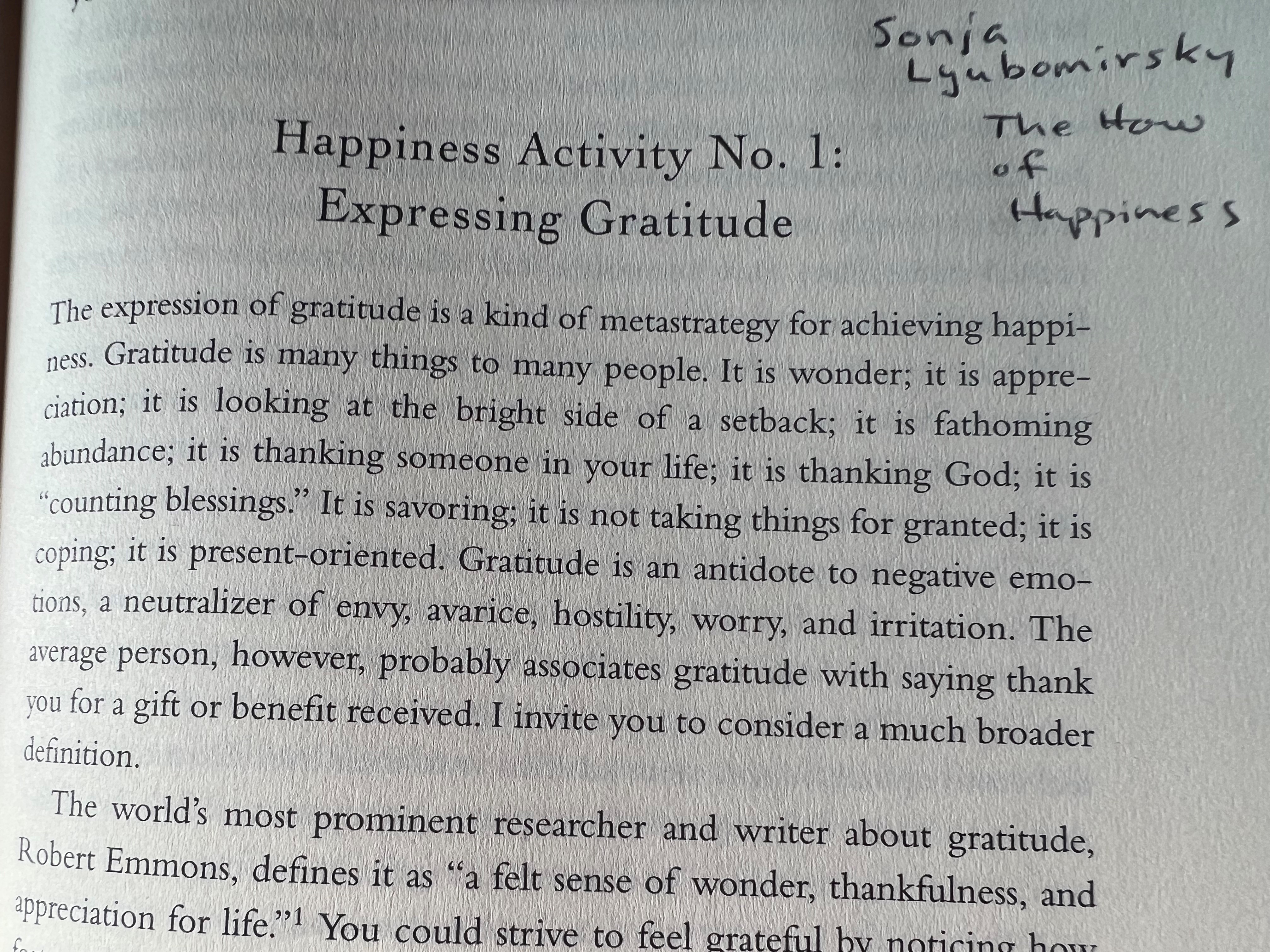
Here’s one example, from a book that offers teachers and school counselors ideas for how to apply positive psychology interventions in school settings.

We’ll be sending out additional ideas and variations on gratitude this week. . . so stay tuned!

Redundancy, Again

One of my long-time friends from graduate school in the 1980s had lots of corny, pithy, and funny commentary on life. He was adept at noticing when professors repeated themselves, often snarking that particular professors had graduated from the “Department of Redundancy Department.” I enjoyed his commentary so much that I forgot to snarkily notice the redundancy of his jokes.

Somewhat later, another colleague told me of his educational motto: “Redundancy works!” After years of counseling and doing presentations, he decided that most people aren’t listening very well and so saying things over and over gives teachers and counselors a better chance of being heard and remembered.

Back when we lived in Great Britain for several fortnights, we learned that the Brits used the term redundant to refer to employee layoffs. For example, when employers cut staff, they referred to staff as having become redundant (or unneeded), and consequently, unemployed.

I bring up redundancy today because I’m posting two things here that are almost exactly the same as what I posted earlier this week. Yesterday and today, I had and have the honor of presenting to STEM graduate students from Montana Tech (yesterday) and the University of Montana (today) on how to integrate a few happiness skills into their lives. The handouts (below) are virtually identical to those I provided on Monday (for the Belgrade Teacher presentation) . . . and so you should bear in mind that I’m clearly a graduate of the Department of Redundancy Department because I’ve learned that Redundancy Works! . . . and I’m hoping I’ve not quite become redundant myself.

To summarize (again). . .

The HOPES Powerpoints are here:

The HOPES Handout is here:

Have a great weekend!

John SF

Happy Habits for Hard Times: Gratitude and Inspiration

Snow Angel

Episode 6 of the Happy Habits for Hard Times series was posted yesterday on the College of Education of the University of Montana’s website.

But it’s probably still relevant today.

The written portion of episode 6 is below.

You can get to the video via this link: https://coehs.umt.edu/happy_habits_series_2020/hhs_module_six.php

*************************

You are what you focus on. When you remember what you’re grateful for and notice what inspires you, your day will be much better.

Humans tend to repeat behaviors that work out well for them and tend to stop doing things that don’t turn out well. Usually, when you get rewarded for something, you keep doing it. Of course, it’s more complicated than that, but today’s topic is all about introducing two new behaviors that we hope you’ll find rewarding.

As you know from previous episodes, there are behaviors (strategies) you can engage in that are likely to boost your mood. In this episode of Happy Habits, we elaborate on two strategies, but we’re confident you can think of more on your own. We are also aware that for some strange reason, even though these behaviors are rewarding, it’s still hard to get started doing them. That’s a topic for another day. For now, trust us and try these. There’s a reasonable chance that when you do them, you’ll feel better, and you’ll want to keep doing them.

Happiness Habit: Expressing Gratitude

Although it’s true that nearly everyone experiences gratitude, most of us don’t intentionally create time and space to express it. Expressing gratitude is a smart thing to do. It reminds you that you have positive things you are grateful for, it feels good to say “Thanks” and often, you make someone else feel good. Expressing gratitude makes for a nice, positive loop.

Along with the COVID-19 pandemic, it can be tempting to think we have little to be grateful for. While this may be true, it won’t help to dwell on the negative and feel sorry for yourself. Someone once said, “Oh, you think you have nothing to be thankful for? Take your pulse.” Now is a good time to use your brain to force yourself to think and behave with positivity.

Try the following steps:

  1. Identify someone toward whom you feel or have felt appreciation and gratitude. You may have plenty of options. It’s helpful to choose someone toward whom you believe you haven’t yet expressed enough gratitude.
  2. Write a gratitude note to that person. Include in the note why you feel gratitude toward to the person. Include specifics as needed, as well as words that best express your sincere heartfelt feelings toward the person.
  3. Find a way to express your feelings directly to your gratitude target. You can read the note in person, over the phone, or send it in whatever way you find best.

Your plan is to express gratitude. That means you need to drop any expectations for how the recipient of your gratitude should or will respond. Don’t focus on their response, instead, focus on doing the best job you can expressing the gratitude that you sincerely feel.

If the person loves hearing about your gratitude, cool. If the person is uncomfortable, or not positive, or silent, that’s okay. Your goal should be within your control—meaning: all you can control is your end of the communication and not how the communication is received.

If you get inspired, feel free to repeat this gratitude experiment a second or third time. You may find that gratitude begets gratitude.

Happy Habit: Notice Something Inspiring

Inspiring things are always happening. People are caring for the infirmed and elderly, risking their own health. People are volunteering, donating, and doing what they can. The word inspire comes from the Middle English enspire, from the Old French inspirer, and from the Latin inspirare ‘breathe or blow into’ from in- ‘into’ + spirare ‘breathe.’ The word was originally related to a divine or supernatural being, in a sense, ‘impart a truth or idea to someone’.

You can go pretty much anywhere on the internet right now and find inspiring stories. But instead, if possible, we want you to go live, in real time. We want you to watch for and then closely observe something inspiring that’s happening in your daily life.

The inspiring action that you notice may be small or it may be big. It might give you a tiny lift, or be jaw-droppingly inspiring. The key is that it involves intentionally watching for that which will inspire. Keep all your sensory modalities open for inspiration. Then, if you’re up for it, jot down what inspired you, or share it with someone else. What was it like to intentionally pay attention to things that might inspire you? The key is attitude. For whatever time you devote to this exercise, you’re focused on noticing positive actions and events. You’ve given yourself a little respite from the bad news lurking in every corner right now.

Inspiration can lift you up. Try it out. See what it can do for you.

What the World Needs Now is Gratitude — Your University of Montana Happiness Homework for the Week

Globe

Gratitude Homework

Although it’s true that most everyone experiences gratitude, most of us don’t intentionally create time and space to express gratitude. That’s why this week’s happiness assignment is all about intentional expressions of gratitude.

This assignment is part contemplation, part writing, and part action. Use the following steps:

  1. Identify someone toward whom you feel or have felt appreciation and gratitude. You may have plenty of options. It’s likely a good idea to choose someone toward whom you believe you haven’t yet expressed enough gratitude.
  2. Write a gratitude note to that person. Include in the note why you feel gratitude toward to the person. Include specifics as needed, as well as words that best express your sincere heartfelt feelings toward the person.
  3. Find a way to express your feelings directly to your gratitude target. You can read the note in person, over the phone, or send it in whatever way you find best.

Remember, your plan is to express gratitude. What that means is that you need to drop any expectations for how the recipient of your gratitude should or will respond. Don’t focus on their response, instead, focus on doing the best job you can expressing the gratitude that you sincerely feel.

If the person loves hearing about your gratitude, cool. If the person is uncomfortable or not positive or silent, that’s okay. Your goal should be within your control—meaning that all you can control is your end of the communication and not how the communication is received.

Turn in a short report to Dan and me about your gratitude experience and put it in the appropriate Moodle bin. Tell us, (a) what it was like to write the gratitude message, (b) what it was like to deliver it, and (c) how it felt to express your gratitude. If you get inspired, feel free to repeat this gratitude experiment a second or third time.

Like last week, your report to us doesn’t need to be long—unless writing it is a pleasant experience for you—in which case, you can linger and write longer.

Good luck and although I know I can’t control the outcome of this experience, I hope you find it fun and meaningful.


Gratitude for Higher Education and The University of Montana

As the calendar year comes to an end, gratitude has clearly become my theme for closing out 2019.

There are, of course, no perfect people, no perfect professions, and no perfect institutions. Such is the nature of everything that involves humans. But this gratitude essay (and video) is about my gratitude for higher education and for the University of Montana, in particular.

Below I’ve posted my 4 minute acceptance speech from this past spring, when I received the George M. Dennison Presidential Faculty Award. Because I wasn’t able to attend the ceremony, I did a short video-recorded thank-you talk. As it turned out, the talk felt very emotional to me, because I spoke about how higher education has changed my life (for the better!).

My higher education experiences included Mount Hood Community College (where I went to play football and baseball), Oregon State University (more football and some psychology), and the University of Montana (graduate school and personal transformations). The memories from these experiences are mostly fantastic. Here’s the video: