The Missoula CASA Keynote

There are a number of problems associated with being asked to do a keynote speech for a local non-profit. Maybe this is all just me, but the pressure feels very big. Keynotes are supposed to be informative and inspiring and funny. Right? Well, to be perfectly honest, although I love to think of myself as able to be informative, inspiring, and funny, to actually have expectations to be informative, inspiring, and funny is miserable. That might be why, 15 minutes before stepping up to the microphone at the Doubletree banquet room in Missoula, I had a case of the complete BLANK MIND. I seriously had no idea what I had planned to say. Two days before the event I was sure I could memorize my 25 minute speech. Now, I looked at my notebook and words were there, but they seemed stupid and boring and not funny and I couldn’t help but wonder, “Who wrote this crap?” I suppose that’s an example of an unfriendly dissociation.

To top all that off, every speaker who offered introductions and who spoke before me was smooth and articulate . . . and I had decided to drink a cup of herbal tea which led to my bladder was telling me that I HAD to get to the bathroom right away. But I wasn’t sure how long I had before being called up as the highly acclaimed keynote speaker whose name was in big bold letters on the program. Mostly, I felt like crawling under the Crowley and Fleck sponsored keynote table or escaping to the bathroom. Neither of these options seemed realistic.

So I told my bladder to wait its turn and listened to Eden Atwood sing along with a group of fabulously talented and cute young girls. A man at the front table started crying. That’s what happens when you’re at an event celebrating and funding an organization that works with abused and neglected children. It was around then that Eden Atwood and her group (called the MOB) distracted me from my anxiety, calmed me out of my dissociative episode, and inspired me to go ahead and sing and dance around the stage as part of the ending of my keynote.

Just in case you missed it, the whole darn event was awesome. The best part was to be right in the middle of the generosity of so many people who help make Missoula a better and healthier and safer place.

And just in case you’re interested, I managed to deliver most my planned speech and people laughed and afterward offered big compliments. But I’m not certain how well I stuck to the script because at some point I remember saying “Of course, I’m lying about that” which I followed with, “But I understand that lying is popular right now.” I also recall, after one particular non-sequitur, saying something about the fact that because I was a university professor, I could say whatever I wanted and didn’t really have to make any logical sense. None of these comments were in the transcript to my speech. Obviously, I went way off script.

It might be surprising, but my plan to start singing and dancing actually was in the script. However, partway through the song my blank mind returned and I forgot the lyrics. The good news is that I’m fairly sure that everyone, including me, was greatly relieved when I stopped singing.

OLYMPUS DIGITAL CAMERA

Today, I am Captain America

ca-wallet

Today, I am Captain America

John Sommers-Flanagan

One of the hardest things about being a superhero is maintaining a secret identity. Sometimes I get so far undercover that even the Marvel Comics people don’t know who I am. This pretty much drives them nuts. But they deal with it, because, after all, I am Captain America.

I was born with the name John Sommers. This might be confusing to those of you who thought Steve Rogers was the original Captain America. That’s a myth Marvel and I perpetuated to help keep my identity secret. To further the deception, in 1985, I changed my name to John Sommers-Flanagan. This addressed the dual objectives of expressing an equal partnership with my wife and further obfuscating my identity.

Hyphenating my last name was a strategy similar to how my friend Superman is able to maintain his secret Clark Kent identity just by wearing nerdy glasses. Obviously, if you wear nerdy glasses, nobody will think you could possibly be Superman. Well, I wear nerdy glasses AND I have a hyphenated last name. Nobody in their right mind could possibly think I’m Captain America. Think about it. One time a guy I know asked me, “What sort of man hyphenates his last name?” I didn’t tell him because I was maintaining the secret identity thing, but the answer was and is: “Captain America.” #perfectdisguise.

I told Superman I was coming out of the secret identity closet and he asked me, “John, why are you choosing, at this moment in history, to give up your perfect disguise?” I said, “Hey Clark. . . ” (we’re on a first name basis because it always feels awkward when people call me Captain), “. . . radical times call for radical measures.” He just nodded thoughtfully. He’s like that.

The thing is, while growing up as Captain America, I realized early on that women were competent and I wanted to work alongside them, as equal partners. This eventually led me to be against the objectification of women and in favor of women’s rights to make their own healthcare decisions.

Being Captain American has also helped me clarify other values. I’m a big fan of the phrase “All men are created equal” but I’m inclined to substitute “people” for “men.” It seems only right that Captain America would support statements that Thomas Jefferson wrote in the Declaration of Independence. Over the years I’ve had Gay and Lesbian and Transgender friends and family and colleagues, and you know what, I found that they’re kind and competent and respectful and loving and safe people to have in my life who are equal to everyone else. I’m also pretty big on liberty and the pursuit of happiness for all people, and that includes Muslims and Mexicans and Native Americans who have sacred lands threatened by oil pipelines and other minorities, including sexual minorities and persons with disabilities.

It might surprise you to find out that I really love music. I’m not that much of a dancer—although I’ve cut a rug or two in my time. Now that I’m older, I’m more into lyrics than swinging my hips. Like that phrase in the Star Spangled Banner about America being “the land of the free and the home of the brave.” To me and most Americans, I think the meaning of those words is simple. We have freedom of religion, freedom of speech, freedom of the press, freedom to marry whomever we like, and we’ve got the courage to accept and embrace the goodness inherent in all this freedom and diversity. We also have the freedom to hate, although most people end up feeling so good about living in America that they usually find they prefer loving over hating.

Another musical reference that gives me tingles is the part of America the Beautiful where it goes: “May all success be nobleness and every gain divine.” That’s massively deep stuff, but right now it doesn’t feel like Wall Street, income inequality, and tax breaks for the wealthy fit with the idea of success being noble and divine. What would Jesus think? Well, along with Superman, he’s one of my besties and so I asked him. Wouldn’t you know, he got all analogy on me. He said something about rich people getting to heaven being as likely as a camel getting through the eye of a needle. My follow up question was about whether that meant it would be easier for Ant Man to get to heaven? At that point Jesus said, “Sure, Ant Man gets in, along with everyone else who makes himself or herself or their-self small and is interested in serving others instead of trying too hard to be bigly.” Then he giggled for almost a whole minute. Sometimes I’m not sure I get Jesus’s humor, but He thinks he’s funny, so that’s good enough for me.

Here’s another thing freedom means to me. Freedom means that we don’t have to register ourselves or be profiled or be put on watch lists because of believing in a particular God or because of having a particular color skin. It also means we’ve got the freedom to vote. And that means registering to vote should be pretty darn easy for all Americans and that voting lines should be equally short in poor and rich neighborhoods. Mostly we should be registering cars and college students, and, because I’m a superhero, I’m also in favor of registering guns. My reasoning is that in the real world it’s not as easy to sort out the good guys from the bad guys as it is in comic books and on television. What helps me is that I wear an easily recognizable spandex red white and blue outfit.  So I figure if you’re planning to carry firearms, you should register them and then at least have the decency to make it clear that you’re one of the good guys and if that involves putting on some spandex, so be it. That’s what my friend Thor would say. He always likes to say “So be it” in his loud, thunderous voice. He can be pretty convincing.

Here’s one last point on the gun thing. You may have noticed, I only carry a shield. Make of that what you will. I believe in the right to bear arms, but I believe even harder in gun safety.

Growing up, I went to public schools all my life. I even went to public universities. And as I’ve made clear, I ended up becoming Captain America. That’s not to say public schools are perfect, but Damn, American public school teachers are fucking amazing (I think that’s how my friend Pink would say it). Do you know how hard teachers work? Do you know how little they get paid? Did you know that John Adams, the 2nd President of the United States said something like (paraphrasing here), “there’s no way you can spend too much money on education for poor people.” Now, if you studied some proper history in a public school, you’d know that during his time, John Adams was just about the smartest and most persistent dude on the planet . . . and you’d also probably know the difference between educational measurements of proficiency and growth. Just saying.

I should confess right now that I’ve thought long and hard about whether to support the new president of the United States. The disrespect he’s shown for anyone he considers beneath him and who didn’t donate to his campaign make it difficult for me to endorse anything about him. But then I had an epiphany. I realized, “Wait, I’m Captain America, and that means I’m all about supporting values and not people.” This epiphany (BTW, “Thank-you Jesus”) helped me see and understand that I’m not a republican or a democrat and that I don’t support specific politicians. Therefore, whenever our new president upholds the values of equality for everyone, freedom for everyone, health insurance for everyone, gun safety, and better education for everyone—I’ll support him acting on those values. Also, whenever he sacrifices his own wealth and ego and treats women, minorities, the disabled, LGBTQ people, and everyone else with the respect they deserve, I’ll support those actions too.  However, to the extent that he advocates unequal treatment of individuals, restricts religious and other freedoms, meddles with women’s health decisions, or interferes with the common person’s pursuit of happiness, I’ll be opposing him along with my friends Jesus, Superman, and Pink.

That’s because I’m Captain America.

And you can be too.

******************************

John Sommers-Flanagan is a clinical psychologist, a professor of counselor education at the University of Montana, the author of eight books, co-host of the Practically Perfect Parenting Podcast, and Captain America.

obama-and-superboy

Vulnerability and Magnificence from Rita

Hi All.

This comes from Rita. It’s her musing on life and death and spirituality. She tells me to warn you that it’s not everyone’s cup of tea. This is true. But then again, who gets to avoid a cup of tea of life and death and spirituality.

You be the judge . . . if you want.

And if you like this, go to her blog and like it and become an email or WordPress follower.

Have a fabulous weekend.

John

Before the snow came, I burned rotten, misshapen wood. Dirty wood, not even worth cutting up for the woodstove. Wood filled with unremovable, wayward screws. Such fires are my last resort. Enduring the scorn of my carpenters, I save every scrap of wood—wood that was once a seed that grew into a tree that was […]

via Fire — Short visits with an honest God

On Becoming a Counselor: What’s a Rogerian, Anyway? by Lauren Leslie

carl-rogers

IMHO, more people should read Carl Rogers. But I understand, sometimes there just isn’t enough time in the day to fit in your Yoga class, mindfulness meditation practice, cardio workout, meal prep, work and family-life, and other responsibilities. So here’s an option: Below you’ll find a review of a classic Carl Rogers work: On Becoming a Person. It was written by Lauren Leslie to fulfill an assignment I give in our Counseling Theories class. It’s a fun read and gives you an abbreviated glimpse of the amazing Carl Rogers from the perspective of a first-year graduate student in clinical mental health counseling.

On Becoming a Counselor: What’s a Rogerian, Anyway?

Lauren Leslie
University of Montana

            Carl Rogers’ On Becoming a Person is a collection of essays and edited speeches written between 1951 and 1961, while client-centered humanistic therapy was being simultaneously embraced and challenged by the establishment. Rogers states he intends to write to professional psychologists, members of the counseling profession, and informed laymen, different populations who nonetheless have at least one thing in common:

. . .while the group to which this book speaks meaningfully will…have many wide-ranging interests, a common thread may well be their concern about the person and his  becoming, in a modern world which appears intent upon ignoring or diminishing him. (Rogers, 2012, “To the Reader” para. 8)

Throughout the text, Rogers offers a picture of himself as a person and a therapist. He provides insights into the growth of his theoretical framework as well as therapy transcripts to flesh out central elements of client-centered practice. Ultimately, the text crystallizes the effectiveness of empathy, congruence, and unconditional positive regard within a therapeutic relationship, and it is difficult to argue against Rogers’ persuasive and clear writing. Critics insist Rogers’ model is incomplete or insufficient, but the core tenets remain central to the practice of contemporary psychotherapy.

On Becoming a Person collects texts of varying genres into a sort of holistic catalog of Rogerian thought. Due to this variety of genre, Rogers’ tone and subject matter shifts; he addresses his own personality and life, includes transcripts of counseling sessions, and tries to systematize examples of his practice into stages of client development to analyze effectiveness of treatment. Rogers philosophizes on the human condition and therapeutic practice, Kierkegaard and Buber, and scientific research and personal change. It is a sweeping book which attempts meaningful understanding and data-driven conclusions. At one point, Rogers claims “There is no general agreement as to what constitutes ‘success’ [in psychotherapy]…. The concept of ‘cure’ is entirely inappropriate, since … we are dealing with learned behavior, not with a disease” (Rogers, 2012, p. 227). He consistently moves in opposition to the kind of concrete, experimental thinking favored in certain parts of the psychological community and comes off far more as a philosopher studying existential questions than as a data-driven scientist.

In considering himself, Rogers (2012) states, a client “discovers how much of his life is guided by what he thinks he should be, not by what he is. Often he discovers that he exists only in response to the demands of others…” (p. 109). In the same passage, he muses on the insight of Kierkegaard on this point: “He points out that…the deepest form of despair is to choose ‘to be another than himself.’ On the other hand, ‘…to be that self which one truly is, is indeed the opposite of despair,’” (p. 109). If this isn’t existential philosophy, the reader must ask, what is? In his own practice, Rogers (2012) characterizes a fundamental shift from “How can I treat, or cure, or change this person?” (p. 32) to his later, fuller question “How can I provide a relationship which this person may use for his own personal growth?” (p. 32). From his training in psychology, Rogers claims to have followed his own instincts into client-centered therapy. His writing overtly embraces that exploration.

Despite his philosophical bent, in large sections of his writing, Rogers draws on established scientific structures or language. He writes a whole chapter which tries to formulate a “general law of interpersonal relationships,” then launches into a lengthy and example-laden consideration of the firmness of knowledge and conclusions within the behavioral sciences at the time. His cognitive resting place seems to be that the behavioral sciences are in their infancy, and while practitioners may rely on a lot of interesting information now being discovered, exploration, philosophy, and instinct still hold places of honor within the field. More than fifty years after the book’s first publication, the situation seems to have changed very little, though there is more data in certain areas. Though Rogers seems to have viewed psychotherapy as a scientific practice, his person-centered view showed him countless variables with which to contend. Perhaps in an environment without controls, philosophy and instinct present better-formed or more immediate solutions than experimentation can.

Rogers seems to boil complex situations down to essentials wherever he can: relationship is his central theme, and empathy, congruence, and unconditional positive regard are the three relationship components. This pursuit of simplicity may be attentiveness to the broad audience of On Becoming a Person or may be indicative of Rogers’ own worldview. Whatever its source, it leaves Rogers open to criticism from those who see things as unsimplifiable. In a similar way, the individual variation and client focus implicit in Rogers’ therapy leave him open to criticism from those who see him acting only as a clarifying mirror for clients, not as a truly congruent party to change-spurring relationships. In one example of a common critique, Ralph H. Quinn (1993) contends that “[a] fully person-centered therapist…would feel compelled to stay with the client’s lead…[and] trust that the client knows best” (p. 20) rather than confronting the client in a moment of genuine human response.

Genuineness in psychotherapy…does not mean simply the willingness to confront a client…. More than anything it means that the therapist must strive to be fully present with the client, to bring all of himself or herself to the therapeutic relationship. As therapists, we must be willing to risk as much as we ask our clients to risk, to be as transparent and courageous as they must be, if the therapy is to produce real life change. (Quinn, 1993, p. 20-21)

This section includes the assertion that bold congruence and full presence are not already parts of person-centered therapy, and Rogers was remiss in not addressing them. Quinn (1993) later implies a fully person-centered approach can easily be seen as practicing “Pollyannish optimism and therapeutic passivity” (p. 21). Such criticism is valid enough, and points out elements of Rogers’ work that may be over-simplified. However, the complexity with which Rogers addresses each essay, idea, and client interaction suggests he did not see humanity or psychotherapy as simple, and did not approach them passively. Rogers may not have dwelled enough in his writing on the practice of congruence; perhaps it was an element that seemed also to contain infinite variables and defy simple definition. I tend to think this criticism stems from a misinterpretation of Rogers’ intentions and practices. In the final analysis, even critic Quinn (1993) only suggests practicing more (riskier?) congruence on the part of the therapist, not abandoning Rogers’ principles.

In terms of my own use of this book, its variety in tone and subject matter makes it a uniquely useful text. Each section and each essay can be read independently, and dipping into Rogers’ world is a clarifying and centering experience that could bring me back to the core of therapeutic practice in times of questioning and uncertainty. Reading this book now gave me a window into the complexities inherent in a model that can be seen as very simple (by Rogers’ design, admittedly). Considering this approach in my own attempts to define or grasp client “distress” has been helpful in placing myself in the wide world of this human-helping profession, and has helped me frame my own conception of what I am doing here and what a client might want or need from me in this role. This reading has been one new way of incorporating personal change into myself: deliberately approaching the self I am discovering myself to be.


References

Quinn, R.H. (1993). Confronting Carl Rogers: A developmental-interactional approach to

person-centered therapy. Journal of Humanistic Psychology, 33(1), 6-23. doi:

10.1177/0022167893331002

Rogers, C. (2012). On Becoming a Person. [Kindle Voyage version]. Retrieved from

Amazon.com

Your Parenting Style: Can You Do It All in 2017?

This is just a link to the Missoulian newspaper OpEd page where they were nice enough to publish a piece I wrote. Click on the link to find out the stunning answer to the question of whether parents can do it all in 2017. And if you do, be sure to read the only comment that the article has generated. It’s taking all of the self-control I possess to not respond with an especially snarky retort. Must remember . . . When they go low, we go high or the story of Brer Rabbit and the Tar Baby or that saying about how you shouldn’t wrestle a pig or that Sweet Spot of Self-Control . . .

Here’s the link: http://missoulian.com/news/opinion/columnists/your-parenting-style-can-you-do-it-all-in/article_a2d9e96c-87e5-58ef-b454-f3ed6c5ba117.html

Feel free to post your sophisticated comments on the Missoulian website.

Happy New Year (or Not) from Me and my Buddy Sigmund

IMG_2481

On November 10, 2016, I decided to read Sigmund Freud’s Civilization and Its Discontents. I was suddenly interested in how and why individuals and society develop an urge toward the death instinct. It’s light reading. I mean, the book is light, and it’s short. So there’s that.

Some people are unhappy that I’ve chosen to read something by Freud. He wasn’t known for his progressive feminist views. He didn’t even make it into the first wave. Maybe I should have read Adler or Dietrich Bonhoeffer. But Freud was on my bookshelf. Besides, the person who doesn’t think I should be reading Freud is the very same person who gave me this particular copy of Civilization and Its Discontents.

Having an impulse to read about the death instinct is ironic. Or maybe it’s funny. But if there’s one thing that’s not especially funny, it’s Freud. I know he has a book on Jokes and Their Relation to the Unconscious, but I’m betting right now—without even looking at it—that it doesn’t make people laugh.  If Civilization and Its Discontents is any indication, Freud may have written about jokes, but he was no joker.

Here’s a little glimpse of his optimistic discourse.

Thus our possibilities of happiness are already restricted by our constitution. Unhappiness is much less difficult to experience. We are threatened with suffering from three directions: from our own body, which is doomed to decay and dissolution and which cannot even do without pain and anxiety as warning signals; from the external world, which may rage against us with overwhelming and merciless forces of destruction; and finally from our relations to [others]. The suffering which comes from this last source is perhaps more painful to us than any other. (1930/1961, pp. 23-24)

Okay. So maybe when Freud wrote this he was a little short on serotonin at his pre-synaptic cleft [as if I believe that neurochemical imbalance nonsense]. Seriously, what Freud needed was some regular aerobic exercise . . . and maybe yoga combined with mindfulness-based cognitive therapy so he could embrace nonjudgmental acceptance. I think Freud would have gotten into mindfulness because it would have allowed him to bask in nonjudgmental acceptance of all things except for people who didn’t practice mindfulness. Or maybe he would have been better served using individual emotion focused therapy with Leslie Greenberg; that way he could talk to a chair and emote. And if you read Freud, it’s easy to conclude he needed to do some emoting because his self-analysis was sort of like late 19th century self-injurious behavior. . . VERY PAINFUL.

In Civilization and Its Discontents, Freud starts by confessing that he feels troubled over his apparent inability to have religious experiences. He seems to long for an “oceanic” experience of being one with the universe that might be attributable to God or religion. Although he seems rather reluctant to openly admit that. Later, he trudges through an analysis of “Love thy neighbor.” Unfortunately (at least for his neighbor), Freud ends up making more of a case for hating the neighbor. His logic is flawless, at least from his perspective. In the end, Freud embraces the likelihood of a death instinct which, in his time, was probably related to Hitler’s rise to power.

But what was Freud’s solution to the death instinct and Hitler’s ascension?

He had no solution. Or at least he had no solution in which he had much confidence. His last two sentences mark the battle lines. He admits to an incontrovertible aggressive and destructive impulse in individuals and in society. That’s much less fun than riding in a convertible. But more to the point, will hate, aggression, and destruction dominate? Freud seems to say—paraphrasing here, “Maybe so, maybe not.” The future, according to Freud, is in the hands of Eros.

With regard to the final outcome, Freud implies, “We shall see.”

This is like when your television show ends with the phrase, “To be continued.” Only now with internet streaming, rarely do we have to wait a whole week for the stunning conclusion. Sadly, Freud died before he reached the stunning conclusion.

But here’s where things get interesting.

Freud died on 23 September 1939 and John Lennon was born on 9 October 1940.

According to Buddhist philosophy, the soul can be reincarnated somewhere between 49 days to 2 years following death.

This leaves open the possibility—or even likelihood—that Freud was reincarnated as John Lennon and eventually, in 1967, wrote and sang, along with his Beatle friends, “All You Need is Love.” The point that Freud, reincarnated as John Lennon, was trying to make is that we all need to be liberally spreading Eros around as a Death Instinct antagonist.

There’s much more to say about this, but for now, I think the obvious take-home message is for us to all practice loving our neighbors even though we might be able to make a better intellectual case for hating them. We should probably love our enemies too. And I’m adding a twist to this for 2017: sometimes this isn’t going to be fluffy gooey love. It’s going to be some bad-ass, in-your-face tough love.

This is my New Year’s resolution—to be a practitioner of good-old Freudian in-your-face tough Eros.

Although I’m ending this with a wish for you all to have a Happy New Year, I’m also recognizing that the pursuit of happiness is aptly phrased because just when you think you’ve got it, it goes and flits off to somewhere else and you have to keep chasing it.

Good luck with the chase and good luck with that Eros thing.

Sleep Well in 2017 and Beyond: Podcast Episode 5

20160702_180444

High quality sleep drives nearly everything; it improves your memory, enhances emotional stability, and contributes to good health. This means that nap-time and sleeping through the night is equally good for children and parents. In episode 5, Sleep Well in 2017 and Beyond, Dr. Sara Polanchek shares her personal story of being an exhausted parent and how she turned to sleep to turn her life around. Our special guest, Chelsea Bodnar, M.D., a Chicago-based pediatrician and co-author of Don’t Divorce Us: Kids’ Advice to Divorcing Parents, will tell you how she gets her children to sleep and why sleep depriving your children is just as bad as feeding them doughnuts all day long.

You can listen on iTunes:https://itunes.apple.com/us/podcast/practically-perfect-parenting/id1170841304?mt=2

Or Libsyn: http://practicallyperfectparenting.libsyn.com/sleep-well-in-2017-beyond

Please like it if you like it and comment if you have a reaction or to offer feedback.

The PPP Podcast is also on Facebook: https://www.facebook.com/PracticallyPerfectParenting/?hc_ref=SEARCH&fref=nf

For a couple other sleep-related blog posts, see:

Insomnia

Insomnia 2.0

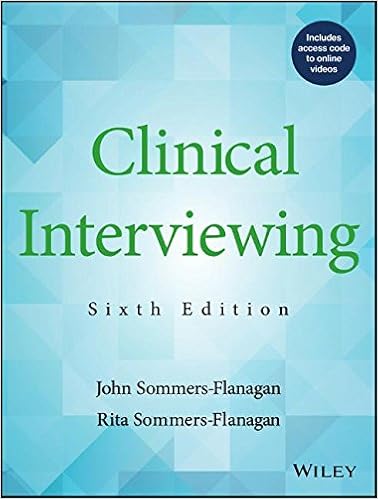
The 6th Edition of Clinical Interviewing is Now Available

Way back in 1990, a university book salesman came by my faculty office at the University of Portland. He was trying to sell me some textbooks. When I balked at what he was offering, he asked, “Do you have any textbook ideas of your own?” I said something like, “Sure” or “As a matter of fact, I do.” He handed me his card and a paper copy of Allyn & Bacon’s proposal guidelines.

Not having ever written a book, I never thought they’d accept my proposal.

They did. But after three years, A & B dropped our text.

Lucky for us.

Two  years later, Rita and I decided to try to resurrect our Clinical Interviewing text. We polished up a proposal, sent it out to three excellent publishers, and immediately got contract offers from W. W. Norton, Guilford, and John Wiley & Sons.

We went with Wiley.

Here we are 18 years later in the 6th edition. It’s been fun and a ton of work. Over the past five years we’ve started recording video clips and interviewing demonstrations to go along with the text. For the 6th edition, we got some pretty fantastic reviews from some pretty fancy (and fantastic) people. Here they are:

“I’m a huge admirer of the authors’ excellent work.  This book reflects their considerable clinical experience and provides great content, engaging writing, and enduring wisdom.”
John C. Norcross, Ph.D., ABPP, Distinguished Professor of Psychology, University of Scranton

“The most recent edition of Clinical Interviewing is simply outstanding.  It not only provides a complete skeletal outline of the interview process in sequential fashion, but fleshes out numerous suggestions, examples, and guidelines in conducting successful and therapeutic interviews.  Well-grounded in the theory, research and practice of clinical relationships, John and Rita Sommers-Flanagan bring to life for readers the real clinical challenges confronting beginning mental health trainees and professionals.  Not only do the authors provide a clear and conceptual description of the interview process from beginning to end, but they identify important areas of required mastery (suicide assessment, mental status exams, diagnosis and treatment electronic interviewing, and work with special populations).  Especially impressive is the authors’ ability to integrate cultural competence and cultural humility in the interview process.  Few texts on interview skills cover so thoroughly the need to attend to cultural dimensions of work with diverse clients.  This is an awesome book written in an engaging and interesting manner.  I plan to use this text in my own course on advanced professional issues.  Kudos to the authors for producing such a valuable text.”
—Derald Wing Sue, Ph.D., Professor of Psychology and Education, Teachers College, Columbia University

“This 6th edition of Clinical Interviewing is everything we’ve come to expect from the Sommers-Flanagan team, and more!  Readers will find all the essential information needed to conduct a clinical interview, presented in a clear, straightforward, and engaging style.  The infusion of multicultural sensitivity and humility prepares the budding clinician not only for contemporary practice, but well into the future.  Notable strengths of the book are its careful attention to ethical practice and counselor self-care. The case studies obviously are grounded in the authors’ extensive experience and bring to life the complexities of clinical interviewing.  This is a ‘must-have’ resource that belongs on the bookshelf of every mental health counselor trainee and practitioner.”
Barbara Herlihy, PhD. NCC, LPC-S, University Research Professor, Counselor Education Program, University of New Orleans

You can check out the text on Amazon https://www.amazon.com/Clinical-Interviewing-John-Sommers-Flanagan/dp/1119215587/ref=dp_ob_title_bk  or Wiley http://www.wiley.com/WileyCDA/WileyTitle/productCd-1119215587.html  or other major (and minor) booksellers.


The Sweet Spot of Self-Control

The Sweet Spot of Self Control (and Anger Management)

The speedometer reads 82 miles per hour. The numbers 8 and 2, represent, to me, a reasonable speed on I-90 in the middle of Montana. Our new (and unnecessary) speed limit signs read eight-zero. So technically, I’m breaking the law by two miles per hour. But the nearest car is a quarter mile away. The road is straight. Having ingested an optimal dose of caffeine, my attention is focused.

Slowly, a car creeps up from behind. He has his cruise control set at 83 mph. He lingers beside me and edges ahead. Then, with only three car lengths between us, he puts on his blinker and pulls in front of me. Now, with no other cars in sight, there’s just me and Mr. 83 mph on I-90, three car lengths apart.

An emotion rises into awareness. It’s almost anger. But nope, it’s not anger, it’s anger’s close cousin, annoyance. I feel it in my psyche and immediately know it can go in one of three directions: It could sit there and remain itself, until I tire of it; if I feed it, it could rise up and blossom into full-blown anger; or, I can send it away, leaving room for other thoughts and actions.

This is fabulous. This is the Sweet Spot of Self-Control.

Anger is lurking there, I know. I see it peeking over the shoulder of its cousin. “Hello anger,” I say.

In this sweet spot, I experience expanding awareness, a pinch of energy, along with an unfolding of possibilities. I love this place. I love the feelings of strength and power. I also recognize anger’s best buddy, the behavioral impulse. This particular impulse (they vary of course), is itching for me to reset my cruise control to 84 mph.  It’s coming to me in the shape of a desire—a desire to send the driver in front of me a clear message.

“You should cut him off,” the impulse says, “and let him know he should get a clue and give you some space.”

The sweet spot is sweet because it includes the empowered choice to say “No thanks” to the impulse and “See you later” to anger.

Now I’m listening to a different voice in my head. It’s smaller, softer, steadier. “It doesn’t matter” the voice whispers. “Let him creep ahead. Revenge only satisfies briefly.”

I feel a smile on my face as I remember an anger management workshop. With confidence, I had said to the young men in attendance, “No other emotion shifts as quickly as anger. You can go from feeling completely justified and vindicated, but as soon as you act, you can feel overwhelmed with shame and regret.”

A man raised his hand, “Lust” he said. “Lust is just like anger. One second you want it more than anything, but the next second you wish you hadn’t.”

“Maybe so,” I said. “Maybe so.”

There are many rational reasons why acting on aggressive behavioral impulses is ill-advised. Maybe the biggest is that the man in the car wouldn’t understand my effort to communicate with him. This gap of understanding is common across many efforts to communicate. But it’s especially linked to retaliatory or revenge-filled impulses. When angry, I can’t provide nuance in my communication and make it constructive.

The quiet voice in my brain murmurs: “You’re no victim to your impulses. You drive the car; the car doesn’t drive you.” That doesn’t make much sense. Sometimes the voice in my head speaks in analogy and metaphor. It’s a common problem. I want straight talk, but instead I get some silly metaphor from my elitist and intellectual conscience.

But I do get it and here’s what I get. I get that my conscience is telling me that this sweet spot is sweet because I get to see and feel my self-control. Not only do I get to see my behavioral options, I get to see into the future and evaluate their likely outcomes. I get to reject poor choices and avoid negative outcomes linked to aggressive actions. I’m not a victim of annoyance, anger, or aggressive impulses. I get to make the plan. I get to drive the car.

Now that other driver is far ahead.

Being on a Montana freeway, it’s hard to not think of deer. It’s clear now, but at dusk, deer will be everywhere. They have an odd instinct. Freud and my elitist conscience are inclined to call it a death instinct. Here’s how it works:

When I drive up alongside a deer on the side of the road, it dashes ahead, running alongside me; then it tries to cut across in front of me. This is the coup de gras of bad judgment. I’m in a big metal machine. The deer isn’t. So the deer dies. Not a good choice for the deer.

Yesterday, my phone alerted me to a Youtube speech by an unnamed alt right big-man. I watched and listened. So much smugness I was sick. In the end he shouted out “Hail Trump” and a few others jumped up and gave the “Heil Hitler!” salute.

Like a crazed deer, I felt an instinct. I wanted to drive to D.C. or Whitefish, Montana and find unnamed alt-right man and cut him off with some uncivil discourse. Instead, because I have a frontal lobe, I walked to the gym. Upon arriving, I discovered I’d stepped in dog poop. I’m sure this was an annoying but meaningful metaphor for something. At least that’s what my metaphor-loving conscience suggested. I didn’t buy it. Instead, I muttered “WTF” to myself. Okay, so maybe I muttered “WTF” several times. Then I walked outside in my socks and started cleaning the poop off my shoe. Not an easy task, especially if you’re wearing brand new trail-runners. I had to find a restroom near my office, an old toothbrush, lots of foamy soap, and mindfully scrub away the poop.

I was reminded of something my daughter Rylee once said at age three. She was being carried down a hill and there were many small piles of deer scat. She noticed, commenting: “I didn’t know the poop was so deep.”

Neither did I.

But the good news is that I (like you) own a functional frontal lobe that gifts me with the Sweet Spot of Self-Control. Many of us will be mindfully removing the metaphorical shit from our shoes for some time into the future. So let’s make some plans. Not revenge-laced plans; they don’t last. Yes. Let’s pause in the special sweet spot, evaluate our alternatives, and make some excellent plans.

rita-and-john-tippet

Why You Should Listen to the Practically Perfect Parenting Podcasts

The Practically Perfect Parenting Podcast is live at:  http://tinyurl.com/ppppod

That’s the good news.

The bad news is that even though the PPPP has been live since October 31, John and Sara still haven’t become famous podcasters.

Apparently, these things take time.

Even so, we’ve gotten a couple fabulous reviews. Here’s one from Brittany Moreland: “For whatever reason, I have avoided “parenting manuals” of any type BUT folks this is awesome. Not only can I attest that one of the hosts (John Sommers-Flanagan) is a great person and parent, but objectively this is worth any parent’s time.”

Don’t delay. Right now you can access three PPPP episodes on our podcasting website: http://tinyurl.com/ppppod

You can also listen to all of the live episodes on iTunes: https://itunes.apple.com/us/podcast/practically-perfect-parenting/id1170841304?mt=2#episodeGuid=2d80f23353e2c7f9d21af865f190d2c4

If you listen on iTunes, be sure to give it a rating. If you’re uncertain about what rating to give, we generally recommend 5 STARSJ.

On Monday, a new episode goes live. It’s titled: Get Curious, Not Furious: Discipline Again and Again and Some More.

Just so you’re up-to-date, here’s a list and description of the line-up through January:

Podcast Schedule

New podcasts will become live on a twice-monthly schedule.

October 31 – Episode 1: Dear Mom and Dad, Please be my Parent and Not my Bestie

Modern parents want high-quality relationships with their children. In this podcast Dr. Sara and Dr. John discuss the downside of forgoing parental responsibilities in favor of parent-child friendships. A balanced relationship where parents have strong emotional connections combined with parental decision-making authority is recommended.

November 14 – Episode 2: Practically Perfect Positive Discipline

Discipline can be a dirty (and misunderstood) word. In this episode, Dr. Sara and Dr. John knock-out old negative notions about discipline and replace them with new and research-based methods for using positive approaches to discipline.

November 28 – Episode 3: Discipline, Part 2

Dr. John and Dr. Sara continue their discussion of how parents can maintain structure and discipline in the family. In this episode they focus like a laser on specific techniques parents can use to set limits and teach their children positive family values and helpful lessons about about life.

December 12 – Episode 4: Get Curious, Not Furious: Discipline Again and Again and Some More.

You can’t get too much information about positive approaches to discipline. Seriously. That’s why Dr. Sara and Dr. John can’t stop talking about it. This episode will help parents step back and get curious about what causes misbehavior. John and Sara will review the four psychological reasons why children misbehave and focus on how to break through the obstacles that get in the way of using positive discipline strategies. This episode’s special guest: Meg Akabas, author of “52 Weeks of Parenting Wisdom: Effective Strategies for Raising Happy, Responsible Kids.”

December 26 – Episode 5: Sleep Well in 2017 and Beyond

As a locally renowned expert on helping children sleep, Dr. Sara shares her story of being an exhausted parent and offers her tips for parents who want to embrace the value of healthy sleep in their families. Special Guest: Chelsea Bodnar, M.D., a Chicago-based pediatrician and co-author of “Don’t Divorce Us: Kids’ Advice to Divorcing Parents.”

January 9, 2017 – Episode 6: Sleeping like a Baby (Should)

In this episode Dr. Sara continues providing tips on healthy sleep habits, this time focusing on babies. Medical and developmental guidance is included. Special Guest: Chelsea Bodnar, M.D., a Chicago-based pediatrician and co-author of “Don’t Divorce Us: Kids’ Advice to Divorcing Parents.”

January 23 – Episode 7: Post-Partum Depression

In this post-Thanksgiving special, Dr. Sara and Dr. John discuss the natural challenges of pregnancy, childbirth, and parenting. The signs and symptoms of postpartum or peri-natal depression are described and specific recommendations for coping with PPD are offered.  Special Guest: Jane Honikman, M.S., author of “I’m Listening: A Guide to Supporting Postpartum Families.”

General Program Description and Co-Host Bios

The Practically Perfect Parenting Podcast features Dr. Sara Polanchek and Dr. John Sommers-Flanagan discussing cutting-edge parenting issues, offering specific guidance, and sharing parenting resources. This podcast is a valuable resource for all parents interested in the art of parenting well. It’s also recommended listening for parenting educators, counselors, psychologists, social workers, teachers, and other school personnel who want more information on basic and contemporary parenting issues.

Sara Polanchek, EdD, (aka the Sleep Guru) is a licensed clinical social worker and Clinical Director in the University of Montana’s Counselor Education department.  Previously she was the Parenting Director at Families First in Missoula and continues to present at workshops and write articles on many issues pertaining to parenting and intimate relationships.

John Sommers-Flanagan, PhD, is a licensed clinical psychologist and Professor of Counselor Education at the University of Montana. He is the former cohost of “What is it with Men?” on Montana Public Radio and former executive director of Families First Missoula. He is author or co-author of nine books (including, “How to Listen so Parents will Talk” published by John Wiley and Sons) and many professional articles, blogs, and rants.

*All podcasts are sponsored in part by a grant from the Engelhard Foundation and support from the National Parenting Education Network.

ry-and-twins


The place to click if you want to learn about psychotherapy, counseling, or whatever John SF is thinking about.