Category Archives: Tough Kids Cool Counseling

Why Children Misbehave — The Adlerian Perspective

Mud

Alfred Adler believed that all human behavior is purposeful. People don’t act randomly, they engage in behaviors designed to help them accomplish specific goals. Adler believed that although individuals may not be perfectly aware of the link between their behaviors and their goals, the link is there nonetheless.

In this excerpt from our Counseling and Psychotherapy Theories text, we describe the four goals of children’s misbehavior. Rudolph Dreikurs, one of Adler’s protégés, developed this theory of children’s misbehavior. Over the years, Dreikurs’s ideas have been extremely useful to many parents and parenting educators. It’s also useful to consider these ideas when trying to understand adult behaviors.

Here’s the excerpt:

Why Children Misbehave

Adler’s followers applied his principles to everyday situations. Rudolph Dreikurs posited that children are motivated to grow and develop. They’re naturally oriented toward feeling useful and a sense of belonging. However, when children don’t feel useful and don’t feel they belong—less positive goals take over. In his book The Challenge of Parenthood, Dreikurs (1948) identified the four main psychological goals of children’s misbehavior:

  1. To get attention.
  2. To get power or control.
  3. To get revenge.
  4. To display inadequacy.

Children’s behavior isn’t random. Children want what they want. When we discuss this concept in parenting classes, parents respond with nods of insight. Suddenly they understand that their children have goals toward which they’re striving. When children misbehave in pursuit of psychological goals, parents and caregivers often have emotional reactions.

The boy who’s “bouncing off the walls” is truly experiencing, from his perspective, an attention deficit. Perhaps by running around the house at full speed he’ll get the attention he craves. At least, doing so has worked in the past. His caregiver feels annoyed and gives him attention for misbehavior.

The girl who refuses to get out of bed for school in the morning may be striving for power. She feels bossed around or like she doesn’t belong; her best alternative is to grab power whenever she can. In response, her parents might feel angry and activated—as if they’re in a power struggle with someone who’s not pulling punches.

The boy who slaps his little sister may be seeking revenge. Everybody talks about how cute his sister is, and he’s sick of being ignored, so he takes matters into his own hands. His parents feel scared and threatened; they don’t know if their baby girl is safe.

There’s also the child who has given up. Maybe she wanted attention before, or revenge, or power, but no longer. Now she’s displaying her inadequacy. This isn’t because she IS inadequate, but because she doesn’t feel able to face the Adlerian tasks of life (discussed later). This child is acting out learned helplessness (Seligman, 1975). Her parent or caregiver probably feels anxiety and despair as well. Or, as is often the case, they may pamper her, reinforcing her behavior patterns and self-image of inadequacy and dependence.

Dreikurs’s goals of misbehavior are psychological. Children who misbehave may also be acting on biological needs. Therefore, the first thing for parents to check is whether their child is hungry, tired, sick, or in physical discomfort. After checking these essentials, parents should move on to evaluating the psychological purpose of their child’s behavior.

For more information on this, see Tip Sheet #4 on johnsommersflanagan.com: https://johnsommersflanagan.com/tip-sheets/


Passing Personal Notes to Ohio School Psychologists

Davis Letter to SantaLast week I had the honor and privilege to spend a day with a group of about 340 mostly school psychologists in Columbus, Ohio. Talk about amazing. Were they nicer than last month’s group in Rock Hill, South Carolina? I don’t know. Both groups were awesome. I’ll keep the details secret just so everyone will wonder why gatherings in Rock Hill and Columbus are or will be inevitably fantastic.

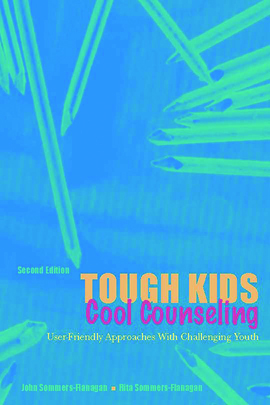
I received a few emails in follow-up to the so-called “Tough Kids, Cool Counseling” workshop in Columbus. I’ll be framing one of the emails for my wall, but there was another one that asked for my feedback on a particularly challenging therapeutic conundrum. That email reminded me of a technique that Rita and I first wrote about in 1995, but hasn’t been posted here. So I dug up an excerpt of it from the second edition of our “Tough Kids, Cool Counseling” book and am inserting it below. Here’s a link to that book on Amazon, but you can get it other places too:   https://www.amazon.com/Tough-Kids-Cool-Counseling-User-Friendly/dp/1556202741/ref=sr_1_1?s=books&ie=UTF8&qid=1494088480&sr=1-1&keywords=tough+kids+cool+counseling

The excerpt follows . . . and it’s followed by a link to an “Extra SCASP Handout” with more detailed info about the SCASP and Columbus Workshop techniques.

Passing Personal Notes

            A simple method for re-engaging an angry or “checked out” child/adolescent in counseling is the note-passing technique (J. Sommers-Flanagan & Sommers-Flanagan, 1995). This technique is used when a young client suddenly appears sullen, angry, or quiet and nonresponsive. In some cases, counselors may have clues as to why the client has become quiet. However, in other cases the young client’s silence may be a complete mystery. Whatever the case, note passing is used to communicate to clients through an alternative format, to reduce pressure on young clients to be verbally productive, to express empathy for an emotional state, and to surprise the client (and thereby modify affect) by being supportive and affectionate rather than critical in response to the client’s silence. When counselors have a positive response to client silence it can be conceptualized as a corrective emotional experience (Alexander & French, 1946).

Children, teenagers, and even some college students are notorious for passing notes in class. Most often the notes are brief and focus on gossip or on whatever is bothering the note writer at the moment. Generally speaking, among teenagers, passing notes is cool.

To utilize this technique all you need is a notebook and pencil or pen. When your client is quiet and perhaps angry or sullen and efforts to interact verbally result in continued withdrawal and silence, simply pick up the notebook and begin writing. This activity may attract the youth’s attention. Your client may assume you’re writing something negative about them. One 12-year-old boy immediately questioned: “Are you writing a note to the group home?” as he expected he would be reprimanded for becoming silent in therapy. I (John) responded: “Nope, I’m just writing a note to you.”

When using this technique, hold the notebook so your client cannot see the content of your note; part of the effect of this technique rests on your client’s surprise at receiving a personal note and on surprise at the content of the note. Of course, the note should be individualized and personal (see Box 4.1 for a sample note).

Box 4.1

Note-Passing Sample

Hey Tonya:

What’s up?  Seems like you might be kind of upset today, but I might be wrong.  I hope I didn’t do something to bug you or make you mad.  If I did, be sure to let me know when you feel like it, okay?  I know that counseling can be kind of dumb or seem like a waste of time or even make people mad sometimes.  I hope we can find ways to make this be a good thing for you.  Thanks for coming—even when you might not feel like it.  So, how are you feeling, anyway?  Do you think it is a little too warm in this office?  That’s a cool sweater you’re wearing.

Your Very Own Counselor,

Rita S-F

P.S. Write back if you want to.

[End of Box 4.1]

            We recommend writing the personal note with a person-centered flavor (Rogers, 1961). Additionally, it’s useful to include a humorous or light closing and an interest in hearing back from your client. Finally, write only what your clients will feel comfortable taking home (e.g., critical comments about teachers or family members, even if such comments are in the service of empathy and emotional validation, may have negative repercussions).

Most of our young clients respond positively to this procedure. Often they act surprised when told: “I wrote you a note.” One client asked to take it into the bathroom to read. Other clients have asked: “Can I keep it?”  Our response to these requests is usually something like, “Of course. I wrote it to you.” Another client refused the note during the session, but accepted it later from her mother (i.e., it was sealed and given to the mother to deliver at home). Sometimes young clients have initiated a note-writing exchange after receiving a note from one of us. On the other hand, we’ve had some young clients rip the note to shreds or toss it in the trash which is perfectly acceptable from our perspective because we view these more aggressive responses as a non-violent and perhaps useful anger expression.

Personal notes can reopen communication, possibly because the activity moves young people out of a negative mood state; it’s hard for clients to maintain a negative mood state when they’re also experiencing surprise or pleasure (Mosak, 1985). Research suggests that it’s common for young people who behave aggressively to anticipate hostility or overt coercion from others during times of stress or threat (Dodge, Lochman, Harnish, Bates, & Pettit, 1997; Dodge & Somberg, 1987). This anticipatory tendency has been labeled the misattribution of hostility.  For youth who anticipate hostility, a nonjudgmental, funny, or caring note can be quite a surprise. Also, many young people we see in therapy have never received a personal handwritten note from an adult (especially from an adult male). Overall, a sincere and nonthreatening effort by a counselor to enhance emotional intimacy and establish a personal connection usually does not go unnoticed.

SCASP Extra Handout

Handouts from South Carolina

This past Thursday I had the honor of offering a full-day workshop on “Tough Kids, Cool Counseling” to the South Carolina Association of School Psychologists. For anyone who has misplaced their handout or who wants additional content, I’m including two handouts in this post.

The first handout includes all the powerpoint slides (except the cartoons and empowered storytelling).

SCASP 2017 for Handout  

The second handout includes additional content corresponding (mostly) to the content in the powerpoint slides.

SCASP Extra Handout

For more information, you can check out our Tough Kids, Cool Counseling book, published by the American Counseling Association, https://www.amazon.com/Tough-Kids-Cool-Counseling-User-Friendly/dp/1556202741/ref=sr_1_10?s=books&ie=UTF8&qid=1491153299&sr=1-10&keywords=sommers-flanagan:

Tough Kids Image

Or you can check out our book on working effectively with parents: https://www.amazon.com/How-Listen-Parents-Will-Talk/dp/1118012968/ref=sr_1_4?s=books&ie=UTF8&qid=1491153770&sr=1-4&keywords=sommers-flanagan


Goodnight, South Carolina

Some days . . . the news is discouraging. Some days . . . evidence piles up suggesting that nearly everyone on the planet is far too greedy and selfish. On those days, I can’t help but wonder how our local, national, and worldwide communities survive. It feels like we’re a hopeless species heading for a cataclysmic end.

Sunset on StillwaterBut then I have a day like yesterday. A day where I had the honor and privilege to spend time hanging out with people who are professional, smart, compassionate, and dedicated to helping children learn, thrive, and get closer to reaching their potentials. I’m sure you know what I mean. If you turn off the media and peek under the surface, you’ll find tons of people “out there” who wake up every day and work tremendously hard to make the world just a little bit better, for everyone.

For me, yesterday’s group was the South Carolina Association of School Psychologists. They were amazing. They were kind. About 110 of them listened to me drone on about doing counseling with students who, due, in part, to the quirky nature of universe, just happen to be living lives in challenging life and school situations. The school psychologists barely blinked. They rarely checked their social media. They asked great questions and made illuminating comments. They were committed to learning, to counseling, to helping the next generation become a better generation.

All day yesterday and into the night I had an interesting question periodically popping up in the back of my mind. Maybe it was because while on my flight to South Carolina, I sat next to a Dean of Students from a small public and rural high school in Wisconsin. Maybe it was because of the SCASP’s members unwavering focus and commitment to education. The question kept nipping at my psyche. It emerged at my lunch with the Chair of the Psychology Department at Winthrop University.  It came up again after my dinner with four exceptionally cool women.

The question: “How did we end up with so many people in government who are anti-education?”

Yesterday, I couldn’t focus in on the answer. I told someone that–even though I’m a psychologist–I don’t understand why people do the things they do. But that was silly. This morning the answer came flowing into my brain like fresh spring Mountain run-off. Of course, of course, of course . . . the answer is the same as it always has been.

The question is about motivation. Lots of people before me figured this out. I even had it figured out before, but, silly me, I forgot. Why do people oppose education when, as John Adams (our second President) said, “Laws for the liberal education of youth, especially for the lower classes of people, are so extremely wise and useful that to a humane and generous mind, no expense for this purpose would be thought extravagant.”

The answer is all about money and power and control and greed and revenge and ignorance. Without these motivations, nearly everyone has a “humane and generous mind” and believes deeply in funding public education.

Thanks to all the members of the South Carolina Association of School Psychologists, for giving me hope that more people can be like you, moving past greed and ignorance and toward a more educated and better world.

Good night, South Carolina. It’s been a good day.


When Teens Talk Back

Sara P Boy Photos

A big thanks to Rick McLeod for inventing this title for a class he taught many years ago at Families First in Missoula.

For tips on how parents can handle it when teens talk back, listen to the latest episode of the Practically Perfect Parenting Podcast. You can catch it on iTunes: https://itunes.apple.com/us/podcast/practically-perfect-parenting-podcast/id1170841304?mt=2

Or Libsyn: http://practicallyperfectparenting.libsyn.com/

Here’s the blurb for When Teens Talk Back:

In this episode, Dr. Sara decides to consult with Dr. John about her hypothetical “friend’s” teenage and pre-teen boys, who coincidently, happen to be the same ages as Sara’s own children. Other than being a disastrously bad consultant, John ends up complaining about how disrespectful our culture is toward teens. This leads Sara and John to affirm that, instead of lowering the expectation bar for teens, we should re-focus on what’s great about teenage brains. Overall, this turns out to be a celebration of all the great things about teenagers . . . along with a set of guidelines to help parents be positive and firm. Specific techniques discussed include limit-setting, do-overs, methods for helping teenagers calm down, role modeling, and natural, but small consequences.

If you want more info on this topic, check out the re-post below, originally posted on psychotherapy.net

A Short Piece on Disrespecting Teenagers

We have an American cultural norm to disrespect teenagers. For example, it’s probably common knowledge that teens are:
• Naturally difficult
• Not willing to listen to good common sense from adults
• Emotionally unstable
• Impulsively acting without thinking through consequences

Wait. Most of these are good descriptors of Bill O’Reilly. Isn’t he an adult?

Seriously, most television shows, movies, and adult rhetoric dismiss and disrespect teens. It’s not unusual for people to express sympathy to parents of teens. “It’s a hard time . . . I know . . . I hope you’re coping okay.” Stephen Colbert once quipped, “Nobody likes teenagers.” Even Mark Twain had his funny and famous disrespectful quotable quote on teens. Remember:

“When I was a boy of 14, my father was so ignorant I could hardly stand to have the old man around. But when I got to be 21, I was astonished at how much the old man had learned in seven years.”

This is a clever way of suggesting that teens don’t recognize their parents’ wisdom. Although this is partly true, I’m guessing most teens don’t find it especially hilarious. Especially if their parents are treating them in ways that most of us would rather not be treated.

And now the neuroscientists have piled on with their fancy brain images. We have scientific evidence to prove, beyond any doubt, that the brains of teens aren’t fully developed. Those poor pathetic teens; their brains aren’t even fully wired up. How can we expect them to engage in mature and rational behavior? Maybe we should just keep them in cages to prevent them from getting themselves in trouble until their brain wiring matures.

This might be a good idea, but then how do we explain the occasionally immature and irrational behavior and thinking of adults? I mean, I know we’re supposed to be superior and all that, but I have to say that I’ve sometimes seen teens acting mature and adults acting otherwise. How could this be possible when we know—based on fancy brain images—that the adult brain is neurologically all-wired-up and the teen brain is under construction? Personally (and professionally), I think the neuroscience focus on underdeveloped “teen brains” is mostly (but not completely) a form of highly scientifically refined excrement from a male bovine designed to help adults and parents feel better about themselves.

And therein lies my point: I propose that we start treating teens with the respect that we traditionally reserve for ourselves and each other . . . because if we continue to disrespect teenagers and lower our expectations for their mature behavior . . . the more our expectations for teenagers are likely to come true.

John and his sister, Peggy, acting immature even though their brains are completely wired up.

Peg and John Singing at Pat's Wedding

Revisiting the 3-Step Emotional Change Trick — Including a Video Example

One of my current students asked where she might find a video example of the 3-Step Emotional Change Trick. Since I made up the Emotional Change Trick in 1997, the answer was easy: No such video exists.

Then I remembered that this past summer, while putting together video content with Wiley for our Clinical Interviewing text, I did a video demo of the 3-Step ETC with a 12-year-old girl. Due to space considerations, the footage didn’t make it into the text, but Wiley sent me a copy of the 6:44 minute clip.

Keep in mind that the girl in this video is exceptional. She’s the daughter of some friends and she agreed to be filmed for educational purposes. My sense is that she could have taught me the 3-Step ECT, but I tried to make it look like I was teaching her anyway.

Here’s the youtube link: https://www.youtube.com/watch?v=ITWhMYANC5c

And below you can read a version of the Emotional Change Technique adapted from Tough Kids, Cool Counseling:

*************************

The Three-Step, Push-Button Emotional Change Technique

            An early and prominent Adlerian therapist, Harold Mosak, originally developed and tested the push-button technique as a method for demonstrating to clients that thinking different thoughts can effectively change mood states (Mosak, 1985). The purpose of Mosak’s technique was to help clients experience an increased sense of control over their emotions, thereby facilitating a sense of encouragement or empowerment (Mosak, 2000, personal communication).

            Mosak’s push-button technique can be easily adapted to work with young clients. When we implement this technique with younger clients, we are playful and call it an emotional change trick. When using this technique with teenagers, we describe it as a strategy for gaining more personal control over less desirable emotions. In essence, the three-step, push-button, emotional change technique is an emotional education technique; the primary goal is to teach clients that, rather than being at the mercy of their feelings, they may learn some strategies and techniques that provide them with increased personal control over their feelings.

The following example illustrates Adlerian emotional education principles and Mosak’s push-button technique expanded to three distinct steps.

Case example.  Sam, a 13-year-old European American boy, was referred because of his tendency to become suddenly stubborn, rigid, and disagreeable when interacting with authority figures. Sam arrived for his appointment accompanied by his mother. It quickly became obvious that Sam and his mother were in conflict. Sam was sullen, antagonistic, and difficult to talk with for several minutes at the outset of the session. Consequently, the Three-Step, Push-Button Emotional Change Technique (TSPB) was initiated:

Preparation/Explanation.

JSF:     I see you’re in a bad mood today. I have this . . . well, it’s kind of a magic trick and I             thought maybe you’d be interested. Want to hear about it?

S:         (Shrugs).

JSF:     It’s a trick that helps people get themselves out of a bad mood if they want to. First, I need to tell you what I know about bad moods. Bad moods are weird because even             though they don’t really feel good, lots of times people don’t want to get out of their bad mood and into a better mood. Do you know what I mean? It’s like you kind of want to stay in a bad mood; you don’t want anybody forcing you to change out of a bad mood.

S:         (Nods in agreement.)

JSF:     And you know what, I’ve noticed when I’m in a bad mood, I really hate it when someone comes up to me and says: “Cheer up!” or “Smile!”

S:         Yeah, I hate that too.

JSF:     And so you can be sure I’m not going to say that to you. In fact, sometimes the best thing to do is just really be in that bad mood—be those bad feelings. Sometimes it feels great to get right into the middle of those feelings and be them.

S:       Uh, I’m not sure what you’re talking about.

JSF:     Well, to get in control of your own feelings, it’s important to admit they’re there, to get to   know them better. So, the first step of this emotional change trick is to express your bad feelings. See, by getting them out and expressing them, you’re in control. If you don’t  express your feelings, especially icky ones, you could get stuck in a bad mood even    longer than you want.

As you can see, preparation for the TSPB technique involves emotional validation of how it feels to be in a bad mood, information about bad moods and how people can resist changing their moods or even get stuck in them, hopeful information about how people can learn to change their moods, and more emotional validation about how it feels when people prematurely try to cheer someone up.

Step 1: Feel the feeling. Before moving clients away from their negative feelings, it’s appropriate—out of respect for the presence and meaning of emotions—to help them feel their feelings. This can be challenging because most young people have only very simplistic ideas about how to express negative feelings. Consequently, Step 1 of the TSPB technique involves helping youth identify various emotional expression techniques and then helping them to try these out. We recommend brainstorming with young clients about specific methods for expressing feelings. The client and counselor should work together (perhaps with a chalk/grease board or large drawing pad), generating a list of expressive strategies that might include:

  • scribbling on a note pad with a black marker
  • drawing an angry, ugly picture
  • punching or kicking a large pillow
  • jumping up and down really hard
  • writing a nasty note to someone (but not delivering it)
  • grimacing and making various angry faces into a mirror
  • using words, perhaps even yelling if appropriate, to express specific feelings.

The expressive procedures listed above are easier for young clients to learn and understand when counselors actively model affective expression or assist clients in their affective expression. It’s especially important to model emotional expression when clients are inhibited or unsure about how to express themselves. Again, we recommend engaging in affective expression jointly with clients. We’ve had particular success making facial grimaces into a mirror. (Young clients often become entertained when engaging in this task with their counselor.) The optimal time for shifting to Step 2 in the TSPB technique is when clients have just begun to show a slight change in affect. (Often this occurs as a result of the counselor joining the client in expressing anger or sadness or general nastiness.)

Note: If a young client is unresponsive to Step 1 of the TSPB technique, don’t move to Step 2. Instead, an alternative mood-changing strategy should be considered (e.g., perhaps food and mood or the personal note). Be careful to simply reflect what you see. “Seems like you aren’t feeling like expressing those yucky feelings right now. Hey, that’s okay. I can show you this trick some other day. Want some gum?”

Step 2: Think a new thought (or engage in a new behavior). This step focuses on Mosak’s push-button approach (Mosak, 1985). It’s designed to demonstrate to the client that emotions are linked to thoughts. Step 2 is illustrated in the following dialogue (an extension of the previous case example with John and Sam):

JSF:     Did you know you can change your mood just by thinking different thoughts? When you think certain things it’s like pushing a button in your brain and the     things you think start making you feel certain ways. Let’s try it. Tell me the funniest thing that happened to you this week.

S:         Yesterday in math, my friend Todd farted (client smiles and laughs).

JSF:     (Smiles and laughs back) Really! I bet people really laughed. In fact, I can see it makes you laugh just thinking about it. Way back when I was in school I had a friend who did that all the time.

The content of what young people consider funny may not seem particularly funny to adults. Nonetheless, it’s crucial to be interested and entertained—welcoming the challenge to empathically see the situation from the 13-year-old perspective. It’s also important to stay with and build on the mood shift, asking for additional humorous thoughts, favorite jokes, or recent events. With clients who respond well, counselors can pursue further experimentation with various affective states (e.g., “Tell me about a sad [or scary, or surprising] experience”).

In some cases, young clients may be unable to generate a funny story or a funny memory. This may be an indicator of depression, as depressed clients often report greater difficulty recalling positive or happy events (Weerasekera, Linder, Greenberg, & Watson, 2001). Consequently, it may be necessary for the counselor to generate a funny statement.

S:         I can’t think of anything funny.

JSF:     Really? Well, keep trying . . . I’ll try too (therapist and client sit together in silence for about 20 seconds, trying to come up with a positive thought or memory).

JSF:     Got anything yet?

S:         Nope.

JSF:     Okay, I think I’ve got one. Actually, this is a joke.  What do you call it when 100 rabbits standing in a row all take one step backwards?

S:         Huh?

JSF:     (repeats the question)

S:         I don’t know.  I hate rabbits.

JSF:     Yeah.  Well, you call it a receding hare line.  Get it?

S:         Like rabbits are called hares?

JSF:     Yup.  It’s mostly funny to old guys like me.  (JSF holds up his own “hare line”)

S:         That’s totally stupid, man (smiling despite himself). I’m gonna get a buzz cut pretty             soon.

When you tell a joke or a funny story, it can help clients reciprocate with their own stories.  You can also use teasing riddles, puns, and word games if you’re comfortable with them.

We have two additional comments for counselors who might choose to use a teasing riddle which the client may get wrong. First, you should use teasing riddles only when a strong therapeutic relationship is established; otherwise, your client may interpret teasing negatively. Second, because preteen and teen clients often love to tease, you must be prepared to be teased back (i.e., young clients may generate a teasing riddle in response to a your teasing riddle).

Finally, counselors need to be sensitive to young clients who are unable to generate a positive thought or story, even after having heard an example or two. If a young client is unable to generate a funny thought, it’s important for you to remain positive and encouraging. For example:

JSF:     You know what. There are some days when I can’t think of any funny stories either. I’m sure you’ll be able to tell me something funny next time. Today I was able to think of some funny stuff . . . next time we can both give it a try again if you want.

Occasionally, young clients won’t be able to generate alternative thoughts or they won’t understand how the pushbutton technique works. In such cases, the counselor can focus more explicitly on changing mood through changing behaviors. This involves getting out a sheet of paper and mutually generating a list of actions that the client can take—when he or she feels like it—to improve mood.

Sometimes depressed young clients will need to borrow from your positive thoughts, affect, and ideas because they aren’t able to generate their own positive thoughts and feelings. If so, the TSPB technique should be discontinued for that particular session. The process of TSPB requires completion of each step before continuing on to the next step.

Step 3: Spread the good mood. Step 3 of this procedure involves teaching about the contagion quality of mood states. Teaching clients about contagious moods accomplishes two goals. First, it provides them with further general education about their emotional life. Second, if they complete the assignment associated with this activity, they may be able to have a positive effect on another person’s mood:

JSF:     I want to tell you another interesting thing about moods. They’re contagious. Do you  know what contagious means? It means that you can catch them from being around other  people who are in bad moods or good moods. Like when you got here. I noticed your  mom was in a pretty bad mood too. It made me wonder, did you catch the bad mood from    her or did she catch it from you? Anyway, now you seem to be in a much better mood. And so I was wondering, do you think you can make your mom “catch” your good mood?

S:         Oh yeah. I know my mom pretty well. All I have to do is tell her I love her and she’ll get all mushy and stuff.

JSF:     So, do you love her?

S:         Yeah, I guess so. She really bugs me sometimes though, you know what I mean?

JSF:     I think so. Sometimes it’s especially easy for people who love each other to bug each other. And parents can be especially good at bugging their kids. Not on purpose, but they bug you anyway.

S:         You can say that again. She’s a total bugging expert.

JSF:     But you did say you love her, right?

S:         Yeah.

JSF:     So if you told her “I love you, Mom,” it would be the truth, right?

S:         Yeah.

JSF:     And you think that would put her in a better mood too, right?

S:         No duh, man. She’d love it.

JSF:     So, now that you’re in a better mood, maybe you should just tell her you love her and spread the good mood. You could even tell her something like: “Dude, Mom, you really   bug me sometimes, but I love you.”

S:         Okay. I could do that.

It’s obvious that Sam knows at least one way to have a positive influence on his mother’s mood, but he’s reluctant to use the “I love you” approach. In this situation it would be useful for Sam to explore alternative methods for having a positive effect on his mother’s mood.

Although some observers of this therapy interaction may think the counselor is just teaching Sam emotional manipulation techniques, we believe that viewpoint makes a strong negative assumption about Sam and his family. Our position is that successful families (and successful marriages) include liberal doses of positive interaction (Gottman et al., 1995). Consequently, unless we believe Sam is an exceptionally manipulative boy (i.e., he has a conduct disorder diagnosis), we feel fine about reminding him of ways to share positive (and truthful) feelings with his mother.

To spread a good mood requires a certain amount of empathic perspective taking. Often, youth are more able to generate empathic responses and to initiate positive interactions with their parents (or siblings, teachers, etc.) after they’ve achieved an improved mood state and a concomitant increased sense of self-control. This is consistent with social–psychological literature suggesting that positive moods increase the likelihood of prosocial or altruistic behavior (Isen, 1987). Because of developmental issues associated with being young, it’s sometimes helpful to introduce the idea of changing other people’s moods as a challenge (Church, 1994).  “I wonder if you have the idea down well enough to actually try and change your mom’s mood.”

Once in a while, when using this technique, we’ve had the pleasure of witnessing some very surprised parents. One 12-year-old girl asked to go out in the waiting room to tell her grandmother that she was going to rake the lawn when they got home (something Grandma very much wanted and needed). Grandma looked positively stunned for minute, but then a huge smile spread across her face. The girl skipped around the office saying, “See.  I can do it.  I can change her mood.”

One 14-year-old boy thought a few minutes, then brought his mom into the office and said “Now Mom, I want you to think of how you would feel if I agree to clear the table and wash the dishes without you reminding me for a week.” Mom looked a bit surprised, but admitted she felt good at the thought, whereupon I (John) gave the boy a thumbs up signal and said, “Well done.”

Step 4.

At this point, readers should beware that although we’re describing a Three-Step technique, we’ve now moved to Step 4. We do this intentionally with young clients to make the point that whenever we’re working with or talking about emotions, surprising things can happen.

In keeping with the learn-do-teach model, we ask our young clients to teach the TSPB procedure to another person after they learn it in therapy. One girl successfully taught her younger brother the method when he was in a negative mood during a family hike. By teaching the technique to her brother, she achieved an especially empowering experience; she began to view herself as having increased control over her and her family’s emotional states.


Using an Invitation for Collaboration in Counseling and Psychotherapy

As I’m sure you know, I believe (rather strongly) that counselors and psychotherapists should work hard to collaborate with clients. Being an authoritarian therapist is passe.

Sometimes collaboration sounds easy in theory, but it can be difficult in practice. It’s especially difficult if clients come into your office not “believing in therapy” and not trusting you. In the following excerpt from the forthcoming 6th edition of Clinical Interviewing, you can see how a skilled therapist deals with some initial client hostility.

Case Example 3.1: An Early Invitation for Collaboration

Sophia, a 26-year-old mother of two was referred for counseling by her children’s pediatrician. When she sat down with her counselor, she stated:

I don’t believe in this counseling thing. I’m stressed, that’s true, but I’m a private person and I believe very strongly that I should take care of myself and not have anyone take care of my problems for me. Besides, you look like you might be 18 years old and I doubt that you’re married or have children. So I don’t see how this is supposed to help.

It’s easy to be shaken when clients like Sophia pour out their doubts about therapy and about you at the beginning of the first session. Our best advice: (a) be ready for it; (b) don’t take it personally, Sophia is speaking of her doubts, don’t let them become yours; (c) be ready to respond directly to the client’s core message; and (d) end your response with an invitation for collaboration. An invitation for collaboration is a clinician statement that explicitly offers your client an opportunity to work together. In some cases, an invitation for collaboration is a time-limited “let’s try this out” offer.

Here’s a sample counselor response to Sophia:

Counselor: I hear you loud and clear. You don’t believe in counseling, you’re a private person, and you’re concerned that I don’t have the experiences needed to understand or help you.

Sophia: That’s right. [Sometimes when the counselor explicitly reflects the client’s core message (i.e., “. . . you’re concerned I don’t have the experience needed to understand or help you”) the client will retreat from this concern and say something like, “Well, it’s not that big of a deal.” But that’s not what Sophia does.]

Counselor: Well then, I can see why you wouldn’t want to be here. And you’re right, I don’t have a lot of the life experiences you’ve had. . But I do have knowledge and experience working with people who are stressed and concerned about parenting and I’d very much like to have a chance to be of help to you. How about since you’re here, we try out working together today and then toward the end of our time together I’ll check back in with you and you can be the judge of whether this might be helpful or not?

Sophia: Okay. That sounds reasonable.

In this case the counselor responded directly and with empathy to Sophia and then offered an invitation for collaboration. As the session ends, Sophia may or may not accept the counselor’s invitation. But either way, the counselor’s skillful response provides an opportunity for a collaborative relationship to develop.

Round Bales


A Brief History and Analysis of Antidepressant Medication Treatment for Youth with Depression Diagnoses

The popular press intermittently acts surprised that antidepressant medications actually have little scientific evidence supporting their efficacy. It’s old news, but it’s still important news and I’m glad for the recent reports. See: http://www.everydayhealth.com/news/did-studies-lack-key-data-on-link-between-antidepressants-youth-suicides/

Rita and I published an article about this in 1996. Below, I’ve pasted a pre-print excerpt from an article I published with Duncan Campbell in 2009 in the Journal of Contemporary Psychotherapy. It includes a brief summary of antidepressant medication research through 2008 or so. Check it out:

A Brief History and Analysis of Antidepressant Medication Treatment for Youth

Medication treatment for depressed youth has evolved over three relatively distinct periods. First, prior to 1987, small exploratory studies examined tricyclic antidepressant (TCAs) efficacy with young patients diagnosed with major depressive disorder (MDD). Second, from 1987-1994 there were a number of randomized, controlled trials (RCTs) of TCA efficacy; these efforts often employed double-blind procedures and inactive placebo controls. Third, since 1997, research efforts have primarily focused on evaluating selective serotonin reuptake inhibitor (SSRI) efficacy with RCTs.

Early Research: Pre-1987

In the early 1980s, psychiatric and pharmaceutical researchers began testing TCAs with youth. Early conclusions about the safety and efficacy of TCAs were generally optimistic (Klein, Jacobs, & Reinecke, 2007). This is a tendency that has been identified in the literature and it may be due to methodological limitations, confirmation bias or an allegiance to the medical model, or financial incentives associated with the pharmaceutical industry (Klein et al., 2007; Luborsky et al., 1999). For example, on the basis of existing studies and their very small double-blind trial with nine prepubertal children, Kashani and colleagues (1984) concluded that amitrityline was possibly efficacious for treating depression in children. Interestingly, the authors’ tentative claim was made despite the fact that no statistically significant effect was observed for amitriptyline and even though 11% of their sample “developed a hypomanic reaction while on the protocol” (p. 350).

RCTs with TCAs

From 1965 to 1994 there were 13 published RCTs evaluating TCA efficacy. Most of these studies were conducted from 1987 to 1994 (Fisher & Fisher, 1996; Sommers-Flanagan & Sommers-Flanagan, 1996). These RCTs confirmed the premature hopefulness of Kashani and colleagues’ early claims. Indeed, no study ever published showed that TCAs outperformed placebo in the treatment of youth depression (Hazell, 2000). More importantly, it is currently recognized that TCAs possess dangerous side effect profiles, while offering no demonstrable advantage over placebo in the treatment of youth depression (Hazell, 2000; Pellegrino, 1996).

In the mid-1990s there was considerable speculation about why TCAs were ineffective for treating youth. The primary hypothesis for involved the fact that children appear to have immature adrenergic synaptic systems. This possibility precipitated a more systematic inquiry of serotonergic medications.

RCTs with SSRIs

Using PsychInfo and PubMed searches combined with cross-referencing, we identified 12 published RCTs evaluating SSRI efficacy with 11 of these studies from 1997 to 2007. In total, these studies compared 1,223 SSRI treated patients to a similar number of placebo controls. On the basis of the researchers’ own efficacy criteria, six RCTs observed outcomes favoring medication over placebo, and six observed nonsignificant differences. Researchers described efficacious outcomes for fluoxetine (3 of 4 studies; G. J. Emslie et al., 2002; G. J. Emslie et al., 1997; Simeon, Dinicola, Ferguson, & Copping, 1990; Treatment for Adolescents With Depression Study (TADS) Team, US, 2004), paroxetine (1 of 3; Berard, Fong, Carpenter, Thomason, & Wilkinson, 2006; G. Emslie et al., 2006; M. B. Keller, 2001), sertraline (1 of 1; K. D. Wagner et al., 2003), and citalopram (1 of 1; K. D. Wagner et al., 2004). Neither of two studies observed efficacy for venlafaxine (G. J. Emslie, Findling, Yeung, Kunz, & Li, 2007; Mandoki, Tapia, Tapia, & Sumner, 1997), and the single escitalopram study returned negative results (K. D. Wagner, Jonas, Findling, Ventura, & Saikali, 2006).

Methodological Issues

Assessing a medication’s efficacy is a complex process with challenges that are difficult to address. We believe, however, that the six aforementioned RCTs favoring SSRIs suffered from methodological problems and issues that temper their positive conclusions. For example, (a) two of the three fluoxetine studies were characterized by unusually high and disproportionate discontinuation rates in the placebo conditions; (b) 11 of the 12 studies based their conclusions exclusively on a structured psychiatric interview; (c) despite simultaneous examination of several outcomes, no study used statistical adjustments for multiple comparisons; (d) placebo washouts and statistical approaches that advantage medications were nearly always employed (R. P. Greenberg, 2001); (e) no procedures were used to evaluate double-blind integrity (R. P. Greenberg & Fisher, 1997); and (f) despite documented inter-racial differences in medication metabolism and responsiveness, conclusions were generalized to all youth and inappropriately failed to account for racial/cultural specificity (Lin, Poland, & Nakasaki, 1993).

Side Effects and Adverse Events

In RCTs and other studies, patients treated with SSRIs experienced substantially more disturbing side effects and adverse events than those not treated with SSRIs. For example, in one of the most rigorous studies to date, the Treatment of Adolescents with Depression Study (TADS), 11.9% of the fluoxetine group evidenced harm-related adverse events (compared to 4.5% in the Cognitive Behavioral Therapy [CBT] group) and 21% experienced psychiatric adverse events (1% in the CBT group). Further, as the authors noted, “…suicidal crises and nonsuicidal self-harming behaviors were not uncommon and, with the caveat that the numbers were so small as to make statistical comparisons suspect, seemed possibly to be associated with fluoxetine treatment” (March et al., 2006; The TADS Team, 2007 p. 818; Treatment for Adolescents With Depression Study (TADS) Team, US, 2004).

Findings like these necessitate critical inspection of study results and should attenuate positive conclusions about medication safety. For example, Emslie et al.’s (1997) study of youth depression was the first ever to demonstrate superior outcome for an SSRI. In addition to the study’s numerous methodological problems, the authors noted that 6.3% of the fluoxetine patients (n = 3) developed manic symptoms. Although this percentage may sound small, extrapolation suggests that 6,250 of every 100,000 fluoxetine-treated youth might develop manic symptoms. Ultimately, despite data based solely on psychiatrist ratings and a placebo condition discontinuation rate approaching 46%, the authors concluded that fluoxetine “…is safe and effective in children and adolescents with MDD” (p. 1037). Moreover, the authors’ intent-to-treat analysis possibly conferred an advantage for the active drug group. In our opinion, this methodological problem and the mania data make it premature to conclude that fluoxetine is safe and effective in children.

Similarly, despite striking data that appear to demonstrate otherwise, authors of the single positive paroxetine study concluded that paroxetine is “safe and effective” for young patients (M. B. Keller et al., 2001). However, in their results section, the research team reported serious adverse effects, “…in 11 patients in the paroxetine group, 5 in the imipramine group, and 2 in the placebo group” (p. 769). More specifically, five adverse effects in the paroxetine group involved suicidal ideation or gestures. Despite these data, the researchers presented their results as evidence for the efficacy and safety of paroxetine treatment for adolescent depression. Because 12% of the paroxetine-treated adolescents experienced at least one adverse event and because 6% of these patients manifested increased suicidality or suicidal gestures (compared with zero in the imipramine and placebo groups), we believe the authors’ conclusion departs from the data in a significant and concerning way.
Shortly after publication of the Keller et al. (2001) study, regulatory agencies in France, Canada, and Great Britain restricted SSRI use among youth. In September of 2004, an expert panel of the U.S. Food and Drug Administration (FDA) followed suit and voted 25-0 in support of an SSRI-suicide link. Later, the panel voted 15-8 in favor of a ‘black box warning’ on SSRI medication labels. The warning states:

“Antidepressants increased the risk compared to placebo of suicidal thinking and behavior (suicidality) in children, adolescents, and young adults in short-term studies of Major Depressive Disorder (MDD) and other psychiatric disorders. Patients of all ages who are started on antidepressant therapy should be monitored appropriately and observed closely for clinical worsening, suicidality, or unusual changes in behavior. Families and caregivers should be advised of the need for close observation and communication with the prescriber.”

In 2006, the FDA extended its SSRI suicidality warning to adult patients aged 18-24 years (United States Food and Drug Administration, 2007).

Combination Medication and Psychotherapy Treatments

Many view the 2004 TADs study as a ‘state of the science’ comparison of SSRI medication (fluoxetine; FLU) with CBT and their combination (FLU + CBT). To date, it represents the largest placebo-controlled study comparing mono-therapy (FLU or CBT alone) with combination therapy. Not surprisingly, the TADs study has generated numerous publications and much controversy (Antonuccio & Burns, 2004; Diller, 2005; Weisz, McCarty, & Valeri, 2006).

To summarize, initial 12-week outcomes showed that 71% of FLU + CBT patients evidenced “much” or “very much” improvement on the on the CGI-Improvement item, a clinician-based assessment. FLU alone produced a similar outcome (60.6%), whereas the CBT alone (43.2) outcome did not differ significantly from placebo (34.8%). Based on these outcomes, several CBT researchers and practitioners criticized the specific CBT delivered to TADs participants. Brent (2006), for example, described TADS psychotherapy as a relatively “dense treatment, with multiple CBT strategies, each delivered at a relatively low dose” (p. 1463). In comparing the initial TADs CBT outcomes with previous and subsequent CBT studies, Weisz et al. (2006) suggested that the TADs CBT was weaker than most CBT interventions, for various reasons:

“the CBT ES (effect size) generated in TADS is not characteristic of most CBT or psychotherapy effects on youth depression; 20 of the 23 other CBT programs. . . showed larger ES than the TADS version of CBT, and the mean ES value across the non-TADS CBT programs. . . was 0.48, markedly higher than the -0.07 ES associated with the TADS CBT intervention” (p. 147).

To complicate issues further, follow-up data suggest that the TADs CBT evidenced delayed effectiveness, as it eventually “caught up” with FLU and CBT+FLU (The TADS Team, 2007). At week 18, for example, there were no statistically significant differences between CBT and FLU, and by week 36 there were no statistical differences among the three groups (CBT, FLU, and CBT + FLU) on primary outcome measures. Although the interventions including FLU might evidence a speedier antidepressant effect, these results suggest that CBT is equally effective over time.

The depression treatment literature frequently includes recommendations for combined interventions in order to maximize outcomes (Watanabe, Hunot, Omori, Churchill, & Furukawa, 2007). Unfortunately, however, little data exists to support these recommendations. In addition to TADs, the only other published RCT comparison of mono- and combination treatments for depressed adolescents reported partial remission rates of 71% for CBT, 33% for sertraline, and 47% for combination (Melvin et al., 2006). Medication group patients also evidenced significantly more adverse events and side effects. Although the researchers attributed the delayed response in the combination group to sertraline, they concluded with the puzzling statement that “CBT and sertraline are equally recommended for the treatment for adolescents with depression, each demonstrating an equivalent response” (Melvin et al., 2006 p. 1160).

20150616_121950

A Relationally-Oriented Evidence-Based Practice Model for Mental Health Counselors

This paper is an adapted summary and extension of an article recently published in the Journal of Mental Health Counseling (April, 2015, pp. 95-108). The original article was titled: Evidence-Based Relationship Practice: Enhancing Counselor Competence. This abbreviation and adaptation is primarily designed to summarize the content, but also to focus more directly on the implications of developing an evidence-based model especially for mental health counselors. This paper ends with an “Appendix” outlining specific parameters of an evidence-based mental health counseling model. The Appendix material isn’t in the original article. If you’re a member of the American Mental Health Counseling Association, you can find the original article here: https://amhca.site-ym.com/?JMHCv37n2

Foundations

There are two domains that serve as a foundation for all competent mental health practice. These are:

1. Ethical practice
2. Multicultural sensitivity.

Professional counselors must practice ethically. At minimum, this means abiding by the ACA (2014) and American Mental Health Counselors Association (AMHCA; 2010) ethical codes. Ponton and Duba (2009) referred to this commitment as a covenant professional counselors have with and for their clients.

Traditional theoretical perspectives must be modified or expanded to address cultural diversity (J. Sommers-Flanagan, Hays, Gallardo, Poyralzi, Sue, & Sommers-Flanagan, 2009). Clients should not be expected to adapt to their counselor’s theory; rather, counselors should adapt their theory or approach to fit clients (Gallardo, 2013). Although multicultural competence is an ethical mandate, the need to embrace multicultural awareness, knowledge, and skills is also a practical reality. [The original article lists six evidence-based ways in which mental health counselors can adapt their counseling services to be more multiculturally sensitive.]

Evidence-Based Counselor Competence

Given the nature of professional counseling and counselor identity, it seems obvious that mental health counselors should embrace a model for counseling competence and EBP that emphasizes therapeutic relationships. That is why the model I propose considers both theoretically and empirically supported relationship factors and specific interventions (procedures). . . .

The reality is that relational acts and treatment methods are so closely interwoven that in counseling sometimes it is difficult to discern which is operating at a given moment (Lambert & Ogles, 2014). Consequently, the following Relationship-Oriented Evidence-Based Practice (ROEBP) behavioral descriptions incorporate both relational and technical components. The ROEBP behavior list primarily focuses on evidence-based relationship factors, although these relational factors are nearly always teamed with technical procedures.

Evidence-Based Relationship Factors

Each mental health counselor will inevitably display therapeutic relational factors in unique ways that may be difficult for other practitioners to replicate, because anything relational or interpersonal is alive, automatically unique, and therefore resists sterile descriptive language. Nevertheless, counselors can implement the following core relational attitudes and behaviors in their own unique manner and still adhere to EBP principles.

Congruence and Genuineness

In mental health counseling, the counselor is the instrument through which treatment is provided. This is probably why Rogers’s original core condition of congruence (1957) is still central to counseling efficacy. However, because Natalie Rogers (Sommers-Flanagan, 2007) once told me that she believed very few mental health professionals in the U.S. really understand her father’s work, let me make four brief points about congruence [You can read the original article to get the details on this].

The Working Alliance

In 1979, Bordin described the working alliance as a three-dimensional and pan-theoretical therapeutic factor. The three dimensions were (a) forming an emotional bond; (b) counselor-client goal-consensus or agreement; and (c) task collaboration. Researchers have affirmed that these working alliance dimensions contribute to positive treatment outcomes (Horvath, Re, Flückiger, and Symonds, 2011). [Practical ways in which mental health counselors can apply these three dimensions in their work are described in the article.]

Unconditional Positive Regard or Radical Acceptance

Originally, Rogers (1957) described unconditional positive regard as the counselor “experiencing a warm acceptance of each aspect of the client’s experience” (p. 98). This is, of course, often impossible. Though unconditional positive regard is easy and natural when counselor and client values are aligned, the competent counselor recognizes that there will be many discrepancies, small or large, between what the counselor thinks is right and what the client thinks is right. I recall a Pakistani Muslim supervisee who reported that hearing people talk about being gay or lesbian made her feel physically nauseated. To her credit, she worked through this (over a period of two years) and was able to embrace an accepting attitude. . . .

In addition to Rogers’s work, I’ve found Marsha Linehan’s dialectical behavior therapy concept of radical acceptance (1993) very helpful. As someone who has logged many counseling hours with clients who display challenging behaviors, remembering radical acceptance helps me greet even the most extreme and disagreeable (to me) client statements with a genuine accepting response (usually something like, “Thanks so much for sharing that with me and being so honest about what you think”).

Empathic Understanding

You should already be thoroughly familiar with Rogers’s ideas about empathy and the robust empirical support for empathy as a contributor to positive counseling outcomes. However, one important caveat about empathy is that the personal feelings of counselors and ratings of their own empathy are relatively unimportant. What matters is whether and how much clients experience their counselors as empathic. This is a crucial distinction. It is all too easy for all humans—including counselors—to focus on their side of interpersonal experiences. When it comes to whether empathy is a facilitative therapy condition, it is the client’s judgment of whether the counselor was empathic that predicts positive outcomes. . . .

Rupture and Repair

Getting it wrong is a natural part of life and counseling. There will always be empathic misses, poorly timed disclosures, and intermittent disengagement. These should be viewed as inevitable problems in the working alliance. As in many other areas of life, tension in the counselor-client relationship offers both danger and opportunity.

The danger is that counselors will ignore, overlook, or be unaware of relationship tensions or ruptures, in which case clients will be more likely to drop out of counseling and outcomes will be adversely affected. But the chance to correct our missteps is an unparalleled therapeutic opportunity. It involves the powerful process of self-correction and refocusing on the client and the counselor-client relationship. . . .

Although there are many ways to repair or work through relationship rupture, the original article discusses two overarching approaches.

Managing Countertransference

Thirty years ago Steve de Shazer (1984) not only reported that “resistance” had died as a therapeutic concept, he held a funeral for it in his backyard. Similarly, some counselors and psychotherapists might like to bury the whole idea of countertransference, putting it out of sight and out of mind. However, renaming or ignoring constructs will not make them go away.

Counselors are more effective when they are aware of and deal with their own unresolved emotional and behavioral reactions (Hayes, Gelso, & Hummel, 2011). Personal counseling or psychotherapy, clinical supervision, participation in peer supervision groups—such practices can help counselors become aware of and gracefully work through their countertransference reactions.

Implementing In- and Out-of-Session Procedures

Proponents of ESTs and EBP emphasize the importance of employing specific psychological or behavioral procedures with clients. Among the procedures that have empirical support are relaxation, exposure, behavioral activation, and problem-solving (Sommers-Flanagan & Sommers-Flanagan, 2012). In addition, some procedures, such as eye movement desensitization reprocessing (EMDR), have significant empirical support even though it is not clear whether the eye movements themselves or other parts of the tightly controlled EMDR protocol are the “active” ingredients. To be consistent with an evidence-based mental health counseling model, professional counselors should implement empirically supported procedures, but should do so using a collaborative interpersonal process. . . .

Progress Monitoring

Progress monitoring (PM) is a relatively new phenomenon on the evidence-based scene. PM is robustly related to positive outcomes and relatively easy to apply (Meier, 2015). Although not covered by many professional counseling publications, all practicing counselors should integrate some form of PM into their practice.

PM simply means that, formally or informally, counselors consistently check with clients about “how things are going.” Data from empirical studies consistently show, however, that practitioners who use formal progress monitoring rating scales tend to have both more favorable outcomes and fewer negative outcomes or treatment failures (Meier, , 2015). . . .

Concluding Comments

Mental health counselors can and should integrate evidence-based approaches into their practice. Although it might be useful for counselors to seek training in ESTs, embracing and applying evidence-based relationships as a core component of counselor competency is more consistent with professional counselor identity. The purpose of making this distinction and providing the information in this article is to advocate for an alternative evidence-based identity—one that counselors can more wholeheartedly embrace.

In this article I focused on nine relational factors that are empirically linked to positive counseling outcomes. This is only a beginning. Research will continue, and for space reasons I neglected several dimensions of counselor-client relational interactions that are consistent with professional counselor identity. For example, other than a brief discussion of PM, I did not address the potential merits and problems of formal assessment. In the future I would hope for a more distinct assessment model that specifies how counselors interact with clients, emphasizing transparency and collaboration. But that discussion must wait for another day. Until then, I wish you all the best as you incorporate relationally-oriented evidence-based counseling principles into the exceptionally important services you provide.

References are included in the original article

Appendix

[This is added material]

A General Practice Model for Evidence-Based Mental Health Counseling

Different professional groups use different terminology for describing their usual and customary standards for clinical practice. In psychology “empirically-supported” is often, but not always used as a means for identifying an approach that meets scientifically-based standards. Physicians and psychiatrists establish “practice parameters” for treating specific disorders. For example, the American Academy of Child and Adolescent Psychiatry (AACAP) has a Committee on Quality Issues that has generated practice parameters for depressive disorders, obsessive-compulsive disorders, multicultural competency, and many other areas of child and adolescent psychiatric clinical practice.

Given that psychology and medicine have their own language for referring to evidence-based standards, it might be useful for professional counseling to come up with its own terminology. This would be terminology that reflects an emphasis on achieving wellness (rather than the medical model) as well as the relational emphasis consistent with counseling. In the Journal of Mental Health Counseling article I referred to this as: Relationship-Oriented Evidence-Based Practice (ROEBP). This isn’t bad, but I’m guessing someone might be able to do better at capturing counselor identity within an evidence-based practice.

Here’s a first try at outlining an ROEBP for mental health counseling. I recognize that this is mostly a rough outline, but also believe that any practice guidelines that are established for professional mental health counselors should be broad so as to include many different and unique styles that exist among individual counselors.

1. All mental health counselors embrace their professional ethical guidelines and use multicultural sensitivity and appropriate multicultural adaptations when working with individual clients. These foundational competencies and commitments must be present for a professional counselor to claim he or she is practicing evidence-based mental health counseling.

2. Mental health counseling is initiated using a collaborative informed consent process. This process should include both written informed consent (consistent with HIPAA), but also verbal interactions to help make every specific counselors approach and style explicit to prospective clients.

3. When referral information is available to mental health counselors, at least some of this information is shared directly with clients using a positive and strength-based format and interaction.

4. Mental health counselors intentionally employ empirically-supported relationship factors throughout counseling. These include, but may not be limited to:

a. Having an office-setting and interpersonal demeanor that contributes to the development of a positive emotional bond between client and counselor

b. Developing a list of mutually agreed upon problems or goals that constitute the main focus of counseling. This involves a collaborative and empathic process.

c. Working with clients on in-session tasks or procedures that are explicitly linked to the mutually agreed upon counseling problems or goals.

d. Congruence and Genuineness

e. Unconditional Positive Regard or Radical Acceptance

f. Empathic Understanding

g. Managing Ruptures and Engaging in Repair

h. Managing Countertransference

5. Recognizing that clients are sometimes drawn toward and benefit from the application of specific therapeutic procedures, mental health counselors seek permission to use these procedures with clients if they are appropriate for the remediation of a particular problem and/or for client personal growth. The procedures employed should be empirically supported. If they are not empirically-supported (e.g., procedures from energy psychology) clients should be informed that the procedure may be promising, but is not a standard and accepted counseling procedure.

6. Mental health counselors use either a formal or informal progress monitoring procedure to consistently check with clients regarding the client’s perception of counseling progress.

Feel free to email me at john.sf@mso.umt.edu with comments about this article summary and ideas about evidence-based mental health counseling practice.