Category Archives: Personal Reflections

Revisiting Rita’s Blog

Hi All.

You know how relationships can be. Sometimes it’s easy to take the person whom you’re living with or hanging out with for granted. This morning, I was reminded (again) that Rita is a very talented writer. So I’m sharing with you a link to her blog. Warning: Rita is exploring varieties of “God” manifestations in the world. It may not be your cup of tea; on the other hand, you might like the idea of ongoing conversations with God and therefore you might love her writing. In this blog-episode, God is coming back from a short vacation. If you’re interested, check it out.

via God Comes Back

Doing Behavior Modification Right

Toilet Drinking Ed

Opposite Day was on January 25th and, sadly, I forgot to celebrate it. Maybe that’s for the best now that it feels like we’re living in an opposite world where, as parents, we need to constantly monitor and compensate for what our children see and hear on social media, television, the news, and from the President.

About a decade ago I “invented” the term: “Backward behavior modification.” It’s sort of like Opposite Day in that it captures the natural (but unintentional) tendency for parents to provide positive reinforcement for their children’s negative and undesirable behavior. As a part of backward behavior modification, parents also often ignore their children’s positive behaviors.

Celebrating Opposite Day requires creativity, mental effort, and planning. Saying the opposite of what you mean is difficult. In contrast, backward behavior modification is all natural, but unhelpful. As parents, we seem to do it automatically. It requires creativity, mental effort, and planning to do behavior modification in the right direction.

The latest episode of the Practically Perfect Parenting Podcast is all about how parents can do behavior modification in the right direction. Now, don’t get me wrong . . . I’m not a BIG proponent of mechanistic, authoritarian behavior modification. However, as Dr. Sara and I talk about on the PPPP, behavior modification is a tool that most parents, at least on occasion, should have in their toolbox.

Here’s a link to the podcast on iTunes: https://itunes.apple.com/us/podcast/practically-perfect-parenting-podcast/id1170841304?mt=2

Here’s another link to the podcast on Libsyn: http://practicallyperfectparenting.libsyn.com/

Here’s the official podcast description:

Behavior Modification: To Use or Not to Use—That is the Question!

Parenting is difficult. Parenting is also wonderful. As parents, most days we’re reminded of parenting challenges and joys. In today’s episode, Dr. Sara and Dr. John talk (and John dons his professorial persona and talks too much). Sara and John they talk about adding the crucial tool of behavior modification to your parenting toolbox. Don’t worry, we know how the idea of “behavior modification” can feel to parents; it can feel too sterile and mechanistic. The expectation isn’t for you to use behavior modification all the time, but instead to be able to use it when you need it. Even more importantly, our hope is for you to learn how to use it effectively. To help fulfill our hopes, Sara tells a story of behavior modification gone wrong and John and Sara share tips for using behavior modification effectively.

Don’t forget to like the PPPP on Facebook: https://www.facebook.com/PracticallyPerfectParenting/

And now we’re on Twitter. You can follow us there:  https://twitter.com/PPParentPod

Feminist Theory and Spirituality

Woman Statue

Continuing on our stroll through counseling and psychotherapy theories and spirituality, we come now to complicated crossroad; this is where feminism and spirituality intersect. Our focus is on how feminist theorists and feminist therapists deal with spirituality.

This intersection is complex primarily because the manner in which many religions characterize women’s roles and women’s potential is, shall we say, limiting. In contrast, feminist theory views the limiting of women as inappropriate, inaccurate, unacceptable, oppressive, and pathology-creating. All this is to say that when religion and women’s rights converge, there’s ample room for conflict.

The following excerpt from Counseling and Psychotherapy Theories in Context and Practice is a lazy stroll. It’s lazy because we don’t go very deep. Instead, because adherents of both perspectives may have strong beliefs (and emotions), we leave the going deep to you. As you contemplate going deeper, it’s nice to keep in mind the theological, philosophical, and practical idea of “Both-And.” There may be paths for becoming both profoundly spiritual and profoundly feminist. And, at least from the surface, the spiritual-feminist path has the look of something quite different from a lazy stroll.

Here’s the short excerpt:

Feminist Theory and Spirituality

Most dominant world religions have rules or practices that restrict women’s freedoms. In some cases, feminists view religion as abusive, coercive, and dangerous toward women. In most cases, feminists view dominant religions as laden with conservative, patriarchal values (Hagen, Arczynski, Morrow, & Hawxhurst, 2011; Jiménez, Almansa, & Alcón, 2017).

The naturally activist orientation of feminism can create tension between feminist therapists and specific religious practices. For example, female genital mutilation is considered a male-perpetuated human rights violation that sanctions systemic violence toward girls and women. Despite the feminist general philosophy of openness to diverse ways of being, feminists view systematic oppression of females in the name of religion to be intolerable (Jiménez et al., 2017).

Feminists see potential for affirmation and liberation in spiritual alternatives. Specifically, feminist writers have discussed ways in which sexually diverse women can use spirituality to enhance their resilience within oppressive sociocultural contexts (Hagen et al., 2011). Integrating affirming spirituality into feminist therapy is an acceptable and, for many clients and therapists, preferred practice (Funderburk & Fukuyama, 2001; Hagen et al., 2011)

Adherents to male-oriented religious or cultural norms are unlikely to welcome feminist critique of their values. This is where the potential for conflict is highest and where feminists could be viewed as imposing their values on other cultural or religious groups. Feminists view the systematic oppression of women as unacceptable, regardless of political, religious, or cultural justifications that might be used to support oppression.


Feeling Sad and Angry About Another School Shooting

20150326_165823

Hi All.

I feel sad and angry about the perpetual and unrelenting series of tragic shootings that have been happening in our country. In response, I’m offering part one of my National Firearms Safety Proposal. You can get to this proposal by clicking on this link to my “other” blog: https://mysecretmagic.com/2018/01/25/a-modest-firearms-safety-proposal-that-everyone-will-hate-and-why-thats-a-good-thing/

Thanks in advance for reading and sharing this firearms safety proposal. I hope we can continue working together to help make America safer.

Sincerely,

John SF

The Birth of My New Secret Magic Unprofessional Blog

John Rap

People sometimes say, “Rules are made to be broken.”

I always say, “That’s just ridiculous. Rules were made to be followed.”

But every yang has a yin and it’s come time for me to let a little of my rule-breaking yin out.

As you know, I have this (Dr. John Sommers-Flanagan) professional blog. It’s serious, with a side of irreverence. But despite my irrepressible irreverence, being narrowly professional left me feeling like an academic in a tweed jacket. As an example, I felt compelled to avoid politics and profanity. I began realizing that this professional blog was too much yang.

So I invented a yin-flavored unprofessional blog. In my unprofessional blog I speak more freely about politics and personal experiences. It’s also a secret blog, and I use a mysterious yin alias, so that helps.

In this professional blog (the one you’re reading now), I avoid particular words, especially words like “secret” or “magic.” I avoid these words because magic is fake, and my professional self thinks that whenever writers use “secret,” it means they’re marketing something. It’s like unveiling the “secret rules to happiness.” The rules aren’t really secret and they won’t bring you happiness, but the words work to sell books and get likes on Facebook and Twitter. I also avoid words that don’t fit with my scientific, academic persona. That means I don’t use words like countless or tireless, because they’re just stupid words; nothing is countless and no one is tireless.

The inaugural post of my new Secret Magic Unprofessional Blog is about gun safety. It’s unprofessional, so don’t click on this link unless you want to read my thoughts on the social and political issue of gun violence and gun safety. Here’s the link:https://mysecretmagic.com/

Okay, I know, gun safety isn’t even controversial and my Pathetic Open Letter to the NRA is political like oatmeal is political. That’s because gun safety is all about professional issues related to suicide, mental health, and child safety. Okay, so I use the F-word and called a certain politician a dip-shit, but that’s just me tossing in some unprofessional language to make a point about what’s right and good and I know you know that making a point about what’s right and good isn’t really much political.

If you enjoy my Secret Magic Unprofessional Blog, please LIKE it and FOLLOW it and share it NOW and OFTEN: https://mysecretmagic.com/. As is the case with most bloggers, my purpose isn’t to become rich and famous. Instead, I’m all about exercising my freedom of expression, while irrationally hoping that someone on the planet might hear my voice and experience learning or pleasure or meaning or inspiration or solidarity. Now that would be magic.

https://mysecretmagic.com/

The Psychology of Evidence-Based Haiku and Freedom (#WordsMatter)

nick-nacks

“Words were originally magic.” At least that’s what Freud said.

Freud, Captain America, and most sentient humans and cartoon characters who haven’t sold their souls, would likely agree that restricting words and language constricts human creativity and potential.

The White House is trying to ban the Centers for Disease Control (CDC) from using specific words. Not long ago, a five-year-old I know used the F-word. I put him in time-out. In this case, the CDC will get put in time-out for using the words “evidence-based” or “vulnerable.” Who does that?

It’s hard to find words to describe people who would restrict words, especially the words needed to report scientific findings. Ironically, for this government: Hate speech is fine. Pornography is no problem. Sexist language designed to demean is something you should grab onto and never say you’re sorry about. This is not a government that promotes family values.

Thou shalt not say: “transgender” or “entitlement.”

Who can use words to prohibit words? That’s a narcissistic megalomaniac fantasy.

Government repression of free speech has inspired me to reflect on the power of words. This reflection somehow led me East, into a temporary preoccupation with Haiku. The impulse to create Haiku with forbidden CDC words was irresistible.

Thou shalt not speak truth

Totalitarians shout

No science for you!

Once upon a time, we the people, formed a more perfect union. The purpose of said union was predominately to protect life, liberty, and the pursuit of happiness. For many, happiness happens when freedom includes science and a recognition that the CDC, being a government agency, is funded by me and you and, by design, is all about protecting life, liberty, and the pursuit of happiness. This made me think of Dr. Suess.

The White House is not the boss of me.

The White House is not the boss of the CDC.

The White House should not tell

Its citizens to go to hell.

We will free our words and use our actions.

To remove the man and all his factions.

I could understand the White House restricting use of the “F-word” or the “C-word.” But now the CDC isn’t supposed to use the word “diversity?” That’s a perversely impressive expression of totalitarian suppression. However, as with most totalitarian expressions, it misunderestimates (in honor of George W. Bush) a basic Haiku-truth.

Vulnerable white

Presidents must obey all

Science-based facts

There’s a robust psychological principle called reactance. In case you wondered, reactance is evidence-based. Reactance is resistance that naturally occurs when behavioral freedoms are threatened. What usually happens is: (a) Freedoms are threatened, (b) motivational arousal occurs, (c) efforts are made to restore threatened freedoms. This means we push back to affirm or re-affirm, our freedom. In honor of reactance, here’s a two-part 5-7-5 Haiku:

I: An entitled

Totalitarian once

Said: Shut the fuck up

II: Instead, we use words

To resist the regime that

Seeks devolution

Haiku can have spiritual dimensions. It requires slowing down, counting syllables, and ending a story near the beginning. There are several famous Zen Haiku poems. None of which are included here among my amateurish Haiku attempts.

This brings me to this blog’s end, which is also only the beginning of something else. To close, I offer a progressive Christian Haiku prayer for freedom:

Dear Lord Jesus, may

I kneel and say transgender?

Yes, my love, you may.

Parenting in the Age of Trump . . . and other Parenting Challenges

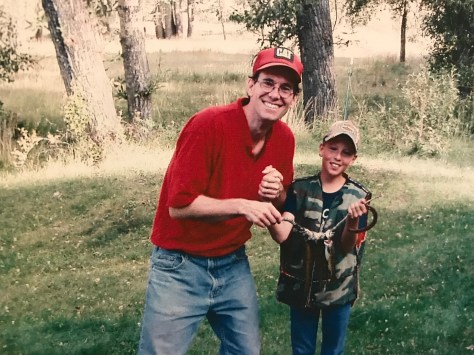
John and Paul with Fish

This past week, Donald Trump posted another name-calling Tweet about Kim Jong Un being short and fat. Before that, he was famously recorded by Access Hollywood saying it was okay to grab women by the pussy. Somewhere in between, he tweeted about shooting Muslims with bullets dipped in pig’s blood and referred to “firing those SOBs.”

This blog isn’t designed to be political. I don’t mean to be picking on Donald Trump. However, the extraordinary number of provocative statements he generates every day makes him a ready example of a poor media role model. His statements are often of the ilk that republicans, democrats, and independents would all rather not have their 12-year-old children hear, much less repeat. The point is that sometimes politicians, news reporters, comedians, musicians, athletes, and other celebrities make statements that are incompatible with mainstream American family values. This isn’t new. For those of us who were parents back then, about 20 years ago President Bill Clinton made a statement about oral sex that—at the very least—constituted horrid advice for teenagers. The other point is that somehow parents have to figure out how to best deal with provocative statements that leak out of the media and into our children’s brains.

In this week’s episode of the practically perfect parenting podcast, Dr. Sara Polanchek and I take on the contemporary Trump phenomenon, as well as the equally challenging phenomenon of comedians who try to make a joke out of holding a picture of a severed Trump head. How should parents deal with this stream of objectionable content?

Not surprisingly, Sarah and I have a thing or two to say about Parenting in the Age of Trump. We encourage you to contemplate, in advance, how you want to address revolting media-based material to which your children will be inevitably exposed. Our hope is for you to identify your personal and family values and then learn how to stimulate your children’s moral development. Bottom line: we can’t completely control the objectionable media discourse, and so we might as well use it for educational purposes.

You can listen to the Practically Perfect Parenting Podcast on iTunes: https://itunes.apple.com/us/podcast/practically-perfect-parenting-podcast/id1170841304?mt=2

Or you can listen to it on Libsyn: http://practicallyperfectparenting.libsyn.com/

You can follow and like us on Facebook: https://www.facebook.com/PracticallyPerfectParenting/

And just as soon as I gain better control of my Twitter finger, then you’ll be able to find us on Twitter too.


The Benefits and Limitations of Rhyming and Alliteration

Smoky Sunrise Aug 2017

Don’t get me wrong. I’m not anti-rhyming and I’m not anti-rap.

Truth is, I think rhyming slogans are pretty darn cool. Ask my students, I use them all the time. Here are a few that have been known to slip out my mouth and into a class lecture from time to time:

  • A pill is not a skill.
  • Get curious, not furious.
  • Your goal should be within your personal control
  • To function to the best of your ability, you should embrace your multicultural humility
  • An alcoholic drink, will not help you think (better)

The benefits of rhyming (and I daresay, alliteration) is that messages emerge with might and mass, which makes them more memorable. What I meant to say here before my alliterative self took over is that rhyming produces a powerful and memorable message. That’s the good news.

The “less good” news (as us therapist types like to say) is that rhyming and alliteration, although clever and appealing, usually don’t capture ALL OF THE TRUTH, and, are often misleading.

All this initial commentary is my way of leading up to my recent critique of the liberal use of a couple of F-words (nope, I’m not talking about “Fire and fury” although that could be an alliterative example of something that’s simply not soothing the simmering psyches of people who need to settle down). Instead, the target of my critique today is the all-too-common utterance, “Fight or flight.”

What follows is an excerpt of a slight rambling rant that was included in my keynote speech at the Montana Prevent Child Abuse Conference this past April.

The context: I had just shown a video of a Harvard professor who happened to mention (without checking with me first) the clever and popular phrase, “fight or flight.” Here’s what came next:

*****************************

You may not be aware of this, but I’m an official, self-appointed member of the counseling and psychotherapy theories police. I don’t have a badge, but I’ve got a book. What this book means is that I’ve done a little background reading on lots of theoretical concepts, like “Fight or Flight.” “Fight or Flight” – We hear that a lot, even from, as my older daughter would say, that fancy Harvard guy on the video.

The problem with most rhyming concepts is that they tend to oversimplify whatever it is we’re talking about. Take for example, “No pain, no gain.” There’s some truth to that, but that statement probably doesn’t hold for everyone, everywhere.

Well, the troubling truth is that fight or flight isn’t really all that accurate. Stress doesn’t just trigger two behavioral options. There are other behaviors activated by stress, some of which also start with an F, but don’t rhyme so neatly.

There’s Faint. And there’s Freeze. Chronic stress can also increase Feeding; some of us know that first-hand. My favorite stress food comes from places that rhyme with Fakery, so I guess that’s another F word. But, then again, stress can also dull your appetite, so the feeding thing isn’t a universal response.

Then there are the “P” words, like poop and pee. High stress can affect those, sometimes rather dramatically.

But what most people—even fancy Harvard guys—don’t tell you or don’t know, is that much of the Fight or Flight research was conducted on White Males.

And as if that wasn’t bad enough, the research was actually conducted on White, Male, Rats.

After re-analyzing old data and new studies focusing on female rats and female humans, years ago, Shelly Taylor and her research colleagues at UCLA discovered that for females of the species, there was a tendency toward a different set of rhyming words. The females coped with stressors using a strategy referred to as “Tend and Befriend.” And to further complexify the situation, sometimes males do the tend and befriend thing too. . . although not quite so frequently as the white, male, rats.

The point . . . I know I’ve strayed from it, is that financial and workplace interventions are very good for decreasing child abuse, but IMHO. . . interventions that increase social support and connection (the tending and befriending as methods for helping highly stressed families cope) are equally important . . . and that brings us right back to you and what you can do to prevent child abuse.

*********************

Today’s blog is just a reminder that although powerful and memorable communication is remarkably powerful and memorable, it’s usually incomplete, not always accurate, and a function of the speaker’s need or desire to be powerful and memorable. This is just as true when I say “a pill is not a skill” or when other people say other things that make use of rambling and reckless rhetoric of the alliterative or rhyming ilk.

To finish, I’ll leave you with what Shelly Taylor said back in the year 2000, as excerpted from our forthcoming textbook, Counseling and Psychotherapy in Context and Practice (John Wiley and Sons, 2018). This particular excerpt ends with brief comments from us that also, in case you are wondering, might be relevant to the recent Google manifesto brouhaha.

****************************

Stress researcher and social psychologist Shelly Taylor made a similar contribution when researching the well-known fight or flight phenomenon (Taylor et al., 2000). She and her colleagues wrote:

A little-known fact about the fight-or-flight response is that the preponderance of research exploring its parameters has been conducted on males, especially on male rats. Until recently, the gender distribution in the human literature was inequitable as well. Prior to 1995, women constituted about 17% of participants in laboratory studies of physiological and neuroendocrine responses to stress. (2000, p. 412)

Reanalysis of existing data and new research revealed significant differences in the ways in which females and males respond to stressful situations. Taylor and colleagues (2000) concluded:

We propose a theory of female responses to stress characterized by a pattern termed “tend-and-befriend.” Specifically, we propose that women’s responses to stress are characterized by patterns that involve caring for offspring under stressful circumstances, joining social groups to reduce vulnerability, and contributing to the development of social groupings, especially those involving female networks, for the exchange of resources and responsibilities. We maintain that aspects of these responses, both maternal and affiliative, may have built on the biobehavioral attachment caregiving system that depends, in part, on oxytocin, estrogen, and endogenous opioid mechanisms, among other neuroendocrine underpinnings. (p. 422)

The preponderance of the research suggests that in fact, that White male ways of being aren’t always normative for females, or even for all males. There are physical and psychological similarities between females and males, but there are also differences. In this case, it would be inappropriate to make the case that a typical male fight-or-flight response is superior to a typical female tend-and-befriend response. There is likely an evolutionary benefit to both stress-related behavior patterns (Master et al., 2009; Taylor & Gonzaga, 2007; Taylor & Master, 2011). Sometimes differences are just differences and there’s no need to advocate for one sex-related pattern as superior over another (although if they feel threatened by this information, white male rats are highly likely to fight for their position…or run and hide in little holes in our cupboards). In this case it seems clear: Neither behavior pattern represents psychopathology…and neither will always be the superior response to threat.

 

Boy Brains, Girl Brains, and Neurosexism

Black White Bikes

Sorry to say, I’ve been irritable the past couple days. If you don’t believe me, just ask my internet provider . . . or my editor . . . or ask me about my upcoming book deadline. There’s evidence everywhere for my irritability and impatience. You might even see evidence for it in this short excerpt from our forthcoming Theories of Counseling and Psychotherapy textbook. In fact, you should read this now, because I’m pretty sure it will get censored before appearing in our text.

Here you go.

You may be aware of popular books describing and delighting in the differences between female and male brains. Here’s a short list, along with my snarky comments:

  1. The essential difference: Male and female brains and the truth about autism (Baron-Cohen, 2003). Baron-Cohen is an autism researcher. His book allegedly, “. . . proves that female-type brains are better at empathizing and communicating, while male brains are stronger at understanding and building systems-not just computers and machinery, but abstract systems such as politics and music.” Comment: It’s so good to finally understand why most of our politicians are smirky White males who look like Baron-Cohen (heads up, this statement is sarcasm).
  2. The female brain (Brizendine, 2006): Brizendine is a neuropsychiatrist. Her book is touted as bringing “. . . together the latest findings to show how the unique structure of the female brain determines how women think, what they value, how they communicate, and who they love.” Comment: In Delusions of gender (2011), Cordelia Fine reduces Brizendine’s arguments to rubble. Nuff said.
  3. Teaching the female brain: How girls learn math and science (James, 2009). Comment: It’s hard to know how this book could be more than two pages given that there’s extremely sparse scientific evidence to support what this book’s title implies.
  4. Female brain gone insane: An emergency guide for women who feel like they are falling apart (Lundin, 2009). No comment. I couldn’t bring myself to read beyond this book’s title.
  5. The male brain: A breakthrough understanding of how men and boys think (Brizendine, 2011). Comment: The main breakthrough finding is that when you sell a million+ copies of your first book, a sequel, with similar drama, but equally slim scientific support, is essential.
  6. Unleash the power of the female brain: Supercharging yours for better health, energy, mood, focus, and sex (Amen, 2014). Comment: Better health, energy, mood, focus, and sex? I want a female brain!

The dangers of over-stating what’s known about the brain is significant, but nowhere are the dangers bigger than when you’re talking about sex and gender. Over time, physical differences between females and males have nearly always been used to justify systemic mistreatment of females (and limitations for males, as well). Some examples:

Plato didn’t think women were created directly by God and so they didn’t have had souls.

Aristotle thought women were deficient in natural heat and therefore unable to cook their menstrual fluids into semen.

Gustav Le Bon (1979) concluded that women’s intellectual inferiority was so obvious that no one could contest it. He wrote: “All psychologists who have studied the intelligence of women, as well as poets and novelists, recognize today that they represent the most inferior forms of human evolution and that they are closer to children and savages than to an adult, civilized man” (see Women’s Brains by S. J. Gould). Le Bon purportedly based his ideas on Broca’s measurements of 6 female and 7 male skulls. Not surprisingly, Le Bon strongly opposed the whole idea of educating women.

More recently, over the past 30 years, I’ve seen and heard and read many different descriptions and explanations about female and male brain differences. Nearly always, there’s the same old story: Women are more “right brained” and intuitive and less “left brained” and rational. Of course the actual brain hemisphere research is sketchy, but the take home messages are much like Baron-Cohen’s and Brizendine, which happen to be much like the philosophy of the Nazi Third Reich, which is that girls and women are well-suited for working in the kitchen and the church, and especially good at caring for children, but that women had best leave politics and the corporate world – where steady rationality is essential – to the men.

All this reminds me of the time my daughter, then a senior in high school, was shown a film in her science class depicting the female brain as structurally less capable of science and math. She came home in distress. We showed up at school the next day. What do you suppose happened next? We’ll leave that story to your imagination.

Genderizing the brain marginalizes and limits females, but it can also do the same for males. Take, for example, this quotation from “Dr.” Kevin Leman.

“Did you know that scientific studies prove why a woman tends to be more ‘relational’ than her male counterpart? A woman actually has more connecting fibers than a man does between the verbal and the emotional side of her brain. That means a woman’s feelings and thoughts zip along quickly, like they’re on an expressway, but a man’s tend to poke slowly as if he’s walking and dragging his feet on a dirt road.” (pp. 5-6).

Just FYI, even though my emotional quotient is just barely dragging along Leman’s dirt road, I can quickly intuit that what he wrote is sheer drivel. It’s not partial drivel because . . . as Cordelia Fine might say, “He just made that shit up.”

Seriously? Am I making the claim that male and female brains are relatively equivalent in terms of empathic processing? Yes. I. am.

Using the best and most rigorous laboratory empathy measure available, empathy researcher William Ickes found no differences between males and females in seven consecutive studies. However, based on a larger group of studies, he and his colleagues acknowledged that there may be small sex-based differences favoring women on empathy tasks. It should be noted that he and his research team (which includes females who may be more limited in their scientific skills than Baron-Cohen) offer at least two caveats. First, they believe that females being raised in social conditions that promote a communal orientation may account for some of the differences. Second, females are especially likely to be better at empathy when they’re primed, directly or indirectly, to recall that they (women) are better at emotional tasks than men. The converse is also true. When men are primed to think all men are empathic dullards, they tend to perform more like empathic dullards.

What all this boils down to is that females and males are generally quite similar in their empathic accuracy, not to mention their math and science and language abilities. It appears that the minor observable differences between females and males may be explained by various environmental factors. This means that if you want to stick with scientific evidence, you should be very cautious in making any conclusions about brain differences between females and males. To do otherwise is to create what has been eloquently termed, a neuromyth.

In summary, the safest empirically-based conclusions on sex- and gender-based brain differences are:

  1. The differences appear to be minimal
  2. When they exist, they may be largely caused by immediate environmental factors or longer-term educational opportunities
  3. To avoid mistakes from the past, we should be cautious in attributing female and male behavioral or performance differences to their brains
  4. If and when true neurological differences are discovered, it would be best if we viewed them using the Jungian concept of Gifts differing (Myers, 1995).
  5. Consistent with Cordelia Fine’s excellent recommendation in Delusions of Gender, we shouldn’t make things up—even if it means we get to sell more books.

When Babies Fly

Nora Flies Crop

The plane vibrated, shook, rattled, and lost altitude. Passengers gasped. The seatbelt light illuminated.

Our pilot had said, “We’ll be having a few bumps.” But when I look out the window, I don’t see bumps. But the name doesn’t matter. A rose or bump by any other name still smells like nausea.

Those so-called bumpy plane rides usually trigger, for me, a mental image of turbulence ripping the wings off the plane. Then we all crash and die. This isn’t a helpful mental image. I know that.

Having repeated images of falling out of the sky to certain death has been unpleasant, but motivating. I’ve been motivated to work on countering turbulence with meditation, deep breathing, and calmness. I’m happy to report that I can keep my heart rate at under 60 beats per minute through the bumps. Is it dissociation or coping? I don’t care. Nausea is minimal and instead of dread and anxiety, I feel accomplishment. I decided that if I’m going to crash and die, I might as well be relaxed.

Until a couple months ago, I was sure I’d worked out the best method ever for flight turbulence. But then, during a particularly series of bumps from Portland to Missoula, I learned how babies fly.

The bumps started. Gasps followed. Then, about three rows ahead, I heard a mom comforting her toddler. I was expecting the typical, “It’s okay . . . we’ll be fine . . . hold my hand.” But this particular mom cranked the ball out of the park with Just. One. Word.

“Weeeeeeee!”

The plane transformed from gasps to chuckles.

“Wooooooo!”

It didn’t take a minute. Not even 10 seconds. The effect was immediate. No longer were we enduring a bumpy flight. We were transported to a fantastic amusement park ride.

I turned to the burly man next to me (I always get seated by another burly man; they like to put us in pairs) and said. “Wow. That’s cool.”

He was smiling. The toddler was laughing. The mom was oohing and ahhing. Several other passengers joined in.

We landed.

Later, I realized that in the midst of my admiration, I had forgotten all about breathing and meditating and tracking my pulse. Instead, I learned an even BETTER METHOD. Not only did this mom transform the flight for herself and her baby, she transformed it for everyone.

It was SO GOOD, I just had to share it with you.

“Weeeeeeeee!”

Pass it on.