About a week ago, those of us in the northern hemisphere experienced the shortest-day solstice. Because of the convergence of the solstice, a 40th anniversary, and the new year, I took the unusual step (for me) of writing a poem. The poetry maven in our home pronounced it “good” which, for me, is not unlike winning a Pulitzer Prize.
I am of the age where nearly everything anyone says or writes prompts a story. Words trigger words. So many choices. Should I wander into a story about the solstice, 40 amazing years with Rita, or the words “Pulitzer Prize?”
To be a word conservationist—like all good poets—suffice it to say that when I was teaching at the University of Portland, a faculty person told the story of one of his students writing a whole essay describing a prestigious award called, “The Pullet Surprise.”
All this brings me back to the poem I wrote about the solstice for Rita and our 40th anniversary. No doubt, after publishing this poem on my blog for New Year’s Eve, I will be a finalist for the prestigious Pullet Surprise.
*********************************************
On This Day
On this day
Our collective orbit
Has reached its edge
This is the great turning
Back
The pendulum has swung
We pause
Earth lingering, stock being taken
Where we have been
Where we are
Where we will be
Let us make lists, at this turning
Have we been kind?
Have we been generous?
Have we let others live freely?
Have we let outrage and judgment claim us?
Perhaps we should murder the long festering log in our eyes, rather than people in boats?
Now
We shall begin
Again
Our collective slow turning
Toward the light
************************************
Peace to you and yours for 2026. I wish you all an excellent New Year’s Evening. May we all turn toward the light.
A guest blog by Tavi Brandenburg, with Hyrum Booth and Beth Loudon
**JSF Note: Below you’ll find a guest blog piece from Tavi Brandenburg. Tavi is a doctoral student in Counseling and Supervision at the University of Montana. The blog piece is a summary of themes she, Hyrum, and Beth (two more doc students), derived from a qualitative study of educator responses to our Happiness for Educators course. The themes are in Bold. As you may know, the HFE course is a 3-credit asynchronous course offered through the University of Montana. I hope you enjoy this “Amazing” summary. I am grateful to Tavi, Hyrum, and Beth for their support of our HFE course.**
For the past several months, Hyrum Booth, Beth Loudon, and I (Tavi Brandenburg) have been working on many levels of the Evidence-based Happiness for Educators Course (COUN 591) offered through CAPE & UM. We had the good fortune to share a bit about the course and our findings at the Association of Counselor Educators and Supervisors in Philadelphia. Here’s a link to the presentation slide deck:
Hyrum and I conducted 38 interviews. We enjoyed immersing ourselves in the interview transcripts to make sense of what the participants shared. We asked questions about the lasting impressions of the course, how the participants applied and continue to apply the evidence-based strategies presented during the course, and we asked about the lasting effects of the course on their personal and professional lives. While not always simple and straightforward, the qualitative results–the stories we collected–indicated positive impressions of the course, continued application of the strength-based strategies, and positive ongoing effects personally and interpersonally. And it was much more than that; the participants shared stories that illustrate deep fundamental shifts in personal wellbeing that have lasted over time. The course caused a ripple effect.
As with any ripple effect, there is a catalyst for change–a pebble, a stone, a boulder–for Montana Educators. This course acted as a catalyst for change, sending participants in the direction of introspection and personal development. Most participants experienced some level of dissonance due to discrepancies between their motivations for signing up for the course, including movement on the pay scale, inexpensive continuing education credits, preconceived notions of the course or content based on what they had heard from others. This dissonance was also related to course structure, expectations, and the responsive feedback they received. The personal nature of the course caught many off guard. The flexibility offered in the course design provided autonomy and allowed participants to select evidence-based practices that were meaningful to them rather than progressing through a set of prescribed exercises that may not resonate. This dissonance also came up for folks when the content felt too close to home. When participants experienced personally challenging life events and the course simultaneously, they tended to have strong reactions to either the material, the activities, the pace, or amount of material in the course. As a result of the dissonance they experienced, participants tended to give themselves permission for self-care, which allowed greater ‘flow’ within their professional and personal lives. Additionally, some participants described wide ranging content from more approachable concepts like developing tiny habits, to emotionally challenging exercises like experimenting with forgiveness. For some, the breadth of the content coupled with the pace of the course felt too much at once.
While engaging with the content, participants experienced vulnerability. Depending on the level of depth participants allowed themselves to go while completing the evidence-based practices, vulnerability challenged participants’ sense of comfort; it is not always easy to look inward. Vulnerability also contributed to meaningful connections with family members, colleagues, and students. Vulnerability led to increased self-awareness and other-awareness, and empathy.
Participants articulated being able to be more mindfully present in their daily tasks ranging from doing the dishes, to grading papers, to the quality of engagement with loved ones and learning communities. Vulnerability and presence gave way for some to take important, life-changing steps in their lives. For some, this meant increased ability to set boundaries around work or areas in their lives that they historically struggled to say ‘no,’ allowing these folks to maintain energy for themselves and their own wellbeing or a deepened state of connection with loved ones. Several participants took radical steps to prioritize themselves by leaving relationships or K-12 education. These folks specifically stated the course did not cause these substantial changes, rather the course illuminated a way of being that was more in line with how they would like to live their lives and they had the presence of mind to execute momentous changes.
Another ripple created by taking the courses includes the development and/or reinforcement of a wellbeing toolkit that they used for themselves and shared with loved ones and learning community members. Many participants took evidence-based exercises from the course and directly and intentionally applied them in their lives, with their families, with their students, and in their learning communities. Some teachers reported marked improvement in the classroom community, noting that students were more engaged in their learning, more empathic with others, more willing to take intellectual risks (be vulnerable). Many participants noted incorporating gratitude into their daily lives at home, and at school. Often professional development is a ‘top down’ experience, leaving teachers struggling to connect with the ‘why’ of new practices. This course, as professional development, had the opposite effect. Teachers applied the practices and developed a wellbeing toolkit that worked for them, leading them to deeply know the importance of strength-based practices. The autonomy created by the course structure allowed for creativity, authenticity, and agency in how educators incorporated the material into their personal and professional lives. Educators incorporated strengths-based concepts into a variety of subject areas, from Special Ed to Ed. Leadership to all levels and subjects in the classroom, to School Counseling, and beyond.
Participants felt like this course and content was so meaningful they advocated on many levels, took on leadership with the content (arranging guest speakers, joining John to advocate for CAPE, sharing the fliers with colleagues, family members also in education, whole districts). Some advocated at the district leadership level by advocating for trickle down happiness. We know that students are happier when their teachers are happier. The connection with others through the course helped educators feel less professionally isolated. This sense of connection led many participants to advocate for the course and improve mental health for others in the community.
We interviewed participants who had taken the course anywhere from four months to about one and a half years prior to the interview. While many participants stated they use their wellbeing toolkit as needed, especially as they encounter new challenges, we also heard participants refer to their notes during the interview, wishing they had periodic reminders about the content; many kept their folders handy. This indicates a quality of evanescence. Participants’ connections with the content faded over time, and there seemed to be genuine interest in a second level, or some means of continuing to regularly connect with the content.
We sought to understand the lasting effect, the applications, and the lingering memories participants had from the course. What we found, however, was a ripple of themes that illustrate the deep and meaningful change that is possible when people are provided with strengths-based information and an invitation to engage in self-reflective activities; the participants connected with agency resulting in improved mental and physical health. Amazing.
Now that I’m immersed in positivity every day as the Director of the Center for the Advancement of Positive Education, I think I’ve become weirder.
Some of you, including my sisters and brothers-in-law may be wondering, “Wait. How could John become any MORE weird than he already is?”
You know what they say: “All things are possible!” [Actually, I don’t know why I just wrote all things are possible, because, even in my most positive mental states, I don’t believe that BS. All things are not possible. I could make a list of impossible things, but I’ve already digressed.]
Here’s what I mean by me becoming even weirder.
I find myself more easily hearing and seeing the pervasive negative narratives emerging around us. I could make another long list of all the bad ideas (negative narratives) I’m noticing (think: “fight or flight”), but I’ll limit myself to one example: The “Trigger warning.”
Trigger warnings are statements that alert listeners or viewers (or people attending my suicide assessment workshops) to upcoming intense and potentially emotionally activating content. Over the past 10ish years, we’ve all started giving and receiving trigger warnings from time to time, now and then. A specific example, “The next segment of this broadcast includes gunfire” or “In my lecture I will be talking about mental health and suicide.”
As a college professor in a mental health-related discipline, I became well-versed in providing trigger warnings. . . and have offered them freely. Because some people have strong and negative emotional reactions to specific content, providing trigger warnings has always made good sense. The point is to alert people to intense content so they can take better care of themselves or opt out (stop listening/viewing). Trigger warnings are important and, no doubt, useful for helping some people prepare for emotionally activating content.
As a college professor, I’m also obligated to keep up with the latest research. Unfortunately, the research on trigger warnings isn’t very supportive of trigger warnings. Argh! In general, it appears that trigger warnings sensitize people and might make some people more likely to have a negative emotional response. You can read a 2024 meta-analysis on trigger warning research here: https://journals.sagepub.com/doi/10.1177/21677026231186625
In response to the potential adverse effects of trigger warnings, I came up with a clever idea: I started giving trigger warnings for my trigger warnings. These were something like, “Because research suggests that trigger warnings can make you more reactive to negative content, I want to give you a trigger warning for my trigger warning and encourage you to not let my warning make you more sensitive than you already would be.”
Then, about a year ago, I had an epiphany. [I feel compelled to warn you that my epiphany might just be common sense, but it felt epiphany-like to me]
I realized—perhaps aided by my experiences training to do hypnosis—that trigger warnings might be functioning as negative suggestions, implying that people might not be able to handle the content and priming them to notice and focus on their negative reactions.
Given my epiphany, I was energized—as the solution-focused people like to say—to do something different. The different thing I settled on was to invent “The Strength Warning.”
[Here’s where I digress again to pitch a podcast. Paula Fontenelle, an all-around wonderful, kind, and competent professional, has a new podcast called, Relating to AI. And, lucky me, I got to be one of her very first guests. And, lucky Paula (joking now), she got to have me start her podcast interview by explaining and demonstrating the strength warning. Consequently, if you’re interested in AI and/or in hearing me demonstrate the strength warning, the link to Paula’s podcast is here: https://www.youtube.com/watch?v=MHDIYrXw_2Y]
Although watching/listening to me give the strength warning with Paula is way more fun, I will also describe it below.
For strengths warnings, I say things like this.
In addition to warning you about sensitive content coming up, I also want to give you a Strength Warning. A strength warning is mostly the opposite of a trigger warning. I want you to watch out for the possibility that being here together in this lecture and with your colleagues might just make you notice yourself feeling stronger, feeling better, feeling more prepared, feeling more knowledgeable, and maybe even feeling smarter. So . . . watch for that, because I think you might even be stronger than you think you are.
Please, let me know what you think about my invention of the strength warning. I encourage you to try it out when you’re teaching or presenting.
I also encourage you to try out Paula’s new podcast. If you do, you might feel smarter, stronger, and more prepared to face the complicated issue of having AI intrude on our lives.
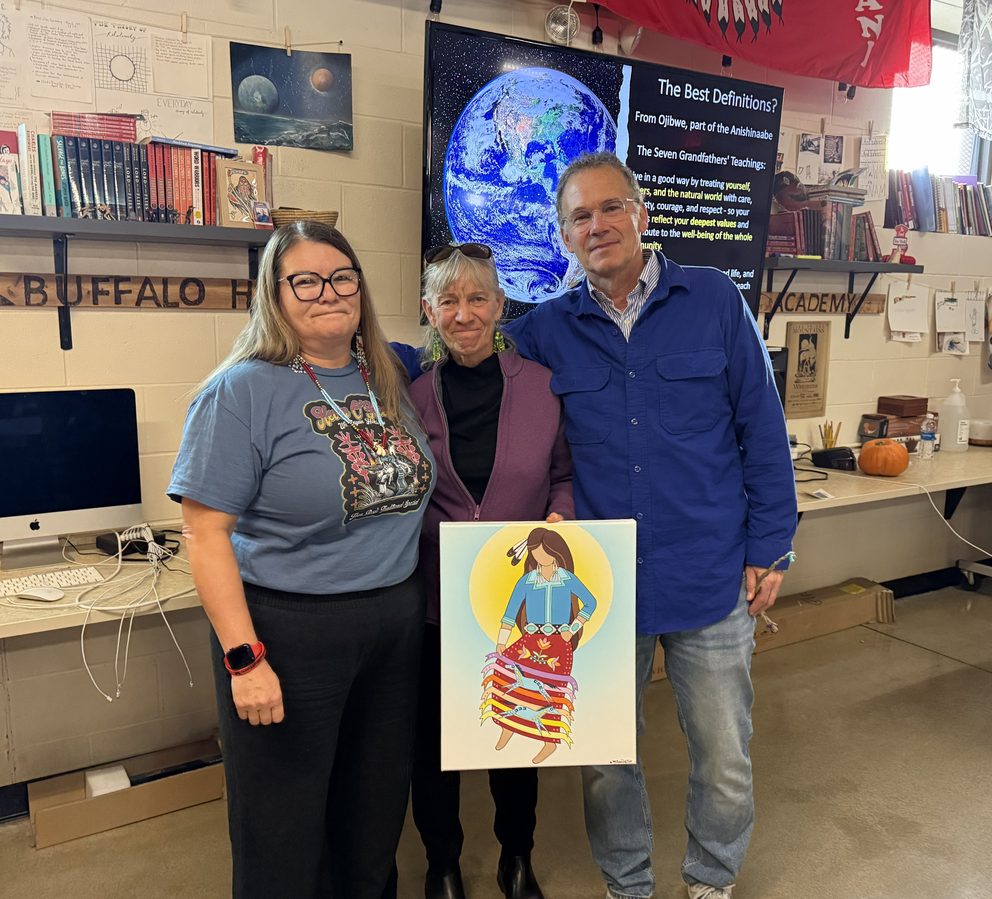
Today, Tammy Tolleson Knee and completed day 1 of a 2-day course on Strengths-Based Suicide Assessment and Interventions in Schools at the Buffalo Hide Academy of Browning Public Schools on the Blackfeet Reservation. We are beyond happy for this opportunity. It’s the first time for Tammy and I to present together (for two days!). As frosting on the presentation cake, Rita is here with us, watching, listening, heckling, and guiding.
In case you haven’t heard, Browning Public Schools and their staff have already started integrating strengths-based suicide prevention work into their programming. Two of our former University of Montana school counseling graduates, Sienna and Charlie Speicher are at the center of this work. Sienna and Charlie have already taught strengths-based courses through Blackfeet Community College, and they founded the Firekeeper Alliance. Here’s the Firekeeper Alliance Mission Statement:
Our mission is to cultivate resources, attention, and awareness to ultimately transform perspectives regarding suicidal distress in Indian Country and to help reduce suicide rates in our communities. We believe that mainstream and current approaches of suicide assessment and intervention struggle to meet the unique needs of Tribal populations. The Firekeeper Alliance promotes a different set of strengths-based, decolonized ideals around suicidal behavior. We believe that systemic and cultural shifts in the clinical community are necessary to truly make a positive change.
The Firekeeper Alliance also focuses on several areas, including offering strengths-based approaches to counseling, as in the following:
Offer individual and group counseling sessions utilizing evidence-based therapies which are effective in addressing suicidality.
Promote assessment techniques and interventions that elicit protective factors and a resilient spirit.
Administer assessment instruments that screen for strengths, character assets, and benevolent experience to depathologize suicidal distress.
Advocate for strengths based assessment and intervention approaches to be used in conjunction with cultural healing mechanisms.
Back to our training. . .here are the ppts that Tammy and I developed. There are SO MANY, but then again, we’re covering two whole days!
In closing, I want to give a big shout-out to Browning Public Schools (BPS) for collaborating with us (the Center for the Advancement of Positive Education; aka CAPE) to bring this training to Browning. Not only do we have a dozen or so school counselors in the room, we’ve also got a dozen or so administrative staff, including principals and the BPS superintendent. We had a blast today and are looking forward to more meaningful fun tomorrow!
I’m looking forward to a morning drive to Bozeman where I’ll meet and talk with healthcare and mental health providers and advocates from all around Montana. In advance of the Summit, I want to say thank you to the Montana Healthcare Foundation and to all the participants for their dedication to the well-being of all Montanans.
I have two talks . . . and the slide decks are linked below:
We’re in the throes of editing our Theories text, meaning I’m so deep into existential, feminist, and third wave counseling and psychotherapy theories that I may have lost myself. If any of you find me somewhere on the street babbling about Judith Jordan and Frantz Fanon and Bryan Cochran, please guide me home.
This brings me to a big ask.
As part of 4th wave feminism, we’re more deeply integrating intersectionality into the practice of feminist therapy. Among other things, intersectionality is about identity. I’m interested in using a variation of Irvin Yalom’s “Who are you?” group technique to explore identity in anyone willing to respond to this post.
To participate, follow these instructions.
Clear a space for thinking, writing, and exploring your identity.
Ask yourself the question: “Who am I?” and write down the response as it flows into your brain/psyche.
Repeat this process nine more times, for a total of 10 responses, numbering each response. One rule about this: You can’t use the same response twice.
After you finish your list of 10, write a paragraph or two about how you were affected by this activity.
If you’re comfortable sharing, send me your list of 10 identities along with your reflections (email: john.sf@mso.umt.edu). If you prefer the more public route, you can post your responses here on my blog. Either way, because I’m in 24/7 theories mode, you may not hear back from me until middle November!
There’s a chance I might want to quote one or more of you in the theories text, instructor’s manual, student guide, or in this blog. If that’s the case, I will email you and request permission.
Thanks for considering this activity and request. Identity and identity development are fascinating. Whether we’re talking about multiple identities (intersectionality), emotions and behaviors (Blake), or the “microbes within us” (Yong), we all contain multitudes.
We had a blast on Saturday afternoon in Absarokee doing a 3-hour workshop on “Tools for Living your Best Life: A Happiness Primer.
Why was it a blast? Let me count the ways.
Rita opened the event with a sweet version of the song, “Happiness Runs. . .”
Turnout was awesome with 33 participants packed into the old Cobblestone Schoolhouse.
Rita and the Cobblestone Board orchestrated a “Best Savoring Treat” contest, brought in a judge, and we all applied our savoring skills before, during, and after our designated snack time. There were many deserving entries. I felt for the judge, who had to sample all 14 food options!
The group was a combination of educators and people off the street. I think the person who won the longest travel to attend drove from Jordan, but we also had a teacher from Townsend, and a handful who drove down the hill from Red Lodge.
Questions, comments, and participation was amazing. I was very impressed with the level of engagement.
At the end, I had the honor and opportunity to act as the auctioneer to raise funds for the Cobblestone Building (which needs gutters installed). As an untrained auctioneer who uses his little league “a-batta” skills combined with a complete breakdown of inhibition, it was great fun.
The event was supported by the Cobblestone Board and the Phyllis J. Washington Center for the Advancement of Positive Education (CAPE) at the University of Montana. If your organization would like to host a community event, contact Torey Wetsch at CAPE for information: torey.wetsch@mso.umt.edu.
Tomorrow’s talk is titled, Ten Things Everyone Should Know About Children’s Mental Health and Happiness. Because this talk is about what everyone should know, I suspect everyone will be there. So, I’ll see you soon.
Given the possibility that everyone won’t be there, I’m sharing the list of the 10 things, along with some spiffy commentary.
First, I’ll give a strength warning. If you don’t know what that means, you’re not alone, because I made it up. It might be the coolest idea ever, so watch for more details about it in future blogs.
Then, I’ll say something profound like, “The problems with mental health and happiness are big, and they seem to just be getting bigger.” At which point, I’ll launch into the ten things.
Mental health and happiness are wicked problems. This refers to the fact that mental health and happiness are not easy to predict, control, or influence. They’re what sociologists call “wicked problems,” meaning they’re multidimensional, non-linear, elicit emotional responses, and often when we try to address them, our well-intended efforts backfire.
Three ways your brain works. [This one thing has three parts. Woohoo.]
We naturally look for what’s wrong with us. Children and teens are especially vulnerable to this. In our contemporary world they’re getting bombarded with social media messages about diagnostic criteria for mental disorders so much that they’re overidentifying with mental disorder labels.
We find what we’re looking for. This is called confirmation bias, which I’ve blogged about before.
What we pay attention to grows. This might be one of the biggest principles in all of psychology. IMHO, we’re all too busy growing mental disorders and disturbing symptoms (who doesn’t have anxiety?).
We’re NOT GOOD at shrinking NEGATIVE behaviors. This is so obvious that my therapist friends usually say, “Duh” when I mention it.
We’re better at growing POSITIVE behaviors. Really, therapy is about helping people develop skills and strengths for dealing with their symptoms. More skills, strengths, and resources result in fewer disturbing symptoms.
Should we focus on happiness? The answer to this is NO! Too much preoccupation with our own happiness generally backfires.
What is happiness? If you’ve been following this blog, you should know the answer to this question. Just in case you’re blanking, here’s a pretty good definition: From Aristotle and others – “That place where the flowering of your greatest (and unique) virtues, gifts, skills, and talents intersect (over time) with the needs of the world [aka your family/community].”
You can flip the happiness. This thing flows from a live activity. To get it well, you’ll need to be there!
Just say “No” to toxic positivity. To describe how this works and why we say no to toxic positivity, I’ll take everyone through the three-step emotional change trick.
Automatic thoughts usually aren’t all that positive. How does this work for you? When something happens to you in your life and your brain starts commenting on it, does your brain usually give you automatic compliments and emotional support? I thought not.
How anxiety works. At this point I’ll be fully revved up and possibly out of time, so I’ll give my own anxiety-activated rant about the pathologizing, simplistic, and inaccurate qualities of that silly “fight or flight” concept.
Depending on timing, I may add a #11 (Real Mental Health!) and close with my usual song.
If you’re now experiencing intense FOMO, I don’t blame you. FOMO happens. You’ll just need to lean into it and make a plan to attend one of my future talks on what everyone should know.
Thanks for reading and have a fabulous evening. I’ll be rolling out of Absarokee on my way to Butte at about 5:30am!
All too often on this blog I’m writing about what I’m doing and I’m thinking. I suppose that’s just fine, after all, it’s my blog. But, as many people have said before me and better than I can, “Other people matter” and seeing the light (or the divine) in others is among the most meaningful experiences we can have.
One light I’ve been seeing lately is the strengths-based suicide prevention work that the Firekeeper Alliance (a non-profit org) is doing on the Blackfeet Reservation in Northern Montana. In July, they had a “suicide prevention” heavy metal concert called Fire in the Mountains, complete with amazing metal bands and equally amazing panels, discussions, and speakers. If you’re interested in creative approaches to well-being, you really should check them out.
This past Thursday, Charlie Speicher, architect of the Firekeeper Alliance and Director of the Buffalo Hide Academy in Browning, shared one of their Suicide Prevention Month activities. The idea is simple: Feature the beauty and strengths of the reservation and its people. The product: A 12-minute video that focuses on what gives the Blackfeet people hope. The video captures the faces, sentiments, and emotions in response to “What gives you hope?” Here’s the link on Youtube:
All too often, people think and share information about the challenges of reservation life. This video shares hope, beauty, and potential.
With your help, I hope this video travels far and wide. Please share. At the very least, it should get all over Montana media. And, just in case anyone has the right connections, I think it’s a great fit for virtually any national media outlet that wants to shift toward a positive narrative in Indian Country.
Thanks for reading . . . and for seeing the light (and fire) in others.
The place to click if you want to learn about psychotherapy, counseling, or whatever John SF is thinking about.