Tag Archives: therapy

Who Are You? A Request

We’re in the throes of editing our Theories text, meaning I’m so deep into existential, feminist, and third wave counseling and psychotherapy theories that I may have lost myself. If any of you find me somewhere on the street babbling about Judith Jordan and Frantz Fanon and Bryan Cochran, please guide me home.

This brings me to a big ask.

As part of 4th wave feminism, we’re more deeply integrating intersectionality into the practice of feminist therapy. Among other things, intersectionality is about identity. I’m interested in using a variation of Irvin Yalom’s “Who are you?” group technique to explore identity in anyone willing to respond to this post.

To participate, follow these instructions.

  1. Clear a space for thinking, writing, and exploring your identity.
  2. Ask yourself the question: “Who am I?” and write down the response as it flows into your brain/psyche.
  3. Repeat this process nine more times, for a total of 10 responses, numbering each response. One rule about this: You can’t use the same response twice.
  4. After you finish your list of 10, write a paragraph or two about how you were affected by this activity.
  5. If you’re comfortable sharing, send me your list of 10 identities along with your reflections (email: john.sf@mso.umt.edu). If you prefer the more public route, you can post your responses here on my blog. Either way, because I’m in 24/7 theories mode, you may not hear back from me until middle November!

There’s a chance I might want to quote one or more of you in the theories text, instructor’s manual, student guide, or in this blog. If that’s the case, I will email you and request permission.

Thanks for considering this activity and request. Identity and identity development are fascinating. Whether we’re talking about multiple identities (intersectionality), emotions and behaviors (Blake), or the “microbes within us” (Yong), we all contain multitudes.

Revisiting the Genius of Mary Cover Jones

While reviewing and revising the behavior therapy chapter from our Theories textbook, I found myself revisiting my awe of Mary Cover Jones. I think too many contemporary therapists don’t know about Mary Cover Jones and don’t understand the behavioral (classical conditioning) model for understanding and treating anxiety disorders, including OCD and PTSD.

In most chapters, we include a feature called a “Brain Box.” Here’s the box from Chapter 7, Behavior Theory and Therapy.

7.1 Brain Science May be Shiny, but Exposure Therapy is Pure Gold

In honor of Joseph Wolpe, let’s start with mental imagery.

***********

Imagine you’ve travelled back in time to your first week of high school. You look around and see that one of your classmates is named Mary Jones.

Mary is an ordinary girl with an ordinary name. Over the years, you don’t notice her much. She seems like a nice person, a fairly good student, and someone who doesn’t get in trouble or draw attention to herself.

Four years pass. A new student joined your class during senior year. His name is Daniel Tweeter. Toward the end of the year, Daniel does a fantastic Prezi presentation about a remarkable new method for measuring reading outcomes. He includes cool video clips and boomerang Snapchat. When he bows at the end, he gets a standing ovation. Daniel is a good student and a hard worker; he partnered up with a college professor and made a big splash. Daniel deserves recognition.

However, as it turns out, over the whole four years of high school, Mary Jones was quietly working at a homeless shelter; week after week, month after month, year after year, she was teaching homeless children how to read. In fact, based on Daniel’s measure of reading outcomes, Mary had taught over 70 children to read.

Funny thing. Mary doesn’t get much attention. All everybody wants to talk about is Daniel. At graduation, he wins the outstanding graduate award. Everyone cheers.

Let’s stop the visualization and reflect on what we imagined.

***********

Like birds and raccoons, humans tend to like shiny things. Mary did incredible work, but hardly anyone noticed. Daniel did good work, and got a standing ovation and the top graduate award.

The “shiny-thing theory” is my best explanation for why we tend to get overly excited about brain science. It’s important, no doubt, but brain imaging isn’t therapy; it’s just a cool way to measure or validate therapy’s effects.

Beginning from at least 1924, when Mary Cover Jones was deconditioning fear out of little children, behavior therapy has shown not only great promise, but great outcomes. However, when researchers showed that exposure therapy “changes the brain,” most of the excitement and accolades were about the brain images; exposure therapy was like background noise. Obviously, the fact that exposure therapy (and other therapies) change the brain is great news. It’s great news for people who have anxiety and fear, and it’s great news for practitioners who use exposure therapy.

This is all traceable to neuroscience and human evolution. We get distracted by shiny objects and miss the point because our neural networks and perceptual processes are oriented to alert us to novel (new) environmental stimuli. This is probably because change in the form of shiny objects might signal a threat or something new and valuable. We therefore need to exercise self-discipline to focus in and not overlook that behavior therapy in general, and exposure therapy in particular, has been, is, and probably will continue to be, the most effective approach on the planet for helping people overcome anxiety and fear. In addition, you know what, it doesn’t really matter that it changes the brain (although that’s damn cool and affirming news). What matters is that it changes clients’ lives.

Exposure therapy, no matter how you package it, is highly effective for treating anxiety. This statement is true whether we’re talking about Mary Cover Jones and her evidence-based counterconditioning cookies or Francine Shapiro and eye movement desensitization reprocessing (EMDR). It’s also true whether we’re talking about virtual reality exposure, imaginal exposure, massed exposure, spaced exposure, in vivo exposure, interoceptive exposure, response prevention (in obsessive-compulsive disorder), or the type of exposure that acceptance and commitment therapists use (note that they like to say it’s “different” from traditional classical conditioning exposure, but it works, and that’s what counts).

In the end, let’s embrace and love and cheer brain imaging and neuroscience, but not forget the bottom line. The bottom line is that exposure therapy works! Exposure therapy is the genuine article. Exposure therapy is pure gold.

Mary Cover Jones is the graduate of the century; she was amazing. Because of her, exposure therapy has been pure gold for 93+ years, and now we’ve got cool pictures of the brain to prove it.

Mary Cover Jones passed away in 1987. Just minutes before her death, she said to her sister: “I am still learning about what is important in life” (as cited in Reiss, 1990).

We should all be more like Mary.

Today’s Rabbit Hole: What Constitutes Scientific Evidence for Psychotherapy Efficacy?

On July 24, in Helena, I attended a fun and fascinating meeting sponsored by the Carter Center. I spent the day with a group of incredibly smart people dedicated to improving mental health in Montana.

The focus was twofold. How do we promote and establish mental health parity in Montana and how do with improve behavioral health in schools? Two worthy causes. The discussions were enlightening.

We haven’t solved these problems (yet!). In the meantime, we’re cogitating on the issues we discussed, with plans to coalesce around practical strategies for making progress.

During our daylong discussions, the term evidence-based treatments bounced around. I shared with the group that as an academic psychologist/counselor, I could go deep into a rabbit-hole on terminology pertaining to treatment efficacy. Much to everyone’s relief, I exhibited a sort of superhuman inhibition and avoided taking the discussion down a hole lined with history and trivia. But now, much to everyone’s delight (I’m projecting here), I’m sharing part of my trip down that rabbit hole. If exploring the use of terms like, evidence-based, best practice, and empirically supported treatment is your jam, read on!

The following content is excerpted from our forthcoming text, Counseling and Psychotherapy Theories in Context and Practice (4th edition). Our new co-author is Bryan Cochran. I’m reading one of his chapters right now . . . which is so good that you all should read it . . . eventually. This text is most often used with first-year students in graduate programs in counseling, psychology, and social work. Consequently, this is only a modestly deep rabbit hole.

Enjoy the trip.

*************************************

What Constitutes Evidence? Efficacy, Effectiveness, and Other Research Models

We like to think that when clients or patients walk into a mental health clinic or private practice, they will be offered an intervention that has research support. This statement, as bland as it may seem, would generate substantial controversy among academics, scientists, and people on the street. One person’s evidence may or may not meet another person’s standards. For example, several popular contemporary therapy approaches have minimal research support (e.g., polyvagal theory and therapy, somatic experiencing therapy).

Subjectivity is a palpable problem in scientific research. Humans are inherently subjective; humans design the studies, construct and administer assessment instruments, and conduct the statistical analyses. Consequently, measuring treatment outcomes always includes error and subjectivity. Despite this, we support and respect the scientific method and appreciate efforts to measure (as objectively as possible) psychotherapy outcomes.

There are two primary approaches to outcomes research: (1) efficacy research and (2) effectiveness research. These terms flow from the well-known experimental design concepts of internal and external validity (Campbell et al., 1963). Efficacy research employs experimental designs that emphasize internal validity, allowing researchers to comment on causal mechanisms; effectiveness research uses experimental designs that emphasize external validity, allowing researchers to comment on generalizability of their findings.

Efficacy Research

Efficacy research involves tightly controlled experimental trials with high internal validity. Within medicine, psychology, counseling, and social work, randomized controlled trials (RCTs) are the gold standard for determining treatment efficacy. RCTs statistically compare outcomes between randomly assigned treatment and control groups. In medicine and psychiatry, the control group is usually administered an inert placebo (i.e., placebo pill). In the end, treatment is considered efficacious if the active medication relieves symptoms, on average, at a rate significantly higher than placebo. In psychotherapy research, treatment groups are compared with a waiting list, attention-placebo control group, or alternative treatment group.

To maximize researcher control over independent variables, RCTs require that participants meet specific inclusion and exclusion criteria prior to random assignment to a treatment or comparison group. This allows researchers to determine with greater certainty whether the treatment itself directly caused treatment outcomes.

In 1986, Gerald Klerman, then head of the National Institute of Mental Health, gave a keynote address to the Society for Psychotherapy Research. During his speech, he emphasized that psychotherapy should be evaluated through RCTs. He claimed:

We must come to view psychotherapy as we do aspirin. That is, each form of psychotherapy must have known ingredients, we must know what these ingredients are, they must be trainable and replicable across therapists, and they must be administered in a uniform and consistent way within a given study. (Quoted in Beutler, 2009, p. 308)

Klerman’s speech advocated for medicalizing psychotherapy. Klerman’s motivation for medicalizing psychotherapy partly reflected his awareness of heated competition for health care dollars. This is an important contextual factor. Events that ensued were an effort to place psychological interventions on par with medical interventions.

The strategy of using science to compete for health care dollars eventually coalesced into a movement within professional psychology. In 1993, Division 12 (the Society of Clinical Psychology) of the American Psychological Association (APA) formed a “Task Force on Promotion and Dissemination of Psychological Procedures.” This task force published an initial set of empirically validated treatments. To be considered empirically validated, treatments were required to be (a) manualized and (b) shown to be superior to a placebo or other treatment, or equivalent to an already established treatment in at least two “good” group design studies or in a series of single case design experiments conducted by different investigators (Chambless et al., 1998).

Division 12’s empirically validated treatments were instantly controversial. Critics protested that the process favored behavioral and cognitive behavioral treatments. Others complained that manualized treatment protocols destroyed authentic psychotherapy (Silverman, 1996). In response, Division 12 held to their procedures for identifying efficacious treatments but changed the name from empirically validated treatments to empirically supported treatments (ESTs).

Advocates of ESTs don’t view common factors in psychotherapy as “important” (Baker & McFall, 2014, p. 483). They view psychological interventions as medical procedures implemented by trained professionals. However, other researchers and practitioners complain that efficacy research outcomes do not translate well (aka generalize) to real-world clinical settings (Hoertel et al., 2021; Philips & Falkenström, 2021).

Effectiveness Research

Sternberg, Roediger, and Halpern (2007) described effectiveness studies:

An effectiveness study is one that considers the outcome of psychological treatment, as it is delivered in real-world settings. Effectiveness studies can be methodologically rigorous …, but they do not include random assignment to treatment conditions or placebo control groups. (p. 208)

Effectiveness research focuses on collecting data with external validity. This usually involves “real-world” settings. Effectiveness research can be scientifically rigorous but doesn’t involve random assignment to treatment and control conditions. Inclusion and exclusion criteria for clients to participate are less rigid and more like actual clinical practice, where clients come to therapy with a mix of different symptoms or diagnoses. Effectiveness research is sometimes referred to as “real world designs” or “pragmatic RCTs” (Remskar et al., 2024). Effectiveness research evaluates counseling and psychotherapy as practiced in the real world.

Other Research Models

Other research models also inform researchers and practitioners about therapy process and outcome. These models include survey research, single-case designs, and qualitative studies. However, based on current mental health care reimbursement practices and future trends, providers are increasingly expected to provide services consistent with findings from efficacy and effectiveness research (Cuijpers et al., 2023).

In Pursuit of Research-Supported Psychological Treatments

Procedure-oriented researchers and practitioners believe the active mechanism producing positive psychotherapy outcomes is therapy technique. Common factors proponents support the dodo bird declaration. To make matters more complex, prestigious researchers who don’t have allegiance to one side or the other typically conclude that we don’t have enough evidence to answer these difficult questions about what ingredients create change in psychotherapy (Cuijpers et al., 2019). Here’s what we know: Therapy usually works for most people. Here’s what we don’t know: What, exactly, produces positive changes.

For now, the question shouldn’t be, “Techniques or common factors?” Instead, we should be asking “How do techniques and common factors operate together to produce positive therapy outcomes?” We should also be asking, “Which approaches and techniques work most efficiently for which problems and populations?” To be broadly consistent with the research, we should combine principles and techniques from common factors and EST perspectives. We suspect that the best EST providers also use common factors, and the best common factors clinicians sometimes use empirically supported techniques.

Naming and Claiming What Works

When it comes to naming and claiming what works in psychotherapy, we have a naming problem. Every day, more research information about psychotherapy efficacy and effectiveness rolls in. As a budding clinician, you should track as much of this new research information as is reasonable. To help you navigate the language of researchers and practitioners use to describe “What works,” here’s a short roadmap to the naming and claiming of what works in psychotherapy.

When Klerman (1986) stated, “We must come to view psychotherapy as we do aspirin” his analogy was ironic. Aspirin’s mechanisms and range of effects have been and continue to be complex and sometimes mysterious (Sommers-Flanagan, 2015). Such is also the case with counseling and psychotherapy.

Language matters, and researchers and practitioners have created many ways to describe therapy effectiveness.

  • D12 briefly used the phrase empirically validated psychotherapy. Given that psychotherapy outcomes vary, the word validated is generally avoided.
  • In the face of criticism, D12 blinked once, renaming their procedures as empirically supported psychotherapy. ESTs are manualized and designed to treat specific mental disorders or specific client problems. If it’s not manualized and doesn’t target a disorder/problem, it’s not an EST.
  • ESTs have proliferated. As of this moment (August 2025), 89 ESTs for 30 different psychological disorders and behavior problems are listed on the Division 12 website (https://div12.org/psychological-treatments/). You can search the website to find the research status of various treatments.
  • To become proficient in providing an EST requires professional training. Certification may be necessary. It’s impossible to obtain training to implement all the ESTs available.
  • In 2006, an APA Presidential Task Force (2006) loosened D12’s definition, shifting to a more flexible term, Evidence-Based Practice (EBP), and defining it as ‘‘the integration of the best available research with clinical expertise in the context of patient characteristics, culture, and preferences’’ (p. 273).
  • In 2007, the Journal of Counseling and Development, the American Counseling Association’s flagship journal, inaugurated a new journal section, “Best Practices.” As we’ve written elsewhere, best practice has grown subjective and generic and is “often used so inconsistently that it is nearly meaningless” (Sommers-Flanagan, 2015, p. 98).
  • In 2011, D12 relaunched their website, relabeling ESTs as research-supported psychological treatments (n.b., most researchers and practitioners continue to refer to ESTs instead of research-supported psychological treatments).
  • As an alternative source of research updates, you can also track the prolific work of Pim Cuijpers and his research team for regular meta-analyses on psychological treatments (Cuijpers et al., 2023; Harrer et al., 2025).
  • Other naming variations, all designed to convey the message that specific treatments have research support, include evidence-based treatment, evidence-supported treatment, and other phrasings that, in contrast to ESTs and APA’s evidence-based practice definition, have no formal definition.

Manuals, Fidelity, and Creativity

Manualized treatments require therapist fidelity. In psychotherapy, fidelity means exactness or faithfulness to the published procedure—meaning you follow the manual. However, in the real world, when it comes to treatment fidelity, therapist practice varies. Some therapists follow manuals to the letter. Others use the manual as an outline. Still others read the manual, put it aside, and infuse their therapeutic creativity.

A seasoned therapist (Bernard) we know recently provided a short, informal description of his application of exposure therapy to adult and child clients diagnosed with obsessive-compulsive disorder. Bernard described interactions where his adult clients sobbed with relief upon getting a diagnosis. Most manuals don’t specify how to respond to clients sobbing, so he provided empathy, support, and encouragement. Bernard described a therapy scenario where the client’s final exposure trial involved the client standing behind Bernard and holding a sharp kitchen knife at Bernard’s neck. This level of risk-taking and intimacy also isn’t in the manual—but Bernard’s client benefited from Bernard trusting him and his impulse control.

During his presentation, Bernard’s colleagues chimed in, noting that Bernard was known for eliciting boisterous laughter from anxiety-plagued children and teenagers. There’s no manual available on using humor with clients, especially youth with overwhelming obsessional anxiety. Bernard used humor anyway. Although Bernard had read the manuals, his exposure treatments were laced with empathy, creativity, real-world relevance, and humor. Much to his clients’ benefit, Bernard’s approach was far outside the manualized box (B. Balleweg, personal communication, July 14, 2025).    

As Norcross and Lambert (2018) wrote: “Treatment methods are relational acts” (p. 5). The reverse is equally applicable, “Relational acts are treatment methods.” As you move into your therapeutic future, we hope you will take the more challenging path, learning how to apply BOTH the techniques AND the common factors. You might think of this—like Bernard—as practicing the science and art of psychotherapy.

**********************************

Note: This is a draft excerpt from Chapter 1 of our 4th edition, coming out in 2026. As a draft, your input is especially helpful. Please share as to whether the rabbit hole was too deep, not deep enough, just right, and anything else you’re inspired to share.

Thanks for reading!

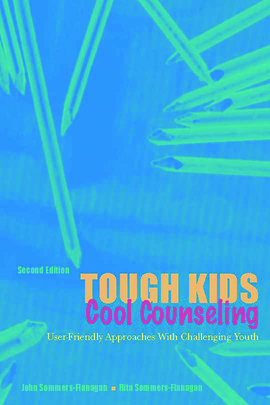
Tough Kids, Cool Counseling — An Online Workshop – Dec 6, 2024

My wife (Rita) and I used to argue over who came up with the catchy “Tough Kids, Cool Counseling” title for our 1997/2007 book with the American Counseling Association. I would swear it was MY grand idea; she would swear back that it was HER idea. If any of you are in–or have been in–romantic partnerships, perhaps you can relate to disagreements over who has all the best ideas. I doubt that this dynamic is unique to Rita and me.

Years passed . . . and now I’ve come to very much dislike the title. . . leading me to give Rita ALL THE CREDIT! You’ve got it Rita! It was all you!

Despite my dislike for the title, I still sometimes use it for workshops. Why might that be, you may be wondering? Good question. I use it so I can make the point, early in the workshop, that we should NEVER use language that blames young people for their problems or their problem behaviors. In fact, we should never even “think” thoughts that assign blame to them for being “tough.”

My reasoning for this is informed by constructive theory and narrative therapy. When we assign blame and responsibility to young people for being “tough” or “difficult” or “challenging,” we risk contributing to them holding a tough, difficult, or challenging identity–which is exactly the opposite of what we want to be doing. Instead, I tell my workshop participants that we should recognize, there are no “tough kids” . . . there are only kids in tough situations . . . and being in counseling or psychotherapy is just another tough situation that young people have to face. Consequently, it’s NOT their fault if they engage in so-called tough or challenging behaviors.

All this leads me to share that I’ll be online all day on December 6, 2024, doing a workshop for mental health professionals. The workshop, anachronistically titled, “Tough Kids, Cool Counseling” is sponsored by the Vermont Psychological Association. You can register for the workshop here: https://twinstates.ce21.com/item/tough-kids-cool-counseling-131540

Even if I do say so myself, I’m proclaiming here and now that this will be a very engaging online workshop. If you work with youth (ages 10-18) in counseling or psychotherapy, and you need/want some year-ending CEUs, we’ll be having some virtual fun on December 6, and I hope you can join in.

More Therapeutic Writing: The Best Possible Self

Last week was about emotional journaling. This week, we stick with the power of words and writing and take a dive into an evidence-based therapeutic writing activity called the Best Possible Self.

You all already know about optimism and pessimism.

Some people see the glass half full. Others see the glass half empty. Still others, just drink and savor the water, without getting hung up on how much is in the glass. Obviously, there are many other responses, because some people spill the water, others find a permanent water source, and others skip the water and drink the wine or pop open a beer.

Reducing people to two personality types never works, but that doesn’t stop people from labeling themselves or others as optimists or pessimists. This week’s activity—The Best Possible Self—is an optimism activity. You don’t have to be a so-called optimist to use it. And the good news is, regardless of your labels, the Best Possible Self writing activity is supposed to crank up your sense of optimism. That’s cool, because generally speaking, optimism is a good thing. Here’s what the researchers say about the Best Possible Self (BPS) activity.

[The following is summarized from Layous, Nelson, and Lyubomirsky, 2012]. Writing about your Best Possible Self (also seen as a representation of your goals) shows long-term health benefits, increases life satisfaction, increases positive affect, increases optimism, and improves overall sense of well-being. Laura King, a professor at U of Missouri-Columbia developed the BPS activity.

King’s original BPS study involved college students writing about their Best Possible Selves for 15 minutes a day for two weeks. The process has been validated with populations other than college students. If you want to jump in that deep, go for it. On the other hand, if you want a lighter version, here’s a less committed alternative:

  • Spend 10 minutes a day for four consecutive days writing a narrative description of your “best possible future self.”
  • Pick a point in the future – write about what you’ll be doing/thinking then – and these things need to capture a vision of you being “your best” successful self or of having accomplished your life goals.
  • As with all these activities, monitor your reactions. Maybe you’ll love it and want to keep doing it. Maybe you won’t.
  • If you feel like it, you can share some of your #writing on social media.

Berkeley’s Greater Good website includes a nice summary of the BPS activity. Here’s a pdf from their website: 

Being a counseling and psychotherapy theories buff, I should mention that this fantastic assignment is very similar to the Adlerian “Future Autobiography.” Adler was way ahead of everyone on everything, so I’m not surprised that he was thinking of this first. Undoubtedly, Adler saw the glass half full, sipped and savored his share, and then shared it with his community. We should all be more like Adler.

Thoughts on Ethnic Matching From Clinical Interviewing (7th edition)

Every chapter in Clinical Interviewing has several pop-out boxes titled, “Practice and Reflection.” In this–the latest–edition, we added many that include the practice and perspective of diverse counselors and psychotherapists. Here’s an example from Chapter One.

PRACTICE AND REFLECTION 1.3: AM I A GOOD FIT? NAVIGATING ETHNIC MATCHING IN PRIVATE PRACTICE

The effects of ethnic matching on counseling outcomes is mixed. In some cases and settings, and with some individuals, ethnic matching improves treatment frequency, duration, and outcomes; in other cases and settings, ethnic matching appears to have no effects in either direction (Olaniyan et al., 2022; Stice et al., 2021). Overall, counseling with someone who is an ethnic/cultural match is meaningful for some clients, while other clients obtain equal meaning and positive outcomes working with culturally different therapists.

For clients who want to work with therapists who have similar backgrounds and experiences, the availability of ethnically-diverse therapists is required. In the essay below, Galana Chookolingo, Ph.D., HSP-P, a licensed psychologist, writes of personal and professional experiences as a South Asian person in independent practice.

On a personal note, being from a South Asian background in private practice has placed me in a position to connect with other Asians/South Asians in need of culturally-competent counseling. In my two years in solo private practice, I have had many individuals reach out to me specifically because of my ethnicity and/or the fact that I am also an immigrant to the U.S. (which I openly share on my website). These individuals hold an assumption that I would be able to relate to a more collectivistic worldview. Because I offer free consultations prior to meeting with clients for an intake, I have had several clients ask directly about my ability to understand certain family dynamics inherent to Asian cultures. I have responded openly to these questions, sharing the similarities and differences I am aware of, as well as my limitations, since I moved to the U.S. before age 10. For the most part, I have been able to connect with many clients of Asian backgrounds; this tends to be the majority of my caseload at any given time.

As you enter into the multicultural domain of counseling and psychotherapy, reflect on your ethnic, cultural, gender, sexual, religious, and ability identities. As a client, would you prefer working with someone with a background or identity similar to yours? What might be the benefits? Alternatively, as a client, might there be situations when you would prefer working with someone who has a background/identity different than yours? If so, why and why not?

Reflecting on Dr. Chookolingo’s success in attracting and working with other Asian/South Asian people . . . what specific actions did she take to build her caseload? How did she achieve her success?

[End of Practice and Reflection 1.3]

For more info on ethnic matching, see these articles:

Olaniyan, F., & Hayes, G. (2022). Just ethnic matching? Racial and ethnic minority students and culturally appropriate mental health provision at British universities. International Journal of Qualitative Studies on Health and Well-being, 17(1), 16. doi:https://doi.org/10.1080/17482631.2022.2117444

https://www.tandfonline.com/doi/full/10.1080/17482631.2022.2117444

Stice, E., Onipede, Z. A., Shaw, H., Rohde, P., & Gau, J. M. (2021). Effectiveness of the body project eating disorder prevention program for different racial and ethnic groups and an evaluation of the potential benefits of ethnic matching. Journal of Consulting and Clinical Psychology, 89(12), 1007-1019. doi:https://doi.org/10.1037/ccp0000697

https://psycnet.apa.org/doiLanding?doi=10.1037%2Fccp0000697

Gestalt Theory and Spirituality

In our Counseling and Psychotherapy Theories in Context and Practice book, we include short sections on spirituality for each of the major theories. Previously, I’ve posted all the others (just search spirituality on this blog to find them), but discovered this evening that I forgot to post the Gestalt one. Maybe I forgot because it’s especially short and enigmatic . . . meaning, I didn’t find much out there on the crossroads between Gestalt theory and spirituality. If you know of something, please enlighten me!

Here’s the very short excerpt:

Spirituality

Although not always visible or palpable, Gestalt theory and therapy have deep spiritual roots. Laura Perls studied with Martin Buber and had interests in Taoism. Fritz Perls studied Zen Buddhism. Paul Goodman had interests in Taoism, and Gestalt writer, Dave Mann (2010) contended that Goodman’s book, Nature heals, is consistent with his Taoist beliefs about living with nature in accordance with nature. It may be that Gestalt experiments are consistent in style with the Zen Buddhist koan, a puzzle orriddle designed to open Zen novices to deeper levels of consciousness. At the very least, Zen Buddhism and Gestalt therapy share an attitude of acceptance of the now and an exploration of experience.

There are, of course, differences between Gestaltists regarding the role and nature of spirituality in Gestalt theory and practice. For some, the I-Thou connection is where the transcending and spiritual contact happens. Boundaries dissolve and deeper connections and insights blossom. This may have been what led Jesse Thomas (1978) to publish an early Gestalt-spiritual work titled, “The youniverse: Gestalt therapy, non-western religions, and the present age.” Spirituality, from the Gestalt perspective, is both personal and universal (or youniversalJ).

At the other end of the continuum are individuals who don’t see spirituality as warranting a place in Gestalt theory and practice (Mann, 2010). Mann (2010) recommended that Gestalt therapists, like clients, need to decide where they stand on religion and spirituality, recognizing, at the same time, that where they stand may well change. This brings us to perhaps the most famous words Fritz Perls ever wrote, the Gestalt prayer:

I do my thing and you do your thing.

I am not in this world to live up to your expectations,

And you are not in this world to live up to mine.

You are you, and I am I,

and if by chance we find each other, it’s beautiful.

If not, it can’t be helped.

(Perls, Gestalt therapy verbatim, 1969, p. 24)

Separating the Psychological (Emotional) Pain from the Self: A Technique for Working with Suicidal Clients

Blogs I follow

I’m working on a Suicide Assessment and Treatment Planning manuscript and here’s a small piece of what I just wrote:

Rosenberg (1999; 2000) and others have described a helpful cognitive reframe intervention for use with clients who are suicidal. She wrote,

The therapist can help the client understand that what she or he really desires is to eradicate the feelings of intolerable pain rather than to eradicate the self (1999, p. 86).

Shneidman’s (1996) guidance on this was similar, but perhaps even more emphatic. He recommended that therapists partner with clients and with members of the client’s support system (e.g., family) to do whatever possible to reduce the psychological pain.

Reduce the pain; remove the blinders; lighten the pressure—all three, even just a little bit (p. 139).

Suicidal clients need empathy for their emotional pain, but they also need to partner with therapists to fight against their pain. Framing the pain as separate from the self can help because therapists can be empathic, but simultaneously illuminate the possibility that the wish isn’t to eliminate the self, but instead, to eliminate the pain.

Rosenberg (1999) also recommended that therapists help clients reframe what’s usually meant by the phrase feeling suicidal. She noted that clients benefit from seeing their suicidal thoughts and impulses as a communication about their depth of feeling, rather than an “actual intent to take action” (p. 86). Once again, this approach to intervening with suicidal clients can decrease clients’ needs to act, partly because of the elegant cognitive reframe and partly because of the therapist’s empathic message.

Here’s a case vignette to illustrate how therapists can work with clients to separate the emotional pain from the self and then partner with clients to reduce the pain. As always, this case vignette is a composite compiled from clinical work and simulations with various individuals.

Case Vignette. Kate is a 44-year-old cisgender married female with two children. She arrived for counseling in extreme emotional distress. She was also agitated, stating, “It just hurts so badly to be alive. It hurts so badly.”

Much of Kate’s emotional pain was centered around the recent death of her mother, whom Kate had cared for over the past seven years. Kate had an ambivalent relationship with her; her mother had been diagnosed as having schizophrenia and caring for her was extremely challenging. Kate’s acute emotional distress was accompanied by fears of turning out like her mother and thoughts of reunifying with her mother. She said, “I just need to be with her.”

To help Kate separate her intense emotional pain from the self, I began by noticing that there were two different parts of Kate, and that these two different parts had different ideas about how to move forward. Noticing and articulating different perspectives of the self is a common approach from a person-centered theoretical perspective. Because of Kate’s family history of schizophrenia, I wouldn’t use an expressive Gestalt technique to separate her different ego states, but it felt like reflecting her obvious ambivalence was a safe approach. Specifically, I said, “Sounds like a part of yourself thinks the solution is to die, and that your kids will be better off. But there’s another part of you that says, maybe the solution isn’t to die. Maybe I can come in here and talk. Maybe my kids actually would suffer if I died.”

Kate accepted that she was “of two minds” about how to go forward. Next, I tried to further clarify these parts of herself, emphasizing that I wanted to align with the “second” part of herself, so that we could work together on her emotional pain.

The one part of yourself thinks your only hope of dealing with the pain is to kill yourself. The other part thinks, maybe I can stay alive, work in counseling to get rid of the pain, and then my children wouldn’t suffer from my death. How about, for now, we work from that second perspective. We can be a team that works hard to decrease the emotional pain you’re feeling. It might not go away immediately, but if you stay alive and we work together, we can chip away at the pain and make it shrink.

You may notice the words I used were somewhat redundant. Using redundancy with clients who are feeling suicidal may be needed because the agitated, depressed state of mind makes cognitive focusing difficult. Sometimes, if you don’t repeat the therapeutic perspective and keep focused on it, the therapeutic perspective can slip away from your clients’ cognitive grasp.

Linehan often uses a more provocative way of talking about partnering with clients to diminish their pain. For example, she might say, “Getting through this is like going through Hell. But I know therapy can help and I want to work with you on this. But I have to tell you this, therapy will only work if you stay alive. Therapy doesn’t work on dead people. So I want you to stay alive and work with me at attacking your pain. Will you give me six months for us to go through hell together so we can get control of your pain?

Either way, the goal is to partner with clients to work on decreasing emotional or psychological pain. This approach combines empathic listening, with an emphasis on the therapeutic alliance. As therapist and client partner together, then cognitive-behavioral problem-solving can commence.

Using Therapeutic Storytelling with Children: Five Easy Steps

Books

Everybody loves a good story.

Good stories grab the listener’s attention and don’t let go. I’ve been reading and telling stories for as long as I can remember. Whether its kindergartners, clients, or college students, I’ve found that stories settle people into a receptive state that looks something like a hypnotic trance.

Nowadays, mostly we see children and teens entranced with their electronic devices, television, and movies. Although it’s nice to see young people in a calm and focused state, the big problem with devices (other than their negative effects on sleep, attention span, weight, brain development, and nearly everything else having to do with living in the real world), is that we (parents, caretakers, and concerned adults), don’t have control over the electronic stories our children see and hear.

Storytelling is a natural method for teaching and learning. Children learn from stories. We’re teaching when we tell them. We might as well add our intentional selection of stories to whatever our children might be learning from the internet.

Way back in 1997, Rita and I wrote a book called Tough Kids, Cool Counseling. One of the chapters focused on how to use therapeutic storytelling with children and teens. Although the content of Tough Kids, Cool Counseling is dated, the ideas are still solid. The following section is good material for counselors, psychotherapists, parents, and other adults who want to influence young people.

In counseling, storytelling was originally developed as a method for bypassing client resistance. Stories are gentle methods that don’t demand a response, but that stimulate, “thinking, experiencing, and ideas for problem resolution” (Lankton & Lankton, 1989, pp. 1–2)

Storytelling is an alternative communication strategy. For counselors, it should be used as a technique within the context of an overall treatment plan, rather than as a treatment approach in and of itself. For parents and caregivers, stories should be fun, and engaging . . . and told in ways that facilitate learning.

Story construction. Even if you’re an excellent natural storyteller, it can help to have a guide or structure for story construction and development. I like using a framework that Bill Cook, a Montana psychologist, wrote about and shared with me. He uses the acronym S-T-O-R-I, to organize the parts of a therapeutic story.

S: Set the stage for the story. To set the stage, you should create a scenario that focuses on a child living in a particular situation. The child can be a human or an animal or an animated object. The central child character should be described in a way that’s positive and appealing. Because much of my work back in the 1990s involved working with boys who were angry and impulsive, the following story features a boy who has an arguing problem. Depending on your circumstances, you could easily feature a girl or a child who doesn’t have a particular gender identity.

Here’s the beginning of the story.

Once upon a time there was a really smart boy. His name was Lancaster. Lancaster was not only smart, he was also a very cool dresser. He wore excellent clothes and most everyone who met Lancaster immediately was impressed with him. Lancaster lived with his mother and sister in the city.

In this example, the client’s name was Larry. If it’s not too obvious, you can give the central character a name that sounds similar to your client’s name. You may also develop a story that has other similarities to your client’s life.

T: Tell about the problem. This stage includes a problem with which the central character is struggling. It should be a problem similar to your client’s or your child’s. This stage ends with a statement about how no one knows what to do about this very difficult and perplexing problem.

Every day, Lancaster went to school. He went because he was supposed to, not because he liked school. You see, Lancaster didn’t like having people tell him what to do. He liked to be in charge. He liked to be the boss. The bad news is that his teachers at school liked to be in charge too. And when he was at home, his mother liked to be the boss. So Lancaster ended up getting into lots of arguments with his teachers and mother. His teachers were very tired of him and about to kick him out of school. To make things even worse, his mother was so mad at him for arguing all the time that she was just about to kick him out of the house. Nobody knew what to do. Lancaster was arguing with everyone and everyone was mad at Lancaster. This was a very big problem.

O: Organize a search for helpful resources. During this part of the story, the central character and family try to find help to solve the problem. This search usually results in identifying a wise old person or animal or alien creature as a special helper. The wise helper lives somewhere remote and has a kind, gentle, and mysterious quality. In this case, because Larry (the client) didn’t have many positive male role models in his life, I chose to make the wise helper a male. Obviously, you can control that part of the story to meet the child’s needs and situation.

Because the situation kept getting worse and worse and worse, almost everyone had decided that Lancaster needed help—except Lancaster. Finally, Lancaster’s principal called Lancaster’s mom and told her of a wise old man who lived in the forest. The man’s name was Cedric and, apparently, in the past, he had been helpful to many young children and their families. When Lancaster’s mother told him of Cedric, Lancaster refused to see Cedric. Lancaster laughed and sneered and said: “The principal is a Cheese-Dog. He doesn’t know the difference between his nose and a meteorite. If he thinks it’s a good idea, I’m not doing it!”

But eventually Lancaster got tired of all the arguing and he told his mom “If you buy me my favorite ice cream sundae every day for a week, I’ll go see that old Seed-Head man. Lancaster’s mom pulled out her purse and asked, “What flavor would you like today?”

After hiking 2 hours through the forest, they arrived at Cedric’s tree house late Saturday morning. They climbed the steps and knocked. A voice yelled: “Get in here now, or the waffles will get cold!” Lancaster and his mom stepped into the tree house and were immediately hit with a delicious smell. Cedric waved to them like old friends, had them sit at the kitchen table, a served them a stack of toasty-hot strawberry waffles, complete with whipped cream and fresh maple syrup. They ate and talked about mysteries of the forest. Finally, Cedric leaned back, and asked, “Now what do you two want . . . other than my strawberry waffles and this pleasant conversation?”

Lancaster suddenly felt shy. His mom, being a sensitive mom, looked up at Cedric’s big hulking face and described how Lancaster could argue with just about anyone, anytime, anywhere. She described his tendency to call people mean names and mentioned that Lancaster was in danger of being kicked out of school. Of course, Lancaster occasionally burst out with: “No way!” and “I never said that,” and even an occasional, “You’re stupider than my pet toad.”

After Lancaster’s mom stopped talking, Cedric looked at Lancaster. He grinned and chuckled. Lancaster didn’t like it when people laughed at him, so he asked, “What are YOU laughing about?” Cedric replied, “I like that line. You’re even stupider than my pet toad. You’re funny. I’m gonna try that one out. How about if we make a deal? Both you and I will say nothing but “You’re even stupider than my pet toad” in response to everything anyone says to us. It’ll be great. We’ll have the most fun this week ever. Okay. Okay. Make me a deal.” Cedric reached out his hand.

Lancaster was confused. He just automatically reached back and said, “Uh, sure.”

Cedric quickly stood up and motioned Lancaster and his mom to the door, smiling and saying, “Hey you two toad-brains, see you next Saturday!!”

Searching for helpful resources can be framed in many ways. For counselors, you might construct it to be similar to what children and parents experience during their search for a counselor. Consistent with the classic Mrs. Piggle Wiggle book series, the therapeutic helper in the story has tremendous advantages over ordinary counselors. In the Lancaster example, Cedric gets to propose a maladaptive and paradoxical strategy without risk, because the whole process is simply a thought experiment. Depending on your preference and situation, you can use whatever “treatment” strategy you like.

R: Refine the therapeutic intervention. In this storytelling model, the initial therapeutic strategy isn’t supposed to be effective. Instead, the bad strategy that Cedric proposes is designed for a core learning experience. During the fourth stage (refinement) the central character learns an important lesson and begins the behavior change process.

Both Lancaster and Cedric had a long week. They called everyone they saw a “stupid toad-brain” and said, “You’re even stupider than my pet toad” and the results were bad. Lancaster got kicked out of school. That morning, when they were on their way to Cedric’s, Lancaster got slugged in the mouth for insulting their taxi driver and he was sporting a fat lip.

When Lancaster stepped into Cedric’s tree house, he noticed that Cedric had a black eye.

“Hey, Mr. Toad-Brain, what happened to your eye?” asked Lancaster. “Probably the same thing that happened to your face, fish lips!” replied Cedric.

Lancaster and Cedric sat staring at each other in awkward silence. Lancaster’s mom decided to just sit quietly to see what would happen. She felt surprisingly entertained.

Cedric broke the silence. “Here’s what I think. I don’t think everyone appreciates our humor. In fact, nobody I met liked the idea of having their brain compared to your pet toad’s brain. They never even laughed once. Everybody got mad at me. Is that what things are usually like for you?”

Lancaster muttered back, “Uh, well, yeah.” But this week was worse. My best friend said he doesn’t want to be best friends and my principal got so mad at me that he put my head in the toilet of the boys’ bathroom and flushed it.”

Cedric rolled his eyes and laughed, “And I thought I had a bad week. Well, Lanny, mind if I call you Lanny?”

“Yeah, whatever, Just don’t call me anything that has to do with toads.”

“Well Lanny, the way I see it, we have three choices. First, we can keep on with the arguing and insulting. Maybe if we argue even harder and used different insults, people will back down and let us have things our way. Second, we can work on being really nice to everyone most of the time, so they’ll forgive us more quickly when we argue with them in our usual mean and nasty way. And third, we can learn to argue more politely, so we don’t get everyone upset by calling them things like ‘toad brains’ and stuff like that.”

After talking their options over with each other and with Lancaster’s mom, Cedric and Lancaster decided to try the third option: arguing more politely. In fact, they practiced with each other for an hour or so and then agreed to meet again the next week to check on how their new strategy worked. Their practice included inventing complimentary names for each other like “Sweetums” or “Tulip” and surprising people with positive responses like, “You’re right!” or “Yes boss, I’m on it!”

As seen in the narrative, Lanny and Cedric learn lessons together. The fact that they learn them together is improbable in real life. However, the storytelling modality allows counselor and client the opportunity to truly form a partnership and enact Aaron Beck’s concept of collaborative empiricism.

I: Integrating the lesson. In the final stage of this storytelling model, the central character articulates the lesson(s) learned.

Months later, Lancaster got an invitation from Cedric for an ice cream party. When Lancaster arrived, he realized the party was just for him and Cedric. Cedric held up his glass of chocolate milk and offered a toast. He said, “To my friend Lanny. I could tell when I first met you that you were very smart. Now, I know that you’re not only smart, but you are indeed wise. Now, you’re able to argue politely and you only choose to argue when you really feel strongly about something. You’re also as creative in calling people nice names as you were at calling them nasty names. And you’re back in school and, as far as I understand, your life is going great. Thanks for teaching me a memorable lesson.”

As Lanny raised his glass for the toast, he noticed how strong and good he felt. He had learned when to argue and when not to argue. But even more importantly, he had learned how to say nice things to people and how to argue without making everyone mad at him. The funny thing was, Lanny felt happier. Mostly, all those mad feelings that had been inside him weren’t there anymore.

At the end of this story (or whatever story you decide to use), you can directly discuss the “moral of the story” or just leave it hanging. In many cases, leaving the story’s message unstated is useful. Alternatively, you might ask the child, “What do you think of this story?”

Letting the child consider the message provides an opportunity for intellectual stimulation and may aid in moral development. Although it would be nice to claim that therapeutic storytelling causes immediate behavior change, the more important outcome is that storytelling provides a way for an adult and a child to have pleasant interactions around a story . . . with the possibility that, over time, positive behavior change may occur.

The 6th Edition of Clinical Interviewing is Now Available

Way back in 1990, a university book salesman came by my faculty office at the University of Portland. He was trying to sell me some textbooks. When I balked at what he was offering, he asked, “Do you have any textbook ideas of your own?” I said something like, “Sure” or “As a matter of fact, I do.” He handed me his card and a paper copy of Allyn & Bacon’s proposal guidelines.

Not having ever written a book, I never thought they’d accept my proposal.

They did. But after three years, A & B dropped our text.

Lucky for us.

Two  years later, Rita and I decided to try to resurrect our Clinical Interviewing text. We polished up a proposal, sent it out to three excellent publishers, and immediately got contract offers from W. W. Norton, Guilford, and John Wiley & Sons.

We went with Wiley.

Here we are 18 years later in the 6th edition. It’s been fun and a ton of work. Over the past five years we’ve started recording video clips and interviewing demonstrations to go along with the text. For the 6th edition, we got some pretty fantastic reviews from some pretty fancy (and fantastic) people. Here they are:

“I’m a huge admirer of the authors’ excellent work.  This book reflects their considerable clinical experience and provides great content, engaging writing, and enduring wisdom.”
John C. Norcross, Ph.D., ABPP, Distinguished Professor of Psychology, University of Scranton

“The most recent edition of Clinical Interviewing is simply outstanding.  It not only provides a complete skeletal outline of the interview process in sequential fashion, but fleshes out numerous suggestions, examples, and guidelines in conducting successful and therapeutic interviews.  Well-grounded in the theory, research and practice of clinical relationships, John and Rita Sommers-Flanagan bring to life for readers the real clinical challenges confronting beginning mental health trainees and professionals.  Not only do the authors provide a clear and conceptual description of the interview process from beginning to end, but they identify important areas of required mastery (suicide assessment, mental status exams, diagnosis and treatment electronic interviewing, and work with special populations).  Especially impressive is the authors’ ability to integrate cultural competence and cultural humility in the interview process.  Few texts on interview skills cover so thoroughly the need to attend to cultural dimensions of work with diverse clients.  This is an awesome book written in an engaging and interesting manner.  I plan to use this text in my own course on advanced professional issues.  Kudos to the authors for producing such a valuable text.”
—Derald Wing Sue, Ph.D., Professor of Psychology and Education, Teachers College, Columbia University

“This 6th edition of Clinical Interviewing is everything we’ve come to expect from the Sommers-Flanagan team, and more!  Readers will find all the essential information needed to conduct a clinical interview, presented in a clear, straightforward, and engaging style.  The infusion of multicultural sensitivity and humility prepares the budding clinician not only for contemporary practice, but well into the future.  Notable strengths of the book are its careful attention to ethical practice and counselor self-care. The case studies obviously are grounded in the authors’ extensive experience and bring to life the complexities of clinical interviewing.  This is a ‘must-have’ resource that belongs on the bookshelf of every mental health counselor trainee and practitioner.”
Barbara Herlihy, PhD. NCC, LPC-S, University Research Professor, Counselor Education Program, University of New Orleans

You can check out the text on Amazon https://www.amazon.com/Clinical-Interviewing-John-Sommers-Flanagan/dp/1119215587/ref=dp_ob_title_bk  or Wiley http://www.wiley.com/WileyCDA/WileyTitle/productCd-1119215587.html  or other major (and minor) booksellers.