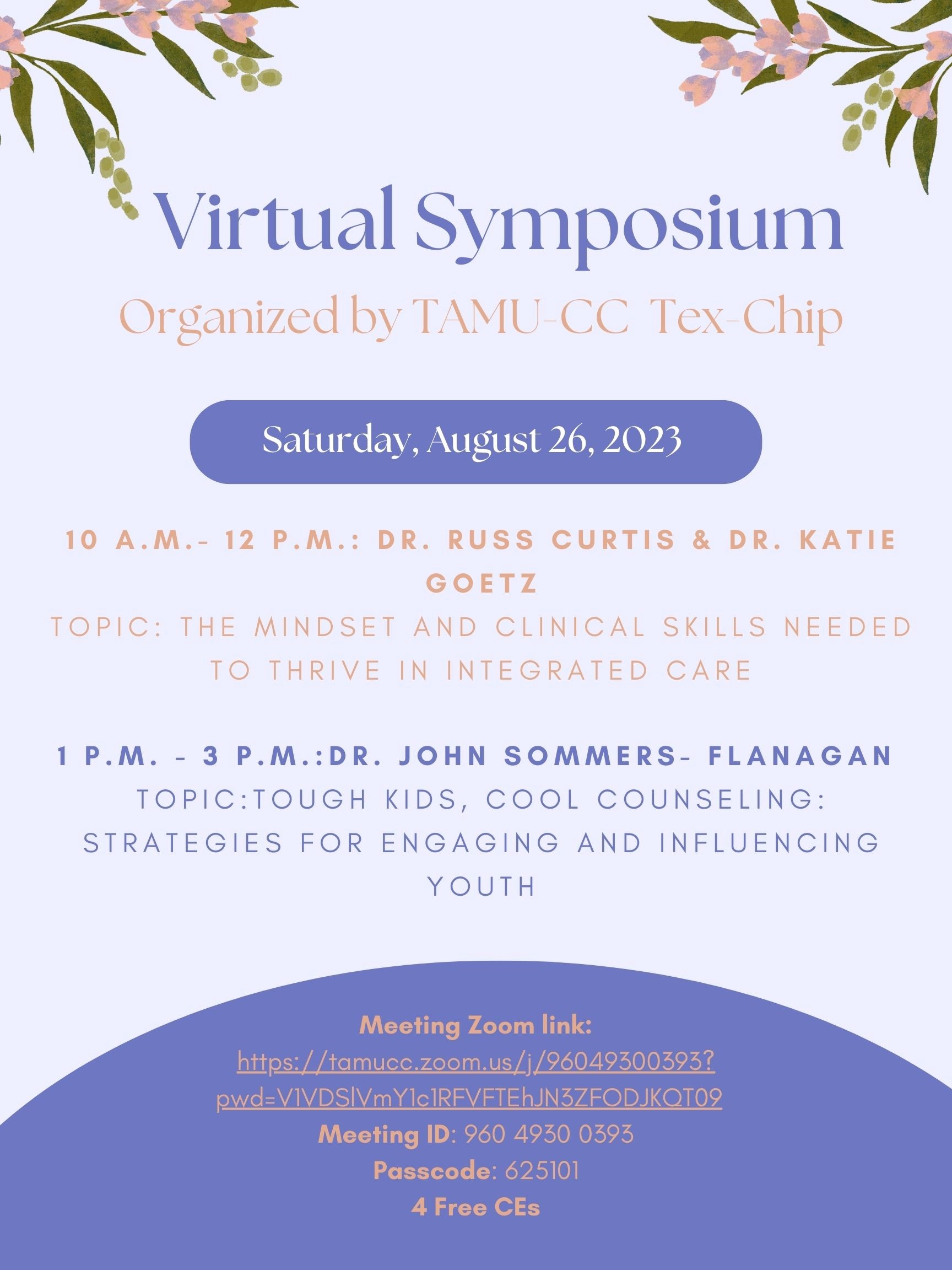
As a part of a virtual symposium offered by Texas A&M University – Corpus Christi, this coming Saturday, August 26, I’m doing a 2-hour free continuing education workshop from 12-2pm Mountain time (2pm-4pm Eastern). The cool thing is that the CEUs for this workshop are FREE. The less cool thing is that the workshop is on a Saturday.
My talk is: Tough Kids, Cool Counseling: Strategies for Engaging and Influencing Youth. Even better, I’ll be preceded by Dr. Russ Curtis and Dr. Katie Goetz (9am-11am Mountain time), who are presenting a 2-hour workshop on The Mindset and Clinical Skills Needed to Thrive in Integrated Care. . . and that’s 2 more FREE CEUs.
Below, I’ve pasted the blurbs and Zoom information for these online workshops.
You are invited to join Tex-Chip Virtual Symposium on Saturday, August 26, 2023, at 10am – 3pm (CST).
Dr. Russ Curtis & Dr. Katie Goetz is scheduled to present from 10am – 12pm CST on “The Mindset and Clinical Skills Needed to Thrive in Integrated Care.” In this interactive presentation, participants will learn how to integrate clinical skills with enlightening philosophical premises to expand their understanding of providing inclusive whole-person care. Attendees will develop their clinical voice through lecture, case examples, and discussions to begin asking the right questions about how to provide next-generation integrated care.
Dr. Sommers-Flanagan is scheduled to present from 1pm – 3pm CST on “Tough Kids, Cool Counseling: Strategies for Engaging and Influencing Youth.” Engaging “tough kids” in behavioral health can be immensely frustrating or splendidly gratifying. The truth of this statement is so obvious that the supportive reference, at least according to many teenagers is “Duh!” In this 2-hour workshop, participants will learn, experience, and practice several strategies for engaging and influencing youth. Several cognitive, emotional, and constructive brief counseling techniques will be described and demonstrated. Examples include acknowledging reality, positive questioning, wishes and goals, the affect bridge, the three-step emotional change trick, what’s good about you?/asset flooding, and more. Essential counseling principles, countertransference, and cultural issues will be included.
Hardly anyone with common sense or social skills ever argues about whether or not relationship factors are crucial to effective counseling and psychotherapy. Nevertheless, some scientists are reluctant to put relationship factors on par with counseling and psychotherapy techniques or procedures. IMHO, relationship factors are every bit as essential as so-called empirically-supported treatments.
This post is a pitch. Or it might be a pitch in a post. Either way, I am honored to share with you a hot-off-the-presses new book, titled Relationship Factors in Counseling, by Dr. Kimberly Parrow. Here’s the publisher’s link: https://titles.cognella.com/relationship-factors-in-counseling-9781793578754. The book is also available on Amazon and other booksellers.
Below, I’m pasting the Foreword to this book. Not only am I jazzed about the book, I’m also jazzed about the Foreword. You should read it. It’s really good. You’ll learn about Kimberly Parrow, as well as a bit of trivia about relationship factors that you should definitely know. I haven’t mentioned who wrote the Foreword, but I’m sure you’ll figure it out.
I first met Kimberly Parrow, before she was Dr. Kimberly Parrow, in a letter of recommendation from a psychology professor at the University of Montana. Having read well over 1,000 letters of recommendation over the years, this one imprinted in my brain. The professor wrote something like, “Kimberly Parrow is the real deal. You should admit her to master’s program in clinical mental health counseling. You will never regret it.”
We did (admit her into our master’s program . . . and our doctoral program). And we didn’t (ever regret it).
Kim Parrow was, is, and continues to be one of the most enthusiastic learners I’ve encountered. She walked onto our campus at 44-years-old, as a first-generation college student, having waited with bated breath for the money and opportunity to pursue her college degree. Nine years later she strolled off campus with her bachelor’s, master’s, and doctoral degrees. If we were Notre Dame, we’d call her a triple domer (n.b., that’s what you call people with three degrees from Notre Dame). At the University of Montana, we just call her amazing.
In one of her first doctoral classes, I introduced Kim to the concept of evidence-based relationship factors (EBRFs). She was hooked; hooked in the way that only graduate students get hooked. She was hooked by an idea. So hooked that she immediately wanted more; she wanted to write a journal article on EBRFs (so we did). She wanted to do her dissertation on EBRFs (so she did). She wanted to do extra additional trainings for practicum and internship students on EBRFs (and so she did). Kim’s attraction to EBRFs stemmed from her belief that relationships constitute the core of what’s therapeutic. As we explored EBRFs together, noting all the research supporting the idea that relationships drive counseling and psychotherapy, I came to see that Kim’s judgment was, and continues to be, practically perfect.
I’ve been reading dissertations for 30+ years. I’m embarrassed to say that I find reading most dissertations—even those written by students whom I love—drudgery. But Kim’s dissertation was electric. Page by page, she kept surprising me with new content and new learning; it was more than I expected. Kim had taken the basic knowledge and skills linked to EBRFs, contextualized them within the scientific literature, and then wrote about them in ways that inspired me to keep reading and keep learning. As she wrote more, her writing got better and better, and the content more illuminating.
About a month ago, I was unable to make it to my initial lecture for an advanced counseling theories course. I asked Kim to fill in. She quickly said yes. I offered to pay her. She quickly said no. To stick with the money theme, if I now had a dollar for every time one of my students has, since Kim’s lecture, mentioned Kim Parrow, eyes agog, and referenced the central role of relationship factors in counseling and psychotherapy, I would have many dollars. What I’m trying to say is that Kim is a natural and talented clinician-teacher. That’s a rare version of the real deal her former developmental psychology professor was trying to tell us about.
And now, a few words about this book. Kim has done what most scholars and professionals are unable to do. She has taken theoretical principles, empirical research findings, blended them with her common-sense-salt-of-the-earth style, and created a practical guide for helping counselors and psychotherapists be better. The book is aimed to slide into the educational development of practicum and/or internship students who have learned microskills and are facing their first clients. This particular point in student development is crucial; it’s a time when students sometimes lose their way as they try to make the improbable leap from microskills to counseling and psychotherapy techniques. In making that leap, they often fall prey to the urge to quickly “prove up” and “do something” with clients. In this process, they often abandon their microskills and forget about the therapeutic relationship. Kim’s overall point is this: Don’t forget about the therapeutic relationship because relationship factors are every bit as evidence-based as theory-based or research-based technical strategies. The renowned writer-researcher John C. Norcross put it this way:
Anyone who dispassionately looks at effect sizes can now say that the therapeutic relationship is as powerful, if not more powerful, than the particular treatment method a therapist is using.
The fact that therapeutic relationships are empirically supported makes Kim’s content relevant not only to students early in their clinical development, but also to all of us. Having taught this content with Kim, and to groups of professional counselors, psychologists, and social workers across the United States, I can say without hesitation that the content in this book can and will make all of us better therapists.
Kim covers 10 specific, evidence-based interactive relationship skills. What unique—and possibly the best thing about Kim’s coverage of relationship skills—is that she provides specific, actionable guidance for how to enact these 10 skills. As a preview, the 10 skills include:
Cultural humility
Congruence
Unconditional Positive Regard
Empathic Understanding
The Emotional Bond
Mutual Goal-Setting
Collaborative Therapeutic Tasks
Rupture and Repair
Countertransference Management
Progress Monitoring
In the pages that follow, you will get a taste of Kim Parrow’s relational orientation and a glimpse of the evidence supporting these 10 relationship factors as therapeutic forces that innervate counseling process. You will also experience the magic of a talented clinician-teacher. The magic—or, if you prefer, secret sauce—is Kim’s ability to make these distant intellectual relationship concepts real, practical, and actionable. To help make relationship concepts real, she has engaged several contributers (and herself) to write pedagogical break-out boxes titled, “Developing Your Skills.” Engaging with these skill development activities will, as the neuroscience fans like to say, “Change your brain” and help you develop neural pathways to enhance your relational connections.
As I write about skills and skill development, I’m aware that Carl (and Natalie) Rogers would view the reduction of his core conditions to “skills” as blasphemy. This awareness makes me want to emphasize that Kim “gets” Rogerian core conditions and does not reduce them into simple skills. Instead, she embraces the attitudinal and intentional dimensions of Rogerian core conditions, while simultaneously offering behaviors and words that counselors and psychotherapists can try on in hopes of expressing congruence, unconditional positive regard, and empathy.
I’ve had a few conversations with Derald Wing Sue over the years and he has always emphasized that culture in counseling and psychotherapy shouldn’t be relegated to a separate chapter at the end of the book—as if culture is ever a separate or standalone issue. Reading how Kim handles culture reminded me of Derald Wing Sue’s message. Instead of relegating it to the end, Kim begins with the relationship factor of cultural humility. That makes for a beautiful start. Cultural humility involves, above all else, the adoption of a non-superiority interpersonal stance. . . which is a simple and excellent anti-racist message. But Kim doesn’t stop talking about culture after Chapter 1. She does what Derald Wing Sue recommends: She integrates cultural awareness, knowledge, and skill development into the whole book. This stance—non-superiority and anti-racist—is consistent with Kim’s interpersonal style and is also the right place to start as counselors set about the journey to collaborate and co-create positive outcomes.
One of Kim’s writing goals is to offer ideas and activities that are likely to increase counselor cognitive complexity. You can see that in the two preceding paragraphs. Instead of reducing Rogerian core conditions into skills, she honors how they can become both attitudes and skills. And instead of putting culture into a silo, she spreads seeds of culture through all her chapters.
This book is a remarkable accomplishment. The language, the examples, the science, the skill development activities, and the tone, welcome readers to engage with this book, and bring the material to life. I believe if you read this book and engage in the activities, your counselor self-efficacy will grow.
For anyone who has gotten this far in reading this foreword, I have some reading tips to share. First, read this book with your heart wide open. I say this because this book is about the heart of the counselor or psychotherapist. Second, as you read, keep yourself in relationship with Kim. The book is about relational factors and the details Kim shares will not only help you in your relationships with clients, but, as she often reminded me and other people whom she cornered so she could talk to us about relational factors, these relationship factors are relevant and applicable to all relationships.
Obviously, I respect Dr. Kimberly Parrow and believe she has produced an excellent book. Obviously, I think you should read this book and do as so many of us have already done, learn about evidence-based relationship factors from someone who is a remarkably talented clinician-teacher. To paraphrase what that developmental psychology professor wrote about Kim many years ago, you should accept Kim Parrow into your personal program of learning immediately, and begin learning from her as soon as you can. You will not regret it.
All my best to you in your counseling and psychotherapy work.
In our Clinical Interviewing text, we open each chapter with a quotation. One of my favorite of all time is from Ursula K. LeGuin (the Left Hand of Darkness). She wrote: “
It is good to have an end to journey towards; but it is the journey that matters, in the end.” (p. 109)
Last week, we finished our year-long journey of revising Clinical Interviewing into the 7th edition. The last publication date was 2017, so this is, IMHO, a significant and important revision. With the help of the Amazing Dylan Wright, we recently uploaded the supplementary videos (there are over 100 clips that align with all of the textbook learning objectives). In the video recording process, we had much help, partly because this edition weaves in greater representation from professionals with diverse identities. Over the next several months, I will be posting additional sneak-peeks, including identity-diverse case examples and video clips. Stay tuned.
For today, I’m posting a rough copy of the final (of the 100+) Clinical Interviewing videos. In this one, I’m lamenting—while Rita consoles me—that our imperfect video recording project is ending. This video was recorded and produced by the multi-talented and aforementioned Dylan Wright, who took the liberty (as he often does in one way or another) of inserting laugh-tracks to help viewers “get” our silly efforts to be funny.
You may wonder why Rita and I are on our cell phones during this clip. It’s because the last chapter is about clinical interviewing and technology. That’s just one example of how hilarious we are.
Today I’ll be online providing a 2-hour workshop titled “Evidence-Based Relationship Factors in Supervision and Practice” on behalf of the Cognitive Behavioral Institute and Geneva College. This workshop content is related to the excellent work of John Norcross, Michael Lambert, and other prominent professionals who have advocated (and researched!) the scientific truth that RELATIONSHIPS are powerful influencers of positive treatment outcomes in counseling and psychotherapy. This topic is also the focus of a forthcoming book authored by a former doc student of mine, Kimberly Parrow (more on her excellent work in a future blog).
For now, I’m posting the ppts for today’s online workshop here:
And here’s the workshop description: Counselors and psychotherapists have a long and storied history of arguing with one another over what makes therapy effective. Some say: We should teach and supervise our students to use empirically-supported treatments (i.e., procedures, as in medicine). Others say: We should teach and supervise our students to establish therapeutic relationships. Although it’s clear that specific treatments and therapeutic relationships both contribute to outcomes, when supervisors and practitioners think of empirically-supported approaches, they tend to think of manualized treatments or procedures. However, in recent years, specific relationship factors have been identified and linked to positive counseling and psychotherapy outcomes (Norcross & Lambert, 2018). These factors include: cultural humility, congruence, unconditional positive regard, empathic understanding, emotional bonds, mutual goal-setting, and more. In this workshop, participants will learn to identify, describe, and apply evidence-based relationship factors in supervision and practice. Video-clips, live demonstrations, and reflective opportunities will be used to facilitate learning.
I hope you have an excellent day and weekend wherein you are enacting as many evidence-based relationship factors as you can fit into your life!
Yesterday I had a marvelous day with a group of about 35 wonderful mental health professionals and students in Ypsilante, Michigan. I was hosted by generous and kind faculty of Eastern Michigan University. I learned about the historical significance of “Ipsy,” along with anecdotes pertaining to the Ipsy water tower on post-cards, details of which—obviously because I’m so classy and sophisticated—I will not mention here.
The weather was marginally dreadful. We worried the in-person workshop would be cancelled and replaced with Zoom. Despite the weather, some people drove 90 minutes or more to arrive, which was just one small measure of their commitment to learning and their commitment to serving youth and families in counseling and psychotherapy. Whenever I’m in a room with professionals like the group yesterday, I have renewed hope in the world and in the future. The participants were: Just. Good. People.
As is my practice, I’m posting the ppts from the workshop here:
And here’s a PG-rated image of the Ypsilante water tower.
Toward the end of the workshop I engaged two participants in an activity that involved shaking imaginary soda pop bottles and opening them. One participant had brought her five-year-old daughter for the day (because of a school closure). As her mother and the woman next to her pretended to shake their imaginary bottles, and I was saying, “Shake, shake, shake,” the five-year-old, who had been incredibly well-behaved for the preceding 8 hours, began giggling in a way that couldn’t be described as representing anything other than pure joy.
In honor of my new five-year-old friend, I encourage you all to find time to giggle this weekend. Even better, find a child to giggle with; it will be time well-spent.
And here’s a photo of me having a giggle with a young person.
I’ve said it before and I’ll say it again: I have a friend who repeatedly espouses the glories of redundancy. Maybe that’s why some politicians stay on-message, regardless of the veracity of their statements. Of course, George Orwell and Hannah Arendt also commented on redundancy as persuasion, and not in a good way. I should emphasize that my goal for using redundancy and writing about the three-step emotional technique again has nothing to do with shaping your reality through political messaging.
When I presented on positive psychology to a bunch of UM STEM graduate students back in August, 2022, I made it very clear that I was not advocating toxic positivity. Nevertheless, in one of the student evaluations, someone complained that all I was doing was telling graduate students to “Cheer up.” Oh my. Sometimes people just hear what they want to hear. That’s a problem with over-valuing “lived experience.” When we over-value lived experience, then everything is viewed through our own, usually narrow and biased, personal lenses. Adler called this private logic. Too much private logic is too much private logic. Although we should strive to value, learn from, and share lived experiences, we should also have a shared value of this thing called . . . wait for it . . . science!
The next time I presented to the UM STEM grad students (in January, 2023), I made an explicit point of emphasizing my “non-toxic positivity street cred” by beginning the lecture with a short lesson on the three-step emotional change trick (which, BTW, with inspiration from Alfred Adler and Harold Mosak, we created as a youth psychotherapy technique in the mid-1990s). You can even find our (with Rita) original three-step article here: https://www.tandfonline.com/doi/abs/10.1300/J019v17n04_02 and a later book chapter here: https://psycnet.apa.org/record/2002-01308-098 and, of course, I’ve written about it on this blog, and have a youtube video demonstration: https://www.youtube.com/watch?v=ITWhMYANC5c, yada, yada, yada.
While presenting the 3SECT (which is what cool people call it) to the STEM students, there was a woman sitting toward the back. She had stationed her 8-year-old son still farther back, where he was sitting, head down, playing on her phone. I did the 3SECT thing, including the famous “And so I put my cat on my head” scene, emphasizing throughout, that the WHOLE reason for the 3SECT existing was because we should NEVER SAY CHEER UP to anyone, anytime!
The next day, I received the following email from the anonymous woman in the back (who generously gave me permission to share it here):
Hi John,
I was at your happiness seminar yesterday and was very disappointed I had to leave early. You may have noticed my son (who is 8) was sitting in the back playing a game on my phone during the seminar. I was delighted to find out this morning, while my 6-year-old daughter was having a meltdown trying to do her hair for school, that my son had been listening and absorbed your 3-step emotional change trick. He remembered the whole thing, and he asked his sister this morning if she wanted to learn it, but only if she wanted to change her own mood. He was clear that it wasn’t because he was trying to tell her to cheer up. He heard it all yesterday! Thought you might enjoy that little anecdote.
A few days later, she wrote:
We have gotten a lot of mileage out of your emotional change trick in the last few days.
I have to admit, I absolutely love it when people listen and get the message, but I truly and deeply love it EVEN MORE when 8-year-olds absorb messages while allegedly playing on a cell phone. I believe this may just be the scientific evidence (or is it my lived experience) I needed to validate that I am not and never have been a proponent of toxic positivity.
One other notable note. When searching (via Google) for my very own 3SECT video, I found that a counselor in Tennessee has copied one of my three-step blog posts and posted it as his own blog post. I was gobsmacked—with annoyance and flattery in equal proportions. If you want to read the blog post worthy of plagiarism (not the plagiarist’s version, which is the same, but my version that was so darn tempting that it literally caused plagiarism, here you go: https://johnsommersflanagan.com/2020/04/15/the-three-step-emotional-change-technique/
I’m ending now with a few core messages:
Don’t say “cheer up” to anyone.
Don’t get too over-focused on your own lived experiences, because, after all, everyone has their own lived experiences, and we should complement them all with scientific knowledge.
Don’t plagiarize.
If the person you plagiarized emails you, asking you to stop plagiarizing or provide a citation, don’t ignore that person.
And, whenever appropriate, follow in the anonymous 8-year-old’s footsteps and spread the good mood – without saying cheer-up!
In 1990, when I moved back to Missoula, Montana to join Philip and Marcy Bornstein in their private practice, my goal was to establish a practice focusing on health psychology. I believed deeply in the body-mind connection and wanted to work with clients/patients with hypertension, asthma, and other health-related conditions with significant behavioral and psychosocial components.
Turns out, maybe because I was the youngest psychologist in town, all I got were referrals from Youth Probation Services, Child Protective Services, local schools, and parents who asked if I could “fix” their children’s challenging behaviors.
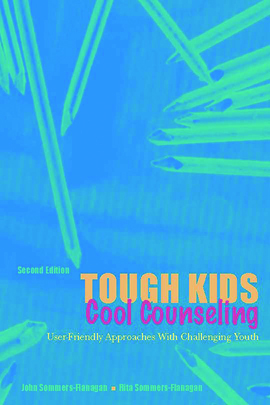
I’d say that I made lemonade from lemons, but it turns out I LOVED working with the so-called “challenging youth.” There were no lemons! The work led to our Tough Kids, Cool Counseling book (1997 and 2007), along with many articles, book chapters, and demonstration counseling videos. Over the years I’ve had the honor of working extensively with parents, families, youth, and young adults.
In about 10 days, I’ll be in Ypsilanti, Michigan doing a full-day professional workshop on “Tough Kids, Cool Counseling.” If you’re concerned about the title, don’t worry, so am I. In the first few minutes of the day, I’ll explain why using the terminology “Tough Kids” is a bad idea for counselors, psychotherapists, and other humans.
Just in case you’re in the Eastern Michigan area, the details and links for the conference are below. I hope to see you there . . . and hope if you make the trip, you’ll be sure to say hello to me at a break or after the workshop.
When: Friday, March 10, 2023, 8:30 AM – 5:00 PM EST
Where: Eastern Michigan University Student Center, Second Floor – Ballroom B Ypsilanti, MI 48197
Counseling so-called “tough kids” can be immensely frustrating or splendidly gratifying. The truth of this statement is so obvious that the supportive reference, at least according to many teenagers is, “Duh!” In this workshop, participants will sharpen their counseling skills by viewing and discussing video clips from actual counseling sessions, discussing key issues, and participating in live demonstrations. Attending this workshop will add tools to your counseling youth tool-box, and deepen your understanding of specific interventions. Over 20 cognitive, emotional, and constructive counseling techniques will be illustrated and demonstrated. Examples include acknowledging reality, informal assessment, the affect bridge, the three-step emotional change trick, asset flooding, empowered storytelling, and more. Four essential counseling principles, counselor counter-transference, and multicultural issues will be highlighted.
Textbook writing is a particular kind of writing that requires a variety of ways to present relatively boring material to students and aspiring professionals. Although we pride ourselves on writing the most entertaining textbooks in the business, our efforts to entertain are all part of a reader-friendly delivery system.
Another (less humorous) reader-friendly delivery strategy is the checklist. We intermittently use checklists to summarize essential information in our Clinical Interviewing text. Below, I’m including links to three checklists. Please note, these checklists are in process, and so if you see any typos or missing information or have some excellent feedback to share with me . . . post your feedback here on this blog or email me: john.sf@mso.umt.edu. I will greatly appreciate your feedback!
From Chapter 10: A Checklist on Suicide Assessment Documentation:
For those of you who are still reading (and I hope that’s everyone), I’m still looking for someone who can write me a short (400 word) case or two on working with LGBTQ+ youth. A transgender case would be especially nice. If you’re interested, send me an email: john.sf@mso.umt.edu
Engaging clients in a collaborative safety planning process is an evidence-based suicide intervention. The typical gold standard for safety planning is the Safety Planning Intervention (SPI) by Stanley and Brown (2012). You can access free material on the SPI and learn how to obtain professional training for using SPIs at this link: https://suicidesafetyplan.com/
As a part of the 7.5-hour Assessment and Intervention with Suicidal Clients video published by psychotherapy.net, I did a short (about 7 minute) demonstration of safety planning with a 15-year-old cisgender female client. The demo comes at the end of the session and naturally, I already know lots of information that can be integrated into the safety plan. Nevertheless, introducing and completing the safety plan is an excellent organizing experience.
In part, safety planning emerged as an alternative to what were called “No-suicide contracts.” No suicide contracts fell out of favor in the mid-to-late 1990s, because many clients/patients viewed them as coercive and liability-dodging behaviors by clinicians, and because they focused on what NOT TO DO, instead of what clients/patients should do, when feeling suicidal. Safety planning involves proactive planning for what clients can do to effectively cope during a suicidal crisis.
Victor Yalom of psychotherapy.net has given me permission to offer this video clip to everyone as a free resource to guide and inspire you as you work to develop your skills for collaborative safety planning. You can find a glittering array of videos, including the previously mentioned, three-part 7.5 hour classic at: https://www.psychotherapy.net/ and https://www.psychotherapy.net/video/suicidal-clients-series
Reframing, as a counseling and psychotherapy intervention, involves nudging clients toward viewing their thoughts, emotions, behaviors, and life situations from a different or new perspective. Reframing is an especially popular technique among cognitive, existential, and solution-focused therapists. In the following excerpt from our book on the strengths-based approach to suicide assessment and treatment, we discuss reframing . . . and what to do when it fails.
***********************
Framing Pain and Suicidality as Evidence of a Normal Self-Care Impulse
Another reframe involves viewing suicidality as coming from a place of self-care or self-compassion. Using your own words, you might try a reframe like this:
As you talk about wanting to die, I’m struck that your wish for death also comes from your wish to feel better . . . and your wish to feel better is normal, natural, and healthy. What I’d like to do for now, is to partner with you on the healthy goal of feeling better. I need your help on this. For now, we can put your wish to die on the sidelines, and focus on feeling better. We can’t expect immediate positive results. Will you work with me to battle your pain, and little by little, to help you feel better?
This reframing message is intentionally repetitive, and almost hypnotic. The purpose is to engage with and activate the healthy part of the self that wants to feel better. When clients respond to this message, hope for positive outcomes may increase. If clients reject this reframing message, suicide risk may be high.
Framing Pain as Meaningful
Victor Frankl (1967) used reframing to address depressive symptoms in the following case.
An old doctor consulted me in Vienna because he could not get rid of a severe depression caused by the death of his wife. I asked him, “What would have happened, Doctor, if you had died first, and your wife would have had to survive you?” Whereupon he said: “For her this would have been terrible; how she would have suffered!” I then added, “You see, Doctor, such a suffering has been spared her, and it is you who have spared her this suffering; but now you have to pay for it by surviving and mourning her.” The old man suddenly saw his plight in a new light, and reevaluated his suffering in the meaningful terms of a sacrifice for the sake of his wife. (1967, pp. 15–16)
Consistent with Frankl’s existential perspective, his reframe involves viewing suffering as meaningful. If clients view suffering as meaningful, life can feel more bearable.
When Reframes Fail
Reframing and redefining client emotional distress takes many forms. But, sometimes reframes don’t fit and don’t work. Reframes may be ineffective due to: (a) cultural insensitivity, (b) symptom severity, (c) inadequate rapport or alliance, and (d) countertransference (Lenes et al., 2020; Parrow et al., 2019). When your efforts to reframe fail, clients may withdraw or become agitated and you may risk a relationship rupture (Safran & Kraus, 2014). If the reframe doesn’t fit, process the issue (e.g., “Based on your reaction, it doesn’t seem like the idea I shared fits well for you”). After listening to your client’s response, you might need to proceed with strategies for rupture repair (see Sommers-Flanagan & Sommers-Flanagan, 2017). Relationship repair might include a direct apology and further processing. For example,
I’m sorry my idea for how to think about your pain wasn’t a good fit. But I’m glad you let me know it doesn’t fit. Lots of counseling is like an experiment. Sometimes we discover something doesn’t work. If you think something doesn’t fit or work for you, I will always want to know. Thank you for telling me.
When it comes to using reframing and redefinitions, your theoretical foundation is less important than the pragmatics of finding something that works for your client. The process involves: (a) identifying a potential reframe, (b) asking clients permission to try it out; (c) sharing the reframe; (d) observing client reactions, (e) verbally checking on client reactions and goodness of fit; (f) continuing to collaboratively experiment with the reframe or collaboratively discard it as a bad idea; and (g) addressing the relationship rupture—if one occurred.
********************
If you’re interested in our suicide book, give it a Google. Given the our unique hyphenated last name, it’s not hard to find.
The place to click if you want to learn about psychotherapy, counseling, or whatever John SF is thinking about.