
Tag Archives: Psychotherapy

Today’s Rabbit Hole: What Constitutes Scientific Evidence for Psychotherapy Efficacy?

On July 24, in Helena, I attended a fun and fascinating meeting sponsored by the Carter Center. I spent the day with a group of incredibly smart people dedicated to improving mental health in Montana.

The focus was twofold. How do we promote and establish mental health parity in Montana and how do with improve behavioral health in schools? Two worthy causes. The discussions were enlightening.

We haven’t solved these problems (yet!). In the meantime, we’re cogitating on the issues we discussed, with plans to coalesce around practical strategies for making progress.

During our daylong discussions, the term evidence-based treatments bounced around. I shared with the group that as an academic psychologist/counselor, I could go deep into a rabbit-hole on terminology pertaining to treatment efficacy. Much to everyone’s relief, I exhibited a sort of superhuman inhibition and avoided taking the discussion down a hole lined with history and trivia. But now, much to everyone’s delight (I’m projecting here), I’m sharing part of my trip down that rabbit hole. If exploring the use of terms like, evidence-based, best practice, and empirically supported treatment is your jam, read on!

The following content is excerpted from our forthcoming text, Counseling and Psychotherapy Theories in Context and Practice (4th edition). Our new co-author is Bryan Cochran. I’m reading one of his chapters right now . . . which is so good that you all should read it . . . eventually. This text is most often used with first-year students in graduate programs in counseling, psychology, and social work. Consequently, this is only a modestly deep rabbit hole.

Enjoy the trip.

*************************************

What Constitutes Evidence? Efficacy, Effectiveness, and Other Research Models

We like to think that when clients or patients walk into a mental health clinic or private practice, they will be offered an intervention that has research support. This statement, as bland as it may seem, would generate substantial controversy among academics, scientists, and people on the street. One person’s evidence may or may not meet another person’s standards. For example, several popular contemporary therapy approaches have minimal research support (e.g., polyvagal theory and therapy, somatic experiencing therapy).

Subjectivity is a palpable problem in scientific research. Humans are inherently subjective; humans design the studies, construct and administer assessment instruments, and conduct the statistical analyses. Consequently, measuring treatment outcomes always includes error and subjectivity. Despite this, we support and respect the scientific method and appreciate efforts to measure (as objectively as possible) psychotherapy outcomes.

There are two primary approaches to outcomes research: (1) efficacy research and (2) effectiveness research. These terms flow from the well-known experimental design concepts of internal and external validity (Campbell et al., 1963). Efficacy research employs experimental designs that emphasize internal validity, allowing researchers to comment on causal mechanisms; effectiveness research uses experimental designs that emphasize external validity, allowing researchers to comment on generalizability of their findings.

Efficacy Research

Efficacy research involves tightly controlled experimental trials with high internal validity. Within medicine, psychology, counseling, and social work, randomized controlled trials (RCTs) are the gold standard for determining treatment efficacy. RCTs statistically compare outcomes between randomly assigned treatment and control groups. In medicine and psychiatry, the control group is usually administered an inert placebo (i.e., placebo pill). In the end, treatment is considered efficacious if the active medication relieves symptoms, on average, at a rate significantly higher than placebo. In psychotherapy research, treatment groups are compared with a waiting list, attention-placebo control group, or alternative treatment group.

To maximize researcher control over independent variables, RCTs require that participants meet specific inclusion and exclusion criteria prior to random assignment to a treatment or comparison group. This allows researchers to determine with greater certainty whether the treatment itself directly caused treatment outcomes.

In 1986, Gerald Klerman, then head of the National Institute of Mental Health, gave a keynote address to the Society for Psychotherapy Research. During his speech, he emphasized that psychotherapy should be evaluated through RCTs. He claimed:

We must come to view psychotherapy as we do aspirin. That is, each form of psychotherapy must have known ingredients, we must know what these ingredients are, they must be trainable and replicable across therapists, and they must be administered in a uniform and consistent way within a given study. (Quoted in Beutler, 2009, p. 308)

Klerman’s speech advocated for medicalizing psychotherapy. Klerman’s motivation for medicalizing psychotherapy partly reflected his awareness of heated competition for health care dollars. This is an important contextual factor. Events that ensued were an effort to place psychological interventions on par with medical interventions.

The strategy of using science to compete for health care dollars eventually coalesced into a movement within professional psychology. In 1993, Division 12 (the Society of Clinical Psychology) of the American Psychological Association (APA) formed a “Task Force on Promotion and Dissemination of Psychological Procedures.” This task force published an initial set of empirically validated treatments. To be considered empirically validated, treatments were required to be (a) manualized and (b) shown to be superior to a placebo or other treatment, or equivalent to an already established treatment in at least two “good” group design studies or in a series of single case design experiments conducted by different investigators (Chambless et al., 1998).

Division 12’s empirically validated treatments were instantly controversial. Critics protested that the process favored behavioral and cognitive behavioral treatments. Others complained that manualized treatment protocols destroyed authentic psychotherapy (Silverman, 1996). In response, Division 12 held to their procedures for identifying efficacious treatments but changed the name from empirically validated treatments to empirically supported treatments (ESTs).

Advocates of ESTs don’t view common factors in psychotherapy as “important” (Baker & McFall, 2014, p. 483). They view psychological interventions as medical procedures implemented by trained professionals. However, other researchers and practitioners complain that efficacy research outcomes do not translate well (aka generalize) to real-world clinical settings (Hoertel et al., 2021; Philips & Falkenström, 2021).

Effectiveness Research

Sternberg, Roediger, and Halpern (2007) described effectiveness studies:

An effectiveness study is one that considers the outcome of psychological treatment, as it is delivered in real-world settings. Effectiveness studies can be methodologically rigorous …, but they do not include random assignment to treatment conditions or placebo control groups. (p. 208)

Effectiveness research focuses on collecting data with external validity. This usually involves “real-world” settings. Effectiveness research can be scientifically rigorous but doesn’t involve random assignment to treatment and control conditions. Inclusion and exclusion criteria for clients to participate are less rigid and more like actual clinical practice, where clients come to therapy with a mix of different symptoms or diagnoses. Effectiveness research is sometimes referred to as “real world designs” or “pragmatic RCTs” (Remskar et al., 2024). Effectiveness research evaluates counseling and psychotherapy as practiced in the real world.

Other Research Models

Other research models also inform researchers and practitioners about therapy process and outcome. These models include survey research, single-case designs, and qualitative studies. However, based on current mental health care reimbursement practices and future trends, providers are increasingly expected to provide services consistent with findings from efficacy and effectiveness research (Cuijpers et al., 2023).

In Pursuit of Research-Supported Psychological Treatments

Procedure-oriented researchers and practitioners believe the active mechanism producing positive psychotherapy outcomes is therapy technique. Common factors proponents support the dodo bird declaration. To make matters more complex, prestigious researchers who don’t have allegiance to one side or the other typically conclude that we don’t have enough evidence to answer these difficult questions about what ingredients create change in psychotherapy (Cuijpers et al., 2019). Here’s what we know: Therapy usually works for most people. Here’s what we don’t know: What, exactly, produces positive changes.

For now, the question shouldn’t be, “Techniques or common factors?” Instead, we should be asking “How do techniques and common factors operate together to produce positive therapy outcomes?” We should also be asking, “Which approaches and techniques work most efficiently for which problems and populations?” To be broadly consistent with the research, we should combine principles and techniques from common factors and EST perspectives. We suspect that the best EST providers also use common factors, and the best common factors clinicians sometimes use empirically supported techniques.

Naming and Claiming What Works

When it comes to naming and claiming what works in psychotherapy, we have a naming problem. Every day, more research information about psychotherapy efficacy and effectiveness rolls in. As a budding clinician, you should track as much of this new research information as is reasonable. To help you navigate the language of researchers and practitioners use to describe “What works,” here’s a short roadmap to the naming and claiming of what works in psychotherapy.

When Klerman (1986) stated, “We must come to view psychotherapy as we do aspirin” his analogy was ironic. Aspirin’s mechanisms and range of effects have been and continue to be complex and sometimes mysterious (Sommers-Flanagan, 2015). Such is also the case with counseling and psychotherapy.

Language matters, and researchers and practitioners have created many ways to describe therapy effectiveness.

  • D12 briefly used the phrase empirically validated psychotherapy. Given that psychotherapy outcomes vary, the word validated is generally avoided.
  • In the face of criticism, D12 blinked once, renaming their procedures as empirically supported psychotherapy. ESTs are manualized and designed to treat specific mental disorders or specific client problems. If it’s not manualized and doesn’t target a disorder/problem, it’s not an EST.
  • ESTs have proliferated. As of this moment (August 2025), 89 ESTs for 30 different psychological disorders and behavior problems are listed on the Division 12 website (https://div12.org/psychological-treatments/). You can search the website to find the research status of various treatments.
  • To become proficient in providing an EST requires professional training. Certification may be necessary. It’s impossible to obtain training to implement all the ESTs available.
  • In 2006, an APA Presidential Task Force (2006) loosened D12’s definition, shifting to a more flexible term, Evidence-Based Practice (EBP), and defining it as ‘‘the integration of the best available research with clinical expertise in the context of patient characteristics, culture, and preferences’’ (p. 273).
  • In 2007, the Journal of Counseling and Development, the American Counseling Association’s flagship journal, inaugurated a new journal section, “Best Practices.” As we’ve written elsewhere, best practice has grown subjective and generic and is “often used so inconsistently that it is nearly meaningless” (Sommers-Flanagan, 2015, p. 98).
  • In 2011, D12 relaunched their website, relabeling ESTs as research-supported psychological treatments (n.b., most researchers and practitioners continue to refer to ESTs instead of research-supported psychological treatments).
  • As an alternative source of research updates, you can also track the prolific work of Pim Cuijpers and his research team for regular meta-analyses on psychological treatments (Cuijpers et al., 2023; Harrer et al., 2025).
  • Other naming variations, all designed to convey the message that specific treatments have research support, include evidence-based treatment, evidence-supported treatment, and other phrasings that, in contrast to ESTs and APA’s evidence-based practice definition, have no formal definition.

Manuals, Fidelity, and Creativity

Manualized treatments require therapist fidelity. In psychotherapy, fidelity means exactness or faithfulness to the published procedure—meaning you follow the manual. However, in the real world, when it comes to treatment fidelity, therapist practice varies. Some therapists follow manuals to the letter. Others use the manual as an outline. Still others read the manual, put it aside, and infuse their therapeutic creativity.

A seasoned therapist (Bernard) we know recently provided a short, informal description of his application of exposure therapy to adult and child clients diagnosed with obsessive-compulsive disorder. Bernard described interactions where his adult clients sobbed with relief upon getting a diagnosis. Most manuals don’t specify how to respond to clients sobbing, so he provided empathy, support, and encouragement. Bernard described a therapy scenario where the client’s final exposure trial involved the client standing behind Bernard and holding a sharp kitchen knife at Bernard’s neck. This level of risk-taking and intimacy also isn’t in the manual—but Bernard’s client benefited from Bernard trusting him and his impulse control.

During his presentation, Bernard’s colleagues chimed in, noting that Bernard was known for eliciting boisterous laughter from anxiety-plagued children and teenagers. There’s no manual available on using humor with clients, especially youth with overwhelming obsessional anxiety. Bernard used humor anyway. Although Bernard had read the manuals, his exposure treatments were laced with empathy, creativity, real-world relevance, and humor. Much to his clients’ benefit, Bernard’s approach was far outside the manualized box (B. Balleweg, personal communication, July 14, 2025).    

As Norcross and Lambert (2018) wrote: “Treatment methods are relational acts” (p. 5). The reverse is equally applicable, “Relational acts are treatment methods.” As you move into your therapeutic future, we hope you will take the more challenging path, learning how to apply BOTH the techniques AND the common factors. You might think of this—like Bernard—as practicing the science and art of psychotherapy.

**********************************

Note: This is a draft excerpt from Chapter 1 of our 4th edition, coming out in 2026. As a draft, your input is especially helpful. Please share as to whether the rabbit hole was too deep, not deep enough, just right, and anything else you’re inspired to share.

Thanks for reading!

Counseling and Psychotherapy Theories: The 4th Edition Revision is Underway

At long last, we’ve begun work on revising our Counseling and Psychotherapy Theories text for its 4th edition. Over the past several weeks, I’ve been putting in an hour or two a day, chipping away on chapter revisions, reaching out to reviewers, and planning with our new and very exciting co-author, Dr. Bryan Cochran, a highly esteemed psychology professor at the University of Montana. If you’re reading this, I want you to know of Bryan’s awesomeness (and if you’re Bryan, I want you to feel the pressure of this public announcement of your awesomeness) [hahahaha!]

You all probably know that our Theories textbook is far and away the Theories textbook with the most hilarity. No doubt, this is a rather low bar, given that I can’t find any funny stories in any other theories texts. We view theories hilarity to be extremely important in a theories text, because reading many theories texts can parallel the proverbial experience of watching paint dry.

Bryan’s addition to the writing team will give us something we need—an expert in the LGBTQ+ domain, and someone with a talent for telling stories that are simultaneously engaging, informative, and fun to read. Right now, he’s busy writing a “Lenses” chapter (to be Chapter 2) to orient readers to important theory-related lenses like (a) Queer theory, (b) Critical Race theory, (c) Intersectionality, and more. I, for one, can hardly wait for his Queer theory quips.  

News Flash: In the past, I’ve put out broad calls for chapter reviewers. This time, I’m being selective and directly asking prominent theories experts to review chapters and offer guidance. Some examples: For the Adlerian chapter we’ve got Marina Bluvshtein (woohoo!) and Jon Sperry (wow!). For the Psychoanalytic chapter, we got Nancy McWilliams (amazing!) and Pratyusha Tammala-Narra (fantastic!).

If you happen to be a specific theories subject matter expert, you should email me at john.sf@mso.umt.edu to get in on the fun. Or if you have a prominent theories friend/colleague to recommend, have them email me.

As one last theories teaser, below I’m pasting a few excerpts from Nancy McWilliams’s 2021 article titled, “Diagnosis and Its Discontents: Reflections on Our Current Dilemma.” I love this article as it gives a glimpse into problems with contemporary diagnoses and how psychodynamic therapists use individualized assessment in ways to honor the real-life complexities clients bring into psychotherapy. The excerpts below are from her article, which is linked at the end of this post.

On Labeling

The idea that one is anxious (or depressed or obsessive) about something that has meaning is being lost. Fitting an individual into a category tends to foreclose exploration of what is unique to a patient; it especially prevents insights into unexpected aspects of a person’s psychology or exploration of areas that are felt as shameful – the very areas that are of particular value in planning and carrying out psychotherapy.

On the vexing ways in which patients think about themselves and their diagnoses

It used to be that a socially avoidant woman would come for therapy saying something like, “I’m a painfully shy person, and I need help learning how to deal better with people in social situations.” Now a person with that concern is likely to tell me that she “has” social phobia – as if an alien affliction has invaded her otherwise problem-free subjective life. People talk about themselves in acronyms oddly dissociated from their lived experience: “my OCD,” “my eating disorder,” “my bipolar.” There is an odd estrangement from one’s sense of an agentic self, including one’s own behavior, body, emotional and spiritual life, and felt suffering, and consequently one’s possibilities for solving a problem. There is a passive quality in many individuals currently seeking therapy, as if they feel that the prototype for making an internal psychological change is to describe their symptoms to an expert and wait to be told what medicine to take, what exercises to do, or what self-help manual to read.

On “chemical imbalances”

. . . viewing psychological suffering as a set of disorders that can be fixed or improved chemically can easily invite the obverse assumption that those painful experiences are ultimately caused by random or genetically based chemical differences among individuals. This is a false conclusion, of course, something like saying that because marijuana improves appetite, the cause of low appetite is lack of marijuana. But it is nevertheless a frequent leap of illogic – in the thinking of nonprofessionals and of some professionals as well – to ascribe much severe psychological suffering to a “chemical imbalance.” Such a construction tempts us to ignore all the painful other sources of psychological suffering, such as poverty, neglect, trauma, and the myriad ways in which human beings can injure each other psychologically.

On not overgeneralizing research findings/recommendations to unique patients

. . . consider patients at the extreme end of the obsessive-compulsive continuum, whose obsessions border on delusional beliefs, who suffer profound annihilation anxiety, who wholeheartedly believe they will die if they fail to carry out their rituals, and who regard the therapist with suspicion for not sharing their conviction – in other words, the subgroup of obsessive patients that Kernberg (1984) would consider as psychologically organized at the low borderline or psychotic level. My experience suggests that with this group exposure therapy not only fails, it demoralizes the patients, makes them feel like failures personally, and kills any hope they may have that psychotherapy can help. It also demoralizes therapists, who have been told again and again that exposure therapy is the treatment of choice for OCD. If they believe their teachers, such clinicians can easily conclude they are simply not good enough therapists.

If I’ve piqued your interest in “Diagnosis and its discontents” by Nancy McWilliams, here’s a pdf of the article.

Stay tuned for more theories revision (we’re calling it T4) updates.

John SF

Two Upcoming Events

Hi All,

I’ve got two events coming up, one sooner and one later.

This Friday, I’m doing the closing talk for Tamarack’s Grief Institute (which is on Thursday and Friday in Missoula, and available online too!).

This is late notice, as the end of day tomorrow (March 3) is the registration deadline. The whole Institute is worth attending. The fantastic Dr. Joyce Mphande-Finn kicks things off on Thursday morning. Then, the amazing Dr. Micki Burns takes over . . . and I’ll be bringing it home Friday afternoon. Check it out. Here’s a registration link:

**********************

This June, I have the incredible fortune of joining Dr. Jeff Linkenbach and the renowned Montana Summer Institute in Big Sky, Montana (and Livestream) from June 17-20. Here’s a description of what’s happening!

Reimagining Community Health:

Uncovering Positive Norms and & Activating Hidden

Protective Factors

In Big Sky, Montana and via Livestream: June 17-20, 2025

Join us at the 2025 Montana Summer Institute for three and a half transformative days dedicated to advancing community well-being. Through thought-provoking keynotes, interactive workshops, and engaging discussions, you’ll explore innovative strategies that leverage positive norms and amplify protective factors.

Learn to uncover hidden community strengths, identify untapped opportunities, and craft impactful communications that drive meaningful change. With insights from leading experts and experienced practitioners, you’ll gain practical tools to reimagine your approach to data, messaging, and the people you serve—all through a positive, effective frame.

Don’t miss this opportunity to expand your expertise, deepen your impact, and shape healthier, more resilient communities. For more information, visit www.montanainstitute.com

Is there any chance you will join us in June? It would be wonderful to have you there! Here is the Montana Discount Code to give $100 off the price:  MSIMONT which would give $100 off registration

***********************

And here’s a fancy flyer for the Montana Summer Institute:

The One-Way Mirror Project and Self-Reflection: A Process of Pain and Growth

This post is for my Chinese friends, or my friends who speak Mandarin . . . or anyone who wants to read about the process of self-evaluation, the pain of self-reflection, and personal/professional growth.

Last year I was asked to participate as a psychotherapist for the One-Way Mirror Project. The project was inspired by the old and now classic “Three Approaches to Psychotherapy” videos. Not surprisingly, I was honored to be asked to participate, and said yes despite a number of challenging factors, including doing therapy late at night with a Chinese woman via Zoom. I share this because this post is about transparency and so I’m transparently beginning by making excuses for not being the best therapist I imagine myself to be.

Here’s the scenario: One session. Minimal pre-meeting information. Post-session viewing (by me) and commentary on my performance. One other therapist also met with the same client. I get to watch his session; he gets to watch mine. We then have a Zoom meeting to debrief and share our thoughts about our respective sessions (mine was in English; his was in Mandarin).

This was a super-interesting process.

Below, I’m sharing my written self-reflection comments. There’s also a video version . . . which is similar to, but not verbatim from, these notes. The comments are numbered sequentially.

I hope you enjoy this self-reflection/analysis. Thanks for reading.

John S-F – Commentary on His Session with Evelyn

  1. My first reaction to watching this video of myself was embarrassment. I’m sharing this reaction because it’s true. I don’t want to pretend that I think this is a particularly good session.
  2. That said, I also don’t think it was a particularly bad session. I did some things well, and some things less well. In this commentary I will try to describe: (a) what I’m doing (or trying to do), especially from different theoretical perspectives, (b) how Evelyn is responding, (c) what I’m doing well and what I’m doing that’s much less good.
  3. In critiquing my own work, I’m also hoping to connect with all of you. Whether you’re a beginning student or an experienced professional psychotherapist, watching ourselves and hearing ourselves can be humbling and embarrassing. It’s natural for all of us to make mistakes and be imperfect . . . and in this session I do an excellent job of being imperfect😊. . . so much so that while watching the video, during several points I kept shouting at myself to “shut up!” So, that’s a glimpse into one thing I would change about MY behavior in this session.  Although I’m okay with being imperfect, I’m not very comfortable with being as imperfect as I was in this session.  
  4. How I Work – 0:10 – This explanation has three main goals. First, I’m showing transparency, which is consistent with person-centered and feminist therapies. Second, I’m explaining the process of our session, which is a role induction designed to help clarify expectations. Third, I’m including an invitation for collaboration.
  5. SFBT Opening Question – 1:30 – “If we have a useful meeting, what will we accomplish?” This is a goal-oriented question to help me be more aware of Evelyn’s vision of a successful session.
  6. Evelyn’s Goal – 1:50 – Evelyn says she wants a “different perspective” of what she’s worried about.
  7. JSF’s Goal – In a single session treatment, and maybe most therapy sessions, it’s best to begin with what the client wants. Evelyn’s goal is a “cognitive goal.” In this moment, I decide to go with George Kelly’s “Credulous approach to assessment,” which essentially means “believe the client.” That could be a variation of Carl Rogers’s assertion that we should “Trust the client, because the client knows what hurts and where to go.” JSF – Your goal is my goal, as long as it’s legal and healthy.”
  8. What I Know – 2:25 – This is another effort to be like Carl Rogers and show transparency.
  9. Feelings and Thoughts Around That – 3:00 – Here, I’m trying to prompt her to explore feelings and/or thoughts. She says, “So many worries overwhelming” and talks about not knowing what is overwhelming and then references social media, and four main issues/worries: (a) Fitness/body image/comparison, (b) feelings of unfairness related to gender issues, (c) she loves her partner, but “he is a man” (with sarcasm, implying he therefore cannot understand), (d) humiliation linked to breasts filling with milk involuntarily.
  10. A Broad Summary/Paraphrase – I respond with an accurate summary of her four “feelings and thoughts”
  11. “You can choose; I cannot” – 7:10 – Evelyn focuses on the inherent sex/gender unfairness as related to having a baby. In response, we discuss the burden of social responsibility and how she has internalized societal expectations around being a woman.
  12. May I Share an Observation? – 8:30 – At this point, I try to be a mirror that reflects back to Evelyn what I’m experiencing as one of her positive attributes or strengths. When working across cultures, it’s especially important to be affirming of client strengths. I end this reflection using first-person pronouns—which is a language skill that Rogers used and called “Walking within” – 9:10
  13. Evelyn Continues – 10:45 – to talk about feeling powerless and influenced by her age, generation, societal expectations, and then notes that she wants to “make peace with what she wants to be and what she can be.” The thought of having a baby is a particular trigger for her anxious thoughts and fears. – 11:15
  14. An Intellectual Grasp – 12:15 – I observe that Evelyn has a good intellectual grasp of feminism and of her internalized expectations about how women should be.
  15. A Reflection and SFBT Question – 12:35–13:29 – Using too many words, I finally get out a “Unique outcomes” question: “How have you dealt with internalized fears and conflicts before?”
  16. I Love That Question – 13:35 – Evelyn reflects on a story from age 24 and provides examples of how she felt time running out, dated like crazy, was very brave, and fought back toward her goal of a loving relationship even after having her heart broken.
  17. How did you manage? – 15:03 – I continue to pursue Evelyn’s pre-existing strengths and insights around, with a bit of a focus on what motivated her to “fight back.”
  18. As a Good Therapist – 15:35 – Evelyn expresses motivation to be a good therapist and that requires expansive live experiences.
  19. Anything Else Pull You – 16:54 – Evelyn shares an early fear of death, noting, after an anecdote, that her class presentation on death left her feeling “more lonely (or different) than ever.” – 17:54. [not psychoanalytic]
  20. I Reflect – 18:30 – Being a better therapist and fear of death motivate her to live a life full of experiences.
  21. Imagine self at end of life – 19:00 – Found someone I love and would like to have a child. I want to try it. That would complete my experience. – 19:30
  22. Values vs. Anxieties – 19:55 – Still feel anxieties. “I have to carry a child” etc. . . walking within. Amplifying expectations so she can hear them.
  23. That’s my barrier
  24. Fought those off those expectations before – 20:45 – And yet . . . you have fought off expectations before. What makes you think you will be a victim to those expectations in the future? Here, I’m trying to identify what CBT people might consider an “irrational” or “maladaptive” thought/belief that doesn’t have much evidence to support it. Also, exception. . .
  25. Focus on the Physical/Somatic – 22:25 – Evelyn notes this task is “harder” and supports that with physical changes she’s experiencing with aging. . . and I interpret that as “Anticipatory grief” regarding her physical decline [this is likely death anxiety too]
  26. Self-Disclosure – 23:40 – May I share something? “I have a 35-y/o daughter with similar issues.” [Too many words! Should have stopped when Evelyn laughed and put her hand to her face and then explored her initial reaction]. I finally get to “What’s your reaction?” [Late, but I got there]. She says . . . and this is potentially central to “one” therapy goal: “I feel, like, less lonely.” [Again, I should just stop there or repeat it back. . . or “What’s it like inside to feel less lonely?”].
  27. Curious about what I could learn from her – 25:35 – I turn this around. Why? Because I want her to value herself as a source of wisdom.
  28. When I share with my partner – 26:25 – She notes “he can relate” and that “men are limited.” [This could have been good transference exploration or Adlerian basic mistake]
  29. Session shift to “so much feeling” – 27:16 – Evelyn is talking about her emotionality, I’m reflecting ok. More on unfairness, but notes BF is pretty accepting. I do a strength-based reflection, “Openness, strength, do not run from feelings!” This is a little CBT as I want her to “perceive” herself with more strengths to cope with her future challenges.
  30. Thoughts about yourself? – 31:00 – I’ve been working on some CBT stuff and now am shifting back to the important self-evaluation process. Her response is constructive as she describes lots of planning she has already done for this coming year.
  31. I want to hear out my fears – 32:10 – This is a great insight on her part. It prompts me to have her listen to her fears in the here and now. Evelyn responds [33:10] that she likes that question and explores, perhaps with a tiny bit of surprise, that her fears are not harsh, but more of a gentle reminder to not have regrets. [Here, I could and probably should have had her get deeper into here and now processing. “Let’s have you hear the gentle voice of your fear right now. What’s it saying to you? Say it as if you are the fear. Also, could have used repetition.]
  32. Reflections and WW – I stay with the themes and use WW to keep bringing them back. Why? In part, desensitization. Hearing her anxiety-producing words in a potentially trusting/comforting setting can take some edge or power out of them [MCJ – 1924]. She says, somewhat conclusively, “Sounds like fear just wants me to get prepared and not critique.” [One thought, I could have been her child and asked her to tell me what she has learned.]
  33. Evelyn asks JSF Q – 36:28 – This is one place where I fall off the rails. She asked me a question and my obnoxious, intellectual, professor-self emerges. . . for far too long. [I could have said, “I have some thoughts about that, but I’d like to hear yours first.”] Instead, JSF blah, blah, blah, and to compound the error, I do not check in on her reaction.
  34. Evelyn continues exploring – 40:52 – She notes Yuval Harrare and feminism as a new way to resolve conflicts without war. I do manage to shift back to listening with a pretty good paraphrase: “Communication with your partner may be your best way to grow and develop and maintain your feminist identity through childbirth and your relationship.”
  35. Evelyn recognizes perfect equality not possible – 42:35 – JSF “Love what you said. What do you think? How does it feel?” [2 Qs, boo, but my focus on her self-evaluation is still pretty solid.] I continue with “What’s your assessment of yourself and your communication skills?” I’m hoping she can express trust in her communication skills.
  36. Non-violent communication as restraint – 46:00 – This is an interesting side road where E says, “Sometimes I just want to be violent and like a child” and notes that she prefers “emotionally charged communication.” She finds emotions and aggressive communication to be helpful. [Note: at this point I’m beginning to feel time pressure. No time to go deeper. If more sessions, I’d earmark this and close. Instead, I ask, “Is it ok to have both” (nonviolent and emotional communication) as a quick prompt toward integration.
  37. Moving toward closing – 49:00 – I’ve lost track of time because of early tech problems. I’d like to think that’s my excuse for ending poorly. First, I begin a summary. This isn’t good. It’s MY summary . . . and I should be asking for HER summary before offering mine. I’m far too verbal. The content isn’t terrible.
  38. Thank-you so much – 52:45 – She’s tracking time, and this should be it. I’m not. And do another disclosure and ask for her summary.
  39. Closing – 56:40 – Awkward. Not smooth. Not good.

The Handout for this Friday’s Strengths-Based Suicide Workshop

Sorry for all the posts, but apparently there’s lots happening in early 2025.

The big NEWS post won’t be until tomorrow.

As you know, on this Friday, January 10, I’ll be doing an online, two-hour workshop on Strategies for Integrating Traditional and Strengths-Based Approaches to Suicide for the Cognitive Behavior Institute.

I’m posting the workshop handouts here, in advance, for anyone interested.

You may recall that this workshop is ALMOST FREE. Only $25. There’s still time to register here:

https://cbicenterforeducation.com/courses/strategies-for-integrating-traditional-and-strengths-based-approaches-to-suicide-january-2025

I hope to see you there!

Questions (and Mindfulness) in Counseling and Psychotherapy

Every day, I keep getting older. I can’t seem to stop myself. And every day, I keep running into dialectics. They’re everywhere. My aging experiences of ubiquitous dialectics seems consistent with the fact that yesterday, Merriam-Webster declared “polarization” their word of the year (https://www.merriam-webster.com/wordplay/word-of-the-year).

Boo, Merriam-Webster! I would have chosen dialectics. Here’s one of the definitions for dialectic listed in the online M-W dictionary: “the Hegelian process of change in which a concept or its realization passes over into and is preserved and fulfilled by its opposite.” TBH, I have very little understanding of what the heck Hegel was talking about, but I’m pretty sure it’s happening ALL. THE. TIME.

This morning I find myself plagued by the idea that although most mental health professionals advocate mindfulness, many mental health professionals (including myself, sometimes), aren’t very mindful when using basic counseling skills in practice. Today’s topic is questions. I’m polarized inside a dialectical and thinking, “We should all be more mindful and intentional in our use of questions in counseling and psychotherapy.”  At the same time, I’m sure, “we should all relax and be more of ourselves.”

With these confusing caveats in mind, today, tomorrow, and maybe the next day, I’m posting about the very basic use of questions in counseling and psychotherapy. This content is excerpted from our Clinical Interviewing textbook.

Here’s our opening section on questions, which is conveniently found in Chapter 5 of Clinical Interviewing, which I’m continually surprised that not everyone has read (but really not at all surprised).

**************************************

Questions

Imagine digging a hole without a shovel or building a house without a hammer. For many clinicians, conducting an interview without using questions constitutes an analogous problem: How can you complete the interviewing task without using your most basic tool?

Despite the central role of questions in clinical interviewing, we’ve avoided discussing them until now. Similarly, when teaching clinical interviewing skills, we usually prohibit question asking for a significant portion of the course (J. Sommers-Flanagan & Means, 1987). Our rationale includes several factors: Questions are easy and often misused. Also, because questioning isn’t the same thing as listening, our goal is for students to develop alternative information-gathering strategies. Asking questions can get in the way of gathering important information from clients. The Little Prince expresses a fundamental problem with excessive questioning.

Grown-ups love figures. When you tell them that you have made a new friend, they never ask you any questions about essential matters. They never say to you, “What does his voice sound like? What games does he love best? Does he collect butterflies?” Instead, they demand: “How old is he? How many brothers has he? How much does he weigh? How much money does his father make?” Only from these figures do they think they have learned anything about him. (de Saint-Exupéry, 1943/1971, p. 17)

The questions you ask may be of no value to the person being asked. Ideally, your questions should focus on what seems most important to clients.

Despite our reservations about excessive questioning, questions are a diverse and flexible interviewing tool; they can be used to

  • Stimulate client talk
  • Inhibit client talk
  • Facilitate rapport
  • Show interest in clients
  • Show disinterest in clients
  • Gather information
  • Confront clients
  • Focus on solutions
  • Ignore the client’s viewpoint
  • Stimulate insight

There are many forms or types of questions. Differentiating among them is important, because different question types produce different client responses. In this section, we describe open, closed, swing, indirect, and projective questions. Chapter 6 covers therapeutic questions. Although we distinguish between general question types and therapeutic questions, all questioning can be used for assessment or therapeutic purposes.

Open Questions

Open questions are used to facilitate talk; they pull for more than a single-word response. Open questions ordinarily begin with either How or What. Sometimes questions that begin with Where, When, Why, and/or Who are classified as open, but such questions are only partially open because they don’t facilitate talk as well as How and What questions (Cormier, Nurius, & Osborn, 2017). The following hypothetical dialogue illustrates how using open questions may or may not stimulate client talk:

Therapist: When did you first begin having panic attacks?

Client: In 1996.

Therapist: Where were you when you had your first panic attack?

Client: I was just getting on the subway in New York City.

Therapist: What happened?

Client: When I stepped on the train, my heart began to pound. I thought I was dying. I just held on to the metal post next to my seat because I was afraid I would fall over and be humiliated. I felt dizzy and nauseated. I’ve never been back on the subway again.

Therapist: Who was with you?

Client: No one.

Therapist: Why haven’t you tried to ride the subway again?

Client: Because I’m afraid I’ll have another panic attack.

Therapist: How are you handling the fact that your fear of panic attacks is so restrictive?

Client: Not so good. I’ve been getting more and more scared to go out. I’m afraid that soon I’ll be too scared to leave my house.

As you can see from this example, open questions vary in their openness. They don’t uniformly facilitate depth and breadth of talk. Although questions beginning with What or How usually elicit the most elaborate responses from clients, that’s not always the case. More often, what’s important is the way a particular What or How question is phrased. For example, “What time did you get home?” and “How are you feeling?” can be answered very succinctly. The openness of a particular question should be judged primarily by the response it usually elicits.

Questions beginning with Why are unique in that they commonly elicit defensive explanations. Meier and Davis (2020) wrote, “Questions, particularly ‘why’ questions, put clients on the defensive and ask them to explain their behavior” (p. 23). Why questions frequently produce one of two responses. First, as in the preceding example, clients may respond with a form of “Because!” and then explain, sometimes through detailed and intellectual responses, why they’re thinking or acting or feeling in a particular manner. Second, some clients defend themselves with a “Why not?” response. Or, because they feel attacked, they respond confrontationally with “Is there anything wrong with that?” Therapists minimize Why questions because they exacerbate defensiveness and intellectualization and diminish rapport. In contrast, if rapport is good and you want your client to move away from emotions and speculate or intellectualize about something, then a Why question may be appropriate and useful.

Closed Questions

Closed questions usually begin with words such as Do, Does, Did, Is, Was, or Are and can be answered with a yes or no response. They’re useful if you want to solicit specific information. Traditionally, closed questions are used later in the interview, when rapport is established, time is short, and efficient questions and short responses are needed (Morrison, 2007). Questions that begin with Who, Where, or When also tend to direct clients toward talking about specific information; therefore, they should be considered closed questions (see Practice and Reflection 5.1).

Closed questions restrict verbalization and lead clients toward details. They can reduce or control how much clients talk. Restricting verbal output is useful when working with clients who talk excessively. Closed questions are used to clarify behaviors and symptoms and consequently used when conducting diagnostic interviews. (For example, in the preceding example about a panic attack on the New York subway, a diagnostic interviewer might ask, “Did you feel lightheaded or dizzy?” This question would help confirm or disconfirm one symptom possibly linked to panic disorder.). As compared to open questions, closed questions usually feel different to clients.

Sometimes, therapists inadvertently or intentionally transform open questions into closed questions with what’s called a tag query. For example, you might start with, “What was it like for you to confront your father after all these years,” and then tag “was it gratifying?” onto the end.

Transforming open questions into closed questions is fine if you want to limit client elaboration. When asked closed question, clients will likely focus solely on the answer (e.g., whether they felt gratification when confronting their father, as in the preceding example). Clients may or may not elaborate on feelings of fear, relief, resentment, or other thoughts, emotions, and sensations.

If you begin an interview using a nondirective approach, but later change styles to obtain more specific information through closed questions, it’s wise to use role induction to inform your client of your forthcoming shift. You might say,

We have about 15 minutes left, and I have a few things I want to make sure I’ve covered, so I’m going to start asking you more specific questions.

Beginning therapists are usually advised to avoid closed questions because closed questions are frequently interpreted as veiled suggestions. For example:

Client: Ever since my husband came back from active duty, he’s been moody, irritable, and withdrawn. This makes me miss him terribly, even though he’s home. I just want my old husband back.

Therapist: Have you tried telling him how you’re feeling?

We usually boldly tell our students to never ask, “Have you tried. . .” We believe have you questions are advice-giving in disguise. We’re not against advice; we’re just against asking questions that imply clients should have already tried what you’re recommending. In the preceding interaction, the client might think the therapist is suggesting she should open up to her husband about her feelings. Although this may be a reasonable idea, therapists and clients are better served with an open question: “What have you tried to help get your old husband back?” Our advice—which is not disguised in the least—is that when you feel an impulse to ask a “have you” question (and you will), simply stop yourself, and add the word “What” to the beginning to make it an open question. Closed questions are a helpful interviewing tool—as long as they’re used intentionally and in ways consistent with their purpose.

Swing Questions

Swing questions can function as either closed or open questions; they can be answered with yes or no, but they also invite more elaborate discussion of feelings, thoughts, or issues (Shea, 1998). Swing questions usually begin with Could, Would, Can, or Will. For example:

  • Could you talk about how it was when you first discovered you were pregnant?
  • Would you describe how you think your parents might react to finding out you’re leaving?
  • Can you tell me more about that?
  • Will you tell me what happened in the argument between you and your daughter last night?

Ivey and colleagues (2023) believe swing questions are the most open of all questions. They note that clients are empowered to decline answering a swing question by saying something like, “No. I’d rather not talk about that.”

For swing questions to work, you should observe two basic rules. First, avoid using swing questions unless rapport has been established. Without rapport, swing questions may backfire and function as a closed question (i.e., the client responds with a shy or resistant yes or no). Second, avoid using swing questions with children and adolescents, especially early in the relationship. This is because children and adolescents often interpret swing questions concretely and respond accordingly (J. Sommers-Flanagan & Sommers-Flanagan, 2007b). For example:

Counselor 1: Would you tell me more about the fights you’ve been having with your classmates?

Young Client 1: No.

Counselor 2: Could you tell me about how you felt when your dad left?

Young Client 2: No.

Counselor 3: Would you like to come back to my office?

Young Client 3: No.

Swing questions with young clients (especially if you don’t have positive rapport) can produce awkward and unhelpful interactions.

Indirect or Implied Questions

Indirect or implied questions usually begin with I wonder or You must or It must (Benjamin, 1987). They’re used when therapists don’t want to directly ask or pressure clients to respond. The following are examples of indirect or implied questions:

  • I wonder how you’re feeling about your upcoming wedding.
  • I’m wondering about your plans after graduation.
  • I’m curious if you’ve given any thought to searching for a job.
  • You must have some thoughts or feelings about discovering your child is transgender.
  • It must be hard for you to cope with your wife being shipped out to serve overseas.

You can use other indirect sentence stems to gently imply a question or prompt clients to speak about a topic. Common examples include “I’d like to hear about…” and “Tell me about…”

Indirect or implied questions can be useful early in interviews or when approaching delicate topics. Like immediacy, they can contain a supportive self-disclosure of interest. They’re noncoercive, so they may be especially useful as an alternative to direct questions with clients who seem reticent (C. Luke, personal communication, August 7, 2012). When overused, indirect questions can seem sneaky or manipulative; after repeated “I wonder…” and “You must…” probes, clients may start thinking, “And I’m wondering why you don’t just ask me whatever it is you want know!”

Projective or Presuppositional Questions

Projective questions are used to ask clients to imagine particular scenarios and help them identify, explore, and clarify unconscious or unarticulated conflicts, values, thoughts, and feelings (see Case Example 5.5). Solution-focused therapists refer to projective questions as presuppositional questions (Murphy, 2023). These questions typically begin with some form of What if and invite client speculation. Projective questions can trigger mental imagery and prompt clients to explore thoughts, feelings, and behaviors they might have if they were in a particular situation. For example:

  • What would you do if you were given one million dollars?
  • If you had three wishes, what would you wish for?
  • If you needed help or were really frightened, or even if you were just totally out of money and needed some, who would you turn to right now? (J. Sommers-Flanagan & Sommers-Flanagan, 1998, p. 193)
  • What if you could go back and change how you acted during that argument (or other significant life event): What would you do differently?

Projective questions are also used to evaluate client values, decision making, and judgment. For example, a therapist can analyze a response to the question “What would you do with one million dollars?” to glimpse client values and self-control. Projective questions are sometimes included as a part of mental status examinations (see Chapter 9 and the Appendix).

CASE EXAMPLE 5.5: PROJECTIVE QUESTIONING TO ELICIT VALUES

Your use of projective questions is limited only by your creativity. John likes to use projective questions to explore relationship dynamics and values. For example, with a 15-year-old male client who had an estranged relationship with his father and was struggling in school, John asked, “If you did really well on a test, who’s the first person you would tell?” The client responded, “My dad.” After hearing this response, John used the fact that the boy continued to value his father’s approval to encourage the boy and his father to meet together for counseling to improve their communication and relationship.

[End of Case Example 5.5]

And . . . here’s a pdf of the Chapter 5 Table describing the different question types.

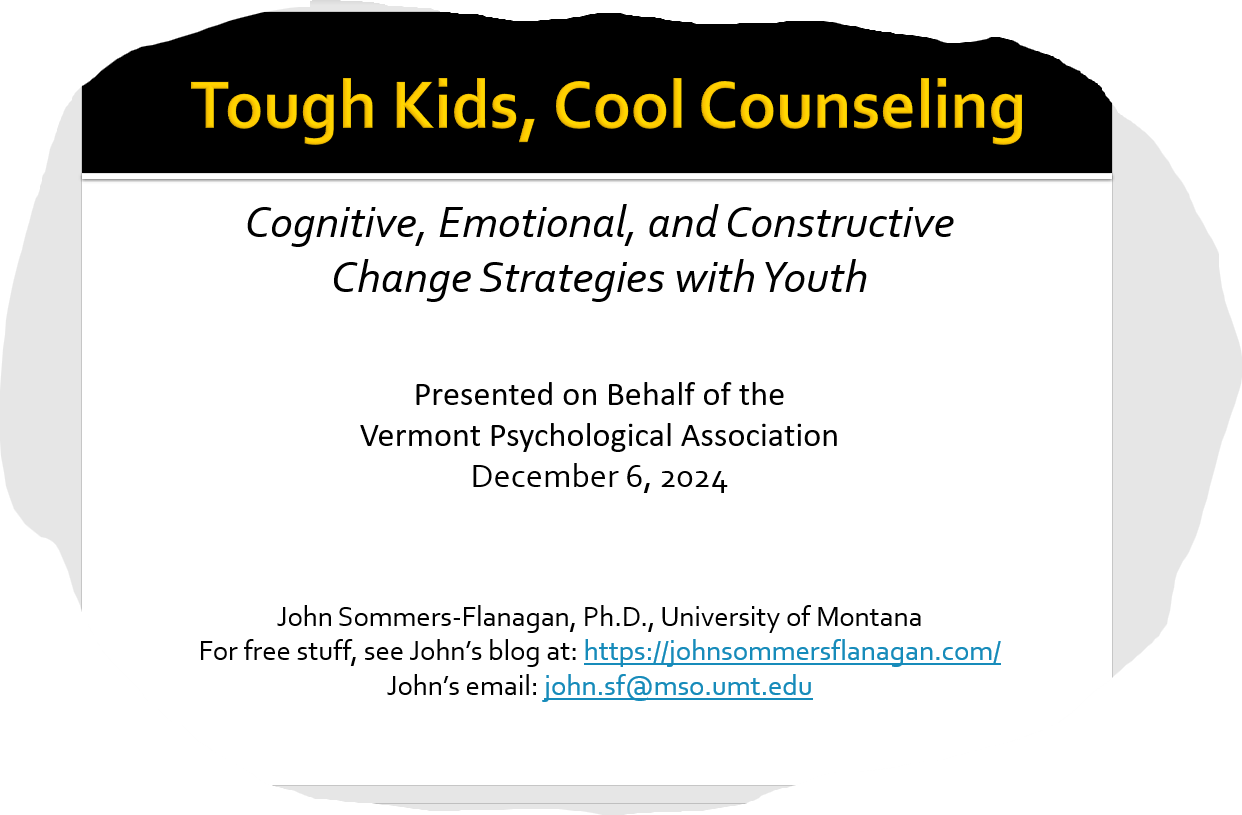
So-Called “Tough Kids” in Vermont: The PPTs

Hi All,

I’m virtually in Vermont tomorrow doing an all-day-long workshop on working with so-called challenging youth in counseling and psychotherapy. We start at 8am Mountain Time . . . and 10am on the East coast. Here’s the link to register for the workshop for anyone who suddenly has found themselves with a wide open day. The cost is: $195.

https://twinstates.ce21.com/item/tough-kids-cool-counseling-131540

And for those of you attending the workshop (or anyone who’s feeling nosy) here are the generic ppts (without the active video links):

Tough Kids, Cool Counseling — An Online Workshop – Dec 6, 2024

My wife (Rita) and I used to argue over who came up with the catchy “Tough Kids, Cool Counseling” title for our 1997/2007 book with the American Counseling Association. I would swear it was MY grand idea; she would swear back that it was HER idea. If any of you are in–or have been in–romantic partnerships, perhaps you can relate to disagreements over who has all the best ideas. I doubt that this dynamic is unique to Rita and me.

Years passed . . . and now I’ve come to very much dislike the title. . . leading me to give Rita ALL THE CREDIT! You’ve got it Rita! It was all you!

Despite my dislike for the title, I still sometimes use it for workshops. Why might that be, you may be wondering? Good question. I use it so I can make the point, early in the workshop, that we should NEVER use language that blames young people for their problems or their problem behaviors. In fact, we should never even “think” thoughts that assign blame to them for being “tough.”

My reasoning for this is informed by constructive theory and narrative therapy. When we assign blame and responsibility to young people for being “tough” or “difficult” or “challenging,” we risk contributing to them holding a tough, difficult, or challenging identity–which is exactly the opposite of what we want to be doing. Instead, I tell my workshop participants that we should recognize, there are no “tough kids” . . . there are only kids in tough situations . . . and being in counseling or psychotherapy is just another tough situation that young people have to face. Consequently, it’s NOT their fault if they engage in so-called tough or challenging behaviors.

All this leads me to share that I’ll be online all day on December 6, 2024, doing a workshop for mental health professionals. The workshop, anachronistically titled, “Tough Kids, Cool Counseling” is sponsored by the Vermont Psychological Association. You can register for the workshop here: https://twinstates.ce21.com/item/tough-kids-cool-counseling-131540

Even if I do say so myself, I’m proclaiming here and now that this will be a very engaging online workshop. If you work with youth (ages 10-18) in counseling or psychotherapy, and you need/want some year-ending CEUs, we’ll be having some virtual fun on December 6, and I hope you can join in.

Cultural Self-Awareness in the Clinical Interview

To continue with my plan to feature culturally diverse case examples from the latest edition of Clinical Interviewing, the following excerpt is from Chapter One and focuses on cultural self-awareness. In particular, I LOVE the quotation on intersectionality from Kimberlé Crenshaw.

Cultural Self-Awareness

Those who have power appear to have no culture, whereas those without power are seen as cultural beings, or “ethnic.” (Fontes, 2008, p. 25)

Culture and self-awareness interface in many ways. As Fontes (2008) implied, individuals from dominant cultures tend to be unaware of and often resistant to becoming aware of their invisible and unearned culturally-based advantages (Sue et al., 2020). In the U.S., these “unearned assets” are often referred to as privilege in general, and White privilege in particular (McIntosh, 1998).

Privilege and oppression are best understood in the context of intersectionality. Intersectionality is the idea that overlapping or intersecting social identities within individuals create whole persons that are different from the sum of their parts (Crenshaw, 1989). Social identities that intersect include, but are not limited to: Gender, sexual orientation, sexual identity, race, ethnicity, religion, nationality, mental disorder, physical disability/illness, citizenship, and social class (Hays, 2022). Understanding multiple social identities helps clinicians understand how feelings of oppression can multiply, be activated under distinct circumstances, and be moderated under other circumstances.

Kimberlé Crenshaw (1989, 1991) introduced intersectionality as a lens to facilitate cultural awareness and understanding, but ideas about intersectionality date back at least to Black female abolitionists. In the 1860s, Sojourner Truth articulated Black women’s simultaneous oppression through classism, racism, and sexism (aka “Triple oppression”; Boyce Davies, 2008). Thirty years after she defined intersectionality, Time Magazine asked Crenshaw, “You introduced intersectionality more than 30 years ago. How do you explain what it means today?” (Steinmetz, 2020). She said,

These days, I start with what it’s not, because there has been distortion. It’s not identity politics on steroids. It is not a mechanism to turn white men into the new pariahs. It’s basically a lens, a prism, for seeing the way in which various forms of inequality often operate together and exacerbate each other. We tend to talk about race inequality as separate from inequality based on gender, class, sexuality or immigrant status. What’s often missing is how some people are subject to all of these, and the experience is not just the sum of its parts.

Through the lens of intersectionality, we can develop nuanced ways to have empathy for clients. For example, sometimes clients simultaneously feel privilege and oppression. Thinking and feeling from an intersectional frame can help clinicians be more prepared to view the world from clients’ perspectives (see Case Example 1.2).

CASE EXAMPLE 1.2: EMPATHY FIRST

Maya, an international student of color was in her first practicum. As was her routine, when introducing herself, she acknowledged her accent, her country of origin, along with her eagerness to be of assistance. Her client, a cisgender male university student, was initially polite, but quickly shifted the conversation to his feelings about White privilege, becoming somewhat agitated in the process. He said, “One thing I think you should know that I don’t believe in that White privilege thing. I just came from a class where that’s all everyone was talking about. I know I’m white, but I didn’t get any privilege. I grew up in a trailer park in West Texas. We were what they call ‘White trash.’ Nobody I grew up with had any privilege. We had poverty, abuse, alcoholism, meth, and government bullshit.”

Maya stayed calm. Even though she was activated by her client’s disclosure and was taking some of what he said personally, she focused on empathy first. She also remembered intersectionality and how common it could be for people to have multiple social identities. She said, “I hear you saying that the White privilege concept really doesn’t fit for you. Being in your very last class before coming here made you realize even more that it doesn’t fit. The idea of trying to make it fit feels annoying.”

Maya’s client simply said, “Damn right,” and continued ranting about White privilege, White fragility, and what he viewed as the politically correct environment at the university. As she continued listening and tried feeling along with him, she was able to see glimpses of his personal perspective. Not surprisingly, Maya’s client had social problems related to his tendency to be angry and abrasive. Eventually, after several sessions, they were able to begin talking about what was underneath his agitated emotional response to multicultural ideas and how his tendency to lead with his anger when in conversations with others might be contributing to him feeling even more isolated and different than everyone else. In the end, the client thanked Maya for “being patient with this dumb ass White boy” and helping him learn to be more aware, softer, and less reactive to triggering cultural conversations.

This case illustrates the importance of intersectionality as a concept that can facilitate counselor and client awareness, while also enhancing empathy. Although Maya’s client may have had even worse oppressive experiences had he been a person of color, he was neither interested nor ready to hear that message (Quarles & Bozarth, 2022). Instead, Maya used her knowledge of intersectionality to have empathy with the part of her client’s social identity that had experienced oppression.

Developing cultural self-awareness is difficult. One way of expressing this is to note, “We don’t know what we don’t know.” When someone tries to help us see and understand something about ourselves that’s outside our awareness, it’s easy to feel defensive. Despite the challenges, we encourage you to be as eager for change and growth as possible, and offer three recommendations:

  1. Be open to exploring your own cultural identity. Gaining greater awareness of your ethnicity is useful.
  2. If you’re from the dominant culture, be open to exploring your privilege (e.g., White privilege, wealth privilege, health privilege) as well as hidden ways that you might judge or have bias toward diverse groups and individuals (e.g., transgender, disabled).
  3. If you’re outside the dominant culture, be open to discovering ways to have empathy not only for members within your group, but also for other diversities and for the struggles that dominant cultural group members might have as they navigate challenges of increasing cultural awareness. Engaging in mutual empathy is a cornerstone of relational cultural psychotherapy (Gómez, 2020).

[End of Case Example 1.2]

Culture-Specific Expertise in Clinical Interviewing

For the next several weeks I’ll be sharing from our almost new 7th edition of Clinical Interviewing.
One of our goals for the 7th edition of Clinical Interviewing is to move toward greater representation of different ethnic/cultural/sexual identities. We want all potential counseling, psychology, and social work students to be able to identify with counseling, psychology, and social work professionals. To accomplish this goal, we added greater representation by broadening our usual chapter content, as well as including case examples contributed by professionals with diverse identities.
Here’s an excerpt from Chapter 1 on culture-specific expertise

******************************************

Culture-Specific Expertise

Culture-specific expertise speaks to the need for clinicians to learn skills for working effectively with diverse populations. For example, learning the attitudes and skills associated with affirmative therapy is important for clinicians working with diverse sexualities, including lesbian, gay, bisexual, transgender, queer/questioning (sexual or gender identity), intersex, and asexual/aromantic/agender (LGBTQIA+) clients (Heck et al., 2013). Similarly, integrating skills for talking about spiritual constructs into your work with African American, Latinx, Indigenous, and traditionally religious clients is often essential (Mandelkow et al., 2021; Sandage & Strawn, 2022).

Stanley Sue (1998, 2006) described two general skills for working with diverse cultures: (a) scientific mindedness and (b) dynamic sizing.

Scientific mindedness involves forming and testing hypotheses about client culture, rather than coming to premature conclusions. Although many human experiences are universal, it’s risky to assume you know the underlying meaning of your clients’ behavior, especially minoritized clients. As Case Example 1.3 illustrates, culturally sensitive clinicians avoid stereotypic generalizations.

Dynamic sizing is a complex multicultural concept that guides clinicians on when they should and should not generalize based on an individual client’s belonging to a specific cultural group. For example, filial piety is a value associated with certain Asian families and cultures (Ge, 2021). Filial piety involves the honoring and caring for one’s parents and ancestors. However, it would be naïve to assume that all Asian people believe in or have their lives affected by this particular value; making such an assumption can inaccurately influence your expectations of client behavior. At the same time, you would be remiss if you were uninformed about the power of filial piety in some families and the possibility that it might play a large role in relationship and career decisions in many Asians’ lives. When clinicians use dynamic sizing appropriately, they remain open to significant cultural influences, but they minimize the pitfalls of stereotyping clients.

Another facet of dynamic sizing involves therapists’ knowing when to generalize their own experiences to their clients. S. Sue (2006) explained that it’s possible for clinicians who have experienced discrimination and prejudice to use their experiences to more fully understand the discrimination-related struggles of clients. However, having had experiences similar to a client may cause you to project your own thoughts and feelings onto that client—instead of drawing out the client’s emotions and showing empathy. Dynamic sizing requires that you know and understand and not know and not understand at the same time. Not knowing—or at least not presuming you know—is essential to interviewer-client collaboration.

CASE EXAMPLE 1.3: NOT AT HOME ANYWHERE

In this case, Devika Dibya Choudhuri, Ph.D., LPC (CT/MI), a self-described Buddhist, South Asian, cisfemale, middle-aged, middle-class, Queer, disabled counselor and professor at Eastern Michigan University, illustrates sophisticated cultural-specific expertise in cross-cultural work with a bi-cultural college student. Dr. Choudhuri uses self-disclosure, researches her client’s culture, and integrates culturally meaningful symbols into her sessions. Imagine how you can aspire to be like Dr. Choudhuri.

Darla, a 19-year-old Ghanian-American cisfemale college student, felt something was wrong with her. Her mother was from Ghana, while her father, with whom she had little contact, was generationally African American. She was halting in the first session, trying to decide whether she could trust me, and talking about her recent visit to Accra where her mother’s family lived. I said, “I know when I go to India, I’m American, and when I’m here, I’m Indian. Is it a bit like that for you?” She emphatically replied, “Yes! I’m not at home anywhere!” “Or,” I returned, “almost at home everywhere, like the rest of us global nomads.” She laughed, then spoke far more comfortably about her friends and boyfriend. I had, in that brief exchange, told Darla very important things about me. I self-disclosed casually about my ethnicity and international navigation, normalized her sense of homelessness, while reframing it to join a new group identity.

After having done some research, I asked Darla if her Ghanian kin were the majority Akan or a minority group. She said they were minority. I reflected on whether she might have picked up a sense of marginalization, not just from being Black in America, but also from being minority in Ghana. This became a deep and intense conversation. She reflected on how her American status in Ghana protected her from discrimination, but also alienated her from her cousins.

Another use of culture as intervention came when I brought in Adinkra (visual pictograph meaning saturated symbols originating in Ghana) for her use. Darla chose four to represent her aspirations, and then designed ways to use them in her daily life, incorporating her cultural roots into her present. One of them, Sankofa, is a symbol of the wisdom of learning from the past to build for the future; expressed in the proverb, “it is not taboo to go back for what you left behind.” Feeling grounded in multiple cultures, and being able to navigate from one context to another with her whole and complex self, rather than fragmenting, led her to see she wasn’t “wrong.” Sometimes the spaces were too limited; it was ok to fit and not fit, just as leftover food on a Ghanian table represented abundance.

[End of Case Example 1.3]

******************************************

As always, feel free to share your thoughts on and reactions to this content. We’re always looking for practical feedback that will help us continue to become better learners and teachers.