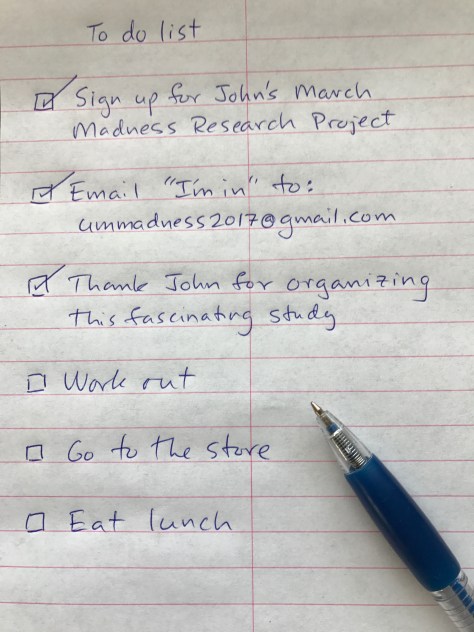
Do You Want to Participate in The March Madness Research Project?

Madness 2017

If your answer is yes . . . here’s what you should do and what will happen:

  1. Email: ummadness2017@gmail.com and say “Yes, I’m in”
  2. You will be randomly assigned to one of three “March Madness Bracket Training” groups:
    • Relaxation and focusing
    • Hypnosis to view the games from the future
    • Educational information
  3. You will receive an email telling you where to meet. All groups will meet on campus at the University of Montana in a specific room in the Phyllis J. Washington College of Education building at 7pm on Tuesday evening, March 14.
  4. Show up at your designated room. When you arrive, you will fill out an informed consent form, a March Madness bracket, and complete a short questionnaire.
  5. Then you will participate in the training.
  6. After the training, you will complete another bracket
  7. You will leave your completed packet and your brackets with the researcher and it will be uploaded in to the ESPN Tournament Challenge website [we will need your email address to upload your selections into the ESPN system]
  8. You will receive information at the “Training” on how to login and track your bracket. If you lose or misplace this information, you can request an additional copy via email: ummadness2017@gmail.com

To sign up for this research project, email:

UMmadness2017@gmail.com

Let’s Do the Sex Talk Again

Rita Reading

Now, more than ever, we need to actively teach children about healthy and safe sexual behaviors. Why now?

First, pornography (which is arguably NOT the best sex education source for our children) is extremely easy to access.

Second, a former reality show star who was recently elected President has made statements that are likely to reinforce archaic ideas about female bodies being grabbed and groped and objectified–all in the interest of male pleasure. Personally, I’m against that message and hope you are too.

Third, parents have an important role in protecting their children from the range of different sexually transmitted diseases are associated with unprotected sex.

Fourth, well . . . why would anyone not want to actively teach children about healthy and safe sexual behaviors?

In the 10th episode of the Practically Perfect Parenting Podcast (PPPP), Dr. Sara Polanchek and I discuss why and how parents and caregivers should “. . . do the sex talk again and again.” Given the ubiquity of sex in the media, parents can’t afford to ignore this important topic. No longer is it good enough for parents or caregivers to toss an old sex education book into their child’s room and then hope that healthy sexual learning will magically occur.

Parents need to be brave. Parents need to face their own sexual issues and hang-ups. To get started, parents might want to listen to our latest PPPP episode titled: “Let’s do the sex talk again.”

Here’s the link to iTunes: https://itunes.apple.com/us/podcast/practically-perfect-parenting-podcast/id1170841304?mt=2

Here’s the link to Lisbyn: http://practicallyperfectparenting.libsyn.com/

Please forward this post and these links to parents or guardians or grandparents who you think might benefit. Feel free to ask questions and engage in discussion. Our podcast offers ideas about how to get more comfortable with this exceptionally important topic. Listening to it is a reasonably good way to spend 28 minutes of your life.

Dear National Review: I’ll help you get government out of parenting if you’ll stop letting bad journalists write articles.

Naked Babies II

A little over two months ago I got all worked up over an article on parenting published in the National Review that I thought was a little too “pro-child abuse” for my taste. I sent them a query about publishing it right away. Their editor responded a couple weeks later, asking to read the piece. Then he politely declined it, noting it was a bit stale (meaning too much time had passed). Of course, it got stale because he sat on it for two weeks. But I figure he didn’t want to publish it anyway, since I basically accused his writer of writing fake news and supporting child abuse.

So . . . I decided to send it to myself. And, after sitting on it for another six weeks, I’m publishing it because it’s crunchy like a piece of old stale bread.

Setting the Record Straight on Government

Interference in Parental Rights

John Sommers-Flanagan, Ph.D.

Abby Schachter’s National Review article (12/26/16) titled, “Why is the government telling us how to raise our kids?” is troubling on many levels.

To start, Ms. Schachter’s headline is inaccurate and misleading. The National Review deserves better than that. In reality, the government isn’t trying to tell parents how to raise their children. An accurate headline would have read, “Why is the government telling us how NOT to raise our kids?”

This is still an important question and begs for a clarification between laws that mandate behavior (e.g., seat belts and registration under the Affordable Care Act) and laws that prohibit behavior (e.g., driving while intoxicated and physical or sexual abuse of minor children). Laws that protect children from abuse are laws that prohibit particular (and unusual) parenting behaviors; they don’t mandate specific parenting behaviors. As is well known, laws mandating specific behaviors—whether within the realm of parenting or focusing on other citizen behaviors—are aligned with tyrannical governments. However, government policies that Schachter mocks in her article are legal efforts designed to protect children from parental abuse and neglect. Is it possible for the government to over-reach in that area? Absolutely yes! But Schachter’s complaints of “bureaucratic busybodies” miss the point and put children at further risk.

Schachter’s complaints about rampant government meddling with good-enough parenting represent a narrow perspective. The historical and current prevalence of child abuse and neglect is stunning. Even the usually stoic Sigmund Freud was shaken after viewing abused children’s bodies at the Paris Morgue in 1885. Child abuse is ugly and disturbing and children need protection. Schachter’s defense of parental rights at the risk of overlooking neglect and abuse implies that she hasn’t seen or appreciated the extent of child abuse in America. Her rhetoric could be interpreted as suggesting that child abuse and neglect should be legal variants of parental rights. I’m sure that’s not her intent.

There’s also a mathematical component to Schachter’s misunderstanding. Government laws prohibiting parental abuse and neglect are a best effort at predicting and therefore reducing child abuse. Schachter’s complaints stem from real cases, but her personal interpretation of the problems reflects no understanding of math and the Bayesian Theorem. To take her position, Schachter must assume the base rates of child abuse and neglect are extremely low, so low that parents and children might be better served if child abuse laws were eliminated. But the facts belie this perspective. According to the Children’s Defense Fund, over 1,800 incidents of child abuse occur every day in the U.S. Even assuming this is an overestimation and the real rates are 20% lower, this still translates to 1,440 abuse incidents daily or 60 per hour or 1 per minute. Let’s assume that Schachter is correct and some laws are an overreach and result in false positive identification of parents as abusive or neglectful. How many times do you suppose false government accusations occur per hour in the U.S.? Do we have 60 parents falsely accused of child abuse per hour? Not even close. But if we embrace Schachter’s position, we protect parental rights and risk a massive increase in unreported child abuse and neglect.

For my money, I’d rather have a few parents deal with the emotional pain of government hassles than to have children deal with the pain of parental neglect or physical and sexual abuse. Over four children a day die from parental maltreatment. I’m betting Schachter can’t find four cases a week like the one she covered in her article.

In the end, I agree with Schachter that government interference in good-enough parenting is wrong. But I also know that in the time it took you to read this article at least five more children in the U.S. experienced abuse or neglect. Parental rights shouldn’t be needlessly usurped. However, in this case, I’m siding with thousands of abused and neglected children over the rights of a relatively small number of parents.

************************************

John Sommers-Flanagan is a clinical psychologist and professor of counselor education at the University of Montana. He’s the author of eight books, including How to Listen so Parents will Talk and Talk so Parents will Listen (John Wiley & Sons).

A Brief Description of Motivational Interviewing

In response to some questions on CESNET, I’m posting a brief description of Motivational Interviewing. Of course, Miller and Rollnick’s Motivational Interviewing text is a much more thorough source and is highly recommended if you want more complete information.

This description is an excerpt from the second edition of our Counseling and Psychotherapy Theories textbook. If you’re interested, you can check it out here: http://bcs.wiley.com/he-bcs/Books?action=index&itemId=0470617934&bcsId=7103

For the third edition (in preparation now), we’ll be substantially expanding this section and so if you have insights, publications, or other information that you think we should be aware of, please email me at john.sf@mso.umt.edu.

Here’s the excerpt:

Motivational Interviewing: A Contemporary PCT Approach

Person-Centered Therapy (PCT) principles have been integrated into most other approaches to counseling and psychotherapy. However, there are three specific approaches that are explicitly new generation person-centered therapies. These include:

  1. Motivational interviewing
  2. Emotion-focused therapy
  3. Nondirective play therapy

Next, we discuss motivational interviewing. Due to its strong integrational characteristics, emotion-focused therapy is covered in Chapter 14. Additional resources are available on nondirective play therapy (Landreth, 2002).

Moving Away From Confrontation and Education

In his research with problem drinkers, William R. Miller was studying the efficacy of behavioral self-control techniques. To his surprise, he found that structured behavioral treatments were no more effective than an encouragement-based control group. When he explored the data for an explanation, he found that regardless of treatment protocol, therapist empathy ratings were the strongest predictors of positive outcomes at 6 months (r = .82), 12 months (r = .71), and 2 years (r = .51; W. R. Miller, 1978; W. R. Miller & Taylor, 1980). Consequently, he concluded that positive treatment outcomes with problem drinkers were less related to behavioral treatment and more related to reflective listening and empathy. He also found that active confrontation and education generally led to client resistance. These discoveries led him to develop motivational interviewing (MI).

MI builds on person-centered principles by adding more focused therapeutic targets and specific client goals. Rollnick and Miller (1995) define MI as “a directive, client-centered counseling style for eliciting behavior change by helping clients to explore and resolve ambivalence” (p. 326).

Focusing on Client Ambivalence

Client ambivalence is the primary target of MI. When it comes to substance abuse and other health related behaviors, Miller and Rollnick (2002) view ambivalence as natural. Most all problem drinkers recognize or wish they could quit, but continue drinking for various reasons. Miller and Rollnick described what happens when therapists try to push healthy behaviors on clients:

[The therapist] then proceeds to advise, teach, persuade, counsel or argue for this particular resolution to [the client’s] ambivalence. One does not need a doctorate in psychology to anticipate what [the client’s] response is likely to be in this situation. By virtue of ambivalence, [the client] is apt to argue the opposite, or at least point out problems and shortcomings of the proposed solution. It is natural for [the client] to do so, because [he or she] feels at least two ways about this or almost any prescribed solution. It is the very nature of ambivalence. (pp. 20–21)

In many situations, humans are naturally inclined to resist authority. Therefore, when resistance rises up in clients, MI advocates person-centered attitudes and interventions. This leads to Miller and Rollnick’s (2002) foundational person-centered principle of treatment:

It is the client who should be voicing the arguments for change (p. 22).

Although Miller and Rollnick describe Rogers as collaborative, caring, and supportive—they emphasize that he was not nondirective (W. R. Miller & Rollnick, 1998). Instead, they note that Rogers gently guided clients to places where they were most confused, in pain, or agitated and then helped them stay in that place and work through it. The four central principles of MI flow from their conceptualization of Rogers’s approach (W. R. Miller & Rollnick, 2002). According to these principles, it’s the therapist’s job to:

  • Use reflective listening skills to express empathy for the client’s message and genuine caring for the client.
  • Notice and develop the theme of discrepancy between the client’s deep values and current behavior.
  • Meet client resistance with reflection rather than confrontation (Miller and Rollnick refer to this as “rolling with resistance”).
  • Enhance client self-efficacy by focusing on optimism, confidence that change is possible, and small interventions that are likely to be successful.

MI is both a set of techniques and a person-centered philosophy or style. The philosophical MI perspective emphasizes that motivation for change is not something therapists can effectively impose on clients. Change must be drawn out from clients, gently and with careful timing. Motivational interviewers do not use direct persuasion.

A Sampling of MI Techniques

Miller and Rollnick (2002) provide many excellent examples of how reflection responses reduce resistance. The following interactions capture how reflection of client efforts lessens the need for resistance:

Client: I’m trying! If my probation officer would just get off my back, I could focus on getting my life in order.

Interviewer: You’re working hard on the changes you need to make.

or

Interviewer: It’s frustrating to have a probation officer looking over your shoulder.

Client: Who are you to be giving me advice? What do you know about drugs? You’ve probably never even smoked a joint!

Interviewer: It’s hard to imagine how I could possibly understand.

Client: I couldn’t keep the weight off even if I lost it.

Interviewer: You can’t see any way that would work for you.

or

Interviewer: You’re rather discouraged about trying again. (pp. 100–101)

In the following excerpt from Clinical Interviewing (2009), we describe the MI technique of amplified reflection:

Recently, in hundreds of brief interviews conducted by graduate students in psychology and counseling with client—volunteers from introductory psychology courses, consistent with Miller and Rollnick’s (2002) motivational interviewing work, we found that clients have a strong need for their interviewers to accurately hear what they’re saying. When their interviewer made an inaccurate reflection, clients felt compelled to clarify their feelings and beliefs—often in ways that rebalanced their ambivalence.

For example, when an interviewer “went too far” with a reflection, the following exchange was typical:

Client: I am so pissed at my roommate. She won’t pick up her clothes or do the dishes or anything.

Interviewer: You’d sort of like to fire her as a roommate.

Client: No. Not exactly. There are lots of things I like about her, but her messiness really annoys me.

This phenomenon suggests that it might be possible for interviewers to intentionally overstate a client’s position in an effort to get clients to come back around to clarify or articulate the more positive side of an issue. In fact, this is a particular motivational interviewing technique referred to as amplified reflection.

When used intentionally, amplified reflection can seem manipulative, which is why amplified reflection is used along with genuine empathy. Instead of being a manipulative response it can also be viewed as an effort on the interviewer’s part to more deeply empathize with the client’s frustration, anger, discouragement, and so on. Examples of this technique include:

Client: My child has a serious disability and so I have to be home for him.

Interviewer: You really need to be home 24/7 and really need to turn off any needs you have to get out and take a break.

Client: Actually, that’s not totally true. Sometimes, I think I need to take some breaks so I can do a better job when I am home.

Client: When my grandmother died last semester I had to miss classes and it was a total hassle.

Interviewer: You don’t have much of an emotional response to your grandmother’s death—other than it really inconveniencing you.

Client: Well, it’s not like I don’t miss her, too.

Again, we should emphasize that amplified reflection is an empathic effort to get completely in touch with or resonate with one side of the client’s ambivalence (from J. Sommers-Flanagan & Sommers-Flanagan, 2009, pp. 316–317).

End of excerpt

Post-Partum (now Peripartum) Depression: What you should know . . . and some resources to help you know it

Note: This post is provided for individuals interested in learning more about post-partum or peripartum depression. It’s also a supplement for the recent Practically Perfect Parenting Podcast on “Post-Partum Depression.” You can listen to the podcast on iTunes: https://itunes.apple.com/us/podcast/practically-perfect-parenting/id1170841304?mt=2

stillwater-winter-view

For the first time ever on planet Earth, the latest version of the Diagnostic and Statistical Manual of Mental Disorders (DSM-5) includes the diagnosis of Peripartum Depression. Although I’m not usually a fan of labeling or big psychiatry, this is generally good news.

So, why is Peripartum Depression good news?

The truth is that many pregnant women and new moms experience depressive symptoms related to pregnancy and childbirth. These symptoms are beyond the normal and transient “baby blues.” Depressive symptoms can be anywhere from mild to severe and, combined with the rigors of pregnancy, childbirth, and parenting a newborn, these symptoms become very difficult to shake.

But the most important point is that Peripartum Depression is a problem that has been flying under the RADAR for a very long time.

Approximately 20% of pregnant women struggle with depressive symptoms. The official 12-15% estimates of post-partum (after birth) depression in women are thought to be an underestimate. What makes these numbers even worse is the fact that society views childbirth as a dramatically positive life event. This makes it all-the-more difficult for most pregnant women and new moms to speak openly about their emotional pain and misery. And, as you probably know, when people feel they shouldn’t talk about their emotional pain, it makes getting the help they deserve and recovering from depression even more difficult.

Jane Honikman, a post-partum depression survivor and founder of Postpartum Support International has three universal messages for all couples and families. She says:

  • You’re not alone
  • It’s not your fault
  • You will be well

Keep in mind that although peripartum depression is thought to have strong biological roots, the first-line treatment of choice is psychotherapy. This is because many new moms are reluctant to take antidepressant medications, but also because psychotherapy is effective in directly addressing the social and contextual factors, as well as the physiological symptoms. Additionally, as Ms. Honikman emphasizes, support groups for post-partum depression can be transformative.

Below, I’m including links and resources related to peripartum or post-partum depression.

*************

A very helpful informational post by Dr. Nicola Gray: http://cognitive-psychiatry.com/peripartum-depression/

Books by Jane Honikman can be found at this Amazon link. Her books include: I’m Listening: A Guide to Supporting Postpartum Families.  https://www.amazon.com/s/ref=dp_byline_sr_book_1?ie=UTF8&text=Jane+I.+Honikman&search-alias=books&field-author=Jane+I.+Honikman&sort=relevancerank

Although it’s true that peripartum depression can be debilitating, it’s also true that it can be a source of personal growth. Dr. Walker Karraa shares optimistic stories of post-partum related trauma and growth in her book:

https://www.amazon.com/Walker-Karraa/e/B00QTWH9PW/ref=dp_byline_cont_book_1


More Methods for Discussing Suicide with Mental Health Clients

nick-nacksNearly everyone agrees that asking clients directly about suicide is the right thing. However, because every client situation is unique, there are also many different strategies for asking about suicide. In this short excerpt from Clinical Interviewing, we discuss how to bring up suicide using information from outside of the counseling or assessment session.

Using Outside Information to initiate Risk and Protective Factor Assessment

Outside of the formal suicide assessment interview, three main sources of information can be used to initiate a discussion with clients about suicide risk and protective factors:

  1. Client Records
  2. Assessment Instruments
  3. Collateral Informants

Client Records

If available, your client’s previous medical or mental health (med-psych) records are a quick and efficient source for client risk and protective factor information. Many risk factors listed in this chapter won’t be in your client’s records, but you should look closely for factors, such as: (a) previous suicide ideation and attempts; (b) a history of a depression diagnosis; and (c) familial suicide. After your standard intake interviewing opening and rapport building, you can use the records to broach these issues.

I saw in your records that you attempted suicide back in 2012. Could you tell me what was going on in your life back then to trigger that attempt? 

When exploring previous suicide attempts, it’s important to do so in a constructive manner that can contribute to treatment (see Case Example 10.2). Using psychoeducation to explain to clients why you’re asking about the past helps frame and facilitate the process.

The reason I’m asking about your previous suicide attempt is because the latest research indicates that the more we know about the specific stresses that triggered a past attempt, the better we can work together to help you cope with that stress now and in the future. 

Don’t forget to balance your questioning about previous suicide attempts with a focus on the positive.

Often, after a suicide attempt, people say they discovered some new strengths or resources or specific people who were especially helpful. How about for you? Did you have anything positive you discovered in the time after your suicide attempt.

It may be difficult to identify protective factors in your client’s med-psych records. However, if you find evidence of protective factors or personal strengths, you should bring them up in the appropriate context during a suicide assessment interview. For example, when interviewing a client who’s talking about despair associated with a current depressive episode, you might say something like:

I noticed in your records that you had a similar time a couple years ago when you were feeling very down and discouraged. And, according to your therapist back then, you worked very hard and managed to climb back up out of that depressing place. What worked for you back then?

Strive to use information from your clients’ records collaboratively. As illustrated, you can use the information to broach delicate issues (both positive and negative).

Traditionally, previous suicide attempts are considered one of the strongest predictors of future suicidal behaviors. However, as with all risk factors, previous attempts should be considered within the idiosyncratic context of each individual client. Case example 10.2 provides a glimpse of a case where a previous attempt ends up serving as a protective factor, rather than a risk factor.

Case Example 10.2

Exploring Previous Attempts as a Method for Understanding Client Stressors and Coping Strategies

Exploring previous suicide attempts is an assessment process. It can illuminate past stressors, but it’s equally useful for helping clients articulate past, present, and future coping responses.

Therapist: You wrote on your intake form that you attempted suicide about a year and a half ago. Can you tell me a bit about that?

Client: Right. I shot myself in the head. It’s obvious. You can see the scar right here.

Therapist: What was happening in your life that brought you to that point?

Client: I was getting bullied in school. I hated my step-father. Life was shit, so one day after school I took the pistol out of my mom’s room, aimed at my head and shot.

Therapist: What happened then?

Client: I woke up in the hospital with a bad fucking headache. And then there was rehab. It was a long road, but here I am.

Therapist: Right. Here you are. What do you make of that?

Client: I’m lucky. I’m bad at suicide. I don’t know. I suppose I took it to mean that I’m supposed to be alive.

Therapist: Have you had any thoughts about suicide recently?

Client: Nope. Nada. Not one.

Therapist: I guess from what you said that getting bullied or having family issues could still be hard for you. How do you cope with that now?

Client: I’ve got some friends. I’ve got my sister. I talk to them. You know, after you do what I did, you find out who really cares about you. Now I know.


Talking with Clients about Suicidal Thoughts and Feelings

fortunes

Spring is coming to the Northern Hemisphere. Along with spring, there will also be a bump in death by suicide. To help prepare counselors and clinicians to talk directly with clients about suicide, I’m posting an excerpt from the Clinical Interviewing text. The purpose is to help everyone be more comfortable talking about suicidal thoughts and feelings because the more comfortable we are, the more likely clients are to openly share their suicidal thoughts and feelings and that gives us a chance to engage them as a collaborative helper.

Here’s a link to the text https://www.amazon.com/Clinical-Interviewing-Video-Resource-Center/dp/1119084237/ref=asap_bc?ie=UTF8

And here’s the excerpt:

Exploring Suicide Ideation

Unlike many other risk factors (e.g., demographic factors), suicide ideation is directly linked to potential suicide behavior. It’s difficult to imagine anyone ever dying by suicide without having first experienced suicide ideation.

Because of this, you may decide to systematically ask every client about suicide ideation during initial clinical interviews. This is a conservative approach and guarantees you won’t face a situation where you should have asked about suicide, but didn’t. Alternatively, you may decide to weave questions about suicide ideation into clinical interviews as appropriate. At least initially, for developing professionals, we recommend using the systematic approach. However, we recognize that this can se0em rote. From our perspective, it is better to learn to ask artfully by doing it over and over than to fail to ask and regret it.

The nonverbal nature of communication has direct implications for how and when you ask about suicide ideation, depressive symptoms, previous attempts, and other emotionally laden issues. For example, it’s possible to ask: “Have you ever thought about suicide?” while nonverbally communicating to the client: “Please, please say no!” Therefore, before you decide how you’ll ask about suicide ideation, you need the right attitude about asking the question.

Individuals who have suicidal thoughts can be extremely sensitive to social judgment. They may have avoided sharing suicidal thoughts out of fear of being judged as “insane” or some other stigma. They’re likely monitoring you closely and gauging whether you’re someone to trust with this deeply intimate information. To pass this unspoken test of trust, it’s important to endorse, and directly or indirectly communicate the following beliefs:

  • Suicide ideation is normal and natural and counseling is a good place for clients to share those thoughts.
  • I can be of better help to clients if they tell me their emotional pain, distress, and suicidal thoughts.
  • I want my clients to share their suicidal thoughts.
  • If my clients share their suicidal thoughts and plans, I can handle it!

If you don’t embrace these beliefs, clients experiencing suicide ideation may choose to be less open.

Asking Directly about Suicide Ideation

Asking about suicide ideation may feel awkward. Learning to ask difficult questions in a deliberate, compassionate, professional, and calm manner requires practice. It also may help to know that, in a study by Hahn and Marks (1996), 97% of previously suicidal clients were either receptive or neutral about discussing suicide with their therapists during intake sessions. It also may help to know that you’re about to learn the three most effective approaches to asking about suicide that exist on this planet.

Use a normalizing frame. Most modern prevention and intervention programs recommend directly asking clients something like, “Have you been thinking about suicide recently?” This is an adequate approach if you’re in a situation with someone you know well and from whom you can expect an honest response.

A more nuanced approach is to ask about suicide along with a normalizing or universalizing statement about suicide ideation. Here’s the classic example:

Well, I asked this question since almost all people at one time or another during their lives have thought about suicide. There is nothing abnormal about the thought. In fact it is very normal when one feels so down in the dumps. The thought itself is not harmful. (Wollersheim, 1974, p. 223)

Three more examples of using a normalizing frame follow:

  • I’ve read that up to 50% of teenagers have thought about suicide. Is that true for you?
  • Sometimes when people are down or feeling miserable, they think about suicide and reject the idea or they think about suicide as a solution. Have you had either of these thoughts about suicide?
  • I have a practice of asking everyone I meet with about suicide and so I’m going to ask you: Have you had thoughts about death or suicide?

A common fear is that asking about suicide will put suicidal ideas in clients’ heads. There’s no evidence to support this  (Jobes, 2006). More likely, your invitation to share suicidal thoughts will reassure clients that you’re comfortable with the subject, in control of the situation, and capable of dealing with the problem.

Use gentle assumption. Based on over two decades of clinical experience with suicide assessment Shawn Shea (2002/ 2004/2015) recommends using a framing strategy referred to as gentle assumption. To use gentle assumption, the interviewer presumes that certain illegal or embarrassing behaviors are already occurring in the client’s life, and gently structures questions accordingly. For example, instead of asking “Have you been thinking about suicide?” you would ask:

When was the last time when you had thoughts about suicide?

Gentle assumption can make it easier for clients to disclose suicide ideation.

Use mood ratings with a suicidal floor. It can be helpful to ask about suicide in the context of a mood assessment (as in a mental status examination). Scaling questions such as those that follow can be used to empathically assess mood levels.

  1. Is it okay if I ask some questions about your mood? (This is an invitation for collaboration; clients can say “no,” but rarely do.)
  2. Please rate your mood right now, using a zero to 10 scale. Zero is the worst mood possible. In fact, zero would mean you’re totally depressed and so you’re just going to kill yourself. At the top, 10 is your best possible mood. A 10 would mean you’re as happy as you could possibly be. Maybe you would be dancing or singing or doing whatever you do when you’re extremely happy. Using that zero to 10 scale, what rating would you give your mood right now? (Each end of the scale must be anchored for mutual understanding.)
  3. What’s happening now that makes you give your mood that rating? (This links the mood rating to the external situation.)
  4. What’s the worst or lowest mood rating you’ve ever had? (This informs the interviewer about the lowest lows.)
  5. What was happening back then to make you feel so down? (This links the lowest rating to the external situation and may lead to discussing previous attempts.)
  6. For you, what would be a normal mood rating on a normal day? (Clients define their normal.)
  7. Now tell me, what’s the best mood rating you think you’ve ever had? (The process ends with a positive mood rating.)
  8. What was happening that helped you have such a high mood rating? (The positive rating is linked to an external situation.)

The preceding protocol assumes clients are minimally cooperative. More advanced interviewing procedures can be added when clients are resistant (see Chapter 12). The process facilitates a deeper understanding of life events linked to negative moods and suicide ideation. This can lead to formal counseling or psychotherapy, as well as safety planning.

Responding to Suicide Ideation

Let’s say you broach the question and your client openly discloses the presence of suicide ideation. What next?

First, remember that hearing about your client’s suicide ideation is good news. It reflects trust. Also remember that depressive and suicidal symptoms are part of a normal response to distress. Validate and normalize:

Given the stress you’re experiencing, it’s not unusual for you to sometimes think about suicide. It sounds like things have been really hard lately.

This validation is important because many suicidal individuals feel socially disconnected, emotionally invalidated, and as if they’re a social burden (Joiner, 2005). Your empathic reflection may be more or less specific, depending on how much detailed information your client has given you.

As you continue the assessment, collaboratively explore the frequency, triggers, duration, and intensity of your client’s suicidal thoughts.

  • Frequency: How often do you find yourself thinking about suicide?
  • Triggers: What seems to trigger your suicidal thoughts? What gets them started?
  • Duration: How long do these thoughts stay with you once they start?
  • Intensity: How intense are your thoughts about suicide? Do they gently pop into your head or do they have lots of power and sort of smack you down?

As you explore the suicide ideation, strive to emanate calmness, and curiosity, rather than judgment. Instead of thinking, “We need to get rid of these thoughts,” engage in collaborative and empathic exploration.

Some clients will deny suicidal thoughts. If this happens, and it feels genuine, acknowledge and accept the denial, while noting that you were just using your standard practice.

Okay. Thanks. Asking about suicidal thoughts is just something I think is important to do with everyone.

On the other hand, if the denial seems forced, or is combined with depressive symptoms or other risk factors, you’ll still want to use acknowledgement and acceptance, but then find a way to return to the topic later in the session.


The White Privilege Piece for the Montana Psychological Association

Reblogging this in response to Michael Smerconish’s feature on CNN today.

johnsommersflanagan's avatarJohn Sommers-Flanagan

Michael Smerconish did a feature on White Privilege today on CNN. It was excellent and reminded me of this piece I’d written on White Privilege about 4 years ago. Check it out if you like this sort of thing.

A White, Male Psychologist Reflects on White Privilege

I’m a white male writing about white privilege. This irony makes the task all the more challenging.

Gyda Swaney asked if I would write this piece. This brings me mixed feelings. I am honored. I met Gyda in 1981 and I like and respect her as a person and as a Native American leader in Montana. But the fact that she thinks I might have something useful to say to psychologists about white privilege is humbling. Rarely have I been asked to write about something I know so well and understand so little.

On Invisibility

The challenge begins with the definition. White privilege…

View original post 912 more words

State Leadership in Education: A Missoulian Op-Ed Piece

Arntzen at opi meeting

Hi All.

I just had another op-ed piece published in the Missoulian Newspaper this morning. It’s about early childhood education. It may come as a surprise to you, but, along with John Adams, our second president, I’m a supporter of early childhood education.

If you’re interested in what John Adams and I think (we’re time-traveling buddies) about education, here’s the link: http://missoulian.com/news/opinion/columnists/state-leadership-in-education-our-children-deserve-better/article_fc8aeea4-7670-5a39-a7f5-bbb1c0875043.html

If you read it and like it, please pass on the link, especially to others in Montana and on Facebook and Twitter and all that.

Thanks . . . I’ll be getting back to the more normal counseling and psychology stuff soon.

John

The place to click if you want to learn about psychotherapy, counseling, or whatever John SF is thinking about.