Imagine the possibility of a scalable single-session intervention that has been shown to be effective with a wide range of mental health issues. In these days of widespread mental health crisis and overwhelmed healthcare and mental health providers, you might think that effective single-session interventions are a fantasy. But maybe not.
This morning, my older daughter emailed me a link to two videos from the lab of Dr. Jessica Schleider of Northwestern University. Dr. Schleider’s focus is on single-session therapeutic interventions. Although I hadn’t seen the website and videos, I was familiar with Dr. Schleider’s work and am already a big fan. Just to give you a feel for the range and potential of single-session interventions, below I’m sharing a bulleted list of titles and dates of a few of Dr. Schleider’s recent publications:
Realizing the untapped promise of single‐session interventions for eating disorders – 2023
In-person 1-day cognitive behavioral therapy-based workshops for postpartum depression: A randomized controlled trial – 2023
A randomized trial of online single-session interventions for adolescent depression during COVID-19 – 2022
An online, single-session intervention for adolescent self-injurious thoughts and behaviors: Results from a randomized trial – 2021
A single‐session growth mindset intervention for adolescent anxiety and depression: 9‐month outcomes of a randomized trial – 2018
Reducing risk for anxiety and depression in adolescents: Effects of a single-session intervention teaching that personality can change – 2016
Single-session therapy or interventions aren’t for everyone. Many people need more. However, given the current mental health crisis and shortage of available counselors and psychotherapists, having a single-session option is a great thing. As you can see from the preceding list, single-session interventions have excellent potential for effectively treating a wide range of mental health issues. Given this good news about single-session interventions, I’m now sharing with you that link my daughter shared with me: https://www.schleiderlab.org/labdirector.html
I’ve been interested in single-session interventions for many years. Just in case you’re interested, here’s a copy of my first venture into single-session research (it’s an empirical evaluation of a single-session parenting consultation intervention, published in 2007).
When I was teaching social skills to elementary school-aged youth, one boy couldn’t stop talking about himself. Because I wanted the students to be interactive with and interested in each other, I intervened.
“Ask a question about her.”
He nodded, in apparent understanding. Returning to the activity, he followed my instructions (sort of), immediately asking,
“What do you think of me?”
The question, “What do you think of me?” is powerful. We all wonder this, at least occasionally, and perhaps constantly. As I just wrote in a previous blog post, being seen and known by others is a profound experience. Having your strengths and positive qualities reflected back to you by others is a gift: https://johnsommersflanagan.com/2023/12/25/the-gift-of-being-seen/
The Natural Talent Interview requires vulnerability; it’s a challenging and potentially awkward assignment. I recommend it anyway. 😲
Here’s a link to the version of the Natural Talent Interview that we assign in the Happiness Course. Note: It includes a nice description of self-awareness and the Johari Window.
Irritability is a fascinating experience. It’s hard to perfectly describe, so I looked up the definition online. Dictionary says: “The quality or state of being irritable.” Hahaha. This is the sort of helpfulness I’ve been experiencing from the pesky universe lately. . . with the exception of the IT guy who helped me for 45 minutes a couple weeks ago. He was nice and tried to help, but sadly, I’m the guy who was once told by IT person at UM that maybe I had swallowed a magnet because of how well electronics work in my presence. Maybe it’s my magnetic personality? Even more hahaha.
Let’s get back to irritability. Lately, I’ve been beset with intermittent bouts of irritability, which, I understand is the quality or state of being irritable. The definition of irritable is more illuminating: “having or showing a tendency to be easily annoyed or made angry.”
Yes, I’ve got that. In my defense, there are SO MANY irritating things in the world.
But there’s really no good excuse for my irritability. I feel it burble up, usually in response to something psychologically, emotionally, or physically painful. I’ve had some chronic pain for the past three months, which makes it easier for my irritability button to get pushed. I’ve also had more than my share of tech problems.
After working out at the gym, a particular Dean whom I saw on campus, asked me, “Did you have a good workout?” I muttered something about never having good workouts anymore. Not surprisingly, he noticed my irritability. Then he shared a few Buddhist thoughts about “All is suffering” with me. Despite my internal lean toward being “easily annoyed” (even with my friend the Dean) I listened and immediately glimpsed my lifelong nemesis peeking at me from around the corner. No . . . it wasn’t the Dean, or Lee Jeffries the red-headed bully who tormented me in junior high. Strangely, my lifelong nemesis happens to be the nemesis of many. I’m betting it may be yours as well.
Given that our nemesis has multitudes, let’s give it the pronoun they. They have a name. Expectations.
My expectations are routinely laughably unrealistic. I know that about myself. I also know that when I set myself up with expectations for an hour or a day, the hour or the day includes more irritability. My friend the Dean was commenting on the All-American tendency to expect happiness, whereas the Buddhists embrace that “all is suffering.”
Several weeks ago, the focus of the Happiness Challenge was on goal-setting. I didn’t do much goal-setting back then, which is okay, because goal-setting should happen when we’re ready for goal-setting. I also know that this week’s Happiness Challenge is about cognitive behavior therapy (CBT). And so this week I’ve been working on a goal to be more immediately self-aware of my expectations and irritability triggers, and to make a concerted effort to manage my irritability in ways I feel good about.
To enhance my self-awareness, I completed the “column technique” for myself and my relationship with irritability. Although I’m not a natural fan of CBT, I found the process helpful, if not illuminating. What was most helpful was to fill out the columns—like a journal—and then read through what I had written. My response was to feel a little embarrassed at the triviality of my irritability triggers. And . . . as Alfred Adler wrote about a century ago, insight (aka self-awareness) is a natural motivator.
For anyone interested, here’s my completed column log activity.
In the end, glimpsing my process and experiences through the column technique this week has made me more motivated that ever to address my irritability in a positive and constructive way.
This morning’s weekly missive of “most read” articles from the Journal of the American Medical Association included a study evaluating the effects of high-dose “fluvoxamine and time to sustained recover in outpatients with COVID-19.” My reaction to the title was puzzlement. What could be the rationale for using a serotonin specific reuptake inhibitor for treating COVID-19? I read a bit and discovered there’s an idea and observations that perhaps fluvoxamine can reduce the inflammation response and prevention development of more severe COVID-19.
To summarize, the results were no results. Despite the fact that back in the 1990s some psychiatrists and pharmaceutical companies were campaigning for putting serotonin in the water systems, in fact, serotonin doesn’t really do much. As you know from last week, serotonin-based medications are generally less effective for depression than exercise.
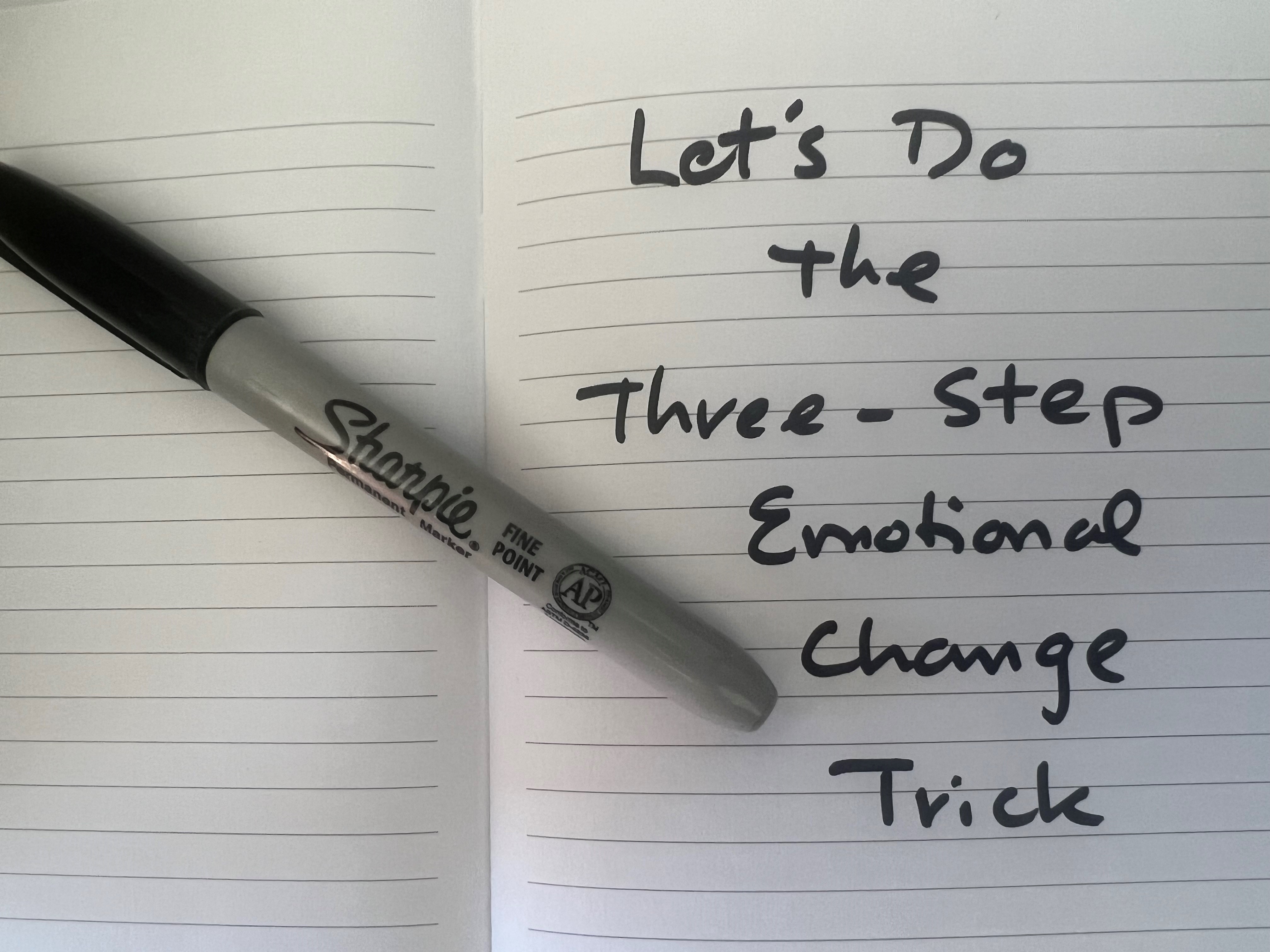
For the happiness challenge this week, we’re touting the effectiveness of my own version of what we should put in the water or in the schools or in families—the Three-Step Emotional Change Trick. Having been in a several month funk over a variety of issues, I find myself returning to the application of the Three-Step Emotional Change Trick in my daily life. Does it always work? Nope. Is it better than feeling like a victim to my unpleasant thoughts and feelings? Yep.
I hope you’ll try this out and follow the instructions to push the process outward by sharing and teaching the three steps. Let’s try to get it into the water system.
Active Learning Assignment 9 – The 3-Step Emotional Change Trick
Almost no one likes toxic positivity. . . which is why I want to emphasize from the start, this week’s activity is NOT toxic positivity.
Back in the 1990s I was in full-time private practice and mostly I got young client referrals. When they entered my office, nearly all the youth were in bad moods. They were unhappy, sad, anxious, angry, and usually unpleasantly irritable. Early on I realized I had to do something to help them change their moods.
An Adlerian psychologist, Harold Mosak, had researched the emotional pushbutton technique. I turned it into a simple, three-step emotional change technique to help young clients deal with their bad moods. I liked the technique so well that I did it in my office, with myself, with parents, during professional workshops, and with classrooms full of elementary, middle, and high school students. Mostly it worked. Sometimes it didn’t.
This week, your assignment is to apply the three-step emotional change trick to yourself and your life. Here’s how it goes.
Introduction
Bad moods are normal. I would ask young clients, “Have you ever been in a bad mood?” All the kids nodded, flipped me off, or said things like, “No duh.”
Then I’d ask, “Have you ever had somebody tell you to cheer up?” Everyone said, “Yes!” and told me how much they hated being told to cheer up. I would agree and commiserate with them on how ridiculous it was for anyone to ever think that saying “Cheer up” would do anything but piss the person off even more. I’d say, “I’ll never tell you to cheer up.* If you’re in a bad mood, I figure you’ve got a good reason to be in a bad mood, and so I’ll just respect your mood.” [*Note to Therapists: This might be the single-most important therapeutic statement in this whole process.]
Then I’d ask. “Have you ever been stuck in a bad mood and have it last longer than you wanted it to?”
Nearly always there was a head nod; I’d join in and admit to the same. “Damn those bad moods. Sometimes they last and last and hang around way longer than they need to. How about I teach you this thing I call the three-step emotional change trick. It’s a way to change your mood, but only when YOU want to change your mood. You get to be the captain of your own emotional ship.”
Emotions are universally challenging. I think that’s why I never had a client refuse to let me teach the three-steps. And that’s why I’m sharing it with you now.
Step one is to feel the feeling. Feelings come around for a reason. We need to notice them, feel them, and contemplate their meaning. The big questions here are: How can you honor and feel your feelings? What can you do to respect your own feelings and listen to the underlying message? I’ve heard many answers. Here are a few. But you can generate your own list.
Frowning or crying if you feel sad
Grimacing and making angry faces into a mirror if you feel angry
Drawing an angry picture
Punching or kicking a pillow (no real violence though)
Going outside and yelling (or screaming into a pillow)
Scribbling on a note pad
Writing a nasty note to someone (but not delivering it)
Using your words, and talking to someone about what you’re feeling
Step two is to think a new thought or do something different. This step is all about intentionally doing or thinking something that might change or improve you mood. The big question here is: What can you think or do that will put you in a better mood?
I discovered that kids and adults have amazing mood-changing strategies. Here’s a sampling:
Tell a funny story (“Yesterday in math, my friend Todd farted”)
Tell a joke (What do you call it when 100 rabbits standing in a row all take one step backwards? A receding hare-line).
Tell a better joke (Why did the ant crawl up the elephant’s leg for the second time? It got pissed off the first time.)
Exercise!
Smile into a mirror
Talk to someone you trust
Put a cat (or a chicken or a duck) on your head
Chew a big wad of gum
I’m sure you get the idea. You know best what might put you in a good mood. When you’re ready, but not before, use your own self-knowledge to move into a better mood.
Step three is to spread the good mood. Moods are contagious. I’d say things like this to my clients:
“Emotions are contagious. Do you know what contagious means? It means you can catch emotions from being around other people who are in bad moods or good moods. Like when you got here. I noticed your mom was in a bad mood too. It made me wonder, did you catch the bad mood from her or did she catch it from you? Anyway, now you seem to be in a better mood. I’m wondering. Do you think you can make your mom “catch” your good mood?”
How do you share good moods? Saying “Cheer up” is off-limits. Here’s a short list of what I’ve heard from kids and adults.
Do someone a favor
Smile
Hold the door for a stranger
Offer a real or virtual hug
Listen to someone
Tell someone, “I love you”
Step four might be the best and most important step in the three-step emotional change trick. With kids, when I move on to step four, they always interrupt:
“Wait. You said there were only three steps!”
“Yes. That’s true. But because emotions are complicated and surprising, the three-step emotional change trick has four steps. The fourth step is for you to teach someone else the three steps.”
I’m a big fan of exercise and movement as a solution for nearly everything. Below is my famous or infamous “Last Dance” video that I filmed after a day when I got beat up pretty bad by all things Moodle, Powerpoint, and Qualtrics. My solution was to Dance it off, which I share with you all despite the fact that this is the sort of thing one should keep private.
I share this video as a challenge to anyone who feels inclined to make their own 1 minute dance-it-off video. Yes please! And share.
[Unless you read this blog regularly] you may be surprised to hear that exercise is more effective in treating depression than antidepressant medications. If so, that’s likely because pharmaceutical companies spend millions every year to tell you their antidepressants are effective. The marketing budget for exercise as a treatment for depression is considerably less.
Movement—along with sleep and a healthy diet—is probably the best way to keep your brain healthy. Nearly all movement helps. In my favorite exercise study on treating depression in youth, preteens and teens who were depressed had a 100% response to cardio (including Jazzercise and Wii) and a 67% response with just stretching. Exercise does so many good things for the brain that it’s hard to track. Also, other than sweat, thirst, and sore muscles, exercise has no real negative side effects—which isn’t the case for medications.
In conclusion, the researchers wrote:
“Compared to antidepressant medication treatment with adolescents, exercise resulted in (a) a faster response rate, (b) a better response rate, (c) fewer relapses (n = 0) at six and 12 month follow-ups, and (d) no side effects or adverse events” (Hughes et al., 2013). One caveat, at the beginning of the study, none of the participants were exercising.
But who were these researchers? Were they anti-drug researchers with an axe to grind?
Nope, and this is my favorite part. The researchers were prestigious academics who mostly do pharmaceutical research. One of them was the guy responsible for the clinical studies that led to FDA approval of Prozac for treating youth with depression. The two biggest names on the study have repeatedly been funded by Eli Lilly, GlaxoSmithKline, Pfizer, and more.
All this leads me to this week’s #MHPHappinessChallenge assignment.
Find your preferred way to move, pair it with your favorite music, and do what the researchers in the Hughes (2013) study did to treat depression. I call this “Dance it off,” because dancing—alone or together—is a fabulous way to make the time fly by while you give your brain a dose of what it’s craving.
Here’s the Hughes et al (2013) study. I’m sharing it because everyone should know about it:
But you don’t have to dance. You can walk, run, skip, or yoga. You can jump rope, do Wii or Jazzercize, kickbox, or just jiggle your body in the kitchen while you’re cooking. If you ride the elevator, take the stairs. If you’re in a chair, dance with whatever parts of your body that will move. Of course, don’t do anything that’s so excessive that you might hurt yourself.
I’m sure you get the point.
And then, if you feel something-maybe a high or a fun new thought or anything that kicks your mood up a notch, savor it, linger, and then share it with us.
As always, thanks for participating in the Montana Happiness Challenge. Let’s dance it off together this week.
Freud once said, “There are many ways and means of conducting psychotherapy. All that lead to recovery are good.”
Coming from rigid old Freud, that was a pretty wildly accepting statement. I’d like to apply it to gratitude.
There are many ways to practice gratitude. All that lead to meaning and happiness are good.
When it comes to gratitude, there are many “ways and means.” Let us count the ways.
1.Gratitude for others who are in our lives right now.
2.Gratitude for others, from the past; these people toward whom we feel gratitude may be alive or may have passed.
3.Gratitude for a higher power. Many people pray to express gratitude. In Traveling Mercies, Anne Lamott said there are only two types of prayer. “Help me. Help me. Help me.” And “Thank-you, thank-you, thank-you.” Obviously, Lamott’s second type of prayer is all about gratitude.
4.Gratitude for a concept a country or belief system.
5.Once, during a workshop, I had a teacher say she was grateful to her 16-year-old self for having the courage and good judgment to go immerse in Spanish, even though she didn’t like Spanish much. She went, learned, and is now a successful Spanish teacher. Very cool.
When it comes to gratitude, there are also many means. Let us count them too.
1.We can keep a gratitude journal. Journals are usually private, but sometimes not. Also, journals can be written, spoken, or video-recorded.
2.Gratitude can be practiced once-a-week, every day, or at whatever rate you choose.
3.We can have surface gratitude, or we can dig down deep and keep asking ourselves, “Why this gratitude for this person, place, or thing?”
4.We can purposefully find a way to communicate our gratitude to the person or persons toward whom we feel it. There are lots of online videos showing what happens when people communicate gratitude. We like this one from SoulPancake: https://www.youtube.com/watch?v=oHv6vTKD6lg
5.You can do a benefit reflection. This means that you take a few moments to reflect on (a) how much someone’s action helped you, (b) the time, money, or effort that a person sacrificed to help you; and (c) the fact that someone helped you on purpose.
Gratitude can have big or small benefits. Like everything, gratitude is in the eye of the beholder (meaning you will have an individualized response to practicing gratitude; it’s not about what you “should” experience; it’s about trying out gratitude and seeing how you feel). Generally, gratitude has small and positive effects on depression and anxiety. Here’s a link to a 2021 meta-analysis, if you want to read the science:
As always, I encourage you to experiment with gratitude. It might make a big difference, a small difference, or no difference at all . . . but it’s hard to know if you’ll benefit from gratitude unless you practice it—at least a little—using the ways and means that fit for you.
In the summer of 2022, we held a Strengths-Based Suicide and Happiness retreat at Boulder Hot Springs in Montana. The food was excellent and well-worth savoring every nibble. Additionally, we encouraged all the participants to do approximately 1-minute videos focusing on a practice in their lives that they believe to be helpful to their happiness.
Here’s Charlie, talking about savoring his experiences as a one-man heavy metal band
Charlie — We Rip
I think these videos are incredible. I love what everyone says. . . and appreciate the participants, the messages, and the videographers. I find myself savoring these savoring videos.
Below, I’m including a few links to more of our retreat videos that, more or less, focus on savoring. They’re short, they’re cool, and I hope you watch, savor, and reflect on how you might do even more savoring in your life. Who knows, maybe you’ll even make your own social media video and share it with us and the world!
I like knowing a little trivia. It’s probably related to wanting to maintain a positive view of myself. If I know a little trivia, maybe that makes me more competent.
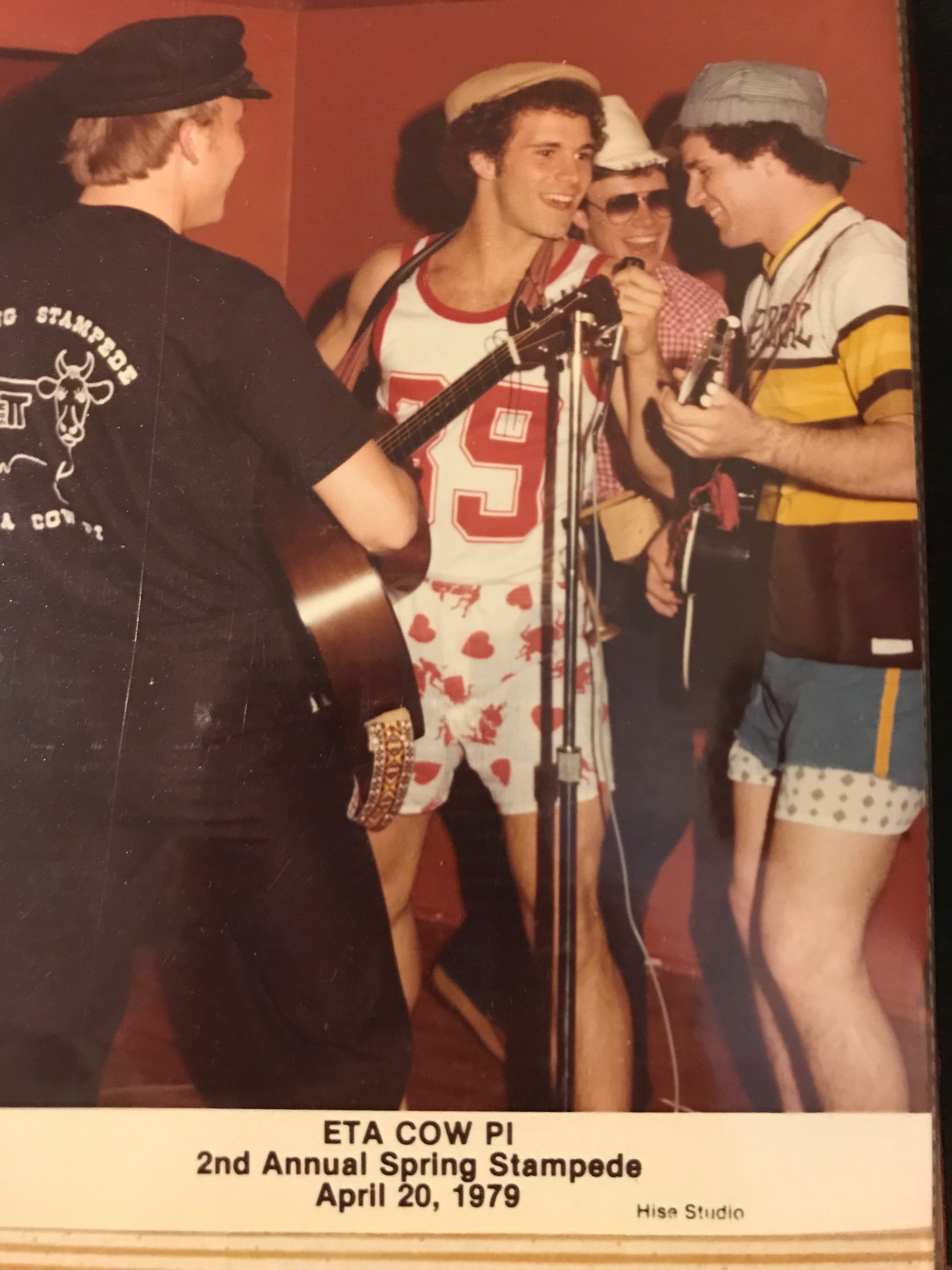
Trivia of the day: Hardly any of you know that my friends Mike Bevill, Neil Balholm, Greg Hopkins, and I invented Karaoke in Mike Bevill’s basement back in 1974. Neil had a portable microphone system. We’d plug it in, put on background music, and belt out tunes, as if we were Crosby, Stills, Nash, Young, Bevill, Balhoum, Hopkins, and Sommers. We created a fake band, named ourselves the “Nugget Brothers,” and sang with great enthusiasm, but little talent, along with a variety of pop musicians.
One odd outcome of this was my continued preoccupation with creating fake bands into and after college, despite nearly complete lack of talent. As an example of the awkwardness of youth, I could “fake perform” to large groups, but I was unable to speak up in classes. Weird, I know. My guess is it was safer to publicly perform with no talent that it was to do so in areas where I was serious.
Here’s a photo attesting to my fake band performance legacy.
As a part of the Montana Happiness Challenge, we’ve been encouraging people to share their favorite songs. . . and now we’re taking it to the next step. Please, if you will, share yourself singing a song that makes you happy, or that you find meaningful. Post it on social media and give us a tag or hashtag: #MHPHappinessChallenge or #MontanaHappiness.
You may wonder, other than embarrassment and social media humiliation, what’s the point? The point is that singing is nearly always therapeutic, partly because of what’s happening in the brain. Think about it.
Singing involves movement, creativity, feedback and adjustment, listening, planning, memory, and language. Some researchers emphasize that singing triggers the release of the so-called “feel-good” neurotransmitter dopamine, which is a limited view, because there’s also more serotonin at the synapse, an oxytocin shower, and more or less involvement by 100s of other neurotransmitters, neuromodulators, and brain structures (including, but not limited to the hippocampus, insula, frontal lobe, Wernicke’s region, occipital cortex, and motor cortex). If you want to light up your brain, sing!
For the Montana Happiness Challenge, we highly recommend singing out loud. Although we would love to watch and listen to you singing on social media, if that’s not your thing, go ahead and sing in the shower, while housecleaning, in the car, or anywhere else you can let your joy happen.
One last point. Research on positive emotions indicate that we don’t need to have BIG positive emotions to experience happiness and well-being benefits. What’s important is to weave in many intermittent small positive emotions. IMHO, singing privately or publicly is one way to give yourself frequent positive emotional boosts.
For my part, I’ve recorded three videos on my social media singing. These videos are silly and embarrassing, which I’m completely embracing. I got nervous for each of these videos and didn’t even say all of what I planned to say. Feel free to skip them and/or #neverspeakofthem.
Thanks for reading this. Please share everything you can about the Montana Happiness Project. Our goal is to reach MANY people with free ideas about positive emotions and meaningful happiness.
Shortly after Beth Brown, Managing Director of Mental Health and Well Being at The Arthur M. Blank Family Foundation (https://blankfoundation.org/) called the meeting to order, she asked us to introduce ourselves and share one word to represent how we were feeling in that moment.
Having taught my fair share of group counseling and psychotherapy courses at the University of Montana, I immediately recognized Ms. Brown’s icebreaking trickery. The trickery is, while ostensibly asking about the emotional tone of participants, the “one word” question simultaneously evaluates participants’ ability and willingness to comply with group leader requests.
It was a raucous group. People immediately began bending, breaking, and straying from Ms. Brown’s one-word rule. Some participants took 30 words to introduce themselves; others took 50 words to frame the rationale for their one-word choice. One participant (who spoke second, and may or may not have been me), immediately displayed annoying attention-seeking behavior by interjecting an anecdote about the worst icebreaker activity ever in the history of time.
Had Sigmund Freud been a Mental Health and Wellness grantee (and therefore invited to the two-day event), he might have used the word delighted. Not only was the one-word activity intrinsically projective, Freud also once famously quipped,
Words were originally magic, and . . . retain much magical power, even today. With words people can make others blessed, or drive them to despair; by words the teacher transfers . . . knowledge to the pupil; by words the speaker sweeps away the audience and determines its judgments and decisions. Words call forth affects and are the universal means of influencing human beings [n.b., this is not a perfect quote because I engaged in minor editing to make Freud more quippy and less sexist].
I have some magic words to describe the participants. They were smart, fun, funny, dedicated, committed, clever, brilliant, generous, compassionate, empathic, connected, passionate, and cool. During Lyft rides, some of them even engaged with each other as if they were live podcasters. My particular program officer is so kind and generous that I now just think of her as Saint Natalie.
Words were the theme and the tool. On the afternoon of Day One Michael Susong, PR Lead at Intrepid, taught us how to use asset-based, instead of deficit-based words on our websites. His presentation was complemented by a gallery-walk through an adjacent room where life-sized word cloud posters of the words in our websites were set up and numbered; we perused the clouds, absorbing the language and seeking to discern which cloud belonged to which organization. I, of course, quickly found the Montana Happiness Project (MHP) word cloud, primarily because the biggest word was SUICIDE, which may or may not have implied that we (the MHP) have a bit of work to do on using more asset-based language on our website. I also felt jealousy because other organizations had way cooler words, like “Nintendo” and “LBGTQ+” and “Youth of color” and “Belonging.”
At the close of Day 1, the prevailing descriptive words were “Tired” and “Exhausted” not principally, but partly because this was a group of people who had likely added this retreat into their already too busy lives and consequently were emailing and doing business-related calls during breaks and lunch and on the airplane the day before and possibly into the night.
Looking back at the previous paragraph, I notice I used the word “business” which connotes a particular entrepreneurial feel, which requires a particular explanation. All of the organizations and people in attendance had a shared passion for the business of helping others achieve greater well-being, mental health, and happiness. IMHO, that’s good business. . . which leads me to sharing a few words about the man behind the curtain.
We all convened at the Arthur M. Blank Foundation headquarters for two days because of one man’s business. That man is Arthur M. Blank, co-founder of Home Depot and owner of the Atlanta Falcons, the Atlanta United professional soccer club, and PGA Superstores. But along with his businesses, Arthur Blank has expanded his service mentality into the business of philanthropy. On the evening of the first day, Arthur Blank joined us as we listened to renowned Harvard researcher Robert Waldinger talk about the world’s longest study of Happiness [n.b., in his usual buoyantly optimistic style, Freud once noted that a main goal of psychotherapy is to move patients from neurotic misery, to common unhappiness].
Although I didn’t get a chance to meet Mr. Blank and impress him with my witty repartee, knowledge of icebreakers, or arcane Freudian quotes (I wish I could have told him, “Where id was, there shall ego be!), I did hear him speak. In one long, hyphenated word, I’d describe his message as gracious-supportive-humble-encouraging-empowering. Had Freud been there, he might have just said, “Arthur Blank’s words were magic.”
The Arthur Blank Foundation has given well over $500 million to philanthropic causes. None of this is required. Arthur Blank could take his money and keep it to himself and his family. Instead, he has embraced philanthropy. Arthur Blank also has a book titled “Good Company.” In a word (or maybe 20 words), if I were offering a New York Times Book Review (which will never happen because the NYT always rejects my editorial pieces, and yes, I’m clearly hanging on too tightly to my resentment toward the NYT), I’d describe his book as: A rather surprising treatise on companies doing values-based good work in the world as a part of a larger philosophy/vision of service-oriented capitalism paradoxically infused with egalitarianism in the workplace. In other (or additional) words, I enjoyed, appreciated, and valued the book and its philosophy WAY more than I expected. Now I want to become as wealthy as Arthur Blank so I can join him in contributing to the culture and welfare of places like West Atlanta, South Chicago, North Philly, Livingston Montana, and East Missoula.
In the end, Beth Brown asked us for a final, departing single word. I cleverly used my hyphenated last name as an excuse to say “overwhelmed-hopeful” but I might have just as easily used “connected-inspired” or “challenged-to-do-more-good” or “I’m-on-a-rocket-ship-headed-to-a-city-called-mental-health-and-wellbeing” or, given the fire of inspiration lit under my feet, I could have decided to demonstrate the worst icebreaker of all time, and just spell out my name and feelings with my hip movements.
Thank you, Arthur Blank, thank you to the AMBFF team, and thank you to the grantees. I am humbled by your generosity and vision of greater mental health and wellbeing for all.
John Wiley and Sons recently informed me of the excellent and exciting news that the 7th edition of Clinical Interviewing (CI7) has gone to press and will drop in the U.S. on or before September 30. Our wish for this edition is the same as previous editions: To provide research-based, theoretically supported, clinically insightful, and culturally informed education and training on how to conduct basic and advanced clinical interviews.
The Resource
Part of CI7 includes video updates. Most of the updates offer greater representation of culturally diverse counselors and psychotherapists. For example, the video link below features Dr. Devika “Dibya” Choudhuri describing a “grounding” technique that she uses when conducting tele-mental health (aka virtual) clinical interviews, the topic of Chapter 14.
Although you may have your own approaches to facilitating grounding during tele-mental health sessions, I believe Dr. Choudhuri’s idea is innovative and may be a resource that you can add to your toolkit.
Stay tuned, because over the next several weeks I’ll be posting additional fresh new text and video content from CI7.
The Request
Traditionally, publishers ask authors to gather promotional endorsements for new books. This time around, maybe because it’s the 7th edition, neither Wiley nor the absent-minded authors of CI7 thought about gathering endorsements. In the past, we’ve had Derald Wing Sue, John Norcross, Victor Yalom, Pamela Hays, Barbara Herlihy, Allen Ivey, David Jobes, and Marianne and Jerry Corey write short blurbs. Here’s what Derald Wing Sue said about the 6th edition:
The most recent edition of Clinical Interviewing is simply outstanding. It not only provides a complete skeletal outline of the interview process in sequential fashion, but fleshes out numerous suggestions, examples, and guidelines in conducting successful and therapeutic interviews. Well-grounded in the theory, research and practice of clinical relationships, John and Rita Sommers-Flanagan bring to life for readers the real clinical challenges confronting beginning mental health trainees and professionals. Not only do the authors provide a clear and conceptual description of the interview process from beginning to end, but they identify important areas of required mastery (suicide assessment, mental status exams, diagnosis and treatment electronic interviewing, and work with special populations). Especially impressive is the authors’ ability to integrate cultural competence and cultural humility in the interview process. Few texts on interview skills cover so thoroughly the need to attend to cultural dimensions of work with diverse clients. This is an awesome book written in an engaging and interesting manner. I plan to use this text in my own course on advanced professional issues. Kudos to the authors for producing such a valuable text.
―Derald Wing Sue, Ph.D., Professor of Psychology and Education, Teachers College, Columbia University
This time around, we’re less than two weeks from publishing and are without formal endorsements. As a consequence, I’m asking: “Is there ANYBODY out there who has read a portion of the CI7 manuscript or used a previous edition, who would like to share their thoughts about how the book influenced you or how the videos helped with your training?
[I know this last paragraph sounds pathetic. However, if you know me, you probably know my sense of humor, and the “Is there anybody out there?” call is BOTH a sincere request for your input AND me mocking myself for making this request.]
To be completely serious: If you want to share something positive about your experience—from any point in time—with the Clinical Interviewing text, I hope you’ll write a sentence or two or three (you don’t have to write half a page, like Derald Wing Sue) on the particular ways in which you found the book and/or videos meaningful to you.
To share your thoughts on any edition of the text, please post them here on this blog, or send them to me at john.sf@mso.umt.edu.
Thanks very much for considering this request. Please, please, I hope someone “out there” is listening!
The place to click if you want to learn about psychotherapy, counseling, or whatever John SF is thinking about.






 John Sommers-Flanagan