Category Archives: Personal Reflections

Cleavage, Revisited

It’s revision time for the Clinical Interviewing textbook (the 6th edition is coming). Revision time also means revisiting time. About three years ago I posted a new proposed section for the 5th edition cleverly titled, “Straight Talk about Cleavage.”

This time around I’m posting our slightly revised version of that section. What’s new is that I’m explicitly asking and hoping for your comments and feedback. Please note that this makes me nervous, but we (Rita and I) hope your comments and feedback will help us provide more perspective and depth to our discussion. We don’t want to come across as old fogeys or rabid feminists. Instead, we want to be reasonable, thoughtful, and balanced . . . and so we’re turning to YOU.

The section is below. You can post comments directly here at Word Press for all to see or email me privately at john.sf@mso.umt.edu.

Straight Talk about Cleavage

Although we don’t have any solid scientific data upon which to base this statement, our best guess is that most of the time most people on the planet don’t engage in open conversations about cleavage. Our goal in this section is to break that norm and to encourage you to break it along with us. To start, we should confess that the whole idea of us bringing up this topic (in writing or in person) and saying something like, “Okay, we need to have a serious talk about cleavage” makes us feel terribly old. But we also hope this choice might reflect the wisdom and perspective that comes with aging.

In recent years we’ve noticed a greater tendency for female counseling and psychology students (especially younger females) to dress in ways that might be viewed as somewhat provocative. This includes, but is not limited to, low necklines that show considerable cleavage. Among other issues, cleavage and clothing were discussed in a series of postings on the Counselor Education and Supervision (CES) listserv back in 2012. The CES discussion inspired many of the following statements that follow. Please read these bulleted statements and consider discussing them as an educational activity.

  • Female (and male) students have the right to express themselves via how they dress.
  • Commenting on how women dress and making specific recommendations may be viewed as sexist or inappropriately limiting.
  • It’s true that women should be able to dress any way they want.
  • It’s also true that agencies and institutions have some rights to establish dress codes regarding how their paid employees and volunteers dress.
  • Despite egalitarian and feminist efforts to free women from the shackles of a patriarchal society, how women dress is still interpreted as having certain socially constructed messages that often, but not always, pertain to sex and sexuality.
  • Although efforts to change socially constructed ideas about women dressing “sexy” can include activities like campus “slut-walks,” a counseling or psychotherapy session is probably not the appropriate venue for initiating a discourse on social and feminist change.
  • For better or worse, it’s a fact that both middle-school males and middle-aged men (and many “populations” in between) are likely to be distracted—and their ability to profit from a counseling experience may be compromised—if they have a close up view of their therapist’s breasts.
  • At the very least, we think excessive cleavage (please don’t ask us to define this phrase) is less likely to contribute to positive therapy outcomes and more likely to stimulate sexual fantasies—which we believe is probably contrary to the goals of most therapists.
  • It may be useful to have young women (and men) watch themselves on video from the viewpoint of a client (of either sex) that might feel attracted to them and then discuss how to manage sexual attraction that might occur during therapy.

Obviously, we don’t have perfect or absolute answers to the question of cleavage during a clinical interview. Guidelines depend, in part, on interview setting and specific client populations. At the very least, we recommend you take time to think about this dimension of professional attire and hope you’ll openly discuss cleavage and related issues with fellow students, colleagues, and supervisors.

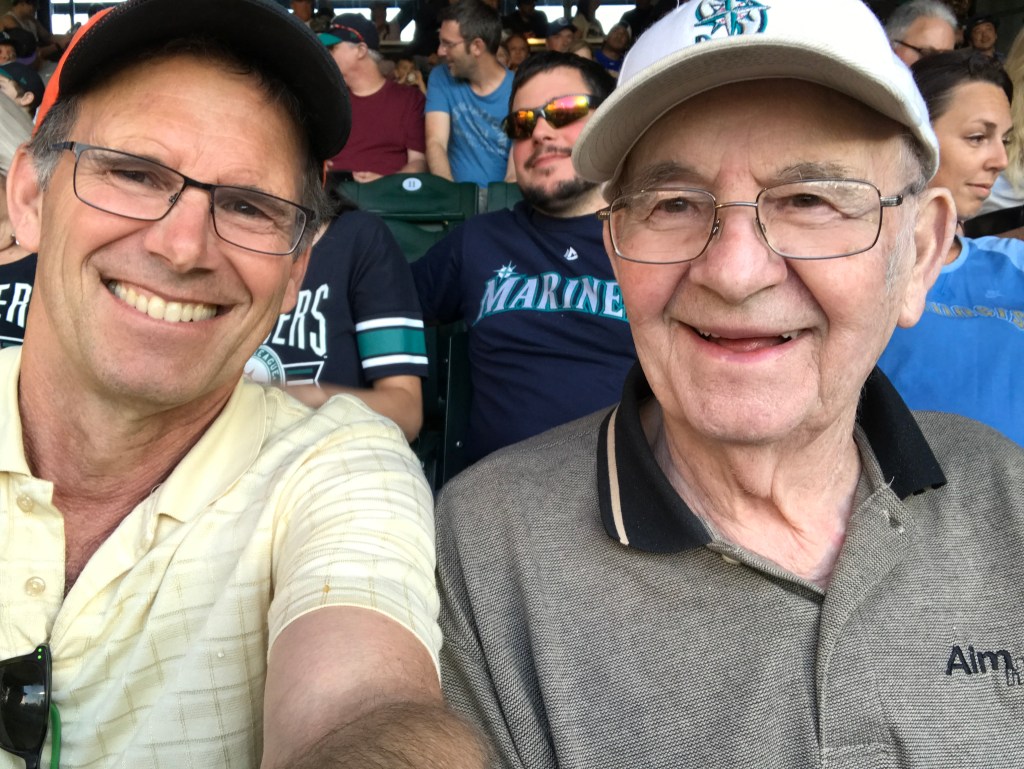
My Father, Who Art in Vancouver (Washington)

That’s where he is (Vancouver) and where he’s been, mostly, since I met him on Thursday, October 18, 1957.

My father was born Jewish and usually says he’s an atheist, but he gives me faith in all things and hope for the world. He’s like solid ground after an earthquake. One time, when I was 15-years-old and riding on 39th street in Vancouver with my sister Peggy, she totaled her blue Toyota Corolla by ramming it into the back end of another car on a hot summer day. I still recall the song playing on the eight-track. “You put the lime in the coconut and drink them both together, you put the lime in the coconut, then you feel better.”

We did not feel better . . . until my dad magically showed up less than five minutes after the accident. This was long before cell-phones. Peggy had just been loaded into an ambulance and suddenly, there he was. He just happened to be driving by. He picked me up in his old yellow Ford van and just talked to me in his calm and soothing voice all the way home. I have no idea what he said, but it made everything okay.

How many times has he made my world safer? How many times has he made my world better? My best guess is countless or maybe double-infinity. And, being a scientist-type, I never use the words countless or double-infinity.

He was always stronger. He was always better. He was always smarter. No one could do mental math like my dad. Even now, at age 88, he’s a mental calculator to be reckoned with. He still beats me at gin, not so much because of using better strategy, but because he can still count cards and so he almost always has greater awareness of the cards I’m holding in MY hand than I do.

He was and is the most competitive person I know. He never gives in. He never gives up. He’ll play cards with you all night if that’s what it takes for him to win. But it never does. He wins long before we get very far into the night.

I know him pretty well. He’s honest to a fault. He would never cheat . . . at anything. He has a fabulous work ethic. He should have been a U.S. Senator. Can you imagine that . . . a trustworthy and hardworking American politician? Now there’s an unrealistic fantasy.

Let me tell you about his usual day. Despite his neuropathy, he’ll get up in the morning and take the dog for a walk. Then he’ll get back and read the paper until my mom wakes up. They’ll have breakfast together. It will be some terrible white bread or frozen waffles with syrup and maybe some bacon and eggs. He’ll probably do the dishes. Then my mom will take a nap and he’ll take the dog for another walk and then either read a book or watch the news or a bad television show until she wakes up again. At some point he’ll drag my mom out of their tiny room to play bean-bag baseball at the retirement home where they live. In the evening he’ll watch the Seattle Mariners struggle to score runs and, of course, the Mariners will lose another baseball game. Later, when we talk on the phone he’ll tell me that the Mariners will be getting a new hitting coach soon. . . and about three days later, they will. The only problem is they shouldn’t have hired Edgar Martinez; they should have hired my dad.

He’ll put my mother on the phone and we’ll talk a couple minutes. I’ll ask her about bean-bag baseball, but she won’t remember playing and so she’ll ask him and he’ll get back on the phone and tell me that she got three triples. All day he’ll cover for her and help her navigate the world that she’s mostly lost touch with. He’ll patiently answer the same questions twelve times over. When I ask him how he stays so calm and patient when my mom mostly has no memory, he’ll say, “I just remind myself that she’s not forgetting things on purpose. She would remember if she could.”

This is the man I can never live up to. But that’s okay. In fact, that’s the way it SHOULD be. To have a role model who is really a role model because he is so good and kind and compassionate and smart. Just being around someone like him makes me want to be a better person. I just have to ask myself: What would my dad do?

Before I get off the phone, he’ll do his usual (since 1982) good bye. He’ll say: “I love you.” And then, “Big hug.”

This is Max Sommers.

He is my father.

I have the honor of being his son.

I have the privilege of wishing him a Happy Father’s Day.

Hallowed be his name.

OLYMPUS DIGITAL CAMERA

Writing about Writing . . . Feedback Please?

Over the past several days I’ve been inspired to pursue a new project that focuses on writing about professional writing. This is the sort of thing that happens to me when I’m facing a big list of imposing writing projects . . . I decide to add one more.

But the good news is that I’m having fun and producing lots of words on this topic. My latest method for generating words is to go for a long walk with my cell phone. Then, I dictate email messages to myself through my cell phone and send them. Pretty cool. Over the past two days I’ve “written” almost 8,000 words.

There are some problems with this system, however. In particular, if there’s any wind, or if I don’t enunciate perfectly, my phone is inclined to misquote me. The result: In the moment I feel exceptionally articulate and then I when I get home and read the emails I’ve sent myself, I sound somewhat less articulate. Here’s an example:

1 thing keep in mind is: your trickster is not my sister. What is means is that are in your obstacles 4 demons are unique to us as individuals. You wear the standard prescription for all riders. Beware the single strategy you overcome writers block. He wear even if we say it, love 1 message to manage your picture.

You can imagine my disappointment at receiving this message from myself, I’m sure. If that preceding paragraph wasn’t absolutely hilarious, I might be furious at having lost whatever profound message I was trying to communicate with myself. But I have to say that reading these emails from myself makes for excellent entertainment.

This reminds me of a dream I had back in grad school. It was amazingly profound . . . but I’ll skip that and get to the point of asking you for feedback.

If you’re a current or recent graduate student, please send me your answer to one or more of the following questions:

1. What emotions and thoughts do you experience when you turn in a paper to a professor (or, better yet, a thesis or dissertation committee)?

2. When you get lots of “constructive feedback” what thoughts and feelings do you experience? This might involve you receiving a paper back with a low grade and/or lots of “red ink.” Can you share an example of what you think or feel in response to that situation?

3. When you get positive feedback, what thoughts or feelings does that trigger? Can you share an example?

4. After you’ve gotten negative or constructive feedback, how do you find the strength or courage to send in another draft or turn in the next assignment?

If you’re currently a professor somewhere, consider answering one or more of the following:

1. What thoughts or feelings do you have to deal with to get yourself to write something?

2. How do you react to or deal with rejection? For example, if you have a manuscript or proposal rejected, what do you say, do, think, or feel? What do you do to “bounce back” from rejections of your written work?

3. How do you react to success? For example, when you have a paper accepted or get positive feedback, how does that affect you?

4. What helps you write well . . . or in what situations are you likely to write efficiently.

Thanks for thinking about this with me. I appreciate it. And I’ll even appreciate it more if you send me an email answering some of the preceding questions. Send it to: john.sf@mso.umt.edu

And . . . I’m confident that whatever you send me will arrive in better shape than the emails I’ve been sending myself.

2014-06-03_15-45-11_474

The 2015 Counselor Education Graduation Speech I Didn’t Give

This is the transcript of the 2015 Graduation Speech for Counselor Education I didn’t give. Of course, I wasn’t invited to deliver a speech, but since I’m in Absarokee and can’t attend graduation, I’m pretending this is the speech I would have given. In other words, I’m making all this up.

The Speech

Traditional graduation speeches are supposed to be lightly profound with a dose of inspiration. This one, not so much.

Seriously? Like you didn’t know this speech would be different?

Two years ago (or maybe three or four years ago for some of you who are extra special), you all enrolled in a graduate program in . . . COUNSELING. What I’m saying is that something in your rational brain snapped and you let an empathic, compassionate, impulse to help others for the rest of your life take over and start making your BIG life decisions for you. You know you did. And your family and friends know you did. I’m just naming the elephant in the room by saying it in public

I’m proud to say that I’m proud of you for that. And this is coming from someone who basically hates and avoids the word proud. That’s partly because pride is one of the seven deadly sins and it goeth before a fall and all that. I just thought you should know how hard it was for me to say that I’m proud of you . . . which makes me think in my head that I almost feel a little proud of myself, which I would never, of course, say out loud, which I’m not doing now because if there’s anything I’m certain of, I’m certain you can’t hear my thoughts.

What I am saying is that I’m glad you made the decision to forsake nearly all of the materialistic messages given to you, heretofore (I really like saying things like heretofore, especially during graduation speeches), by contemporary society. Just think, if everyone went down the evil road of materialism we wouldn’t even have graduate programs in counseling where people like you spend good money to learn how to listen well and help others, while not making very much bank. You know what I’m talking about.

My point is, you’re just DIFFERENT and unless your faculty forgot to tell you, you should know that by now. And my other point is: that’s why you should have known this would be YET ANOTHER LECTURE and not some sappy, emotionally inspiring speech. And the reason for this is that in the business you’ve chosen to practice . . . learning NEVER ENDS . . . and so I don’t want to give any of you the wrong impression that somehow graduating means you get to stop learning. You don’t. I’m here to tell you that.

This leads me to my lecture, the title of which is something like:

Everything I Should Have Taught You Over the Past Several Years,

But Because You All Talked Way Too Much In Class I Didn’t Have Time.

And I should mention that this lecture could take anywhere from a few minutes to several days. Please. There’s no need to thank me. You’ve earned this.

Let’s start with you taking notice of the imprecision I used in stating my lecture title. I said, “. . . something like.” This is our first and most important lesson for the day. When it comes to counseling humans, we shouldn’t fool ourselves into thinking we can be precise. This is why you chose to study with us touchy-feely-counseling types over here in the College of Education instead of running over with your calculators to psychology where you could be a scientist (at this point in the speech I’m making an enigmatic face that makes you wonder if I’m praising psychology as a science or making fun of psychology for having lots of irrational cognitions about being a science). This is why you set collaborative goals in counseling and not unilateral goals.

As Salvadore Minuchin said a couple of decades ago at a workshop here in Missoula, “Don’t be too sure.” I like that message.

And now although I’m not too sure about whether what I’ve got planned next is a good idea, it’s something I feel compelled to teach you. After all, prior to this last year’s holiday party, when there was an opportunity for Karaoke and, in the humble way that you’ve come to know as characteristic of me, I sent you all an email explaining that I had co-invented Karaoke in 1973 in Mike Bevill’s basement and consequently was happy to provide everyone with Karaoke lessons, the response was COMPLETE EMAIL SILENCE. Consequently, how could I not conclude that either you (a) have debilitating Karaoke anxiety, or (b) have low Karaoke-esteem, or (c) are uninformed as to the benefits of Karaoke, or (d) all of the above, or (e) only a and b?

Hopefully you got the answer to that rhetorical question correct, because here comes the Karaoke lesson.

OLYMPUS DIGITAL CAMERA

Before I start, as I like to say in my classes and workshops, you can always pass on this experience and if you so choose, please do so by doing what many of my teenage clients do – ignoring me – which may or may not involve you placing your hands over your ears and humming or laying your head on your arm and snoring.

The first rule of Karaoke is, as the late Bill Glasser would have said—had he ever had the good sense to lecture on Karaoke—“Your goal should be within your personal control.”

This rule has several implications, but most importantly, it speaks to song and wardrobe selection. Specifically, you always want to select a Karaoke song that’s within your range and within your wardrobe. I cannot emphasize this enough. For example, although I very much like the song . . . “This Girl is on Fire,” but I tried singing it and it didn’t go well.

As you can infer from the photo below, choosing the wrong song can be embarrassing and beyond your control. Don’t do it . . . unless it’s part of your shame- attacking treatment plan. And you can thank Dr. Albert Ellis for building you a personalized shame-attacking treatment plan.

Peg and John Singing at Pat's Wedding

So, obviously, pick a song that fits your voice and your gender stereotypes.

The second rule is all about song lyrics and so I’ve made up another rhyme to help you auditory learners remember. That is, “To function to the best of your ability, you should embrace your multicultural humility.”

What I’m saying here is that, as you know, many pop songs have lyrics that are racist, sexist, and sexually explicit. To maintain our multicultural sensitivity (and humility), it’s important to either (a) avoid songs with insensitive or sexualized lyrics (which is why I never sing Lady Gaga’s song that includes the line about her not bluffin’ with her muffin) or (b) change the lyrics on the spot (for “Say a Little Prayer for You” I like to substitute, “Do a little non-denominational mindfulness meditation for you.” It works fine, you just have to say the words very quickly) or (c) just mumble when the offending lyrics appear.

The third rule can also be captured with a nifty, easily memorized rhyme: “An alcoholic drink, will not help you think.” It also won’t improve your judgment or make you look more impressive to your audience. I hope what I’m saying here is clear. Just like when you’re providing professional counseling, when doing Karaoke, it’s best to be squeaky clean and sober. I should also add, contrary to popular belief, drinking alcohol will NOT MAKE YOU A BETTER DANCER. Although the caveat to this is that if OTHERS are drinking alcohol during your performance, it might make them THINK you’re a better dancer.

The corollary to this rule is that evidence-based Karaoke-ers use dancing to optimize their performance. This probably goes without saying, but I’ll say it anyway, “Be solution-focused and go with your strengths!” If your voice is bad or the lyrics are bad or you’re so nervous you’ve lost your ability to read, DANCE BIG. I did this a few years ago when I planned a rap to the Simon and Garfunkle tune “Feeling Groovy” and it quickly became obvious that the audience mostly wanted to watch my radical rapping dance moves and so I just went with that. The fact that no one at that party will talk to me anymore is irrelevant. I think it’s mostly because I intimidated the heck out of them and so they’re afraid to approach me now. I should note that this is a particular cognition that my counselor and I decided I shouldn’t test . . . so I’m just going with it. Here’s a photo of that performance. Apparently all the video recordings were lost or burned.

John Rap

The fourth and final Karaoke rule is this: “A pill is not a skill . . . but Karaoke is a thrill.” What this means is that if you want to grow up to be a bad-ass Karaoke singer like me, then you have to practice, practice, and then practice some more . . . because as they say about counseling and counselors, all we ever do is practice.

There is no final performance.
There is no end to your learning.
And this is not my final goodbye to you.

I will be thinking of you all and wishing and hoping you the best success in whatever you choose to practice, knowing that I’ve had the excellent fortune and gift of time with you and that I’ve come to believe deeply in your ability, skill, compassion, and character.

One time when I was working with a dad and his son in counseling, the dad got right in his son’s face and delivered him a message that he would never forget. And so I want to end by sharing that message with you in hopes that you will hear it over-and-over in your brain:

“I will always be proud of you.”

Thanks for listening. Thanks for reading. Thanks for watching.

And thanks for being different.

P.S. I’m available for Karaoke tutoring and supervision and I can show you some hand movements, that, in particular, will blow your mind and insure an unforgettable Karaoke experience.

The Art and Science of Clinical Interviewing (in Chicago)

In about 10 days I’ll be on my way to Chicago to video-record five short lectures on Clinical Interviewing. Alexander Street Press is producing this video project and Dr. Sharon Dermer of Governor’s State University is hosting. The project is titled “Great Teachers, Great Courses.” [This is pretty cool and my thanks to JC for getting me included.]

I’ll be recording the morning of Tuesday, May 19, which happens to be just before Debbie Joffe Ellis, who just happens to be the wife of the late Albert Ellis. She asked to switch times with me and so I obliged, noting in an email to Dr. Dermer:

Sure. I can do morning. Besides, if I said no I would end up with the Ghost of Albert Ellis’s scratchy voice in the back of my head saying things like, “What the Holy Hell is wrong with you?”

I’d just as soon avoid that.

All this is my slightly braggy way of explaining why I’ll be writing about five upcoming blogs on Clinical Interviewing. Here we go.

What is a Clinical Interview?

Definitions can be slippery. This is especially true when our intention is to define something related to human interaction.

One of my favorite descriptions of clinical interviewing is scheduled for inclusion in the forthcoming “Handbook of Clinical Psychology.” Mostly I suppose I like this description because I wrote it (smiley face). Here it is:

In one form or another, the clinical interview is unarguably the headwaters from which all mental health interventions flow. This remarkable statement has two primary implications. First, although clinical psychologists often disagree about many important matters, the status of clinical interviewing as a fundamental procedure is more or less universal. Second, as a universal procedure, the clinical interview is naturally flexible. This is essential because otherwise achieving agreement regarding its significance amongst any group of psychologists would not be possible. (page numbers tbd)

When it comes to formal definitions, it’s clear that clinical interviewing has been defined in many ways by many authors. Some authors appear to prefer a narrow definition:

An interview is a controlled situation in which one person, the interviewer, asks a series of questions of another person, the respondent. (Keats, 2000, p. 1)

Others are more ambiguous:

An interview is an interaction between at least two persons. Each participant contributes to the process, and each influences the responses of the other. However, this characterization falls short of defining the process. Ordinary conversation is interactional, but surely interviewing goes beyond that. (Trull & Prinstein, 2013, p. 165)

Others emphasize the development of a positive and respectful relationship:

. . . we mean a conversation characterized by respect and mutuality, by immediacy and warm presence, and by emphasis on strengths and potential. Because clinical interviewing is essentially relational, it requires ongoing attention to how things are said and done, as well as to what is said and done. The emphasis on the relationship is at the heart of the “different kind of talking” that is the clinical interview. (Murphy & Dillon, 2011, p. 3)

From my perspective, the BIG goals of this “different kind of talking” can be broken into two main parts: (1) ASSESSMENT and (2) HELPING That said, I’m likely to further break these two main parts into four interrelated and overlapping parts that may or may not be formally including in a single clinical interview:

1. Establishing a therapeutic relationship
2. Collecting assessment information
3. Developing a case formulation or treatment plan
4. Providing a specific educational or psychotherapeutic intervention

What are the Goals of a Clinical Interview?

[In the following two paragraphs I’m including a more wordy and erudite way of saying the preceding . . . which is one of the things that we academics are wont to do. I should note these paragraphs are excerpted from my entry in the Encyclopedia of Clinical Psychology (2015). This piece, very recently published, is cleverly titled, “The Clinical Interview” and coauthored with Drs. Waganesh Abeje Zeleke, and Meredith H. E. Hood.]

Perhaps the clearest way to define a clinical interview is to describe its purpose or goals. Generally, there are four possible goals of a clinical interview. These include: (a) the goal of establishing (and maintaining) a working relationship or therapeutic alliance between clinical interviewer and patient; research has suggested the relationship between interviewer and patient is multidimensional, including agreement on mutual goals, engagement in mutual tasks, and development of a relational bond (Bordin, 1979; Norcross & Lambert, 2011); (b) the goal of obtaining assessment information or data about patients; in situations where the goal of the clinical interview is to formulate a psychiatric diagnosis, the process is typically referred to as a diagnostic interview; (c) the goal of developing a case formulation and treatment plan (although this goal includes gathering assessment information, it also moves beyond problem definition or diagnosis and involves the introduction of a treatment plan to a patient); (d) the goal of providing, as appropriate and as needed, a specific educational or therapeutic intervention, or referral for a specific intervention; this intervention is tailored to the patient’s particular problem or problem situation (as defined in items b and c).

All clinical interviews implicitly address the first two primary goals (i.e., relationship development and assessment or evaluation). Some clinical interviews also include, to some extent, case formulation or psychological intervention. A single clinical interview can simultaneously address all of the aforementioned goals. For example, in a crisis situation, a mental health professional might conduct a clinical interview designed to quickly establish rapport or an alliance, gather assessment data, formulate and discuss an initial treatment plan, and implement an intervention or make a referral.

What Happens During a Clinical Interview?

The range of interactions that can happen during a clinical interview is staggering. This could partly explain why we (foolishly) wrote a textbook on this topic that’s 598 pages long and includes an instructional DVD.

My son-in-law says one good way to get a flavor for any book is to put together the first and last words. In this case, our Clinical Interviewing text reads (not including the front or back matter), “This . . . culture.” To give you a further taste of “This . . . Clinical Interviewing . . . culture,” here’s a modified excerpt from the text:

Imagine sitting face-to-face with your first client. You carefully chose your clothing. You intentionally arranged the seating, set up the video camera, and completed the introductory paperwork. You’re doing your best to communicate warmth and helpfulness through your body posture and facial expressions. Now, imagine that your client:

  • Refuses to talk.
  • Talks so much you can’t get a word in.
  • Asks to leave early.
  • Starts crying.
  • Tells you that you’ll never understand because of your racial or ethnic differences.
  • Suddenly gets angry (or scared) and storms out.

Any and all of these responses are possible in an initial clinical interview. If one of these scenarios plays out, how will you respond? What will you say? What will you do?

From the first client forward, every client you meet will be different. Your challenge or mission (if you choose to accept it) is to make human contact with each client, to establish rapport, to build a working alliance, to gather information, to instill hope, and, if appropriate, to provide clear and helpful professional interventions. To top it off, you must gracefully end the interview on time and sometimes you’ll need to do all this with clients who don’t trust you or don’t want to work with you. (pp. 3-4)

In my opening Great Teachers, Great Courses lecture I’ll be focusing on the definition of the clinical interview and then limit myself to describing and demonstrating about 18 different interviewing “behaviors” or responses that clinicians who conduct clinical interviewing have at their disposal. These behaviors are named and organized into three categories. And so to help myself stop writing this blog and get back to work, I’ll wait and write about them later.

20141204_153904

My Adams State University Chi Sigma Iota Initiation Speech

It’s an honor to be here on this excellent almost-spring-day in Alamosa, Colorado. Thanks to Jazmin, Chris, and Lori for inviting me here and arranging this visit. I’m so touched about this that I wrote a song especially for this event. And so you’ve got that to look forward to.

When it comes to giving speeches and workshops, one of my former professors used to say this: If you ask me to give a 15 minute talk, I’ll need all day to prepare; if you ask me to talk for a couple hours, I’ll likely need a couple hours of prep. But if you want me to talk all day . . . I’m ready.

This is why I have some verbatim notes here. Tomorrow I’ll be talking all day and therefore be way more spontaneous. Today, I need a guide to keep me focused.

The first thing I’d like to report is that the profession and discipline of Counselor Education is doing well . . . and maybe even booming. Just last night at the University of Montana we held our live group admissions interview for our CACREP-accredited Clinical Mental Health and School Counseling M.A. Programs. We have a total of 18-20 openings for these degrees and 71 applicants. About 45 applicants showed up for a 2 ½ hour group interview. After the interview, late into the night, we were discussing the applicants and one of our current students who was helping with the process exclaimed, “Thanks for letting me be a part of this. This was like Fantasy Football in February.” We took that as a compliment.

This is why I LOVE being a Counselor Educator. I don’t love it for the Listserv, or the ACA convention, or the status and prestige of being a Counselor Educator and teaching at the University of Montana. I love it because every year I get to spend most of my time teaching the kindest and most respectful graduate students on the planet; students who are deeply committed to helping others and to making the world just a little bit better place for individuals, couples, families, groups, schools, and communities. I have the honor of teaching these great people and maybe partly because we teach them how to have awesome listening skills, when I teach, they actually look like they’re listening to me. This is the best job ever.

And so thanks for letting ME be a part of THIS Excellent Day and CSI Induction Ceremony. It’s definitely better than fantasy football in February.

What I hope is that this is not just an initiation ceremony . . . it should also be a celebration . . . which brings up an important question: “How shall we celebrate?”

Well, of course, there should be dancing . . . and singing . . . and maybe some slam poetry . . . and of course, high fives all around, and arms raised in the air, and clapping and cheering (woo hoo) and toasting and smiling and laughing and eating desserts. Let’s do it all!

Counseling is a profession and identity that comes from the people. From way back in 1909, with Frank Parsons publishing “Choosing a Vocation” (with Pauline Agassiz Shaw’s unwavering financial and emotional support), it had become clear that modern citizens from the early 20th Century could benefit from assistance in making important decisions.

Think about that. Where do we learn to make decisions? Not just decisions about vocation and career, but other important life decisions? Did your parents explicitly teach you? Did you take a “Decision-Making” course in high school or college? Did you enroll in a life decision-making workshop? Probably not. Sometimes I think it’s mostly only in graduate school where Counselor Education students get taught how to make decisions and how to help people make important decisions.

This is still a big part of what we, as counselors, do. We help people make everyday life decisions. We help them sort through the thoughts, feelings, impulses, and social and cultural forces that make decision-making so challenging. And we help them make bigger decisions too.

Counseling is a profession with roots back in the early 1900s with Frank and Pauline, but professional counseling is a much more recent development.

Not long before Thomas Sweeney of Ohio University founded CSI in 1983, it was becoming apparent that Psychiatry, Psychology, and Social Work weren’t adequately serving the needs of all the people. In the 1960s and 70s, Psychiatry was mostly taking the BIG PHARMA road, Social Work mostly linked hands with Medical professionals, and Psychology mostly decided to embrace Ph.D.-only training, a sort of scientific fundamentalism, and the pursuit of becoming mini-physicians.

IMHO, this was a mass exodus from the needs of most people. Helping became much more about the medical model – assessment, diagnosis, and treatment – and less about helping people achieve what most of us really want in our daily lives, good health and positive wellness.

So there was something big missing. People wanted to work with professional practitioners who were empathic, kind, compassionate, and positive, and interested in helping them feel WELL, instead of just helping them not feel sick. This is the breech into which professional counseling stepped. And this is probably why, in a study conducted in the Psychology Department at the University of Montana in 1991, it was reported that consumers rated Counselors as warmer, kinder, more genuine, and more desirable to see than Psychiatrists or Psychologists.

At the University of Montana we have an MSW, a Clinical Psychology, and our Counselor Education graduate programs. Not surprisingly, we have a bit of a friendly competition for graduate students. Don’t get me wrong, I love my colleagues in Psychology and Social Work and I think they do a fantastic job educating their students; I just think their professional disciplines have gotten drawn a bit too far over into the medical model. Consequently, when prospective students ask me what program they should choose, I find it very easy to say, “If you want to learn how to do, I mean, really how to do individual, couple, family, and group counseling, then you should join us in the Department of Counselor Education.” Even the graduate students in these respective programs recognize that Counselor Education students learn these skills faster than other disciplines . . . principally because that’s what we focus on.

This brings me to some concerns for the future.

There will always be medical creep, pharmaceutical creep, and insurance company creep. The medical model is strong and compelling. We have to watch out for that. For example, right now we’re right in the middle of a Neuroscience party that’s dominating popular discourse. This reminds me of a Psychiatrist with whom I worked at a Psychiatric Hospital back in 1981. He said it wouldn’t be long until we were all taking drugs to manage and moderate our emotions and behaviors. Well, mostly he was wrong.

Now we have “brain-based” this and “brain science” that and to be “in the dominant cultural discourse club” we have to put “neuro” in front of every other word or sentence.

But there are some surprising ways in which the medical model and neuroscience don’t provide much guidance or truth.

There’s really no such thing as a chemical imbalance. If you speak Spanish and I don’t, then our unique brains have to be different. The chemical imbalance as an explanation for mental health problems has no particular scientific support.

In addition, the track record of psychiatric medications curing illness is rather abysmal. I’m not saying that medications never work, I’m just saying they work less well than most of the public has been led to believe.

And the majority of the quantitative research published in psychology journals is, to borrow Carl Rogers’s words from 1957, “for the most part, a colossal waste of time.”

My point here is: Let’s be damn good professional counselors, and not try to be like those other professional disciplines. They have their niche; they’re needed in some ways for some things. But let’s stick with what we’re doing well.

As I’m sure you all know, because I don’t have a portable MRI or PET scanner in my office—which wouldn’t allow me to really “see” what’s happening in someone’s brain anyway—there’s really only one good method for me to know what’s going on in my client or student’s brain.

The best way to do this is to sit with the person and listen well and develop a trusting relationship and ask things like:

• What are you thinking right now?
• What do you want?
• What emotions are coming up for you?
• What feelings and sensations do you have in your body?

Being with people in positive therapeutic relationship and sometimes asking no questions at all, is the best brain scanner we’ve got.

And here are a few more important truths:

1. A pill is not a skill
2. There’s no better medicine than a healthy and caring relationship, and
3. The profession that is currently doing the best at focusing on skills and relationships is Counselor Education!

As the EMDR therapists would say, “Let’s go with that.”

Before ending, I’d like to tell one short story; then we can officially start celebrating.

Meeting Jesus at the Portland VA Story: What this psychotic patient wanted and what he responded to was what most of us want and respond to . . . to be listened to . . . and to be treated with respect and as an individual, not as a psychiatric label.

Now let’s begin our official celebration with a song that I wrote especially for this auspicious occasion. Ready? I’ll sing it through first and then you can all stand if you like and join me:

Oh, I wish I were a counselor-in-training, counselor-in-training . . .
I think it’d be rather swell
To help everyone be well
Oh, I wish I were a counselor-in-training, counselor-in-training.”

Everybody now . . .

Thanks for listening and my BIG congratulations to all of the initiates and the faculty here at Adams State University.

Wishing for a Super Bowl that Promotes Non-Violence

It’s been a tough year for the National Football League. There was renewed emphasis (for a while) on the devastating brain damage caused by repeated concussions. Then there was the Ray Rice domestic violence incident. And then there was the Adrian Peterson child abuse incident. And now there’s the Aaron Hernandez trial for murder and weapons charges that started a couple days ago. All these scandals added up to big, bad publicity . . . so much so that the Fiscal Times noted in a recent headline that these incidents “Rocked the NFL.”

Then there was deflate-gate, the ridiculousness that led us to wonder if our football heroes might just be a bunch of cheats.

But wait.

Through all these scandals the NFL has continued laughing its way to the Bank with obscene gobs of money that could be used to wipe out Ebola or end child abuse. Last year, NFL commissioner Roger Goodell made about $44 million. Vegas odds are that he’ll do better this year. Super Bowl advertisings are doing just fine, thank-you. And Katy Perry may or may not have a wardrobe malfunction tomorrow evening, but you can bet there will be millions of viewers. The NFL is right on pace to increase its economic worth to something well over being a $9 billion dollar industry. Not bad. Talk about Teflon.

It’s clear the situation is hopeless and that the Juggernaut that is the NFL will stroll into the future without substantially addressing anything that might be remotely linked to a social virtue. Nevertheless, I can’t stop cheering for underdogs, and that leaves me with an array of dreams that are so silly that I’m embarrassed to admit them. That said, I’ll go ahead and embrace my embarrassment and tell you what I’m watching for tomorrow.

I’ll be watching to see how many advertising bucks are used to promote domestic violence or child abuse prevention. Will we see NFL players, coaches, owners, and the commissioner go on record to support sexual assault prevention? Might there be room for the tiniest of sprinklings of valuable educational public service announcements during the four hour Super Bowl feast?

I think not; but I hold out hope.

And here’s my biggest irrational wish. I’m wishing for the NFL to provide educational information about the dangers of corporal punishment. Adrian Peterson said something to the effect that all he did was send his kiddo out to get a stick so he could beat him with it, just like his Momma did to him. Peterson was talking about our great American tradition of believing that it’s a good thing for parents to hit their children.

Even more disturbing than the single Adrian Peterson incident is the fact that during a typical 4 hour time period (about the length of the Super Bowl broadcast) there are approximately 1,500 reports of child abuse . . . and so maybe, just maybe, we could use a little NFL-sponsored education here.

But what really smacks my pigskin is the fact that Adrian Peterson’s parenting philosophy is still alive and well on the internet. In particular, it’s featured on the website of Christian “parenting expert” James Dobson. Seriously. It’s on a Christian-based website. This is stunning not only because there’s a truckload of science telling us that hitting kids is linked to bad outcomes, but also because it’s pretty difficult to imagine the Jesus that I read about in the Bible hitting children with a stick . . . or advocating the hitting of children with a stick.

Now that it’s the 21st century and time for Super Bowl XLIX, shouldn’t we know better? Shouldn’t we know that we shouldn’t send our kids out to get sticks so we can beat them? Come on NFL . . . just share that fun fact. Just come out and say you don’t support beating children . . . and how about you take 0.001% of your net worth and use it to launch an educational campaign that will teach parents what to do instead of hitting kids.

That’s what I’ll be watching for tomorrow . . . if I can manage to stomach turning on the game at all.

A Guest Essay on the Girl Code and Feminism

The past several years I’ve offered a few extra credit points for students in my theories class who write me a short essay on the Girl Code. The Girl Code is defined–using William Pollack’s Boy Code as a guide–as the unhealthy societal and media-based rules by which girls and women are supposed to live. These rules are typically limiting (e.g., women who get angry are considered bitches) and are often damaging to girls and women.

This year students had to watch three feminist-related video clips as a part of this extra credit assignments and then write a short essay. The clips are listed below so you can click on the links and watch them if you like:

Eve Ensler doing a TED talk: Embrace Your Inner Girl — https://www.youtube.com/watch?v=YhG1Bgbsj2w

Emma Watson speaking to the U.N.: https://www.youtube.com/watch?v=c9SUAcNlVQ4

Cameron Russell’s TED talk: http://www.ted.com/talks/cameron_russell_looks_aren_t_everything_believe_me_i_m_a_model?language=en

The following essay was written by Tristen Valentino. He gave me permission to post it here.

I’m featuring Tristen’s essay not only because I found it to be well-written and insightful, but also because his ideas stretch my thinking. Frequently I find myself puzzled as to why so many people in our society have such negative reactions to the word “feminist.” Why would anyone be against equal rights and opportunities for males and females? What’s the problem with that? In fact, this past year Time Magazine went so far as to suggest it be eliminated from the dictionary (inserted stunned silence here). For me, Tristen’s essay is important because, although he strongly criticizes what he sees as the overly generalized messages within the assigned video clips (which I happen to like), he also explicitly condemns the mistreatment of women based on gender.

Here’s Tristen’s essay. I hope you enjoy it . . . or at least find it thought-provoking.

Extra Credit Commentary on Feminism Clips
Tristen Valentino
COUN 485
November 24, 2014

Advocating equal rights is a noble and admirable pursuit. The video clips featuring Eve Ensler, Emma Watson, and Cameron Russell each speak about sexual discrimination, and their own personal roles in feminism. While I fully support equality in opportunity, and applaud their intention, I believe their execution was flawed. The three of them generalized men across the globe, lumping all men from all cultures and nations together in the oppression of women. The three of them claimed that male chauvinism is not only prevalent but pervasive in all societies.

Eve Ensler speaks briefly of her violent and abusive father and alludes that her experiences at the hands of her father set her in motion to help end the victimization of women. In this case I feel that Eve Ensler is looking at everything through the same tinted lens. In her world, the lens with which she views the world is completely blue (victimization of women), so when she looks upon the world she sees everything as blue. While not incorrect, since there are many things blue in the world, this view is incomplete as there are many things not blue. So too with her view on victimization and the causes of it.

Emma Watson’s speech appealed to emotion, but wilted under even slight pressure from a factual basis. She claimed that in her country (United Kingdom) women were oppressed and drew comparisons between the UK and African nations. She failed to mention that in her country the longest serving Prime Minister was a female (Margaret Thatcher) and that the longest living monarch, and second longest reigning monarch, is a female (Queen Elizabeth II).

Cameron Russell speaks about how damaging the media can be to female self-esteem and the female identity. She attributes insecurity, eating disorders, and other self-image issues with fantastical, and often fictional, portrayals of the female form. I find this to be incredibly hypocritical and disingenuous coming from someone who is an active participant in the very mechanism that she claims is doing harm to the female psyche.

However, those issues aside, the issue of gender equality is a serious one, and one that deserves our attention. There is little doubt that acts of female oppression and victimization are completely evil. There is no arguing that in some areas, horrible atrocities happen to women simply because they are women. This culture of male predatory behavior resulting in the victimization of women needs to be addressed and halted immediately. The damage that is caused is not always as easily seen and overt as physical injury. The mental and psychological injuries inflicted by the gender expectations of such things as the “Girl Code” apply pressure to already stressed women to perform up to a standard, and in such a way, as to be unrealistic. Expectations—such as women must always look pretty, must always be as thin as they can be, or must be sexy, but not too sexy—place the value of women on their physical appearance. It prevents their self-expression and their validation of life by stripping away the value of all their other qualities. Women are not objects to be used or abused at the whims of men. Women are not toys to be played with and then discarded. They are equal partners in the venture of life. They are doctors, lawyers, teachers, police officers, and politicians. They are mothers, daughters, sisters, friends, confidants, and mentors. They are strong, intelligent, indomitable, competent, and capable. They are all that and more. They are women. They are human.

Entering the Danger Zone: Why Counselors (and Psychologists) Need to Find the Courage to Talk with Boys about Sex and Pornography

This article was published in the Reader Viewpoint section of Counseling Today magazine this week. If you get the magazine, you’ll find it on page 52. If not, because it’s not available online, I’m posting the article (with minor modifications) in-full right here. To check out the Counseling Today magazine, click here: http://ct.counseling.org/

Here’s the article:

Reader Viewpoint

Entering the Danger Zone

Why Counselors Need to Find the Courage to Talk with Boys about Sex and Pornography

By John Sommers-Flanagan

For the most part, the United States lacks a coherent and systematic approach to sexual education. Instead, as lampooned in an online issue of The Onion, sex education is typically informal, unorganized, and inaccurate. The Onion article describes a scene in which a 10-year-old boy takes his 8-year-old cousin behind his parents’ garage with a page ripped out of a magazine and shares “the vast misguided knowledge of human sexuality he had gleaned from classmates’ hearsay as well as 12 minutes of a Real Sex episode he watched in a hotel room once.” The older boy recounts his rationale: “Every time people have sex the woman has a baby, and I just want [my younger cousin] to be completely prepared before getting naked with a girl.”

The good news about this is that The Onion is a fictional news source. The bad news is that the current state of sex education in our country isn’t much better than The Onion’s version.

Consider that a report this past April from the Centers for Disease Control and Prevention indicated that more than 80 percent of adolescents between the ages of 15 and 17 have no formal sexual education before actually having sex. If teenagers have no formal sex education, then what informal sex education do you suppose they take with them into their first sexual experiences?

One such source of informal sex education is pornography. In 2009, University of Montreal professor Simon Louis Lajeunesse designed a study to evaluate how pornography use affects male sexual development. He planned to interview 20 males who had viewed pornography and then compare their responses with those of 20 males who had never viewed porn. Remarkably, Lajeunesse had to abandon his project because he couldn’t find any college-aged males who hadn’t already viewed porn.

Other researchers report similar experiences. It appears that most boys, rather than learning about sex from a well-meaning, albeit uninformed cousin, get their information from the pornography industry … and my best guess is that the porn industry isn’t focusing on the best interests of American youth. This is one way in which reality may be worse than The Onion.

The absence of formal and accurate sexual education is a particularly American problem that may find its way into the offices of professional counselors. Many young males probably have very little basic knowledge or hold unhelpful ideas about sex and sexuality. Some will have porn addictions. Others will want to talk about how pornography may be affecting their real sex lives. You may also have clients who are concerned about their partner’s or potential partner’s porn viewing behaviors. Working with young (and older) males (and females) who want to talk about their sexual knowledge, beliefs and behaviors, including watching pornography, is both a challenge and an opportunity for professional counselors.

Counselors have an ethical mandate to strive toward competence. As articulated in the multicultural counseling literature, this requires cultivating personal awareness, gathering knowledge and developing skills.

Awareness: Expanding your comfort zone

Talking about sex, sexuality and sexual attraction can be difficult at every level. Think about yourself: How easy is it to talk about sex with your supervisor, colleagues, students, or clients? Your own experience may give you a glimpse into how challenging it can be to broach the topic of sex — even for professionals.

In comparison, it’s probably an understatement to say that it is especially difficult for boys to initiate a conversation about sex or sexuality with a professional counselor. This is why counselors who work with boys should become comfortable initiating conversations about sex. If you don’t ask at least a few gentle, polite, yet direct questions, you may be waiting a long time for the boy in your office to bring up the subject.

On the opposite extreme, some young clients will jump right into talking about sexuality and push us straight out of our comfort zones. Recently, I was working with a 16-year-old boy who described himself as a polyamorous “furry” (which I later learned involved sexualized role-playing as various animals). Admittedly, it was a challenge to maintain a nonjudgmental attitude. But without such an attitude, we wouldn’t have been able to have repeated open and useful conversations about his sexuality and sexual identity development.

Knowledge: The effects of pornography on boys and men

Many potential areas related to sexuality deserve attention, focus, and discussion in counseling. But because pornography and mixed messages about pornography are everywhere, it can be an especially important subject.

Most counselors probably believe that repeated exposure to pornography has a negative impact on male sexual development. This negative impact is likely exacerbated by the fact that most boys aren’t getting any organized, balanced, and scientific sexual information. Nevertheless, within the dominant American culture, there remains strong resistance to both sex education and pornography regulation. Even in a recent issue of Monitor on Psychology, the authors of an article questioned whether porn is addictive and blithely noted that “people like porn.”

It’s not surprising that porn has advocates. After all, it’s estimated to be a $6 billion-plus industry. In addition, media outlets explicitly and implicitly use pornlike sexuality to attract an audience and sell products. Recently, we’ve seen the increased use of hypermasculine male body types in the media, but most of the rampant sexual objectification still focuses on young female bodies.

Given that sexual development includes a complex mix of culture, biology and life experience, it’s not surprising that researchers have had difficulty isolating pornography as a single causal factor in male sexual developmental outcomes. However, a summary of the research indicates that as the viewing of pornography increases, so does an array of negative attitudes, behaviors, and symptoms. Generally, increased exposure to pornography is correlated with:
• More positive attitudes toward sexual aggression, increases in sexual aggression, multiple sexual partners, and engaging in paid sex
• Increased depression, anxiety and stress, and poorer social functioning
• Positive attitudes toward teen sex, adult premarital sex, and extramarital sex
• More positive attitudes toward pornography and more viewing of violent or hypersexual pornography
• Higher alcohol consumption, greater self-reported sexual desire, and increased rates of boys selling sexual acts

In contrast to these findings, a 2002 Kinsey Institute survey indicated that 72 percent of respondents considered pornography to be a relatively harmless outlet. This might be true for adults. I recall listening to B.F. Skinner talk about how older adults could use pornography as a sexual stimulant in ways similar to how they use hearing aids and glasses.

But the point isn’t whether people like porn or whether porn can be relatively harmless for some adults. The point is that pornography is a bad primary source of sexual information for developing boys and young men. As a consequence, it’s crucial for counselors who work with males to be knowledgeable about the potential negative effects of pornography.

Skills: How can counselors help?

A big responsibility for professional counselors who work with boys is to consistently keep sex and sexuality issues on the educational and therapeutic radar. This doesn’t mean counselors should be preoccupied with asking about sex. Rather, we should be open to asking about it, as needed, in a matter-of-fact and respectful manner.

As with most skills, asking about sex and talking comfortably about sexuality requires practice and supervision. But as Carl Rogers often emphasized, having an accepting attitude may be even more important than using specific skills. This implies that finding your own way to listen respectfully to boys (and all clients) about their sexual views and practices is essential. It also requires openness to listening respectfully even when our clients’ sexual views and practices are inconsistent with our personal values. As with other topics, if we ask about it, we should be ready to skillfully listen to whatever our clients are inclined to say next.

Case example
Some years ago, I had a young client named Ben who was in foster care. We began working together when he was 10 and continued intermittently until he was 17.
When Ben was around 13, I started routinely asking about possible romance in his life. He typically redirected the conversation. Occasionally he gave me a few hints that he wanted a girlfriend, but he mostly still seemed frightened of girls. As my counseling with Ben continued, I became aware that I had been conspiring with him to avoid talking directly about sex, possibly because I was afraid to bring it up.

I finally faced the issue when I realized (far too slowly) that Ben had no father figure in his life and, thus, I was one of his best chances at having a positive male role model. With encouragement from my supervision group, I was able to face my anxieties, do some reading about male sexual development, and finally broach the subject of having a sex talk with Ben.

Toward the end of a session I said, “Hey, I’ve been thinking we’ve never really talked directly about sex. And I realized that maybe you don’t have any men in your life who have talked with you about sex. So, here’s my plan. Next week we’re going to have the sex talk. OK?”

Ben’s face reddened and his eyes widened. He mumbled, “OK, fine with me.”

The next session I plowed right in, starting with a nervous monologue about why talking directly about sex was important. I then asked Ben where he’d learned whatever he knew about sex. He answered, “Sex ed at school, some magazines, a little Internet porn, and my friends.”

I felt a sense of gratitude that he was listening and being open, even if we were both feeling awkward. We talked about homosexuality, pornography, sexually transmitted diseases, pregnancy, contraception, and emotions. I tried to gently warn him that too much porn could become way too much porn. He agreed. He told me that he didn’t feel like he was gay but that he didn’t have anything against gays and lesbians. At the end of the conversation, we were both flushed. We had stared down our mutual discomfort and navigated our way through a difficult topic.

Professional sex educators emphasize that parents shouldn’t have just one sex talk with their kids; they should have many sex talks. What I thought was THE talk with Ben turned into something we could revisit. Over the next two years, Ben and I kept talking — off and on, here and there — about sex, sexuality, and pornography.

Final thoughts

Boys are a unique counseling population, and sex is a hot topic. Together, the two provide both challenge and opportunity for professional counselors. As counselors, we should work to develop our awareness, knowledge, and skills for talking with boys about sex and sexuality. You may not be the perfect sex educator, but when the alternatives for accurate information are pornography or someone’s uninformed older cousin, it becomes obvious that having open conversations about sex with boys is an excellent role for counselors to embrace.

BOX

John Sommers-Flanagan is a counselor educator at the University of Montana and the author of nine books. Get more information on this and other topics related to counseling and parenting at johnsommersflanagan.com.

Letters to the editor: ct@counseling.org

SIDEBAR
Readings and resources for working with boys and men
• A Counselor’s Guide to Working With Men, edited by Matt Englar-Carlson, Marcheta P. Evans & Thelma Duffey, 2014, American Counseling Association
• “Addressing sexual attraction in supervision,” by Kirsten W. Murray & John Sommers-Flanagan, in Sexual Attraction in Therapy: Clinical Perspectives on Moving Beyond the Taboo — A Guide for Training and Practice, edited by Maria Luca, 2014, Wiley-Blackwell
• Guyland: The Perilous World Where Boys Become Men, by Michael Kimmel, 2010, Harper Perennial
• Tough Kids, Cool Counseling: User-Friendly Approaches With Challenging Youth, second edition, by John Sommers-Flanagan & Rita Sommers-Flanagan, 2007, American Counseling Association
• The Macho Paradox: Why Some Men Hurt Women and How All Men Can Help, by Jackson Katz, 2006, Sourcebooks
• The Good Men Project: goodmenproject.com

Non-Drug Options for Dealing with Depression

Evidence supporting the efficacy of antidepressant medications continues to be weak. That doesn’t mean they never work; some individuals with depressive symptoms find them very helpful and that’s okay. But for many, antidepressant meds just don’t work very well . . . there are side effects and less than desirable antidepressant effects. This is why many people wonder: What are some of the best non-drug alternatives for treating symptoms of depression?

Here’s a short list that might be helpful.

1. Counseling or Psychotherapy: Going to a reputable and licensed mental-health professional who offers counseling or psychotherapy for depression can be very helpful. This may include individual, couple, or family therapy.

2. Vigorous aerobic exercise: Consider initiating and maintaining a regular cardiovascular or aerobic exercise schedule. This could involve a specific referral to a personal trainer and/or local fitness center (e.g., YMCA). In a recent small study of adolescents with clinical depression, 100% of the teens in the aerobic exercise group no longer met the diagnostic criteria for depression after receiving several months of exercise treatment.

3. Herbal remedies: Some individuals benefit from taking herbal supplements. In particular, there is evidence that omega-3 fatty acids (fish oil) and St. John’s Wort are effective in reducing depressive symptoms. It’s good to consult with a health-care provider if you’re pursuing this option.

4. Light therapy: Some people describe great benefits from light therapy. Specific information on light therapy boxes is available online and possibly through your physician.

5. Massage therapy: Research indicates some patients with depressive symptoms benefit from massage therapy. A referral to a licensed massage therapy professional is advised.

6. Bibliotherapy: Research indicates that some patients benefit from reading and working with self-help books or workbooks. The Feeling Good Handbook (Burns, 1999) and Mind over Mood (Greenberger and Padesky, 1995) are two self-help books used by many individuals.

7. Post-partum support: There is evidence suggesting that new mothers with depressive symptoms who are closely followed by a public-health nurse, midwife, or other professional experience fewer post-partum depressive symptoms. Additionally, new moms and all individuals suffering from depressive symptoms may benefit from any healthy and positive activities that increase social contact and social support.

8. Mild exercise and physical/social activities: Even if you’re not up to vigorous exercise, you should know that nearly any type of movement is an antidepressant. These activities could include, but not be limited to, yoga, walking, swimming, bowling, hiking, or whatever you can do! In the same exercise study mentioned above, 71% of the teenagers in the mild exercise group experienced a substantial reduction in their symptoms of depression.

9. Other meaningful activities: Never underestimate the healing power of meaningful activities. Activities could include (a) church or spiritual pursuits; (b) charity work; (c) animal caretaking (adopting a pet); and (d) many other activities that might be personally meaningful to you.

The preceding list is adapted from a tip-sheet in our book, “How to Listen so Parents will Talk and Talk so Parents will Listen.” See: http://www.amazon.com/How-Listen-Parents-Will-Talk/dp/1118012968/ref=la_B0030LK6NM_1_9?s=books&ie=UTF8&qid=1413432346&sr=1-9
Or: http://lp.wileypub.com/SommersFlanagan/

John and his sister working on their positive emotions.

Peg and John Singing at Pat's Wedding