Category Archives: Personal Reflections

The Morning of November 9, 2016

**This is only a semi-coherent first reaction to the Presidential election. Read if you want. Be aware that I channel a little Albert Ellis at the end.**

****************************************************

In four hours I’m supposed to teach a three-hour course on advanced theories of counseling and psychotherapy. The topic today is emotion-focused therapy for couples. It’s a good day to focus on emotions. I have more than a couple of them bouncing around inside me.

Maybe that’s why I made my way to a coffee shop at 5am this morning. That’s abnormal. But today is abnormal; the new abnormal.

Back in college a fellow student who was from Nepal explained to me the meaning of the greeting, “Namaste.”

“It means,” he said, “I salute the light within you.”

It’s a sad and painful morning. I’m not sure about the light in me. Instead, mostly I’m certain that yesterday and last night was a cosmic mistake. It feels like sexism, racism, and hate have triumphed over “. . . all men (and women) being created equal.” I feel this, even though I’m a White, heterosexual, Jewish-Christian-Agnostic male. Given my privileged status, it’s hard to comprehend the pain this vote has caused women and minorities.

But I can imagine it.

When I woke up to sounds on the street at 3am, my mind created evil agents of Donald Trump gathering outside my home to take me away. It was the sort of paranoid thought that can come in the night—even to those of us who are well endowed with safety and privilege. It makes me wonder if that what’s it like for my Lesbian, Gay, Transgender, Mexican, and Muslim friends and students?

Late last night I got a text from a wealthy White Christian man who described himself as in tears. “What’s happening to our country?” he asked. And then he wondered what he could tell his children in the morning. He had put them to bed with kisses and the anticipation that they would awaken to the first woman President in the history of the United States.

There’s too much pain and sadness and suffering in the world. But there was too much pain and sadness and suffering in the world last week. And there will be too much next week.

I hold vivid memories of suffering through Reagan’s election, and George H. W. Bush’s election, and George W. Bush’s election. Those were difficult times. In each case I was certain that an evil force on the planet had somehow made it possible for the less honest, less compassionate, and less competent candidate to win.

But this is worse.

Even so, I refuse to believe that the majority of Americans are sexist and racist. I see too much kindness. I hope that Donald Trump is only a temporary phenomenon. I hope his existence will motivate us to swing the pendulum back toward justice, kindness, and empathy.

I’m reminded of the alleged words of Jesus, “Forgive them father, they know not what they do.”

Somewhat irrationally, I still have faith.

I have faith in the possibility that, as Jesus said, many people do not know what they’ve done. I have faith that although Donald Trump won the vote, that most people are not inherently sexist and racist at their core. I have faith that we can reach out to, reason with, and love our enemies, even when they’re our neighbors.

I will also follow the advice that I give people for coping with crisis.

  • Take care of yourself.
  • Look around and do what you can do to take care of others, your family, your friends, and your community.
  • And, don’t do anything stupid.

After I woke up at 3 a.m. and shook off my paranoid thoughts of evil Trump agents outside my door, other words emerged.

“Don’t mourn.”

An old memory was knocking at my door.

“But I want to mourn,” was my response. “I want to mourn. I need to mourn. I want to feel the pain for myself, and for my community of friends and family who have had their hopes crushed.”

“Okay. The voice conceded. “Mourn briefly. Do not linger.”

I recognized that this message wasn’t necessarily mine or God’s. It sounded like Joe Hill, the old union activist. He was saying,

“Don’t mourn. Organize.”

Then I was up. I had my hour of mourning. It was 4am. The sun will rise. I will teach my class.

But more important, I will focus. I will organize. I will, in Freud’s words, “Sublimate my emotions.”

I will whisper “Namaste” to everyone I see. I will salute the light within them.

Even though, right now, it’s so fucking hard to see the light.


What My Card-Playing Genius Father Says About Donald Trump

There are so many things in the world I just don’t understand.

One of the biggest mysteries to me is how my 90-year-old father can keep beating me at cards. It happens every time. Often it’s not even close. Yesterday he skunked me in two of three games of Gin. I’d switch to Poker, but I know from experience, it would just be worse.

What’s puzzling is that I have the younger brain. But somehow he still counts and remembers the cards better than I do. I’m also the one with the Ph.D. in psychology. He made it through one semester of college at the University of Portland. Mostly he spent his semester playing football. Despite my eight years of college and graduate school, nine published books, and over 50 professional articles in psychology, he reads me like I’m the book. He knows what’s in my hand better than I do. And then, when he obfuscates and complains that I’ve dealt him a bad hand, my ability to reason fogs over and I don’t know if he’s telling me the truth or setting me up. He’s like a card-playing mystic wrapped in an enigma.

All I can say is that must have been one damn good fall semester at the University of Portland way back in 1945.

When I need a break from repeated stinging defeats, our conversation naturally turns to politics. CNN is on in the background. We complain back and forth about various issues. I tell him that I’m disappointed and don’t understand how and why so many people are planning to vote for Donald Trump. I follow that with an over-analysis of socioeconomic disparities, racial dynamics, and voter motivation.

His eyes meet mine and I know it’s time for me to shut up and listen. As he begins speaking, his analysis—like his card-playing, is simple, incisive, and on-point.

“He’s a cheat and a con man,” my dad says, “and a very good one.”

His words are elegant and precise. As a professor and academic, I’d describe it as parsimonious.

“You can see him do it in every speech. He repeats himself. He says ‘crooked Hillary.’ Then he says it again and the media broadcasts it dozens of times every day. He says our economy is a disaster. He says he’ll make it beautiful. Then he repeats that message. It’s a disaster. It will be beautiful. Even though there’s no evidence for what he’s saying, he’s an actor, he’s convincing, and he’s repetitive. That’s what a good con man does. After a while, the truth doesn’t matter, people believe him. That’s how he’s made money. That’s how he gets votes. He says what some people want to hear. Then he says it again. Truth be damned, people believe him.”

In some ways, I still prefer my intellectual analysis. But part of me knows that my father’s explanation for Trump’s success is better than mine. How can you get people to believe the economy is bad when Obama has successfully cut unemployment in half? How can you get people to believe the country is less safe when overall, crime rates are down? How can you convince people you know more about ISIS than all the generals? How can you get away with saying that if you’re a star you can grab a woman by the pussy? How can you convince people that Hillary Clinton is corrupt and dishonest when your lies outnumber hers five-to-one?

“He’s a cheat and a con man . . . and a very good one.”

This is my father talking. He has 90 years of experience on this planet. I believe him.

Then again, it’s always good to question yourself; maybe I only believe him because he just beat me in Gin again. If I think of him as a psychic superhero it helps comfort my aching ego.

But there’s one other thing. My father is also the most honest man I know. He’s never cheated anyone of anything in his life. He’s a role model and card-playing genius. He reads people like I never could. And so when he says Donald Trump is a cheat and a con man. . . it’s simple.

I believe him.

Suicide Prevention Article in the Missoulian

Hi All.

In case you haven’t seen it, I had an op-ed piece on suicide prevention published in the Missoulian yesterday. I think it has pretty good information, but would like feedback if you have some thoughts on the topic.

Here’s the link: http://missoulian.com/news/opinion/columnists/suicide-prevention-ignore-the-math/article_ce3c7f1e-ab86-587e-9505-310cc00b3355.html

Have a great rest of the week.

John SF


Making Memories in L.A.

I’ve never been the sort of person who can memorize a script or speech. My preference is to have an outline handy so I can speak to a coherent set of points and go free form from there. Memorizing or reading speeches always struck me as too lacking in spontaneity. This is probably pure rationalization. More likely, I either don’t have the self-discipline or cognitive ability to memorize speeches. But I’d just as soon forget that explanation.

Tomorrow I’ll be participating in an Alexander Street Press video recording session in L.A. It would be nice to have memorized at least some of my 2+ hours of content. I comfort myself with the unrealistic hope that—when the moment strikes—I’ll be locked in, spontaneous, and articulate, in a profound sort of way.

Last month I was in my first-ever theatrical performance. I had a bit role (or two) in Death by Dessert, put on by the Old Stone Players in Absarokee, MT. The crowds were immense (upwards of 90). Fortunately, my lines were short, and I memorized them all. The longest of my 14 lines (some of which included, “Okay” and “Yes sir.”) was: “What a shocking development. A set of twins. A boy and a girl.” I nailed those 13 words in four straight performances. Tomorrow, all I need to do is fill up about 130 minutes.

So I made up a pretend script for my L.A. recording. Most of which I’m fairly sure I’ll forget in the heat of the moment. I’ve also made up some personal notes, but because, when on camera, I’m too proud to want to let myself look down at my notes, they’ll probably go unused. This means I’ll achieve my goal of being spontaneous and being spontaneous usually works well if I’m not too anxious. The bad news is that because this will be video-recorded I will of course be anxious and Mr. Anxiety will exert his ugly head and super-funny sense of humor. The way it works for me is that Mr. Anxiety grabs a big eraser, causing all my profound thoughts to suddenly disappear, leaving me with the sort of blank mind that I wish for when trying to meditate. Then, I’m forced to fill in the blank, which makes me sound more like Sarah Palin than the silver-tongued sophisticate that I imagine myself to be.

The reassuring part of all this is that Dr. Matt Englar-Carlson (one of the nicest guys on the planet), son of Dr. Jon Carlson (one of the other nicest guys on the planet) will be interviewing me and facilitating the process. That’s good, because when I start sounding like Sarah Palin, it’s best to be around very nice and forgiving people.

Anyway, this brings me to my script, which I’m studying right now in one way or another. I’ve included a portion below. It seemed prudent to post this now, because by tomorrow at this time, the screen will be blank.

Matt E-C: Can you talk about your approach to counseling?

John S-F: I consider myself dogmatically eclectic. I believe, rather strongly, that we counselor-types need to shift our approach depending on the client, problem, goals, setting, and other factors. I think counselors should modify their theory to fit the client; clients shouldn’t be expected to adapt to their counselor’s theory.

That said, I think most of what we do requires a relational connection or working alliance. It’s important to establish credibility and trust. With this in mind I follow concrete steps linked to what Norcross has called “Evidence-Based Relationships.” There are several relational factors that appear to contribute substantially to positive counseling outcomes. A few examples include: (a) the working alliance (which includes the Adlerian concept of goal alignment); (b) Rogers’s core conditions; and (c) progress monitoring. Overall, I hope to establish a positive and collaborative working relationship and then use specific techniques, activities, and homework assignments that fit with clients and their problems/goals.

Matt E-C: If the counseling is effective what do you want to see happen?

John S-F: Early in the process of working with teenagers I use what I call an authentic purpose statement. This is a clear statement of MY PURPOSE in the room. It varies depending on the client, the referral situation, the setting, and other factors, but one example is: “My goal is to help you accomplish your goals, as long as they’re legal and healthy.” Occasionally I’ll add, “. . . and sometimes we might disagree on what’s legal and healthy and need to talk about it.”

Mostly I want clients to achieve their counseling goals. But I’d be lying if I didn’t admit that I have my own thoughts and values about good counseling goals. For example, I value social interest, healthy egalitarian and respectful relationships, self-management, healthy habits, and psychological/emotional awareness. I think these are usually good goals for most clients. You may notice I didn’t include happiness or anxiety management in my list of good counseling goals. Although I value symptom reduction and often work directly on that, overall I think a life well-lived is a better way to alleviate depression and anxiety than providing treatments that are too circumscribed.

Matt E-C: Can you tell the viewers a little about your background and how you learned the skills of professional counseling?

John S-F: I have an early pivotal memory. I was a Junior at Oregon State University. Having just transferred from a Community College where I pretty much ONLY focused on athletics, I had only recently declared myself to be a psychology major. I remember the first time I “tried” to do counseling in a pre-practicum undergraduate psychology class. My professor was a man named Thomas Murphy. He was Native American. At that point I was fairly lost in terms of my potential professional career. He set us up to do “counseling” with each other in front of the class. My counseling partner had a bicycle accident on her way to class. She showed up; she wasn’t physically injured, but was very distressed and angry. All I did was use my best listening skills. The feedback I got from Dr. Murphy and the class was fabulously positive (you might say encouraging). I think that was the day I became a counselor.

Later, I got my Ph.D. in clinical psychology from the University of Montana. At the time, the program was purposefully eclectic. We had cognitive, psychoanalytic/hypnoanalytic, person-centered, existential, and behavioral professors. While in that program, I volunteered to help with a dissertation and got training in Constance Fischer’s collaborative assessment approach, which was profound and enlightening.

I also did a year-long psychoanalytic internship in Syracuse, NY.

Looking back, none of my training experiences were perfect (and I wasn’t either), but in every situation I was able to learn and grow and develop myself as a person and professional.

Matt E-C: When you train counselors what are some of the most important areas that you want to make sure they learn or develop?

John S-F: If students aren’t able to listen non-directively, then I think they should find a different profession. When I hear myself say that, it sounds too bIunt and narrow minded, but I mean it. I don’t expect students to be constantly person-centered, but if they can’t ever become person-centered and do so intentionally, that’s a big problem and they’ll need to address it in their professional development. It scares them when they hear this, but I want them to understand my expectations.

Students should be open to supervision; that’s another expectation. When they’re not, it drastically limits their professional development. It’s not so much that I want them to be open to me, but they should be open to the possibility that there’s a better way to do counseling than what they’re doing; and they should keep trying to improve themselves.

I also want students to learn theory AND techniques and to understand how the two are related. One of my old supervisors used to talk about how it was unacceptable to “fly by the seat of your pants.” I still don’t really get the metaphor, but when I’m supervising, I want to be able to pause the recording and get a solid answer when I ask, “What are you doing and where are you going?” I tell students that we may not agree on what’s best at any specific point, but I want them to be able to articulate their rationale.

Students should respect scientific research and not be woo-woo. On the other hand, I want them to be open to intuition and to the fact that much of the variation that contributes to positive counseling outcomes is simply unknown. Minuchin used to say, “Don’t be too sure” and I like that attitude very much. When students act too sure, I usually try to teach them a constructive lesson about letting go of some of their certainty.

OKAY. THAT’S IT FOR NOW. THANKS FOR READING. I HOPE MR. ANXIETY TAKES A DAY OFF TOMORROW.

20150320_204427

Professional Writing 101: Dealing with Rejection

This is how it goes.

You read, gather background information, do research, and carefully write a manuscript. You put in so many hours or days or weeks that you lose track of how much time you’ve put in—which is a good thing. You re-read, edit, get feedback, revise, and do your best to produce an excellent manuscript. You upload it a portal where it magically finds its way to a professional journal editor. Then, because you can only submit a manuscript to one journal at a time, you wait.

A month passes.

You keep waiting.

If you’re lucky, you hear back from the journal editor via email within two months. You click on the email with a mix of anticipation and dread. Then, ta-da, you learn your manuscript was REJECTED.

The editor is polite, but pointedly informs you that this particular journal doesn’t recognize the magnificence of your work. To add insult to injury, your rejection is accompanied by critiques from three different reviewers. These reviewers were apparently named by Dr. Seuss: Reviewer 1, Reviewer 2, and Reviewer 3.

Some rejections are worse than others. Maybe it’s because your hopes were too high; or maybe it’s because the journal’s impact factor rating was so low. Getting rejected when the journal has an impact rating of “0” can bring down your self-esteem to a similar level.

And then there are the reviewers.

It’s important to remember that reviewers are busy, fallible, human, and unpaid volunteers. They’re also purportedly experts, although I’ve had experiences that led me to question their expertise. Many appear to have a proverbial axe to grind. Perhaps because they experienced scathing critiques in their professional childhood, they feel the need to pass on the pain. Sometimes they just seem obtuse. I’ve wondered a time or two if maybe a reviewer forgot to actually read the manuscript before offering an off-point “review.”

If you sense bitterness, it might be because over the past several years I’ve experienced an extra-large load of rejections. When the New England Journal of Medicine (NEJM) rejected my manuscript in less than a week, I was disappointed. But because the NEJM is the most prestigious journal on the planet, I didn’t linger much on the rejection, because rejection was expected. But when a decidedly less-prestigious professional group rejected all my proposals to present at an annual conference, I was deeply hurt, saddened, and angry. Reading the reviewers’ comments didn’t help.

At one point last summer, in a fit of self-pity, I decided to count up my two-year rejection total. I got to 20, had a flash of insight, and stopped. It was like counting cloudy days. My advice: Unless you’re especially serious about depressing yourself, don’t count up your rejections. If you’re into counting, put that energy into counting the sunny days.

One time, back when I was immature and impulsive, I received an insensitive and insulting rejection from a low tier journal. My response: A hasty, nasty, and indignant email lambasting the editor and his single reviewer for their poor decision-making process and outcome. Sending the email was immediately gratifying, but, like many immediately gratifying things, not reflective of good judgment. I never heard back. And now, when I see that editor at conferences, it’s awkward.

More recently, I responded to a rejection from a high-status conference with humility along with a gentle inquiry about re-consideration. Less than 24 hours later they discovered “one more slot” and I was in! It was a paid gig, for an excellent conference, and at a convenient venue. Bingo. Let that be a lesson to me.

Last month I received a different sort of journal rejection. It was an invitation to “Revise and Resubmit.”

Put in romantic terms, revise and resubmit is lukewarm and confusing. The message is, “I kind of like you, and you have potential, but I’m not ready for a commitment.” But if you’ve been casting out and reeling in a raft of rejections, revise and resubmit is a welcome flirtation.

I had submitted a manuscript focusing on suicide risk assessment to a reasonably good journal. It was a good manuscript. In fact, Reviewer 3 recommended publication. But Reviewer 1 spoiled my day by offering 23 substantial and picky suggestions. The editor, who wrote me a long and rather nice email, decided to go with Reviewer 1’s opinion: revise and resubmit.

Given that I’ve been reviewing the suicide risk assessment literature for a couple decades, I assumed I was well-versed in the area. But when I read through Reviewer 1’s suggestions I was surprised, humbled, and eventually pleased. Reviewer 1 had many excellent points.

Looking back and forward, I think this is what I like best about submitting manuscripts to professional journals. Basically, you get a free critique and although some reviewers are duds, others are experts in the field who provide you with a fabulous educational opportunity. There’s always so much more to learn.

The moral of this story and blog post is that the attitude we have toward rejection is far more important than our fragile egos (at least it’s more important than my fragile ego). In response to the revise and resubmit verdict, I’ve graciously accepted the feedback, engaged a co-author to help me, and we have now systematically plowed through the 23 recommendations. The result: Last week we re-submitted a vastly improved manuscript.

Now we wait.

Although I have hope for success, I also realize that Reviewer 1 may have a bit more educational feedback to offer. But this time around, I’m looking forward to it.


OLYMPUS DIGITAL CAMERA

Why Xavier University Students in Cincinnati Sent Me a Petition . . .

Yesterday I had the honor of receiving my first-ever petition from a group of “disgruntled” graduate students. Actually, the petition arrived in my email in-box, but was addressed to my publisher, John Wiley and Sons.

I read it anyway. Here it is:

Petition for Wiley Publishing – 4/27/16

We, the undersigned and overworked graduate counseling students in Dr. Brent Richardson’s Counseling Theories and Techniques course at Xavier University strongly object to the inference on page 480 of “Counseling and Psychotherapy Theories” that  Dr. Brent Richardson only “thinks he is funny.” All of us have chuckled at least one time over the past 14 weeks. We declare that he is actually funny and demand that this phrase be amended to reflect this fact in future editions.

Sincerely,

The names and signatures of 14 students followed, along with an electronic copy of page 480.

I have the following response to offer the “petitioners.”

Dear Petitioners.

Your note to Wiley raises a number of concerns.

First and foremost, it makes me worry about the level of academic discourse that may or may not be happening in your class with Dr. Richardson. Here’s the passage toward which you are alleging offense:

As one of our colleagues who thinks he’s funny says, “Sometimes counselors mix up the words eclectic and electric—they think they can just do whatever turns them on” (Richardson, personal communication, November 2002).

I think a close reading of this passage makes it obvious that we’re just maintaining truth and objectivity. In no way are we claiming or implying that Dr. Richardson is NOT funny. We’re only staying within the safe harbor of direct observation. It seems indisputable that Dr. Richardson THINKS HE’S FUNNY. But is he objectively funny? We admit (a) we’ve laughed at him, (b) we’ve seen him laugh at himself, and (c) we’ve witnessed other people laughing at him during professional presentations . . . but how can we be sure that people (including Dr. Richardson) weren’t laughing out of their discomfort because he sometimes uses words like “piss” when he tells counseling stories. We just didn’t feel right privileging the text with our assumptive biases. Let that be a lesson to you in your future petition-writing.

Second, inasmuch as we respect your lived experience and it appears you signed your petition in solidarity, how can we be certain that each of you really think Dr. Richardson is funny? He obviously still has an evaluative relationship with you and, given that relational component, some or all of you may have felt compelled to sign said petition. This is of especial concern because the petition was delivered to me via email from the man who, quite obviously, thinks he’s funny.

Third, and I’m taking an educated guess here, but it shouldn’t be left unsaid that many alternative interpretations exist for you forwarding this petition to me through Dr. Richardson. One prominent alternative interpretation is that vicarious learning/imitation/modeling might have occurred.

In your case, because Dr. Richardson thinks he’s funny and you’ve been exposed to him for the past 14 weeks, you’ve probably started thinking you’re funny too. It’s natural. My evidence? The phrasing,  “We, the undersigned and overworked graduate counseling students . . .” This phrase appears to be an effort at humor. Am I correct? And so I am loathe, but forced to conclude, that you have absorbed Dr. Richardson’s way of being and consequently, are at risk for future incidents where you end up thinking you’re pretty darn funny.

And so finally, to the question of whether I’ll forward this to John Wiley and Sons and make corrections for the forthcoming 3rd edition? The answer: It depends on whether 14 students who may well have been coerced and who most certainly are under the impression that they’re funny, can provide me with more concrete and substantial evidence that either you or Dr. Richardson are objectively funny. . . because I’m really on the fence about that right now.

Sincerely yours,

John SF

Here’s a photo of Dr. Brent Richardson. Does he look funny? Just curious.

Brent Richardson

Cancer Part III: What Happy Feet Can Do For You

I wrote this a few weeks ago, but am just getting around to posting it now. It’s just a personal essay; sort of a cancer update along with a few thoughts on politics. There’s only a little psychology or counseling here. Feel free to read or pass.

***************************************************

What Happy Feet Can Do For You

Anger can easily give way to angst. All it needs is a little room to grow.

Rita’s cancer treatment is over. Her hair obediently fell out during week three of chemotherapy. But yesterday, we ran together in an it’s-hard-not-to-think-about-global-warming 68-degree March day in Montana. Winter is retreating. Everything is growing, including two full inches of new curly hair on Rita’s recently bald scalp. I can hardly wait for the blossoms this year.

A puzzling fact on this puzzling planet is that spring is the season with far more suicide deaths than any other. But this is also a planet where Donald Trump can say disparaging things about Mexicans, women, Muslims, and other vulnerable groups and yet still increase support for his presidential campaign. There are theories for both these phenomena. Perhaps the sad and suffering find spring intolerable, with all its promises of love and regrowth? Or maybe the energy of individuals with depression, having hibernated over the winter, has returned to fuel self-destructive actions to accompany the previously lonely self-destructive thoughts. Energy can be like that.

People say Trump openly articulates what they’re thinking. If so, we’ve got lots of people who are angry and looking for someone to blame. Mexicans, women, and Muslims are convenient targets. Rarely do angry bullies target the rich and powerful because bullying is all about power: It’s big on little; rich on poor; many on few; smart on less smart; strong on weak. Anger is way more fun when you can vent it on a safe target. I get that. I was there . . . just looking for someone to piss me off or articulate a little hate on my behalf. But now my anger has abandoned me like rats off a sinking ship. It’s nowhere to be found. Hair growth on my wife’s head can do things like that.

One thing for sure, this spring will bring more suicides. Another thing is likely too; it will bring more hate. Hate is on sale at a premium right now. You can get it at yard sales and flea markets. Everyone seems to have a little extra hate and most people who have it feel compelled to pass it on. Hate is like that. It’s not enough to have it and be alone with it. You just gotta get out there and sell that shit.

Over the past nine months I’ve given my wife well over 200 foot rubs. Not that I’m counting and bragging; I’m estimating and sharing. Our evening ritual involves streaming a video and, as it turns out, trying to rub the chemo leftovers of neuropathy out of her feet feels good to both of us. It’s simple. Her feet are right there next to me on the couch. I can’t believe I never thought about rubbing her feet every night for the first 29 years of our marriage. What was I thinking? And now that she’s feeling better, she’s rubbing my feet too. Not that it matters. That’s one thing cancer taught me. If you love someone, counting and tracking to make sure everything is in balance is stupid and irrelevant.

I don’t have much hate to sell right now. My feet are happy. I can run my fingers through Rita’s hair. But the cancer she had was a bad cancer. In the medical literature they refer to it as aggressive and chemo-resistant. It could return any time. Every day of health is a gift. But every day of her illness was a gift too; it was just an angrier gift.

This is why I’m not voting for hate or suicide or guns this spring. I have the gift of a new day and season. Instead, I’m voting for joy and blossoms and a perfect March madness bracket. I’d like to hug all the Mexicans and women and Muslims and invite them for a stroll along the Stillwater River in Montana. Right about now I’d even be happy to give the Donald a foot rub. God knows, he needs someone to help him unwind and stop selling all that hate.

Dancing Bear

What Brain Science Says about Becoming a Better Professional Writer

This piece on professional writing is in anticipation of our upcoming John Wiley & Sons sponsored ACA presentation on April 1 in Montreal titled: Writing for Publication: Insights and Strategies

The “Decade of the Brain” started way back in 1990. It’s been over for more than 15 years. So you would think everyone could get over it and move on. But obviously that’s not how things pertaining to the brain work. Too many neuroscientists, journalists, and other people are happily riding along on the brain science bandwagon to just let it go. Most things would be perfectly satisfied with their own decade and the attention that goes with that, but the brain is a selfish organ and obviously interested in hogging all the decades. And so the brain discoveries just keep rolling in and eager journalists keep on writing and talking about the brain, which is why the popularity of neuroscience is now officially off the map. Neuroscience’s reach has far exceeded its grasp, but such is the nature of popular things. Just think about bell-bottoms.

We still know very little about the brain. That’s partly why neuroscience excites people. The excitement is more related to our collective brains collective imagination of what neuroscience might be than neuroscience reality. This has turned neuroscience into a projective test (think of the Rorschach Inkblots). There’s some vague information or structure out there and so everyone takes some of it in, blends it with their unique personality and past experiences, and then projects hypothetical possibilities about brain science onto the blank canvass of reality. Then voila, people start talking about ridiculous things like male brains and female brains and teen brains.

I say all this as a balancing introduction that will help me not sound completely trite and ridiculous when I write,

Coming up next: What brain science says about how you can become a better writer.

Let’s pause and self-reflect here. This statement is both bad writing and bad science. It’s bad writing because I’ve transformed (through grammatical magic) the inanimate field of brain science into an entity that has something to say. It’s bad science because the first rule of becoming a better writer, although supported by neuroscience, is such numbingly basic common sense that it’s inappropriate to gift it the charade of scientific authority.

Put another way, brain science can’t talk; people talk. But if brain science could talk, and you asked it, “What can I do to become a better writer?” it would likely respond with something like:

The first rule to good writing is WRITER’S WRITE. This is what literary and professional writers have said over and over for centuries and you didn’t need me, brain science, to tell you something you already knew. (see also: https://johnsommersflanagan.com/2013/09/04/professional-writing-for-us-professionals-who-may-not-quite-be-writers-yet/)

If there’s one thing we know from brain science (and common sense), it’s that practice leads to improvement. Neuroscientists might say it this way, “Your behavior directly influences your brain structure and chemistry; when you repeatedly practice something, you’re actually creating specific neurons and neural pathways to make that something easier.” Common sense (if it could talk) might say, “Repeated practice generally leads to skill development.” Speaking (apparently) on behalf of common sense, the renowned science fiction writer Ray Bradbury wrote:

Just write every day of your life. Read intensely. Then see what happens. Most of my friends who are put on that diet have very pleasant careers.

The take home message here is simple. If your goal is writing success, then you must make time to write.

There is, of course, a caveat to this general brain-based common sense rule. Yes, practice leads to improvement, but there are always exceptions.

Sometimes, even when you practice with great effort, consistency, and sincerity, you don’t improve much. The good news about this exception is that in the world of writing there are usually fascinating reasons for why diligent writers aren’t improving . . . and I’ll get to that important content at some point in the future. For now, remember this: The first step to becoming a successful professional writer involves taking Bradbury’s advice—which I repeat and elaborate on below:

  • Write every day
  • Read intensely
  • Get feedback
  • Engage in self-editing—produce a 2nd, 3rd, and 4th draft
  • Schedule more time to write
  • Identify your target audience and then learn more about them
  • Deal with multiple distractions
  • Reward yourself
  • Get more feedback so that you can be certain that you’re not rewarding yourself when you should be engaging in more self-reflection and scrutiny
  • Read your 4th draft aloud to yourself, then read it aloud to someone you trust to get even more feedback
  • Find somewhere to submit your precious manuscript
  • Hope for the best, but prepare for rejection
  • When you get your rejection, stay calm and integrate the feedback into your writer-identity
  • Revise your manuscript again, read it aloud again, get feedback again
  • After dealing with your neuroses, improving your manuscript, and gnashing your teeth, find the courage and strength to face your fears and resubmit your precious manuscript to somewhere that will recognize its greatness
  • Hope for the best, but prepare for rejection—again
  • Repetitively do all these things to help your brain structure and chemistry develop itself and you into a better writer who has a better chance of writing success

Before moving on I should say that I realize Bradbury was advising fiction writers and fiction writers fall within the literary writing domain. This is an important distinction. If you’re reading this blog, you’re probably busy juggling numerous professional activities. These activities might include a combination of teaching, research, service, attending classes, clinical practice, supervision, and more. Traditionally, writers with literary ambitions only juggle their daily writing and reading with a job delivering pizza or waiting tables. It’s likely that you have a more rigorous and full professional life. This is one good reason why your immediate goal shouldn’t be to publish your first novel or personal memoir. You probably don’t have time for those more ambitious goals; most human services professionals who write novels and memoirs do so during sabbatical or after retirement. For now, our goal for you and your goal for yourself should be to begin taking small steps toward becoming a professional writer. The best-selling novel will have to wait.

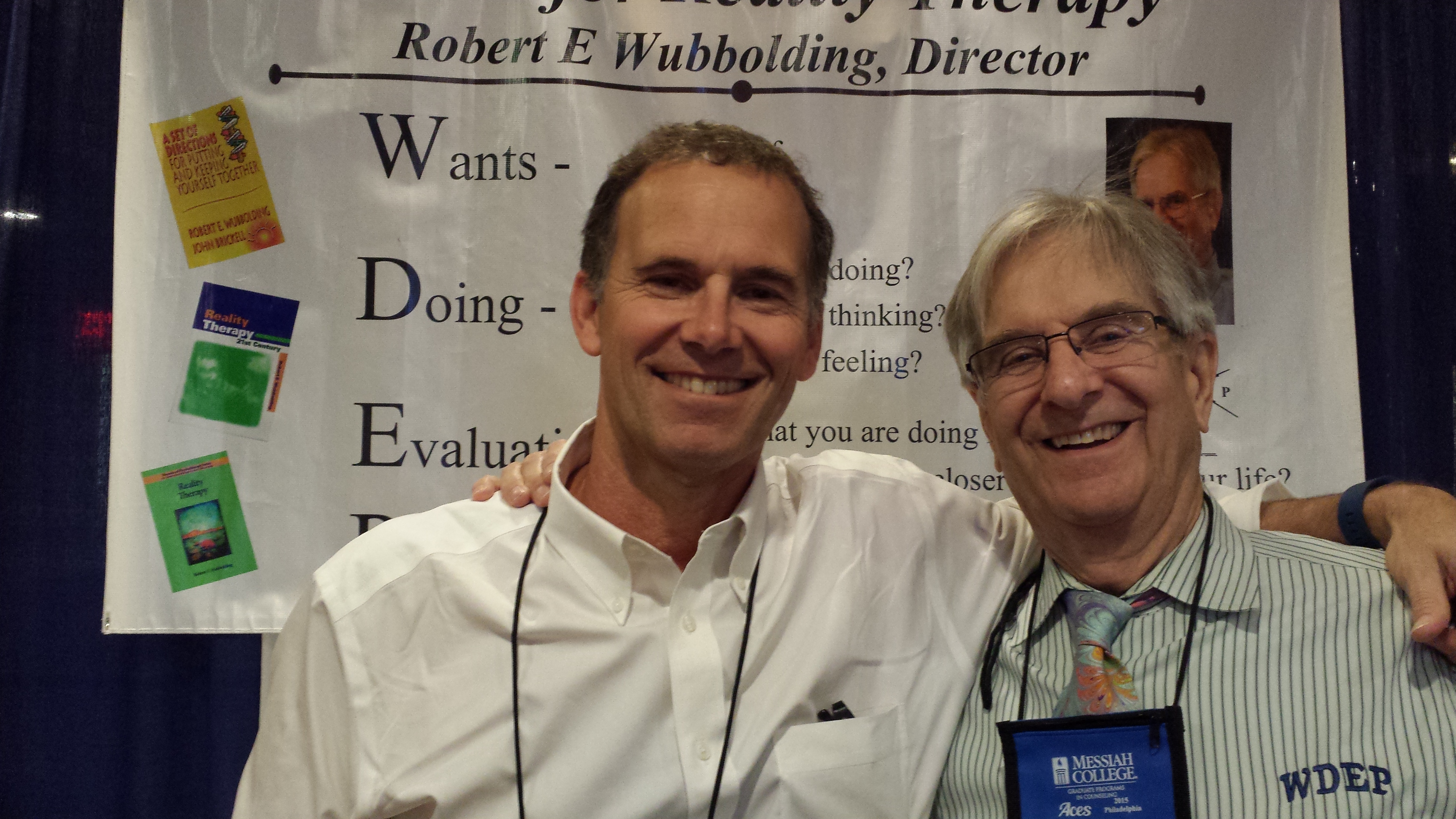
John hanging out with Robert Wubbolding

With Wubbolding

Reflections on Guantanamo in Austin, TX

Several weeks ago I was traveling in Texas to do a professional workshop. The following essay is a short reflection on a small part of that experience. It’s not a professional essay, but just a personal reflection on an interesting social experience. If you’re just following this blog for professional information, feel free to skip this . . . there will be more professionally-oriented posts later this week.

**************************

Fox News was flickering in the background in the fitness room of an unnamed Austin, Texas hotel. I hadn’t noticed. I was busy concentrating on peddling the exercise bike and balancing myself on its loose handlebars.

Hotel fitness centers are like that. They require focus and planning. My next move was to climb aboard what appeared to be the first treadmill ever built on the other side of the room. Watching television wasn’t on the agenda.

Before I moved to the treadmill, a White man about my age entered the room. He grunted and stretched. Then that I noticed Fox News. They were about to cut to the White House. President Obama would be announcing his plan to close Guantanamo. I silently wished I’d changed the channel while I’d been alone in the room.

The White guy climbed onto the elliptical machine immediately to my left. He decided to strike up a political conversation.

“I know how we should shut that place down,” he said. “We should line everybody up and shoot the fuckers.”

My brand new exercise buddy was celebrating our first special moment together.

Mostly I felt anxiety. Images of firing squads do that to me. Two words escaped my mouth before the communication system locked down. “Uh . . . yeeeaaahh,” I said in a long moan. There was no eye contact. He went on:

“That’s all those people are worth. Just line them up and shoot them all.”

I pedaled. But I also felt a natural social pull his direction, as if I should agree with him. This was combined with an equally natural impulse to leap off the bike and flee the scene.

Thoughts bounced around in my head, but no words came. He kept talking, but more quietly. He said something else about shooting. Then he described the worthless prisoners of Guantanamo. Then he trailed off into inaudible muttering. Finally, there was silence.

Five more minutes passed. I moved to the treadmill on the far side of the room and ran for 15 minutes. He stayed on the elliptical. A part of me worried I might have offended him. There was only silence with the television in the background.

Maybe he mistook me for an ally. After all, I was alone in a fitness room and tuned into Fox News. Maybe he was looking for a fight. Maybe he was just talking to the television out of frustration, as many people do. But he got nothing of substance from me.

Several rejoinders nearly made their way out of my mouth.

“That’s not how we do things in America” was closest to surfacing.

In second place there was a flood of sarcasm:

“Oh. So you must be in the CIA. You sound like you actually know something. Have you been there? Have you met the Guantanamo prisoners? Or have you somehow come to this informed opinion from a distance?”

Back in my room, I expressed a mix of disappointment and pride to my wife, Rita. I was disappointed in my silence. Perhaps I should have engaged him. But the other side of me was proud of maintaining silence. As a psychologist and counselor educator I know there’s no better extinction schedule than ignoring someone 100%. Besides, I had a feeling he wasn’t the sort of guy who was open to other perspectives.

My wife was reassuring. She commiserated with me on how difficult it is to think of something clever to say on the spot. She expressed support for my “That’s not how we do things in America” idea. She suggested an amplified version:

“Right. That’s how ISIS would handle things. Only they’d probably behead them.”

And that’s just one more reason why today I’m grateful to be an American in Austin, TX.

Parallel Process in Clinical Supervision

This short case example from the forthcoming 6th edition of Clinical Interviewing is a small tribute to all the great supervisors I had over the years.

Case Example 7.2:

Intermittent Unconditional Positive Regard and Parallel Process

Abby is a 26-year-old graduate student. She identifies as a White Heterosexual female. After an initial clinical interview with Jorge, a 35-year-old who identifies as a male heterosexual Latino, she meets with her supervisor. During the meeting she expresses frustration about her judgmental feelings toward Jorge. She tells her supervisor that Jorge sees everyone as against him. He’s extremely angry at his ex-wife and he’s returning to college following his divorce and believes his poor grades are due to racial discrimination. Abby tells her supervisor that she just doesn’t get Jorge. She thinks she should refer him instead of having a second session.

Abby’s supervisor listens empathically and is accepting of Abby’s concerns and frustrations. The supervisor shares a brief story of a case where she had difficulty experiencing positive regard toward a client who had a disability. Then, she asks Abby to put herself in Jorge’s shoes and imagine what it would be like to return to college as a 35-year-old Latino man. She has Abby imagine what might be “under” Jorge’s palpable anger toward his ex-wife. The supervisor also tells Abby, “When you have a client who views everyone as against him, it’s all the more important for you to make an authentic effort to be with him.” At the end of supervision Abby agrees to meet with Jorge for a second session and to try to explore and understand his perspectives on a deeper level. During their next supervision session, Abby reports great progress at experiencing intermittent unconditional positive regard for Jorge and is enthused about working with him in the future.

One way to enhance your ability to experience unconditional positive regard is to have a supervisor who accepts your frustrations and intermittent judgmental-ness. If the issues that arise in therapy are similar (or parallel) to the issues that arise in supervision, it’s referred to as parallel process (Searles, 1955). This is one reason why when you get a dose of unconditional positive regard in supervision, it may help you pass it on to your client.


John Rap