I’m taking the opportunity this fine Sunday afternoon to post a blog piece that Rita wrote earlier this week. Oddly, or perhaps not that oddly for those who know her, Rita has an alter-identity that she refers to as “Dr. Bossypants.” In this alternate voice, Rita refers to herself in third person and lets herself be a bit more pedantic than she is in real life.
In this blog post, Dr. Bossypants jumps into the domain of forgiveness and offers up ideas that I found exquisitely interesting and very helpful.
Without further ado, I’d like you to meet, my friend, Dr. Bossypants.
Turns out, yesterday was Tuesday, not Friday. I got so disoriented yesterday that by the day’s end, I was emailing people and telling them to have a great Labor Day weekend. My excuse is that I got 17 new stitches in my forehead during a 4.5 hour marathon Mohs surgery on Monday. Sheesh. Now I’m a poster-boy for sun block. See the photo at the bottom of this post for the evidence.
I’m posting today (Wednesday, not Saturday!) to let you know about a unique opportunity, and to ask for your support.
Beginning this September (National Suicide Prevention Month), the Montana Happiness Project, L.L.C., in collaboration with Families First Learning Lab, is launching a 20-week Happiness Activity Challenge. Using various social media platforms, this campaign guides participants through 20 distinct evidence-based positive psychology interventions designed to increase personal happiness and life meaning.
This Campaign will be available for free, online, through social media. Because we’re offering it for free, we’re looking for two levels of support.
Collaborator: Being a collaborator costs you nothing. All it means is that you’re publicly saying that you support our efforts at spreading evidence-based happiness and will share our happiness activities with colleagues, friends, and perhaps formally engage your organization to participate. If you’re a collaborator, we’ll put your name or organization name and logo on our website.
Sponsor: We’re asking specific organizations to partner with us to sponsor each week. To sponsor a week, we ask for a $500 contribution. In return, we’ll include your Logo and our Thanks in our social media posts for the week. This will include posts on Instagram, Facebook, Youtube, WordPress, and on our Squarespace Montana Happiness Project website. If you’re a sponsor, we’d love for you to encourage your staff to participate in this happiness promotion activity, talk about it with each other, and post about it on social media.
You may wonder, if we can be collaborators and my staff and colleagues can participate for free, why be a sponsor? That’s a great question. We’re doing our Happiness Challenge as an act of kindness for the people of Montana and beyond and acts of kindness are evidence-based happiness strategies. We hope you’ll join us, perform an act of kindness, and sponsor at least one homework week.
Whether you’re a collaborator, sponsor, or evesdropper, we hope you’ll engage with our happiness challenge to see if participation in some or all of our 20-day happiness project helps you (and your staff, friends, family, etc.) feel happier.
Below, I’ve answered a few questions:
Who can participate? – Anyone. Our primary focus is Montana, but our goal is to reach out and promote positivity and happiness to anyone and everyone who is interested.
Howmuch does it cost? – Nothing. Nada. Nil. This is free because we believe life is hard and people need support, skills, and to have hope for greater happiness.
Do I have to commit to all 20 homework assignments? – Nope. We’re doing this on social media. You can participate as much or as little as possible. You can be explicitly active by posting and sharing about your experiences, but you can also keep your experiences to yourselves.
Are the homework assignments really evidence-based? – Yes. Nearly all of the assignments have direct scientific support as “interventions” that increase happiness and decrease depression. That doesn’t mean increased happiness and decreased depression are guaranteed, because even “effective” interventions don’t work for everyone. . . but they’re worth a try. A few of the assignments don’t have direct experimental support, but they’re based on concepts shown to increase happiness and meaningfulness.
What’s the catch? – No catch. We’re offering this experience as an act of kindness because we think it’s a good thing. We also recognize that positive psychology or evidence-based happiness interventions are not a great fit for everyone. Just do what you can when you can if you can.
How can I contribute to the idea of sharing evidence-based happiness knowledge and skills? – We hope you will do this activity with co-workers, friend, and/or family. We hope you’ll share it on social media, or talk with your children about your experiences over dinner. If you’re especially inspired by our 20-week Happiness Challenge, you’re welcome to donate (not required, but appreciated) to Families First Learning Lab. Just let the good people at Families First know that your donation is to support the FFLL Happiness Project.
I’d end with “Mark your calendars!” but given that I’m still not certain that I’m fully oriented to time, I’ll just say, thanks for reading all this and considering full engagement with our Happiness Challenge.
Last week I did a little cliff-jumping into the Stillwater River with my twin 13-year-old grandchildren. It was only about 20 feet, but high enough to feel the terror and exhilaration of a brief free-fall.
This week I’m having a different kind of buzz. Dr. Margaret Rutherford reached out to me with a link to her TEDx Boca Raton talk. Previously I was a guest on her video podcast show (here’s the link to her podcast page: https://drmargaretrutherford.com/podcast-2-2/, and a link to her website and book, “Perfectly Hidden Depression” https://drmargaretrutherford.com/perfectlyhiddendepressionbook/). We’ve stayed in touch via email. Along with her link, she apologetically noted that she “barely” got a plug in for my work on strengths-based suicide assessment. I thought it was incredibly nice for her to give a nod, even a brief one, to my work. But then I watched and discovered that she had only mentioned three professionals: Edwin Shneidman (the “Father of Suicidology), Sidney Blatt (a renowned suicide and depression researcher from Yale), and some obscure guy from the University of Montana (that would be me).
Aside from feeling honored, humbled, and flattered to even get a mention, Dr. Margaret’s talk is fantastic. She makes the point–with a couple of articulate cases–for moving away from a strictly medical model perspective and toward working with people who may be suicidal through a lens of no judgment and acceptance. Here’s the link to her talk, which is well-worth a watch: https://www.youtube.com/watch?v=lXZ5Bo5lafA
There are other signs that how professionals (and hopefully the public) view suicidal ideation and behavior may be shifting toward greater acceptance. I’ll go into these other signs in a future post, but right now I want to emphasize that the point is not to replace the medical model, but to move the needle toward less pathologizing and more acceptance of the fact that having suicidal thoughts is often a normal part of life. To the extent that we can approach people who are thinking about suicide with, as Dr. Margaret said, “non-judgment and acceptance,” the more likely they are to be open with us about their pain. . . and . . . when people are open about their pain and suffering, then we have a chance to listen with empathy and a greater opportunity to be of help. . . which, I think, is the main point.
Thanks to the support of the Arthur M. Blank Foundation, we (the Montana Safe Schools Center and the Montana Happiness Project) have funding to support a very low cost 3-credit online graduate course titled, “Evidence-Based Happiness for Educators.”
This course is available very soon – the first class “meeting” is on July 5, from 9:30am-11:30am. I have “meeting” in quotes here because the course can be taken asynchronously, although we recommend synchronous “live” attendance on specific dates. The details follow:
When: The course begins on Wednesday, July 5, 2023. The course consists of 20, 2-hour sessions. The final meeting is on Tuesday, August 1. Live (synchronous) class meetings will be held from 9:30am to 11:30am on the following dates:
Wednesday, July 5
Monday, July 10
Monday, July 17
Monday, July 24
Monday, July 31
Where: Online. After you register, as soon as we have the final course details taken care of, you’ll receive a Zoom link for attending sessions, and accessing course videos and materials.
What: The course, COUN 595 (Evidence-Based Happiness for Educators) is an academic review and experiential practice of evidence-based happiness strategies. Participants will have daily reading/podcast/video assignments, along with experiential practice assignments. The primary purpose of the course is for teachers to learn to apply evidence-based happiness strategies (e.g., gratitude, savoring, etc.) to themselves. The secondary purpose of the course is for teachers to make plans for how they can integrate evidence-based happiness principles and activities into their classrooms. You will not be required to implement these ideas in your classrooms, but we will encourage you to experiment with the ideas on yourself and, to the extent that you desire, to share them with students.
Who can enroll: All Montana teachers are eligible to enroll. There is a class cap at 40.
Who will teach the course: Lillian Martz, M.A., a doctoral student in the Department of Counseling at the University of Montana will be the lead instructor. John Sommers-Flanagan, a professor in the Department of Counseling will be the secondary instructor.
The cost: Due to a generous grant from the Arthur M. Blank Foundation, we can offer this course at approximately 20% of a usual University of Montana summer course. Instead of over $1,000, the course is $175.00 for 3 graduate credits. You can also take the noncredit version of the course (and qualify for 40 OPI hours), for $75.00.
What else: Because this course is underwritten by the Arthur M. Blank Foundation, we will ask participants to complete questionnaires before and after the course. You will not be required to complete the questionnaires, but if you do, that will help us to better understand the usefulness of this course content for Montana educators . . . and we would greatly appreciate your participation.
I’ve spent the morning learning. At this point in my life, learning requires simultaneous regulation of my snarky irreverence. Although I intellectually know I don’t know everything, when I discover, as I do ALL. THE. TIME., that I don’t know something, I have to humble myself unto the world.
Okay. I know I’m being a little dramatic.
After pushing “submit” on our latest effort to publish Round 1 of our happiness class data, less than an hour later I received a message from the very efficient editor that our manuscript had been “Unsubmitted.” Argh! The good news is that the editor was just letting us know that we needed to follow the manuscript submission guidelines and include a “Structured Abstract.” Who knew?
The best news is I wrote a structured abstract and discovered that I like structured abstracts way more than I like traditional abstracts. So, that’s cool.
And, here it is!
Abstract
Background: University counseling center services are inadequate to address current student mental health needs. Positive psychology courses may be scalable interventions that address student well-being and mental health.
Objective: The purpose of this study was to evaluate the effects of a multi-component positive psychology course on undergraduate student well-being, mental health, and physical health.
Method: We used a quantitative, quasi-experimental, pretest-posttest design. Participants in a multi-component positive psychology course (n = 38) were compared to a control condition (n = 41). All participants completed pre-post measures of well-being, physical health, and mental health.
Results: Positive psychology students reported significant improved well-being and physical health on eight of 18 outcome measures. Although results on the depression scale were not statistically significant, a post-hoc analysis of positive psychology students who were severely depressed at pretest reported substantial depression symptom reduction at posttest, whereas severely depressed control group students showed no improvement.
Conclusion:Positive psychology courses may produce important salutatory effects on student physical and mental health. Future research should include larger samples, random assignment, and greater diversity.
Teaching Implications: Psychology instructors should collaborate with student affairs to explore how positive psychology courses and interventions can facilitate student well-being, health, and mental health.
What’s new about anger? Everything and nothing. You will feel angry over and over in your life. Each time it will be your familiar anger, which may come to feel old, tired, and boring. But each time it also will be new and compelling—as if you’ve been charged with energy to change the world.
Here’s one big truth about anger; it will come around again.
Here’s another: when doing anger management, it’s helpful to develop awareness of your usual triggers because if you see it coming, you may have a better chance to handle your anger in ways that are less embarrassing or destructive.
Here’s a third. This one I like to tell my clients and students: One good thing about having anger problems is that—and you can count on this—you will get many opportunities to work on your anger in the future, because it won’t be long until your anger visits you again (and again).
To summarize: Anger is repetitive; it’s good to develop self-awareness of your personal triggers; you will be presented with many opportunities to deal with your anger differently.
What follows is a slight revision of a post from seven years ago.
The speedometer reads 82 miles per hour. The numbers 8 and 2, represent to me, a reasonable speed on I-90 in the middle of Montana. Our speed limit signs read eight-zero. So technically, I’m breaking the law by two miles per hour. But the nearest car is a quarter mile away. The road is straight. Having ingested an optimal dose of caffeine, my attention is focused. All is well.
In my rear-view mirror, I notice a car slowly creeping up on me from behind. He gets a little to close to my rear bumper, and then slowly drifts into the left lane past me, lingering beside me and edging ahead. Then, with only three car lengths between us, he puts on his blinker and drifts in front of me. Now, with no other cars in sight, there’s just me and Mr. 83 mph on I-90, three car lengths apart.
An emotion rises into awareness. It’s anger, from a distance. I see it coming slowly, as if it’s in the rear-view mirror of my brain. At this distance, it’s only annoyance. I feel it and see it coming and immediately know it can go in one of three directions: My annoyance could sit there and remain unpleasant, until I tire of it. If I provide it with oxygen, could rise up and blossom into full-blown anger. Or, I can send it away, leaving room for other—more pleasant—thoughts and actions.
That’s not to say annoyance and anger is wholly unpleasant. Part of me likes it; part of me feels so damn aggrieved and indignant and justified.
All this self-awareness is fabulous. This is the Sweet Spot of Self-Control.
Without moving or speaking, “Hello anger,” I say, to myself, in my brain.
In this sweet spot, I experience expanding awareness, a pinch of energy, along with unfolding possibilities. I love this place. I love the strength and power. I also recognize anger’s best buddy, the behavioral impulse. This particular impulse (they vary of course), is itching for me to reset my cruise control to 84 mph. It’s coming to me in the shape of a desire—a desire to send the driver in front of me a clear message. Isn’t that what anger, in its behavioral manifestation, aggression, is all about—sending a message?
“You should cut him off,” the impulse says, “and let him know he should give you some space.”
The sweet spot is sweet because it includes the empowered choice to say “No thanks” to the impulse and “See you later” to anger.
Now I’m listening to a different voice in my head. It’s smaller, softer, steadier. “It doesn’t matter” the voice whispers. “Let him move on ahead. Revenge is only briefly sweet. Those who seek revenge should dig two graves.”
I smile remembering an anger management workshop. With confidence, I had said to the young men in attendance, “No other emotion shifts as quickly as anger. You can go from feeling completely justified and vindicated, but as soon as you act, you can feel overwhelmed with shame, regret, or embarrassment.”
One participant said, “Lust. Lust is like anger. One second you want something more than anything, but the next second you might wish you hadn’t.”
“Maybe so,” I said.
There are many rational reasons why acting on aggressive behavioral impulses is ill-advised. Maybe the biggest is that the man in the car wouldn’t understand my effort to communicate with him. This gap of understanding is common across many efforts to communicate. But it’s especially linked to retaliatory impulses. When angry, I can’t provide nuance in my communication; I can’t make it constructive.
The quiet voice in my brain murmurs: “You’re no victim to your impulses. You drive the car; the car doesn’t drive you.” That doesn’t make much sense. Sometimes the voice in my head speaks in analogy and metaphor. It’s a common problem. I want straight talk, but instead I get some silly metaphor from my elitist and intellectual conscience.
But here’s what I get. I get that my conscience is telling me that this sweet spot is sweet because I get to see and feel my self-control. Not only do I see my behavioral options, I get to see into the future and evaluate their likely outcomes. I get to reject poor choices and avoid negative outcomes. I’m not a victim of annoyance, anger, or aggressive impulses. I make the plan. I drive the car.
The other driver is now far ahead. I recognize that I could resurrect my anger. I choose to let it go instead.
I haven’t always let go of my anger. In my teen years I developed a temper. I had many sport-related fits of embarrassing anger. I went to psychotherapy. My therapist listened, and helped me grow my better judgment. He said, “I don’t believe in the bowel movement theory of anger control.” That was a little indirect, and interesting. We don’t have to expel it. We can sit with it. We can reflect on it. We can watch it go away. We can put it in the rear-view mirror, or let it pass us by. Using our functional frontal lobes, we can experience the joy of the Sweet Spot of Self-Control.
My anger is like an old, greedy, needy, and fickle friend. It has an all-or-nothing mentality. My anger wants attention and power, because it values power over long-term happiness.
Anger is also a source of energy; it can fuel us to be assertive, to fight injustice, to be clear on our values. Anger has its place, and is sometimes a useful partner: a partner whom we should keep in the passenger seat, never letting it get behind the wheel and drive—even on a wide-open Montana highway.
No one has excellent judgment when sleep deprived and so no one should expect to have excellent judgment when sleep deprived. I’m making this bold claim based on my recent personal experience of writing and posting last week’s blog titled, “Sleep Well.” Sometimes I write late at night. That’s great for the muse and creativity; it’s less great for me remembering what the heck I was planning to write. I start writing. . . I finish writing. . . and sometimes I stay with my focus, while other times, well, I forget the whole point.Last week, my main reason for writing a blog on sleep was to link readers to a specific sleep podcast. However, because I was doing my late-night writing thing, by the time I finished it, I completely forgot to mention the podcast or include the link. Has this sort of thing ever happened to you? My guess is that, if it does, it happens more often when you’re sleep deprived, than when you’re sleep restored. Now, after a nice weekend of restorative sleep, here’s info and the link to the podcast.The podcast is called “All things Vagus.” I confessed to the host (Kathy Mangan, who is great) that I was scientifically opposed to “polyvagal theory” but she still let me on the show. That’s an example of how great she is. Here’s the description for the April 3, 2023 episode, titled: Sleep Well, Be Well: Why talk about sleep? It is important to our health, so we need to get clear on the types of insomnia and how we can cope with distress and anxiety that might be disrupting our rest.The link: https://allthingsvagus.fireside.fm/10P.S.: This is a 42-minute podcast episode, which makes it a nice length to go along with the workout you should be doing every day to optimize your sleep. And if you optimize your sleep, you’re more likely to remember what you’re writing about.
When it comes to literally everything, knowledge is power. The more we know and the more we understand, the better we’re able to cope with—as Alfred Adler used to say—the tasks of life. One very important task of life is to sleep well.
In September, 1975, I went to college for one reason: to play college football and baseball. Going to class and learning anything was required for me to be able to do what I wanted to do. So, I went to class and I played sports.
Being away from the structure of home and family, I didn’t sleep well. Then, several months into my college career, I started having what I considered “Very weird experiences.” I didn’t tell anyone about those experiences, because they were weird and I was a young male and unaccustomed to being open with others about any of my private experiences. The very weird experiences just kept on happening.
The experiences happened as I tried to nap (on the floor, or a couch, a bed, or wherever I was). While dropping off to sleep, or waking up, I would start to hear what sounded like loud static. The static was bad and weird on its own, but then I discovered I couldn’t move, which was especially disturbing because I began seeing the shape of an ominous figure standing at the end of my bed, or couch, or in the doorway. I had to just lay there in panic because, of course, I was paralyzed.
Eventually, I would completely wake up, be able to move, and discover no one was in my room. And eventually, maybe because I adjusted to college or started sleeping better, the very weird experiences stopped. But, while they were happening, I searched my mind for explanations.
Because there was no Internet and no Google back then, I relied on what was in my brain. But basically, I had nearly nothing in my brain. Remember, I was interested in sports, not knowledge. . . and I was a bit averse to doing anything rational, like going to the library or consulting a professional. Consequently, being a meaning-making creature, I created two hypotheses, basically out of thin air.
Hypothesis #1: I was about to be possessed by a demon.
Hypothesis #2: I might be developing psychic powers.
There was no hypothesis #3. My mind bounced from hypothesis 1 to hypothesis 2, and back again.
Funny thing. In the early 2000s, I happened to be reading the Diagnostic and Statistical Manual of Mental Disorders and found a section that described a phenomenon called, “Sleep paralysis.” I was, as they say, gobsmacked. The description was EXACTLY my experience, including the frightening and shadowy figure at the end of the bed.
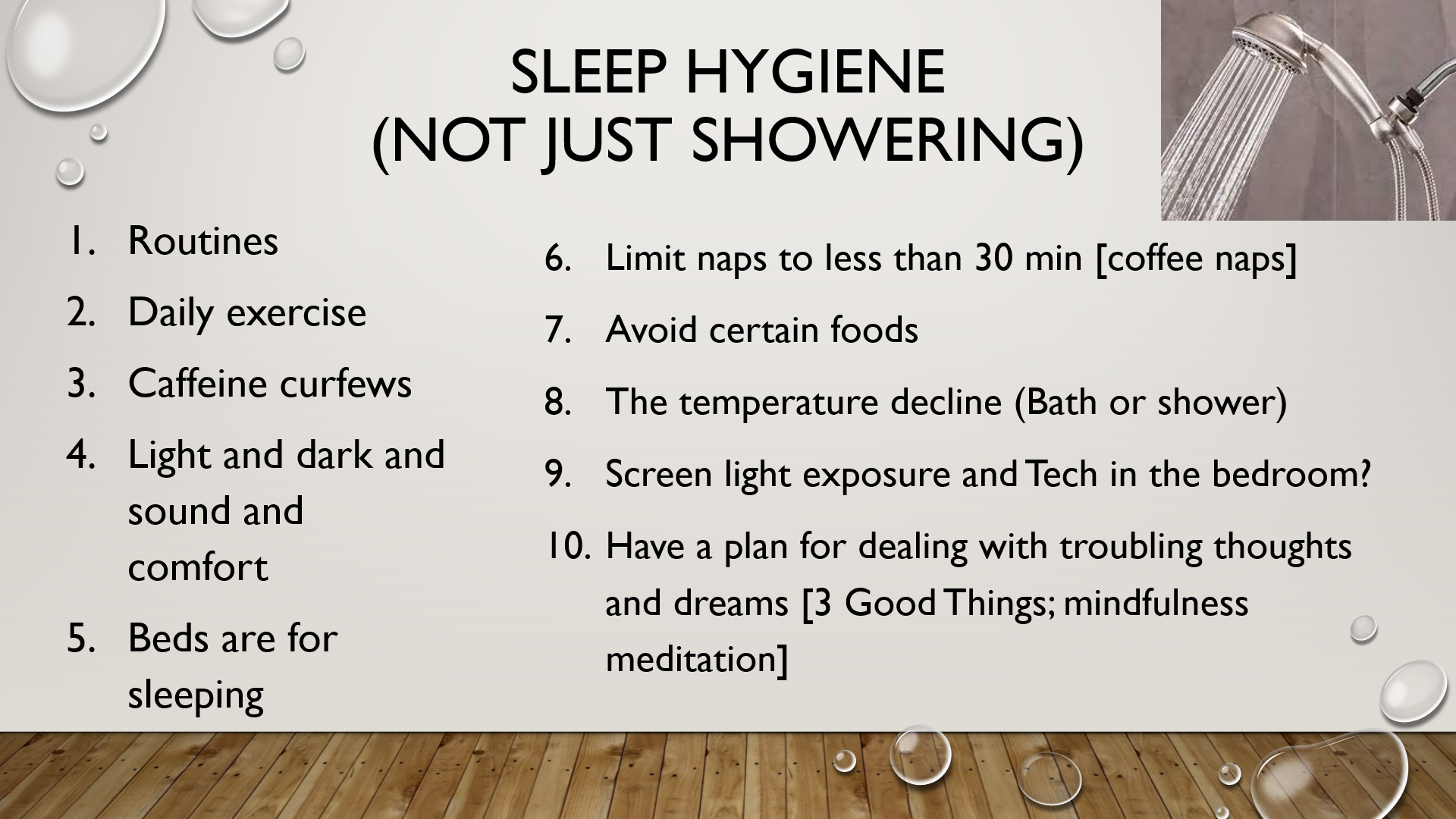
My point is that it’s good to know stuff in general, and good to know specific stuff about our own experiences around mental health and. . . including that thing we call insomnia. I’ve posted before about insomnia (https://johnsommersflanagan.com/2012/05/23/insomnia/). I will also post more soon, but for now, I’m just sharing the “sleep hygiene” slide from my happiness and sleep lectures.
Sleep hygiene is a thing. I’ve got lots of funny and snarky things to say about sleep hygiene. Maybe the most important is that sleep is an elusive little bugger. What I mean by that is that sleep comes somewhat easier when we stop trying too hard, and often runs away when we’re feeling especially desperate to get some good sleep. The other piece of important information is that having sleep disruptions and not sleeping the magical 8 hours is pretty darn normal. Many or most people have regular sleep disruptions. And, fun fact, expecting that you should get 8 hours of sleep every night can get in your head and interfere with you getting 8 hours of sleep a night.
For now, here’s the famous sleep hygiene powerpoint slide (below). More to come (later) on tricks and techniques for sleeping well. Thanks for reading.
This morning in Toronto I’m talking about happiness. That means I’ll be singing at the end of the presentation . . . which may make you feel better about missing this particular event.
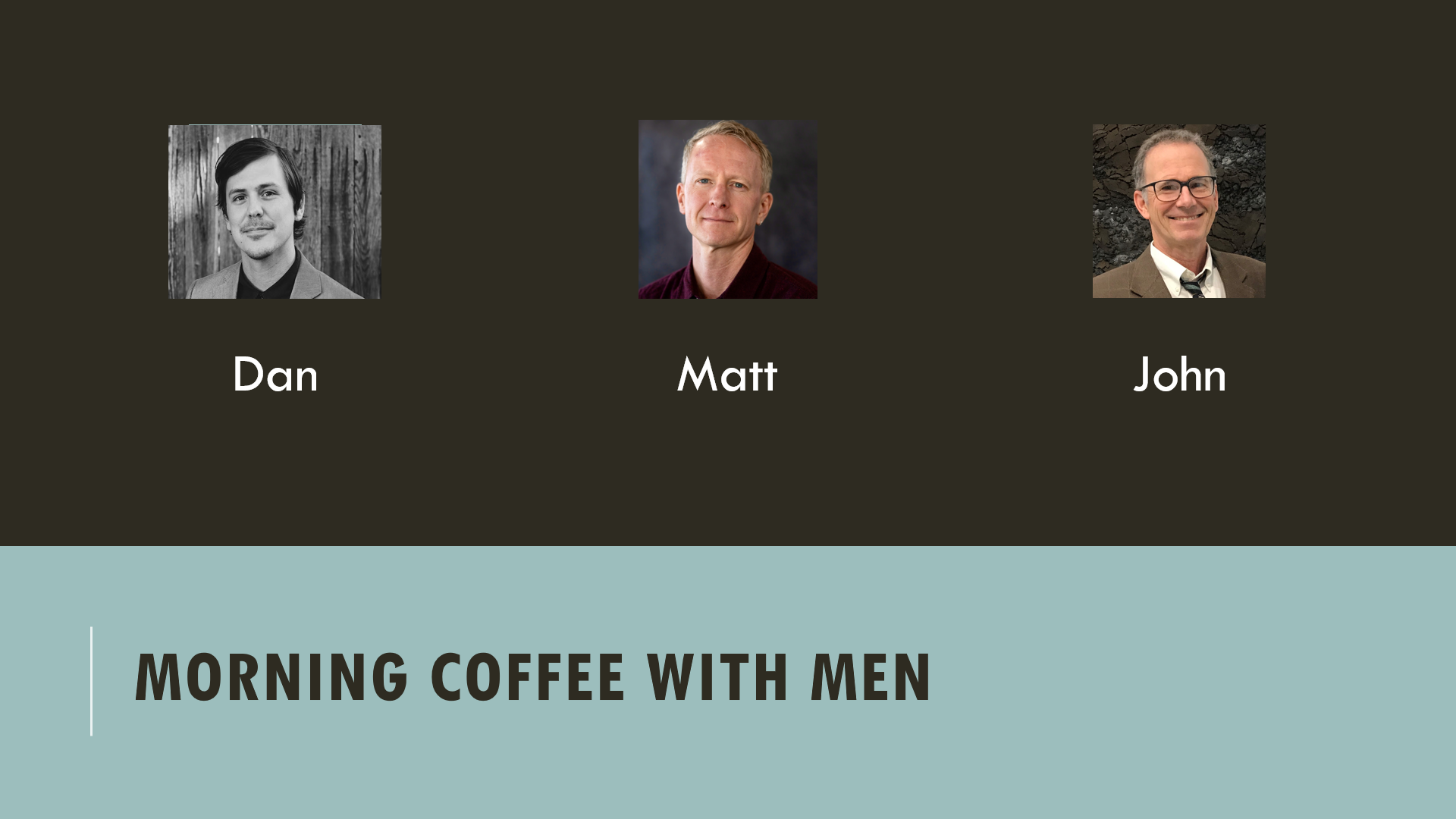
Tomorrow morning, March 31, 2023, at 8am, I’m co-presenting with Matt Englar-Carlson and Dan Salois on suicide and happiness with men at the American Counseling Association World Conference in Toronto.
Here’s the session blurb:
Men and boys account for nearly 80% of all suicide deaths in the U.S. Factors contributing to high suicide rates include: constricted emotional expression, reluctance to seek help, firearms, alcohol abuse, and narrowly defined masculinity. In this educational session, we will use a case demonstration to illustrate suicide assessment counseling methods to help boys and men liberate themselves from narrow masculine values, while embracing alternative and meaningful paths to happiness.
If you’re in Toronto, I hope to see you there. . . and for anyone interested, here’s the Powerpoint presentation:







 John Sommers-Flanagan