Tag Archives: Positive Psychology

The Invention of the Strength Warning

Now that I’m immersed in positivity every day as the Director of the Center for the Advancement of Positive Education, I think I’ve become weirder.

Some of you, including my sisters and brothers-in-law may be wondering, “Wait. How could John become any MORE weird than he already is?”

You know what they say: “All things are possible!” [Actually, I don’t know why I just wrote all things are possible, because, even in my most positive mental states, I don’t believe that BS. All things are not possible. I could make a list of impossible things, but I’ve already digressed.]  

Here’s what I mean by me becoming even weirder.

I find myself more easily hearing and seeing the pervasive negative narratives emerging around us. I could make another long list of all the bad ideas (negative narratives) I’m noticing (think: “fight or flight”), but I’ll limit myself to one example: The “Trigger warning.”

Trigger warnings are statements that alert listeners or viewers (or people attending my suicide assessment workshops) to upcoming intense and potentially emotionally activating content. Over the past 10ish years, we’ve all started giving and receiving trigger warnings from time to time, now and then. A specific example, “The next segment of this broadcast includes gunfire” or “In my lecture I will be talking about mental health and suicide.”

As a college professor in a mental health-related discipline, I became well-versed in providing trigger warnings. . . and have offered them freely. Because some people have strong and negative emotional reactions to specific content, providing trigger warnings has always made good sense. The point is to alert people to intense content so they can take better care of themselves or opt out (stop listening/viewing). Trigger warnings are important and, no doubt, useful for helping some people prepare for emotionally activating content.

As a college professor, I’m also obligated to keep up with the latest research. Unfortunately, the research on trigger warnings isn’t very supportive of trigger warnings. Argh! In general, it appears that trigger warnings sensitize people and might make some people more likely to have a negative emotional response. You can read a 2024 meta-analysis on trigger warning research here: https://journals.sagepub.com/doi/10.1177/21677026231186625

In response to the potential adverse effects of trigger warnings, I came up with a clever idea: I started giving trigger warnings for my trigger warnings. These were something like, “Because research suggests that trigger warnings can make you more reactive to negative content, I want to give you a trigger warning for my trigger warning and encourage you to not let my warning make you more sensitive than you already would be.”

Then, about a year ago, I had an epiphany. [I feel compelled to warn you that my epiphany might just be common sense, but it felt epiphany-like to me]

I realized—perhaps aided by my experiences training to do hypnosis—that trigger warnings might be functioning as negative suggestions, implying that people might not be able to handle the content and priming them to notice and focus on their negative reactions.

Given my epiphany, I was energized—as the solution-focused people like to say—to do something different. The different thing I settled on was to invent “The Strength Warning.”

[Here’s where I digress again to pitch a podcast. Paula Fontenelle, an all-around wonderful, kind, and competent professional, has a new podcast called, Relating to AI. And, lucky me, I got to be one of her very first guests. And, lucky Paula (joking now), she got to have me start her podcast interview by explaining and demonstrating the strength warning. Consequently, if you’re interested in AI and/or in hearing me demonstrate the strength warning, the link to Paula’s podcast is here: https://www.youtube.com/watch?v=MHDIYrXw_2Y]

Although watching/listening to me give the strength warning with Paula is way more fun, I will also describe it below.

For strengths warnings, I say things like this.

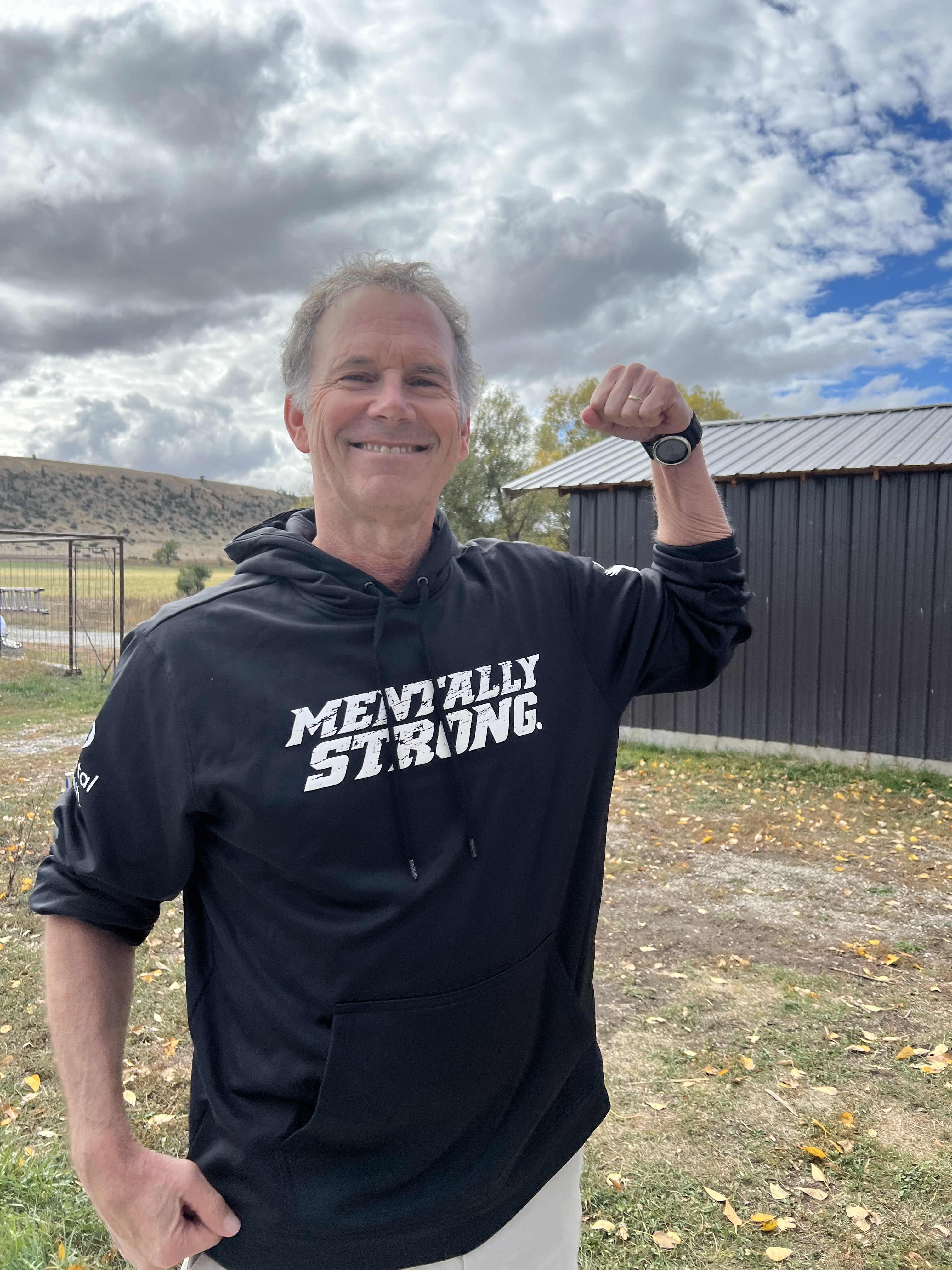
In addition to warning you about sensitive content coming up, I also want to give you a Strength Warning. A strength warning is mostly the opposite of a trigger warning. I want you to watch out for the possibility that being here together in this lecture and with your colleagues might just make you notice yourself feeling stronger, feeling better, feeling more prepared, feeling more knowledgeable, and maybe even feeling smarter. So . . . watch for that, because I think you might even be stronger than you think you are.

Please, let me know what you think about my invention of the strength warning. I encourage you to try it out when you’re teaching or presenting.

I also encourage you to try out Paula’s new podcast. If you do, you might feel smarter, stronger, and more prepared to face the complicated issue of having AI intrude on our lives.

Positive Psychology and Eudaimonia for Greater Happiness and Health

Some late-breaking news . . .

Tomorrow morning, from 7:30am-8:30am (Mountain time), I’ll be presenting for the online Friday Medical Conference at St. Patrick Hospital. It’s free. All you need to do is click on the link below a couple minutes before the start time and join in.

When: Friday, 1/31
Time: 730am-830am
Where: Register Here: https://umontana.zoom.us/meeting/register/BvxjQYKCTY2Yybbh4bhltw

Below are the presentation ppts:

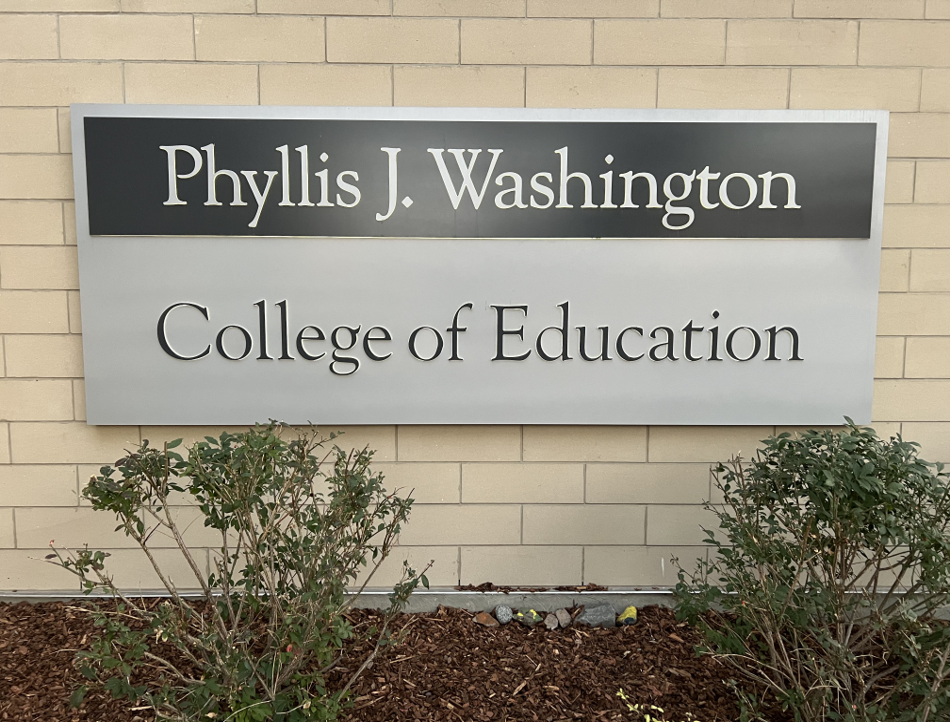
The Washington Foundation Awards $9.4M to the Phyllis J. Washington College of Education to Support Montana Teachers, School Counselors, and Positive Education

Hi All,

As predicted, I have great news today.

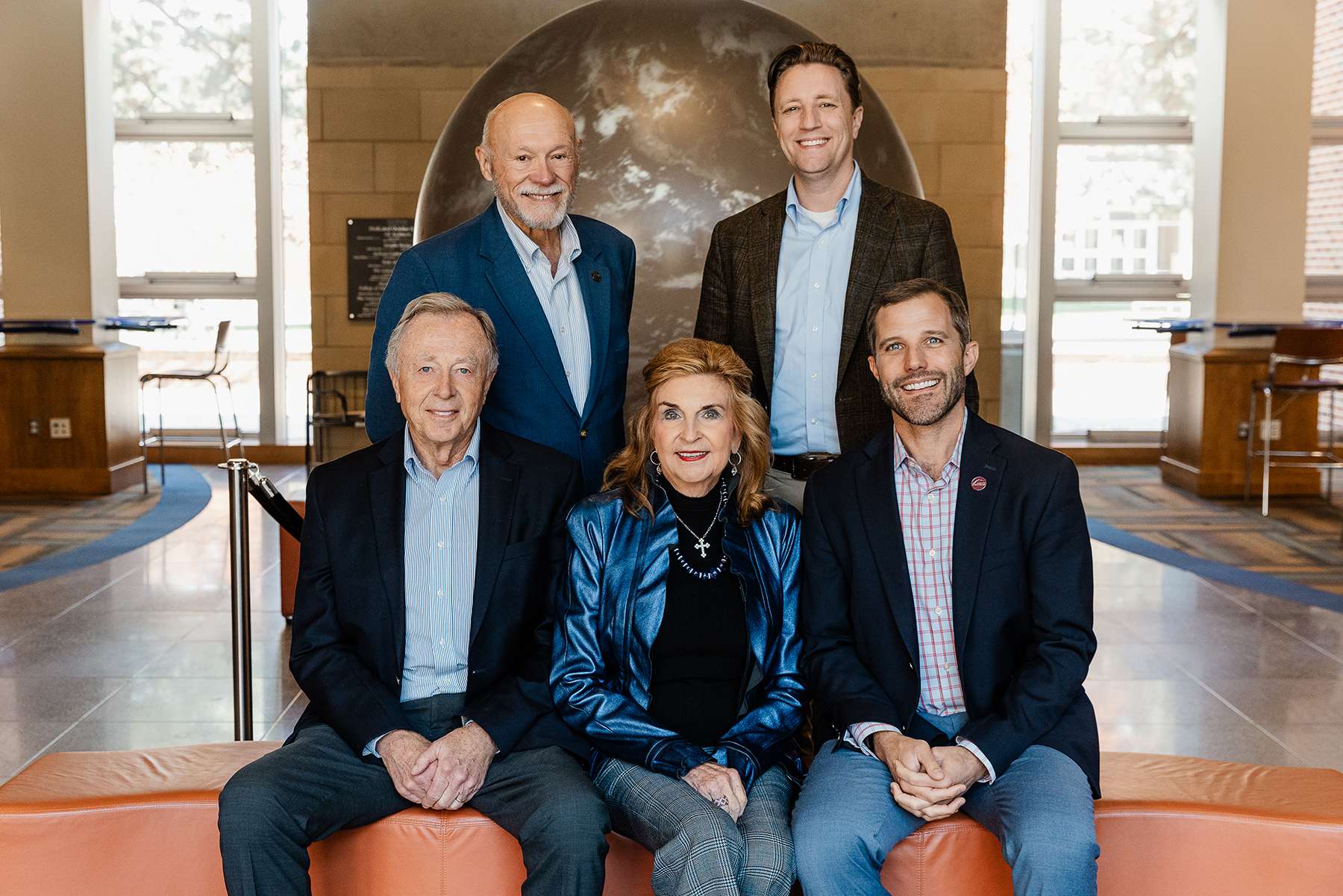
The University of Montana Foundation and the Phyllis J. Washington College of Education have just issued a press release announcing a $9.4M grant from the Dennis and Phyllis Washington Foundation to support positive education at the University of Montana and throughout the state. I am humbled to hear of this amazing support and immensely grateful to Phyllis Washington and the Washington Foundation for their vision and generosity.

Specifically, these funds will support the educational journey of prospective Montana teachers and school counselors and will grow our efforts to address the emotional and behavioral health of Montana educators and students through positive education. As you may know, thanks to a previous grant from the Arthur M. Blank Family Foundation, I’ve been very involved in promoting the principles of positive psychology and education throughout Montana. I look forward to continuing my work with Montana teachers and administrators. This incredibly generous grant will deepen our support for current and future Montana educators, including professional school counselors. Together, we will work to improve the emotional and behavioral health of young people in Montana and beyond.

If you have questions, please reach out to the names and numbers listed in the official press release.

All my best,

John S-F

P.S.: Along with my thanks to the Washington Foundation, in keeping with the principles of positive psychology, I want to emphasize my gratitude to Dr. Dan Lee, Dean of the Phyllis J. Washington College of Education, and the extremely competent and capable team of Erin Keenan, Erin White, and Jason Newcomer from the University of Montana Foundation. Of course, many of you who receive this message are also on my gratitude list. I hope you can feel good feelings deep inside yourselves about your own contributions to creating a better future for Montana youth, educators, and schools. I look forward to working collaboratively with all of you in the future.  

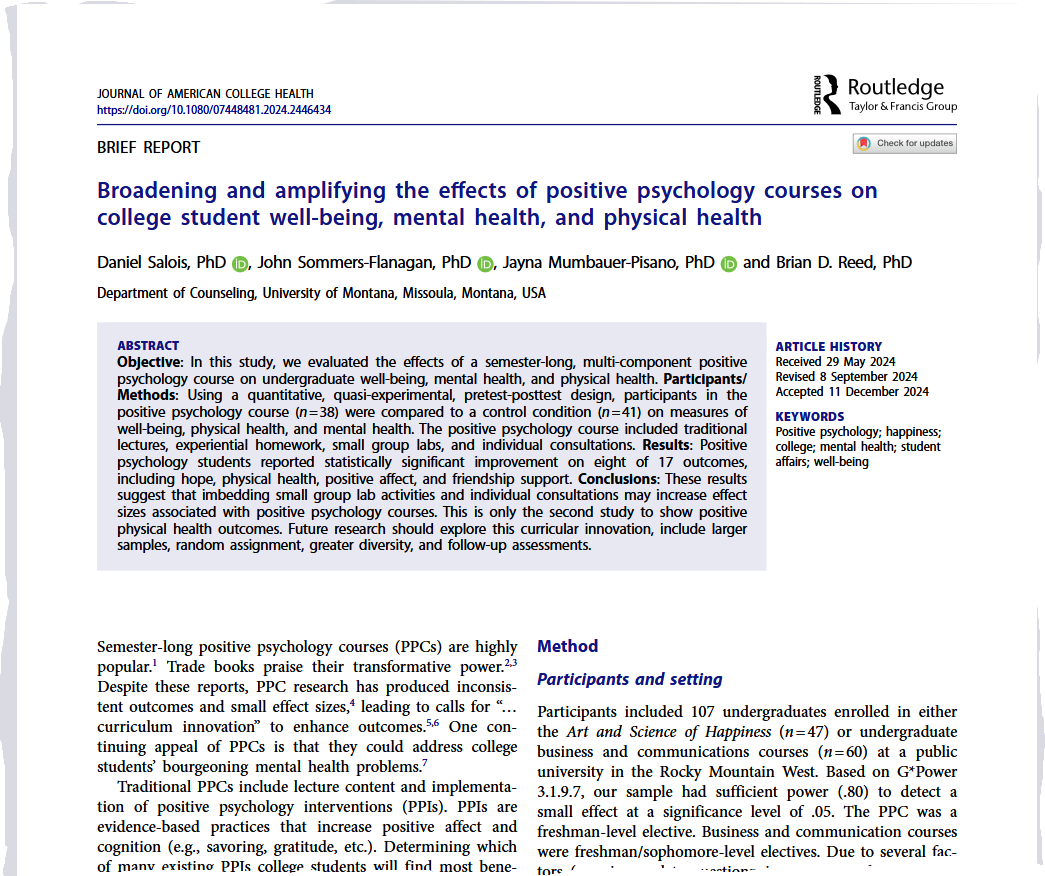
Publication Alert — Broadening and Amplifying the Effects of Positive Psychology Courses on College Student Well-Being, Mental Health, and Physical Health

We have more good news for 2025. At long last, we’ve published a research article based on Dr. Dan Salois’s doctoral dissertation. Congratulations Dan!

This article is part of growing empirical support for our particular approaches to teaching positive psychology, happiness, and how people can live their best lives. As always, I want to emphasize that our approach is NOT about toxic positivity, as we encourage people to deal with the deep conflicts, trauma, and societal issues that cause distress — while also teaching strategies for generating positive affect, joyspotting, and other practices derived from positive psychology.

One of the big takeaways from Dr. Dan’s dissertation is that our happiness class format may produce physical health benefits. Also, it’s important to note that this publication is from early on in our research, and that our later research (currently unpublished) continues to show physical health benefits. Exciting stuff!

Here’s a link to the article. My understanding from the publisher is that only the first 50 clicks on this link can read/view the whole article.
https://www.tandfonline.com/eprint/VXXD3ISCT7EUJ8WAM7UY/full?target=10.1080/07448481.2024.2446434

My Positive Education Stump Speech

Earlier this week I was asked to write a very brief stump speech for positive education. I’ve never written a stump speech. . . and mostly feel good about that. For this stump speech, I decided to stick with very basic facts or tendencies associated with positive psychology and positive education.

Here’s a hastily written first draft. Feel free to comment and make recommendations as you like.

*********

Positive education, as we define it at the University of Montana, is based on three essential psychological truths (or tendencies).

  1. Most people are naturally compelled to focus on the negative, as captured by the question: “What’s wrong with you?”
  2. The things and experiences that we pay attention to, will grow.
  3. We are better at growing strengths than we are at getting rid of problems or symptoms.

These truths explain why current approaches to education unintentionally grow negative emotions and symptoms like anxiety, depression, and trauma. These truths also explain why we need to train all educators, counselors, and students to overcome their tendency to over-focus on the negative, and instead systematically focus on growing student, teacher, and administrator strengths, skills, resources, and virtues. 

Positive education is the best path forward for education in Montana and beyond.

Who Supports Educators?

Hi All,

I’m writing for a little social marketing assistance to support Montana Educators.

As I’ve written before, because of the generosity and funding from the Arthur M. Blank Family Foundation, we have funding to support Montana educators. The main way we’ve chosen to support Montana educators is to offer a highly subsidized three-credit course on “Happiness for Teachers” through the fantastically helpful UMOnline people at the University of Montana.

We believe this course supports Montana Educators in three ways:

  1. The course can be used to help increase educator pay (because we believe educators should be paid more).
  2. The course can help educators feel positive feelings more often, savor them, increase their sense of meaning, and possibly reduce depression and improve physical health.  
  3. Educators can use the information to support their students’ happiness and well-being.

We’ve got a large section of the course open and starting on June 17. I’d love to get it all filled up.

If you are a Montana educator or know a Montana educator you can register here and now at this link: https://www.campusce.net/umextended/course/course.aspx?C=712&pc=13&mc=&sc=

In addition, to support educators, please consider sharing this blogpost or the Memo to Montana Educators linked here:

Negative and Positive Reflections on Positive Psychology

In my Group Counseling class, I’ve experienced predictable questioning of or resistance to evidence-based happiness ideas from positive psychology. . . and so I wrote out some of my thoughts . . . which went on and on and ended with a video clip.

Hello Group Class,

I’m writing my group takeaway to your all this week. Feel free to read at your leisure . . . or not at all . . . because I’m a writer and obviously, sometimes I get carried away and write too much.

When I responded to a question last week expressing reservations about the use of positive psychology—perhaps generally and perhaps more specifically with oppressed populations—I launched into a psychoeducational lecture. Upon reflection, I wish I had been more receptive to the concerns and encouraged the class as a group chew on the pros and cons of positive psychology in general and positive psychology with oppressed populations, in particular. I suspect this would have been an excellent discussion.

Given that we have limited time for discussion in class, I’ll share more reflections on this topic here.

1.       The concerns that were expressed (and others have expressed in your takeaways) are absolutely legitimate. I’m glad you all spoke up. Some people have used positive psychology as a bludgeon (claiming things like “happiness is a choice”) in ways that make people feel worse about themselves. Never do that!

2.       Positive psychology is poorly named (even the great positive psych researcher, Sonja Lyubomirsky, hates the name). Among its many naming problems, the word positive implies that it’s better, preferable, and the opposite of negative—which must then be the correct descriptor for all other psychology. None of this is true; positive psychology is not “better” and, in fact, it’s not even exclusively positive.

3.       The point of positive psychology is not to “take over” psychology, but to balance our focus from being nearly always on psychopathology, to being equally about strengths, joy, happiness, etc., and psychopathology. If you think of it as an effort to balance how we work with individuals, it makes more sense. The point isn’t, and never has been, that we should only focus on positive mental health regardless of how our clients and students are feeling. That would be silly and insensitive.

4.       As someone reminded me in the takeaways, the sort of happiness we focus on in positive psych is called eudaimonic happiness. This term comes from Aristotle. It refers to a longer form of happiness that emphasizes meaning, interpersonal connection, and finding the sweet spot where our own virtues intersect with the needs of the community. The other side of happiness is referred to as “hedonic” happiness. Hedonic happiness is more about hedonism, which involves immediate pleasure and material acquisitions. Nearly everyone in positive psychology advocates primarily for eudaimonic happiness, but also recognizes that we all usually need some pleasure as well.

5.       Individuals and groups who have been historically (and currently) oppressed are naturally sensitive to coercion, judgment, and possibility of repeated oppression. What this means for counselors (among many things) is that we need to careful, sensitive, and responsive to their needs and not our assumptions of their needs. They may appreciate us being positive and supportive. Or they may appreciate us explicitly acknowledging their pain and affirming the legitimacy of the reasons for their pain. There’s substantial research indicating that certain ethnic group expect counselors to be experts and offer guidance. If that’s the case, should we avoid offering guidance because a particular theorist (or supervisor) said not to offer guidance? I think not. Many clients benefit from going deep and processing their disturbing emotions and sensations. There are probably just as many who don’t really want to go deep and would prefer a surface-focused problem-solving approach. Either way, my point is that we respond to them, rather than forcing them to try to benefit from a narrow approach we learned in grad school.

6.       Good counselors . . . and you will all become good counselors . . . can use virtually any approach to make connection, begin collaborating, remain sensitive to what clients and students are saying (verbally and non-verbally), and work constructively with them on their emotions, thoughts, sensations/somatics, behaviors, and the current and/or historical conditions contributing to their distress.

7.       We should not blame clients for their symptoms or distress, because often their symptoms and distress are a product of an oppressive, traumatic, or invalidating environment. This is why reflections of feeling can fall flat or be resisted. Feeling reflections are tools for having clients sit with and own their feelings. While that can be incredibly important, if you do a feeling reflection and you don’t have rapport or a rationale, feeling reflections will often create defensiveness. Instead, it can be important to do what the narrative and behavioral folks do, and externalize the problem. When it comes to issues like historical trauma, often clients or students have internalized negative messages from a historically oppressive society, and so it makes perfect sense to NOT contribute to their further internalization of limits, judgments, discrimination, and trauma that has already unjustly taken hold in their psyche. The problem is often not in the person.     

8.       I know I said this in class, but it bears repeating that many people practice simple, superficial, and educational positive psychology using bludgeon-like strategies. Obviously, I’m not in support of that. That said, many people practice simplistic implementation of technical interventions in counseling (think: syncretism from theories class), and many counselors do bad CBT, bad ACT, bad DBT, bad behaviorism, bad existentialist therapy, and bad versions of every form of counseling out there. No matter which approach you embrace, you should do so using your excellent fundamental listening skills . . . so that if your client or student doesn’t like or isn’t benefiting from your approach, you can change it!

I want to end this little 1K word writing project with a video. In the linked clip, I’m doing about a 3 1/2 minute opening demonstrating a “Strengths-based approach” to suicide assessment and treatment planning with a 15-year-old. As you watch, ask yourself, “Is this strengths-based?” Can you identify anything that makes this approach strengths-based or as including even a whiff of positive psychology. [Again, you’re not required to watch this, I’m just rambling.]

Okay. That’s all for this Sunday evening!

John

Check Out This Happiness Class (and Experiential Small Group) for ALL Adults

Spring is coming: it’s a good time to try something new.

In collaboration with the MOLLI program on campus at the University of Montana, I’m offering a unique “Happiness” class that combines an initial lecture with 5 small group experiential discussions. The course begins in about 1 month (April 2, 2024). Here’s the course description:

Evidence-Based Happiness: An Experiential Approach

In this course, participants will learn about and experience seven different research-based approaches to achieving greater happiness. Using a unique format, participants will have one week of traditional lecture, followed by five weeks of small-group experiential learning sessions. Each small group (aka happiness lab) will meet to practice, experience, and discuss specific happiness interventions. Before each lab group, participants will be provided with a short reading and a short video to guide their weekly happiness practice. Specific positive psychology interventions to be covered include (a) three good things, (b) savoring, (c) gratitude, (d) cognitive behavior therapy, (e) forgiveness, (f) acts of kindness, (g) and the best possible self. Labs will be facilitated by graduate students in counseling and supervised by John Sommers-Flanagan.

Here’s a link to me talking about the course in a 2-minute video: https://www.youtube.com/watch?v=H3gAimLZPvU

And here’s a link to a cool promo flyer made by one of our M.A. students in Counseling:

The course is live and offered simultaneously in virtual and in-person formats. To enroll, you need to become a MOLLI member, which costs $0. The cost of the course is $70. If you do the math, you’ll see that’s about $12 per educational hour . . . which is a fantastic deal. The other fantastic part is that research indicates your participation may contribute to you feeling greater meaning and happiness.

For remote users, there are no borders. You can take it from anywhere: To enroll in the VIRTUAL (remote) course, click here, and if you’re not a MOLLI member, start by clicking on sign-in to become a member and then register: https://www.campusce.net/umtmolli/course/course.aspx?C=844&pc=38&mc=42&sc=0

To enroll in the IN-PERSON course, click here, and if you’re not a MOLLI member, start by clicking on sign-in to become a member and then register: https://www.campusce.net/umtmolli/course/course.aspx?C=844&pc=38&mc=45&sc=0

I hope to see you on April 2.

John SF

The Many Paths to Gratitude

Freud once said, “There are many ways and means of conducting psychotherapy. All that lead to recovery are good.”

Coming from rigid old Freud, that was a pretty wildly accepting statement. I’d like to apply it to gratitude.

There are many ways to practice gratitude. All that lead to meaning and happiness are good.

When it comes to gratitude, there are many “ways and means.” Let us count the ways.

1.       Gratitude for others who are in our lives right now.

2.       Gratitude for others, from the past; these people toward whom we feel gratitude may be alive or may have passed.

3.       Gratitude for a higher power. Many people pray to express gratitude. In Traveling Mercies, Anne Lamott said there are only two types of prayer. “Help me. Help me. Help me.” And “Thank-you, thank-you, thank-you.” Obviously, Lamott’s second type of prayer is all about gratitude.

4.       Gratitude for a concept a country or belief system.

5.       Once, during a workshop, I had a teacher say she was grateful to her 16-year-old self for having the courage and good judgment to go immerse in Spanish, even though she didn’t like Spanish much. She went, learned, and is now a successful Spanish teacher. Very cool.

When it comes to gratitude, there are also many means. Let us count them too.

1.       We can keep a gratitude journal. Journals are usually private, but sometimes not. Also, journals can be written, spoken, or video-recorded.

2.       Gratitude can be practiced once-a-week, every day, or at whatever rate you choose.

3.       We can have surface gratitude, or we can dig down deep and keep asking ourselves, “Why this gratitude for this person, place, or thing?”

4.       We can purposefully find a way to communicate our gratitude to the person or persons toward whom we feel it. There are lots of online videos showing what happens when people communicate gratitude. We like this one from SoulPancake: https://www.youtube.com/watch?v=oHv6vTKD6lg

5.       You can do a benefit reflection. This means that you take a few moments to reflect on (a) how much someone’s action helped you, (b) the time, money, or effort that a person sacrificed to help you; and (c) the fact that someone helped you on purpose.

Gratitude can have big or small benefits. Like everything, gratitude is in the eye of the beholder (meaning you will have an individualized response to practicing gratitude; it’s not about what you “should” experience; it’s about trying out gratitude and seeing how you feel). Generally, gratitude has small and positive effects on depression and anxiety. Here’s a link to a 2021 meta-analysis, if you want to read the science:

As always, I encourage you to experiment with gratitude. It might make a big difference, a small difference, or no difference at all . . . but it’s hard to know if you’ll benefit from gratitude unless you practice it—at least a little—using the ways and means that fit for you.

Three Good Things: Martin Seligman’s Signature Positive Psychology Intervention

This week, for the Montana Happiness Challenge, we’re encouraging participants to experiment with Martin Seligman’s “Three Good Things” technique. Three good things (TGT) is an evidence-based positive psychology intervention. For example, six months of twice-weekly TGT has been shown to decrease burnout in nurses (Luo et al., 2019) and four weeks of unguided internet-based TGT reduced insomnia in adults (Sato et al., 2022). In Seligman’s (Seligman et al., 2005) original research, TGT had positive effects on mood and depression.  

Like everything, TGT is not one-size fits all. You should use it in any way that works for you. You can start with Seligman’s instructions, and riff on it from there. For me, I like it best at 4am, when I wake up and my brain seems preoccupied with depressing things. If you want to listen to me talking about TGT, here’s a 5+ minute video:  https://www.youtube.com/watch?v=45fsZMDMPOQ

If you want to read the long and winding version of this happiness activity, I’ve pasted it below the references. If not, just jump right in, try it out, and post your thoughts and reactions on your favorite social media platform.

References

Luo, Y., Li, H., Plummer, V., Cross, W. M., Lam, L., Guo, Y., . . . Zhang, J. (2019). An evaluation of a positive psychological intervention to reduce burnout among nurses. Archives of Psychiatric Nursing, 33(6), 186-191. doi:https://doi.org/10.1016/j.apnu.2019.08.004

Sato, D., Sekizawa, Y., Sutoh, C., Hirano, Y., Okawa, S., Hirose, M., . . . Shimizu, E. (2022). Effectiveness of unguided internet-based cognitive behavioral therapy and the three good things exercise for insomnia: 3-arm randomized controlled trial. Journal of Medical Internet Research, 24(2), 1-17. doi:https://doi.org/10.2196/28747

Seligman, M. E. P., Steen, T. A., Park, N., & Peterson, C. (2005). Positive psychology progress: Empirical validation of interventions. American Psychologist, 60(5), 410-421. doi:https://doi.org/10.1037/0003-066X.60.5.410