Tag Archives: Happiness

The Many Paths to Gratitude

Freud once said, “There are many ways and means of conducting psychotherapy. All that lead to recovery are good.”

Coming from rigid old Freud, that was a pretty wildly accepting statement. I’d like to apply it to gratitude.

There are many ways to practice gratitude. All that lead to meaning and happiness are good.

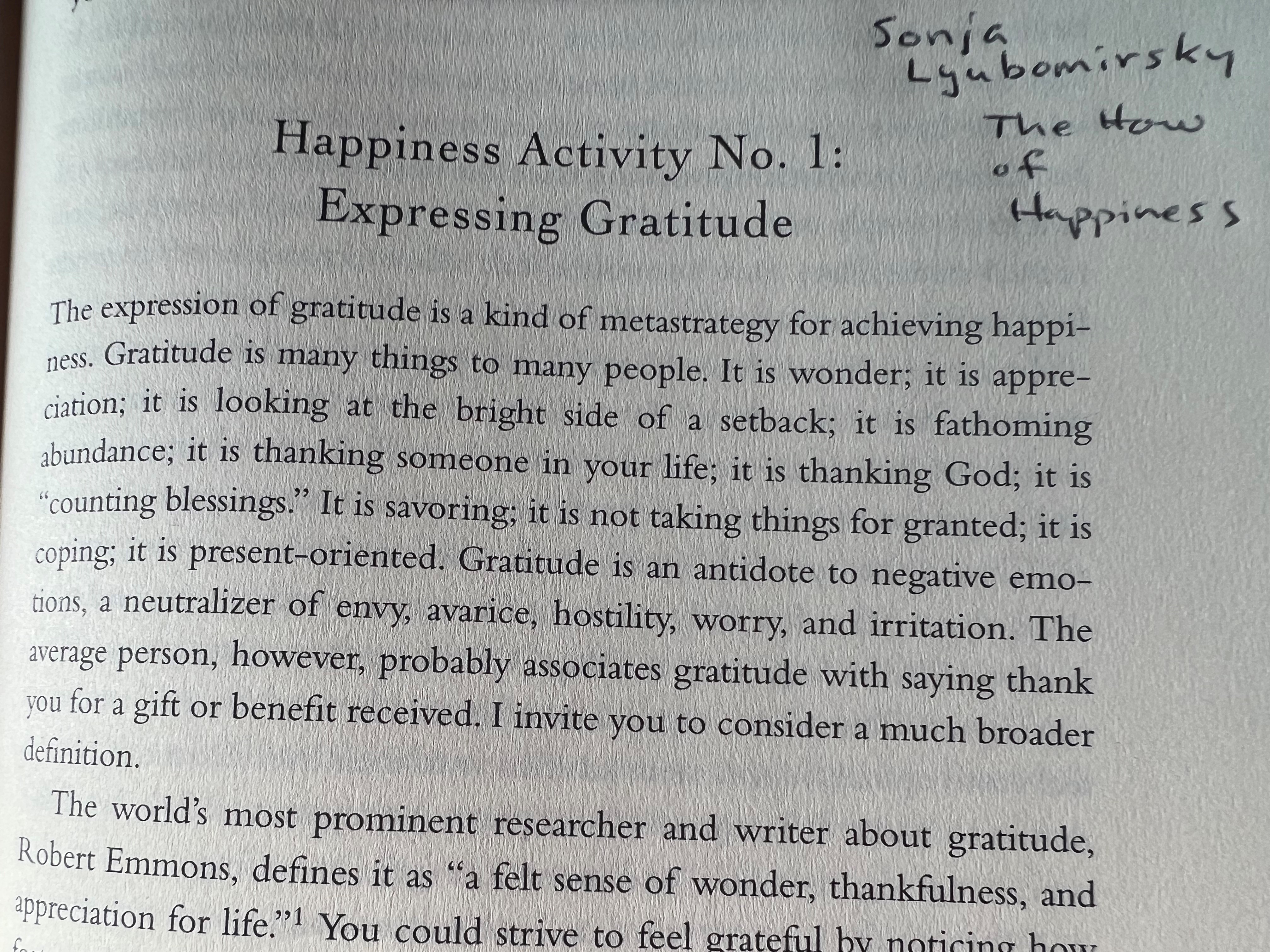
When it comes to gratitude, there are many “ways and means.” Let us count the ways.

1.       Gratitude for others who are in our lives right now.

2.       Gratitude for others, from the past; these people toward whom we feel gratitude may be alive or may have passed.

3.       Gratitude for a higher power. Many people pray to express gratitude. In Traveling Mercies, Anne Lamott said there are only two types of prayer. “Help me. Help me. Help me.” And “Thank-you, thank-you, thank-you.” Obviously, Lamott’s second type of prayer is all about gratitude.

4.       Gratitude for a concept a country or belief system.

5.       Once, during a workshop, I had a teacher say she was grateful to her 16-year-old self for having the courage and good judgment to go immerse in Spanish, even though she didn’t like Spanish much. She went, learned, and is now a successful Spanish teacher. Very cool.

When it comes to gratitude, there are also many means. Let us count them too.

1.       We can keep a gratitude journal. Journals are usually private, but sometimes not. Also, journals can be written, spoken, or video-recorded.

2.       Gratitude can be practiced once-a-week, every day, or at whatever rate you choose.

3.       We can have surface gratitude, or we can dig down deep and keep asking ourselves, “Why this gratitude for this person, place, or thing?”

4.       We can purposefully find a way to communicate our gratitude to the person or persons toward whom we feel it. There are lots of online videos showing what happens when people communicate gratitude. We like this one from SoulPancake: https://www.youtube.com/watch?v=oHv6vTKD6lg

5.       You can do a benefit reflection. This means that you take a few moments to reflect on (a) how much someone’s action helped you, (b) the time, money, or effort that a person sacrificed to help you; and (c) the fact that someone helped you on purpose.

Gratitude can have big or small benefits. Like everything, gratitude is in the eye of the beholder (meaning you will have an individualized response to practicing gratitude; it’s not about what you “should” experience; it’s about trying out gratitude and seeing how you feel). Generally, gratitude has small and positive effects on depression and anxiety. Here’s a link to a 2021 meta-analysis, if you want to read the science:

As always, I encourage you to experiment with gratitude. It might make a big difference, a small difference, or no difference at all . . . but it’s hard to know if you’ll benefit from gratitude unless you practice it—at least a little—using the ways and means that fit for you.

Experimenting with Gratitude

In the midst of an online workshop on happiness, I came to the gratitude slide, and asked the Zooming participants for their reactions. One person, a school psychologist, said, “I hate gratitude. I’m sick and tired of gratitude. Everybody talks about gratitude and how we all should be doing it. It just feels fake and trite to me.”

Being aware of the futility of trying to convince anyone of anything, I listened, reflected and validated her concerns, “Yes, gratitude can feel very trite, and it sounds like you pretty much hate it.” Then I kept on rolling.

A few minutes later, I asked for a volunteer to engage with me in a live “gratitude experience.” Of the 40 checkerboard faces on my screen, who volunteered? Of course, the woman who was “sick and tired of gratitude” spoke up quickly, “I’ll do it.”

It felt like a set-up for my gratitude demonstration to fail. But I’m a professional . . . and so I forged onward, encouraging her to think of someone specific—past or present—toward whom she felt gratitude. She cooperated. I nudged her to go a bit deeper, “What do you think it is, in particular, that makes you feel grateful to this person. Tell me the details.” She paused, responded, there was a sparkle of emotion, which I noticed and reflected back to her. In the end, she commented, “That was cool. Maybe I don’t really hate gratitude. Maybe I just hate superficial gratitude.”

This is a great example of the difference of thinking about gratitude vs. taking the time to feel about gratitude. Like everything, if we brush past gratitude like a stranger on the street, it can feel meaningless and trite. And then if people keep telling us we “should” do it because it has all these “benefits” we might become even more entrenched in our dislike of gratitude.

As with all things related to positive psychology, don’t do gratitude as an obligation. Intentionality in choosing to engage in a gratitude practice is foundational. Although random experiences of gratitude are fine, intentionally making the space and time to feel grateful is substantially better.

This week, your gratitude activity is part contemplation, part writing, and part action. Use the following steps:

1.       Identify someone toward whom you feel or have felt appreciation and gratitude. You may have plenty of options. It’s likely a good idea to choose someone toward whom you believe you haven’t yet expressed enough gratitude.

2.       Write a gratitude note to that person. Include in the note why you feel gratitude toward to the person. Include specifics as needed, as well as words that best express your sincere heartfelt feelings toward the person.

3.       Find a way to express your feelings directly to your gratitude target. You can read the note in person, over the phone, or send it in whatever way you find best.

Your goal is to express your gratitude. What that means is that you need to drop expectations for how the recipient of your gratitude should or will respond. Don’t focus on their response, instead, focus on doing the best job you can expressing the gratitude that you sincerely feel.

If the person loves hearing about your gratitude, cool. If the person is uncomfortable or not positive or silent, that’s okay. Your goal should be within your control—meaning that all you can control is your end of the communication and not how the communication is received.  

If you feel moved to do so, please share your experiences on social media. Tell the world (and us), (a) what it was like to write the gratitude message, (b) what it was like to deliver it, and (c) how it felt to express your gratitude. Feel free to repeat this gratitude experiment a second or third time.

There are many other ways to approach gratitude practice.

Here’s one example, from a book that offers teachers and school counselors ideas for how to apply positive psychology interventions in school settings.

We’ll be sending out additional ideas and variations on gratitude this week. . . so stay tuned!

Savoring these Savoring Videos

In the summer of 2022, we held a Strengths-Based Suicide and Happiness retreat at Boulder Hot Springs in Montana. The food was excellent and well-worth savoring every nibble. Additionally, we encouraged all the participants to do approximately 1-minute videos focusing on a practice in their lives that they believe to be helpful to their happiness.

Here’s Charlie, talking about savoring his experiences as a one-man heavy metal band

Charlie — We Rip

I think these videos are incredible. I love what everyone says. . . and appreciate the participants, the messages, and the videographers. I find myself savoring these savoring videos.

Below, I’m including a few links to more of our retreat videos that, more or less, focus on savoring. They’re short, they’re cool, and I hope you watch, savor, and reflect on how you might do even more savoring in your life. Who knows, maybe you’ll even make your own social media video and share it with us and the world!

Joyce – Happy Grandma: https://www.youtube.com/watch?v=kP36toKBS4E

Sidney – Feel It: https://www.youtube.com/watch?v=Q1nQ2uKufNg

Jennifer – Savoring: https://www.youtube.com/watch?v=r2WrLATF7QY

Chris – The Savoring Mindset: https://www.youtube.com/watch?v=pHTQiQEbFXk

Dylan – Bring in the Light: https://www.youtube.com/watch?v=fGtO–GhL2U

John – Color and Art: https://www.youtube.com/watch?v=IuFsGa3PhRo

Savor This!

As many of you who know me in-person or through this blog, I’m quite capable of backward-savoring. . . which might be why I find this week’s Montana Happiness Challenge activity especially compelling.

Savoring is defined as a deliberate effort to extend and expand positive experiences. Or, as I learned from Dr. Heidi Zetzer of the University of California, Santa Barbara, “Savoring is amplifying and extending positive emotions, by lingering, reveling, relishing, or something even more active like taking a victory lap! I also stole this photo from one of Heidi’s happiness slides. Thanks Heidi!!

So, how can anyone—or me—do savoring backward? Enter another fun word: Rumination.

Dictionary.com defines rumination as (1) a deep or considered thought about something. Or, (2) the action of chewing the cud.

Essentially, to ruminate is to think hard. You may be ruminating right now, wondering, “What’s backward or bad about thinking hard.”

Well, in the domain of mental health, we focus on a particular type of rumination. For example, according to the American Psychiatric Association, “Rumination involves repetitive thinking or dwelling on negative feelings and distress and their causes and consequences.”

Thinking hard about negative things is precisely the opposite of savoring. And, despite my surface penchant for the positive, both my wife and I would attest to the fact that I’m also an excellent ruminator—as in the psychiatric sense, not so much in the cud-chewing sense.

As we like to say in academia, the research on savoring is damn good. Well, maybe we don’t really like to say “damn good,” but I’m sure someone has said that at some point in time, probably while savoring all the savoring research.  

How good is the research, you ask?

People instructed to savor, depending on the type of savoring, generally report improved mood, increased satisfaction, greater hope for positive life events, increased planning, and a greater likelihood of repeating a previously savor-worthy experience. Just savor that for an extra moment or two. For something so simple, savoring research has damn good outcomes.

This week, our Montana Happiness Challenge savoring activity provides you with a menu of different savoring activities to try out. You can read the details on the Montana Happiness Project website: https://montanahappinessproject.com/savoring

The summary is: For this week the plan is for you to pick one savoring assignment from a menu of research-based savoring activities (below). Each of these activities has research support; doing any of them might make you feel significantly more happiness or less depression. Here are your options:

  • Engage in mutual reminiscence. Mutual reminiscence happens when you get together with someone and intentionally pull up and talk about fun, positive, or meaningful memories. I was on the phone with a friend last week and did a bit of this and it was nice. Now I have memories of us remembering our shared positive memories.
  • Make a list of positive memories. After making the list, transport yourself to reminisce on one of the memories. You can do this by yourself. Retrieve the memory. Play it back in your mind. Explore it. Feel it. Let your brain elaborate on the details.
  • Celebrate good news longer than you would. This is easy. You need to track/observe for a positive message or news in your life that feels good. Then, let your mind linger on it. Notice how you feel. What parts of the news are especially meaningful and pleasant to you? Extend and celebrate the good news.
  • Notice and observe beauty. This activity is mostly visual, but you can listen for beautiful sounds and smells too. Let yourself see color, patterns, and nuanced beauty in nature or in art. Linger with that visual and let its pleasant effects be in your eyes, brain, and body. Notice and feel those sensations and thoughts.

As usual, consider making your savoring public. . . and tag us, so we have more things to savor.

Goal-Setting for Happiness

One of my favorite old New Yorker cartoons, by Tom Cheney, features a man in a cap standing on a street corner next to a paper shredding machine. He’s smoking. A hand-written sign leans against his shredder; it reads,

It took me months to “get it.” Cheney’s man on the street is telling us to shred our ambitions, and not look back.

But why?

Probably because, in a hung-over stupor or on a misinformed high, we set a bunch of DUMB New Year’s resolutions.

Despite Cheney’s cynical irreverence (which I appreciate very much), the evidence on goal-setting is extremely positive. We do better when we set goals. The problem is, much like Cheney’s man on the street, most of us set ill-conceived, unrealistic, poor goals and double-down on that with ill-conceived, unrealistic, and poor plans—or no plans at all, which is another bad option).

We could be smarter. . . at least when it comes to goal-setting and planning.

There is literally a digital ton of information on the internet on what has been affectionately named, SMART goals. If you don’t know what they are do a search and learn. For brevity, and to keep our focus on happiness, I’m limiting my goal-setting advice to three main points.

First, set goals to increase positive behavioral practices in your life. Avoid setting goals to reduce or eliminate negative or undesirable behaviors. Turns out, usually we have greater success adding positive behaviors and using them to “crowd out” our negative behaviors. An example: Instead of thinking “I’ll stop procrastinating,” set a goal to get started on new projects within 24 hours (or sooner) of putting them on your list.

Second, set goals that are completely within your control. Don’t set goals for someone else, “I’m going to get my son to clean his room.” In that case, your goal might be to develop the best plan possible for trying to get your son to clean his room, while recognizing that him cleaning is slightly outside of your direct control.

Third, keep in mind that goal-setting—although a highly effective personal growth strategy—can be fraught. Imagine the athlete or musician who focuses exclusively on perfection. Although perfect performances may be aspirational, when reality sets in and the performance is less than perfect—as it always will be—frustration and disappointment ensue. Realistic and SMART goal-setting, along with self-compassion for facing failure, is a healthier road to success.

For this activity, identify a SMART, achievable goal within your control. Then, in contrast to how Americans approach New Year’s Resolutions, develop an excellent plan for accomplishing your goals. Here are some planning tips:

  1. Our brains are imperfect and so you should develop a sticky-note or smart-phone reminder system to aid you in remembering to implement your plan.
  2. Be very aware of the small and simple behaviors that lead toward your goal. For example, if healthier eating is your goal, when you drink a green smoothie instead of eating pound cake, stop, and immediately give yourself a “high-five” or anything physical to celebrate your very small accomplishment. Even better, say “Yesssssss!” or “Oh yeah!” aloud. Your self-reinforcement should be immediate and noticeable. If your goal is to get a school paper or work project done on time (instead of procrastinating) do a little dance, clap your hands, or sing a few lines from a celebratory song right after you power up your computer and open the document you want to work on. You may need to keep doing this every 5 to 15 minutes to give your brain the neurochemical push to make avoiding procrastination a habit.
  3. Link your challenging “goal” behaviors with something pleasant. The best example I ever heard of was a student in my happiness class who developed and sustained a running routine because she would only let herself listen to her favorite music when she was running.
  4. Get a goal-setting partner. Usually, we all do better with social support.
  5. Consider going public with your goal and plans. Usually, we all do better with social support.

Because there’s evidence that going public with well-thought-out goals and plans can enhance goal attainment, to the extent that you’re comfortable, please share your goals/plans on social media, encourage others to do so, and support them in their goal-setting efforts.

In the meantime, happy goal-setting!

It’s Okay to Bitch about Bad Things

In my cynical and obstinate heart, when someone like Martin Seligman (or John Sommers-Flanagan) tells me I should think about three good things, I immediately start thinking about three bad things. I like to imagine my own brand of oppositionality as normal or natural . . . but I also recognize there is, and always has been, a twisted and angry part of me unwilling to believe that someone else has anything to offer me on how to live my life. [Note: I know the twisted and angry part of me is NOT the best part of me, but it’s in there nonetheless, and as the Jungians might say, denying and suppressing parts of ourselves usually comes back to bite us in the ass.] [Note: the Jungians don’t actually say anything about getting bitten in the ass; that’s just my blue-collar background translation of what the high-falutin Jungians really mean.]

Ironically, for the first four weeks of the Montana Happiness Challenge, we’ve been prodding and pummeling people with “activities” (a nice word for homework) involving happy songs, witnessing inspiration, happy places, and this week, three good things. If you’re like me, I owe you an apology—I’m sorry about all this damn positivity—especially in the face of a world filled with oppression, war, mass shootings, and destructive politics.

The point and purpose of our positive psychology assignments is not to imply that you shouldn’t bitch about bad things in your life or scary things in the world. Please do that. You should. There’s plenty to bitch about. I’d get into my own bitching right now, but the main point of the Montana Happiness Challenge is to encourage people (including cranky old me) to intentionally create space and time for positive thoughts.

The idea that we should focus more on the positive is neither rocket science nor news flash. The bummer of reality includes the fact that most humans find it easier and more natural to bitch about the bad things than remind themselves of the good things. Remembering that there’s something (or anything) positive in the world or in our lives is hard work.

Feel free to bitch about that too.  

If you’re doing the three good things activity, you may find yourself tempted to list your 17 most recent bad things. That might be the unique twisted and angry part of you pushing back on this silly and not so silly assignment. If so, the twisted and angry part of me would just like to say, either, “Welcome to my world” or “Come on, get your shit together, do the effing assignment, and even though it feels like bragging, post it on social media for all the world to see.”

Have a great day, and be sure to bitch and moan as you please.

#MHPHappinessChallenge #MontanaHappiness


Day Two Powerpoints for the Happiness for Educators Class

Last Thursday and Friday I had a great time hanging out and learning with Montana educators at the annual MFPE Teacher Conference. Over two days we crammed in 16 continuing education hours. Following an initial Thursday morning organizational blip wherein I was sent to the wrong classroom twice and finally found someone in the hall to lead a couple lost teachers and me to the correct location, I discovered a packed classroom, with several teachers seated on the floor. I also discovered an incredibly dedicated, talented, and knowledgeable group of teachers who are immensely engaged in teaching and connecting with Montana students in ways that should humble us all . . . and inspire us to advocate for raising Montana teacher salaries.

On Thursday evening—after a full day of educational inspiration—my computer decided it was finished with the internet. Apparently my Wifi driver turned into toast (the technical term). Being disconnected from the internet (until Sunday evening) had its benefits, but it’s also why I’m only now posting the ppts for Day Two of the conference.

Here they are:

Happy Tuesday!

John S-F

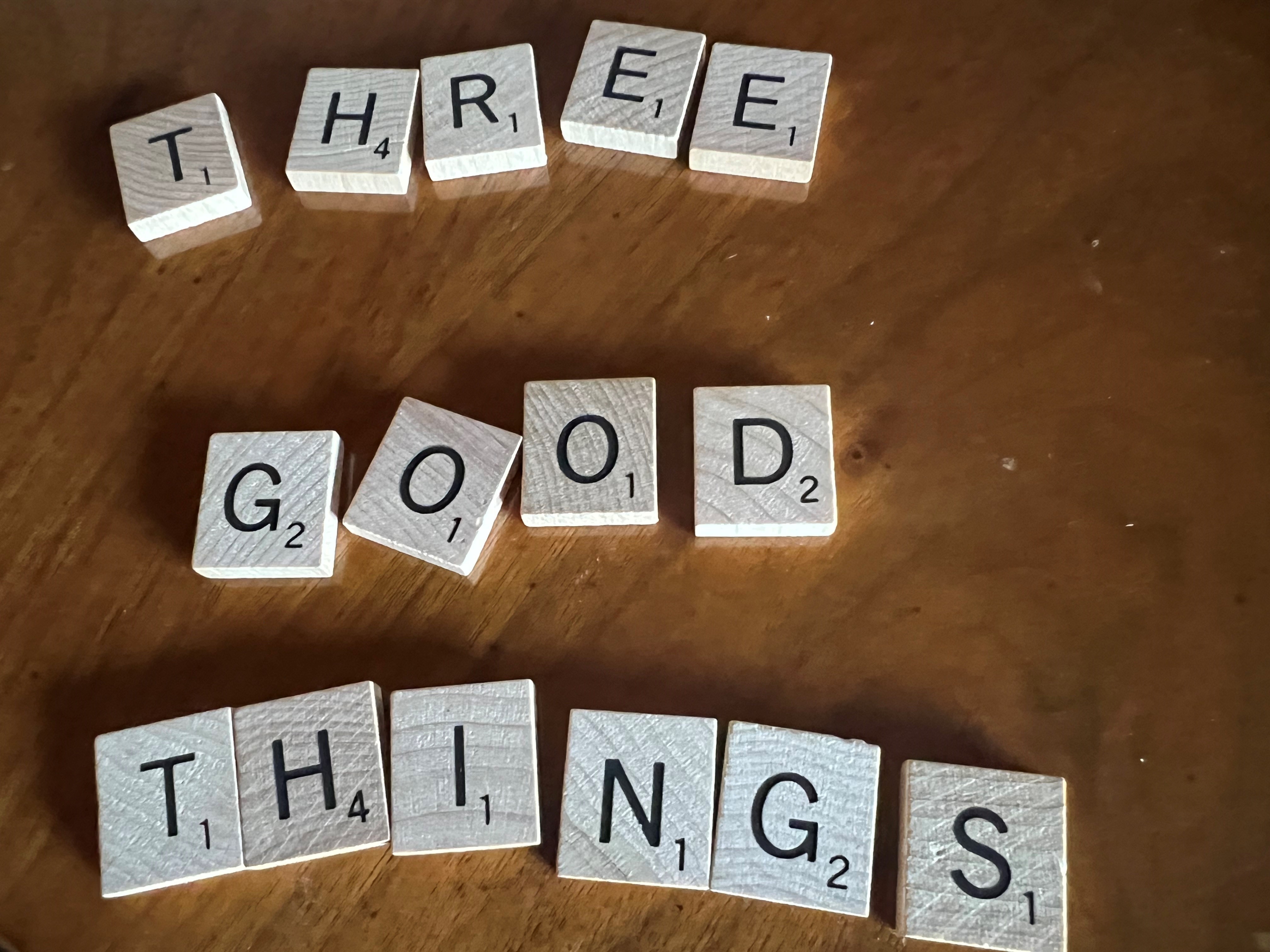
Three Good Things: Martin Seligman’s Signature Positive Psychology Intervention

This week, for the Montana Happiness Challenge, we’re encouraging participants to experiment with Martin Seligman’s “Three Good Things” technique. Three good things (TGT) is an evidence-based positive psychology intervention. For example, six months of twice-weekly TGT has been shown to decrease burnout in nurses (Luo et al., 2019) and four weeks of unguided internet-based TGT reduced insomnia in adults (Sato et al., 2022). In Seligman’s (Seligman et al., 2005) original research, TGT had positive effects on mood and depression.  

Like everything, TGT is not one-size fits all. You should use it in any way that works for you. You can start with Seligman’s instructions, and riff on it from there. For me, I like it best at 4am, when I wake up and my brain seems preoccupied with depressing things. If you want to listen to me talking about TGT, here’s a 5+ minute video:  https://www.youtube.com/watch?v=45fsZMDMPOQ

If you want to read the long and winding version of this happiness activity, I’ve pasted it below the references. If not, just jump right in, try it out, and post your thoughts and reactions on your favorite social media platform.

References

Luo, Y., Li, H., Plummer, V., Cross, W. M., Lam, L., Guo, Y., . . . Zhang, J. (2019). An evaluation of a positive psychological intervention to reduce burnout among nurses. Archives of Psychiatric Nursing, 33(6), 186-191. doi:https://doi.org/10.1016/j.apnu.2019.08.004

Sato, D., Sekizawa, Y., Sutoh, C., Hirano, Y., Okawa, S., Hirose, M., . . . Shimizu, E. (2022). Effectiveness of unguided internet-based cognitive behavioral therapy and the three good things exercise for insomnia: 3-arm randomized controlled trial. Journal of Medical Internet Research, 24(2), 1-17. doi:https://doi.org/10.2196/28747

Seligman, M. E. P., Steen, T. A., Park, N., & Peterson, C. (2005). Positive psychology progress: Empirical validation of interventions. American Psychologist, 60(5), 410-421. doi:https://doi.org/10.1037/0003-066X.60.5.410

Happiness for Educators: Day 1 Powerpoints

Hello Montana Educators

The link at the bottom of this post gives you access to powerpoints for day one of our Happiness for Educators course offered at the Montana Federation of Public Employees (MFPE) annual Teachers Conference.

This course is funded through a grant from the Arthur M. Blank Family Foundation (AMBFF). I’m grateful to AMBFF because the funding gives me the opportunity to work with some of the best people on the planet. I say this because my experience with educators in general, and Montana educators in particular, is phenomenal. If you’re an educator, THANK YOU for your incredible and essential service of teaching our youth.

Comments on the ppts. First, they don’t include the short videos that we’ll watch in class. Second, we may or may not get all the way through these slides . . . and that’s okay, because psychological flexibility is a sign of mental health. Third, the ppts for day two will be posted later.

Exploring the Happy Places Activity

Right now, maybe more than ever, there are plenty of places, spaces, and events in the world that evoke sadness, despair, anxiety, and hopelessness. Speaking for myself, I often feel the tug of despair, despite having so many people and things in my life for which I am grateful.

The purpose of the happy places activity is to expand awareness of places where we experience meaning, safety, support, and happiness. At the same time, the purpose is also to develop awareness of places, people, and contexts, that stimulate negative affect in us, such as anxiety and unhappiness. We want to be aware of how all the many dimensions of our environments influence us. 

Although awareness is important, action is equally important. It’s easy to feel trapped by all the negative things happening around us and to us. Sometimes we need to push ourselves to intentionally move out of difficult places and spaces. This movement can happen mentally. As Victor Frankl wrote in his memoir about his concentration camp experiences, people can be wholly oppressed by external forces, and yet still exercise at least some mental freedom.

The happy places activity involves recognizing our power to intentionally move toward thoughts and places that are more pleasant and meaningful. As needed, when you need a break from your heavier work, you can take yourself to happier physical or mental places; you can take yourself to a pleasant mental space, or physically go somewhere—like the beautiful outdoors of Montana. Additionally, when we develop awareness of our unhappy, or unsafe spaces, we can prepare for and develop plans for dealing with those difficult places.

Below the dancing photo, you will find the long version of the happy places activity for this week. I hope you engage with it as you are able. And please, if you feel inspired, share some of what you experience with the rest of us, either here on this blog, or on one of the social media platforms listed below.

MHP TikTok

MHP Insta

MHP Facebook

MHP YOU TUBE

MHP Linkedln

Also remember, use the hashtags 

#MHPHappinessChallenge, 

#MontanaHappiness

As for myself, after having a rather rough weekend, I will be infusing some thoughts and activities around the happy places concept. Good luck to you (and me).

Active Learning Assignment 3 – Three Happy Places

John Sommers-Flanagan

University of Montana

The environment, setting, or context we’re in will directly influence our mood and sense of well-being more often than we think. This is most obvious when we’re in settings or environments that we find aversive.

To start this assignment, reflect on environments, settings, or contexts that you find aversive. For example, you may find cloudy days, rain, smoky skies (or rooms), or the news (or particular news channels) aversive or uncomfortable. Other people might find churches, schools, gyms, or libraries aversive. Your context or environment can also include people. You probably find being with some people easy, and with other people, it’s much less easy.

Often, we label particular environments, contexts, smells, and people as emotionally “triggering.” Naturally, we often feel like avoiding emotionally triggering environments. Sometimes that’s possible. However, if you VALUE something enough (e.g., supporting your loved ones, or being involved in a theatre performance, or camping), you may be VERY WILLING to face and work through anxiety or other situationally-based emotional triggers (e.g., a natural disaster, fear of public speaking, or a bear phobia), to be with the people or do the things that you VALUE. More on this later.  

Now, consider the opposite: What environments, settings, contexts, or people do you find pleasurable, comforting, or energizing? In Montana, many of us think of the outdoors, or the natural environment. In fact, researchers report that, in general, more time in the outdoors is linked to increased feelings of well-being and mental health.

The main point of this assignment is for you to explore and increase your awareness of “Your happy places.” Additionally, because we can’t always be in our happy places, we also encourage you to explore, increase your awareness of, and develop a personal coping plan for the situations, contexts, and people that you find triggering. As noted above, sometimes we want to face our fears or emotional triggers. If so, knowing yourself and making a coping plan can help.

After reading and reflecting on the above, contemplate, or write a few words, in response to the following prompts:

  1. List three settings that usually trigger negativity or discomfort in you.
  2. List three settings that usually trigger happiness and wellbeing in you (and be specific). These are your happy places
  3. What can you do to prepare for or cope with challenging settings that usually cause you discomfort? (Other than avoiding them)
  4. What can you do to increase the frequency of time you spend in environments that contribute to your feelings of wellness?
  5. What can you do to create places or spaces in your mind that you can use (anywhere and anytime) to increase your sense of comfort and wellness in the moment?