Our Evidence-Based Happiness: An Experiential Approach course through MOLLI at the University of Montana is starting soon. Note: THIS MOLLI COURSE IS OPEN TO ALL INTERESTED ADULTS, AND NOT JUST OLDER ADULTS.
This course combines one 90 min lecture, followed by 5 weeks of home assignments and small group discussion. We believe this format will offer a great balance of information, experiential learning, and talking and listening with others who are working on positive psychology practices.
You can get more info on the MOLLI course from my previous post . . . or on the MOLLI website. The clock is ticking on this one as the first meeting is Tuesday, April 2, at 1pm (Mountain Time).
In my Group Counseling class, I’ve experienced predictable questioning of or resistance to evidence-based happiness ideas from positive psychology. . . and so I wrote out some of my thoughts . . . which went on and on and ended with a video clip.
Hello Group Class,
I’m writing my group takeaway to your all this week. Feel free to read at your leisure . . . or not at all . . . because I’m a writer and obviously, sometimes I get carried away and write too much.
When I responded to a question last week expressing reservations about the use of positive psychology—perhaps generally and perhaps more specifically with oppressed populations—I launched into a psychoeducational lecture. Upon reflection, I wish I had been more receptive to the concerns and encouraged the class as a group chew on the pros and cons of positive psychology in general and positive psychology with oppressed populations, in particular. I suspect this would have been an excellent discussion.
Given that we have limited time for discussion in class, I’ll share more reflections on this topic here.
1. The concerns that were expressed (and others have expressed in your takeaways) are absolutely legitimate. I’m glad you all spoke up. Some people have used positive psychology as a bludgeon (claiming things like “happiness is a choice”) in ways that make people feel worse about themselves. Never do that!
2. Positive psychology is poorly named (even the great positive psych researcher, Sonja Lyubomirsky, hates the name). Among its many naming problems, the word positive implies that it’s better, preferable, and the opposite of negative—which must then be the correct descriptor for all other psychology. None of this is true; positive psychology is not “better” and, in fact, it’s not even exclusively positive.
3. The point of positive psychology is not to “take over” psychology, but to balance our focus from being nearly always on psychopathology, to being equally about strengths, joy, happiness, etc., and psychopathology. If you think of it as an effort to balance how we work with individuals, it makes more sense. The point isn’t, and never has been, that we should only focus on positive mental health regardless of how our clients and students are feeling. That would be silly and insensitive.
4. As someone reminded me in the takeaways, the sort of happiness we focus on in positive psych is called eudaimonic happiness. This term comes from Aristotle. It refers to a longer form of happiness that emphasizes meaning, interpersonal connection, and finding the sweet spot where our own virtues intersect with the needs of the community. The other side of happiness is referred to as “hedonic” happiness. Hedonic happiness is more about hedonism, which involves immediate pleasure and material acquisitions. Nearly everyone in positive psychology advocates primarily for eudaimonic happiness, but also recognizes that we all usually need some pleasure as well.
5. Individuals and groups who have been historically (and currently) oppressed are naturally sensitive to coercion, judgment, and possibility of repeated oppression. What this means for counselors (among many things) is that we need to careful, sensitive, and responsive to their needs and not our assumptions of their needs. They may appreciate us being positive and supportive. Or they may appreciate us explicitly acknowledging their pain and affirming the legitimacy of the reasons for their pain. There’s substantial research indicating that certain ethnic group expect counselors to be experts and offer guidance. If that’s the case, should we avoid offering guidance because a particular theorist (or supervisor) said not to offer guidance? I think not. Many clients benefit from going deep and processing their disturbing emotions and sensations. There are probably just as many who don’t really want to go deep and would prefer a surface-focused problem-solving approach. Either way, my point is that we respond to them, rather than forcing them to try to benefit from a narrow approach we learned in grad school.
6. Good counselors . . . and you will all become good counselors . . . can use virtually any approach to make connection, begin collaborating, remain sensitive to what clients and students are saying (verbally and non-verbally), and work constructively with them on their emotions, thoughts, sensations/somatics, behaviors, and the current and/or historical conditions contributing to their distress.
7. We should not blame clients for their symptoms or distress, because often their symptoms and distress are a product of an oppressive, traumatic, or invalidating environment. This is why reflections of feeling can fall flat or be resisted. Feeling reflections are tools for having clients sit with and own their feelings. While that can be incredibly important, if you do a feeling reflection and you don’t have rapport or a rationale, feeling reflections will often create defensiveness. Instead, it can be important to do what the narrative and behavioral folks do, and externalize the problem. When it comes to issues like historical trauma, often clients or students have internalized negative messages from a historically oppressive society, and so it makes perfect sense to NOT contribute to their further internalization of limits, judgments, discrimination, and trauma that has already unjustly taken hold in their psyche. The problem is often not in the person.
8. I know I said this in class, but it bears repeating that many people practice simple, superficial, and educational positive psychology using bludgeon-like strategies. Obviously, I’m not in support of that. That said, many people practice simplistic implementation of technical interventions in counseling (think: syncretism from theories class), and many counselors do bad CBT, bad ACT, bad DBT, bad behaviorism, bad existentialist therapy, and bad versions of every form of counseling out there. No matter which approach you embrace, you should do so using your excellent fundamental listening skills . . . so that if your client or student doesn’t like or isn’t benefiting from your approach, you can change it!
I want to end this little 1K word writing project with a video. In the linked clip, I’m doing about a 3 1/2 minute opening demonstrating a “Strengths-based approach” to suicide assessment and treatment planning with a 15-year-old. As you watch, ask yourself, “Is this strengths-based?” Can you identify anything that makes this approach strengths-based or as including even a whiff of positive psychology. [Again, you’re not required to watch this, I’m just rambling.]
Spring is coming: it’s a good time to try something new.
In collaboration with the MOLLI program on campus at the University of Montana, I’m offering a unique “Happiness” class that combines an initial lecture with 5 small group experiential discussions. The course begins in about 1 month (April 2, 2024). Here’s the course description:
Evidence-Based Happiness: An Experiential Approach
In this course, participants will learn about and experience seven different research-based approaches to achieving greater happiness. Using a unique format, participants will have one week of traditional lecture, followed by five weeks of small-group experiential learning sessions. Each small group (aka happiness lab) will meet to practice, experience, and discuss specific happiness interventions. Before each lab group, participants will be provided with a short reading and a short video to guide their weekly happiness practice. Specific positive psychology interventions to be covered include (a) three good things, (b) savoring, (c) gratitude, (d) cognitive behavior therapy, (e) forgiveness, (f) acts of kindness, (g) and the best possible self. Labs will be facilitated by graduate students in counseling and supervised by John Sommers-Flanagan.
The course is live and offered simultaneously in virtual and in-person formats. To enroll, you need to become a MOLLI member, which costs $0. The cost of the course is $70. If you do the math, you’ll see that’s about $12 per educational hour . . . which is a fantastic deal. The other fantastic part is that research indicates your participation may contribute to you feeling greater meaning and happiness.
For remote users, there are no borders. You can take it from anywhere: To enroll in the VIRTUAL (remote) course, click here, and if you’re not a MOLLI member, start by clicking on sign-in to become a member and then register: https://www.campusce.net/umtmolli/course/course.aspx?C=844&pc=38&mc=42&sc=0
Last summer, when I taught our Happiness for Teachers course along with Lillian Martz, one of the most powerful assignments involved forgiveness. Even though we emphasized that the teachers taking our class didn’t need to actually engage in a forgiveness process, they shared incredibly deep and profound stories of betrayal, forgiveness, and the struggles in between. Here’s the assignment. Again, we’re not saying you need to engage in a forgiveness process. All we’re suggesting is for you to read this and think about forgiveness. Here’s the assignment:
Whether we’re talking self-forgiveness, forgiving others, or spiritual forgiveness, forgiveness is a big deal and a big ask.
For this learning activity, we don’t expect you to purge yourself of all personal guilt or become free from all resentments. Nevertheless, for this assignment, your job is to explore what forgiving yourself, forgiving others, and being forgiven might look like AND how forgiving yourself, forgiving others, and being forgiven might feel to you.
To do this activity, you’re not expected to actually do the forgiveness work; instead, you get to think about doing the forgiveness work and speculate on its effects. . . FOR YOU. Although forgiveness is probably the biggest issue we’ve tackled in this Happiness Challenge, the plan is for you to just take a small sip from the very large cup of potential forgiveness issues that we all have. If you want to go deeper and take a bigger drink, that’s perfectly fine, but that’s all up to you.
To get yourself oriented toward forgiveness you could (if you want) consider and access some of the following ideas and online resources:
Consider that forgiving others can improve your physical health. As Anne Lamott wrote in Traveling Mercies: “Not forgiving is like drinking rat poison and then waiting for the rat to die.” Is there anyone other there toward whom you might offer forgiveness? You don’t even have to talk with them (although you can, if that works for you). You can just bring yourself to a place where you’ve let go of any lingering anger or resentment that you’re holding.
Last week was about emotional journaling. This week, we stick with the power of words and writing and take a dive into an evidence-based therapeutic writing activity called the Best Possible Self.
You all already know about optimism and pessimism.
Some people see the glass half full. Others see the glass half empty. Still others, just drink and savor the water, without getting hung up on how much is in the glass. Obviously, there are many other responses, because some people spill the water, others find a permanent water source, and others skip the water and drink the wine or pop open a beer.
Reducing people to two personality types never works, but that doesn’t stop people from labeling themselves or others as optimists or pessimists. This week’s activity—The Best Possible Self—is an optimism activity. You don’t have to be a so-called optimist to use it. And the good news is, regardless of your labels, the Best Possible Self writing activity is supposed to crank up your sense of optimism. That’s cool, because generally speaking, optimism is a good thing. Here’s what the researchers say about the Best Possible Self (BPS) activity.
[The following is summarized from Layous, Nelson, and Lyubomirsky, 2012]. Writing about your Best Possible Self (also seen as a representation of your goals) shows long-term health benefits, increases life satisfaction, increases positive affect, increases optimism, and improves overall sense of well-being. Laura King, a professor at U of Missouri-Columbia developed the BPS activity.
King’s original BPS study involved college students writing about their Best Possible Selves for 15 minutes a day for two weeks. The process has been validated with populations other than college students. If you want to jump in that deep, go for it. On the other hand, if you want a lighter version, here’s a less committed alternative:
Spend 10 minutes a day for four consecutive days writing a narrative description of your “best possible future self.”
Pick a point in the future – write about what you’ll be doing/thinking then – and these things need to capture a vision of you being “your best” successful self or of having accomplished your life goals.
As with all these activities, monitor your reactions. Maybe you’ll love it and want to keep doing it. Maybe you won’t.
If you feel like it, you can share some of your #writing on social media.
Berkeley’s Greater Good website includes a nice summary of the BPS activity. Here’s a pdf from their website:
Being a counseling and psychotherapy theories buff, I should mention that this fantastic assignment is very similar to the Adlerian “Future Autobiography.” Adler was way ahead of everyone on everything, so I’m not surprised that he was thinking of this first. Undoubtedly, Adler saw the glass half full, sipped and savored his share, and then shared it with his community. We should all be more like Adler.
This post is for Montana Educators. Please forward this message to any Montana Educators you know. Due to support from the Arthur M. Blank Family Foundation, we have an opportunity to support Montana Educators with VERY LOW COST graduate credit courses on “Evidence-Based Happiness” through the University of Montana. We’re doing this because we deeply appreciate the work of Montana teachers and we believe this course and the added credits to their payscale is one way for us to support them.
Thanks for your help. Please share. Montana Educators are awesome.
Dear Montana Educators,
In collaboration with the Arthur M. Blank Family Foundation, the Montana Safe Schools Center, UMOnline, and the Montana Happiness Project, the Phyllis J. Washington College of Education at the University of Montana is pleased to offer very low-cost Graduate Credit courses on “Evidence-Based Happiness” exclusively designed for Montana Educators.
We have 3-credit ($195) and 1-credit ($70) options available, beginning January 18.
Although seats are limited, please forward this information to other potentially interested Montana teachers. We will open as many sections as we can handle.
When I was teaching social skills to elementary school-aged youth, one boy couldn’t stop talking about himself. Because I wanted the students to be interactive with and interested in each other, I intervened.
“Ask a question about her.”
He nodded, in apparent understanding. Returning to the activity, he followed my instructions (sort of), immediately asking,
“What do you think of me?”
The question, “What do you think of me?” is powerful. We all wonder this, at least occasionally, and perhaps constantly. As I just wrote in a previous blog post, being seen and known by others is a profound experience. Having your strengths and positive qualities reflected back to you by others is a gift: https://johnsommersflanagan.com/2023/12/25/the-gift-of-being-seen/
The Natural Talent Interview requires vulnerability; it’s a challenging and potentially awkward assignment. I recommend it anyway. 😲
Here’s a link to the version of the Natural Talent Interview that we assign in the Happiness Course. Note: It includes a nice description of self-awareness and the Johari Window.
Rylee said there was an internet thing going around about how men should be more like women and start complimenting each other. Then we watched “Rye Lane” (two thumbs up). In the movie, the protagonist male tried out that compliment-another-guy thing; the guy he complimented told him to “Fuck off” and a few other things I won’t repeat.
Maybe compliments don’t translate all that well across genders. But maybe they do.
Years ago, I was doing psychotherapy with a Native American father and his teenage son. To try to help with their strained relationship, I coached the dad on being more authentically positive with his son. During the next session, I had them do a version of the “What’s good about you?” therapy activity.
I asked the son to sit across from his dad and ask, “What’s good about me?” ten times in a row. The only rules were that dad was supposed to give 10 different answers and respond honestly. The boy muttered along with an eye-roll. I felt nervous.
He looked at his dad and asked, “What’s good about me?”
The dad said, “You have a big heart.”
What’s good about me?
“You treat your mom with respect.”
What’s good about me?
“You love your sister.”
What’s good about me?
“You’re my son and I’m proud of you.”
The tears came slowly at first.
What’s good about me?
“You are intelligent”
It was over. They embraced, with the boy sobbing in his father’s arms.
The points: Parents can get so overfocused on providing constructive criticism to their children that their children don’t KNOW the inner strengths their parents see within them. In the preceding example, the teen boy was shocked—in a very positive way—to hear the strengths, skills, and talents that his father saw in him.
This can happen in all relationships. Nearly everyone wants to be seen and known. It’s probably easier to imagine—especially without clear and reassuring evidence—that others see our negative qualities. Our strengths can feel invisible, even to ourselves. It’s often hard to imagine that others notice anything good about us.
Some say that true self-esteem is all about self-evaluation, and not reliant on what others think of us. That’s partly true. But, it’s ridiculous to think that any of us can feel good about ourselves without at least getting occasional feedback about our strengths and positive qualities.
One new thing you can try this holiday season is to give the people you love the gift of seeing their strengths. It can be as simple as noticing and saying something that you think your friend or family member does well, like, “You’re really good at picking out just the right gifts.” Or, “You’re always so much fun to have around.” Or, “You make the best pumpkin pie.”
You can take this deeper if you want by noticing character traits and patterns. “You’re the most honest person I know, and I really value that.” “I love how you pay attention to your grandma. You are such a good person.”
Recognizing and naming the strengths and positive qualities of others is an amazing gift. You’re not just “seeing” people, you’re seeing, acknowledging, and articulating their best qualities. And by naming their best qualities, you’re not just giving them a compliment; you’re nurturing those qualities, and helping them grow.
I’ve taught a different version of this activity for years, and called it the “Natural Talent Interview.” For more on the Natural Talent Interview, which is this week’s Montana Happiness Challenge activity, go to the Montana Happiness Project’s webpage: https://montanahappinessproject.com/natural-talent-interviews
I’m a little embarrassed to report that Rita and I are on the Big Island of Hawai’i. We’re house-sitting for a friend. I know it’s hard work (insert eye-roll here). I have to wipe up the gecko poop and pee every morning. We’re here and experiencing this great fortune because a friend presented us with a very big act of kindness.
This week’s Montana Happiness Challenge is all about acts of kindness. Turns out, kindness is emotionally and psychologically healthy; this is true whether we engage in the act, receive the act, or observe the act. In a fascinating study titled, “Brief exposure to social media during the COVID-19 pandemic: Doom-scrolling has negative emotional consequences, but kindness-scrolling does not,” the researchers noted that doom scrolling during COVID reduced positive affect and optimism. In contrast, looking for positive stories of kindness on the internet either had no effect, or reduced negative affect.
Below, please find the kindness homework for this week. I know it’s Wednesday and the week is growing shorting, but I’ve found that being in Hawai’i is terribly distracting. Who knew?
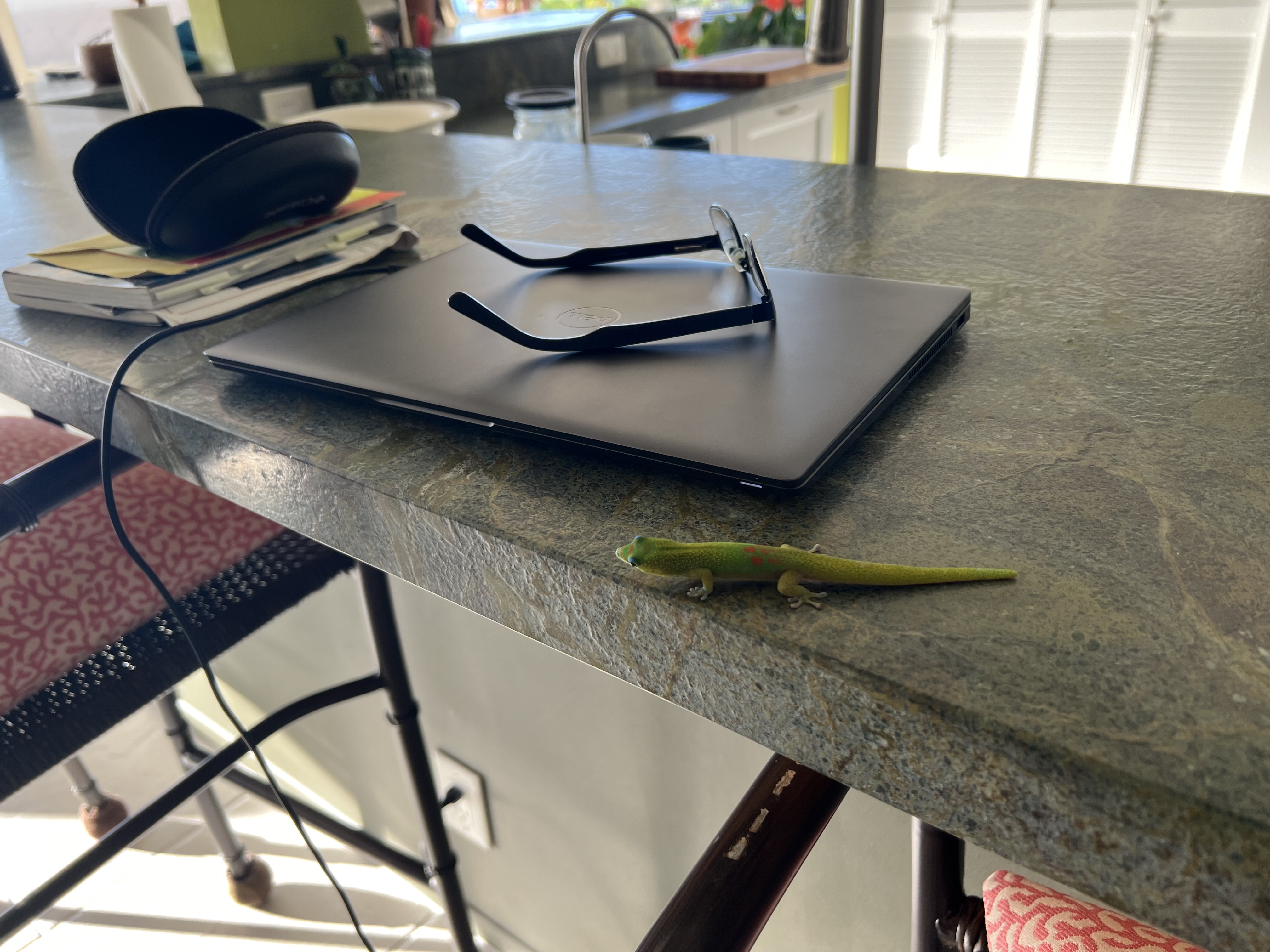
Here’s a gecko trying to either work on or poop on my computer.
*******************************
About a decade or two ago, the concept, “Random acts of kindness” gained traction. Now, about a decade or two later, I’m a little sad that random acts of kindness has become the most common way we talk about kindness. I say this despite the fact that I’m a big fan of randomness and kindness.
For your assignment this week, I’d like all of us to break away from the mentality of randomness and embrace the mentality of intentionality.
Intentional acts give us—as actors in the grand theater of life—greater agency. Instead of being stuck with a script someone else wrote, when we embrace intentionality, we become the author of every scene. Rather than randomly responding to opportunities with kindness, we exert our will. What this means is that when an opportunity for kindness pops up, we already have a plan . . . and that plan involves creatively finding a way to respond with kindness. How cool is that?
Let’s think about this together.
Toward whom would you like to demonstrate kindness? A stranger? If so, it might feel random in that you might act kind in a moment of spontaneity. But your spontaneity—although wonderful—is a moment when your intentionality (to be a person who acts with kindness) meets opportunity. In this way, even acts toward strangers that seem or feel spontaneous, will be acts that reflect your deeper values and character.
Maybe you’d like to intentionally be kind to a friend, a parent, or a sibling. Again, this requires thought and planning and the ability to step outside yourself. Assuming that others want what you want can backfire. You’ll need to step into another person’s world: What would your friend, parent, or sibling appreciate?
To stay with the theater metaphor, you’re the script-writer and you’ve written yourself into this performance. For this week, the script or plan includes a character who values kindness and who watches for opportunities to share that value with others. You’re that character.
Your job is to translate your character trait of kindness into actions that represent kindness. I don’t what that will look like for you. Maybe you don’t either. That’s the magic—where your character meets opportunity and opportunity meets planned spontaneity.
Your other job is to share about your kindness experiences on social media. You can share your efforts to act with kindness or share your experience of someone acting with kindness toward you.
Thanks to BEN ALLAN SMITH of the Missoulian for this fantastic photo!
Now that the University of Montana Grizzly football team won today, and will be going to the FCS Championship game, we can all relax. Of course, I’m joking, but I know some fans (not necessarily me) have lots of trouble relaxing while their favorite team is playing, and many of them (not necessarily me) will be out celebrating, and not at home relaxing. Of course, all that cheering and jeering and beering may not be optimal for our health, but I want to emphasize that just because this week’s happiness challenge activity is “Your favorite relaxation method,” I’m not suggesting that anyone should relax (other than the kickers) when you’re in (or cheering) a double overtime semi-final game.
That said, I hope, at some point during this weekend, everyone takes time to explore and experiment with their favorite relaxation method. As I’ve already noted on social media, relaxation is a viable and evidence-based intervention for several different problems and mental disorders. Indeed, learning relaxation skills—so you can use them when you want to use them—is a very good deal.
In 1975, Herbert Benson of Harvard University published a book titled, The Relaxation Response. Benson wrote that for humans to achieve the relaxation response, they need four components:
A quiet place.
A comfortable position.
A mental device.
A passive attitude.
Benson’s research was pretty phenomenal. When people were able to create a state of relaxation within themselves, they experienced physiological and psychological benefits similar to (but not quite as good as) the benefits of sleep. For this reason, I sometimes refer to the relaxation response as “almost sleep” and recommend it as an in-bed goal for those of us who suffer from insomnia.
The relaxation response involves slowing your respiration and heart rate, with a concomitant reduction of blood pressure. People can achieve the relaxation response via different pathways. . . including, but not limited to methods like deep breathing, visualization, meditation, and self-hypnosis.
For this assignment, your job is to identify and practice your favorite pathway for reducing your heart rated and breathing (aka your relaxation method). The good news is that you don’t really need a quiet place and a comfortable position (although they help, they’re not essential). But you do need a mental device and a passive attitude.
Unfortunately, as it turns out, for some people, the act of trying to relax creates anxiety. This is a puzzling paradox. Why would trying to relax trigger anxiety?
The intent to relax can trigger anxiety in several different ways. For some, if you try to relax, you can also trigger worries about not being able to relax. This is a relatively natural byproduct of self-consciousness. If this is the case for you, take it slowly. Self-awareness can trigger self-consciousness and self-consciousness can trigger anxiety . . . but time and practice can overcome these obstacles.
For others, a history of trauma or physical discomfort can be activated. This is similar to self-consciousness because the turning of your attention to your body inevitably makes you more aware of your body and this awareness can draw you into old, emotionally or physically painful memories. If this is the case for you, again, take it slowly. Also, manage your expectations, and get support as needed. Support could come in the form of specific comforting and soothing cues (even physical cues), an outside support person, or a professional counselor or psychotherapist.
Trauma and anxiety are common human challenges. Although trauma and anxiety can be terribly emotionally disturbing and disruptive, the core treatment for these problems usually involves one or more forms of exposure and can be traced back to Mary Cover Jones. You can read more about Mary Cover Jones and her amazing work on my blog: https://johnsommersflanagan.com/2018/06/04/the-secret-self-regulation-cure-seriously-this-time/
Okay, that’s enough of my jibber-jabbering. Here’s the activity:
Try integrating your favorite relaxation method (no drugs please) into your daily life. You can do it for a minute here and there, or 20 minutes all at once.
Experiment! Try different methods for helping your body achieve a relaxed state.
If you feel inspired, share about your relaxation experiences here, or on social media, or with your friends and family,
I hope you all become fantastic at relaxing . . . at least until the Grizzlies face South Dakota State for the national championship on January 7.
The place to click if you want to learn about psychotherapy, counseling, or whatever John SF is thinking about.









 John Sommers-Flanagan