I know this saying dates me, but sometimes I feel like a broken record. However, as I’ve said before (and I’ll say it again), redundancy works.
In this post, I’m sending out yet another call for Montana educators to register for our bargain-priced “Happiness for Teachers” course, offered through the University of Montana’s UMOnline program.
I’ve said it before: We’ve had over 150 educators complete the course and the outcomes have been rather stunningly positive. I could promote this like an advertisement:
“If you want to be less depressed, more hopeful, have better physical health (including better sleep), and experience greater hope and mindfulness . . . you should consider taking this course!”
The cost is $195 for 3 U of Montana graduate credits. Here’s the link to register:
The educators enrolled in our asynchronous “Happiness for Teachers” course continue to stun me with the extremely high quality of their responses to the assignments. They go WAY beyond what’s necessary and are clearly and deeply committed to not only their personal growth, but also to the growth of their students, family, and friends. Seriously. When I read their assignments, I immediately have more hope for the world . . . and I think to myself, “I want to be your friend!”
But, teaching an asynchronous course is weird. I feel detached. I want to be more connected and more involved. On the other hand, we’ve got hours of video lectures we’ve produced and so the students might be getting more exposure to me than anyone really should bargain for. Maybe I’m too connected and involved? Funny thing how everything often boils down to a dialectic. Hegel (the philosopher) would be so happy he wouldn’t need a happiness course.
Despite the weirdness, our educator-students keep giving us great feedback. Here are a few anonymous examples that have popped into my email inbox without any solicitation:
“I’ve truly enjoyed the material thus far in the class. . . . I hope your class becomes required for all teachers at the EDU dept for certification. It’s the real deal.” S.S.
“Loving the course! Thanks for providing it!” J.E.
“Thank you so much for sharing this video. Just watching it Brings me joy. I love the contributors and all the great things they are doing in their classes! You guys are amazing for doing this.” J.R.
“Loved this course! I shared it with my school! I will send it to my principal now too! Thanks again!” L.W.
“Thanks again for this enriching class. I needed it more than you know and I have so many tools to carry me into next year!” S.M.
Thanks to the Arthur M. Blank Family Foundation, we’re offering yet another section of the course this fall semester. If you’re a Montana educator, and want a big bargain ($195.00) for 3 Grad Credits or 48 OPI Hours, here’s the link to register:
For you non-Montana educators who may still be reading . . . I’m wondering, if we opened the course to anyone across the U.S. would there be much interest?
Just FYI, here’s a copy of the syllabus for the summer version of the course:
Tomorrow morning Alli Bristow (recent Montana School Counselor of the Year), Hannah Lewis (awesome elementary HPE teacher), and I will travel eastbound and take the Montana I-90 exit #166 for Gold Creek. We won’t be panning for gold. Instead, we’ll get way richer than we would from finding gold—because we’re offering a couple presentations on “Happiness and You” to the Young Survivors Group at Camp Mak-A-Dream.
The Young Survivors group consists of 13-18-year-olds who have experienced brain tumors. As someone who had the good fortune and great privilege of excellent health during my teen years, I can barely imagine the strength, resilience, persistence, and family support these young people have needed to bear their medical challenges. Although Alli, Hannah, and I have powerpoints and presentation plans, our two presentations will truly be an example of us all learning together.
The Practical Psychology Podcast just dropped a new episode titled “On Happiness and a Life with Meaning.” This episode includes Kyrie Russ (the show’s host” and me in conversation about happiness, CBT, life, and other things. This conversation was based, in part, on content from a keynote I gave at a conference in Helena about 2 years ago. The ppts (which is are a bit cryptic. . .) are here:
Are you a Montana educator . . . or do you know one?
If so, maybe you—or your friend—would like three (3) bargain-rate University of Montana graduate credits. As you may know, we’ve got an online and asynchronous “Happiness for Teachers” course starting on June 17 for only $195 and the credits (or OPI hours) can contribute to raising teacher salaries. Given all that teachers do for our youth and society, it’s the least we can do. And we can do it thanks to a fantastic grant from the Arthur M. Blank Family Foundation (AMBFF: https://blankfoundation.org/).
Because I’ve written about this opportunity before, this time I want to focus on outcomes. We’ve taught this course to teachers as asynchronous semester-long courses last summer (2023) and this spring (2024). I just finished crunching the numbers for our spring outcomes; I’ve got the summer outcomes in front of me as well.
We’ve pre-post data on 16 different outcome measures. For last summer, we had statistical significance on 12 of the 16 outcomes. For this spring, we had statistical significance on 13 of the 16 outcomes. Even better, based on Cohen’s guidance, many of the effect sizes are in the medium to large range.
For you stats nerds, here’s a Table describing the outcomes:
Outcome Measure
What Teachers Reported at Post-Test
Summer – 2023 – Statistical Significance (n = 40) and Effect Size (ES is Cohen’s d)
Spring – 2024 – Statistical Significance (n = 48) and Effect Size (ES is Cohen’s d)
NAPAS: Negative Affect
Fewer negative emotional symptoms (e.g., nervousness and sadness)
p < .001 ES = .671 (medium)
p < .006 ES = .389 (small to medium)
NAPAS: Positive affect
More positive emotions (e.g., “in good spirits”)
p < .001 ES = .887 (large)
p < .001 ES = .497 (medium)
CES-D: Depression
Fewer symptoms of depression
p < .001 ES = .751 (large)
p < .013 ES = .346 (small to medium)
Sleep
Better sleep
p < .001 ES = .644 (med to large)
p < .001 ES = .502 (medium)
Headaches
Fewer headaches
p < .009 ES = .393 (small to med)
p < .001 ES = .699 (medium to large)
Gastrointestinal symptoms
Less gastrointestinal distress
p < .027 ES = .315 (small to med)
p < .023 ES = .298 (small)
Colds
Fewer and less severe colds
p < .010 ES = .382 (small to med)
p < .024 ES = .298 (small)
PHQ: Total Health
Better total health
p < .001 ES = .589 (medium)
p < .001 ES = .625 (medium to large)
Days Sick
Fewer days of physical illness
P < .015 ES = .354 (small to med)
N/A
Hope-Agency
Greater goal directed energy
p < .001 ES = .704 (med to large)
p < .008 ES = .365 (small to medium)
Hope-Pathways
Greater planning to meet goals
p < .001 ES = .545 (medium)
p < .013 ES = .341 (small to medium)
AHS: Total Hope
Higher agency and pathways hope
p < .001 ES = .677 (med to large)
p < .004 ES = .416 (small to medium)
Significant Other Support
Support from a romantic partner
p < .166 ES = .158 (minimal)
p < .195 ES = .127 (minimal)
Family Support
Support from family
p < .114 ES = .194 (minimal)
p < .030 ES = .282 (small)
Friendship Support
Support from friends
p < .165 ES = .156 (minimal)
p < .177 ES = .137 (minimal)
MSPSS: Total Social Support
Combined romantic partner, family, and friend support
p < .133 ES = .181 (small)
p < .091 ES = .198 (small)
MAAS: Mindfulness
Less distracted and more tuned into the here and now
p < .001 ES = .892 (large)
p < .001 ES = .597 (medium to large)
To summarize: If Montana educators want to have less negative affect and depression, more positive emotions, greater hope, better sleep, fewer headaches, less gastrointestinal distress, fewer colds (and days of physical illness), and greater mindfulness . . . they should register and complete this course.
Good news. Yesterday, I got a mysterious email from ORCID–which stands for: Open Researcher and Contributor ID. ORCID is a global, non-profit organization. Their vision is: “a world where all who participate in research, scholarship, and innovation are uniquely identified and connected to their contributions across disciplines, borders, and time.”
Cool.
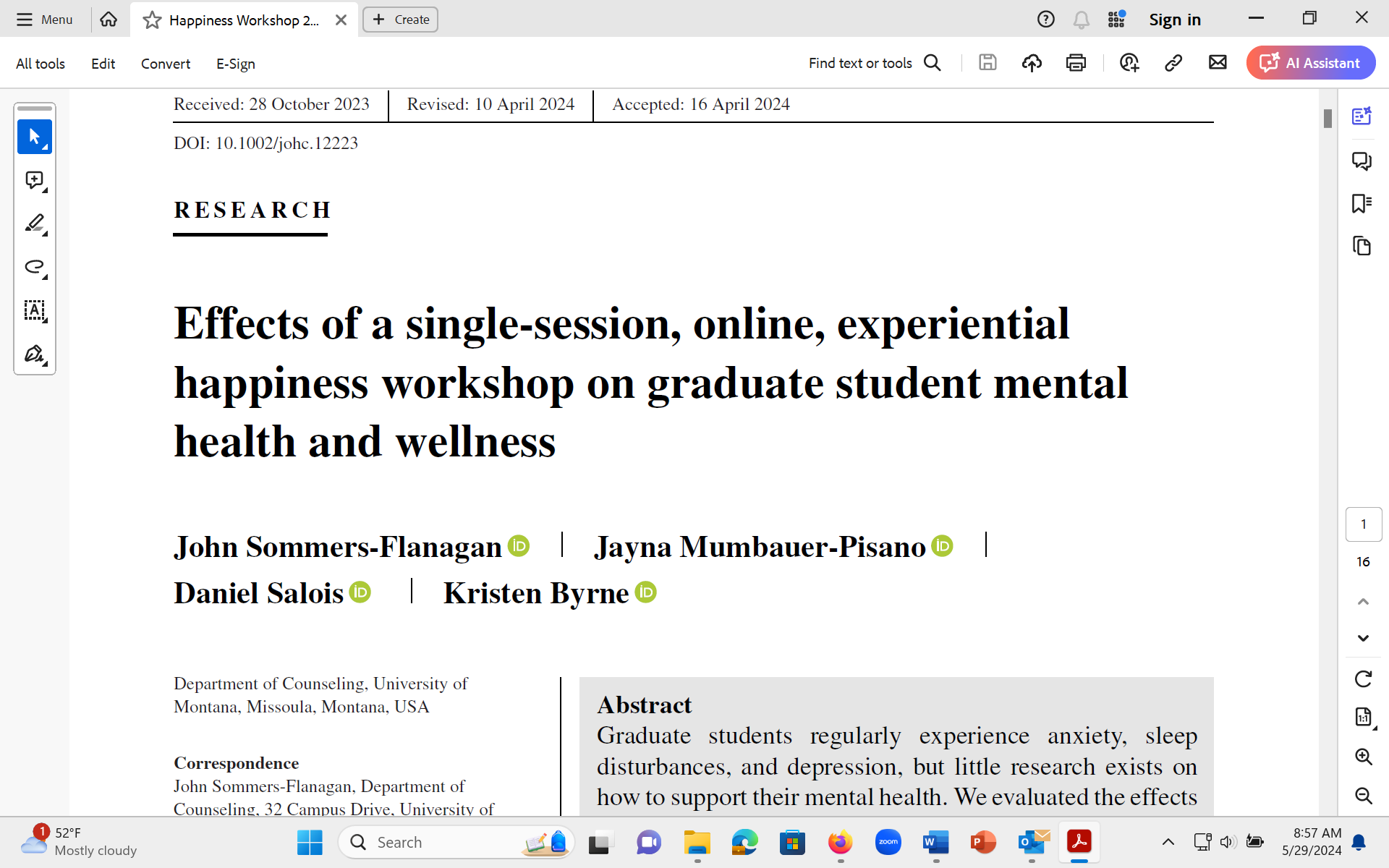
Anyway, ORCID was notifying me of a change to my ORCID record. A few minutes later, I received an email from Wiley telling me that our Happy Workshop for Grad Students article was now officially published online.
As some of you know, I’ve complained about the journal publishing process, and, although I still think it’s a pretty broken and disturbing process, working with the editors and reviewers from the Journal of Humanistic Counseling was pretty smooth and pretty fabulous. Check them out: https://onlinelibrary.wiley.com/journal/21611939
And so, without further ado, here’s the Abstract, followed by methods to access the article. . .
Effects of a Single-Session, Online, Experiential Happiness Workshop on
Graduate Student Mental Health and Wellness
John Sommers-Flanagan
Jayna Mumbauer-Pisano
Daniel Salois
Kristen Byrne
Abstract
Graduate students regularly experience anxiety, sleep disturbances, and depression, but little research exists on how to support their mental health. We evaluated the effects of a single-session, online, synchronous, happiness workshop on graduate student well-being, mental health, and physical health. Forty-five students participated in a quasi-experimental study. Students attended a synchronous 2.5-h online happiness workshop, or a no-workshop control condition. After workshop completion and as compared with no-treatment controls, participants reported significant reductions in depression symptoms but no significant changes on seven other measures. At 6 months, participants reported further reductions in depression symptoms. Moreover, across four open-ended questions, 37.0%–48.1% of workshop participants (a) recalled workshop tools, (b) found them useful, (c) had been practicing them regularly, and (d) used them in sessions with clients. Despite study limitations, single-session, synchronous, online, happiness workshops may have salutatory effects on graduate student mental health. Additional research is needed.
K E Y W O R D S: depression, graduate students, mental health, single-session, wellness
I’m writing for a little social marketing assistance to support Montana Educators.
As I’ve written before, because of the generosity and funding from the Arthur M. Blank Family Foundation, we have funding to support Montana educators. The main way we’ve chosen to support Montana educators is to offer a highly subsidized three-credit course on “Happiness for Teachers” through the fantastically helpful UMOnline people at the University of Montana.
We believe this course supports Montana Educators in three ways:
The course can be used to help increase educator pay (because we believe educators should be paid more).
The course can help educators feel positive feelings more often, savor them, increase their sense of meaning, and possibly reduce depression and improve physical health.
Educators can use the information to support their students’ happiness and well-being.
We’ve got a large section of the course open and starting on June 17. I’d love to get it all filled up.
We’ve been collecting outcomes data on our Evidence-Based Happiness course for Teachers. From last summer, we have pre-post data on 39 participants. We had VERY significant results on all of the following outcomes
If you’re not an educator, you must know one, and they deserve this, so share it, please!
Now for you researcher nerds. Over the past week, I’ve tried to fit in some manuscript writing time. If you’re following this blog, you’ll already know that I’ve experienced some rejections and frustrations in my efforts to publish out positive psychology/happiness outcomes. I’ve also emailed various editors and let them know what I think of their reviews and review processes. . . which means I may have destroyed my chances at publication. On the other hand, maybe sometimes the editors and reviewers need a testy review sent their way!
Yesterday, a friend from UC Santa Barbara sent me a fairly recent review of all the empirical research on College Happiness Course Outcomes. To summarize the review: There are HARDLY ANY good studies with positive outcomes that have been published. Specifically, if you look at U.S. published studies, only three studies with control groups and positive outcomes have been published. There’s one more I know of. If you want to read the article, here it is:
Yesterday I kicked off the MOLLI class on “Evidence-Based Happiness Practices” with a psychoeducational lecture. It was standard information about positive psychology, including Seligman’s 1998 inaugural Presidential speech in San Francisco (I was there!), the three-step emotional change trick, three good things, sleep hygiene, savoring, gratitude, forgiveness, and positive distractions. We started and ended with music, and had five-minutes of very small group interactive discussion in the middle. All-in-all, I thought it was a solid start.
This kick-off reminded me of the complex relationship between structured psychoeducation and less-structured or guided interpersonal interactions. In traditional psychoeducational groups (or classes), the emphasis is on information delivery and participant learning. Psychoeducational groups are especially important when participants can benefit from useful information. Most psychoeducational group leaders, also try to integrate some form of interactive or experiential learning into group sessions.
For me, despite the fact that I often (but not always) like listening to myself and believe I have good information to share, the MOLLI class highlight (during the whole 90 minutes) emerged right after the very small group discussions. I had given a prompt like, “I know it’s awkward to talk about your strengths, but I’d like you to share a nice story about how your own skills or talents usually come out in your relationships with others.” Participants in the room seemed engaged, but the class was hybrid, and so I wasn’t sure of the overall interaction quality. Rather than quickly moving on, I asked if one or two of the participants would share a highlight from their conversation. Silence followed. I waited through it, and finally, an online participant broke the silence with,
“At first we weren’t sure how to start, but by the end, I thought to myself, I want to be friends with these people.”
These words broke the ice in the room, and several similarly positive comments followed. What I loved about these reactions to their “talk-time” was that participants were responding in exactly the ways I had hoped, they were connecting with each other.
The balance of psychoeducational content with interpersonal connection is very cool. Sometimes—as in yesterday’s kick-off lecture—we do more psychoeducation and have less interpersonal activity. Other times, we do a five-minute lecture and follow it with 85 minutes of conversation.
One of my takeaways yesterday is to not underestimate the power of psychoeducation to stimulate conversation. Obviously, we use psychoeducation to teach. But when we use it to direct and focus subsequent conversations, we’re also using it to help people to learn from each other.



 John Sommers-Flanagan