Whatever the influences, while in grad school, I got slightly obsessed with predicting human behavior. My four roommates were an inspiration. They were wonderful, and, they provided entertaining signs of four different DSM personality disorders. Although not officially “diagnosable,” they each had distinctive “features” of compulsive, histrionic, narcissistic, and dependent personality disorders.
I was convinced I could predict the behavior of my roommates based on their personalities. As one example, during a group therapy session involving nickname-sharing, my so-called “narcissistic” friend shared that his nickname was “Lord.” As another, my “dependent” friend took to following me around and calling me his “hero.” I could go on, but this blogpost is about the future and not the past.
But first, four more historical reflections: (1) I developed my own totally bizarre personality test (the Sommers-Circles), (2) I did my thesis and dissertation on personality and prediction, (3) I discovered, as it turns out, personality is a rather poor predictor of human behavior, and (4) I also discovered that nothing is a very good behavioral predictor, and humans are more unpredictable than not.
Now, with my thesis 40 years behind me, and despite scientific evidence against anything being predictable, I still believe—as the famous/infamous social psychologist Daryl Bem wrote in 1974 (paraphrasing here), “That my predictions are right and the research is wrong.”
In honor of my lifelong prediction obsession, here are my Predictions for 2025.
On January 8, I, along with the Montana Happiness Project, will announce big, luscious, and wonderful news.
In early 2025, we will rediscover once again that, in fact, the body does NOT keep the score, but that the brain and body keep the score together, just as nature and nurture work together, despite annoying efforts by the misinformed to keep them apart.
To rebalance our collective worldwide preoccupation during the first half of the 2020s with TRAUMA as being at the root of everything and everything being TRAUMA, the second half of the 2020s will be about growth and resilience in the face of stress and oppression.
After January 20, Trump will continue to be Trump. What will that mean, specifically? First, he won’t suddenly become “presidential” (although the media will continue to expect him to). Second, he will lie about nearly everything, nearly all the time. Third, he will take credit for positive local and world events, and avoid or deflect responsibility for anything negative. Fourth, he will be cruel toward anyone he views as (a) beneath him or (b) unloyal. The corollary to this is that he will not be cruel toward Elon Musk or Vladimir Putin, but people like Laura Loomer will be left out to dry like laundry in the wind. Fifth, cracks will form within his circle of influence, which liberals will gleefully interpret as signs of his imminent fall, but he will carry on halfheartedly with his public agendas, and full-heartedly with his private agenda of making as much money as possible, while stomping on the poor, needy, and vulnerable.
Other than a few rogue reporters here and there, the press will continue to snuggle up to Trump in ways that make many of us feel sad about journalism.
Similar to #3, other than a few rogue republicans, when it comes to Trump, the GOP will continue to be unable to find their voices, souls, and morals. . . in ways that make many of us discouraged about the future of the country. This charade of cooperation with emperor trump will begin deteriorating in the run-up to the midterm elections, unless the so-called emperor coalesces power in ways that allow him to destroy the constitution and democracy.
The Buffalo Bills will defeat the Detroit Lions 36-30 in Super Bowl LIX.
Around the time of the Super Bowl, Trump will fire someone from his cabinet. Although Ramaswamy would be likely, his position will only ever be pretend, and so his squeaky voice will only fade into the background.
Auburn will defeat Duke, 80 to 76, for the NCAA basketball championship.
The price of groceries will NOT come down. If anyone in the media has the courage to mention high grocery prices, Trump will blame it on Biden, Harris, Obama, “Crooked” Hillary, fake news, or whomever is most convenient.
Global and local temperatures will continue to rise. Politicians and businesses with corporate interests in fossil fuels will continue to question climate science . . . just as they have since the 1950s, when Edward Teller and others began warning the world about carbon.
The New York Mets will defeat the Los Angeles Dodgers in the World Series, in six games, partly due to Dodger’s manager Dave Roberts continued affinity with his “gut” over analytics.
Suicide rates in the U.S. will remain stable, at or near modern highs.
Taylor Swift will marry her boyfriend.
The rate of worldwide species extinction will continue at unprecedented rates, matched only by the collective denial of politicians and corporations (which, as it turns out, are not people).
Jennifer Lopez will marry Michael B. Jordan, resulting in J-Lo-Jo.
At some point, someone will make the obvious point that even though the media loves rich people, most (not all) rich people have gotten rich through selfishness and greed, and consequently, putting rich people in charge of the country will not work out well for anyone other than the rich people.
Like other predictions by famous pundits, no one will remember this blog, and consequently, I’ll be free to boldly, irresponsibly, and confidently make predictions for 2026, despite having no successful track record or credibility for making predictions.
But one thing is certain: January 8th will be big news day here. . . on this blog, and elsewhere. . . so stay tuned.
Happy New Year,
John
P.S.: Here’s a copy of the 1974 (Bem and Allen) article that inspired me to pursue the science of prediction.
Every day, I keep getting older. I can’t seem to stop myself. And every day, I keep running into dialectics. They’re everywhere. My aging experiences of ubiquitous dialectics seems consistent with the fact that yesterday, Merriam-Webster declared “polarization” their word of the year (https://www.merriam-webster.com/wordplay/word-of-the-year).
Boo, Merriam-Webster! I would have chosen dialectics. Here’s one of the definitions for dialectic listed in the online M-W dictionary: “the Hegelian process of change in which a concept or its realization passes over into and is preserved and fulfilled by its opposite.” TBH, I have very little understanding of what the heck Hegel was talking about, but I’m pretty sure it’s happening ALL. THE. TIME.
This morning I find myself plagued by the idea that although most mental health professionals advocate mindfulness, many mental health professionals (including myself, sometimes), aren’t very mindful when using basic counseling skills in practice. Today’s topic is questions. I’m polarized inside a dialectical and thinking, “We should all be more mindful and intentional in our use of questions in counseling and psychotherapy.” At the same time, I’m sure, “we should all relax and be more of ourselves.”
With these confusing caveats in mind, today, tomorrow, and maybe the next day, I’m posting about the very basic use of questions in counseling and psychotherapy. This content is excerpted from our Clinical Interviewing textbook.
Here’s our opening section on questions, which is conveniently found in Chapter 5 of Clinical Interviewing, which I’m continually surprised that not everyone has read (but really not at all surprised).
**************************************
Questions
Imagine digging a hole without a shovel or building a house without a hammer. For many clinicians, conducting an interview without using questions constitutes an analogous problem: How can you complete the interviewing task without using your most basic tool?
Despite the central role of questions in clinical interviewing, we’ve avoided discussing them until now. Similarly, when teaching clinical interviewing skills, we usually prohibit question asking for a significant portion of the course (J. Sommers-Flanagan & Means, 1987). Our rationale includes several factors: Questions are easy and often misused. Also, because questioning isn’t the same thing as listening, our goal is for students to develop alternative information-gathering strategies. Asking questions can get in the way of gathering important information from clients. The Little Prince expresses a fundamental problem with excessive questioning.
Grown-ups love figures. When you tell them that you have made a new friend, they never ask you any questions about essential matters. They never say to you, “What does his voice sound like? What games does he love best? Does he collect butterflies?” Instead, they demand: “How old is he? How many brothers has he? How much does he weigh? How much money does his father make?” Only from these figures do they think they have learned anything about him. (de Saint-Exupéry, 1943/1971, p. 17)
The questions you ask may be of no value to the person being asked. Ideally, your questions should focus on what seems most important to clients.
Despite our reservations about excessive questioning, questions are a diverse and flexible interviewing tool; they can be used to
Stimulate client talk
Inhibit client talk
Facilitate rapport
Show interest in clients
Show disinterest in clients
Gather information
Confront clients
Focus on solutions
Ignore the client’s viewpoint
Stimulate insight
There are many forms or types of questions. Differentiating among them is important, because different question types produce different client responses. In this section, we describe open, closed, swing, indirect, and projective questions. Chapter 6 covers therapeutic questions. Although we distinguish between general question types and therapeutic questions, all questioning can be used for assessment or therapeutic purposes.
Open Questions
Open questions are used to facilitate talk; they pull for more than a single-word response. Open questions ordinarily begin with either How or What. Sometimes questions that begin with Where, When, Why, and/or Who are classified as open, but such questions are only partially open because they don’t facilitate talk as well as How and What questions (Cormier, Nurius, & Osborn, 2017). The following hypothetical dialogue illustrates how using open questions may or may not stimulate client talk:
Therapist: When did you first begin having panic attacks?
Client: In 1996.
Therapist: Where were you when you had your first panic attack?
Client: I was just getting on the subway in New York City.
Therapist: Why haven’t you tried to ride the subway again?
Client: Because I’m afraid I’ll have another panic attack.
Therapist: How are you handling the fact that your fear of panic attacks is so restrictive?
Client: Not so good. I’ve been getting more and more scared to go out. I’m afraid that soon I’ll be too scared to leave my house.
As you can see from this example, open questions vary in their openness. They don’t uniformly facilitate depth and breadth of talk. Although questions beginning with What or How usually elicit the most elaborate responses from clients, that’s not always the case. More often, what’s important is the way a particular What or How question is phrased. For example, “What time did you get home?” and “How are you feeling?” can be answered very succinctly. The openness of a particular question should be judged primarily by the response it usually elicits.
Questions beginning with Why are unique in that they commonly elicit defensive explanations. Meier and Davis (2020) wrote, “Questions, particularly ‘why’ questions, put clients on the defensive and ask them to explain their behavior” (p. 23). Why questions frequently produce one of two responses. First, as in the preceding example, clients may respond with a form of “Because!” and then explain, sometimes through detailed and intellectual responses, why they’re thinking or acting or feeling in a particular manner. Second, some clients defend themselves with a “Why not?” response. Or, because they feel attacked, they respond confrontationally with “Is there anything wrong with that?” Therapists minimize Why questions because they exacerbate defensiveness and intellectualization and diminish rapport. In contrast, if rapport is good and you want your client to move away from emotions and speculate or intellectualize about something, then a Why question may be appropriate and useful.
Closed Questions
Closed questions usually begin with words such as Do, Does, Did, Is, Was, or Are and can be answered with a yes or no response. They’re useful if you want to solicit specific information. Traditionally, closed questions are used later in the interview, when rapport is established, time is short, and efficient questions and short responses are needed (Morrison, 2007). Questions that begin with Who, Where, or When also tend to direct clients toward talking about specific information; therefore, they should be considered closed questions (see Practice and Reflection 5.1).
Closed questions restrict verbalization and lead clients toward details. They can reduce or control how much clients talk. Restricting verbal output is useful when working with clients who talk excessively. Closed questions are used to clarify behaviors and symptoms and consequently used when conducting diagnostic interviews. (For example, in the preceding example about a panic attack on the New York subway, a diagnostic interviewer might ask, “Did you feel lightheaded or dizzy?” This question would help confirm or disconfirm one symptom possibly linked to panic disorder.). As compared to open questions, closed questions usually feel different to clients.
Sometimes, therapists inadvertently or intentionally transform open questions into closed questions with what’s called a tag query. For example, you might start with, “What was it like for you to confront your father after all these years,” and then tag “was it gratifying?” onto the end.
Transforming open questions into closed questions is fine if you want to limit client elaboration. When asked closed question, clients will likely focus solely on the answer (e.g., whether they felt gratification when confronting their father, as in the preceding example). Clients may or may not elaborate on feelings of fear, relief, resentment, or other thoughts, emotions, and sensations.
If you begin an interview using a nondirective approach, but later change styles to obtain more specific information through closed questions, it’s wise to use role induction to inform your client of your forthcoming shift. You might say,
We have about 15 minutes left, and I have a few things I want to make sure I’ve covered, so I’m going to start asking you more specific questions.
Beginning therapists are usually advised to avoid closed questions because closed questions are frequently interpreted as veiled suggestions. For example:
Client: Ever since my husband came back from active duty, he’s been moody, irritable, and withdrawn. This makes me miss him terribly, even though he’s home. I just want my old husband back.
Therapist: Have you tried telling him how you’re feeling?
We usually boldly tell our students to never ask, “Have you tried. . .” We believe have you questions are advice-giving in disguise. We’re not against advice; we’re just against asking questions that imply clients should have already tried what you’re recommending. In the preceding interaction, the client might think the therapist is suggesting she should open up to her husband about her feelings. Although this may be a reasonable idea, therapists and clients are better served with an open question: “What have you tried to help get your old husband back?” Our advice—which is not disguised in the least—is that when you feel an impulse to ask a “have you” question (and you will), simply stop yourself, and add the word “What” to the beginning to make it an open question. Closed questions are a helpful interviewing tool—as long as they’re used intentionally and in ways consistent with their purpose.
Swing Questions
Swing questions can function as either closed or open questions; they can be answered with yes or no, but they also invite more elaborate discussion of feelings, thoughts, or issues (Shea, 1998). Swing questions usually begin with Could, Would, Can, or Will. For example:
Could you talk about how it was when you first discovered you were pregnant?
Would you describe how you think your parents might react to finding out you’re leaving?
Can you tell me more about that?
Will you tell me what happened in the argument between you and your daughter last night?
Ivey and colleagues (2023) believe swing questions are the most open of all questions. They note that clients are empowered to decline answering a swing question by saying something like, “No. I’d rather not talk about that.”
For swing questions to work, you should observe two basic rules. First, avoid using swing questions unless rapport has been established. Without rapport, swing questions may backfire and function as a closed question (i.e., the client responds with a shy or resistant yes or no). Second, avoid using swing questions with children and adolescents, especially early in the relationship. This is because children and adolescents often interpret swing questions concretely and respond accordingly (J. Sommers-Flanagan & Sommers-Flanagan, 2007b). For example:
Counselor 1: Would you tell me more about the fights you’ve been having with your classmates?
Young Client 1: No.
Counselor 2: Could you tell me about how you felt when your dad left?
Young Client 2: No.
Counselor 3: Would you like to come back to my office?
Young Client 3: No.
Swing questions with young clients (especially if you don’t have positive rapport) can produce awkward and unhelpful interactions.
Indirect or Implied Questions
Indirect or implied questions usually begin with I wonder or You must or It must (Benjamin, 1987). They’re used when therapists don’t want to directly ask or pressure clients to respond. The following are examples of indirect or implied questions:
I wonder how you’re feeling about your upcoming wedding.
I’m wondering about your plans after graduation.
I’m curious if you’ve given any thought to searching for a job.
You must have some thoughts or feelings about discovering your child is transgender.
It must be hard for you to cope with your wife being shipped out to serve overseas.
You can use other indirect sentence stems to gently imply a question or prompt clients to speak about a topic. Common examples include “I’d like to hear about…” and “Tell me about…”
Indirect or implied questions can be useful early in interviews or when approaching delicate topics. Like immediacy, they can contain a supportive self-disclosure of interest. They’re noncoercive, so they may be especially useful as an alternative to direct questions with clients who seem reticent (C. Luke, personal communication, August 7, 2012). When overused, indirect questions can seem sneaky or manipulative; after repeated “I wonder…” and “You must…” probes, clients may start thinking, “And I’m wondering why you don’t just ask me whatever it is you want know!”
Projective or Presuppositional Questions
Projective questions are used to ask clients to imagine particular scenarios and help them identify, explore, and clarify unconscious or unarticulated conflicts, values, thoughts, and feelings (see Case Example 5.5). Solution-focused therapists refer to projective questions as presuppositional questions (Murphy, 2023). These questions typically begin with some form of What if and invite client speculation. Projective questions can trigger mental imagery and prompt clients to explore thoughts, feelings, and behaviors they might have if they were in a particular situation. For example:
What would you do if you were given one million dollars?
If you had three wishes, what would you wish for?
If you needed help or were really frightened, or even if you were just totally out of money and needed some, who would you turn to right now? (J. Sommers-Flanagan & Sommers-Flanagan, 1998, p. 193)
What if you could go back and change how you acted during that argument (or other significant life event): What would you do differently?
Projective questions are also used to evaluate client values, decision making, and judgment. For example, a therapist can analyze a response to the question “What would you do with one million dollars?” to glimpse client values and self-control. Projective questions are sometimes included as a part of mental status examinations (see Chapter 9 and the Appendix).
CASE EXAMPLE 5.5: PROJECTIVE QUESTIONING TO ELICIT VALUES
Your use of projective questions is limited only by your creativity. John likes to use projective questions to explore relationship dynamics and values. For example, with a 15-year-old male client who had an estranged relationship with his father and was struggling in school, John asked, “If you did really well on a test, who’s the first person you would tell?” The client responded, “My dad.” After hearing this response, John used the fact that the boy continued to value his father’s approval to encourage the boy and his father to meet together for counseling to improve their communication and relationship.
[End of Case Example 5.5]
And . . . here’s a pdf of the Chapter 5 Table describing the different question types.
Tomorrow is a celebrated holiday involving gratitude. Given the American history of mistreatment, oppression, and abuse of indigenous peoples, I have trouble saying the holiday name. You may think I’m being over-sensitive or politically correct, or you may find yourself seeking some other label to describe me. No worries, I’m here to help. My current labels (which switch with considerable frequency) are grumpy and discouraged.
I know better than to dwell too long on my grumpy and discouraged thoughts, feelings, and somatic complaints. Those of you who know me well know that it makes me grumpy to even use the word somatic, and so the discouragement is deep. While I’m drilling down into my negativity, I’ll add that it also makes me grumpy to hear the words “fight-or-flight” and “brain shut-down” and “amygdala hijack” and “PHQ-9 or GAD-7” and “mental illness” and the mispronunciation of “Likert” and everything else our culture is using to push us into negative mental and emotional states—and keep us there.
I also know that some of the preceding linguistic pet peeves may seem cryptic. That’s okay. I like being mysterious. I’ll just say that I would prefer “amygdala hijinks” over “hijack,” and leave the mystery unsolved.
Not surprisingly, the bigger laments are what give the smaller laments most of their negative power. My bigger laments are probably obvious, but here are a few: How did we develop into a culture where the voices and opinions of people like Andrew Tate and Joe Rogan shape the psychology, emotions, and behavior of so many young men? How did we become a nation that could elect a convicted felon, rapist, racist, sexist, reality television star as the next president? When did Christianity take a turn and become a narcissistic, nationalist, anti-immigrant movement? How did our mainstream media become an entity that gives voice to social media posts from the president elect? And, because the president elect is a well-known serial and pathological liar, how did the media decide they should center their reporting around his likely dissembling bloviations as potentially truthful statements?
I do have to admit that it makes me a little bit happy to use the word bloviations. That was fun.
Now that I have you (my six faithful readers) grumpy and discouraged along with me, maybe I should pause to take stock of the many things and people toward whom I feel gratitude. If, by chance, you’ve also been feeling your share of doom and gloom, I hope you’ll consider joining me in a gratitude activity.
First in line is Rita. Only minutes ago, while planning a few Turkey Day dishes, I offered up one simple suggestion that may have required only one or two brain cells and could easily have been brought forth during a so-called fight-or-flight brain shut-down. Her response of, “That’s a REALLY good idea!” made me laugh out loud (even amidst my gloomy mood). This small interaction reminded me of the many ways that I am lucky to be supported and inspired by Rita every day.
Our children (and son-in-law) are basically overachieving geniuses who work every day to make the world a better place. I won’t go into details here, but this is more good fortune on a rather magnificent scale.
This past weekend I hung out with my sisters, attending a Bat Mitzvah with my Jewish cousins who welcomed us into their celebration with open arms and hearts. We mercilessly teased each other, laughed together, played games, and did what family does. My sisters and I often marvel at our mutual family experiences . . . as given to us by our amazing parents. More big gratitude.
First thing this morning, I got to lightly supervise a few interns who are facilitating a group for dads, prepping to present to classrooms of 8th graders, and being coached by Dylan Wright, who just might be the most dynamic presentation coach of all time. These young people are smart, capable, and committed to being therapeutic forces in the world. . . and I get to work with them.
Tomorrow Rita and I will have dinner with a long-time friend who, having already made substantial contributions to the mental health of a multitude of Montanans, invited us over to help her eat up a frozen turkey that she surprisingly found in her freezer. We have gratitude to her for the past, present, and future.
Just in case you’re wondering, the empirical research on gratitude is pretty fantastic. Focused and intentional gratitude will not immediately transform your life, but in general, gratitude practice is linked to improved mood, increased positive communications with others, hope, and improvements in physical exercise. That last one is as cryptic as my linguistic pet peeves. How could gratitude make you exercise more? Nobody knows. All I can say is this: How about you practice gratitude tonight, tomorrow, and into the future and then see if it helps you exercise more? As B.F. Skinner might say, we should all experiment with our experiences.
Given all the world-wide and local reasons to be grumpy and discouraged, my plan is to counter those feelings by spending more time being grateful. I know it won’t fix the world . . . but I know it will create nicer feelings . . . and that, I suppose, is plenty good for now.
Someone in one of my classes recently mentioned Hand, Foot, and Mouth Disease. This reminded me of my blog post on the topic, which made me realize that I’ve blogged about nearly everything!
Earlier this week, I had an amazing Montana educator tell me, among other things, about how the election results ignited fears for the future of public education. In response, I wrote the following piece. I know it’s a little intellectual, but that’s what you get from a college professor. I’m sharing this with you mostly because I think you’re all amazing Montana educators and want to support you in whatever way I can.
********************
In this moment, I’m aware that while some are celebrating this morning’s election outcome, others are experiencing despair, sadness, anger, betrayal, and fear. After an election like this one, it’s easy to have our thoughts and emotions race toward various crisis scenarios. If that’s what’s happening to you, no doubt, you are not alone.
We all have unique responses to emotional distress. If you feel threatened by the election outcome, you may have impulses toward action that come with your emotions. In stress situations, we often hear about the fight or flight (or freeze) response, but because we’re all complex human beings, fight or flight or freeze is an oversimplification. Although feeling like running, hiding, freezing, or feeling surges of anger are natural and normal, most of the fight or flight research was conducted on rats—male rats in particular. For better and worse, our emotional and behavioral responses to the election outcomes are so much more complex than fight or flight.
As humans we respond to threat in more sophisticated ways. One pattern (derived from studies with female rats) is called tend and befriend. Although these are also simplistic rhyming words, I translate them to mean that if you’re feeling stressed, threatened and fearful, it’s generally good to reach out to others for support and commiseration, to support others, and to gather with safe people in pairs or families or groups.
If you work in a school, I encourage you to be there for each other, regardless of your political views. For now, it will probably feel best to stay close to those with whom you have common beliefs. Eventually, I hope that even those of you with different beliefs can recognize and respect the humanity within each other. The most destructive responses to stress and threat are usually characterized by hate and division. The more we can connect with others who feel safe, the better we can deal with our own rising feelings—feelings that may be destructive or hateful.
Another complex thing about humans is that we can have a therapeutic response to focusing on our pain, grief, anger, and other disturbing emotions. There’s clear evidence that letting ourselves feel those feelings, and talking and writing about them, is important and therapeutic. But, in an odd juxtaposition, it’s also therapeutic to intentionally focus on the positive, to imagine and write about the best possible outcomes in whatever situations we face, and in looking—every day—for that which is inspiring (rather than over-focusing on that which is depressing or annoying). To the extent that you’re feeling distressed, I encourage you, when you can, to take time going down both those roads. That means taking time to experience your difficult and painful feelings, as well as taking time to focus on what you’re doing that’s meaningful in the moment, and whatever positive parts of life you can weave into your life today, tomorrow, and in the future.
My main point is that you are not alone. Many people, right alongside you, are in deep emotional pain over the outcome of the election. As you go through these bumpy times, times that include fears for the future of children, families, education, and communities I hope we can do this together. Because in these moments of despair and pain, we are better together.
Or, as Christopher Peterson said, “Other people matter. And, we are all other people to everyone else.”
You matter and your reactions to this immense life event matters. Please take good care of yourself and your colleagues, friends, and family.
During my supervision this week, I noticed that the concepts and process of Motivational Interviewing came up several times. When students or professionals don’t know the basics of Motivational Interviewing (MI), I feel compelled to speak up. MI is a method, strategy, or philosophy that’s complex, nuanced, and essential. We should all know about and have MI skills. To feel the centrality of MI to counseling and psychotherapy, it helps to start with MI’s most fundamental organizing principle.
“It is the client who should be voicing the arguments for change” (Miller & Rollnick, 2002, p. 22).
If you contemplate this principle (and you should), then you’ll need to examine your own role in the change process. That’s because, if look at (or listen to) yourself, and YOU’RE the one voicing the arguments for change, you must stop.
If you don’t stop, then you may be contributing to your clients’ resistance to change.
MI ideas are challenging to our natural impulses. We want to tell clients how to be healthier, but our job is not to voice the argument for positive and healthy change; our job is to nurture their argument for positive and healthy change. This is where the nuance comes in. How can we, as interviewers (aka counselors or psychotherapists) create an interaction wherein the client is more likely to take the lead in voicing the arguments for positive and healthy change?
The answer to that question is complex, as it should be. In part, my answer today is to include an excerpt from Chapter 12 (Challenging Client Behaviors and Demanding Situations) of our Clinical Interviewing text. This excerpt starts with the topic of “Challenging Client Behaviors” or behaviors that clients engage in that counselors and psychotherapists often find challenging. The content includes a discussion of the concept of “resistance,” MI strategies, as well other ideas of our own and from the literature.
***************
Challenging Client Behaviors
As the client and therapist talk more and more about the solution they want to construct together, they come to believe in the truth or reality of what they are talking about. This is the way language works, naturally.
—Insoo Kim Berg and Steven de Shazer, Making numbers talk, 1993, p. 6
Not all clients are equally cooperative. Here are a few opening lines we’ve heard over the years:
Do I have to be here?
No disrespect, but I hate counselors.
I’ll never talk to you about anything important, and you can’t make me.
This is a shitty little office; you must be a shitty little therapist.
How long will this take?
How old are you? How are you supposed to help me if you’re still in middle school?
In our work with adolescents and young adults, we’ve directly experienced the pleasure (or pain) of being in interviews with people who want little to do with therapy, and nothing to do with us. We’ve had clients refuse to be alone in the room with us, others who refused to speak, a few who insisted on standing, and many who told us with great disdain (and punctuated with profanity) that they don’t believe in counseling.
The first part of this chapter is about interviewing clients who oppose the helping process. It’s also about the deep satisfaction of working with clients who slowly or suddenly shift their attitudes and become cooperative. When these clients eventually enter the room, begin speaking, stop swearing, agree to sit, and begin believing in counseling (and counselors!), it can be a profoundly rewarding experience.
Defining and Exploring Resistance
Freud viewed resistance as inevitable and ubiquitous. Following Freud’s lead, psychotherapists for many years considered virtually anything clients did or said as potential signs of resistance, such as
Talking too much, or talking too little
Arriving late, or arriving early
Being unprepared or overprepared for psychotherapy
The Death (or Reframing) of Resistance
Many theorists and practitioners question the nature and helpfulness of resistance as a concept. In 1984, writing from a solution-focused perspective, Steven de Shazer announced the “death of resistance.” He subsequently held a ceremony and buried it in his backyard. Other theorists and researchers—particularly from culturally diverse perspectives—have followed his lead in viewing resistance differently (Adames et al., 2022; Chimpén-López, C., 2021). They view resistance as an unhelpful linguistic creation that developed because sometimes clients don’t want to (or shouldn’t) do what their “bossy” or oppressive therapist wants them to do (Ratts et al., 2016). In other words, resistance isn’t a problem centered in the client; it’s a problem created by therapists and the power dynamic this presents.
Around the time de Shazer was burying resistance in his backyard, William R. Miller was discovering that reflective listening, empathy, and encouragement with clients who had substance problems, outperformed confrontation and behavioral interventions (W. Miller, 1978, 1983). This discovery led to the development of motivational interviewing (W. Miller & Rollnick, 1991; Miller & Moyers, 2021). Motivational interviewing (MI) is now widely acknowledged as an effective treatment for health, substance, and mental health problems (McKay, 2021; Romano & Peters, 2015).
Resistance is Multidetermined
Unlike the early psychoanalytic position, resistance is neither inevitable or ubiquitous. But it’s probably not dead either. Instead, resistance (aka ambivalence or reluctance) originates from three main sources:
Resistance from the client. Sometimes resistance is real, palpable, and originates from clients’ beliefs, attitudes, ambivalence, or internalized view of therapy as an oppressive situation (Adames et al., 2022). When resistance emanates from clients (regardless of therapist behavior), clients are usually in the precontemplation (not interested in changing) or contemplation (occasional transient thoughts of changing) stages of change (see Chapter 6 for an overview of the transtheoretical stages of change model; Prochaska & DiClemente, 2005).
Resistance that therapists stimulate. Sometimes therapists behave in ways that create resistance rather than cooperation. Overuse of confrontation or interpretation can stimulate client resistance (Romano & Peters, 2015). Therapists who don’t examine and manage their countertransference biases toward particular client populations (e.g., teenage clients, reluctant clients, mandated clients, or clients from diverse cultures), or who perpetuate marginalization of diverse populations, are especially prone to creating client resistance (Ratts, 2017; Tishby & Wiseman, 2020).
Resistance as a function of the situation. Resistance may be a product of a difficult and uncomfortable situation, a situation or expected coercive interpersonal interactions that naturally trigger reactance (i.e., negative expectations and defensiveness; Beutler et al., 2011). Reactance is a well-established psychological phenomenon (Brehm, 1966; Place & Meloy, 2018): When people feel coerced or pushed, they tend to push back, resisting the perceived source of coercion (e.g., therapist). For most mandated clients and for many ambivalent clients, resistance to therapy is a natural, situationally triggered behavior (J. Sommers-Flanagan et al., 2011). Also, for clients with diverse ethnicities or societally-marginalized identities, therapy can naturally feel like the repetition of power-imbalanced colonization experiences (Gone, 2021; Singh et al., 2020).
We realize that framing resistance as multidetermined and natural (or burying it) doesn’t automatically make it easier to handle (J. Sommers-Flanagan & Bequette, 2013). To therapists, resistance can still feel aggressive, provocative, oppositional, and threatening.
It’s unrealistic to expect all clients—especially adolescents or mandated adults in precontemplation or contemplation stages of change—to immediately speak openly and work productively with an unfamiliar authority figure. It’s also unrealistic to expect clients for whom therapy is a new and uncomfortable experience to immediately begin sharing their innermost thoughts. If you use the word resistance, it’s helpful to add the word “natural.” Doing so offers empathy for the client’s entry into an uncomfortable situation and acknowledges the need for strategies and techniques for dealing with client behaviors that are too easily labeled resistant (Hara et al., 2018; Miller & Moyers, 2021). The central question then becomes: What clinician behaviors reduce natural client resistance and defensiveness?
Motivational Interviewing and Other Strategies
In their groundbreaking text, Motivational Interviewing, W. Miller and Rollnick (1991, 2002, 2013) described a practical approach to recognizing and working with client resistance. They emphasized that most humans are ambivalent about personal change because of competing motivations. For example, a client may simultaneously have two competing motivations about smoking cigarettes:
I should quit because smoking is expensive and unhealthy.
I should keep smoking because it’s pleasurable and gives me a feeling of emotional control.
Imagine yourself in an interview situation. You recognize your client is engaging in a self-destructive behavior (e.g., smoking, cutting, punching walls). In response, you educate your client and make a case for giving up the self-destructive behavior. W. Miller and Rollnick (2002) described this classic scenario:
[The therapist] then proceeds to advise, teach, persuade, counsel or argue for this particular resolution to [the client’s] ambivalence. One does not need a doctorate in psychology to anticipate what [the client’s] response is likely to be in this situation. By virtue of ambivalence, [the client] is apt to argue the opposite, or at least point out problems and shortcomings of the proposed solution. It is natural for [the client] to do so, because [he or she] feels at least two ways about this or almost any prescribed solution. It is the very nature of ambivalence. (pp. 20–21)
In MI, resistance is framed as natural ambivalence about change. Consider this from a physical perspective. If you hold out an open hand and ask someone else to do the same and then push against their hand, the other person usually pushes back, matching your force. During a clinical interview, this process happens verbally. The more you push for healthy change, the more clients push back for staying less healthy (Apodaca et al., 2015).
This leads to the central MI hypothesis for resolving client ambivalence and activating motivation:
This points toward a fundamental dynamic in the resolution of ambivalence: It is the client who should be voicing the arguments for change. (W. Miller & Rollnick, 2002, p. 22, italics added)
But how can clinicians help clients make arguments for change?
MI practitioners refer to clients voicing their own arguments for change as change talk. When clients voice their arguments against change, it’s called sustain talk,because clients are arguing to continue or sustain their unhealthy behaviors. The central hypothesis of MI is that the more clients engage in change talk, positive change is more likely to occur.
MI has relational and technical components. The relational component involves embracing a spirit of collaboration, acceptance, and empathy. Embracing the relational component is crucial, if only because clients who report greater secure attachment to their therapists, also report less resistance (Yotsidi et al., 2019). The technical components include intentional evocation and reinforcement of client change talk (W. Miller & Rose, 2009). In practice, it’s difficult to separate the relational and technical components, and it’s likely more efficacious when they’re delivered together anyway. As you work with reluctant, ambivalent, or so-called resistant clients, you’ll need to make sure your Rogerian person-centered hat is firmly in place, while simultaneously using good behavioral skills to evoke and reinforce change talk.
Using Open Questions, Opening Questions, Evocation, and Goal-Setting Strategies
Open questions are fundamental to MI. However, W. Miller and Rollnick (2013) cautioned asking too many questions, including open questions:
A simple rhythm in MI is to ask an open question and then to reflect what the person says, perhaps two reflections per question, like a waltz. Even with open questions, though, avoid asking several in a row, or you may set up the question-answer trap. (p. 63)
Miller and Rollnick (2013) recommended loosely following their two-to-one waltz metaphor; the point is to do more reflecting than questioning. They offer a stronger warning against repeated closed questions, noting, “Chaining together a series of closed questions can be deadly for engagement” (p. 63).
When opening sessions with clients who may be unenthused to see you, you should use positive, strength-focused, empathic, and non-blaming opening questions:
What brings you here today and how do you hope we might help? (Miller & Moyers, 2021, p. 95)
What would make this a helpful visit?
If we have a great meeting today, what will happen?
What needs to happen in here for our time to be productive?
Open questions and opening questions are especially good tools for evoking clients’ strengths, hope, and solutions (McKay, 2021). Not surprisingly, reluctant clients tend to be more responsive when therapists pursue strengths, rather than pathology. Evocation is a technique used to help clients speak to their resources and strengths. Miller and Moyer (2021) view evocation as inherently containing the message: “You have what you need, and together we’re going to find it (p. 93”). If you’re using open questions to bypass natural resistance, you should aim toward evoking client change talk.
Consider the following example of using a variety of questions to facilitate change talk in an emergency room setting (M. Cheng, 2007, p. 163, parenthetical comments added):
Clinician: What would make today’s … visit helpful? (Clinician asks for goals.)
Patient: I want to kill myself, just let me die… (Patient states unhealthy goal/task.)
Clinician: I’m sure you must have your reasons for feeling that way … What makes you want to hurt yourself? (Clinician searches for underlying healthy goal.)
Patient: I just can’t stand the depression anymore and all the fighting at home. I just can’t take it. (The underlying healthy goals include coping with depression and fighting.)
Clinician: … so we need to find a way to help you cope with the depression and the fighting. You told me yourself that there used to be less fighting at home. What would it be like if we found a way to reduce the fighting, have people getting along more? (Clinician uses past hope to focus on future goal)
Patient: A lot better, I guess. But it’s probably not going to happen. (Client expresses little hope)
Clinician: Okay, I can see why you’re frustrated and I do understand that probably the depression makes it hard to see hope. But I believe that there is a part of you that is stronger and more hopeful, because otherwise you wouldn’t be here talking with me. (Clinician externalizes unhealthy thoughts or behaviors as being part of the depression and tries to help the patient rally against the depression.) That hopeful part of you said that your mood used to be happy. What would it be like if we could get your mood happy again?
Patient: A lot better I guess.
Clinician: Just to help me make sure I’m getting this right then, what would you like to see different with your mood? (The clinician reinforces the client’s goals by having the client articulate them.)
Patient: I want to be happy again.
Clinician: And at home, what would you like to see with how people get along?
Patient: I want us to get along better.
Clinician: Let’s agree then that we will work together on finding a way to help people get along, as well as help your mood get better. How does that sound? (Clinician paraphrases patient’s healthy goals.)
Patient: Sounds good… (Patient agrees with goals.)
In this example, Cheng (2007) illustrated how to help patients articulate goals and potential benefits of positive change (change talk). Although the process began with a negatively worded question—“What makes you want to hurt yourself?”—Cheng listened for positive, health-oriented goals. This is an important principle: Even when exploring emotional pain, you can listen for and resonate with unfulfilled positive goals contributing to that pain.
Using Reflection, Amplified Reflection, and Undershooting
Throughout this text, we’ve emphasized nondirective interviewing skills: paraphrasing, reflection of feeling, and summarizing. Research on MI supports this emphasis, showing that these reflective techniques are powerful tools for working with resistance (McKay, 2021). W. Miller and Rollnick (2002, pp. 100–101) provided examples of simple reflections that reduce resistance:
Client 1: I’m trying! If my probation officer would just get off my back, I could focus on getting my life in order.
Therapist 1: You’re working hard on the changes you need to make. Or,
Therapist 1: It’s frustrating to have a probation officer looking over your shoulder.
Client 2: Who are you to be giving me advice? What do you know about drugs? You’ve probably never even smoked a joint!
Therapist 2: It’s hard to imagine how I could possibly understand.
Client 3: I couldn’t keep the weight off even if I lost it.
Therapist 3: You can’t see any way that would work for you. Or,
Therapist 3: You’re rather discouraged about trying again.
When therapists accurately reflect client efforts, frustration, hostility, and discouragement, the need for clients to defend their positions is reduced.
Reflections also stimulate talk about the constructive side of ambivalence. While supervising graduate students in counseling and psychology as they conducted hundreds of brief interviews with client-volunteers, we noticed that when student therapists made an inaccurate reflection, the volunteer-clients felt compelled to clarify their feelings and beliefs in ways that rebalanced their ambivalence. For example:
Client: I’m pissed at my roommate. She won’t pick up her clothes or do the dishes or anything.
Therapist: You’d like to fire her as a roommate.
Client: No. Not that. There are lots of things I like about her, but her messiness really annoys me.
This exchange shows the interviewer inadvertently overstating the client’s negative view of the roommate. In response, the client immediately clarifies: “There are lots of things I like about her.”
As it turns out, the interviewer accidentally used an MI technique called amplified reflection (W. Miller & Rollnick, 2013). Amplified reflection involves intentionally overstating the client’s main message. W. Miller and Rollnick wrote: “As a general principle, if you overstate the intensity of an expressed emotion, the person will tend to deny and minimize it, backing off from the original statement” (p. 59).
When used intentionally, amplified reflection can feel manipulative. This is why amplified reflection is used along with genuine empathy and never includes sarcasm. Instead of being a manipulative response, it’s the therapist’s effort to deeply empathize with client frustration, anger, and discouragement. The following are amplified reflections. Scenario 1 involves a mother of a child with a disability and her ambivalence over whether she can take any time for self-care:
Client 1: My child has a serious disability, so I have to be home for him.
Therapist 1: You need to be home 24/7 and turn off any needs you might have to get out and take a break.
Client 1: Actually, that’s not totally true. Sometimes, I think I need to take some breaks so I can do a better job when I’m home.
Scenario 2 involves a college student with ambivalence over giving herself the time and space to grieve her grandmother’s death.
Client 2: When my grandmother died last semester, I had to miss classes and it was a total hassle.
Therapist 2: You don’t have much of an emotional response to your grandmother’s death—other than it’s really inconveniencing you.
Client 2: Well, it’s not like I don’t miss her, too.
Amplified reflection is an empathic effort to fully resonate with one side of the client’s ambivalence; it naturally nudges clients the opposite direction.
It’s also possible to use reflection to understate what clients are saying. W. Miller and Rollnick (2013) refer to this as undershooting. They advocate using it to encourage clients to continue exploring their thoughts and feelings:
Client: I can’t stand it when my mom criticizes my friends right in front of me.
Therapist: You find that a little annoying.
Client: It’s way more than annoying. It pisses me off.
Therapist: What exactly pisses you off about your mom criticizing your friends?
Client: It’s because she doesn’t trust me and my judgment.
In this example, the therapist uses an understatement and then an open question to continue exploring what hurts about the mother’s criticism.
Coming Alongside (Using Paradox)
Intentionally undershooting or using amplified reflections are subtle ways to move client talk in particular directions. A less subtle form of this is paradox. Paradox has traditionally involved prescribing the symptom (Frankl, 1967). For example, with a client who is using alcohol excessively, a traditional paradoxical intervention would involve something like, “Maybe you’re not drinking enough.”
Paradox is a high-risk and provocative intervention. We don’t advocate using traditional paradox. Interestingly, Viktor Frankl, who wrote about paradox in the early 1900s, viewed paradox as operating based on humor. It’s as if clients unconsciously or consciously understand the silliness of behaving in a destructive extreme and consequently pull back in the other direction. Frankl’s formulation might be viewed as working with ambivalence in a manner similar to MI.
W. Miller and Rollnick (2013) discuss using paradox to address resistance, but refer to it as coming alongside. Similar to amplified reflection, coming alongside is used with empathy and respect. The difference between amplified reflection and coming alongside is that in the latter the therapist makes a statement instead of a reflection. Here are two examples:
Client 1: I don’t think this is going to work for me, either. I feel pretty hopeless.
Therapist 1: It’s certainly possible that after giving it another try, you still won’t be any better off, so it might be better not to try at all. What’s your inclination?
Client 2: That’s about it, really. I probably drink too much sometimes, and I don’t like the hangovers, but I don’t think it’s that much of a concern, really.
Therapist 2: It may just be worth it to you to keep on drinking as you have, even though it causes some problems. It’s worth the cost.
Using coming alongside requires authentic empathy for the less healthy side of the ambivalence.
W. Miller and Rollnick (2002) commented on the difference between using coming alongside as compared to traditional paradox:
We confess some serious discomfort with the ways in which therapeutic paradox has sometimes been described. There is often the sense of paradox being a clever way of duping people into doing things for their own good. In some writings on paradox, one senses almost a glee in finding innovative ways to trick people without their realizing what is happening. Such cleverness lacks the respectful and collaborative tone that we understand to be fundamental to the dialectical process of motivational interviewing. (p. 107)
Paradoxical techniques should be delivered along with basic person-centered core attitudes of congruence, unconditional positive regard, and empathic understanding. Paradox shouldn’t be used as a clever means to outwit or trick clients, but to explore the alternative outcome out loud with the client and allow them to respond.
Using Emotional Validation, Radical Acceptance, Reframing, and Genuine Feedback
Clients sometimes begin interviews with hostility, anger, or resentment. If clinicians handle these provocations well, clients may open up and cooperate. The key is to keep an accepting attitude and restrain from lecturing, scolding, or retaliating if clients express hostility.
Empathy, emotional validation, acceptance, and concession can elicit cooperation. We often coach graduate students to use concession when power struggles emerge, especially when working with adolescent clients (J. Sommers-Flanagan & Sommers-Flanagan, 2007b). If a young client opens a session with “I’m not talking and you can’t make me,” conceding power and control can shift the dynamic: “You’re absolutely right. I can’t make you talk, and I definitely can’t make you talk about anything you don’t want to talk about.” This statement validates the client’s perspective and concedes an initial victory in what the client might view as a struggle for power. MI therapists refer to this as affirming the client.
Empathic, emotionally validating statements are also important. If clients express anger about you or therapy, a reflection of feeling and/or feeling validation response communicates that you hear their emotional message. In some cases, you can go beyond empathy and emotional validation and join clients with parallel emotional responses:
I don’t blame you for feeling pissed about having to see me.
I hear you saying you don’t trust me, which is totally normal. You don’t know me, and you shouldn’t trust me until you do.
It sucks to have a judge require you to meet with me.
I know we’re being forced to meet, but we’re not being forced to have a bad time together.
Radical acceptance (RA) is a principle and technique based on person-centered theory and dialectical behavior therapy (Görg et al., 2019). RA involves consciously accepting and actively welcoming all client comments—even odd, disturbing, or blatantly provocative comments (J. Sommers-Flanagan & Sommers-Flanagan, 2007a). Here’s a case where a client began a session with angry statements about counseling:
Opening client volley: I don’t need no stupid-ass counseling. I’m only here because my wife is forcing me. This counseling shit is worthless. It’s for pansy-ass wimps like you who need to sit around and talk rather than doing any real work.
RA return: Wow. Thanks for being so honest about what you’re thinking. Lots of people really hate counseling but just sit here and pretend to cooperate. I really appreciate your telling me exactly where you’re coming from.
RA can be combined with reframing to communicate a deeper understanding about why clients have come for therapy. One version of this is the love reframe (J. Sommers-Flanagan & Barr, 2005).
Client: This is total bullshit. I don’t need counseling. The judge required this. Otherwise, I can’t see my daughter for unsupervised visitation. Let’s just get this over with.
Therapist: You must really love your daughter to come to a meeting you think is bullshit.
Client: (softening) Yeah. I do love my daughter.
The magic of the love reframe is that clients nearly always agree with the positive observation about loving someone. The love reframe shifts the interview to a more pleasant and cooperative focus.
Often, when working with angry or hostile clients, there’s no better approach than reflecting and validating feelings … pausing … and then following with honest feedback and a solution-focused question.
I hear you saying you hate the idea of talking with me. I don’t blame you for that. I’d hate to be forced to talk to a stranger about my personal life too. But can I be honest with you for a minute? [Client nods in assent.] You’re in legal trouble. I want to be helpful—even just a little. We’re stuck meeting together. We can either sit and stare at each other and have a miserable hour, or we can talk about how you might dig yourself out of this legal hole. I can go either way. What do you think … if we have a good meeting today, what would we accomplish?
*********************
The chapter goes on and on from here, including content on dealing with clients who may be delusional, as well as substance abuse interviewing.
Also, if you want more info, here’s a nice article, albeit dated, where Miller and Rollnick write about 10 things that MI is NOT.
This past week I spent four days at West Creek Ranch, where I was forced to eat gourmet food, do sunrise yoga, experience a ropes course (briefly becoming a “flying squirrel”), watch a reflective horse session, dance away one night, hike in the beautiful Paradise Valley, and hang out, converse, and learn from about 25 very smart/cool/fancy people. Yes, it was a painful and grueling experience—which I did not deserve—but of which I happily partook.
On the first morning, I provided a brief presentation to the group on the concept of belonging, from the perspective of the Montana Happiness Project. Despite having shamefully forgotten to take off my socks during the sunrise morning yoga session, and having anxiety about whether or not I belonged with this incredible group of people, they let me belong. They also laughed at all the right moments during my initial mini-comedy routine, and then engaged completely in a serious reflective activity involving them sharing their eudaimonic belongingness sweet-spots with each other.
If you don’t know what YOUR eudaimonic belongingness sweet-spot is, you’re not alone (because hardly anyone knows what I mean by that particular jumble of words). That’s because, as a university professor, I took the liberty of making that phrase up, while at the same time, noting that it’s derived from some old Aristotelean writings. Yes, that’s what university professors do. Here’s the definition that I half stole and half made up.
That place where the flowering of your greatest (and unique) virtues, gifts, skills, talents, and resources intersect (over time) with the needs of the world [or your community or family].
I hope you take a moment to reflect on that definition and how it is manifest in who you are, and how you are in your relationships with others. If you’re reading this blog post, I suspect that you’re a conscious and sentient entity who makes a positive difference in the lives of others in ways that are uniquely you. Because we can’t and don’t always see ourselves as others see us, in our University of Montana Happiness course, we have an assignment called the Natural Talent Interview designed to help you gain perspective on your own distinct and distinctive positive qualities. You can find info on the Natural Talent Interview here: https://johnsommersflanagan.com/2023/12/26/what-do-you-think-of-me/
And my West Creek presentation powerpoint slides (all nine of them) are here:
You may have missed the main point of this blog post—which would be easy because I’m writing like a semi-sarcastic and erudite runaway loose association train that’s so busy whistling that it can’t make a point. My main point is GRATITUDE. Big, vast, and immense gratitude. Gratitude for the Arthur M. Blank Family Foundation (AMBFF) and our massively helpful program officers. Gratitude for our retreat facilitators. Gratitude for the staff at West Creek Ranch. Gratitude for the presence of everyone at the gathering. And gratitude for the therapeutic feelings of belonging I had the luxury of ruminating on all week. My experience was so good that I’m still savoring it like whatever you think might be worth savoring and then end up savoring even more than you expected.
Thank you AMBFF and Arthur Blank for your unrelenting generosity and laser-focus on how we can come together as community and make the world a better place.
************
*Note: At the Montana Happiness Project, we do not support toxic positivity. What I mean by that is: (a) no one should ever tell anyone else to cheer up (that’s just offensive and emotionally dismissive), and (b) although we reap benefits from shifting our thinking and emotions in positive directions, we also reap similar benefits from writing and talking about trauma, life challenges, and social injustice. As humans, we are walking dialectics, meaning we grow from exploring the negative as well as the positive in life. We are multitudes, simultaneously learning and growing in many directions.
It can be good to have an IOU. I knew I owed my former student and current colleague, Maegan Rides At The Door, a chance to publish something together. We had started working on a project several years ago, but I got busy and dropped the ball. For years, that has nagged away at me. And so, when I read an article in the American Psychologist about suicide assessment with youth of color, I remembered my IOU, and reached out to Maegan.
The article, written by a very large team of fancy researchers and academics, was really quite good. But, IMHO, they neglected to humanize the assessment process. As a consequence, Maegan and I prepared a commentary on their article that would emphasize the relational pieces of the assessment process that the authors had missed. Much to our good fortune, after one revision, the manuscript was accepted.
I saw Maegan yesterday as she was getting the President Royce Engstrom Endowed Prize in University Citizenship award (yes, she’s just getting awards all the time). She said, with her usual infectious smile, “You know, I re-read our article this morning and it’s really good!”
I am incredibly happy that Maegan felt good about our published article. I also re-read the article, and felt similar waves of good feelings—good feelings about the fact that we were able to push forward an important message about working with youth of color. Because I know I now have your curiosity at a feverish pitch, here’s our closing paragraph:
In conclusion, to improve suicide assessment protocols for youth of color, providers should embrace anti-racist practices, behave with cultural humility, value transparency, and integrate relational skills into the assessment process. This includes awareness, knowledge, and skills related to cultural attitudes consistent with local, communal, tribal, and familial values. Molock and colleagues (2023) addressed most of these issues very well. Our main point is that when psychologists conduct suicide assessments, relational factors and empathic attunement should be central. Overreliance on standardized assessments—even instruments that have been culturally adapted—will not suffice.
And here’s the Abstract:
Molock and colleagues (2023) offered an excellent scholarly review and critique of suicide assessment tools with youth of color. Although providing useful information, their article neglected essential relational components of suicide assessment, implied that contemporary suicide assessment practices are effective with White youth, and did not acknowledge the racist origins of acculturation. To improve suicide assessment process, psychologists and other mental health providers should emphasize respect and empathy, show cultural humility, and seek to establish trust before expecting openness and honesty from youth of color. Additionally, the fact that suicide assessment with youth who identify as White is also generally unhelpful, makes emphasizing relationship and development of a working alliance with all youth even more important. Finally, acculturation has racist origins and is a one-directional concept based on prevailing cultural standards; relying on acculturation during assessments with youth of color should be avoided.
And finally, if you’re feeling inspired for even more, here’s the whole Damn commentary:
Uncommon Courses is an occasional series from The Conversation U.S. highlighting unconventional approaches to teaching.
Title of Course
Evidence-Based Happiness for Teachers
What prompted the idea for the course?
I was discouraged. For nearly three decades, as a clinical psychologist, I trained mental health professionals on suicide assessment. The work was good but difficult.
I consulted my wife, Rita, who also happens to be my favorite clinical psychologist. We decided to explore the science of happiness. Together, we established the Montana Happiness Project and began offering evidence-based happiness workshops to complement our suicide prevention work.
In 2021, the Arthur M. Blank Family Foundation, through the University of Montana, awarded us a US$150,000 grant to support the state’s K-12 public school teachers, counselors and staff. We’re using the funds to offer these educators low-cost, online graduate courses on happiness. In spring 2023, the foundation awarded us another $150,000 so we could extend the program through December 2025.
What does the course explore?
Using the word “happiness” can be off-putting. Sometimes, people associate happiness with recommendations to just smile, cheer up and suppress negative emotions – which can lead to toxic positivity.
As mental health professionals, my wife and I reject that definition. Instead, we embrace Aristotle’s concept of “eudaimonic happiness”: the daily pursuit of meaning, mutually supportive relationships and becoming the best possible version of yourself.
The heart of the course is an academic, personal and experiential exploration of evidence-based positive psychology interventions. These are intentional practices that can improve mood, optimism, relationships and physical wellness and offer a sense of purpose. Examples include gratitude, acts of kindness, savoring, mindfulness, mood music, practicing forgiveness and journaling about your best possible future self.
Students are required to implement at least 10 of 14 positive psychology interventions, and then to talk and write about their experiences on implementing them.
The lesson on sleep is especially powerful for educators. A review of 33 studies from 15 countries reported that 36% to 61% of K-12 teachers suffered from insomnia. Although the rates varied across studies, sleep problems were generally worse when teachers were exposed to classroom violence, had low job satisfaction and were experiencing depressive symptoms.
The sleep lesson includes, along with sleep hygiene strategies, a happiness practice and insomnia intervention called Three Good Things, developed by the renowned positive psychologist Martin Seligman.
I describe the technique, in Seligman’s words: “Write down, for one week, before you go to sleep, three things that went well for you during the day, and then reflect on why they went well.”
Next, I make light of the concept: “I’ve always thought Three Good Things was hokey, simplistic and silly.” I show a video of Seligman saying, “I don’t need to recommend beyond a week, typically … because when you do this, you find you like it so much, most people just keep doing it.” At that point, I roll my eyes and say, “Maybe.”
Then I share that I often awakened for years at 4 a.m. with terribly dark thoughts. Then – funny thing – I tried using Three Good Things in the middle of the night. It wasn’t a perfect solution, but it was a vast improvement over lying helplessly in bed while negative thoughts pummeled me.
The Three Good Things lesson is emblematic of how we encourage teachers in our course – using science, playful cynicism and an open and experimental mindset to apply the evidence-based happiness practices in ways that work for them.
I also encourage students to understand that the strategies I offer are not universally effective. What works for others may not work for them, which is why they should experiment with many different approaches.
What will the course prepare students to do?
The educators leave the course with a written lesson plan they can implement at their school, if they wish. As they deepen their happiness practice, they can also share it with other teachers, their students and their families.
Over the past 16 months, we’ve taught this course to 156 K-12 educators and other school personnel. In a not-yet-published survey that we carried out, more than 30% of the participants scored as clinically depressed prior to starting the class, compared with just under 13% immediately after the class.
The educators also reported overall better health after taking the class. Along with improved sleep, they took fewer sick days, experienced fewer headaches and reported reductions in cold, flu and stomach symptoms.
As resources allow, we plan to tailor these courses to other people with high-stress jobs. Already, we are receiving requests from police officers, health care providers, veterinarians and construction workers.
Parenting books are ubiquitous; they vary greatly by population (e.g., teens, toddlers, LGBTQ+, culture), problem (e.g., ADHD, autism, sleep, etc.) and approach. This is a field where nearly everyone has very strong (and often opposing) opinions and feelings and very much believe THEY ARE RIGHT. Think of Tiger Parenting vs. Free Range Parenting and the fights that might start between adherents to those approaches. You’ll notice I don’t include books on Tiger or Free Range parenting (which may or may not be a statement), but I do capture some of the extremes and nuances of the different approaches to helping babies and children sleep.
I’m not necessarily advocating the books on this list. In fact, I think some of them are pretty silly. For those of you who know me, you know that I dislike hype, and I dislike it when authors write and act like they’re the ones who have suddenly developed a new and revolutionary paradigm shift. Many contemporary parenting book authors are de-emphasizing compliance and behavioral control, and focusing instead on the underlying neurological states that are contributing to disruptive or undesirable behaviors. Although I don’t dispute the value of these approaches, they sound very Adlerian—other than the use of fancy pseudo-neuroscience terminology. They also sound like my mentor, Linda Braun, of Families First Boston, who always taught parents to “Get Curious, Not Furious.” Yes, I am now officially an old crank.
Many of these newer so-called “paradigm-shifting” approaches are very anti-behaviorism. That’s perfectly okay; after all, John Watson began the behavioral movement in parenting by advising parents not to hug or show too much affection to their children. His children suffered. Watson was a whack (and a genius); his form of behavioral parenting belongs only in the history books. On the other hand, parents need to pay attention to the repeating contingency patterns happening in their homes. Whether or not you buy into behaviorism, ignoring environmental contingencies happening in your home is a recipe for repeated parenting disasters. We need the knowledge of behavioral approaches, if only to make sure we’re not engaging in backward behavior modification. [for more on backward behavior modification, see: https://johnsommersflanagan.com/2012/12/02/backward-behavior-modification/ or https://johnsommersflanagan.com/2018/02/02/doing-behavior-modification-right/]
Many years ago, Sigmund Freud said something like, “There are many ways and means of conducting psychotherapy, all that lead to recovery are good.” The same might be said about parenting books. There are—truly—many ways and means of parenting. As you explore this field, you may want to focus your search on your particular interest. There’s great (and not so great) stuff out there on LGBTQ+ parenting, Indigenous parenting, and many other foci. You may want to find curated lists (like mine). For example,Maryam Abdullah and Megan Bander’s (of Berkeley’s Greater Good Magazine) favorite parenting books of 2023, see: https://greatergood.berkeley.edu/article/item/our_favorite_parenting_books_of_2023
My own list, which I’m sharing with my parenting consultation workshop participants is below.
Bryson, T. P., & Siegel, D. J. (2015). No-drama discipline: The whole-brain way to calm the chaos and nurture your child’s developing mind. Bantam.
Chiaramonte, N., & Chiaramonte, K. J. (2024). Embracing queer family: Learning to live authentically in our families and communities. Broadleaf Books.
Clarke-Fields, H. (2020). Raising good humans: A mindful guide to breaking the cycle of reactive parenting and raising kind, confident kids. New Harbinger.
Delahooke, M. (2019). Beyond behaviors: Using brain science and compassion to understand and solve children’s behavioral challenges. PESI Publishing.
Eriksen, T. (2022). Unconditional: A guide to loving and supporting your LGBTQ child. Mango.
Healy, G. (2023). Regulation and co-regulation: Accessible neuroscience and connection strategies that bring calm into the classroom. National Center for Youth Issues.
Lansford, J. E., Rothenberg, W. A., & Bornstein, M. H. (2021). Parenting across cultures from childhood to adolescence development in nine countries. Routledge.
Tyler, S., & Makokis, L. (2021). Ohpikinâwasowin/Growing a child: Implementing Indigenous ways of knowing with indigenous families. Fernwood Publishing.
Weissbluth, M. (2022). Healthy sleep habits, happy child: A new step-by-step guide for a good night’s sleep (5th ed.). Ballantine Books.
West, K., & Kenen, J. (2020). The sleep lady’s good night, sleep tight: Gentle proven solutions to help your child sleep without leaving them to cry it out (rev. ed.). Hatchet
FYI: Below is an annotated list of older parenting classics.
Ackerman, M. (1998). Does Wednesday mean Mom’s house or Dad’s? Wiley.
This book is written by a nationally renowned expert on child custody evaluations. It includes broad coverage of how parents can co-parent in a manner that is less confusing and more healthy for children. One of the book’s strengths is a chapter on developing parenting and custodial schedules, which is a practical problem often plaguing parents who are divorced or divorcing.
Brazelton, T. B., & Sparrow, J. D. (2006). Touchpoints: Birth to 3(2nd ed.). MA: Da Capo Press.
T. Berry Brazelton is one of the most renowned parenting experts in the world. His Touchpoints books (there is also a Touchpoints: 3–6 years) are packed with critical information about how to deal with parenting challenges. Although you may not agree with every recommendation in the book, it’s difficult to find a more comprehensive, balanced, and gentle approach to parenting. The book includes three main sections: Touchpoints of Development; Challenges to Development; and Allies in Development. The breadth and depth of these books are very impressive.
Cline, F., & Fay, J. (2006). Parenting with love and logic(rev. ed.). NavPress.
The love-and-logic model for parenting and teaching is extremely popular, particularly among educators. Cline and Fay are master storytellers and they bring home the lesson that parents need to give children increasing responsibility and stand by them (but not in for them) with empathy when they make mistakes or fail. The underlying premise of this model is that children learn best from their own mistakes and natural consequences and that we should all avoid being “helicopter” parents who rescue our children from real-world learning.
Coloroso, B. (2009). The bully, the bullied, and the bystander: From preschool to high school—How parents and teachers can help break the cycle (rev. ed.). Harper.
Barbara Coloroso is a popular parent educator from the Pacific Northwest. She has written several well-received books and this is her latest. It focuses on how parents and teachers can help children cope with bullying. Coloroso paints the bully, the bullied, and the bystander as “three characters in a tragic play.” Her focus on the bystander is especially important because of its consistency with research suggesting that the best bullying interventions focus not only on the bully and victim, but also on bystanders, parents, and teachers.
Dreikurs, R., & Soltz, V. (1991). Children: The challenge. Plume.
This is an early parenting classic, originally published in 1964. It’s based on Adlerian theory and emphasizes natural consequences and other methods through which parents can encourage, but not spoil, their children. The book provided foundational concepts for many parenting books that followed. For example, it discussed the goals of misbehavior, the family council, and natural consequences—all of which have been used as basic principles and strategies in many different contemporary parenting books.
Faber, A., & Mazlish, E. (1999). How to talk so kids will listen and listen so kids will talk. Harper.
This classic book, originally published in 1980, focuses on enhancing parent–child communication and remains immensely popular. As of this writing it was ranked #149 overall and #5 in the parenting book category on Amazon.com. The book includes communication strategies for helping children deal with their feelings, engaging cooperation, and dealing with misbehavior without punishment. It includes cartoons illustrating positive and negative communication strategies.
Faber, A., & Mazlish, E. (2005). Siblings without rivalry. New York: Harper.
Originally published in 1988, the latest edition of Faber and Mazlish’s second parenting classic begins with an excellent story that helps parents see that sibling rivalry can stem from jealousy similar to the jealousy a spouse might feel if asked to welcome another husband or wife into the home. The book provides clear ideas about how to avoid comparing, assigning roles, or taking sides and suggests specific alternative strategies to avoid conflict and promote more peaceful interactions.
Ferber, R. (1985). Solve your child’s sleep problems. Simon & Schuster.
This is a very distinct approach to helping very young children sleep better. It has been called the “Ferber approach” or the “cry-it-out solution.” About a two decades ago it was featured on the comedy series, Mad About You. Many parents swear by this approach while other parents believe it could be emotionally damaging. Research indicates it is effective in improving sleep onset, but there is no clear evidence about whether “crying it out” causes emotional damage. Sleep is such a common issue that we also recommend you be familiar with the extreme opposite approach (Tine Thevenin’s The family bed), and a more moderate approach (Pantley & Sears, The no-cry sleep solution).
Fields, D., & Brown, A. (2009). Baby 411: Clear answers & smart advice for your baby’s first year (4th ed.). Windsor Peak Press.
This book was recommended to us by a colleague who swears by its authoritative guidance. She raved about the precision of the authors’ advice . . . ranging from sleep to teething to illness to feeding. Not surprisingly, we also found it helpful both in terms of comprehensiveness and clarity. It’s a practical book designed as a much needed instruction manual for new parents. There are also additional 411 books by the same authors focused on handling pregnancy and parenting your toddler.
Fisher, B., & Alberti, R. E. (1999). Rebuilding: When your relationship ends. Impact Publishers.
This book is designed to help adults deal with the emotional side of divorce. It is highly acclaimed as a self-help book for parents and a good recommendation for parents who are suffering emotionally from divorce. As discussed in Chapter 11, many parents struggle deeply with divorce and knowing about a book that can help navigate this process is important.
Ginott, H. G., Ginott, A., Goddard, H. W. (2003). Between parent and child: The bestselling classic that revolutionized parent-child communication (rev ed.). Three Rivers Press.
This is another classic book focusing on parent–child communication. The main emphasis is on respecting and understanding children’s emotional states. Like Adler and Dreikurs, Haim Ginott’s work was a foundation for many to follow. For example, Faber and Mazlich attribute their approach to their experiences in workshops with Ginott.
Glasser, W. (2002). Unhappy teenagers. HarperCollins.
Glasser developed choice theory and in this book he applies it to raising teenagers. Similar to Dreikurs (and Adler), he believes all children (and teens) strive for love and belonging, but that if they feel excessively controlled or criticized they will rebel and begin seeking freedom and fun and their primary goals. Glasser’s approach in this book is very liberal and it may make some parents and consultants uncomfortable, but he provides a worthwhile and stimulating perspective.
Gordon, T. (2000). Parent Effectiveness Training: The proven program for raising responsible children. Three Rivers Press.
Thomas Gordon’s Parent Effectiveness Training (PET) was originally published in 1970. You can find many copies of these original editions on used-book shelves. PET quickly became very popular and still has a substantial following. Gordon’s PET is a very non-authoritarian approach that emphasizes listening and communication. Gordon is strongly opposed to using force, coercion, or power when parenting children. Instead, he emphasizes using active listening and interactive problem-solving when conflicts arise.
Gottman, J. & DeClaire, J. (1998). The heart of parenting: Raising an emotionally intelligent child. Simon & Schuster.
John Gottman is a renowned marriage researcher at the University of Washington. Apparently, in his spare time, he produced an excellent book on helping parents deal with their children’s emotions. This book emphasizes emotion-coaching, which is a procedure through which parents can teach their children how to cope with challenging and uncomfortable emotions. Gottman and DeClaire encourage parents to view their children’s meltdowns and tantrums as opportunities for positive and educational interactions. This book uses Daniel Goleman’s concept of emotional intelligence as a founding principle.
Kazdin, A. E. (2008). The Kazdin method for parenting the defiant child. Mariner Books.
Alan Kazdin is a past-president of the American Psychological Association and a highly respected researcher in the area of behavior therapy for teenagers and families. Not surprisingly, his approach to parenting the defiant child is strongly behavioral. Although behavioral approaches can be overly tedious and impersonal, Kazdin’s approach is relatively user-friendly (and perhaps more importantly, child-friendly). His substantial hands-on experience with children and families make this book a reasonable choice for parents and consultants. In particular, he does a fabulous job discussing challenging issues like punishment and provides immensely clarifying comments about timeout.
Kohn, A. (2006). Unconditional parenting. Atria Books.
Alfie Kohn is a well-known and controversial writer who is strongly against using behavioral psychology to control children’s behavior. Author of Punished by rewards, he emphasizes that children do best with unconditional love, respect, and the opportunity to make their own choices. He also emphasizes that most parents don’t really want compliance and obedience from their children in the long run and so they should work more on establishing positive relationships than on controlling their children. He believes controlling and authoritarian parenting methods communicate a destructive message of conditional love.
Kurcinka, M. S. (2001). Kids, parents, and power struggles. Harper.
Kurcinka’s book gives a concise, practical, and engaging account of how to use non-authoritarian approaches to attain children’s compliance and cooperation. The focus is on parents as emotion coaches (see Gottman for another resource) and does not offer immediate or magical solutions. Instead, it covers a range of creative techniques for using power struggles as pathways to better parent–child relationships and mutual understanding. There is a strong emphasis on firm guidelines and mutual respect.
Kurcinka, M. S. (2016). Raising your spirited child: A guide for parents whose child is more intense, sensitive, perceptive, persistent, and energetic(3rd ed.). William Morrow.
When we get feedback on books especially designed for parents of children who have very active and challenging temperaments, parents generally rate this as their favorite. Of course, spirited children have been called a variety of less positive names in the literature, including but not limited to: active alert, challenging, difficult, explosive, and strong-willed. These are also children who might be labeled as having attention-deficit/hyperactivity disorder. Kurcinka takes a masterful approach to relabeling and accommodating spirited children in a way that focuses on their personal strengths and avoids unnecessary power struggles.
Mack, A. (1989). Dry all night: The picture book technique that stops bedwetting. New York: Little, Brown.
There are several different approaches to address bedwetting in children. This is our favorite. The author takes a gentle approach to helping parents work through their own bedwetting reactions (which she refers to as sleepwetting). The book includes two main sections: (1)stet ten steps that will help your child become dry all night, and (2)stet a picture book with a story to read to your child. In contrast to more behavioral and medical approaches, this book offers reasonable guidance that parents are likely to understand and implement without much ambivalence.
McKenzie, R. G. (2001). Setting limits with your strong-willed child: Eliminating conflict by establishing clear, firm, and respectful boundaries. Three Rivers Press.
This book is hailed by many parents as a kinder and gentler approach to being a firm parent and limit-setter. Parents are educated about how they partake in the “dance” of noncompliance, and taking disciplinary action rather than using repeated warnings is emphasized. McKenzie helps parents move beyond using the constant reminders that erode parental authority and teach children to ignore their parents.
The lead author of this book, Jane Nelsen, is the author of the original, and very popular, ‘positive discipline’ book, published in the 1980s. Like many other parenting authorities, Nelsen bases much of her advice for parents on the theoretical perspective of Alfred Adler and Rudolf Dreikurs. The main emphasis is on mutual respect and helping children learn from the natural consequences of their behaviors.
Pantley, E., & Sears, W. (2002). The no-cry sleep solution: Gentle ways to help your baby sleep through the night. McGraw Hill.
This is the middle-of-the-road book for helping parents cope with their young child’s sleeping difficulties. Pantley and Sears help parents study their child’s sleep patterns and discover how to work with the baby’s biological sleep rhythms. They also articulate a “Persistent Gentle Removal System” that teaches babies to fall asleep without the breast, bottle, or pacifier.
Phelan, T. (2004). 1-2-3 magic: Effective discipline for children 2 through 12 (3rd ed.). Parentmagic.
This book and its accompanying video describes and advocates a simple approach for parents to set limits and take back control from children. Phelan coaches parents on avoiding the endless arguments with children. He also does a great job pointing out that one of the best ways to get your child to continue misbehaving is to have an extreme emotional reaction to the misbehavior.
Popkin, M. (2005). Doc Pop’s 52 weeks of Active Parenting. Active Parenting.
Michael Popkin is a popular contemporary parenting expert who has authored most books in the “Active Parenting” series. His approach is highly democratic and, like many parenting authorities, he follows the work of Adler and Dreikurs. In this book (there are many other Active Parenting books you could become familiar with), Popkin provides 52 weekly family activities designed to promote parenting skill development and family bonds. Sample activities include actively listening to children, methods for monitoring and limiting television/computer time, sharing stories from family history, as well as playful activities.
Reichlin, G., & Winkler, C. (2001). The pocket parent. Workman Publishing.
This is a handy, pocket-sized book filled with tips on how to deal with challenging parenting situations. It’s organized in an A–Z format and includes quick, bulleted suggestions on what to try when facing specific behaviors and situations (e.g., anger, bad words, lying, morning crazies, etc.). This book provides direct advice in ways that can help expand the repertoire of parenting consultants.
Ricci, I. (1997). Mom’s house, Dad’s house (2nd ed.). Fireside
Originally published in 1980, this is the classic book for establishing a joint custodial or shared parenting arrangement. Generally, if we recommend only one book for divorcing parents, this is it. The author clearly addresses many biases that our society and individual parents have about divorce and shared parenting. She articulates clear ways parents can modify their thinking and develop more healthy and adaptive post-divorce attitudes. She also includes a sample parenting plan and excellent chapters on how ex-spouses can work to establish a productive business relationship for managing their joint parenting interests more effectively. In 2006, Ricci published a second book, titled Mom’s house, Dad’s house for kids.
Samalin, N., & Whitney, C. (2003). Loving without spoiling: And 100 other timeless tips for raising terrific kids. McGraw-Hill.
Nancy Samalin, a well-known parenting expert, includes 100 mini-chapters in this book of tips. Similar to the Pocket parent, she covers a wide range of parenting challenges. Her focus often acknowledges the intense love and concern that parents have for their children, which can make it easy for parents to become too lenient, spoil their children, and then end up dealing with repeated bratty behavior. Samalin help parents recognize how they can give their children responsibility, maintain their authority, and raise well-mannered children.
Sears, W., Sears, M., Sears, R., & Sears, J. (2003). The baby book: Everything you need to know about your baby from birth to age two(revised and updated edition). Little, Brown.
This is a great resource for parents of very young children. The focus is on developing a strong attachment and raising a healthy baby. It’s written by the Sears family, three of whom are physicians and one a registered nurse. William and Martha Sears (the parents) are strong advocates of attachment parenting, a style that emphasizes touch and connection.
Siegel, D., & Hartzell, M. (2014). Parenting from the inside out. Tarcher
Daniel Siegel is a child psychiatrist and Mary Hartzell is an early childhood expert. In this book they explore recent developments in neurobiology and attachment research and discuss how interpersonal relationship patterns can affect brain development. They also address the interesting phenomenon of parents suddenly noticing that they’re unintentionally repeating their parents’ parenting patterns. This book helps parents look at their own lives in an effort to become parents who provide more optimal levels of love and security for their children.
Thevenin, T. (1987). The family bed. Avery Publishing Group.
Getting babies to sleep well can be challenging. This approach emphasizes that it’s natural and nurturing for babies/children and their parents to sleep together. The family bed is viewed as a very helpful solution to children’s sleeping problems. As you may recognize, this approach is the polar opposite to the Ferber or “cry-it-out” approach described previously (see Ferber). We don’t endorse either the cry-it-out or the family bed approach (both of which will raise heated emotions from some parents), but believe it’s very important for parenting consultants to know the ends of the spectrum when it comes to dealing with sleep problems.
And if you want a pdf of this to print, it’s here:






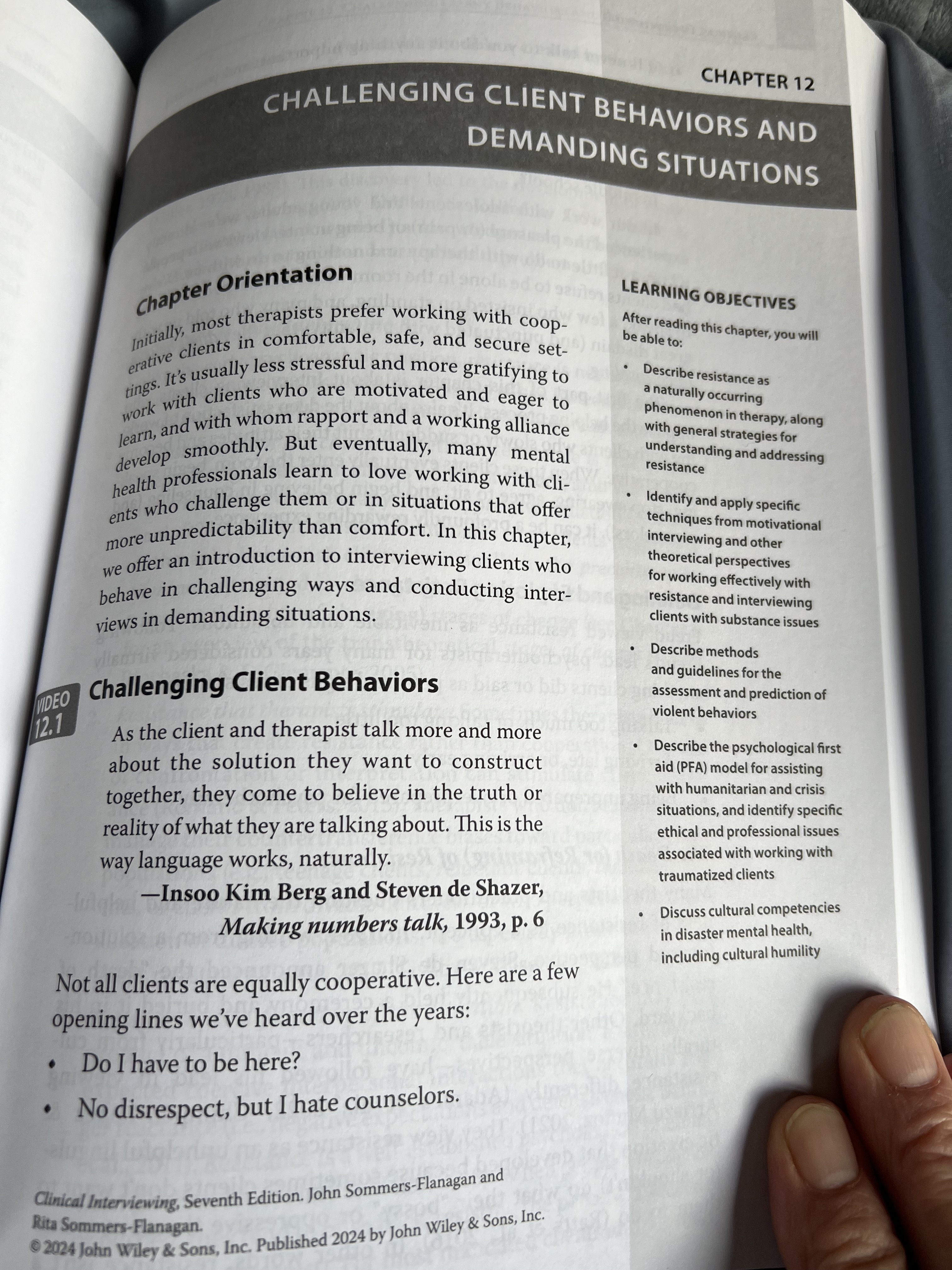




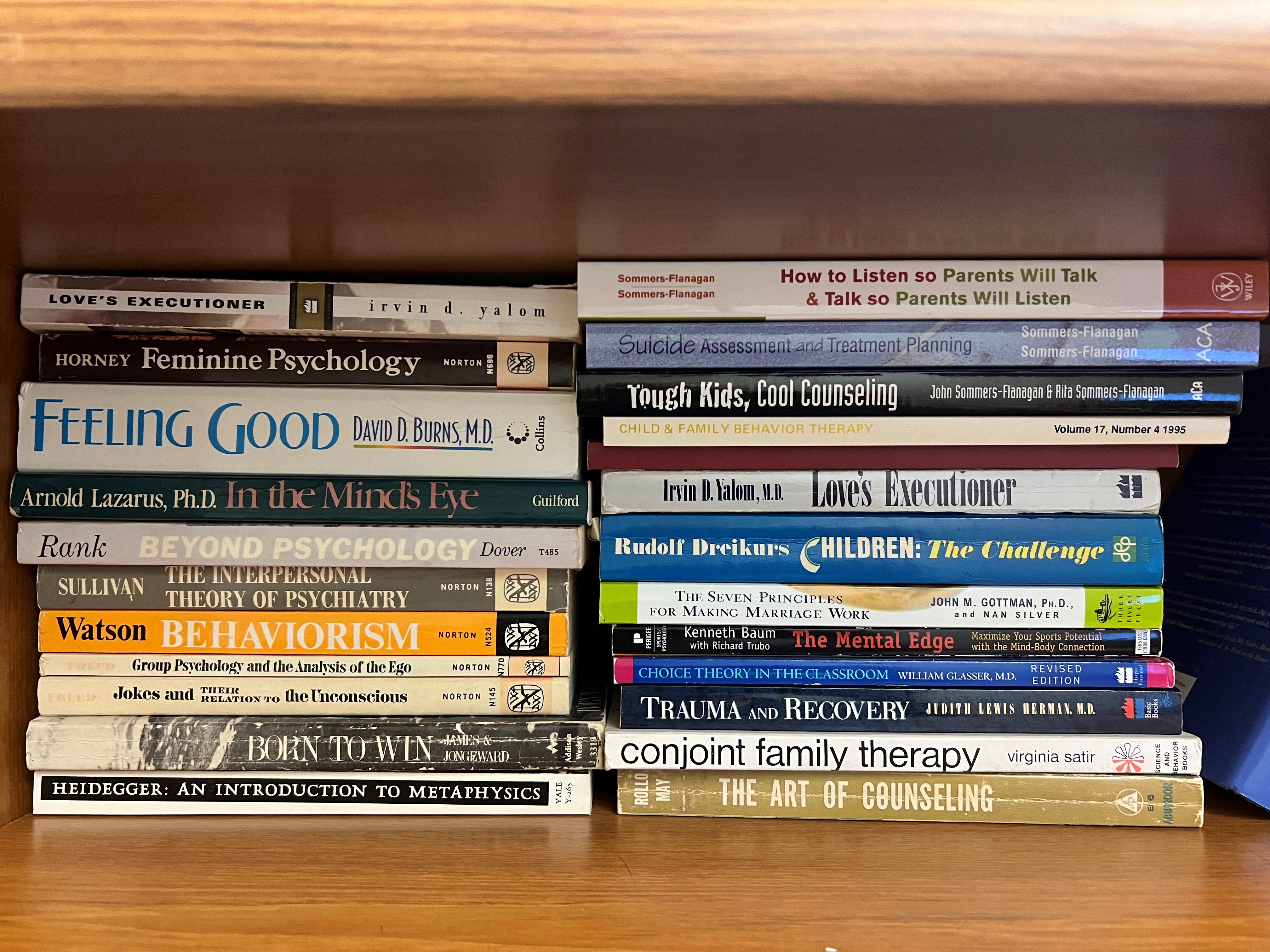
 John Sommers-Flanagan