Category Archives: Personal Reflections

2022: The Year of The Big Truth

If 2021 was the year of the Big Lie, given humanity’s tendency to swing like a pendulum, 2022 should be the Year of the Big Truth. That sounds nice. Let’s embrace truth and facts. Let’s not embrace Kellyanne Conway’s philosophy of alternative facts. But things don’t just happen. We have to make it happen. We need to, as Jean Luc Picard (aka Patrick Stewart) used to say, “Make it so.”

I’ll start.

Below I’ve made a list about what’s mostly true and mostly indisputable about the novel coronavirus (AKA COVID-19, and its variants).

There really is a virus that was identified and labelled as COVID-19. As is often the case with complicated things, the precise origins of COVID-19 are not known, and are likely unknowable. If you go online and read of someone claiming that COVID-19 was developed in a Chinese laboratory, unless you’re reading a legitimate and documented confession from someone directly involved in creating COVID-19, you’re reading something that somebody just made up. Not knowing all the facts is difficult to live with, and in the space of uncertainty, many people will make up stories. The stories might be an effort to explain something (e.g., because I can see the horizon, the earth is flat) or it may be to intentionally deceive. We have to live with the truth that there are things we do not know, including the exact origin story of COVID-19. To avoid conspiracy theories and behave like mature adults who want to contribute to the well-being of society, we should not, in the elegant words of Dr. Cordelia Fine, make shit up.

COVID-19 and its variants are highly transmissible. Our neighbors just informed us they “have the flu.” That may or may not be the perfect truth. They may have COVID. Either way—flu or COVID—I’m keeping my distance. The COVID-19 virus is virulent, and the flu sucks. You can argue the specifics, but COVID-19 is a remarkably transmissible virus.

Upon contracting COVID-19, you may have very minimal and possibly zero COVID symptoms. Some people—even people over 80 and with significant health issues—have had no noticeable COVID symptoms at all. Maybe their test was a false positive? Or, maybe their individualized response was negligible? My father, age 95, bedridden, with a variety of heart and lung ailments, is healthier now—after having tested positive for COVID-19.  

In contrast to my father and other luckier victims of the viral vector, COVID-19 makes other people moderately ill, gets others very ill, and kills the rest. COVID-19 killed my mother and several other people I know. Recently, Rita talked with someone who had seven family members die from COVID. The hard truth is that individuals have highly variable responses to a COVID-19 infection; it’s a hard truth because Americans and other humans don’t do well with variability. We like things to be simple and predictable. On average, the vast majority of people infected by COVID are not terribly ill. On the other hand, with about 824,000 Americans dead over a 24-month period, COVID-19 may be unpredictable, but it’s also consistently lethal.

Despite famous people who famously minimized COVID-19, saying it would magically go away, it hasn’t. COVID-19 has proven itself to be very persistent. Sure, the media loves a hot crisis and COVID-19 feeds the media’s need for constant crisis, but COVID’s persistence is not simply media hype.

Although it’s good to be skeptical, the preponderance of the evidence points to the likelihood that COVID-19 death estimates are just as likely to be underestimates as overestimates. Some COVID-minimizers question the death rate estimates from COVID-19, thinking they’re inflated. But there’s also evidence they’re deflated. Other minimizers argue that many COVID-related deaths have occurred in nursing home patients who, like my mother, would have died anyway, in the next year or two. Given all the other evidence pointing to COVID-19 as a legitimate medical crisis, questioning death rate estimates and quibbling over who’s dying is mostly a method to avoid thinking about 824,000 dead Americans and 5.44 million deaths worldwide.

Whether you “believe” in the transmissibility, lethality, or death rates is up to you. We should all try to remember that personal beliefs are not facts; in “fact,” thinking our personal beliefs are facts is the root of many problems. To be intellectually honest means, at least in part, that we don’t go out looking only for evidence to support our pre-existing beliefs. If we do, that’s called confirmation bias. . . which is just fancy scientific terminology for getting good at lying to ourselves.  

Speaking of lying, to describe COVID-19 as a “mild flu” is simply untrue. Not only is the mild flu rhetoric a lie, it’s a big lie that can and does cost people their lives. If you’ve spent any time working, volunteering, or hanging out in medical settings, you can see with your own eyes that COVID-19 is having an immense, dreadful, and potentially catastrophic effect on the healthcare systems and healthcare workers around the world.  

Medical journals and medical authorities have the best information available about COVID-19. Although their information isn’t perfect, and it’s consistently changing, legitimate medical professionals still give us the best information we have. People who write medical journal articles and people with medical degrees are way smarter than most of the rest of us. If you’re REALLY SERIOUS about “researching COVID-19,” you should read medical journal articles. It’s just as easy to Google the New England Journal of Medicine, the Journal of the American Medical Association, the British Medical Journal, and other top-tier medical journals, as it is to Google fringe conspiracy theorists who make up shit from their own demented imaginations. Seriously. The Big Truth Here: You should trust physicians who have taken the Hippocratic oath over COVID-19 deniers and conspiracy theorists who’s only oath is to do whatever they can to get attention and feel more important than they really are.

COVID-19 minimizers or deniers do not have your best interests at heart. Believe them at your own risk. Or, better yet, choose to not believe them. If you’re the sort of skeptic who looks for cracks in the arguments of legitimate medical research, be sure to use equal rigor to look for cracks in the arguments of people like Candace Owens, Tucker Carlson, Marco Rubio, Ted Cruz, and Laura Schlessinger. Take a minute to contemplate who you think is more interested in your (and all Americans’) well-being. Take another minute to contemplate who you think has underlying financial motivations to deceive you. In the end, the CDC, Dr. Fauci, and the World Health Organization are better sources of useful, health-promoting information than COVID-minimizers or deniers.

I’ve written all this and just now realizing I haven’t even gotten to the issues of wearing masks and vaccinations. Obviously, there’s more to come.

Please join me in working to make 2022, The Year of the Big Truth.

What’s Happening at the Montana Happiness Project: The 2021 Annual Report

Montana Happiness Project – 2021 – Year End Report

Despite global exhaustion from wave after wave of the coronavirus pandemic, and despite immense national and local loss and suffering, amazing examples of resilience continue. At the Montana Happiness Project, we believe in facing, validating, and working through individual and collective pain and suffering. We believe everyone needs time and space to be with, and gain insight from, their emotions. This is one side of the truth of living.

On the other side is the need to stay strong, positive, and resilient. Although it’s human nature and therapeutic for individuals and communities to be with their emotions, we also benefit from focusing on strengths, positivity, gratitude, and kindness. In an ideal world, we do both. We take time to be with our painful emotions and learn from them. We also intentionally turn toward wellness and happiness. This is part of the balance that facilitates well-lived lives.

The year 2021 remained challenging for many Montanans. This brief Year-End Report describes activities associated with the smaller and larger ways in which the Montana Happiness Project made efforts to nurture wellness within our Montana communities. To summarize our activities, we’ve organized this report into several sections: (a) Happiness Funding, (b) Bimonthly Activities, (c) 2022 Goals and Organizing Principles, (d) Outcomes, and (d) Gratitude.

*******

Just in case you don’t want to read the whole 7 page report, I’ve pasted the Executive Summary below.

Executive Summary

In our first complete year of operations, the Montana Happiness Project, L.L.C. provided substantial contributions to wellness awareness and happiness promotion throughout the state of Montana and beyond. Highlights of 2021 include: (a) reaching well over 1,000 Montanans with high-quality educational presentations on suicide prevention and happiness promotion; (b) offering seminars, classes, and trainings viewed by over 50,000 professionals around the globe; (c) delivery of a 2½ day retreat for 15 professionals committed to implementing a strengths-based approach to suicide assessment, treatment, and prevention in Montana; (d) data collection and continued scientific research on the effectiveness of strengths-based suicide assessment and treatment workshops for professionals, happiness classes, and happiness workshops; (e) initiation of collaborative programming with the University of Montana, Families First Learning Labs, and other community organizations.

If you’d like to read the whole report, send me an email (john.sf@mso.umt.edu) or message me here and I’ll get one out to you.

Have a great day.

John

Wishing You a Fantastic Holiday Season – And Lifelong Learning

For the past ten days I’ve been contemplating a witty and profound holiday greeting and blog post that would lift moods everywhere and inspire greater wellness. Sadly (or happily), the profound words did not emerge from my brain, perhaps because my brain–like many objects at this time of the season–preferred to remain at rest. The universe seemed to be saying something like, “Let there be inertia.” Who am I to dispute messages from the universe?

And then, in the midst of my stare-down with inertia, I read that today is Day 2 of Kwanzaa, the principle for which is “self-determination.” I don’t know much about Kwanzaa, and so I did a bit of reading and discovered that Day 2 involves the lighting of a candle that represents the principle of Kujichagulia (aka self-determination). Self-determination can be taken a few different ways, including the process of defining, creating, naming, and speaking for ourselves.

I have no intention of engaging in cultural appropriation here, but instead, my desire (in a Bertrand Russell sort of way) is to continue to embrace new learning—which seems to me as a nice antidote to staying at rest or remaining inert. Learning a bit more about African-American culture . . . as well as other cultures . . . strikes me as a good thing, and is consistent with what I hope for in the coming year.

In my momentarily state of naïve idealization (unfortunately, this too shall likely pass), I wish you all the best for Christmas, Kwanzaa, Hanukkah, and other celebratory holidays. I also wish for more learning, more openness to the ideas and cultures of others, and more of that social fabric that Alfred Adler called Gemeinschaftsgefühl. And, to paraphrase the great positive psychologist, Chris Peterson, remember, “Other people matter,” which, of course, means that because you’re an “other” person to everyone else, you matter too.

Be well,

John S-F

Paradoxical Intention, Part II: Transformative Epiphanies

Often, I have the honor of getting a personal preview of Rita S-F’s Godblogs. I sit in a cushy chair, shut my eyes, and let her words create images in my brain. It’s not unusual for her readings to stimulate unusual thoughts. But, last week, while listening, I was taken with a particular epiphany.

She was reading about how easy (and destructive) it is to be judgmental; I can’t recall the details. In response, a voice in my head spoke gently,

“I wonder if it might help if you could try, just a little, to be even more judgmental. . .” followed by an additional internal commentary “. . . said no one ever.”

The thought—of trying to be even more judgmental—made my lips curl upward into a smile. I felt an urge to laugh. Then, naturally, I thought of Viktor Frankl.

As I wrote in my last blog (https://johnsommersflanagan.com/2021/12/06/paradoxical-intention-dont-try-this-at-home-or-maybe-dont-try-it-anywhere/), Frankl was the first person I know of who explicitly discussed paradoxical intention as working like a joke to the psyche. I’ve written about that, but I’d never felt it in my gut. This time I did actually feel it. Then, and in response to the thought of intending to be “even more judgmental,” along with the urge to laugh, I also felt a small internal push back toward acceptance.  

Paradoxical intention has two parts. First, there’s the intention. I’ve tried the intention part of paradoxical intention with myself (and used it with clients) in specific situations when physical behaviors or responses feel outside of voluntary control. One example is the twitching eye syndrome. If you have an eye that’s prone to twitching, you can try to make it twitch more or try to make it twitch when it hasn’t been twitching. That’s the intention part. The other part is for the intention to be aimed toward the opposite of your goal. In the case of listening to Rita’s blog, the thought of intending to be more judgmental was received and then produced psychological push-back. What was different than any other response I’ve ever felt about paradoxical intention was my urge to smile and laugh. I’d never felt like laughing when I tried to make a bothersome eye twitch . . . twitch more.

Later—while driving I-90 west—a place where I’m prone to feeling intermittent anger toward drivers I label in my mind as “stupid,” I did another experiment.

“I wonder,” I thought to myself, “if maybe I could try to start feeling just a little angrier toward those other drivers. Being alone in the car, I tried it out with a brief litany of profanity. In response, I felt increased anger. That wasn’t good. But within seconds, my brain started the natural push-back. I took note of my greater anger and quickly judged it as unpleasant. Then, I noticed an internal psychological push-back toward the center. I suddenly wanted the anger—which usually feels so justified in the moment—to go away. And so, I let it go.

Paradoxical intention isn’t a magic trick. Nothing in the world of human psychology is magical. Paradoxical intention operates on natural psychological dynamics. Laura and Fritz Perls would have called it an internal polarity. Behaviorists like to call it a form of overcorrection. The popular press tends to reduce it to a term I can’t help but find offensive: reverse psychology.

Although you might try paradoxical intention on your children or your friends, because of one central underlying principle, that’s not a great idea. The underlying principle is best expressed by an old (and bad) joke.

“How many mental health professionals does it take to change a light bulb?”

“Only one. But the light bulb has to want to change.”

You could try a little paradoxical intention . . . on yourself . . . but only if you want to experience a new transformative epiphany.

For a Win-Win-Win on Giving Tuesday – Support College Student Mental Health

After facing an overwhelming number of choices on Black Friday and Cyber Monday, now we’re faced with another litany of excellent choices for Giving Tuesday. There are so many wonderful charities to support. You can’t go wrong with supporting food banks, shelters, and other organizations that push back against poverty. You also can’t go wrong supporting children, minorities, education, and the environment . . . these are all huge needs.

Along with the preceding charity types, this year Rita and I are wholeheartedly supporting college student mental health. We’ve seen the struggles firsthand and we believe college students can benefit from greater access to mental health services. Specifically, we’re supporting a University of Montana Foundation project called “The University of Montana Mental Health and Happiness Fund.” We see the University of Montana Mental Health and Happiness Fund as a win-win-win. Here’s why.

The first win is that the funds will go to provide more hours of mental health counseling for college students. Unfortunately, more than ever before, college students are stressed and experiencing mental health struggles. These struggles can include suicidal thoughts and behaviors. As far as age groups vulnerable to death by suicide, the college student age group is among the highest (along with older males). Supporting college student mental health can literally save lives and help college students graduate and become significant contributors to their communities. Currently, Counseling Services at the University of Montana needs more counselors to meet increased needs.

The second win is about “workforce development.” In Montana, and around the nation, we need a continuous flow of competent and capable mental health professionals. That’s why the first priority of the University of Montana Mental Health and Happiness Fund is to support a ½ time Counseling Intern for UM’s Counseling Services department. Funding an intern means that the intern gains valuable experience and supervision and can then go out and contribute to mental health in the community. If we receive more funds than expected, we will either fund a second ½ time counseling intern or we will fund happiness promotion projects at UM and within the Western Montana area.

The third win is basic economics. College students contribute to local economies. When they graduate, college students also create capital. College students become entrepreneurs, scientists, grant writers, community leaders, parents, and grandparents. In all these roles, college graduates will do better and be better if they have better mental health.  

Our 2021 fundraising goal is $45,000. We’ve already raised over $22,000. Please help us reach our goal so we can contribute to positive mental health and happiness at the University of Montana.

If you’re interested in joining Rita and me in supporting the University of Montana Mental Health and Happiness fund here are the instructions.

  1. Click on this Link for Support
  2. As you complete the donation form, about halfway down the page, you will see “Designation Choice.” Choose “Other.”
  3. In the Additional Comments/Info Section – type/write University of Montana Mental Health and Happiness Fund

Thanks for considering college student mental health for this Giving Tuesday!

The Feminist Lab in Counseling and Psychotherapy Theories

Sometimes when I’m talking about feminism in my theories class, I refer to it as the F-word. I feel like I have to do more “selling” of feminist therapy than any other approach. Maybe I’m just imagining it, but I hear rumors like, “I hope we get to skip feminist therapy in the lab” and “How do you practice feminist therapy?”

The answers are: “No, you don’t get to skip feminist therapy” and “Because feminist therapy is technically eclectic, you can practice it nearly any which way you like.” Freedom is another F-word, and there’s plenty of that when you’re being afeminist.

Yesterday, while facilitating a grad lab where the practicing happens, it was fascinating to observe feminist therapy in 10 minute snippets. I heard a beautiful self-disclosure. I heard talk of clothes and bodies and of the wish to be taken seriously. No one mentioned the patriarchy . . . but everyone . . . hopefully . . . got to taste and talk about oppression and hierarchy and the wish to be a free and expansive self.

Someone even talked about farting. Someone else about dancing. Others about uninhibited delight.

Should you be interested in what prompted these interactions, I’m attaching my feminist lab instructions here:

Let’s Go Rita!

This morning, being behind not only on my grading, course planning, writing, and housecleaning, I also found myself behind on current events. As a consequence, I was forced (not literally, of course) to do an internet search to understand the meaning of the “Let’s go Brandon” catchphrase or meme or whatever we’re calling such things in our contemporary and ever-changing vernacular.

What I found was—on its face—disturbing. After having won his first NASCAR event, a man named Brandon is being interviewed by an NBC reporter. He looks so young, so happy, and so excited to talk about his first victory. In the background, there is chanting. Although not PERFECTLY clear, if you listen closely and look at the video clip, some in the crowd are shouting, “Fuck Joe Biden.” The reporter, in an effort to weave the chanting into her interview, explicitly interprets the chanting as “Let’s go Brandon!”

At a deeper level, the chants, their interpretation, their re-interpretation, and their current use as a method for mocking and insulting President Biden, represent a deep, sad, and pathetic powerlessness. We all feel it. We all want to shout out our own beliefs, because, of course, we think our own beliefs are the best beliefs and the right beliefs and the beliefs that should be heard above the roar of the crowd.

What saddens me the most is that it also represents not only the deep divisions in our country (and the world), but that it has become viral fodder for confirmation bias and spinning. People see whatever they’re inclined to see in the chant. Is it evidence of fake news or disrespect for the presidency? Have we caught the press intentionally remaking reality or have we caught Trump supporters in their anti-patriotic hypocrisy? The facts don’t matter much anymore. Polarizing is the thing. Sloganizing is the thing. It’s not so much about what unites us; it’s about what divides us.

Like many, I feel a paradox. I care about the deep divisions. I wish I could bridge them. At the same time, I don’t care for people stoking deep divisions. I wish to ignore them.

All this brings me to something that I unequivocally and unapologetically wish would go viral . . . instead of the popular outrage and mockery.

After discovering and lamenting the Let’s Go Brandon mockery, I read Rita Sommers-Flanagan’s Sunday morning blog post. Hers are the messages I wish would catch fire on the internet.

She wrote:

“God,” I whisper, awake and facing morning, “You know I’d like to extend my reach; do things that make me feel important and complete. I’d like to turn the tide of hate into an ocean of love. I’d like to make the fear go away.”

This is the call for unity, love, and peace that SHOULD be in my newsfeed.

Here’s another line: “I am of your doing, and you of mine.” Just spectacular.

Rita’s blog is titled, “Short visits with an honest God.” Should you be interested in deeper unity, here’s the link to her blog: https://godcomesby.com/ . . .

And here’s the link to this morning’s post: https://godcomesby.com/2021/11/14/the-long-gray-bird/?fbclid=IwAR1kYlUDhLOUdj0lV-9001MnEIeK3XCsCd-FjkAmlZinBTMp7z1lq0NkEyw

Flying (Literally) with Privilege

This view: The larches and Missions as we descend into Missoula

Flying is more or less privilege. Think about it; we’re looking down on everyone. Maybe that’s why I still feel a charge of excitement when I get to fly somewhere. . . especially on my favorite airline . . . which will remain unnamed in this story.

Flying privilege moves past the abstract as soon as we begin forming lines, because there’s not just one line. I’m a TSA pre-check person, a recent holiday gift I value. Earlier today I strolled past lined-up throngs in Portland, shrugging off minor traces of guilt. All those long faces staring into their cell phones or glaring at me. I don’t have a solution to the security checkpoint lines; I just don’t care to populate them.

Other than my holier than thou security line experience, on this particular trip my favorite airline treated me like a bottom-feeder. I would have gladly eaten the cake left by the anonymous French princess or flight attendant or whomever it was who said the poor could just eat cake, but then I recalled my recently discovered gluten sensitivity and demurred, “Um, no thanks, I think I’ll pass.”

Hours earlier, while checking in, my computer informed me I had no seat on my outgoing Seattle flight. No seat = bad omen. The airline also wouldn’t print me a boarding pass for my second flight. No boarding pass = Not good. I found an email offering me $250 to take a “later” flight. Briefly, I weighed my options. Let’s see, will I give up or shorten my planned trip to see my 95-year-old father who’s on hospice? The question was about cash vs. connection. You know the answer. We all know the answer.

Without a seat, and missing a boarding pass, I approached the gate. I found a very pleasant woman. She explained. “You’re on the bottom of the list. I think we’ll get you on, but I can’t give you a seat and I can’t print your second boarding pass until we get people to be bumped and agree to take a later flight.”

“Bumped.” What a fun word. I think what she really meant was “left behind.”

After three straight 12-hour University of Montana work days, I was too tired to be expressive), and so I blandly asked, “How did I end up on the bottom?” She started to say it was my “Saver” seat status, but looked at her computer screen, hesitated, and then said “maybe you were the last person to check in,” before completely clarifying her response with a weak smile and the words, “I don’t know.”

Feeling the “bump” closing in on me, I asked, “What’s the later flight?” Turns out, there was no later flight. The very pleasant woman mumbled something about “tomorrow,” then detoured to “the closest alternative airport is Spokane,” and then stopped talking midsentence.

Half livid and half hopeless, I thanked her for the information and ambled off to a part of the airport where I could send whining texts to family and friends in relative peace. Three years ago, my favorite airline had twice upgraded me to first class. Oh, how the mighty had fallen.

I also purchased some consolation treats, which is another tool in the toolbox of being an unhappy, but still relatively privileged person.

At the penultimate moment, I escaped the bump, and was assigned a back-row seat. Oddly, the flight attendant, looking distressed, noted that my assigned seat was taken. Apologizing profusely, she took me up to a palpably better seat, and then came by and whispered, “I’ll get you compensation.” I ended up with a $25 credit in my airline account . . . for no good reason. I’ll let you guess why I got the compensation.

The worst (maybe) was yet to come. Rather than having a seat I originally selected, the airline did what airlines sometimes do: They put me in a middle seat, way in the back of the next flight (row 36). You would have thought I bought a cheap ticket. I didn’t. The whole idea that airlines can take away your personally selected assigned seat and give it to someone else just seems wrong.  

As I end this melancholy reflection, I’m aware this sounds like a pathetic, long, drawn-out whine. Do I feel sorry for myself? Sure. But that’s not the point. I feel sorry for everyone. Even though I enjoy being in the short, privileged line (and having an assigned seat on the plane, or at the metaphorical table), there’s still a panoply of things for which to feel EVEN MORE sorry. Airlines have continually faced financial conundrums, and global pandemics don’t make that easier. All the flight personnel were unyieldingly nice and kind. I could bitch and moan and throw money around to get me mega-privilege (first class, anyone?), but someone will always be on “the bottom of the list,” and, no doubt, they have just as good a good reason as I do for wanting a good seat and for hoping to get to their destination on time.

Now I’m just back from visiting Max, my father, an immense and positive influence in my life and on the world . . . which is just one more reason why, even when threatened with a bump and stuck in a middle seat with two big people on each side, not only am I one of the lucky ones . . . I’m also FLYING. 

The Efficacy of Antidepressant Medications with Youth: Part II

After posting (last Thursday) our 1996 article on the efficacy of antidepressant medications for treating depression in youth, several people have asked if I have updated information. Well, yes, but because I’m old, even my updated research review is old. However, IMHO, it’s still VERY informative.

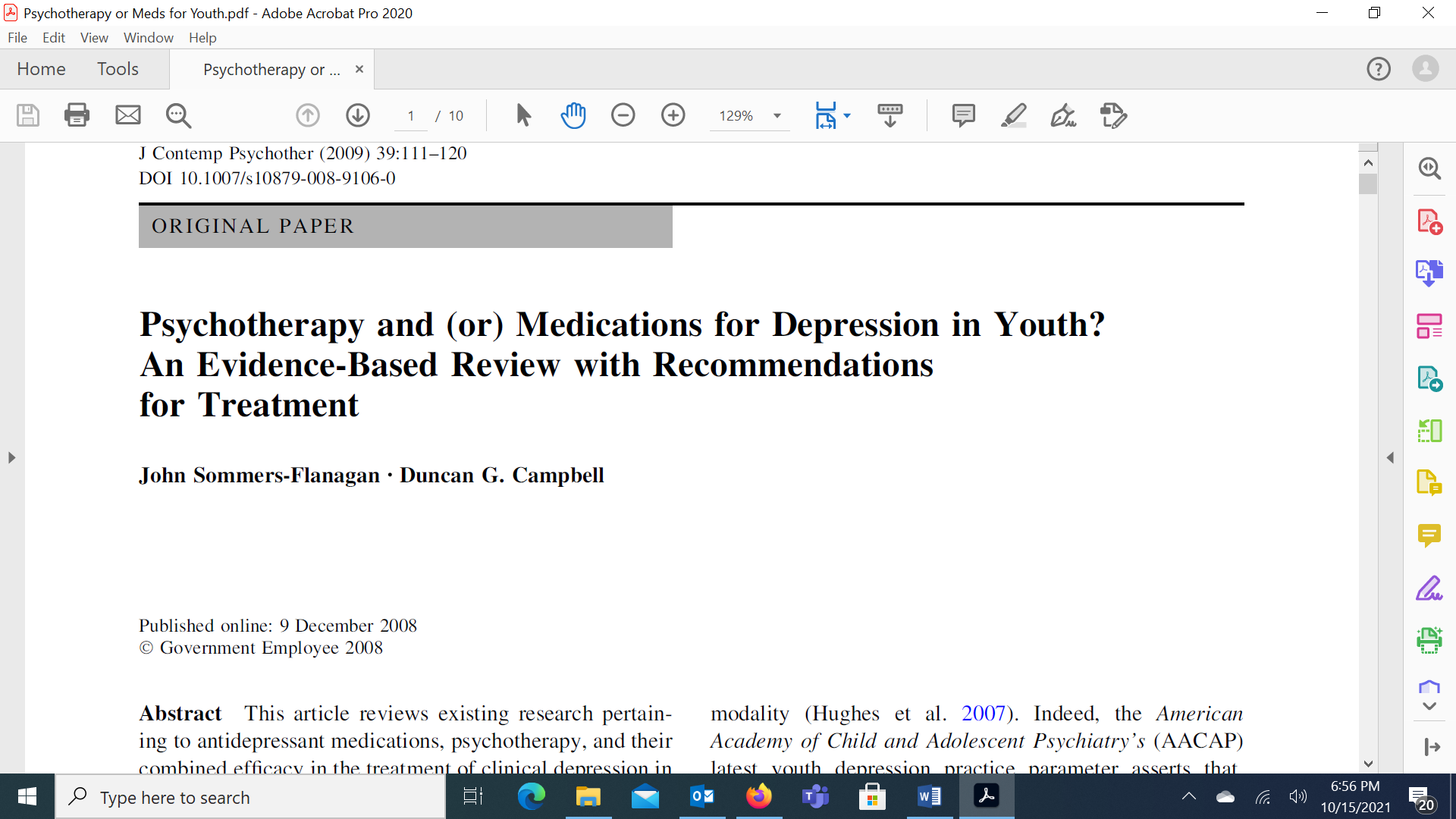
In 2008, the editor of the Journal of Contemporary Psychotherapy, invited Rita and I to publish an updated review on medication efficacy. Rita opted out, and so I recruited Duncan Campbell, a professor of psychology at the University of Montana, to join me.

Duncan and I discovered some parallels and some differences from our 1996 article. The parallels included the tendency for researchers to do whatever they could to demonstrate medication efficacy. That’s not surprising, because much of the antidepressant medication research is funded by pharmaceutical companies. Another parallel was the tendency for researchers to overstate or misstate or twist some of their conclusions in favor of antidepressants. Here’s the abstract:

Abstract

This article reviews existing research pertaining to antidepressant medications, psychotherapy, and their combined efficacy in the treatment of clinical depression in youth. Based on this review, we recommend that youth depression and its treatment can be readily understood from a social-psycho-bio model. We maintain that this model presents an alternative conceptualization to the dominant biopsychosocial model, which implies the primacy of biological contributors. Further, our review indicates that psychotherapy should be the frontline treatment for youth with depression and that little scientific evidence suggests that combined psychotherapy and medication treatment is more effective than psychotherapy alone. Due primarily to safety issues, selective serotonin reuptake inhibitors should be initiated only in conjunction with psychotherapy and/or supportive monitoring.

The main difference from our 1996 review was that in the late 1990s and early 2000s, there were several SSRI studies where SSRIs were reported as more efficacious than placebo. Overall, we found 6 of 10 reporting efficacy. An excerpt follows:

Our PsychInfo and PubMed database searches and cross- referencing strategies identified 10 published RCTs of SSRI efficacy. In total, these studies compared 1,223 SSRI treated patients to a similar number of placebo controls. Using the researchers’ own efficacy criteria, six studies returned significant results favoring SSRIs over placebo. These included 3 of 4 fluoxetine studies (Emslie et al. 1997, 2002; Simeon et al. 1990; The TADS Team 2004), 1 of 3 paroxetine studies (Berard et al. 2006; Emslie et al. 2006; Keller 2001), 1 of 1 sertraline study (Wagner et al. 2003), and 1 of 1 citalopram study (Wagner et al. 2004).

Despite these pharmaceutical-funded positive outcomes, medication-related side-effects were startling, and the methodological chicanery discouraging. Here’s an excerpt where we take a deep dive into the medication-related side effects and adverse events (N.B., the researchers should be lauded for their honest reporting of these numbers, but not for their “safe and effective” conclusions).

SSRI-related medication safety issues for young patients, in particular, deserve special scrutiny and articulation. For example, Emslie et al. (1997) published the first RCT to claim that fluoxetine is safe and efficacious for treating youth depression. Further inspection, however, uncovers not only methodological problems (such as the fact that psychiatrist ratings provided the sole outcome variable and the possibility that intent-to-treat analyses conferred an advantage for fluoxetine due to a 46% discontinuation rate in the placebo condition), but also, three (6.25%) fluoxetine patients developed manic symptoms, a finding that, when extrapolated, suggests the possibility of 6,250 mania conversions for every 100,000 treated youth.

Similarly, in the much-heralded Treatment of Adolescents with Depression Study (TADS), self-harming and suicidal adverse events occurred among 12% of fluoxetine treated youth and only 5% of Cognitive Behavioral Therapy (CBT) patients. Additionally, psychiatric adverse events were reported for 21% of fluoxetine patients and 1% of CBT patients (March et al. 2006; The TADS Team 2004, 2007). Keller et al. (2001), authors of the only positive paroxetine study, reported similar data regarding SSRI safety. In Keller et al.’s sample, 12% of paroxetine-treated adolescents experienced at least one adverse event, and 6% manifested increased suicidal ideation or behavior. Interestingly, in the TCA and placebo comparison groups, no participants evinced increased suicidality. Nonetheless, Keller et al. claimed paroxetine was safe and effective.

When it came to combination treatment, we found only two studies, one of which made a final recommendation that was nearly the opposite of their findings:

Other than TADS, only one other RCT has evaluated combination SSRI and psychotherapy treatment for youth with depression. Specifically, Melvin et al. (2006) directly compared sertraline, CBT, and their combination. They observed partial remission among 71% of CBT patients, 33% of sertraline patients, and 47% of patients receiving combined treatment. Consistent with previously reviewed research, Sertraline patients evidenced significantly more adverse events and side effects. Surprisingly and in contradiction with their own data, Melvin et al. recommended CBT and sertraline with equal strength.

As I summarize the content from our article, I’m aware that you might conclude that I’m completely against antidepressant medication use. That’s not the case. For me, the take-home points include, (a) SSRI antidepressants appear to be effective for some young people with depression, and (b) at the same time, as a general treatment, the risk of side effects, adverse effects, and minimal treatment effects make SSRIs a bad bet for uniformly positive outcomes, but that doesn’t mean there won’t be any positive outcomes. In the end, for my money—and for the safety of children and adolescents—I’d go with counseling/psychotherapy or exercise as primary treatments for depressive symptoms in youth, both of which have comparable outcomes to SSRIs, with much less risk.

And here’s a link to the whole article:


Antidepressant Medications for Treating Depression in Youth: A 25-Year Flashback

About 25-years ago Rita and I published an article titled, “Efficacy of antidepressant medication with depressed youth: what psychologists should know.” Although the article targeted psychologists and was published in the journal, Professional Psychology, the content was relevant to all mental health professionals as well as anyone who works closely with children.

Yesterday, when teaching my research class to a fantastic group of Master’s students in the Department of Counseling at UM, I had a moment of reminiscence. Not surprisingly, along with the reminiscence, came a resurgence of emotion and passion. I was sharing about how it’s possible to find an area of interest that hooks so much passion, that you might end up tracking down, literally everything ever published on that topic (as long as the topic is small enough!).

The motivation behind my interest in the efficacy of antidepressants with youth came about because of a confluence of factors. First, I was working with youth every day, many of whom were prescribed antidepressant medications. Second, I was in a sort of professional limbo—working in full-time private practice—but wishing to be in academia. Third, out of virtual nowhere, in 1994, Bob Deaton, a professor of social work at the University of Montana, asked Rita and I to do an all-day presentation for the Montana Chapter of the National Association of Social Workers. Bob’s offer was not to be refused, and I’ve been in Bob Deaton’s debt ever since. If you’re out there reading this, thanks again Bob, for your confidence and the opportunity.

To prep, Rita and I split up the content. One of my tasks was to dive into all things related to antidepressant medications. Before embarking on the journey into the literature, I expected there would be modest evidence supporting the efficacy of antidepressants in treating depression in youth.

My expectations were completely wrong. Much to my shock, I discovered that not only was there not much “out there,” but the prevailing research was riddled with methodological problems and, bottom line, there had NEVER been a published study indicating that antidepressants were more effective in treating depression in youth than placebo. I was gob smacked.

Just to give you a taste, here’s the abstract:

Pharmacologic treatments for mental or emotional disorders are becoming increasingly popular, especially in managed care environments. Consequently, psychologists must remain cognizant of medication efficacy concerning specific mental disorders. This article reviews all double-blind, placebo- controlled efficacy trials of tricyclic antidepressants (TCAs) with depressed youth that were published in 1985-1994. Also, all group-treatment studies of depressed youth using fluoxetine, a serotonin-specific reuptake inhibitor (SSRI), are summarized. Results indicate that neither TCAs nor SSRIs have demonstrated greater efficacy than placebo in alleviating depressive symptoms in children and adolescents, despite the use of research strategies designed to give antidepressants an advantage over placebo. The implications of these findings for research and practice are discussed.

Early in my research class this semester, an astute young woman asked about the “rule” she had heard about that you shouldn’t cite research that’s more than 10-years-old. It was a great question. I hope I responded rationally, but my apoplectic-ness may have showed in my complexion and words. In my view, we cannot and should not ignore past research. As Samuel Clemens once wrote, “History doesn’t repeat itself, it only rhymes.” If we don’t know the old stuff, we may miss out on the contemporary rhyming pattern. In our article, 25-years-old now, we also discussed some medication research reporting shenanigans (although we used more professional language. Here’s an excerpt of our discussion about drop-out rates.

Dropout rates. Side effects and adverse events can significantly affect medication study outcomes by causing participants to discontinue medication treatment. For example, in the IMI [imipramine] study with children ( Puig-Antich et  al.,  I987), 4 out of 20 (20%) of the medication group did not complete the study, whereas in the two DMI [desipramine] studies ( Boulos et al., l99 l; Kutcher et al., 1994 ), 6 out of 18 (33%) and 9 out of 30 (30%) medication participants dropped out because of side effects. For each of these studies, participants who dropped out of the treatment groups before completing the treatment protocol were eliminated from data analyses. The elimination of dropout participants from data analyses produced inappropriately inflated treatment-response rates. For example, although Puig-Antich et al. (1987) reported a treatment-response rate of 56% (9 of 16 participants), if all participants are included within the data analyses, the adjusted or intent-to-treat response rate is 45% (9/20). For the three studies that reported the number of medication protocol participants who dropped out of the study, the average reduction in response rate was 16.5%. Overall, intent­to-treat response rates ranged from less than 8% to 45% (see Table 2 for intent-to-treat response rates for all reviewed TCA studies).

What’s the value, you might wonder, of looking back 25-years at the methodology and outcomes related to tricyclic antidepressant medication use? You may disagree, but I think the rhyming pattern within antidepressant medication research for youth (and adults) remains. If you’re interested in expanding your historical knowledge about this rhyming, I’ve linked the article here.

Research can be boring; it can be opaque; it can be riddled with stats and numbers. Nevertheless, for me, research remains exciting, both as a source of amazing knowledge, but also as something to read with a critical eye.