All posts by johnsommersflanagan

Carl Rogers and Brain-Science do an Empathy Smackdown in Chapter 3

Just because I know you all want in on the new introductory comments for Chapter 3 of the 6th edition of Clinical Interviewing.

And just because I’m wondering if my reference to Csikszentmihalyi’s fish cutter is too enigmatic.

Here’s the text; note it’s a draft with incomplete citations and likely grammar challenges.

Chapter 3

One vision for this chapter (and the next two) is to identify, describe, and illustrate every technical skill that therapists might employ during a clinical interview. We hope to do this so clearly that you can easily acquire and practice these skills. If we accomplish this vision, then you’ll know how to help clients:

• Talk openly about themselves, their problems, and their hopes;
• Have insights or new ideas about what they can do to manage their problems and achieve their personal goals; and
• Begin engaging in positive behavior change.

Other scholars and practitioners have referred to clinical interviewing technical skills as facilitative behaviors, helping skills, microskills, counseling behaviors, and more.

As we focus like a laser on skill-building, we also feel a troubling discomfort. This discomfort stems from our awareness that the great Carl Rogers would NOT AGREE IN THE LEAST with what we’re writing. Rogers would vehemently disagree because, for him, the special ingredients that make therapy work were NOT techniques or skills or behaviors. Instead, he repeatedly and emphatically claimed that successful therapy (even one-session clinical interviews) were all about therapist ATTITUDE—and the subsequent development of a “certain type of relationship” (Rogers, 1942, 1957, 1961; more on this in Chapter 6).

It’s always difficult to argue with Carl Rogers. His gentle, caring, and reflective voice keeps urging us to abandon skill development in the service of empathy training. And his point is exceptionally valuable, essential, and profound (we hope we’re making our thoughts on this clear). Many contemporary therapists, academics, and others don’t understand the essence of what Carl Rogers wrote and said about person-centered therapy. Too often his ideas are dumbed down to reflection skills (e.g., paraphrasing and reflection of feeling). The consequence of this dumbing down is that far too many helping professionals-in-training end up learning parroting skills. And we should note that parroting skills—unless emanating from an actual parrot and not a human counselor—are universally annoying and not particularly therapeutic.

As we open this chapter, we cannot in good conscience risk having you conclude that all you need to do is learn a couple dozen behavioral skills to become a good therapist or clinical interviewer. Rogers was right; that’s just not how it works.

Adopting a Therapeutic Attitude

Back in the 1940s, 50s, and 60s, Rogers repeatedly wrote about his core conditions or counselor attitudes. The conditions he viewed as necessary and sufficient to establish a therapeutic relationship were congruence, unconditional positive regard, and empathic understanding. If he were alive today, he would probably cringe at the modern emphasis on teaching therapeutic behaviors or skills, noting that nothing clinicians do can be therapeutic unless the clinician experiences and expresses the attitudes of congruence, unconditional positive regard, and empathic understanding. For the most part, research on counseling and psychotherapy has borne out his claims. As you’ll see, even contemporary neuroscience research is also broadly supportive of Rogers’s ideas.

Neurogenesis refers to the birth of neurons and is the biggest revelation in recent brain research. Although neurogenesis primarily occurs during pre-natal brain development, the so-called new brain research emphasizes adult neurogenesis; this is the discovery that humans can generate new neurons (brain cells) throughout the lifespan and not just during prenatal brain development). When adult neurogenesis happens, new neurons are integrated into existing neuro-circuitry.

From our perspective, the adult neurogenesis revelation is neither new nor particularly revelatory. For example, over 25 years ago, it was demonstrated that repeated tactile experiences produced functional reorganization in the primary somatosensory cortex of adult owl monkeys (Jenkins et al., 1990). This finding and subsequent research supporting neurogenesis essentially articulates a common sense principle that counselors and psychotherapists have utilized for decades. That is: Whatever behavior you rehearse, practice, or repeat, is likely to strengthen your skills in that area; and then, whatever skills you repeatedly practice will lead to you developing a brain that allows you to demonstrate these skills more efficiently. This is probably why Mihaly Csikszentmihalyi’s (1990) famous fish-cutter became able to experience optimal “flow” while fileting fish. It’s also how Carl Rogers became so adept at empathic understanding. For you, it’s the explanation and prescription for how you will become more like Carl Rogers than Csikszentmihalyi’s famous fish-cutter.

Research on the neuroscience of emotions is in its infancy. Consequently, you should take everything we write about it here (and that anyone writes about it anywhere) with a grain of salt. With that caveat in mind, let’s look at how modern brain science might support ideas for training yourself to be like Carl Rogers.

Researchers have recently been developing theories about what’s happening in different brain regions during an empathic experience. To summarize a large body of research, it appears that various brain regions and structures are especially activated when individuals have an empathic response. One particularly important brain structure involved in empathy experiences, self-regulation, and other behaviors linked to being helpful and compassionate is the insula.

More specifically, it appears that compassion meditation (aka lovingkindness meditation) is associated with neural activity and structural development (or strengthening) of the insula (or insular cortex). Researchers have reported that individuals who are highly experienced with compassion meditation have a thicker insula and that when they view or hear someone in distress they experience more neural activity in that brain region than individuals without much compassion meditation experience (Hölzel, Carmody, Vangel, Congleton, Yerramsetti, Gard, & Lazar, 2011). Other researchers have reported meta-analyses and other reviews indicating that during cognitive-emotional perception, regulation, and response, several brain structures are activated and the relationships among them are highly complex and integrated. In describing the role of the anterior insular cortex in empathic responding, Mutschler, Reinbold, Wankerl, Seifritz, and Ball (2013) wrote:

Accumulating evidence indicates a crucial role of the insular cortex in empathy: in particular the anterior insular cortex (AIC)—a brain region which is situated in the depth of the Sylvian fissure and anatomically highly interconnected to many other cortical regions (p. 1).

At the risk of oversimplifying a complex neurological process, it appears generally safe to conclude that compassion meditation and other human activities related to empathic experiencing may contribute in some way to the thickening of the insula and subsequently enhance empathic responsiveness.

Overall, at this early stage, it’s difficult for anyone to definitively declare how individuals can develop their brains to become more empathic. It’s tempting to conclude that, if you want to improve your empathic abilities, then you should engage in rigorous training to strengthen and grow your insula (and some of its empathy and self-regulation cohort like the middle cingulate cortex and pre-supplementary motor area; Kohn, Eickhoff, Scheller, Laird, Fox, and Habel, 2014). This brings to mind silly images of you engaging your insula in a series of cross-fit type workouts focusing particularly on its anterior muscular structure. Although the analogy and our knowledge about what’s really happening in the brain break down rather quickly, we nevertheless believe it makes sense for you to participate in a “training regime” that includes the following general steps:

1. Commit yourself to the intention of becoming a person who can listen to others in ways that are accepting, empathic, and respectful.

2. Similar to how meditators develop a meditation practice, develop an empathic listening practice. This could involve any form of regular interpersonal experience where you devote time to using the active listening skills described in this chapter. As you engage in this practice it is important to have listening with compassion as your primary goal.

3. Engage in the active listening, multicultural, and empathy development activities sprinkled throughout this text, offered in your classes, and that you obtain from additional outside readings.

4. When you watch television, read literature, and obtain information via technology, let yourself linger on and experience the emotions triggered during these normal daily activities.

5. Reflect on these experiences and then . . . repeat . . . repeat . . . and repeat some more.

Rogers wrote in very personal ways about his core conditions for counseling and psychotherapy. In the following lengthy quotation, he’s discussing obstacles that prevent most people from allowing themselves to step into another’s shoes and experience empathic understanding. Reading this excerpt (and following the preceding five steps and contemplating Multicultural Highlight 3.1) is part of our prescription for helping you adopt an empathic orientation toward individuals with whom you will work.

I come now to a central learning which has had a great deal of significance for me. I can state this learning as follows: I have found it of enormous value when I can permit myself to understand another person. The way in which I have worded this statement may seem strange to you. Is it necessary to permit oneself to understand another? I think that it is. Our first reaction to most of the statements which we hear from other people is an immediate evaluation or judgment, rather than an understanding of it. When someone expresses some feeling or attitude or belief, our tendency is, almost immediately, to feel “That’s right”; or “That’s stupid”; “That’s abnormal”; “That’s unreasonable”; “That’s incorrect”; “That’s not nice.” Very rarely do we permit ourselves to understand precisely what the meaning of his [or her] statement is to him [or her]. I believe this is because understanding is risky. If I let myself really understand another person, I might be changed by that understanding. (Rogers, 1961, p. 18; specific italics from the original are missing here)

All this makes me want to ask: How will you work to be more like Carl Rogers today?

2012-12-07_20-02-03_836

What’s the Difference between the Clinical Interview and Full-On Counseling or Psychotherapy?

I know my obsession with all things clinical interviewing is abnormal. This means I already know that most humans on the planet will have no interest in my hashing out the details and differences between clinical interviewing and psychotherapy. So, why then do I persist on blogging about such things? Well, the answer is simple: Obsessions are thoughts and compulsions are behaviors. Therefore, obsessions and compulsions go together like beans and rice. And so, as George Bush senior might have said, “It wouldn’t be prudent to not follow my clinical interviewing obsessions with a clinical interviewing behavior or two.” Now that I think of it, I’m certain that’s exactly what GWB I would have said, had he been asked about this very important situation.

There is, of course, the other reason. I’m revising (along with Rita) our Clinical Interviewing text to put it into the 6th edition. While doing so I have intermittent inspirations to post some of the new material we’re adding here and there. I think to myself . . . “this is the 6th edition of one of the most profound and exciting textbooks of all time and so I’m sure there might be 6 people out there who are interested in reading about what we’re writing.” Then again, as most of us know from either psychological research or common sense, it’s super-easy for me to fool myself into thinking other people are interested in whatever I’m interested in.

Now, having sufficiently fooled or rationalized or intellectualized or inspired myself . . . I present you with our latest thinking on clinical interviewing vs. counseling and psychotherapy.

Clinical interviewing vs. Counseling and Psychotherapy

Students often ask: “What’s the difference between a clinical interview and counseling or psychotherapy?” This is an excellent question and although it’s tempting to answer flatly, “There’s no difference whatsoever” the question deserves a more nuanced response.

The clinical interview is a remarkably flexible and ubiquitous interpersonal process. It’s designed to simultaneously initiate a therapeutic relationship, gather assessment information, and begin therapy. As such, it’s the entry point for clients (or patients) seeking mental health treatment, case management, or any form of counseling. Depending on setting, clinician discipline, theoretical orientation, and other factors, the clinical interview is also commonly known as the intake interview, the initial interview, the psychiatric interview, the diagnostic interview, the first contact or meeting, or any one of a number of other idiosyncratic and theoretically-driven names (Sommers-Flanagan, 2016, in press).

Although it includes therapeutic dimensions, the clinical interview is viewed primarily as an assessment procedure. This is one reason why clinical interviewing is typically included within the assessment portion of course curricula in counseling, psychology, psychiatry, psychiatric nursing, and social work. However, beginning with Constance Fischer’s work on Individualized Psychological Assessment and continuing with Stephen Finn’s articulation and development of therapeutic assessment, it’s also clear that, when done well, clinical assessment is or can be simultaneously therapeutic.

To make matters more complex, every attitude, technique, and strategy described in this text are also the attitudes, techniques, and strategies used in counseling and psychotherapy. Examples (along with their theoretical orientations) range from projective questions (psychoanalytic), therapeutic questions (solution-focused therapy), unconditional positive regard (person-centered), to psychoeducation (cognitive behavior therapy). Even further, some theoretical orientations ignore or de-emphasize assessment to such an extent that the traditional initial clinical assessment interview is transformed completely into an intervention (think solution-focused or narrative). In other cases, the clinical setting or client problem require that single therapy sessions involve an entire course of counseling or psychotherapy. For example,

“. . . in a crisis situation, a mental health professional might conduct a clinical interview designed to quickly establish . . . an alliance, gather assessment data, formulate and discuss an initial treatment plan, and implement an intervention or make a referral.” (Sommers-Flanagan et al., 2015, p. 2)

From this perspective, not only is the clinical interview always the starting point for counseling, psychotherapy, and case management, it also may be the end-point. This is partly because many clients stop treatment after only one therapy session.

There may be other situations where an ordinary therapy session (if there is such a thing) can suddenly transform into a clinical assessment interview. The most common example of this involves suicide assessment interviewing (see Chapter 10). If and when clients begin talking about suicide ideation or exhibiting other suicide risk factors, the usual and customary standard of practice for all mental health and healthcare professionals is to smoothly shift the clinical focus from whatever was happening to a state-of-the-art suicide assessment.

All this leads us to the stunning conclusion: Everything that happens in a full course of counseling or psychotherapy may also occur within the context of a single clinical interview—and vice versa. Although it’s usually the starting point of counseling and psychotherapy, parts of a traditional clinical interview also occur during counseling and psychotherapy, regardless of theoretical orientation. The entire range of attitudes, techniques, and strategies you learn from this text constitute the foundation of skills you’ll need for conducting more advanced and theoretically specific counseling or psychotherapy.

R and J in Field

Cleavage, Revisited

It’s revision time for the Clinical Interviewing textbook (the 6th edition is coming). Revision time also means revisiting time. About three years ago I posted a new proposed section for the 5th edition cleverly titled, “Straight Talk about Cleavage.”

This time around I’m posting our slightly revised version of that section. What’s new is that I’m explicitly asking and hoping for your comments and feedback. Please note that this makes me nervous, but we (Rita and I) hope your comments and feedback will help us provide more perspective and depth to our discussion. We don’t want to come across as old fogeys or rabid feminists. Instead, we want to be reasonable, thoughtful, and balanced . . . and so we’re turning to YOU.

The section is below. You can post comments directly here at Word Press for all to see or email me privately at john.sf@mso.umt.edu.

Straight Talk about Cleavage

Although we don’t have any solid scientific data upon which to base this statement, our best guess is that most of the time most people on the planet don’t engage in open conversations about cleavage. Our goal in this section is to break that norm and to encourage you to break it along with us. To start, we should confess that the whole idea of us bringing up this topic (in writing or in person) and saying something like, “Okay, we need to have a serious talk about cleavage” makes us feel terribly old. But we also hope this choice might reflect the wisdom and perspective that comes with aging.

In recent years we’ve noticed a greater tendency for female counseling and psychology students (especially younger females) to dress in ways that might be viewed as somewhat provocative. This includes, but is not limited to, low necklines that show considerable cleavage. Among other issues, cleavage and clothing were discussed in a series of postings on the Counselor Education and Supervision (CES) listserv back in 2012. The CES discussion inspired many of the following statements that follow. Please read these bulleted statements and consider discussing them as an educational activity.

  • Female (and male) students have the right to express themselves via how they dress.
  • Commenting on how women dress and making specific recommendations may be viewed as sexist or inappropriately limiting.
  • It’s true that women should be able to dress any way they want.
  • It’s also true that agencies and institutions have some rights to establish dress codes regarding how their paid employees and volunteers dress.
  • Despite egalitarian and feminist efforts to free women from the shackles of a patriarchal society, how women dress is still interpreted as having certain socially constructed messages that often, but not always, pertain to sex and sexuality.
  • Although efforts to change socially constructed ideas about women dressing “sexy” can include activities like campus “slut-walks,” a counseling or psychotherapy session is probably not the appropriate venue for initiating a discourse on social and feminist change.
  • For better or worse, it’s a fact that both middle-school males and middle-aged men (and many “populations” in between) are likely to be distracted—and their ability to profit from a counseling experience may be compromised—if they have a close up view of their therapist’s breasts.
  • At the very least, we think excessive cleavage (please don’t ask us to define this phrase) is less likely to contribute to positive therapy outcomes and more likely to stimulate sexual fantasies—which we believe is probably contrary to the goals of most therapists.
  • It may be useful to have young women (and men) watch themselves on video from the viewpoint of a client (of either sex) that might feel attracted to them and then discuss how to manage sexual attraction that might occur during therapy.

Obviously, we don’t have perfect or absolute answers to the question of cleavage during a clinical interview. Guidelines depend, in part, on interview setting and specific client populations. At the very least, we recommend you take time to think about this dimension of professional attire and hope you’ll openly discuss cleavage and related issues with fellow students, colleagues, and supervisors.

My Father, Who Art in Vancouver (Washington)

That’s where he is (Vancouver) and where he’s been, mostly, since I met him on Thursday, October 18, 1957.

My father was born Jewish and usually says he’s an atheist, but he gives me faith in all things and hope for the world. He’s like solid ground after an earthquake. One time, when I was 15-years-old and riding on 39th street in Vancouver with my sister Peggy, she totaled her blue Toyota Corolla by ramming it into the back end of another car on a hot summer day. I still recall the song playing on the eight-track. “You put the lime in the coconut and drink them both together, you put the lime in the coconut, then you feel better.”

We did not feel better . . . until my dad magically showed up less than five minutes after the accident. This was long before cell-phones. Peggy had just been loaded into an ambulance and suddenly, there he was. He just happened to be driving by. He picked me up in his old yellow Ford van and just talked to me in his calm and soothing voice all the way home. I have no idea what he said, but it made everything okay.

How many times has he made my world safer? How many times has he made my world better? My best guess is countless or maybe double-infinity. And, being a scientist-type, I never use the words countless or double-infinity.

He was always stronger. He was always better. He was always smarter. No one could do mental math like my dad. Even now, at age 88, he’s a mental calculator to be reckoned with. He still beats me at gin, not so much because of using better strategy, but because he can still count cards and so he almost always has greater awareness of the cards I’m holding in MY hand than I do.

He was and is the most competitive person I know. He never gives in. He never gives up. He’ll play cards with you all night if that’s what it takes for him to win. But it never does. He wins long before we get very far into the night.

I know him pretty well. He’s honest to a fault. He would never cheat . . . at anything. He has a fabulous work ethic. He should have been a U.S. Senator. Can you imagine that . . . a trustworthy and hardworking American politician? Now there’s an unrealistic fantasy.

Let me tell you about his usual day. Despite his neuropathy, he’ll get up in the morning and take the dog for a walk. Then he’ll get back and read the paper until my mom wakes up. They’ll have breakfast together. It will be some terrible white bread or frozen waffles with syrup and maybe some bacon and eggs. He’ll probably do the dishes. Then my mom will take a nap and he’ll take the dog for another walk and then either read a book or watch the news or a bad television show until she wakes up again. At some point he’ll drag my mom out of their tiny room to play bean-bag baseball at the retirement home where they live. In the evening he’ll watch the Seattle Mariners struggle to score runs and, of course, the Mariners will lose another baseball game. Later, when we talk on the phone he’ll tell me that the Mariners will be getting a new hitting coach soon. . . and about three days later, they will. The only problem is they shouldn’t have hired Edgar Martinez; they should have hired my dad.

He’ll put my mother on the phone and we’ll talk a couple minutes. I’ll ask her about bean-bag baseball, but she won’t remember playing and so she’ll ask him and he’ll get back on the phone and tell me that she got three triples. All day he’ll cover for her and help her navigate the world that she’s mostly lost touch with. He’ll patiently answer the same questions twelve times over. When I ask him how he stays so calm and patient when my mom mostly has no memory, he’ll say, “I just remind myself that she’s not forgetting things on purpose. She would remember if she could.”

This is the man I can never live up to. But that’s okay. In fact, that’s the way it SHOULD be. To have a role model who is really a role model because he is so good and kind and compassionate and smart. Just being around someone like him makes me want to be a better person. I just have to ask myself: What would my dad do?

Before I get off the phone, he’ll do his usual (since 1982) good bye. He’ll say: “I love you.” And then, “Big hug.”

This is Max Sommers.

He is my father.

I have the honor of being his son.

I have the privilege of wishing him a Happy Father’s Day.

Hallowed be his name.

OLYMPUS DIGITAL CAMERA

Why You Need Special Training to Work Effectively with Parents

The following case example is excerpted from a chapter I wrote along with two colleagues at the University of Montana, Kirsten W. Murray and Christina G. Yoshimura. This chapter is titled, “Filial Play Therapy and Other Strategies for Working with Parents.” It’s published as Chapter 15 in Foundations of Couples, Marriage, and Family Counseling.

The first 750 words follow.

Parents constitute a complex and challenging population. When parents come to counseling or psychotherapy, they bring unique problems that can test the competence of even the most well-seasoned helping professionals (Holcomb-McCoy & Bryan, 2010; Slagt, Deković, de Haan, van den Akker, Alithe, & Prinzie, 2012). The nature, range, scope, and intensity of parenting problems are immense.

The following case example illustrates the complexity inherent in counseling parents:

Casey and Pat arrive in your office with the intent to discuss concerns about their 6-year-old daughter, Hazel. Initially, they describe their worries about a small behavioral or motor tic that Hazel has developed over the past year. Repeatedly throughout the day and particularly during novel social situations, Hazel cocks her head to the side, rolls her eyes backward, and then brings the knuckle of her right hand upward to her nose. She then presses her knuckle into the side of her nose while scrunching up her face. When Casey or Pat ask her about the purpose of her behavior, she usually reports that her nose “itches on the inside” and that she cannot resist scratching it.

As is often the case with children, Casey and Pat are worried about more than just Hazel’s nose-itching behavior. They’re also worried about how this behavior will affect Hazel’s social development. Hazel will be starting full-day kindergarten in less than a month and Casey and Pat are terrified that other kindergarten students will pick on her. In addition, as you explore their worries about Hazel’s social development, you also discover she’s having severe emotional outbursts (i.e., tantrums) and that neither Casey nor Pat seem to have skills for effectively dealing with their daughter’s anger.

Not long into your session both parents also tell you that their relationship is in crisis. Pat’s anger has been only marginally in control. Their couple conflicts have become more frequent and more intense. Two weeks prior to their counseling appointment they were fighting so intensely that their neighbors called the police. Pat was nearly cited for domestic abuse. Then, Pat quickly escalates in your session, claiming that Casey is too “easy” on Hazel and that Hazel just needs more firm and consistent discipline. Pat gives a short monologue on the effectiveness of spanking. Casey responds with tears, disclosing a personal history of physical abuse and adamant opposition to corporal punishment. Casey emphatically states: “I will not let Pat abuse my daughter.”

Not surprisingly, all this talk about discipline and abuse may raise emotional issues within the helping professional. You may begin to feel like supporting Casey and chastising Pat—at least up until the point that Pat bursts into tears. Pat then begins detailing their financial stressors and the fact that neither of them has had a full-time job over the past year. They’re living in run-down, low-income apartments within a neighborhood that both Pat and Casey find frightening. Eventually, Pat discloses that he has a 13-year-old son from a previous relationship. In an effort to escape the tension between himself and his stepfather, Pat’s teenage son is intermittently showing up at the apartment late at night after a round of drinking with his buddies. When the appointment ends, you end up with more questions than answers.

This case illustrates how working directly with parents is a unique process that requires special knowledge and skills. Pat and Casey present a profoundly complex scenario—even without adding dimensions related to their sexuality or culture. For example, how might Casey and Pat’s parenting and family issues shift if they were a lesbian or gay couple? And how would potential cultural matches or mismatches between the parental dyad and the therapist—or within the parental dyad—affect the therapeutic process and potential outcomes? Obviously, working with Rosa and Miguel or Minkyong and Liang (and all the stereotypes linked to these client names) instead of Casey and Pat might add complexity to the counseling process. Our main point is that you should try not to fool yourself into thinking you can work effectively with parents unless you’ve obtained specific training for working effectively with parents.

This chapter [published in Foundations of Couples, Marriage, and Family Counseling, which is edited by David Capuzzi and Mark Stauffer] describes principles, methods, and techniques for counseling parents. It’s organized into three parts: (1) parenting problems and theoretical models; (2) general knowledge and skills for working directly with parents; and (3) the history, knowledge, and skills associated with Filial Therapy, a specific play therapy approach to working with parents and children.

Opportunities for Graduate Students and Professors as We Revise Our Clinical Interviewing Textbook

Revising textbooks is a joy and a burden. When I’m first forced to face the revision process, I feel unfairly burdened. I think things like, “I thought we wrote a perfect book that would last forever. How could anyone think it needs revision?” To say that I lack the necessary enthusiasm is an understatement. I lack any enthusiasm.

However, once I dive back into the text, it’s like visiting an old friend. And in this case, the good news is that it’s like visiting an old friend whom I like very much.

Rita and I started working on the first edition of Clinical Interviewing way back in 1990. Yep. It’s a very old friend.

During the next 6-8 months, we’ll be working on the 6th edition revision. If you’re a graduate student or faculty in Counselor Education, Psychology, or Social Work, we’re looking for your help. But, as before, we really only want your help if it will be meaningful to you. If you think that might be the case, read on:

You’re invited to help in one of four ways:

1. You can choose one or more of the chapters from the fifth edition, read it (them), and offer feedback and advice on changes you think would improve the text. We can take up to three reviewers for each chapter, but more than that will overwhelm us.

2. You can provide us with feedback and recommendations for DVD content that will help in the teaching and learning of basic and advanced counseling and interviewing assessment skills. This is very important because having excellent video content facilitates learning and is one of our big goals.

3. You can provide expert analysis of specific literature related to basic counseling skills and/or advanced interviewing assessment strategies. For example, if you’re on the cutting edge of administering mental status exams (or want to be), we can work together to read and select new literature that will help us update that chapter.

4. You can develop and write up specific classroom activities that help students learn basic and more advanced interviewing skills. If your contribution in this area is original, we’ll work with you to organize your learning activity so that it can be included as a short publication in our electronic instructor’s manual.

5. If you’re an expert in a particular area and want to send us citations of your published work, we’ll review your work and consider including those citations in the 6th edition, as appropriate.

If any of these opportunities sound good to you, or, if you have other ideas, questions, or comments about our revision process, please email me directly at: john.sf@mso.umt.edu.

Thanks for considering these opportunities to contribute to the Clinical Interviewing 6th edition!

Sincerely yours,

John SF

P.S.: In case you don’t know much about this text and the accompanying DVD, here’s what a couple reviewers said:

“A superb synthesis and presentation of the key concepts any beginning student absolutely needs to know about clinical interviewing. John and Rita Sommers-Flanagan make an eloquent case that connecting with the client on a human level is the superordinate task, without which little else of value can be achieved. Replete with relevant clinical examples, helpful how-to hints, as well as pearls of clinical wisdom, this comprehensive yet accessible text is highly recommended.”—Victor Yalom, Ph.D., Founder and CEO, Psychotherapy.net

About the DVD:
“Indispensable interviewing skills imparted by two master teachers in an engaging, multimedia presentation. Following the maxim of ‘show and tell,’ the Sommers-Flanagans provide evidence-based, culture-sensitive relational skills tailored to individual clients. An instructional gem!”
John C. Norcross, PhD, ABPP, Distinguished Professor of Psychology, University of Scranton; Editor, Psychotherapy Relationships That Work

Writing about Writing . . . Feedback Please?

Over the past several days I’ve been inspired to pursue a new project that focuses on writing about professional writing. This is the sort of thing that happens to me when I’m facing a big list of imposing writing projects . . . I decide to add one more.

But the good news is that I’m having fun and producing lots of words on this topic. My latest method for generating words is to go for a long walk with my cell phone. Then, I dictate email messages to myself through my cell phone and send them. Pretty cool. Over the past two days I’ve “written” almost 8,000 words.

There are some problems with this system, however. In particular, if there’s any wind, or if I don’t enunciate perfectly, my phone is inclined to misquote me. The result: In the moment I feel exceptionally articulate and then I when I get home and read the emails I’ve sent myself, I sound somewhat less articulate. Here’s an example:

1 thing keep in mind is: your trickster is not my sister. What is means is that are in your obstacles 4 demons are unique to us as individuals. You wear the standard prescription for all riders. Beware the single strategy you overcome writers block. He wear even if we say it, love 1 message to manage your picture.

You can imagine my disappointment at receiving this message from myself, I’m sure. If that preceding paragraph wasn’t absolutely hilarious, I might be furious at having lost whatever profound message I was trying to communicate with myself. But I have to say that reading these emails from myself makes for excellent entertainment.

This reminds me of a dream I had back in grad school. It was amazingly profound . . . but I’ll skip that and get to the point of asking you for feedback.

If you’re a current or recent graduate student, please send me your answer to one or more of the following questions:

1. What emotions and thoughts do you experience when you turn in a paper to a professor (or, better yet, a thesis or dissertation committee)?

2. When you get lots of “constructive feedback” what thoughts and feelings do you experience? This might involve you receiving a paper back with a low grade and/or lots of “red ink.” Can you share an example of what you think or feel in response to that situation?

3. When you get positive feedback, what thoughts or feelings does that trigger? Can you share an example?

4. After you’ve gotten negative or constructive feedback, how do you find the strength or courage to send in another draft or turn in the next assignment?

If you’re currently a professor somewhere, consider answering one or more of the following:

1. What thoughts or feelings do you have to deal with to get yourself to write something?

2. How do you react to or deal with rejection? For example, if you have a manuscript or proposal rejected, what do you say, do, think, or feel? What do you do to “bounce back” from rejections of your written work?

3. How do you react to success? For example, when you have a paper accepted or get positive feedback, how does that affect you?

4. What helps you write well . . . or in what situations are you likely to write efficiently.

Thanks for thinking about this with me. I appreciate it. And I’ll even appreciate it more if you send me an email answering some of the preceding questions. Send it to: john.sf@mso.umt.edu

And . . . I’m confident that whatever you send me will arrive in better shape than the emails I’ve been sending myself.

2014-06-03_15-45-11_474

The 2015 Counselor Education Graduation Speech I Didn’t Give

This is the transcript of the 2015 Graduation Speech for Counselor Education I didn’t give. Of course, I wasn’t invited to deliver a speech, but since I’m in Absarokee and can’t attend graduation, I’m pretending this is the speech I would have given. In other words, I’m making all this up.

The Speech

Traditional graduation speeches are supposed to be lightly profound with a dose of inspiration. This one, not so much.

Seriously? Like you didn’t know this speech would be different?

Two years ago (or maybe three or four years ago for some of you who are extra special), you all enrolled in a graduate program in . . . COUNSELING. What I’m saying is that something in your rational brain snapped and you let an empathic, compassionate, impulse to help others for the rest of your life take over and start making your BIG life decisions for you. You know you did. And your family and friends know you did. I’m just naming the elephant in the room by saying it in public

I’m proud to say that I’m proud of you for that. And this is coming from someone who basically hates and avoids the word proud. That’s partly because pride is one of the seven deadly sins and it goeth before a fall and all that. I just thought you should know how hard it was for me to say that I’m proud of you . . . which makes me think in my head that I almost feel a little proud of myself, which I would never, of course, say out loud, which I’m not doing now because if there’s anything I’m certain of, I’m certain you can’t hear my thoughts.

What I am saying is that I’m glad you made the decision to forsake nearly all of the materialistic messages given to you, heretofore (I really like saying things like heretofore, especially during graduation speeches), by contemporary society. Just think, if everyone went down the evil road of materialism we wouldn’t even have graduate programs in counseling where people like you spend good money to learn how to listen well and help others, while not making very much bank. You know what I’m talking about.

My point is, you’re just DIFFERENT and unless your faculty forgot to tell you, you should know that by now. And my other point is: that’s why you should have known this would be YET ANOTHER LECTURE and not some sappy, emotionally inspiring speech. And the reason for this is that in the business you’ve chosen to practice . . . learning NEVER ENDS . . . and so I don’t want to give any of you the wrong impression that somehow graduating means you get to stop learning. You don’t. I’m here to tell you that.

This leads me to my lecture, the title of which is something like:

Everything I Should Have Taught You Over the Past Several Years,

But Because You All Talked Way Too Much In Class I Didn’t Have Time.

And I should mention that this lecture could take anywhere from a few minutes to several days. Please. There’s no need to thank me. You’ve earned this.

Let’s start with you taking notice of the imprecision I used in stating my lecture title. I said, “. . . something like.” This is our first and most important lesson for the day. When it comes to counseling humans, we shouldn’t fool ourselves into thinking we can be precise. This is why you chose to study with us touchy-feely-counseling types over here in the College of Education instead of running over with your calculators to psychology where you could be a scientist (at this point in the speech I’m making an enigmatic face that makes you wonder if I’m praising psychology as a science or making fun of psychology for having lots of irrational cognitions about being a science). This is why you set collaborative goals in counseling and not unilateral goals.

As Salvadore Minuchin said a couple of decades ago at a workshop here in Missoula, “Don’t be too sure.” I like that message.

And now although I’m not too sure about whether what I’ve got planned next is a good idea, it’s something I feel compelled to teach you. After all, prior to this last year’s holiday party, when there was an opportunity for Karaoke and, in the humble way that you’ve come to know as characteristic of me, I sent you all an email explaining that I had co-invented Karaoke in 1973 in Mike Bevill’s basement and consequently was happy to provide everyone with Karaoke lessons, the response was COMPLETE EMAIL SILENCE. Consequently, how could I not conclude that either you (a) have debilitating Karaoke anxiety, or (b) have low Karaoke-esteem, or (c) are uninformed as to the benefits of Karaoke, or (d) all of the above, or (e) only a and b?

Hopefully you got the answer to that rhetorical question correct, because here comes the Karaoke lesson.

OLYMPUS DIGITAL CAMERA

Before I start, as I like to say in my classes and workshops, you can always pass on this experience and if you so choose, please do so by doing what many of my teenage clients do – ignoring me – which may or may not involve you placing your hands over your ears and humming or laying your head on your arm and snoring.

The first rule of Karaoke is, as the late Bill Glasser would have said—had he ever had the good sense to lecture on Karaoke—“Your goal should be within your personal control.”

This rule has several implications, but most importantly, it speaks to song and wardrobe selection. Specifically, you always want to select a Karaoke song that’s within your range and within your wardrobe. I cannot emphasize this enough. For example, although I very much like the song . . . “This Girl is on Fire,” but I tried singing it and it didn’t go well.

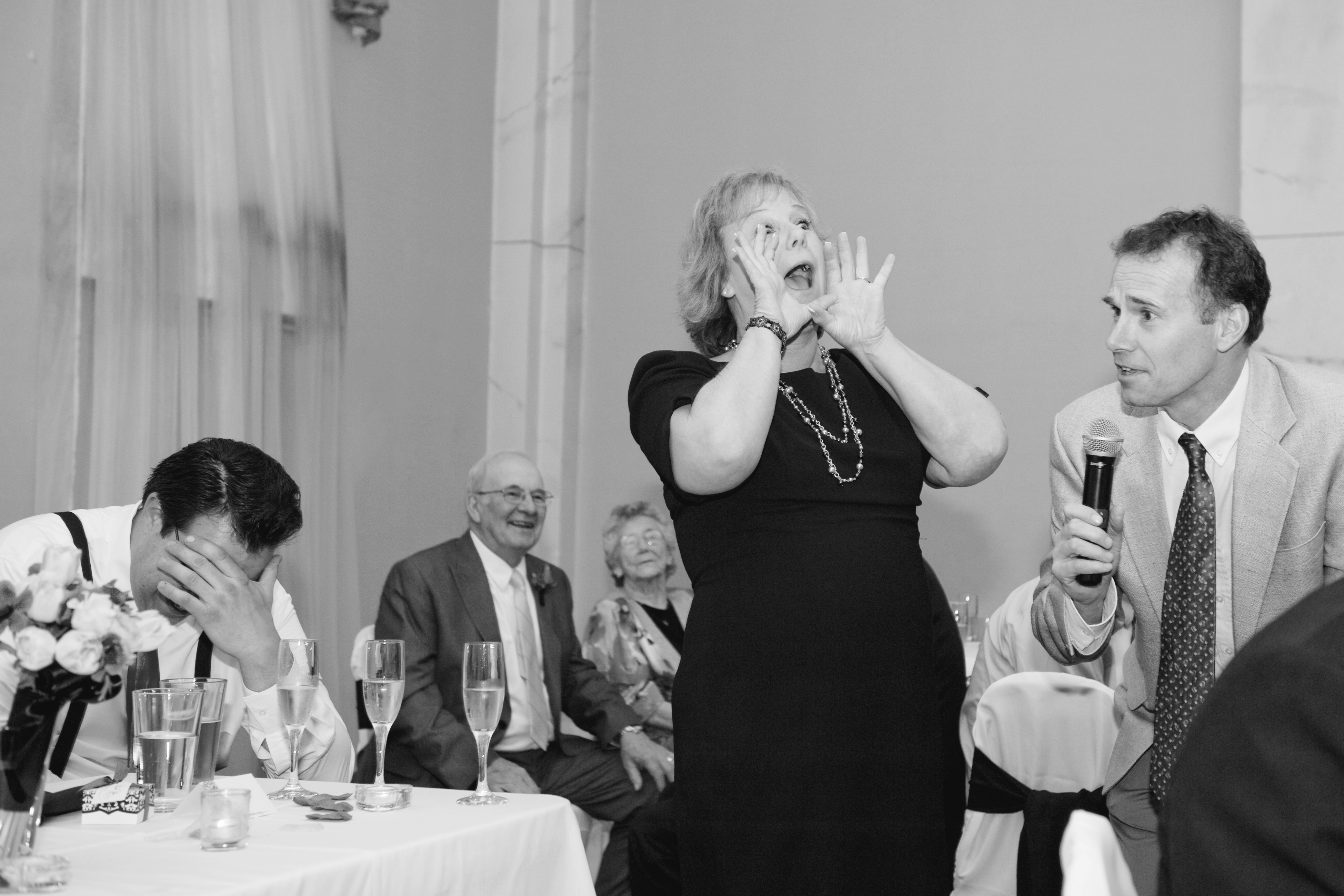
As you can infer from the photo below, choosing the wrong song can be embarrassing and beyond your control. Don’t do it . . . unless it’s part of your shame- attacking treatment plan. And you can thank Dr. Albert Ellis for building you a personalized shame-attacking treatment plan.

Peg and John Singing at Pat's Wedding

So, obviously, pick a song that fits your voice and your gender stereotypes.

The second rule is all about song lyrics and so I’ve made up another rhyme to help you auditory learners remember. That is, “To function to the best of your ability, you should embrace your multicultural humility.”

What I’m saying here is that, as you know, many pop songs have lyrics that are racist, sexist, and sexually explicit. To maintain our multicultural sensitivity (and humility), it’s important to either (a) avoid songs with insensitive or sexualized lyrics (which is why I never sing Lady Gaga’s song that includes the line about her not bluffin’ with her muffin) or (b) change the lyrics on the spot (for “Say a Little Prayer for You” I like to substitute, “Do a little non-denominational mindfulness meditation for you.” It works fine, you just have to say the words very quickly) or (c) just mumble when the offending lyrics appear.

The third rule can also be captured with a nifty, easily memorized rhyme: “An alcoholic drink, will not help you think.” It also won’t improve your judgment or make you look more impressive to your audience. I hope what I’m saying here is clear. Just like when you’re providing professional counseling, when doing Karaoke, it’s best to be squeaky clean and sober. I should also add, contrary to popular belief, drinking alcohol will NOT MAKE YOU A BETTER DANCER. Although the caveat to this is that if OTHERS are drinking alcohol during your performance, it might make them THINK you’re a better dancer.

The corollary to this rule is that evidence-based Karaoke-ers use dancing to optimize their performance. This probably goes without saying, but I’ll say it anyway, “Be solution-focused and go with your strengths!” If your voice is bad or the lyrics are bad or you’re so nervous you’ve lost your ability to read, DANCE BIG. I did this a few years ago when I planned a rap to the Simon and Garfunkle tune “Feeling Groovy” and it quickly became obvious that the audience mostly wanted to watch my radical rapping dance moves and so I just went with that. The fact that no one at that party will talk to me anymore is irrelevant. I think it’s mostly because I intimidated the heck out of them and so they’re afraid to approach me now. I should note that this is a particular cognition that my counselor and I decided I shouldn’t test . . . so I’m just going with it. Here’s a photo of that performance. Apparently all the video recordings were lost or burned.

John Rap

The fourth and final Karaoke rule is this: “A pill is not a skill . . . but Karaoke is a thrill.” What this means is that if you want to grow up to be a bad-ass Karaoke singer like me, then you have to practice, practice, and then practice some more . . . because as they say about counseling and counselors, all we ever do is practice.

There is no final performance.
There is no end to your learning.
And this is not my final goodbye to you.

I will be thinking of you all and wishing and hoping you the best success in whatever you choose to practice, knowing that I’ve had the excellent fortune and gift of time with you and that I’ve come to believe deeply in your ability, skill, compassion, and character.

One time when I was working with a dad and his son in counseling, the dad got right in his son’s face and delivered him a message that he would never forget. And so I want to end by sharing that message with you in hopes that you will hear it over-and-over in your brain:

“I will always be proud of you.”

Thanks for listening. Thanks for reading. Thanks for watching.

And thanks for being different.

P.S. I’m available for Karaoke tutoring and supervision and I can show you some hand movements, that, in particular, will blow your mind and insure an unforgettable Karaoke experience.

The Art and Science of Clinical Interviewing (in Chicago)

In about 10 days I’ll be on my way to Chicago to video-record five short lectures on Clinical Interviewing. Alexander Street Press is producing this video project and Dr. Sharon Dermer of Governor’s State University is hosting. The project is titled “Great Teachers, Great Courses.” [This is pretty cool and my thanks to JC for getting me included.]

I’ll be recording the morning of Tuesday, May 19, which happens to be just before Debbie Joffe Ellis, who just happens to be the wife of the late Albert Ellis. She asked to switch times with me and so I obliged, noting in an email to Dr. Dermer:

Sure. I can do morning. Besides, if I said no I would end up with the Ghost of Albert Ellis’s scratchy voice in the back of my head saying things like, “What the Holy Hell is wrong with you?”

I’d just as soon avoid that.

All this is my slightly braggy way of explaining why I’ll be writing about five upcoming blogs on Clinical Interviewing. Here we go.

What is a Clinical Interview?

Definitions can be slippery. This is especially true when our intention is to define something related to human interaction.

One of my favorite descriptions of clinical interviewing is scheduled for inclusion in the forthcoming “Handbook of Clinical Psychology.” Mostly I suppose I like this description because I wrote it (smiley face). Here it is:

In one form or another, the clinical interview is unarguably the headwaters from which all mental health interventions flow. This remarkable statement has two primary implications. First, although clinical psychologists often disagree about many important matters, the status of clinical interviewing as a fundamental procedure is more or less universal. Second, as a universal procedure, the clinical interview is naturally flexible. This is essential because otherwise achieving agreement regarding its significance amongst any group of psychologists would not be possible. (page numbers tbd)

When it comes to formal definitions, it’s clear that clinical interviewing has been defined in many ways by many authors. Some authors appear to prefer a narrow definition:

An interview is a controlled situation in which one person, the interviewer, asks a series of questions of another person, the respondent. (Keats, 2000, p. 1)

Others are more ambiguous:

An interview is an interaction between at least two persons. Each participant contributes to the process, and each influences the responses of the other. However, this characterization falls short of defining the process. Ordinary conversation is interactional, but surely interviewing goes beyond that. (Trull & Prinstein, 2013, p. 165)

Others emphasize the development of a positive and respectful relationship:

. . . we mean a conversation characterized by respect and mutuality, by immediacy and warm presence, and by emphasis on strengths and potential. Because clinical interviewing is essentially relational, it requires ongoing attention to how things are said and done, as well as to what is said and done. The emphasis on the relationship is at the heart of the “different kind of talking” that is the clinical interview. (Murphy & Dillon, 2011, p. 3)

From my perspective, the BIG goals of this “different kind of talking” can be broken into two main parts: (1) ASSESSMENT and (2) HELPING That said, I’m likely to further break these two main parts into four interrelated and overlapping parts that may or may not be formally including in a single clinical interview:

1. Establishing a therapeutic relationship
2. Collecting assessment information
3. Developing a case formulation or treatment plan
4. Providing a specific educational or psychotherapeutic intervention

What are the Goals of a Clinical Interview?

[In the following two paragraphs I’m including a more wordy and erudite way of saying the preceding . . . which is one of the things that we academics are wont to do. I should note these paragraphs are excerpted from my entry in the Encyclopedia of Clinical Psychology (2015). This piece, very recently published, is cleverly titled, “The Clinical Interview” and coauthored with Drs. Waganesh Abeje Zeleke, and Meredith H. E. Hood.]

Perhaps the clearest way to define a clinical interview is to describe its purpose or goals. Generally, there are four possible goals of a clinical interview. These include: (a) the goal of establishing (and maintaining) a working relationship or therapeutic alliance between clinical interviewer and patient; research has suggested the relationship between interviewer and patient is multidimensional, including agreement on mutual goals, engagement in mutual tasks, and development of a relational bond (Bordin, 1979; Norcross & Lambert, 2011); (b) the goal of obtaining assessment information or data about patients; in situations where the goal of the clinical interview is to formulate a psychiatric diagnosis, the process is typically referred to as a diagnostic interview; (c) the goal of developing a case formulation and treatment plan (although this goal includes gathering assessment information, it also moves beyond problem definition or diagnosis and involves the introduction of a treatment plan to a patient); (d) the goal of providing, as appropriate and as needed, a specific educational or therapeutic intervention, or referral for a specific intervention; this intervention is tailored to the patient’s particular problem or problem situation (as defined in items b and c).

All clinical interviews implicitly address the first two primary goals (i.e., relationship development and assessment or evaluation). Some clinical interviews also include, to some extent, case formulation or psychological intervention. A single clinical interview can simultaneously address all of the aforementioned goals. For example, in a crisis situation, a mental health professional might conduct a clinical interview designed to quickly establish rapport or an alliance, gather assessment data, formulate and discuss an initial treatment plan, and implement an intervention or make a referral.

What Happens During a Clinical Interview?

The range of interactions that can happen during a clinical interview is staggering. This could partly explain why we (foolishly) wrote a textbook on this topic that’s 598 pages long and includes an instructional DVD.

My son-in-law says one good way to get a flavor for any book is to put together the first and last words. In this case, our Clinical Interviewing text reads (not including the front or back matter), “This . . . culture.” To give you a further taste of “This . . . Clinical Interviewing . . . culture,” here’s a modified excerpt from the text:

Imagine sitting face-to-face with your first client. You carefully chose your clothing. You intentionally arranged the seating, set up the video camera, and completed the introductory paperwork. You’re doing your best to communicate warmth and helpfulness through your body posture and facial expressions. Now, imagine that your client:

  • Refuses to talk.
  • Talks so much you can’t get a word in.
  • Asks to leave early.
  • Starts crying.
  • Tells you that you’ll never understand because of your racial or ethnic differences.
  • Suddenly gets angry (or scared) and storms out.

Any and all of these responses are possible in an initial clinical interview. If one of these scenarios plays out, how will you respond? What will you say? What will you do?

From the first client forward, every client you meet will be different. Your challenge or mission (if you choose to accept it) is to make human contact with each client, to establish rapport, to build a working alliance, to gather information, to instill hope, and, if appropriate, to provide clear and helpful professional interventions. To top it off, you must gracefully end the interview on time and sometimes you’ll need to do all this with clients who don’t trust you or don’t want to work with you. (pp. 3-4)

In my opening Great Teachers, Great Courses lecture I’ll be focusing on the definition of the clinical interview and then limit myself to describing and demonstrating about 18 different interviewing “behaviors” or responses that clinicians who conduct clinical interviewing have at their disposal. These behaviors are named and organized into three categories. And so to help myself stop writing this blog and get back to work, I’ll wait and write about them later.

20141204_153904

Dandelion Day: First Paddle of 2015

This is my friend Gary’s blog. He likes to stay under the radar. But he’s such a good writer that I want to share this anyway and he never told me not to. So there. That’s what I like to say. John SF

kestrelgwh's avatarospreypaddler

I hope I’m wrong, but I have a sense that this summer may be hot and dry with all the consequences we’ve come to expect. The best paddling this season might be in May or June rather than later in the year. When the forecast for a Tuesday in late April predicted 75 degrees and waves less than a foot tall, I decided to ignore the laundry, dandelions in the front yard and my need for a haircut, as well as a few more serious responsibilities.

IMG_2482After winter, even a mild one by Montana standards, I need reassurance that life at 47 degrees latitude shows signs of rejuvenation. On a scale larger than my back yard or the slope leading down to the stream I want to see evidence of the generative and recuperative power of the earth. I want to see arrowleaf balsamroot in bud and bloom, a bee…

View original post 358 more words