My apologies for some bad links when I posted this yesterday. I tried a different linking strategy and it seemed to work on my computer, but not so much for anyone else. Sorry for your inconvenience! And embarrassed for myself.
For the past two years I’ve been using some new theories course assignments and am sharing them here.
New Assignments
The first new homework assignment is called: Multicultural Competence, Multicultural Humility, and Me. I use this as an early (about week 3) writing assignment for first-year, first-semester M.A. students. I like using it because it gives me a taste of their writing skills, while also introducing them to foundational multicultural content. I have been consistently impressed with the students’ sensitivity to culture and desires to be humble, lifelong learners when it comes to cultural diversity.
The second new homework assignment is for students to take the long form of my Theoretical Orientation test during week 1 and then to retake it during week 15. I have them compare their scores and declare up to three “favorite” theoretical perspectives. Like the multicultural paper, this assignment has produced very interesting…
For the past two years I’ve been using some new theories course assignments and am sharing them here.
New Assignments
The first new homework assignment is called: Multicultural Competence, Multicultural Humility, and Me. I use this as an early (about week 3) writing assignment for first-year, first-semester M.A. students. I like using it because it gives me a taste of their writing skills, while also introducing them to foundational multicultural content. I have been consistently impressed with the students’ sensitivity to culture and desires to be humble, lifelong learners when it comes to cultural diversity.
The second new homework assignment is for students to take the long form of my Theoretical Orientation test during week 1 and then to retake it during week 15. I have them compare their scores and declare up to three “favorite” theoretical perspectives. Like the multicultural paper, this assignment has produced very interesting (and relatively fun to read) reflections from our students.
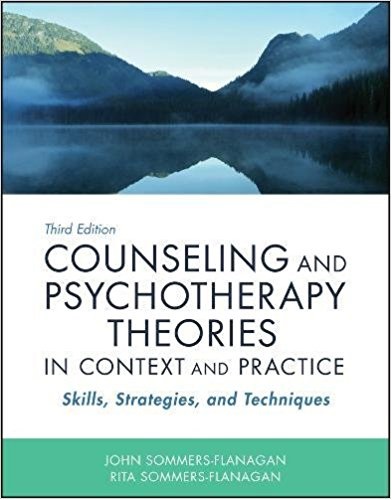
If you’re new to teaching or haven’t caught my previous postings for Theories resources, below are some links to materials I’ve found useful. As I’ve said before, although it’s great if you use our Theories text (woohoo), you can also use all these materials in combination with whatever text you’re using. I’m aware of many other strong textbooks—although my bet is that ours is the leader in theories jokes and humor and is probably the most well-liked by students (but I might be biased!).
Although we have an excellent theories-specific video series, you need to adopt our text to access them.
Lab Activities
If you want these, email me at john.sf@mso.umt.edu and I’ll email them to you at my earliest convenience.
Good luck in your teaching this semester. I know the challenges are big, but the process of witnessing and participating in student learning is a big positive reinforcement.
“Never work just for money or for power. They won’t save your soul or help you sleep at night.” – Marian Wright Edelman
Recently, I was struck by the concept of influencer. As far as I can tell, influencers are all about working for money and power; maybe most of all, they’re working for attention.
Today on NPR, I listened to a woman talk about vision boards. I won’t mention her name. She said lots of influencers are using vision boards. Vision boards are all about envisioning what you want to get it to manifest. Other than the fact that vision boards are extremely self-centered, I’ll keep my comments about vision boards out of this blog. I wasn’t surprised that influencers are using all the woo-woo powers they can to get what they want. Okay. I know. I’ll stop talking about vision boards and influencers.
Or maybe not. At least I should acknowledge that all this is terribly Adlerian. When people don’t feel useful, or as if they belong, they can get overly preoccupied with attention, power/money, and revenge. I’m sure Adler would have had something to say about vision boards, had they been around in the early-to-mid 1900s.
Of course, I’m jealous of influencers. Beginning in high school, I had a wish to be featured, as a professional football player, on a United Way advertising. At the time, the NFL and the United Way had a collaborative thing going and I loved the idea of promoting the United Way from a place of power and influence. Of course, my football-playing days ended in 1979, but my fantasies of being able to reach people with the message that mostly we should focus on helping each other still deeply resonates in my soul. It’s too bad so many influencers are all about superficial qualities like fashion and appearance.
I do have tiny bits of influence here and there and I hope I try to wield that influence in ways consistent with my initial wishes to be in one of those old United Way adverts.
For this week and next week, you’ll likely see my pathetic efforts to be an influencer. I want people to enroll in our Art & Science of Happiness course at the University of Montana. I believe engaging in the class can make people not only feel happier, but also begin experiencing less depression and more engagement in meaningful lives. Here are a few comments from previous course participants.
From a young man who described himself as depressed: “After a couple of weeks of participating and attending class I noticed that the slides and the activities really helped me out. I was able to finally have someone explain what feelings I was going through, why I felt this way, and what we could possibly do to improve. At first, I didn’t think any of this was going to work, but after trying meditating and positive thinking I noticed my overall mood was changing.”
From a young woman who really loved savoring: “One of the most influential activities for me was the activity on savoring. I found that mutual reminiscing had a really positive effect on me. After mutual reminiscing with my friends, I gained a lot of gratitude and appreciation for my friends and the experiences I have had in my life. This activity had a really positive influence on me and is something that I plan to try and do often after leaving this class.”
From a young woman with plans to be a teacher: “This semester of the happiness class has been really wonderful for me. I have two big take-aways. The first applies to my personal life. In class, we learned about how to build new habits, something that has helped me to progress this semester. The second take-away relates to my career. I am pursuing life as a teacher, and being in this class helped me expand my ideas about what we can teach.”
From a young man missing his family during a lockdown: “COVID-19 pandemic changed many things in my life. It changed how I was learning and prevented me from joining my family during Ramadan. But, looking at my situation: I am isolating partly to protect my health and mainly for other peoples’ health. And that is one of the pillars for being happy when you believe that others matter.”
From a 30-something woman who likened the course as a trip down the Yellow Brick Road: “I have grown as a person that was made all the more valuable because I was able to do it with the help of so many. I deeply appreciate the people I came to know through this process. This class will only help people as it gives us the knowledge and skills to appreciate ourselves and the others in our life as we gain a better understanding of what true happiness looks like.”
This last testimonial reminds me of something I said last year. That is, you should consider signing up for happiness class with a friend. Or maybe not. Because if you don’t sign up with a friend, you’re likely to leave with one.
Here’s are the deets on the class and how to enroll:
When
The course is offered “live” on Tuesdays/Thursdays from 1pm to 2:20pm, beginning on January 18, 2022, ending the week of May 9, 2022. However, because the course is fully online via Zoom, you can also take the course asynchronously.
If 2021 was the year of the Big Lie, given humanity’s tendency to swing like a pendulum, 2022 should be the Year of the Big Truth. That sounds nice. Let’s embrace truth and facts. Let’s not embrace Kellyanne Conway’s philosophy of alternative facts. But things don’t just happen. We have to make it happen. We need to, as Jean Luc Picard (aka Patrick Stewart) used to say, “Make it so.”
I’ll start.
Below I’ve made a list about what’s mostly true and mostly indisputable about the novel coronavirus (AKA COVID-19, and its variants).
There really is a virus that was identified and labelled as COVID-19. As is often the case with complicated things, the precise origins of COVID-19 are not known, and are likely unknowable. If you go online and read of someone claiming that COVID-19 was developed in a Chinese laboratory, unless you’re reading a legitimate and documented confession from someone directly involved in creating COVID-19, you’re reading something that somebody just made up. Not knowing all the facts is difficult to live with, and in the space of uncertainty, many people will make up stories. The stories might be an effort to explain something (e.g., because I can see the horizon, the earth is flat) or it may be to intentionally deceive. We have to live with the truth that there are things we do not know, including the exact origin story of COVID-19. To avoid conspiracy theories and behave like mature adults who want to contribute to the well-being of society, we should not, in the elegant words of Dr. Cordelia Fine, make shit up.
COVID-19 and its variants are highly transmissible. Our neighbors just informed us they “have the flu.” That may or may not be the perfect truth. They may have COVID. Either way—flu or COVID—I’m keeping my distance. The COVID-19 virus is virulent, and the flu sucks. You can argue the specifics, but COVID-19 is a remarkably transmissible virus.
Upon contracting COVID-19, you may have very minimal and possibly zero COVID symptoms. Some people—even people over 80 and with significant health issues—have had no noticeable COVID symptoms at all. Maybe their test was a false positive? Or, maybe their individualized response was negligible? My father, age 95, bedridden, with a variety of heart and lung ailments, is healthier now—after having tested positive for COVID-19.
In contrast to my father and other luckier victims of the viral vector, COVID-19 makes other people moderately ill, gets others very ill, and kills the rest. COVID-19 killed my mother and several other people I know. Recently, Rita talked with someone who had seven family members die from COVID. The hard truth is that individuals have highly variable responses to a COVID-19 infection; it’s a hard truth because Americans and other humans don’t do well with variability. We like things to be simple and predictable. On average, the vast majority of people infected by COVID are not terribly ill. On the other hand, with about 824,000 Americans dead over a 24-month period, COVID-19 may be unpredictable, but it’s also consistently lethal.
Despite famous people who famously minimized COVID-19, saying it would magically go away, it hasn’t. COVID-19 has proven itself to be very persistent. Sure, the media loves a hot crisis and COVID-19 feeds the media’s need for constant crisis, but COVID’s persistence is not simply media hype.
Although it’s good to be skeptical, the preponderance of the evidence points to the likelihood that COVID-19 death estimates are just as likely to be underestimates as overestimates. Some COVID-minimizers question the death rate estimates from COVID-19, thinking they’re inflated. But there’s also evidence they’re deflated. Other minimizers argue that many COVID-related deaths have occurred in nursing home patients who, like my mother, would have died anyway, in the next year or two. Given all the other evidence pointing to COVID-19 as a legitimate medical crisis, questioning death rate estimates and quibbling over who’s dying is mostly a method to avoid thinking about 824,000 dead Americans and 5.44 million deaths worldwide.
Whether you “believe” in the transmissibility, lethality, or death rates is up to you. We should all try to remember that personal beliefs are not facts; in “fact,” thinking our personal beliefs are facts is the root of many problems. To be intellectually honest means, at least in part, that we don’t go out looking only for evidence to support our pre-existing beliefs. If we do, that’s called confirmation bias. . . which is just fancy scientific terminology for getting good at lying to ourselves.
Speaking of lying, to describe COVID-19 as a “mild flu” is simply untrue. Not only is the mild flu rhetoric a lie, it’s a big lie that can and does cost people their lives. If you’ve spent any time working, volunteering, or hanging out in medical settings, you can see with your own eyes that COVID-19 is having an immense, dreadful, and potentially catastrophic effect on the healthcare systems and healthcare workers around the world.
Medical journals and medical authorities have the best information available about COVID-19. Although their information isn’t perfect, and it’s consistently changing, legitimate medical professionals still give us the best information we have. People who write medical journal articles and people with medical degrees are way smarter than most of the rest of us. If you’re REALLY SERIOUS about “researching COVID-19,” you should read medical journal articles. It’s just as easy to Google the New England Journal of Medicine, the Journal of the American Medical Association, the British Medical Journal, and other top-tier medical journals, as it is to Google fringe conspiracy theorists who make up shit from their own demented imaginations. Seriously. The Big Truth Here: You should trust physicians who have taken the Hippocratic oath over COVID-19 deniers and conspiracy theorists who’s only oath is to do whatever they can to get attention and feel more important than they really are.
COVID-19 minimizers or deniers do not have your best interests at heart. Believe them at your own risk. Or, better yet, choose to not believe them. If you’re the sort of skeptic who looks for cracks in the arguments of legitimate medical research, be sure to use equal rigor to look for cracks in the arguments of people like Candace Owens, Tucker Carlson, Marco Rubio, Ted Cruz, and Laura Schlessinger. Take a minute to contemplate who you think is more interested in your (and all Americans’) well-being. Take another minute to contemplate who you think has underlying financial motivations to deceive you. In the end, the CDC, Dr. Fauci, and the World Health Organization are better sources of useful, health-promoting information than COVID-minimizers or deniers.
I’ve written all this and just now realizing I haven’t even gotten to the issues of wearing masks and vaccinations. Obviously, there’s more to come.
Please join me in working to make 2022, The Year of the Big Truth.
Last year, for the first time, we offered the Art & Science of Happiness simultaneously as a 3 credit COUN 195 course through the University of Montana and as a non-credit course open to community members through UMOnline. The course was fully online. Many students took the course “live” and synchronously; others enrolled and completed the course at their convenience.
We had 50 students sign up for the course: 30 UM students took the course for credit; 20 were “community” members (hailing from Missoula, Browning, Billings, Pennsylvania, and Canada). Many of the UM students were 19 to 22 years-old. Many of the community members were 60 to 87 years-old. The inter-generational synergy was fabulous.
What You Get in the Art & Science of Happiness
25+ instructional hours with John Sommers-Flanagan, and occasionally Rita Sommers-Flanagan. You can experience these lectures synchronously through Zoom, or asynchronously at times that work into your personal schedule.
10+ hours of small group counseling designed to facilitate reflection, discussion, and experiencing of evidence-based happiness activities (these “lab” groups can be face-to-face or via Zoom)
8 hours of individual supportive wellness counseling with a Master’s student from the Counseling Department at the University of Montana (these services are face-to-face or via Zoom and on a first-come, first served basis, because we have a limited number of available counselors-in-training)
The cost for community UMOnline participants is $250. If that sounds expensive, think of it this way. You get 40+ total hours of a combination of large group instruction, small group counseling, and individual counseling, which translates to $6.25 an hour.
Potential Benefits
Research from the two previous semesters indicate that some (not all) participants experience:
Reduced depression symptoms (in some cases, depressive symptoms were substantially reduced)
Increased hope and optimism
An increased rate of positive emotions
A reduction in headaches
Improved sleep
Greater feelings of social connection
Comments from Previous Community Participants
“Words are inadequate to express my gratitude for the Happiness Class and your amazing expertise. Literally transforming my life after a very difficult and sad nine months; plus, it’s a heckuva lot of fun. Again, thank you.”
“I found the course interesting and rewarding far beyond my expectations.”
“I feel a major shift in my thinking. I am now more focused on gratitude and living in the moment and have developed an unexpected confidence about facing the inevitable challenges that lie ahead, a confidence that even others have noticed.”
[In response to the group counseling component] “I appreciate the interactions that I have with everyone in my group. We are all very different, yet willing to be open and share our thoughts. I wasn’t sure what this would be like and I am already liking it a lot.”
[In response to a homework assignment] “I am applying a very simple formula to myself…When I become aware of how grumpy and scared and negative I feel about an issue in our family, I consciously think of two things for which I feel grateful. It fills the basket of my emotions with more positivity and opens up a new way of approaching my worries.”
When
The course is offered “live” on Tuesdays/Thursdays from 1pm to 2:20pm, beginning on January 18, 2022, ending the week of May 9, 2022. However, because the course is fully online via Zoom, you can also take the course asynchronously.
I believe this course content is very helpful, and so I’d like to make this course available as widely as possible. Please help me by sharing this information with others. Also, because I’m paid by the University of Montana to teach this course, all proceeds are returned to the University of Montana in general, and the Department of Counseling, in particular.
Montana Happiness Project – 2021 – Year End Report
Despite global exhaustion from wave after wave of the coronavirus pandemic, and despite immense national and local loss and suffering, amazing examples of resilience continue. At the Montana Happiness Project, we believe in facing, validating, and working through individual and collective pain and suffering. We believe everyone needs time and space to be with, and gain insight from, their emotions. This is one side of the truth of living.
On the other side is the need to stay strong, positive, and resilient. Although it’s human nature and therapeutic for individuals and communities to be with their emotions, we also benefit from focusing on strengths, positivity, gratitude, and kindness. In an ideal world, we do both. We take time to be with our painful emotions and learn from them. We also intentionally turn toward wellness and happiness. This is part of the balance that facilitates well-lived lives.
The year 2021 remained challenging for many Montanans. This brief Year-End Report describes activities associated with the smaller and larger ways in which the Montana Happiness Project made efforts to nurture wellness within our Montana communities. To summarize our activities, we’ve organized this report into several sections: (a) Happiness Funding, (b) Bimonthly Activities, (c) 2022 Goals and Organizing Principles, (d) Outcomes, and (d) Gratitude.
*******
Just in case you don’t want to read the whole 7 page report, I’ve pasted the Executive Summary below.
In our first complete year of operations, the Montana Happiness Project, L.L.C. provided substantial contributions to wellness awareness and happiness promotion throughout the state of Montana and beyond. Highlights of 2021 include: (a) reaching well over 1,000 Montanans with high-quality educational presentations on suicide prevention and happiness promotion; (b) offering seminars, classes, and trainings viewed by over 50,000 professionals around the globe; (c) delivery of a 2½ day retreat for 15 professionals committed to implementing a strengths-based approach to suicide assessment, treatment, and prevention in Montana; (d) data collection and continued scientific research on the effectiveness of strengths-based suicide assessment and treatment workshops for professionals, happiness classes, and happiness workshops; (e) initiation of collaborative programming with the University of Montana, Families First Learning Labs, and other community organizations.
If you’d like to read the whole report, send me an email (john.sf@mso.umt.edu) or message me here and I’ll get one out to you.
For the past ten days I’ve been contemplating a witty and profound holiday greeting and blog post that would lift moods everywhere and inspire greater wellness. Sadly (or happily), the profound words did not emerge from my brain, perhaps because my brain–like many objects at this time of the season–preferred to remain at rest. The universe seemed to be saying something like, “Let there be inertia.” Who am I to dispute messages from the universe?
And then, in the midst of my stare-down with inertia, I read that today is Day 2 of Kwanzaa, the principle for which is “self-determination.” I don’t know much about Kwanzaa, and so I did a bit of reading and discovered that Day 2 involves the lighting of a candle that represents the principle of Kujichagulia (aka self-determination). Self-determination can be taken a few different ways, including the process of defining, creating, naming, and speaking for ourselves.
I have no intention of engaging in cultural appropriation here, but instead, my desire (in a Bertrand Russell sort of way) is to continue to embrace new learning—which seems to me as a nice antidote to staying at rest or remaining inert. Learning a bit more about African-American culture . . . as well as other cultures . . . strikes me as a good thing, and is consistent with what I hope for in the coming year.
In my momentarily state of naïve idealization (unfortunately, this too shall likely pass), I wish you all the best for Christmas, Kwanzaa, Hanukkah, and other celebratory holidays. I also wish for more learning, more openness to the ideas and cultures of others, and more of that social fabric that Alfred Adler called Gemeinschaftsgefühl. And, to paraphrase the great positive psychologist, Chris Peterson, remember, “Other people matter,” which, of course, means that because you’re an “other” person to everyone else, you matter too.
Often, I have the honor of getting a personal preview of Rita S-F’s Godblogs. I sit in a cushy chair, shut my eyes, and let her words create images in my brain. It’s not unusual for her readings to stimulate unusual thoughts. But, last week, while listening, I was taken with a particular epiphany.
She was reading about how easy (and destructive) it is to be judgmental; I can’t recall the details. In response, a voice in my head spoke gently,
“I wonder if it might help if you could try, just a little, to be even more judgmental. . .” followed by an additional internal commentary “. . . said no one ever.”
The thought—of trying to be even more judgmental—made my lips curl upward into a smile. I felt an urge to laugh. Then, naturally, I thought of Viktor Frankl.
As I wrote in my last blog (https://johnsommersflanagan.com/2021/12/06/paradoxical-intention-dont-try-this-at-home-or-maybe-dont-try-it-anywhere/), Frankl was the first person I know of who explicitly discussed paradoxical intention as working like a joke to the psyche. I’ve written about that, but I’d never felt it in my gut. This time I did actually feel it. Then, and in response to the thought of intending to be “even more judgmental,” along with the urge to laugh, I also felt a small internal push back toward acceptance.
Paradoxical intention has two parts. First, there’s the intention. I’ve tried the intention part of paradoxical intention with myself (and used it with clients) in specific situations when physical behaviors or responses feel outside of voluntary control. One example is the twitching eye syndrome. If you have an eye that’s prone to twitching, you can try to make it twitch more or try to make it twitch when it hasn’t been twitching. That’s the intention part. The other part is for the intention to be aimed toward the opposite of your goal. In the case of listening to Rita’s blog, the thought of intending to be more judgmental was received and then produced psychological push-back. What was different than any other response I’ve ever felt about paradoxical intention was my urge to smile and laugh. I’d never felt like laughing when I tried to make a bothersome eye twitch . . . twitch more.
Later—while driving I-90 west—a place where I’m prone to feeling intermittent anger toward drivers I label in my mind as “stupid,” I did another experiment.
“I wonder,” I thought to myself, “if maybe I could try to start feeling just a little angrier toward those other drivers. Being alone in the car, I tried it out with a brief litany of profanity. In response, I felt increased anger. That wasn’t good. But within seconds, my brain started the natural push-back. I took note of my greater anger and quickly judged it as unpleasant. Then, I noticed an internal psychological push-back toward the center. I suddenly wanted the anger—which usually feels so justified in the moment—to go away. And so, I let it go.
Paradoxical intention isn’t a magic trick. Nothing in the world of human psychology is magical. Paradoxical intention operates on natural psychological dynamics. Laura and Fritz Perls would have called it an internal polarity. Behaviorists like to call it a form of overcorrection. The popular press tends to reduce it to a term I can’t help but find offensive: reverse psychology.
Although you might try paradoxical intention on your children or your friends, because of one central underlying principle, that’s not a great idea. The underlying principle is best expressed by an old (and bad) joke.
“How many mental health professionals does it take to change a light bulb?”
“Only one. But the light bulb has to want to change.”
You could try a little paradoxical intention . . . on yourself . . . but only if you want to experience a new transformative epiphany.
As W. R. Miller noted in his treatise on motivational interviewing (MI), ambivalence is nearly always the order of the day. Most people, most of the time, would like to be better and healthier versions of themselves. And, most people, most of the time, resist becoming better and healthier versions of themselves. Who knew?
Alfred Adler may have been the first modern psychotherapist to write from a non-psychoanalytic perspective about how to work with individuals not interested in changing. What follows is a complex quote from Adler. He’s writing about how to work with a patient who is depressed, but not motivated or willing to change. You may need to read this excerpt several times to track it and appreciate Adler’s method. You may see all those words below and not want to put in the effort. That’s okay. You can stop reading now if you don’t want to gather in the nuance sprinkled into Adler’s indirect suggestion.
After establishing a sympathetic relation, I give suggestions for a change of conduct in two stages. In the first stage my suggestion is “Only do what is agreeable to you.” The patient usually answers, “Nothing is agreeable.” “Then at least,” I respond, “do not exert yourself to do what is disagreeable.” The patient, who has usually been exhorted to do various uncongenial things to remedy this condition, finds a rather flattering novelty in my advice, and may improve in behavior. Later I insinuate the second rule of conduct, saying that “It is much more difficult and I do not know if you can follow it.” After saying this I am silent, and look doubtfully at the patient. In this way I excite his [her/their] curiosity and ensure his attention, and then proceed, “If you could follow this second rule you would be cured in fourteen days. It is—to consider from time to time how you can give another person pleasure. It would very soon enable you to sleep and would chase away all your sad thoughts. You would feel yourself to be useful and worthwhile.”
I receive various replies to my suggestion, but every patient thinks it is too difficult to act upon. If the answer is, “How can I give pleasure to others when I have none myself?” I relieve the prospect by saying, “Then you will need four weeks.” The more transparent response, “Who gives me pleasure?” I counter with what is probably the strongest move in the game, by saying, “Perhaps you had better train yourself a little thus: do not actually do anything to please anyone else, but just think about how you could do it!” (Adler, 1964a, pp. 25–26)
Similar to Adler, Viktor Frankl also wrote about using “anti-suggestion” or paradox. Frankl was keen on this method as a means for treating anxiety, compulsions, and physical symptoms. An excerpt from our theories textbook describing Frankl’s paradoxical intention follows.
***********************************
Paradoxical Intention
. . . In a case example, Frankl discussed using paradox with a bookkeeper who was suffering from chronic writer’s cramp. The man had seen many physicians without improvement; he was in danger of losing his job. Frankl’s approach was to instruct the man to:
Do just the opposite from what he usually had done; namely, instead of trying to write as neatly and legibly as possible, to write with the worst possible scrawl. He was advised to say to himself, “now I will show people what a good scribbler I am!” And at that moment in which he deliberately tried to scribble, he was unable to do so. “I tried to scrawl but simply could not do it,” he said the next day. Within forty-eight hours the patient was in this way freed from his writer’s cramp, and remained free for the observation period after he had been treated. He is a happy man again and fully able to work. (Frankl, 1967, p. 4)
Frankl attributed the success of paradox, in part, to humor. He claimed that paradox allows individuals to place distance between themselves and their situation. New (humorous) perspectives allow clients to let go of symptoms. Frankl considered paradoxically facilitated attitude changes to represent deep and not superficial change.
Given that Frankl emphasized humor as the therapeutic mechanism underlying paradoxical intention, it fits that he would use a joke to explain how paradoxical intention works,
The basic mechanism underlying the technique…perhaps can best be illustrated by a joke which was told to me some years ago: A boy who came to school late excused himself to the teacher on the grounds that the icy streets were so slippery that whenever he moved one step forward he slipped two steps back again. Thereupon the teacher retorted, “Now I have caught you in a lie—if this were true, how did you ever get to school?” Whereupon the boy calmly replied, “I finally turned around and went home!” (Frankl, 1967, pp. 4–5)
Frankl believed paradoxical intention was especially effective for anxiety, compulsions, and physical symptoms. He reported on numerous cases, similar to the man with writer’s cramp, in which a nearly instantaneous cure resulted from the intervention. In addition to ascribing the cure to humor and distancing from the symptom, Frankl emphasized that paradox teaches clients to intentionally exaggerate, rather than avoid, their existential realities.
********************************
I’m writing about paradoxical intention today because of an inspiration from Rita’s blog yesterday. There’s so much ostensible hate, judgment, and certainty in contemporary discourse. That got me thinking about whether a paradoxical approach might be timely and effective. Yesterday, I tried it on myself. Stay tuned, in my next post, I’ll write about how a little paradox worked out for me, and how it might help shift some of the lamentable, polarized arguments happening all around us.
After facing an overwhelming number of choices on Black Friday and Cyber Monday, now we’re faced with another litany of excellent choices for Giving Tuesday. There are so many wonderful charities to support. You can’t go wrong with supporting food banks, shelters, and other organizations that push back against poverty. You also can’t go wrong supporting children, minorities, education, and the environment . . . these are all huge needs.
Along with the preceding charity types, this year Rita and I are wholeheartedly supporting college student mental health. We’ve seen the struggles firsthand and we believe college students can benefit from greater access to mental health services. Specifically, we’re supporting a University of Montana Foundation project called “The University of Montana Mental Health and Happiness Fund.” We see the University of Montana Mental Health and Happiness Fund as a win-win-win. Here’s why.
The first win is that the funds will go to provide more hours of mental health counseling for college students. Unfortunately, more than ever before, college students are stressed and experiencing mental health struggles. These struggles can include suicidal thoughts and behaviors. As far as age groups vulnerable to death by suicide, the college student age group is among the highest (along with older males). Supporting college student mental health can literally save lives and help college students graduate and become significant contributors to their communities. Currently, Counseling Services at the University of Montana needs more counselors to meet increased needs.
The second win is about “workforce development.” In Montana, and around the nation, we need a continuous flow of competent and capable mental health professionals. That’s why the first priority of the University of Montana Mental Health and Happiness Fund is to support a ½ time Counseling Intern for UM’s Counseling Services department. Funding an intern means that the intern gains valuable experience and supervision and can then go out and contribute to mental health in the community. If we receive more funds than expected, we will either fund a second ½ time counseling intern or we will fund happiness promotion projects at UM and within the Western Montana area.
The third win is basic economics. College students contribute to local economies. When they graduate, college students also create capital. College students become entrepreneurs, scientists, grant writers, community leaders, parents, and grandparents. In all these roles, college graduates will do better and be better if they have better mental health.
Our 2021 fundraising goal is $45,000. We’ve already raised over $22,000. Please help us reach our goal so we can contribute to positive mental health and happiness at the University of Montana.
If you’re interested in joining Rita and me in supporting the University of Montana Mental Health and Happiness fund here are the instructions.









 John Sommers-Flanagan