

Tag Archives: Well-Being

Interested in Expansion and Collaboration of Happiness for Educators?

Hello from Montana where we continue to offer and collect data on our evidence-based “Happiness for Educators” course.

Although we’re in the process of updating the following abstract (see below) with fancier stats, for now, it’s a solid summary of our outcomes to date. You’ll notice our depression outcomes (g = 0.59) are not far from worldwide estimates of counseling and psychotherapy outcomes for depression (see Harrer et al., 2025; estimated effect size for depression treatment is g = 0.73)

I’m writing today with expansion and collaboration on my mind.

If any of you academics, educators, or practitioners out there are interested in offering the Happiness for Educators course in your state, or if you happen to be interested in research collaboration, please email me: john.sf@mso.umt.edu. We’ve got a good thing going (who’s against having happier and healthier educators?) and would love to begin scaling up (within our capacity).

Abstract

Purpose: Using an approach grounded in happiness research, this study contributes to the literature on strategies for supporting educator well-being. Educators deserve good health; when educators have better health, students benefit. We developed and evaluated the effectiveness of a three-credit, graduate-level, online and asynchronous evidence-based “Happiness for Educators” course on educator well-being, mental health, and physical health.

Research Methods/Approach: Using a pre-experimental design with five repeated cohorts, we evaluated pre-post course changes on six different well-being, mental health, and physical health questionnaires with 17 end-point outcomes. Across five cohorts, 266 of 293 (90.8%) educators completed the course. We evaluated outcomes using paired t-tests.

Findings: After using a Bonferroni adjustment for multiple comparisons, educators completing the course reported statistically significant improvements (p < .002) on all 17 outcomes. These outcomes included measures of positive and negative affect, hope, depression, mindfulness, and physical health. Large to medium effect sizes (using Hedge’s g) were obtained on the following outcomes:

  1. Positive affect, (g = .802)
  2. Total health, (g = .719)
  3. Negative affect, (g = .705)
  4. Depression (g = 590)
  5. Total hope (g = .568)
  6. Sleep (g = .556)
  7. Mindfulness, (g = .542).

Overall, course participation was linked to a 60.8% reduction in depression rates.

Implications: Implications that can be drawn from a pre-experimental exploratory study are limited. However, these outcomes suggest that an asynchronous, online graduate-level course on positive psychology (aka happiness) has potential for improving educators’ well-being, mental health, and physical health. Future research on this approach is recommended. 

Let me know your thoughts!

John SF
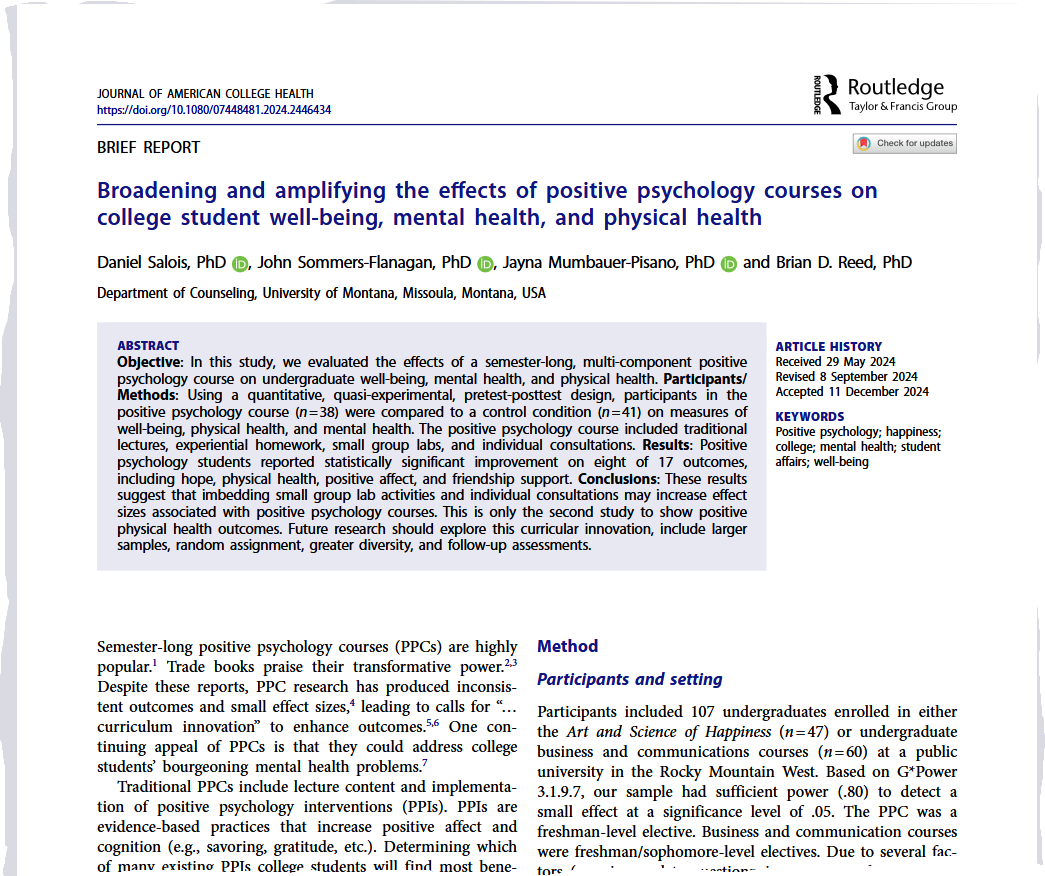
Publication Alert — Broadening and Amplifying the Effects of Positive Psychology Courses on College Student Well-Being, Mental Health, and Physical Health

We have more good news for 2025. At long last, we’ve published a research article based on Dr. Dan Salois’s doctoral dissertation. Congratulations Dan!

This article is part of growing empirical support for our particular approaches to teaching positive psychology, happiness, and how people can live their best lives. As always, I want to emphasize that our approach is NOT about toxic positivity, as we encourage people to deal with the deep conflicts, trauma, and societal issues that cause distress — while also teaching strategies for generating positive affect, joyspotting, and other practices derived from positive psychology.

One of the big takeaways from Dr. Dan’s dissertation is that our happiness class format may produce physical health benefits. Also, it’s important to note that this publication is from early on in our research, and that our later research (currently unpublished) continues to show physical health benefits. Exciting stuff!

Here’s a link to the article. My understanding from the publisher is that only the first 50 clicks on this link can read/view the whole article.
https://www.tandfonline.com/eprint/VXXD3ISCT7EUJ8WAM7UY/full?target=10.1080/07448481.2024.2446434

On the Road to Billings . . . and Well-Being . . . and Happiness

Baby Laugh

Tonight I have the honor of offering a public lecture in Billings. Situated as a part of a series of community suicide-related talks, my title is “Psychological Well-Being and the Pursuit of Happiness.” I suspect somewhere between 3 and 30 people will be in attendance. Although I’m hoping for 30, I’m realistically assuming that Rita and the program’s host will show. Counting me, that makes three!

To help get attendance over 3, someone suggested I edit this post to include the time and location. I’m on at 7pm till 8:30pm on the second floor of the MSU-B library, room 231. Hope to see you there.

Below, I’m pasting the handout for tonight. Being in the green lane, I’m trying to save paper and make these products available online. Here you go!

Psychological Well-Being and the Pursuit of Happiness

John Sommers-Flanagan, Ph.D.

Following is a summary of key points for John Sommers-Flanagan’s presentation for the Big Sky Youth Empowerment Program and Montana Social Scientists, LLC, Billings, MT – November 7, 2019

Introduction: Happiness can run very fast. So, let’s chase well-being instead

  1. The Many Roads to Well-Being. You can find well-being on emotional, mental, social, physical, spiritual/cultural, behavioral, and environmental roadways.
  2. It’s Natural, but not Helpful, to do the Opposite of What Creates Well-Being. If we want to catch well-being, we need to actively plan and pursue it.
  3. The Pennebaker Studies. Writing or talking about deeper emotions and thoughts will make you healthier (better immune functioning) and happier. Choking off our emotions is inadvisable.
  4. The Cherries Story. It’s not what happens to us . . . but what we think about what happens to us . . . that increases or decreases our misery. Focusing on your good qualities can be difficult, but doing so helps build a strong foundation.
  5. Savoring. Use the power of your mind to extend and expand positive experiences.
  6. Why Children (and Adults) Misbehave. When people feel a deep sense of belonging and socially useful, the need to misbehave and feelings of suicide diminish.
  7. Exercise is the Solution (No matter the question). Exercise reduces depression in youth and offsets the genetic predisposition toward depression in adults. You can stretch or lift or do cardio, but get moving!
  8. Holding Hands and Hugging is a Chemical Gift (or not). Consent, timing, and desirable companionship are foundational to whether touch contributes to health.
  9. If You Can’t Catch Happiness or Well-Being, Start Chasing Meaning. Regular involvement in spiritual, cultural, religious, or social justice groups will feel so good that you might experience happiness and well-being along the way.
  10. Remember gratitude. All too often we forget to notice and express gratitude. Put it on your planner; both you and the person who receives your gratitude will thank you for it.

 ****************************************************

John Sommers-Flanagan is a Professor of Counseling at the University of Montana. For more information, go to his blog at johnsommersflanagan.com. John is solely responsible for the content of this handout. Good luck in your pursuit of wellness.