The Montana Happiness Project (MHP) is rolling along.
After having our first “train-the-trainer” retreat at Boulder Hot Springs this summer, several of our retreat “graduates” are out doing amazing things. . . like offering a class through Blackfeet Community College, teaching happiness activities to youth in Frenchtown, filming a happiness-based television show through Missoula Community Access Television, and more. Although our focus is primarily Montana, we believe in building eudaimonic happiness skills and attitudes everywhere.
If you don’t know what eudaimonic happiness is or you want to learn more about the MHP, we have a brand-new website. The website includes a few videos, information about our mission, vision, and values, a calendar of upcoming events, and other resources.
If you have the time and inclination, we’d love to have you check it out the website and offer feedback. The website is in early phases—and so your feedback can be especially formative.
I was just now finishing up the Moodle (not Poodle) shell for my upcoming Happiness class. While working, I noticed one more person added into the course. . . so there’s still time . . . and I know some of you have been thinking about it.
Whether you take my class or not, you should consider some form of a happiness intervention with yourself. I’m not saying that because I promote toxic positivity. Instead, although I think we should all explore our pain and deepen our understanding of ourselves, we also need tools that will help us feel better on a daily basis and more tools to help us make sure we’re pointed in a direction likely to create meaningful lives.
This leads me to some highlights from happiness class research.
In a small study of 23 undergraduates in a traditional, face-to-face psychology course format, “students reported gains in hope, self-actualization, well-being, agency, and pathway hopefulness, purpose, and mission in life” (Maybury, 2013, p. 62). Note: there was no control group in this study.
In a small study of 18 undergraduates (and 20 control participants who took a social psychology course) in traditional, face-to-face psychology course formats, “the positive psychology students reported higher overall happiness, life satisfaction, routes to happiness, and lower depressive symptoms and stress compared to students in the control course” (Goodmon et al., 2016, p. 232)
In a series of three studies conducted during a COVID-19 lockdown in the U.K., the researchers reported (a) undergraduates in a happiness course had higher mental well-being than a waiting list control; (b) during lockdown, the happiness course did not have significantly positive effects, but participants seemed somewhat buffered from negative effects because they had higher subjective well-being than a control group; (c) a short (4 week), online version of the course used with “university staff and students produced significant benefits across a range of mental and personal well-being measures” (Hood et al., 2021, p. 11). Note: there was no control group in the third study.
In a series of three large studies (n = 500+ for each) of massive open online courses (MOOCs), adult students reported significantly higher subjective well-being than students in an alternative introductory psychology MOOC (Yaden et al., 2021).
We’ve now—at the University of Montana—have collected data on three of our own happiness interventions (one 2.5-hour workshop and two full-semester courses). We have, or will soon, submit these for publication. Our outcomes included:
Study 1 (a 2.5-hour happiness workshop): We had an immediate statistically significant effect on depression symptoms in our workshop group (n = 28) as compared to the waiting list control group (n = 17). At six-months follow-up, over 60% of the workshop participants reported they were still feeling the benefits from the workshop.
Study 2 (Spring 2020 class; half face-to-face and half online, due to COVID-19): We had several positive outcomes for our happiness class members (n = 38) as compared to an alternative course control group (n = 41). Positive outcomes included: (a) greater perceived friendship support, (b) greater hope, (c) fewer/less intense negative emotions, (d) better total health, including better sleep and fewer headaches, and (e) slightly improved mindfulness.
Study 3 (Spring 2021 class; all online): Again, we had several positive outcomes for our happiness class members (n = 36) as compared to an alternative course control group (n = 34). This time, the positive outcomes included: (a) fewer/less intense negative emotions, (b) higher positive emotions, (c) increased hope on both agency and pathways subscales, as well as total hope, and (d) slight increases in perceived friendship support. Unfortunately, we forgot to include the physical health questionnaire.
*In closing, I should mention that I used anthropomorphizing language in this blog’s title. Rest assured, I realize that “research” as a non-sentient activity, is unable to speak, and so if I were to be perfectly honest, I’d say something like “Research says nothing about happiness classes, because research cannot speak.” The reason for my wanton anthropomorphizing is that I’ve noticed this sort of linguistic error in many popular articles that get lots of attention. . . and obviously, I’m trying to attract attention here.
“Never work just for money or for power. They won’t save your soul or help you sleep at night.” – Marian Wright Edelman
Recently, I was struck by the concept of influencer. As far as I can tell, influencers are all about working for money and power; maybe most of all, they’re working for attention.
Today on NPR, I listened to a woman talk about vision boards. I won’t mention her name. She said lots of influencers are using vision boards. Vision boards are all about envisioning what you want to get it to manifest. Other than the fact that vision boards are extremely self-centered, I’ll keep my comments about vision boards out of this blog. I wasn’t surprised that influencers are using all the woo-woo powers they can to get what they want. Okay. I know. I’ll stop talking about vision boards and influencers.
Or maybe not. At least I should acknowledge that all this is terribly Adlerian. When people don’t feel useful, or as if they belong, they can get overly preoccupied with attention, power/money, and revenge. I’m sure Adler would have had something to say about vision boards, had they been around in the early-to-mid 1900s.
Of course, I’m jealous of influencers. Beginning in high school, I had a wish to be featured, as a professional football player, on a United Way advertising. At the time, the NFL and the United Way had a collaborative thing going and I loved the idea of promoting the United Way from a place of power and influence. Of course, my football-playing days ended in 1979, but my fantasies of being able to reach people with the message that mostly we should focus on helping each other still deeply resonates in my soul. It’s too bad so many influencers are all about superficial qualities like fashion and appearance.
I do have tiny bits of influence here and there and I hope I try to wield that influence in ways consistent with my initial wishes to be in one of those old United Way adverts.
For this week and next week, you’ll likely see my pathetic efforts to be an influencer. I want people to enroll in our Art & Science of Happiness course at the University of Montana. I believe engaging in the class can make people not only feel happier, but also begin experiencing less depression and more engagement in meaningful lives. Here are a few comments from previous course participants.
From a young man who described himself as depressed: “After a couple of weeks of participating and attending class I noticed that the slides and the activities really helped me out. I was able to finally have someone explain what feelings I was going through, why I felt this way, and what we could possibly do to improve. At first, I didn’t think any of this was going to work, but after trying meditating and positive thinking I noticed my overall mood was changing.”
From a young woman who really loved savoring: “One of the most influential activities for me was the activity on savoring. I found that mutual reminiscing had a really positive effect on me. After mutual reminiscing with my friends, I gained a lot of gratitude and appreciation for my friends and the experiences I have had in my life. This activity had a really positive influence on me and is something that I plan to try and do often after leaving this class.”
From a young woman with plans to be a teacher: “This semester of the happiness class has been really wonderful for me. I have two big take-aways. The first applies to my personal life. In class, we learned about how to build new habits, something that has helped me to progress this semester. The second take-away relates to my career. I am pursuing life as a teacher, and being in this class helped me expand my ideas about what we can teach.”
From a young man missing his family during a lockdown: “COVID-19 pandemic changed many things in my life. It changed how I was learning and prevented me from joining my family during Ramadan. But, looking at my situation: I am isolating partly to protect my health and mainly for other peoples’ health. And that is one of the pillars for being happy when you believe that others matter.”
From a 30-something woman who likened the course as a trip down the Yellow Brick Road: “I have grown as a person that was made all the more valuable because I was able to do it with the help of so many. I deeply appreciate the people I came to know through this process. This class will only help people as it gives us the knowledge and skills to appreciate ourselves and the others in our life as we gain a better understanding of what true happiness looks like.”
This last testimonial reminds me of something I said last year. That is, you should consider signing up for happiness class with a friend. Or maybe not. Because if you don’t sign up with a friend, you’re likely to leave with one.
Here’s are the deets on the class and how to enroll:
When
The course is offered “live” on Tuesdays/Thursdays from 1pm to 2:20pm, beginning on January 18, 2022, ending the week of May 9, 2022. However, because the course is fully online via Zoom, you can also take the course asynchronously.
Last year, for the first time, we offered the Art & Science of Happiness simultaneously as a 3 credit COUN 195 course through the University of Montana and as a non-credit course open to community members through UMOnline. The course was fully online. Many students took the course “live” and synchronously; others enrolled and completed the course at their convenience.
We had 50 students sign up for the course: 30 UM students took the course for credit; 20 were “community” members (hailing from Missoula, Browning, Billings, Pennsylvania, and Canada). Many of the UM students were 19 to 22 years-old. Many of the community members were 60 to 87 years-old. The inter-generational synergy was fabulous.
What You Get in the Art & Science of Happiness
25+ instructional hours with John Sommers-Flanagan, and occasionally Rita Sommers-Flanagan. You can experience these lectures synchronously through Zoom, or asynchronously at times that work into your personal schedule.
10+ hours of small group counseling designed to facilitate reflection, discussion, and experiencing of evidence-based happiness activities (these “lab” groups can be face-to-face or via Zoom)
8 hours of individual supportive wellness counseling with a Master’s student from the Counseling Department at the University of Montana (these services are face-to-face or via Zoom and on a first-come, first served basis, because we have a limited number of available counselors-in-training)
The cost for community UMOnline participants is $250. If that sounds expensive, think of it this way. You get 40+ total hours of a combination of large group instruction, small group counseling, and individual counseling, which translates to $6.25 an hour.
Potential Benefits
Research from the two previous semesters indicate that some (not all) participants experience:
Reduced depression symptoms (in some cases, depressive symptoms were substantially reduced)
Increased hope and optimism
An increased rate of positive emotions
A reduction in headaches
Improved sleep
Greater feelings of social connection
Comments from Previous Community Participants
“Words are inadequate to express my gratitude for the Happiness Class and your amazing expertise. Literally transforming my life after a very difficult and sad nine months; plus, it’s a heckuva lot of fun. Again, thank you.”
“I found the course interesting and rewarding far beyond my expectations.”
“I feel a major shift in my thinking. I am now more focused on gratitude and living in the moment and have developed an unexpected confidence about facing the inevitable challenges that lie ahead, a confidence that even others have noticed.”
[In response to the group counseling component] “I appreciate the interactions that I have with everyone in my group. We are all very different, yet willing to be open and share our thoughts. I wasn’t sure what this would be like and I am already liking it a lot.”
[In response to a homework assignment] “I am applying a very simple formula to myself…When I become aware of how grumpy and scared and negative I feel about an issue in our family, I consciously think of two things for which I feel grateful. It fills the basket of my emotions with more positivity and opens up a new way of approaching my worries.”
When
The course is offered “live” on Tuesdays/Thursdays from 1pm to 2:20pm, beginning on January 18, 2022, ending the week of May 9, 2022. However, because the course is fully online via Zoom, you can also take the course asynchronously.
I believe this course content is very helpful, and so I’d like to make this course available as widely as possible. Please help me by sharing this information with others. Also, because I’m paid by the University of Montana to teach this course, all proceeds are returned to the University of Montana in general, and the Department of Counseling, in particular.
Montana Happiness Project – 2021 – Year End Report
Despite global exhaustion from wave after wave of the coronavirus pandemic, and despite immense national and local loss and suffering, amazing examples of resilience continue. At the Montana Happiness Project, we believe in facing, validating, and working through individual and collective pain and suffering. We believe everyone needs time and space to be with, and gain insight from, their emotions. This is one side of the truth of living.
On the other side is the need to stay strong, positive, and resilient. Although it’s human nature and therapeutic for individuals and communities to be with their emotions, we also benefit from focusing on strengths, positivity, gratitude, and kindness. In an ideal world, we do both. We take time to be with our painful emotions and learn from them. We also intentionally turn toward wellness and happiness. This is part of the balance that facilitates well-lived lives.
The year 2021 remained challenging for many Montanans. This brief Year-End Report describes activities associated with the smaller and larger ways in which the Montana Happiness Project made efforts to nurture wellness within our Montana communities. To summarize our activities, we’ve organized this report into several sections: (a) Happiness Funding, (b) Bimonthly Activities, (c) 2022 Goals and Organizing Principles, (d) Outcomes, and (d) Gratitude.
*******
Just in case you don’t want to read the whole 7 page report, I’ve pasted the Executive Summary below.
In our first complete year of operations, the Montana Happiness Project, L.L.C. provided substantial contributions to wellness awareness and happiness promotion throughout the state of Montana and beyond. Highlights of 2021 include: (a) reaching well over 1,000 Montanans with high-quality educational presentations on suicide prevention and happiness promotion; (b) offering seminars, classes, and trainings viewed by over 50,000 professionals around the globe; (c) delivery of a 2½ day retreat for 15 professionals committed to implementing a strengths-based approach to suicide assessment, treatment, and prevention in Montana; (d) data collection and continued scientific research on the effectiveness of strengths-based suicide assessment and treatment workshops for professionals, happiness classes, and happiness workshops; (e) initiation of collaborative programming with the University of Montana, Families First Learning Labs, and other community organizations.
If you’d like to read the whole report, send me an email (john.sf@mso.umt.edu) or message me here and I’ll get one out to you.
After facing an overwhelming number of choices on Black Friday and Cyber Monday, now we’re faced with another litany of excellent choices for Giving Tuesday. There are so many wonderful charities to support. You can’t go wrong with supporting food banks, shelters, and other organizations that push back against poverty. You also can’t go wrong supporting children, minorities, education, and the environment . . . these are all huge needs.
Along with the preceding charity types, this year Rita and I are wholeheartedly supporting college student mental health. We’ve seen the struggles firsthand and we believe college students can benefit from greater access to mental health services. Specifically, we’re supporting a University of Montana Foundation project called “The University of Montana Mental Health and Happiness Fund.” We see the University of Montana Mental Health and Happiness Fund as a win-win-win. Here’s why.
The first win is that the funds will go to provide more hours of mental health counseling for college students. Unfortunately, more than ever before, college students are stressed and experiencing mental health struggles. These struggles can include suicidal thoughts and behaviors. As far as age groups vulnerable to death by suicide, the college student age group is among the highest (along with older males). Supporting college student mental health can literally save lives and help college students graduate and become significant contributors to their communities. Currently, Counseling Services at the University of Montana needs more counselors to meet increased needs.
The second win is about “workforce development.” In Montana, and around the nation, we need a continuous flow of competent and capable mental health professionals. That’s why the first priority of the University of Montana Mental Health and Happiness Fund is to support a ½ time Counseling Intern for UM’s Counseling Services department. Funding an intern means that the intern gains valuable experience and supervision and can then go out and contribute to mental health in the community. If we receive more funds than expected, we will either fund a second ½ time counseling intern or we will fund happiness promotion projects at UM and within the Western Montana area.
The third win is basic economics. College students contribute to local economies. When they graduate, college students also create capital. College students become entrepreneurs, scientists, grant writers, community leaders, parents, and grandparents. In all these roles, college graduates will do better and be better if they have better mental health.
Our 2021 fundraising goal is $45,000. We’ve already raised over $22,000. Please help us reach our goal so we can contribute to positive mental health and happiness at the University of Montana.
If you’re interested in joining Rita and me in supporting the University of Montana Mental Health and Happiness fund here are the instructions.
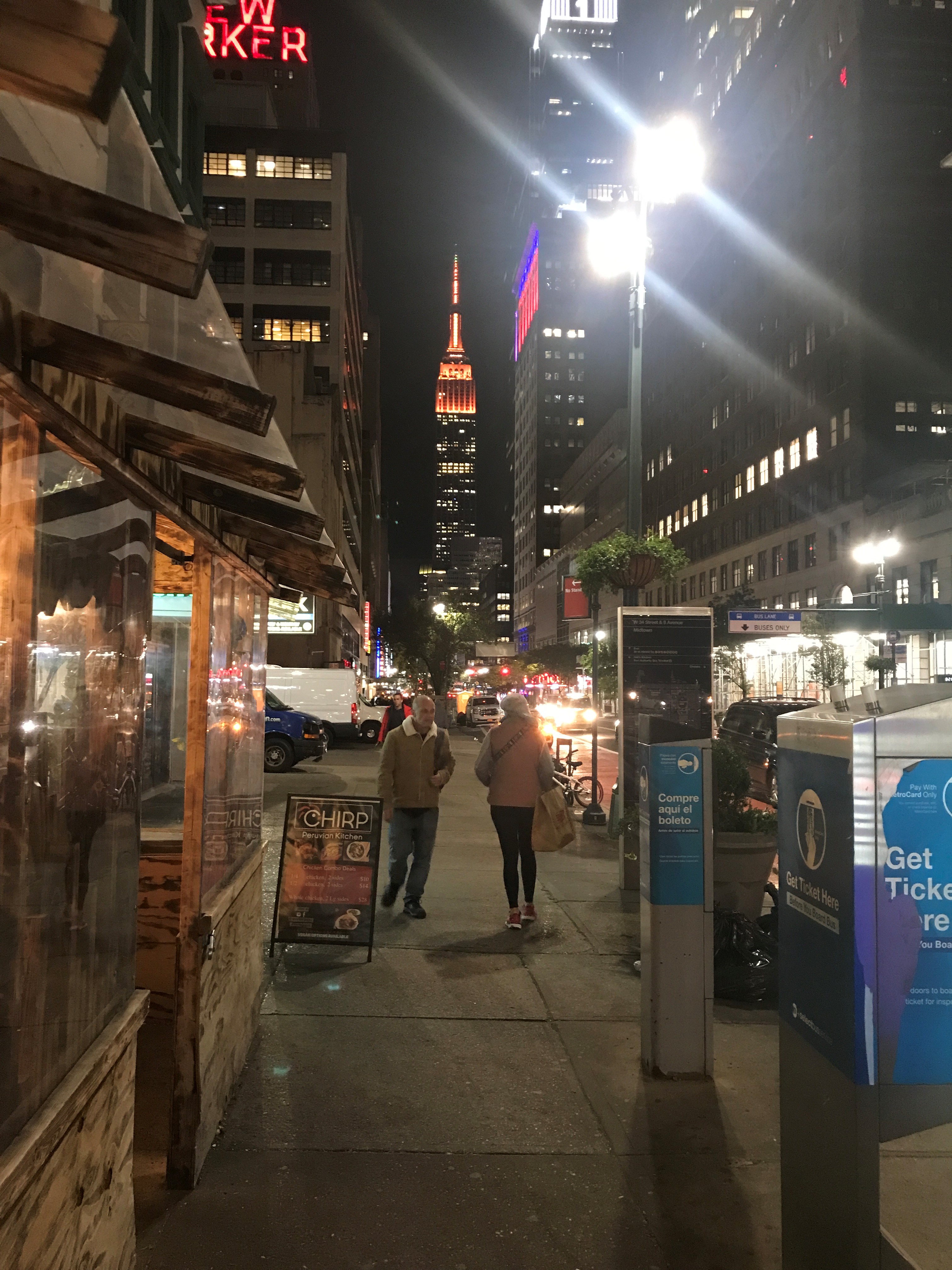
Before and after a quick trip to NYC (see the photo), I’m teaching the research class in our Department of Counseling this year. This leads me to re-affirm a conclusion I reached long ago: Research is hard.
Research is hard for many reasons, not the least of which is that scientific language can look and feel opaque. If you don’t know the terminology, it’s easy to miss the point. Even worse, it’s easy to dismiss the point, just because the language feels different. I do that all the time. When I come upon terminology that I don’t recognize, one of my common responses is to be annoyed at the jargon and consequently dismiss the content. As my sister Peggy might have said, that’s like “throwing the baby out with the bathtub.”
Teaching research to Master’s students who want to practice counseling and see research as a bothersome requirement is especially hard. It doesn’t help that my mastery of research design and statistics and qualitative methods is limited. Nevertheless, I’ve thrown myself into the teaching of research this semester; that’s a good thing, because it means I’m learning.
This week I shared a series of audio recordings of a woman bereaved by the suicide of her former husband. The content and affect in the recordings are incredible. Together, we all listened to the woman’s voice, intermittently cracking with pain and grief. We listened to each excerpt twice, pulling out meaning units and then building a theory around our observations and the content. More on the results from that in another blog.
During the class before, I got several volunteers, hypnotized them, and then used a single-case design to evaluate whether my hypnotic interventions improved or adversely affected their physical performance on a coin-tossing task. The results? Sort of and maybe. Before that, I gave them fake math quizzes (to evaluate math anxiety). I also used graphology and palmistry to conduct personality assessments and make behavioral and life predictions. I had written the names of four (out of 24 students) who would volunteer for the graphology and palmistry activities, placed them in an envelope, and got ¾ correct. Am I psychic? Nope. But I do know the basic rule of behavioral prediction: The best predictor of future behavior is past behavior.
Today is Friday, which means I don’t have many appointments, which means I’m working on some long overdue research reports. Two different happiness projects are burning a hole in my metaphorical research pocket. The first is a write-up of a short 2.5-hour happiness workshop on counseling students’ health and wellness. As it turns out, compared with the control group, students who completed the happiness workshop immediately and significantly had lower scores on the Center for Epidemiologic Studies Depression scale (p = .006). Even better, after 6-months, up to 81% of the participants believed they were still experiencing benefits from the workshop on at least one outcome variable (i.e., mindfulness). The point of writing this up is to emphasize that even brief workshops on evidence-based happiness interventions can have lasting positive effects on graduate students in counseling.
Given that I’m on the cusp of writing up these workshop results, along with a second study of the outcomes of a semester-long happiness course, I’m stopping here so I can get back to work. Not surprisingly, as I mentioned in the beginning of this blog, research is hard; that means it’s much easier for me to write this blog than it is to force myself to do the work I need to do to get these studies published.
As my sister Peggy used to say, I need to stop procrastinating and “put my shoulder to the grindstone.”
Yesterday, Rita posted a free rooster to give away on a local Facebook page. She was surprised that no one claimed him. I waxed empathic, “I don’t understand,” I said, “people always want free things. Getting a free rooster would make the right person very happy.”
We’ve been studying happiness, but not the smiley sort of happiness. We’re into Aristotelian eudaimonic happiness (of course we are). You know, the sort of happiness you experience from living your life in ways that honor others and consistent with your deep values. That just might involve high-quality daily interactions with a free rooster. Think about it.
I was so puzzled by not having our rooster snapped up for immediate adoption that I took to the streets. Really, it was just one street. We’re living in Absarokee for the summer; there are streets, but not very many, and I only spent time on one street.
I cleverly wove the rooster opportunity into my banking business. With only two employees left in the bank on a late Friday afternoon, I asked with great cheer, “Would either of you like a free rooster?” They both quickly said “No thanks,” but I got my transaction processed in record time.
Rita was still in the grocery store (we were dividing and conquering our errands). I marched in, offered to carry her beer, and announced, “Hey. Anybody want a free rooster?” The cashiers avoided eye contact. The bagger started talking about his pigs; they made him happy. He didn’t need a rooster. I guess that proves it’s possible to have too much happiness.
Despite repeated rejections, I’m still convinced that our rooster could bring free happiness to someone. In fact, I think our failed transactions are evidence that happiness is in the eye of the beholder. When I was a teenager, our neighbors got a rooster. We woke up every morning to fantasies of murdering the neighbor’s rooster. I started plotting a late-night abduction. After all, roosters are the mother of opportunity. [I know that’s a wrong and terrible butchering of the saying “necessity is the mother of invention,” and I know that butchering must be the wrong word here, but I’m typing fast and consequently it’s impossible for me to suppress or repress my aggression and mother issues when free associating at this pace. Freud would be happy. But then Freud had his own peculiar tastes regarding what made him happy, which is, of course my point.
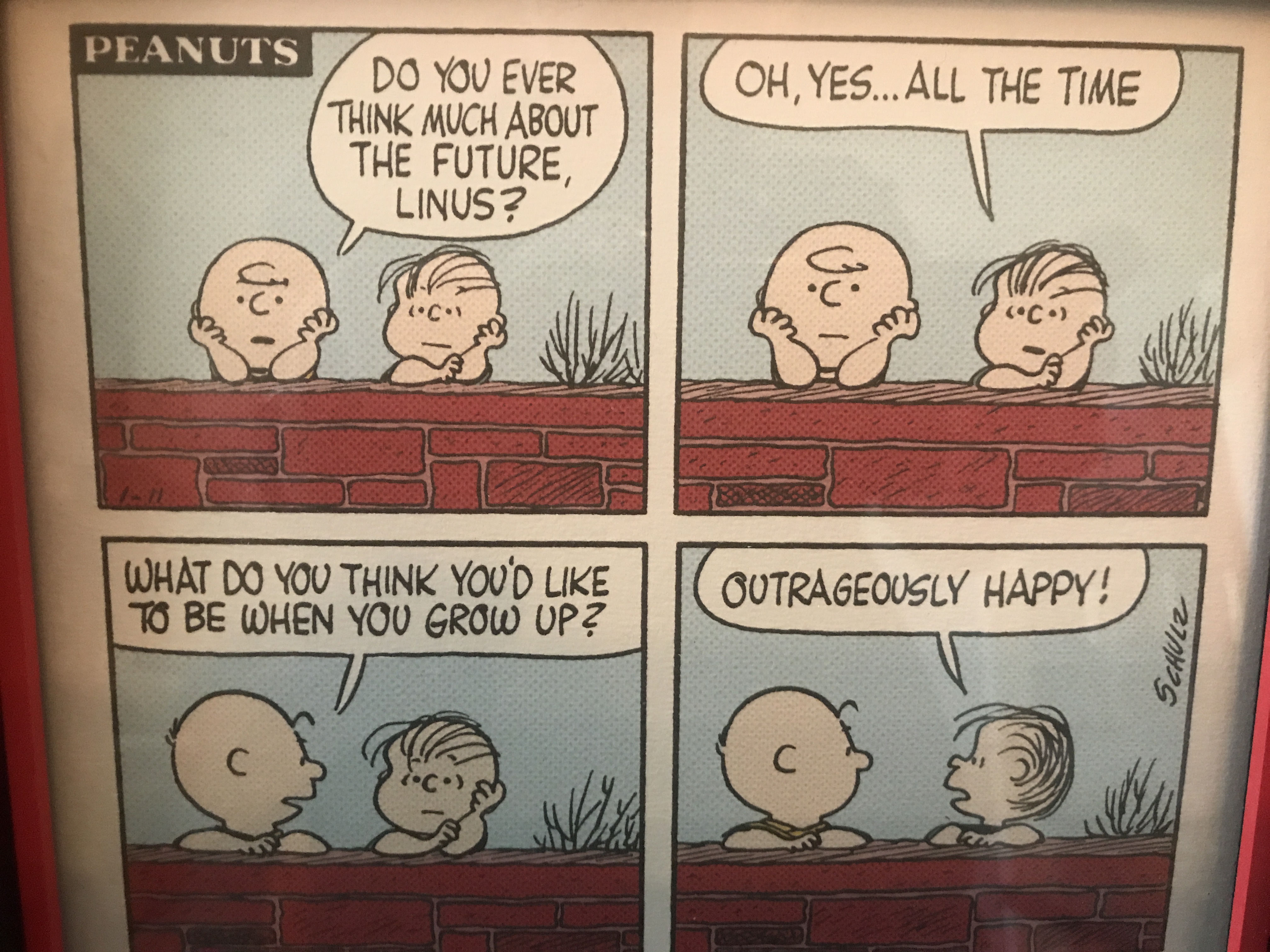
The famous Peanuts cartoonist, Charles Shulz, wrote a book titled, “Happiness is a warm puppy.” Although warm puppies likely bring happiness for many people, they’re certainly not the recipe for happiness for everyone. If I recall correctly, for Linus, happiness was a warm blanket.
And I can’t stop myself from thinking that, perhaps, for some lucky person out there . . .
. . . happiness is a warm, free, pet rooster.
If you’re that person, contact me, because right now, for me, happiness is giving away a free pet rooster.
Dan Salois is teaching an abbreviated version of the Montana Happiness Class this summer. The course starts in ONE WEEK!
Dan is a doctoral student in the Department of Counseling and a great instructor. The course is noncredit, offered through our campus continuing education unit, and all online . . . so you can get a boost of happiness from the convenience of home.
Here’s the course description:
Over the past 20 years, research on happiness has flourished. Due to the natural interest that most Americans have for happiness, research findings (and unfounded rumors) have been distributed worldwide. Every day, happiness is promoted via online blogs, newspaper and magazine articles, Twitter posts, Instagram videos, TikTok, and through many other media and social media venues. Ironically, instead of increases in national happiness, most epidemiological research indicates that all across the U.S., children, adolescents, adults, and seniors are experiencing less happiness, more depression, and higher suicide rates. To help sort out scientific reality from unsubstantiated rumors, in this course, we will describe, discuss, and experience the art and science of happiness. We will define happiness, do some short readings, try out research experiments in class, engage in happiness lab assignments, and measure our own happiness and well-being. Overall, we will focus on how happiness and well-being are manifest in the physical, cognitive, emotional, interpersonal, spiritual/cultural, behavioral, and contextual dimensions of our lives.
The course meets online July 12 – 30, Tuesday and Thursday, 11:00 a.m. – 12:20 p.m. Course fee is $90, which translates to about $10 per instructional hour. . . and a pretty good deal for a dose of happiness.
For years I’ve been teaching counseling students that the cause of most emotional and psychological misery can be boiled down to one word. To inflame their competitive spirits, I tell them this powerful word starts with the letter E, and offer prizes to students if they can guess the correct word.
Sadly, no one ever guesses that I’m talking about “Expectation.”
Expectation is, IMHO, the biggest source of bad, sad, and maladaptive emotions. I suffer from my own expectations all the time. Just this morning, while trying to listen to a podcast on a walk, I became irrationally enraged with all things Apple. Why? Because my iPhone podcasting app didn’t work in an elegant, user-friendly manner. Even worse is that I’m fully aware of how silly it is for me to justify holding such high—or even modest—expectations when it comes to technology. I have repeated lived experiences that should have led me to know how often I (and others) are thwarted by technology. I also happily rely on and use technology for many hours every day, and although it feels otherwise, most of the time technology provides . . . my computer powers up, my emails get sent, my phone dials the right number, and magical things like Zoom conferences happen without adverse incident.
Here’s the irony: My expectations thwart my happiness far more often than technology thwarts my personal plans and goals. Nevertheless, I’m eager to throw a childish fit when an app malfunctions, but I continue to barely question my unrealistic expectations despite their predictable adverse emotional outcomes. Funny that (as the Brits might say). I resist blaming and changing that which I have some control over (my expectations), while I let loose with relentless complaints about that which I have little control over (technology).
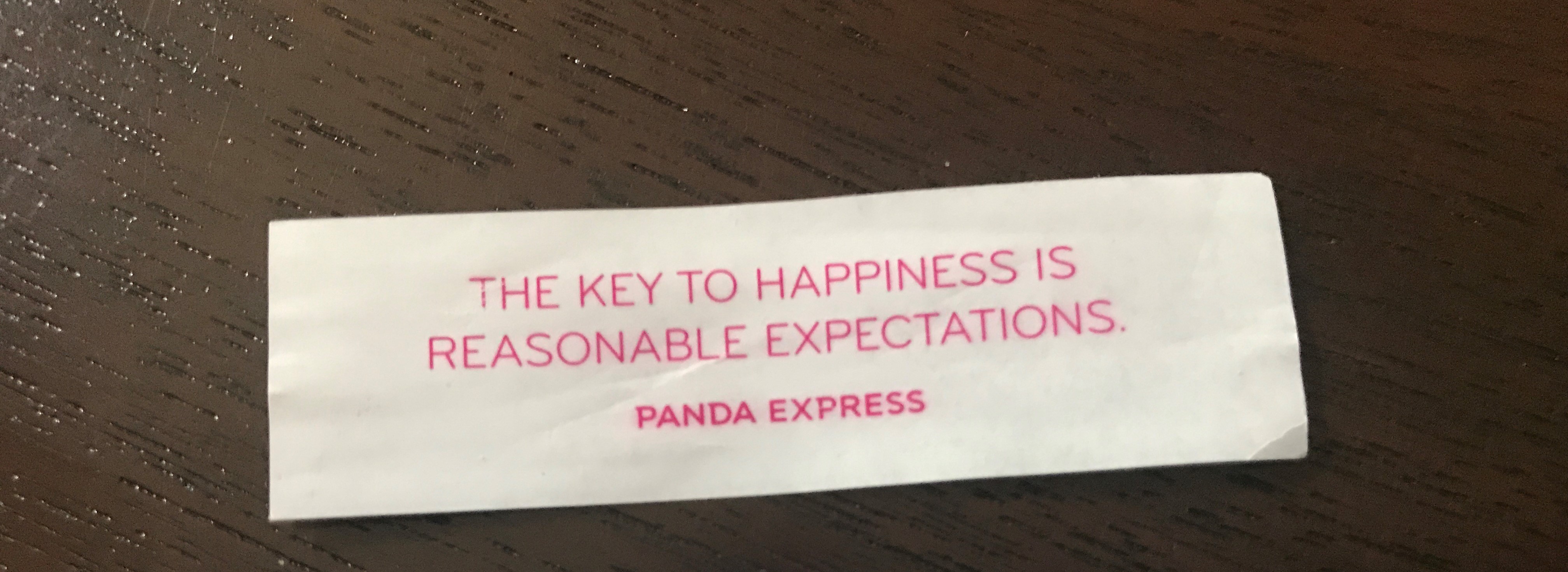
The fortune in my fortune cookie from dinner with my father gave me a nudge toward recognizing and managing my expectations. Panda Express—not usually where I look for guidance—provided me with the wisdom I seek.
If I were inclined to use the word “wiring” when referring to neural networks (I’m not), I might question whether there’s a glitch in my wiring. However, because I’m pretty certain I’ve got no wires in my brain, I’m going after the glitch in my attitude. Sure, as I pursue my attitudinal glitch, my brain may undergo physical, chemical, and electrical changes, but I suspect the fix will be ever so much more complicated than clipping a wire here, and reconnecting another one there.
Thanks for reading . . .
The place to click if you want to learn about psychotherapy, counseling, or whatever John SF is thinking about.








 John Sommers-Flanagan