Over and over—probably because I have a friend who once told me “Redundancy works!”—I told my group class that ending groups is about “learning consolidation.” In other words, we want group members to learn something from group. At the end of each session, and especially during the final session, we want to facilitate experiences that will help group members take their key learning beyond group, and into their lives.
Because role-modeling is a central part of being a group leader, to close our group class, I gave my students a learning consolidation assignment. Although we had been in a group (of 34) together all semester, the “final paper” was, idiographic (like Adlerian theory); students got to do their final paper in their own way. I mentioned poetry as an option, and then told the story of my own risky graduate school strategy of responding to my Advanced Learning professor’s weekly homework prompts with limericks. Turned out, my professor loved the limericks, shared them with his wife who was a writer-aficionado, and I got an “A” in Advanced Learning, while polishing my limerick skills.
Several students took me seriously and sent me fun and creative final papers. But the very last paper I read, by Astrid Santana, was BEYOND MY WILDEST DREAMS! She incorporated Haiku, knock-knock jokes, and a few limericks into her reflections on our group counseling course. I was gobsmacked, and I think you will be too. Happily, I’m here to report that I have her permission to share the paper.
Because WordPress has some difficulty in handling Haiku, I’m excerpting a sampling of Astrid’s work: First, some Haiku; second, a knock-knock joke; third, a limerick. Thanks Astrid!!
Her whole paper is available in a pdf at the bottom of this post.
My Attempt at Brevity:
Reflections on My Reflections
By Astrid Santana
Universality
Even if it sinks,
we’re in this boat together.
I’m grateful for that.
Development of Socializing Techniques
Finally realizing
I was the asshole, and not
everybody else.
Imitative Behavior
They’re so curious,
insightful, calm, and funny.
Could I do this, too?
Phases of Group Therapy
Forming
Knock knock.
Who’s there?
Hugo.
Hugo who?
Hugo first. I feel uncomfortable sitting in this circle and I don’t know if I want to be here
In group class, we’re covering content related to group stage called “Storming.” The Coreys’, who’ve written about and led many groups, call this the “Transition” stage. During the storming or transition stage, group members start to push against or question group norms and/or the group leader’s authority. Not to be trite, but like roses, no matter what name it, the smell and tension of storming feels the same.
I’ve been waiting and watching for storming to emerge within my class. I know group process unfolds during class groups, just as it unfolds in psychoeducational, counseling, and psychotherapy groups. I thought I might ignite storming, by asking my counseling graduate students to focus on positive psychology. I did get a little push-back from students who emailed me about their “mixed” feelings about positive psychology. My response was to share that I also hold mixed feelings about positive psychology, along with mixed feelings about psychoanalytic theory, behavioral theory, CBT, feminist theory, acceptance and commitment therapy, and every other theory or approach I can think of.
This past week an ever-so-minor edge of a storm found its way into class. After class started, one student expressed negative feelings about a reading I’d assigned, noting that she thought the article was “shaming” to mandated clients. As often occurs with storming, I had an immediate and complex emotional and impulse-ridden response. Rather than acting on my emotions or defending the reading, I managed to welcome the critique. When I say “managed” I mean to communicate that IMHO, welcoming critiques is not easy, and maybe not natural. A few minutes later, I acknowledged that although I wished everyone would love all the class readings, I also wanted people to feel they had permission to not love the readings and speak openly about their opinions. Later that evening, I received an email takeaway from the student who didn’t like the reading. As you may recall, one of my group class assignments is for students to email me two takeaways in the days following class. Because she expressed what I want to communicate better than I can, here’s her email (shared with her permission).
Hey John,
My biggest takeaway from today was watching your modeling of working with storming, both with myself and [with another student]. The way that you allowed for expression of our feelings, were vulnerable with your own, and then used the material to create more conversations, norms, etc., was really helpful to see. I also want to share on this topic that when my oldest kiddo and I were talking this morning about what our days were looking like, I was talking to her about my feelings about an article we read for class that I didn’t agree with, and that I was going to bring it up in class. And her response was, “You’re going to tell your professor that?!?!” She was shocked that I felt like I could say that in class, and I wanted to thank you for creating a space where I felt like that was alright.
My other takeaway is your quote from class today, “We want to give people the chance to be interesting.” I think there are so few opportunities that people have to be seen and heard by others in a way that is meaningful. Coupled with the big, sort of inherent opportunity as a group leader to take up ‘too much space,’ your advice feels like a really important nugget that I want to take with me into leading groups in the future.
What I love best about this email (and I love a lot of it) is my student’s anecdote about her daughter’s reaction: “You’re going to tell your professor that?!?!” And what I love best about that is—consistent with other conversations we’ve been having in class—we should not run groups like cults. As leaders, professors, administrators, clergy, and politicians, we need to be open to independence of thought and listen to unique perspectives. What I think is not the truth and what I value is not necessarily the correct moral philosophy for everyone.
Today. . . I am very happy to have handled a little storming with acceptance and openness. Tomorrow may be different. But for today, I get to feel the good feelings of being able to live my best group leader values—even if it didn’t involve me being right about anything.
I feel sorry for Mick Jagger. In that one song he lamented over and over about not getting no satisfaction. If he would just have asked me, I could have helped. I would have told him exactly how to get satisfaction. I’d have said, “Hey Mick. All you have to do to get satisfaction is to teach a course on group counseling to about 34 fantastic counseling students from the University of Montana, along with having a couple of teaching assistants.”
That’s it, Mick. Even you can achieve satisfaction. Getting satisfaction from teaching group counseling might even inspire you to write a new song titled “So Much Satisfaction.” Here are some lyrics for you to consider (no need to thank me Mick):
I can’t stop getting, satisfaction,
cause I tried, and I tried, and I tried, and I tried
I keep getting so, much satisfaction. . . satisfaction. . . satisfaction.
No doubt all you readers are now on the edges of your seats and experiencing bated breath while waiting to hear how group class #1 went. Well, here’s the answer. Great. Awesome. Exciting. Fun. And satisfying. . . so satisfying.
During our introduction activities, everyone was engaged, funny, profound, humble, and always interesting. During my lecture time, I talked about group types and made my “we need to stretch ourselves to listen with acceptance to everyone” speech. One response to my little speech was genuine concern about being able to be accepting with clients who, in their presentation, are harsh, judgmental, and politically and socially extreme in their values. This was a challenging comment/question, because of how incredibly hard it is to listen with compassion and empathy when someone is expressing extremely unkind and judgmental thoughts and beliefs.
Had I been a better group counselor in the moment, what I might have done was to push the question/comment out to the group. On the other hand, I knew that I was probably the one in the room with the most experiences of this type. I was immediately (in Class #1) thrown into an Irv Yalom-esque group leader dilemma. Should I respond with my thoughts. . . or should I deflect the question/scenario to the group.
Yalom also emphasizes that group leaders are, by default, the group role-models and norm-setters. That being the case (and given that this is a graduate course with 36 “group participants”), I chose to throw myself and a couple stories into my response.
The stories—working with parents who insisted on not accepting their child’s sexuality/gender and working with fathers who, not infrequently, would call me variations on the theme of “pansy-ass”—emphasized the strategy of listening first, of thanking parents, clients, students, for their openness, and then highlighting the truth that we cannot lead with education (no matter how much we think it’s needed). Instead, we listen with acceptance and empathy until there’s an opportunity to “broaden” the parent/client/student’s perspective.
I’ve put the word “broaden” in quotations because it’s related to what I want to share next: The Weekly Class Takeaway Email Assignment.
The Takeaway Assignment
This past year, I’ve been using the weekly takeaways assignment to give me a clearer sense of what the students are experiencing in our classes together. For this assignment, students send me, within 5 days of the lecture/class time, an email describing their top two class takeaways. The takeaways assignment also allows me to evade the possibility of an AI generated response.
Typically, and this was the case with week one of the group class, student responses are consistent with what I thought they would takeaway. However, the most exciting part of reading the takeaways is when students weave their own personalized perceptions into their responses; this gives me a glimpse not only of what they’re thinking, but how the content I’m presenting on is being received and interpreted by students. I especially like it when students have reflections that surprise me, or include content that I had not expected, because . . . that’s when the learning goes both directions.
In their takeaways, a couple students used the word “broaden” to discuss their perceptions of my response to the “How can we handle very judgmental clients?” question. I hadn’t remembered using the word, but it felt perfect—especially in the context of group counseling. One of the big goals of group counseling—again, I’m channeling Yalom—is to hear, see, feel, and experience the reflected appraisals of ourselves that come from other group members. Because we cannot always (or maybe ever) see ourselves as others see us, experiencing how other group members experience us is gold. When it’s working, the group offers us other perspectives that can broaden or expand our own narrow views of ourselves and the world.
Among many of my takeaways is that I loved the use of the word “broaden” to describe what good group counseling can give us. With broadened perspectives we can grow the depth, breadth, and accuracy of our perceptions of ourselves and others.
For the first time in seven years, I’m teaching group counseling this semester. This forces me to think about, “What’s the latest scoop on teaching group counseling?” I’ve been reading and talking and gaining information, but if anyone out there has particular insights to share with me, please do.
In my prep, I’ve decided that there’s tons of content out there, in professional journals, books, book chapters, and everywhere else I look. Nevertheless, to break free from the oppression of content, one of my first decisions is to go experiential. This isn’t much different from seven years ago, but my plan is to be even MORE experiential.
Based on previous experiences teaching group, talking with faculty, and talking with students, the Group course is a place with a complex mix of anxiety, vulnerability, and potential conflict. To manage this exciting and challenging mix, I’ve got several plans.
After my infamous “Group is open” anecdote, I will share my philosophy on brain development and counselor skill development. In the Moodle shell, I wrote: “Hey Everybody, Welcome to our group counseling course at U of M. I love group counseling and I love teaching group counseling. More than any other approach, group work requires that we maintain an attitude of acceptance and hold the statements and disclosures that others make with sensitivity and grace. One big goal in this class is for all of us to continue to grow those parts of our brain that makes us excellent listeners. Mostly, we need to let go of other parts of our brain that wants to debate, argue, and express our opinions. I look forward to this adventure and journey with you. See you Tuesday, John SF”
TBH, I’m not sure how my philosophy will fly with students . . . but sharing it fits with Irvin Yalom’s mantra that the group leader is instantly the primary norm setter and role model. Along with my philosophy, I will also disclose some of my anxieties and insecurities. Yes . . . even after 40+ years as a mental health professional, I still feel the creep of imposter anxiety.
Then we’ll circle up and jump into two rounds of experiential introductions. I do two rounds of experiential introductions to give students a chance to “feel” the difference between more structured and less structured group process. I’ve done this before; it feels like a relatively safe, fun, and process-oriented opening.
Then, in the spirit of Yalom’s “self-reflective loop,” we will debrief and debrief some more.
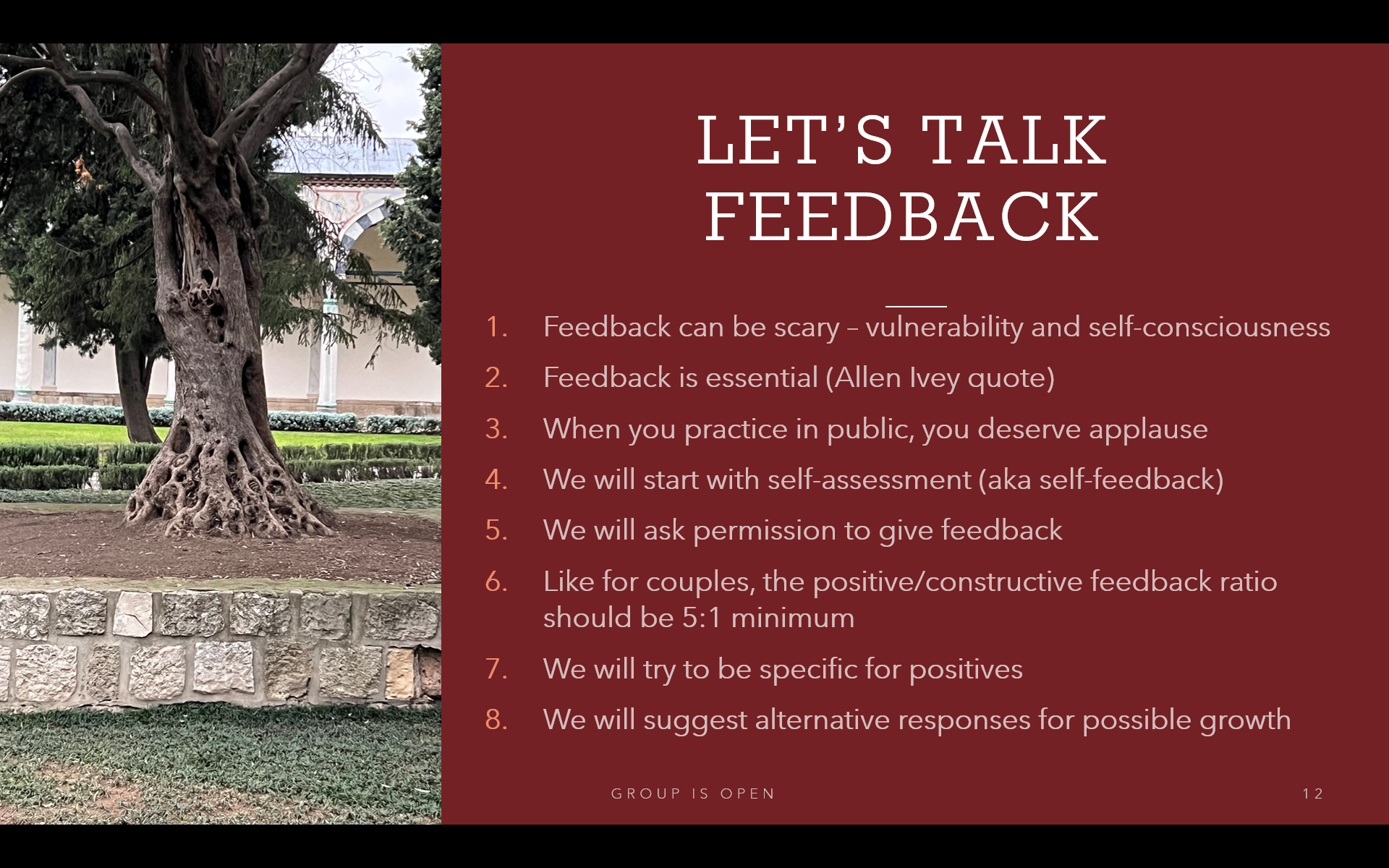
After exiting the experiential introductions, we’ll stay in the circle, review the course syllabus (assignments), and then talk about our planned feedback process. Once, when I asked Allen Ivey for his best advice on learning counseling skills, he said he could summarize his advice in six words: “Practice, practice, practice, feedback, feedback, feedback.” I thought that was a pretty cool answer. You can check out my ideas about feedback on a previous blog post: https://johnsommersflanagan.com/2020/08/18/guidelines-for-giving-and-receiving-feedback/
The last part of class #1 (time permitting) will be me reviewing a few group counseling basics (e.g., group types, group stages, cultural humility, under-confidence, overconfidence, and the wonder and narrowness of the dialectic of lived experience. Should be a blast.
I’m hoping to blog every week about my Group Counseling class and the teaching and learning experience. Of course, that will depend on my time management skills. I’m thinking maybe I’ll coax one of my students into running a psychoeducational group on time management—and then maybe I’ll actually achieve my weekly Group Counseling goals.
Here’s a screenshot of my feedback prompt (aka ppt slide).
I forgot how much I love teaching group counseling.
Maybe I forgot because I haven’t taught Group Counseling at the University of Montana since 2017. Whatever the reason, last week, I remembered.
I remembered because I got to provide a group-oriented counseling training to seven very cool program managers and staff of the Big Sky Youth Empowerment program in Bozeman. We started with a structured question and answer opening, followed with a self-reflective debrief, and then re-started with a different version of the same opening so we could engage in a second self-reflective debrief. I’ve used this opening several times when teaching group; it’s getting better every time.
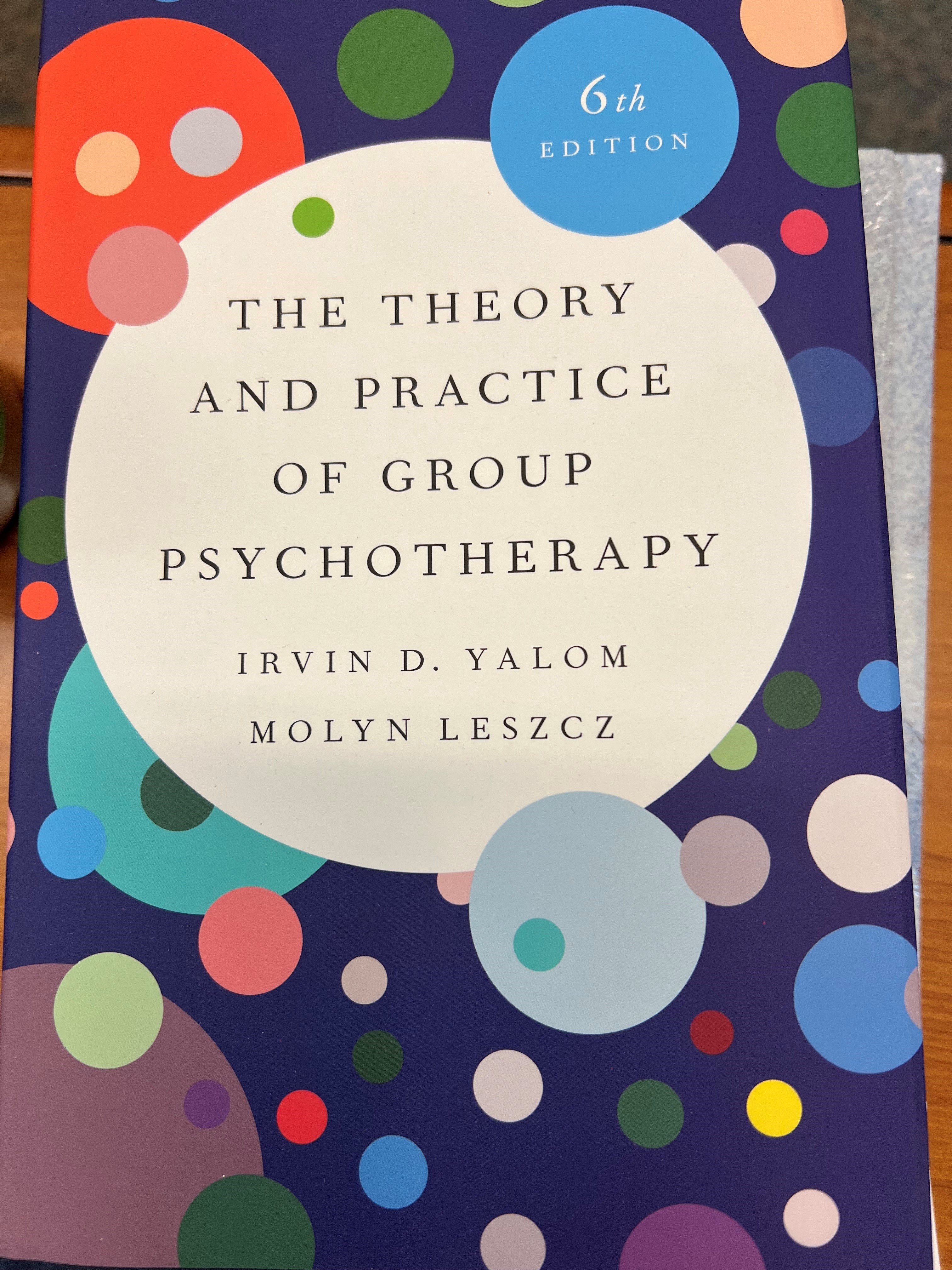
I love the experiential part where I get to flit back and forth between process facilitator and contributor. I love the opportunity to quote Irvin Yalom about the “self-reflective loop” and “The group leader is the norm-setter and role model.” Then I love getting to quote Yalom again, “Cohesion is the attraction of the group for its members.” And again, “I have a dilemma . . .” Boom. When teaching group counseling, the Yalom quotes never stop!
Groups are about individuals and groups and individuals’ learning from the power of groups. I get to learn and re-learn about strong openings, monopolizers, closing for consolidation, and the natural temptation of everyone in the group to fix other group members’ problems—and the need for group facilitators to tightly manage the problem-solving process. We get to “go vertical” and back out through linking and then “go horizontal.”
Tomorrow I head back to Bozeman for more training with the fabulous BYEP staff. Part of the day we’ll focus on specific group facilitation techniques, which reminded me of a handout I created back in 2017. The handout lists and provides examples for 18 different group counseling techniques/strategies. For anyone interested, the group techniques handout is here:
I hope you’re all having a great Memorial Day and engaging in something that feels like just the right amount of meaningful or remembrance for you on this important holiday when we recognize individuals who made huge sacrifices for the sake of the greater and common good of the group.
All my best,
John
The place to click if you want to learn about psychotherapy, counseling, or whatever John SF is thinking about.




 John Sommers-Flanagan