Hello from Montana where we continue to offer and collect data on our evidence-based “Happiness for Educators” course.
Although we’re in the process of updating the following abstract (see below) with fancier stats, for now, it’s a solid summary of our outcomes to date. You’ll notice our depression outcomes (g = 0.59) are not far from worldwide estimates of counseling and psychotherapy outcomes for depression (see Harrer et al., 2025; estimated effect size for depression treatment is g = 0.73)
I’m writing today with expansion and collaboration on my mind.
If any of you academics, educators, or practitioners out there are interested in offering the Happiness for Educators course in your state, or if you happen to be interested in research collaboration, please email me: john.sf@mso.umt.edu. We’ve got a good thing going (who’s against having happier and healthier educators?) and would love to begin scaling up (within our capacity).
Abstract
Purpose: Using an approach grounded in happiness research, this study contributes to the literature on strategies for supporting educator well-being. Educators deserve good health; when educators have better health, students benefit. We developed and evaluated the effectiveness of a three-credit, graduate-level, online and asynchronous evidence-based “Happiness for Educators” course on educator well-being, mental health, and physical health.
Research Methods/Approach: Using a pre-experimental design with five repeated cohorts, we evaluated pre-post course changes on six different well-being, mental health, and physical health questionnaires with 17 end-point outcomes. Across five cohorts, 266 of 293 (90.8%) educators completed the course. We evaluated outcomes using paired t-tests.
Findings: After using a Bonferroni adjustment for multiple comparisons, educators completing the course reported statistically significant improvements (p < .002) on all 17 outcomes. These outcomes included measures of positive and negative affect, hope, depression, mindfulness, and physical health. Large to medium effect sizes (using Hedge’s g) were obtained on the following outcomes:
Positive affect, (g = .802)
Total health, (g = .719)
Negative affect, (g = .705)
Depression (g = 590)
Total hope (g = .568)
Sleep (g = .556)
Mindfulness, (g = .542).
Overall, course participation was linked to a 60.8% reduction in depression rates.
Implications: Implications that can be drawn from a pre-experimental exploratory study are limited. However, these outcomes suggest that an asynchronous, online graduate-level course on positive psychology (aka happiness) has potential for improving educators’ well-being, mental health, and physical health. Future research on this approach is recommended.
Apparently, it’s winter in Grand Forks, North Dakota. Who knew? Clearly not me. Being from balmy Montana where we’ve barely experienced any winter in 2025-2026, I arrived here in Grand Forks to the -25 F degree windchill without a stocking cap or gloves. What was I thinking, you ask? Well, maybe I was just in a here-and-now mindfulness state where the future had not yet arrived. Yep. That’s it. I didn’t forget to plan. I was just in the moment.
In this moment, I’m in my hotel room prepping for three things:
My keynote presentation at Red River H.S.
My hoped-for good night’s sleep, and
How to get to the airport and make it to Boston before I get frostbite.
While prepping for these first two things I had an incredible epiphany and discovered or recovered the simple solution to insomnia. Some of this is old, so bear with me:
Sleep is a challenge for much of the U.S. population. If you struggle with sleep, join the club. It’s a big club. We welcome you, principally because misery loves miserable company.
There are three main forms of insomnia: (a) initial insomnia (aka difficulty falling asleep); (b) terminal insomnia (aka early morning awakening); and (c) intermittent insomnia (aka choppy sleep).
Several other factors also interfere with sleep including children, pets, light, your neighbors starting up their chainsaw, alcohol, caffeine, temperature, nightmares, and more.
This means that many Americans are awake in the night at times when they would rather be asleep. I know you’ve been there, done that, and will likely do it again.
But when you’re there in that “I wish I was sleeping” state, did you ever have the epiphany that you should stop trying to get back to sleep? Sure, you have. Maybe you’ve even gotten up. But that’s not what I’m about to suggest.
Because sleep is elusive and difficult to directly achieve, if you awaken in the night—and you have a pattern of insomnia—you could (and maybe should)—immediately let go of sleep as your primary goal. This is because if you have a goal and you’re not achieving it, you’re going to feel frustration and other unpleasant emotions (anger, sadness, anxiety, etc.) that are directly contrary to sleep.
Do you recall the main characteristic of a smart goal? A smart goal is within your control. If your goal is not within your control, then it’s a dumb goal. Make sense?
So, if you’re awake and struggling to return to sleep, try shifting your goal away from sleep and toward something that is, literally, the next best thing. You should shift to a goal of relaxation, of soothing, of comfort, of emotional peace, and of getting yourself into a generally pleasant state of mind and body. You can accomplish this via several strategies. You can meditate. You can count your breaths. You can use the Seligman technique of three good things. You can do progressive muscle relaxation. You can use the cognitive shuffle. Essentially, you can use anything you want that helps you get to an emotionally calm and pleasant state (although I recommend avoiding drugs and alcohol to get there).
Or, if you need more info on this stuff, plus sleep hygiene, you can watch the video linked below.
The point is that, over time and with practice, you will begin to be able to achieve your very pleasant, almost sleep state. And physically, physiologically, and emotionally, the benefits of almost sleep are very close to the benefits of sleep. But—on the other hand—if you directly keep pursuing sleep as your primary goal, you will feel frustrated and less restored that you would with almost sleep.
Experiencing frustration through the night offers you zero benefits.
I’ve thrown out several ideas here and this may not feel like the ultimate fix for your sleep issues, but then again, expecting to find an ultimate fix for your sleep problems will likely only magnify the problem. For most of us, there is no ultimate sleep fix. There is just time alone in bed with our own brain and our own thoughts, and so teaching ourselves to be as comfortable as possible with our brains and our thoughts is a fantastic goal.
If you want more on this, I’ve stolen the Module 3, Part 2 Sleep video from our Happiness for Educators course and the link is here (Note: for some reason, maybe because I pretended I was asleep at the beginning of this video, I seem—at least to me—to have a very slow pace in this video; of course, this may be a good thing; it could make you very, very, sleepy): https://www.youtube.com/watch?v=qOXW_5Df3UE
As for me, I’m looking forward to up to 850 Grand Fork educators tomorrow, so I’m stopping here, not in search of a good night’s sleep, but in search of experiencing a pleasant mental and emotional state, which just might translate to a more restorative nighttime experience. . . and maybe even more sleep.
A friend and colleague in the Counseling Department at the University of Montana forwarded me an article by Lucy Foulkes of Oxford University titled, “Mental-health lessons in schools sound like a great idea. The trouble is, they don’t work.”
That is troubling. My friend knows I’ve been thinking about these things for years . . . and I feel troubled about it too.
Children’s behavioral or mental or emotional health has been in decline for decades. COVID made things worse. Even at the University, our collective impression is that current students—most of whom are simply fantastic—are more emotionally fragile than we’ve ever seen before.
As Craig Bryan says in his remarkable book, “Rethinking Suicide,” big societal problems like suicide, homelessness, addiction, and mental health are “wicked problems” that often respond to well-intended efforts by not responding, or by getting worse.
Such is the case that Lisa Foulkes is describing in her article.
I’ve had a front row seat to mental health problems getting worse for about 42 years now. Oh my. That’s saying something. Mostly it’s saying something about my age. But other than my frightening age, my point is that in my 42+ years as a mental health professional, virtually everything in the mental health domain has gotten worse. And when I say virtually, I mean literally.
Anxiety is worse. Depression is worse. ADHD is worse, not to mention bipolar, autism spectrum disorder, suicide, and spectacular rises in trauma. I often wonder, given that we have more evidence-based treatments than ever before in the history of time . . . and we have more evidence-based mental health prevention programming than ever before in the history of time . . . how could everything mental health just keep on going backward? The math doesn’t work.
In her article, Lisa Foulkes points out that mental health prevention in schools doesn’t work. To me, this comes as no big surprise. About 10 years ago, mental health literacy in schools became a big deal. I remember feeling weird about mental health literacy, partly because across my four decades as an educator, I discovered early on that if I presented the diagnostic criteria for ADHD to a class of graduate students, about 80% of them would walk away thinking they had ADHD. That’s just the way mental health literacy works. It’s like medical student’s disease; the more you learn about what might be wrong with you the more aware and focused you become on what’s wrong with you. We’ve known this since at least the 1800s.
But okay, let’s teach kids about mental health disorders anyway. Actually, we’re sort of trapped into doing this, because if we don’t, everything they learn will be from TikTok. . . which will likely generate even worse outcomes.
I’m also nervous about mindful body scans (which Foulkes mentions), because they nearly always backfire as well. As people scan their bodies what do they notice? One thing they don’t notice is all the stuff that’s working perfectly. Instead, their brains immediately begin scrutinizing what might be wrong, lingering on a little gallop in their heart rhythm or a little shortness of breath or a little something that itches.
Not only does mental health education/prevention not work in schools, neither does depression screenings or suicide screenings. Anyone who tells you that any of these programs produces large and positive effects is either selling you something, lying, or poorly informed. Even when or if mental health interventions work, they work in small and modest ways. Sadly, we all go to bed at night and wake up in the morning with the same brain. How could we expect large, dramatic, and transformative positive outcomes?
At this point you—along with my wife and my team at the Center for the Advancement of Positive Education—may be thinking I’ve become a negative-Norman curmudgeon who scrutinizes and complains about everything. Could be. But on my good days, I think of myself as a relatively objective scientist who’s unwilling to believe in any “secret” or public approaches that produce remarkably positive results. This is disappointing for a guy who once hoped to develop psychic powers and skills for miraculously curing everyone from whatever ailed them. My old college roommate fed my “healer” delusions when, after being diagnosed with MS, “I think you’ll find the cure.”
The painful reality was and is that I found nothing helpful about MS, and although I truly believe I’ve helped many individuals with their mental health problems, I’ve discovered nothing that could or would change the negative trajectory of physical or mental health problems in America. These days, I cringe when anyone calls themselves a healer. [Okay. That’s likely TMI.]
All this may sound ironic coming from a clinical psychologist and counselor educator who consistently promotes strategies for happiness and well-being. After what I’ve written above, who am I to recommend anything? I ask that question with full awareness of what comes next in this blog. Who am I to offer guidance and educational opportunities? You decide. Here we go!
*********************************************
The Center for the Advancement of Positive Education (CAPE) and the Montana Happiness Project (that means me and my team) are delighted to be a part of the upcoming Jeremy Bullock Safe Schools Conference in Billings, MT. The main conference will be Aug 5-6. You can register for the conference here: https://jeremybullocksafeschools.com/register. The flyer with a QR code is here:
In the same location, beginning on the afternoon of Aug 6 and continuing for most of Aug 7, CAPE is offering a “Montana Happiness” infused 7-hour bonus training. Using our combined creative skills, we’ve decided to call our workshop: “Happiness for Educators.” Here’s the link to sign up for either a one-credit UM grad course (extra work is required) or 7 OPI units: https://www.campusce.net/umextended/course/course.aspx?C=763&pc=13&mc=&sc=
The flyer for our workshop, with our UM grad course or OPI QR code is at the top of this blog post.
In the final chapter of Rethinking Suicide, Craig Bryan, having reviewed and lamented our collective inability to prevent suicide, turns toward what he views as our most hopeful option: Helping people create lives worth living. Like me, Dr. Bryan has shifted from a traditional suicide prevention perspective to strategies for helping people live lives that are just a little more happy, meaningful, and that include healthy supportive relationships. IMHO, this positive direction provides hope.
In our Billings workshop, we’ll share, discuss, and experience evidence-based happiness strategies. We’ll do this together. We’ll do it together because, in the words of the late Christopher Peterson, “Other people matter. And we are all other people to everyone else.”
Come and join us in Billings . . . for the whole conference . . . or for our workshop . . . or for both.
If you’re an educator, you can sign up for the “Spring” version (starting in January) of our Happiness for Teachers course. This course has been very popular among teachers who have taken it. Here’s what one Montana educator emailed me first thing on January 1:
John, your course is fantastic! It absolutely exceeded my high expectations, and I find myself reflecting on and applying things I’ve learned all the time. There’s likely some recency bias, but I’m trying to think of another college course I have taken that is as meaningful and applicable for me. It has helped my overall happiness and well-being both personally and professionally, and it has given me the ideas and language to share with and support others (wife, children, students, coworkers, etc.). Thank you!
If you’re an educator or you want to share this information with an educator, read on for the details.
To Register
This semester, we have a reduced price for Rural Montana Educators: $95. We also have our usual extremely reduced price for Montana Educators for the Big Seven School Districts: $195. Either way, thanks to a grant from the Arthur M. Blank Family Foundation, the price is a bargain for 3 Grad Credits from the University of Montana.
Because we want to support teachers, our approach to grading is flexible. Teachers can select from one of three grading options.
Teachers can receive 3 graduate credits from the University of Montana – graded using a Credit/No Credit system. That means you need to complete enough course assignments to obtain 70% (you can do more). Then you will pass the course and receive the credits. Even if you get an NCR in the course, you can qualify for a pro-rated number of OPI credits based on your percentage completion.
Teachers can receive 3 graduate credits from the University of Montana – graded using a traditional “letter” grading system. Some school districts require a letter grade to count the course toward your payscale.
You can receive up to 48 OPI credits. This option is especially useful if you find you’re unable to complete at least 70% of the assignments. You can receive a pro-rated total of OPI hours . . . depending on how many hours of the course you complete.
How Much Work will the Course Be?
This is a graduate-level course, and so there’s a significant workload. If you can take the course for credit/no credit (see above), then you only need to obtain 70%, which makes the workload lighter.
At the ½ point in the course, we will ask all participants to inform us how they want to take the course (for credit/no credit; for a letter grade; for OPI hours). If you get ½ way through the course and you think you’re not going to pass (or get the grade you want), then you can take it for OPI hours. In the end, even if you get an NCR in the course, you can still qualify for a prorated number of OPI hours.
To complete the whole course, teachers need to complete the following assignments:
Initial and Final Happiness Assessments (20 points each; 40 points total): During the first and final days of class you’ll be given a link to a happiness assessment packet via Qualtrics. We’re collecting this data to support the grant we have that enabled us to offer you this course at a steep discount.
Active Learning Assignments (complete 10 of the 14 options available; 10 points each; 100 total points): These are short assignments designed to get you in the habit of incorporating happiness-related activities into your life. These assignments are graded pass (10 points) or not pass (0 points). To get your 10 points you need to complete the bare minimum of a thoughtful response.
Weekly Discussion Board Postings and Comments (30 posts; total 60 points): We want you to engage with each other on how you might apply what you’re learning in this course. To encourage this, you’re assigned to make two posts each week (30 total posts). We’d like you to make one post about the weekly course content (lectures and other assigned content) and one post commenting on the post of someone else.
Development of One Educational Lesson Plan (3-5 pages; 40 points): Pick a topic from class (e.g., savoring, gratitude, acts of kindness, etc.) and then write a lesson plan that you could potentially use in your educational setting. You DO NOT need to implement these lesson plans; the assignment is only to create them.
Live online or recorded final pub quiz (30 points, plus prizes): During the last Unit of class John Sommers-Flanagan will hold a live and synchronous open pub-style happiness trivia quiz. If you participate live you can win prizes. Whether you participate live or watch the recording, you can earn 30 points by turning in the answers to the 30 happiness trivia questions.
Substitute (or Extra) Credit (40 points): You can engage in 5 or more sessions of individual counseling with a Master’s student at the University of Montana. You can use these points to substitute for another assignment, or as extra credit.
How Much Time will This Course Take?
The video-recorded lecture component of the course takes about 45 hours to view.
If you complete the whole course, assignments outside of class will take approximately an additional 100 hours.
For the Fall, 2024 version of the course, there will be 15 weeks—although you’ll be working at your own pace. Assuming you worked at an even pace over the 15 weeks, anticipating about 10 hours a week for the course is a reasonable estimate.
Our Goals
We want to support teachers because we view them as unappreciated, underpaid, and highly stressed by the demands of their jobs. We have three objectives:
Offer a high quality and low-cost course to Montana teachers and other school personnel. The fee is $195 for 3-credits.
Focus the course content on emotional wellness—teachers can apply this content to themselves, and possibly also apply it in their classrooms.
By offering a 3-credit graduate course through the University of Montana, teachers may qualify for a salary bump.
Here are a couple of un-flashy memos describing the courses, just in case you want to download and share them. First, the Rural Educator section:
Earlier this week, I had an amazing Montana educator tell me, among other things, about how the election results ignited fears for the future of public education. In response, I wrote the following piece. I know it’s a little intellectual, but that’s what you get from a college professor. I’m sharing this with you mostly because I think you’re all amazing Montana educators and want to support you in whatever way I can.
********************
In this moment, I’m aware that while some are celebrating this morning’s election outcome, others are experiencing despair, sadness, anger, betrayal, and fear. After an election like this one, it’s easy to have our thoughts and emotions race toward various crisis scenarios. If that’s what’s happening to you, no doubt, you are not alone.
We all have unique responses to emotional distress. If you feel threatened by the election outcome, you may have impulses toward action that come with your emotions. In stress situations, we often hear about the fight or flight (or freeze) response, but because we’re all complex human beings, fight or flight or freeze is an oversimplification. Although feeling like running, hiding, freezing, or feeling surges of anger are natural and normal, most of the fight or flight research was conducted on rats—male rats in particular. For better and worse, our emotional and behavioral responses to the election outcomes are so much more complex than fight or flight.
As humans we respond to threat in more sophisticated ways. One pattern (derived from studies with female rats) is called tend and befriend. Although these are also simplistic rhyming words, I translate them to mean that if you’re feeling stressed, threatened and fearful, it’s generally good to reach out to others for support and commiseration, to support others, and to gather with safe people in pairs or families or groups.
If you work in a school, I encourage you to be there for each other, regardless of your political views. For now, it will probably feel best to stay close to those with whom you have common beliefs. Eventually, I hope that even those of you with different beliefs can recognize and respect the humanity within each other. The most destructive responses to stress and threat are usually characterized by hate and division. The more we can connect with others who feel safe, the better we can deal with our own rising feelings—feelings that may be destructive or hateful.
Another complex thing about humans is that we can have a therapeutic response to focusing on our pain, grief, anger, and other disturbing emotions. There’s clear evidence that letting ourselves feel those feelings, and talking and writing about them, is important and therapeutic. But, in an odd juxtaposition, it’s also therapeutic to intentionally focus on the positive, to imagine and write about the best possible outcomes in whatever situations we face, and in looking—every day—for that which is inspiring (rather than over-focusing on that which is depressing or annoying). To the extent that you’re feeling distressed, I encourage you, when you can, to take time going down both those roads. That means taking time to experience your difficult and painful feelings, as well as taking time to focus on what you’re doing that’s meaningful in the moment, and whatever positive parts of life you can weave into your life today, tomorrow, and in the future.
My main point is that you are not alone. Many people, right alongside you, are in deep emotional pain over the outcome of the election. As you go through these bumpy times, times that include fears for the future of children, families, education, and communities I hope we can do this together. Because in these moments of despair and pain, we are better together.
Or, as Christopher Peterson said, “Other people matter. And, we are all other people to everyone else.”
You matter and your reactions to this immense life event matters. Please take good care of yourself and your colleagues, friends, and family.
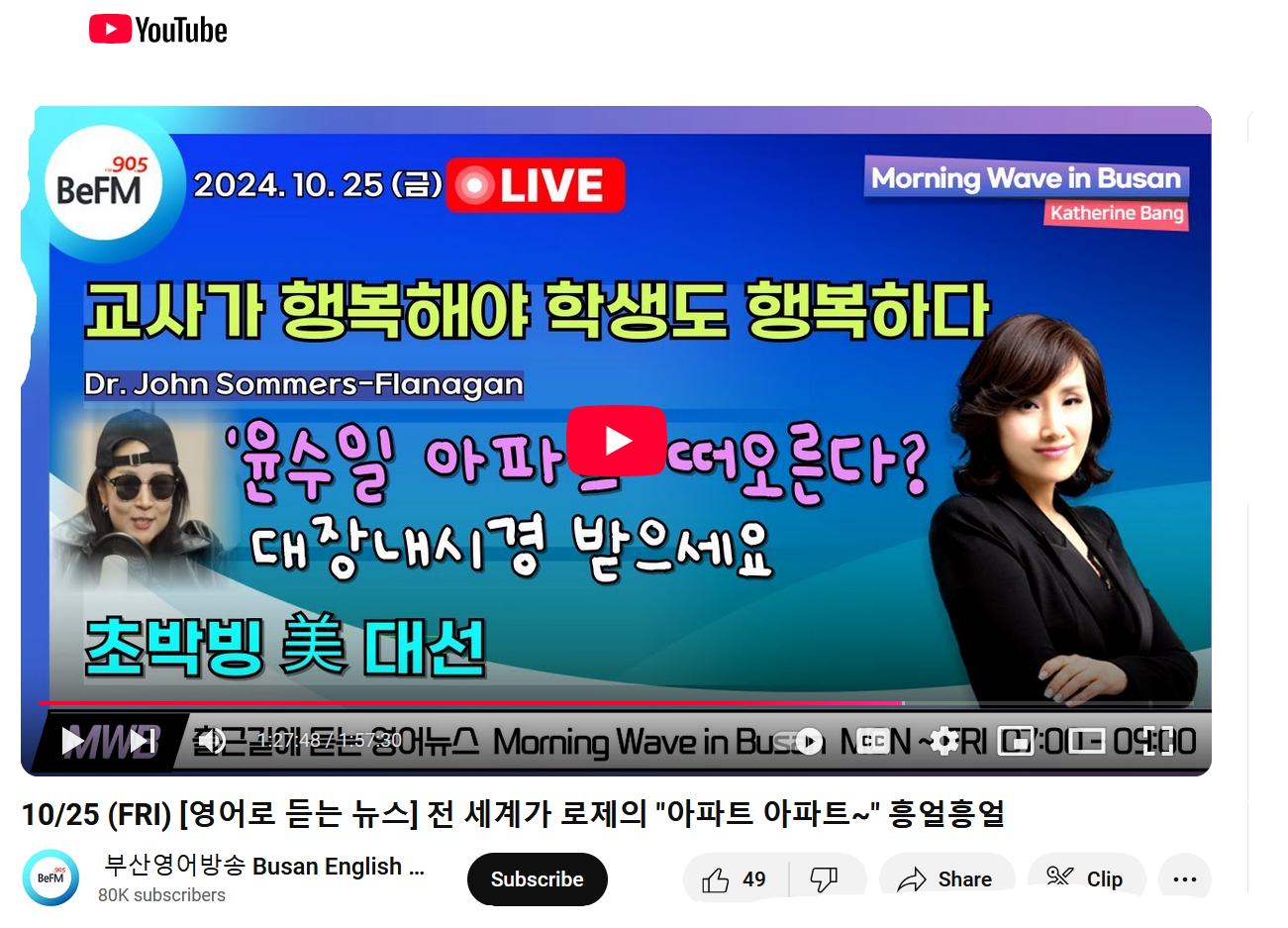
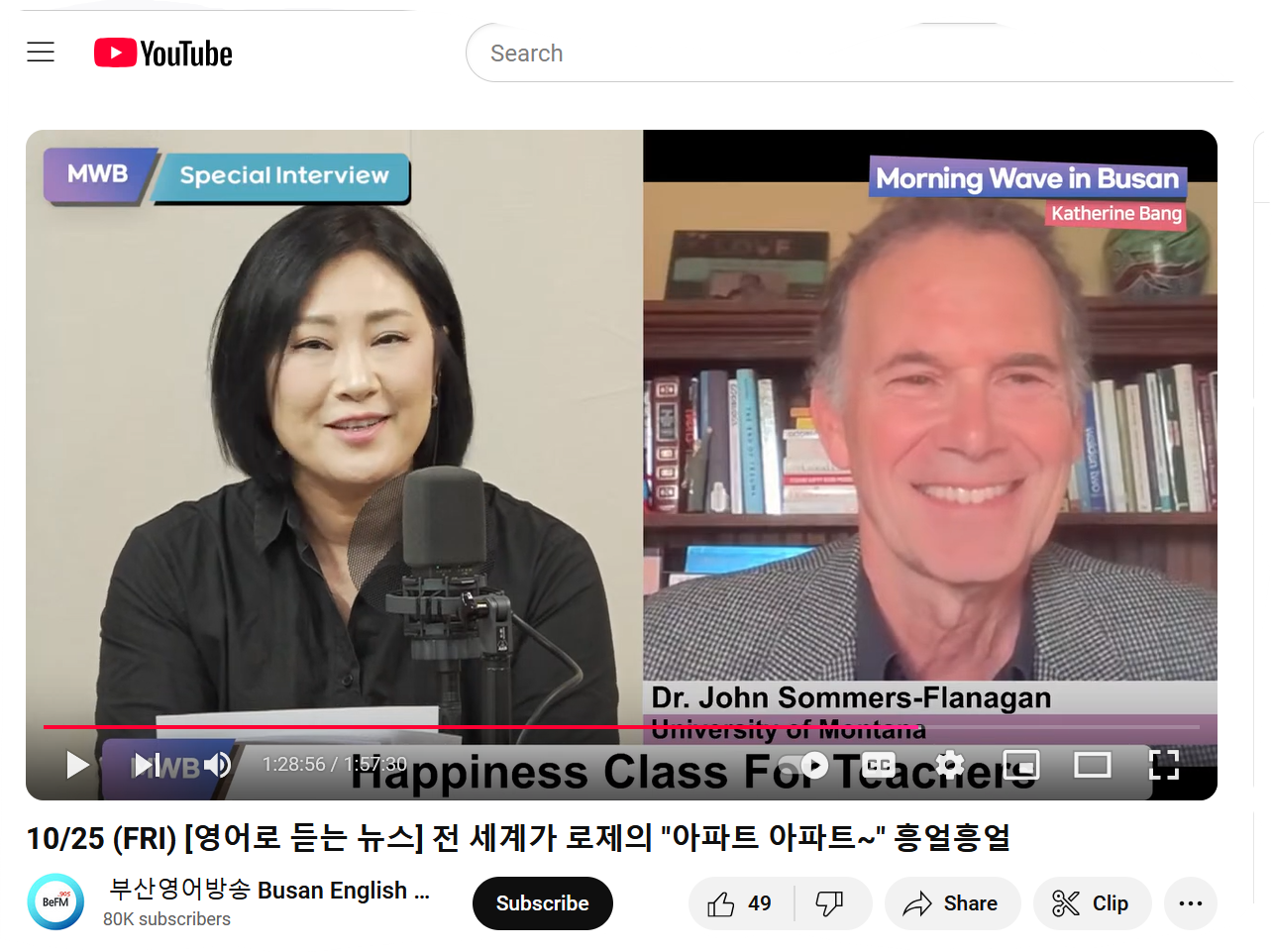
Last week I had my Andy Warholian 15 minutes of fame in South Korea. Actually, it was only 12 minutes and 27 seconds, and as some historians note, Andy Warhol may have never actually said the 15 min of fame thing. But, pushing the silly details aside, the truth is: I got over 12 minutes of fame on a South Korean radio station! “How cool is that?”
My answer is, “Very cool,” partly because I was on a very cool English-speaking South Korean radio station and radio show: The Morning Wave in Busan (BeFM 90.5). Before I went “live” on the air, I listened to Kathryn Bang, the radio host, interviewing someone about college students selling their ADHD meds and voyeurism and some singing/dancing and a Bruno Mars song that’s popular in South Korea. Wow. That was an amazing line-up.
If you’re interested, The Morning Wave has a recorded video of my appearance. The focus of the interview was our “Happiness for Educators” course. I got the gig because the radio station tracks The Conversation, where I had a publication pop back on October 11.
Here’s the link to the YouTube video.
Just in case the link doesn’t load to the right moment in the show, the interview with me starts at 1:27:50 and ends at 1:40:17 . . . although the whole show is worth a listen/viewing!
I know this saying dates me, but sometimes I feel like a broken record. However, as I’ve said before (and I’ll say it again), redundancy works.
In this post, I’m sending out yet another call for Montana educators to register for our bargain-priced “Happiness for Teachers” course, offered through the University of Montana’s UMOnline program.
I’ve said it before: We’ve had over 150 educators complete the course and the outcomes have been rather stunningly positive. I could promote this like an advertisement:
“If you want to be less depressed, more hopeful, have better physical health (including better sleep), and experience greater hope and mindfulness . . . you should consider taking this course!”
The cost is $195 for 3 U of Montana graduate credits. Here’s the link to register:
The educators enrolled in our asynchronous “Happiness for Teachers” course continue to stun me with the extremely high quality of their responses to the assignments. They go WAY beyond what’s necessary and are clearly and deeply committed to not only their personal growth, but also to the growth of their students, family, and friends. Seriously. When I read their assignments, I immediately have more hope for the world . . . and I think to myself, “I want to be your friend!”
But, teaching an asynchronous course is weird. I feel detached. I want to be more connected and more involved. On the other hand, we’ve got hours of video lectures we’ve produced and so the students might be getting more exposure to me than anyone really should bargain for. Maybe I’m too connected and involved? Funny thing how everything often boils down to a dialectic. Hegel (the philosopher) would be so happy he wouldn’t need a happiness course.
Despite the weirdness, our educator-students keep giving us great feedback. Here are a few anonymous examples that have popped into my email inbox without any solicitation:
“I’ve truly enjoyed the material thus far in the class. . . . I hope your class becomes required for all teachers at the EDU dept for certification. It’s the real deal.” S.S.
“Loving the course! Thanks for providing it!” J.E.
“Thank you so much for sharing this video. Just watching it Brings me joy. I love the contributors and all the great things they are doing in their classes! You guys are amazing for doing this.” J.R.
“Loved this course! I shared it with my school! I will send it to my principal now too! Thanks again!” L.W.
“Thanks again for this enriching class. I needed it more than you know and I have so many tools to carry me into next year!” S.M.
Thanks to the Arthur M. Blank Family Foundation, we’re offering yet another section of the course this fall semester. If you’re a Montana educator, and want a big bargain ($195.00) for 3 Grad Credits or 48 OPI Hours, here’s the link to register:
For you non-Montana educators who may still be reading . . . I’m wondering, if we opened the course to anyone across the U.S. would there be much interest?
Just FYI, here’s a copy of the syllabus for the summer version of the course:
Are you a Montana educator . . . or do you know one?
If so, maybe you—or your friend—would like three (3) bargain-rate University of Montana graduate credits. As you may know, we’ve got an online and asynchronous “Happiness for Teachers” course starting on June 17 for only $195 and the credits (or OPI hours) can contribute to raising teacher salaries. Given all that teachers do for our youth and society, it’s the least we can do. And we can do it thanks to a fantastic grant from the Arthur M. Blank Family Foundation (AMBFF: https://blankfoundation.org/).
Because I’ve written about this opportunity before, this time I want to focus on outcomes. We’ve taught this course to teachers as asynchronous semester-long courses last summer (2023) and this spring (2024). I just finished crunching the numbers for our spring outcomes; I’ve got the summer outcomes in front of me as well.
We’ve pre-post data on 16 different outcome measures. For last summer, we had statistical significance on 12 of the 16 outcomes. For this spring, we had statistical significance on 13 of the 16 outcomes. Even better, based on Cohen’s guidance, many of the effect sizes are in the medium to large range.
For you stats nerds, here’s a Table describing the outcomes:
Outcome Measure
What Teachers Reported at Post-Test
Summer – 2023 – Statistical Significance (n = 40) and Effect Size (ES is Cohen’s d)
Spring – 2024 – Statistical Significance (n = 48) and Effect Size (ES is Cohen’s d)
NAPAS: Negative Affect
Fewer negative emotional symptoms (e.g., nervousness and sadness)
p < .001 ES = .671 (medium)
p < .006 ES = .389 (small to medium)
NAPAS: Positive affect
More positive emotions (e.g., “in good spirits”)
p < .001 ES = .887 (large)
p < .001 ES = .497 (medium)
CES-D: Depression
Fewer symptoms of depression
p < .001 ES = .751 (large)
p < .013 ES = .346 (small to medium)
Sleep
Better sleep
p < .001 ES = .644 (med to large)
p < .001 ES = .502 (medium)
Headaches
Fewer headaches
p < .009 ES = .393 (small to med)
p < .001 ES = .699 (medium to large)
Gastrointestinal symptoms
Less gastrointestinal distress
p < .027 ES = .315 (small to med)
p < .023 ES = .298 (small)
Colds
Fewer and less severe colds
p < .010 ES = .382 (small to med)
p < .024 ES = .298 (small)
PHQ: Total Health
Better total health
p < .001 ES = .589 (medium)
p < .001 ES = .625 (medium to large)
Days Sick
Fewer days of physical illness
P < .015 ES = .354 (small to med)
N/A
Hope-Agency
Greater goal directed energy
p < .001 ES = .704 (med to large)
p < .008 ES = .365 (small to medium)
Hope-Pathways
Greater planning to meet goals
p < .001 ES = .545 (medium)
p < .013 ES = .341 (small to medium)
AHS: Total Hope
Higher agency and pathways hope
p < .001 ES = .677 (med to large)
p < .004 ES = .416 (small to medium)
Significant Other Support
Support from a romantic partner
p < .166 ES = .158 (minimal)
p < .195 ES = .127 (minimal)
Family Support
Support from family
p < .114 ES = .194 (minimal)
p < .030 ES = .282 (small)
Friendship Support
Support from friends
p < .165 ES = .156 (minimal)
p < .177 ES = .137 (minimal)
MSPSS: Total Social Support
Combined romantic partner, family, and friend support
p < .133 ES = .181 (small)
p < .091 ES = .198 (small)
MAAS: Mindfulness
Less distracted and more tuned into the here and now
p < .001 ES = .892 (large)
p < .001 ES = .597 (medium to large)
To summarize: If Montana educators want to have less negative affect and depression, more positive emotions, greater hope, better sleep, fewer headaches, less gastrointestinal distress, fewer colds (and days of physical illness), and greater mindfulness . . . they should register and complete this course.
I’m writing for a little social marketing assistance to support Montana Educators.
As I’ve written before, because of the generosity and funding from the Arthur M. Blank Family Foundation, we have funding to support Montana educators. The main way we’ve chosen to support Montana educators is to offer a highly subsidized three-credit course on “Happiness for Teachers” through the fantastically helpful UMOnline people at the University of Montana.
We believe this course supports Montana Educators in three ways:
The course can be used to help increase educator pay (because we believe educators should be paid more).
The course can help educators feel positive feelings more often, savor them, increase their sense of meaning, and possibly reduce depression and improve physical health.
Educators can use the information to support their students’ happiness and well-being.
We’ve got a large section of the course open and starting on June 17. I’d love to get it all filled up.






 John Sommers-Flanagan