

Tag Archives: Books

The Invention of the Strength Warning

Now that I’m immersed in positivity every day as the Director of the Center for the Advancement of Positive Education, I think I’ve become weirder.

Some of you, including my sisters and brothers-in-law may be wondering, “Wait. How could John become any MORE weird than he already is?”

You know what they say: “All things are possible!” [Actually, I don’t know why I just wrote all things are possible, because, even in my most positive mental states, I don’t believe that BS. All things are not possible. I could make a list of impossible things, but I’ve already digressed.]  

Here’s what I mean by me becoming even weirder.

I find myself more easily hearing and seeing the pervasive negative narratives emerging around us. I could make another long list of all the bad ideas (negative narratives) I’m noticing (think: “fight or flight”), but I’ll limit myself to one example: The “Trigger warning.”

Trigger warnings are statements that alert listeners or viewers (or people attending my suicide assessment workshops) to upcoming intense and potentially emotionally activating content. Over the past 10ish years, we’ve all started giving and receiving trigger warnings from time to time, now and then. A specific example, “The next segment of this broadcast includes gunfire” or “In my lecture I will be talking about mental health and suicide.”

As a college professor in a mental health-related discipline, I became well-versed in providing trigger warnings. . . and have offered them freely. Because some people have strong and negative emotional reactions to specific content, providing trigger warnings has always made good sense. The point is to alert people to intense content so they can take better care of themselves or opt out (stop listening/viewing). Trigger warnings are important and, no doubt, useful for helping some people prepare for emotionally activating content.

As a college professor, I’m also obligated to keep up with the latest research. Unfortunately, the research on trigger warnings isn’t very supportive of trigger warnings. Argh! In general, it appears that trigger warnings sensitize people and might make some people more likely to have a negative emotional response. You can read a 2024 meta-analysis on trigger warning research here: https://journals.sagepub.com/doi/10.1177/21677026231186625

In response to the potential adverse effects of trigger warnings, I came up with a clever idea: I started giving trigger warnings for my trigger warnings. These were something like, “Because research suggests that trigger warnings can make you more reactive to negative content, I want to give you a trigger warning for my trigger warning and encourage you to not let my warning make you more sensitive than you already would be.”

Then, about a year ago, I had an epiphany. [I feel compelled to warn you that my epiphany might just be common sense, but it felt epiphany-like to me]

I realized—perhaps aided by my experiences training to do hypnosis—that trigger warnings might be functioning as negative suggestions, implying that people might not be able to handle the content and priming them to notice and focus on their negative reactions.

Given my epiphany, I was energized—as the solution-focused people like to say—to do something different. The different thing I settled on was to invent “The Strength Warning.”

[Here’s where I digress again to pitch a podcast. Paula Fontenelle, an all-around wonderful, kind, and competent professional, has a new podcast called, Relating to AI. And, lucky me, I got to be one of her very first guests. And, lucky Paula (joking now), she got to have me start her podcast interview by explaining and demonstrating the strength warning. Consequently, if you’re interested in AI and/or in hearing me demonstrate the strength warning, the link to Paula’s podcast is here: https://www.youtube.com/watch?v=MHDIYrXw_2Y]

Although watching/listening to me give the strength warning with Paula is way more fun, I will also describe it below.

For strengths warnings, I say things like this.

In addition to warning you about sensitive content coming up, I also want to give you a Strength Warning. A strength warning is mostly the opposite of a trigger warning. I want you to watch out for the possibility that being here together in this lecture and with your colleagues might just make you notice yourself feeling stronger, feeling better, feeling more prepared, feeling more knowledgeable, and maybe even feeling smarter. So . . . watch for that, because I think you might even be stronger than you think you are.

Please, let me know what you think about my invention of the strength warning. I encourage you to try it out when you’re teaching or presenting.

I also encourage you to try out Paula’s new podcast. If you do, you might feel smarter, stronger, and more prepared to face the complicated issue of having AI intrude on our lives.
Peggy Bit Me . . . and Then She Wrote a Children’s Book

Version 1.0.0

To prevent confusion and conflation, I should note that the title of this blog post represents two separate events:

  1. In 1958, Peggy bit me.
  2. Then, in 2025, she wrote a children’s book.

Just so you know, the 2025 children’s book is NOT about that time she bit me. I’m hoping that will be her second book because I’d really love to get to the bottom of what the heck 3-year-old Peggy was thinking right before she tried to bite off my big toe. My guess it was something like, “I’ll show that chubby, whiny infant baby John a thing or two; he’s not bumping me off my youngest child throne. And if he does, he’ll be limping all the way, because he’ll be missing a toe.”

But I digress. This post is about my wonderful sister’s wonderful new children’s book. I don’t want to make a big deal about my toe injury. The “toe incident,” which people are now calling it, although still emotionally painful for me, is ancient history. Although initially a wild-rabid-feral child, my sister Peggy has grown into a gentle, kind, creative, smart, compassionate, and amazing woman. She would never bite my toe again. Right Peggy?

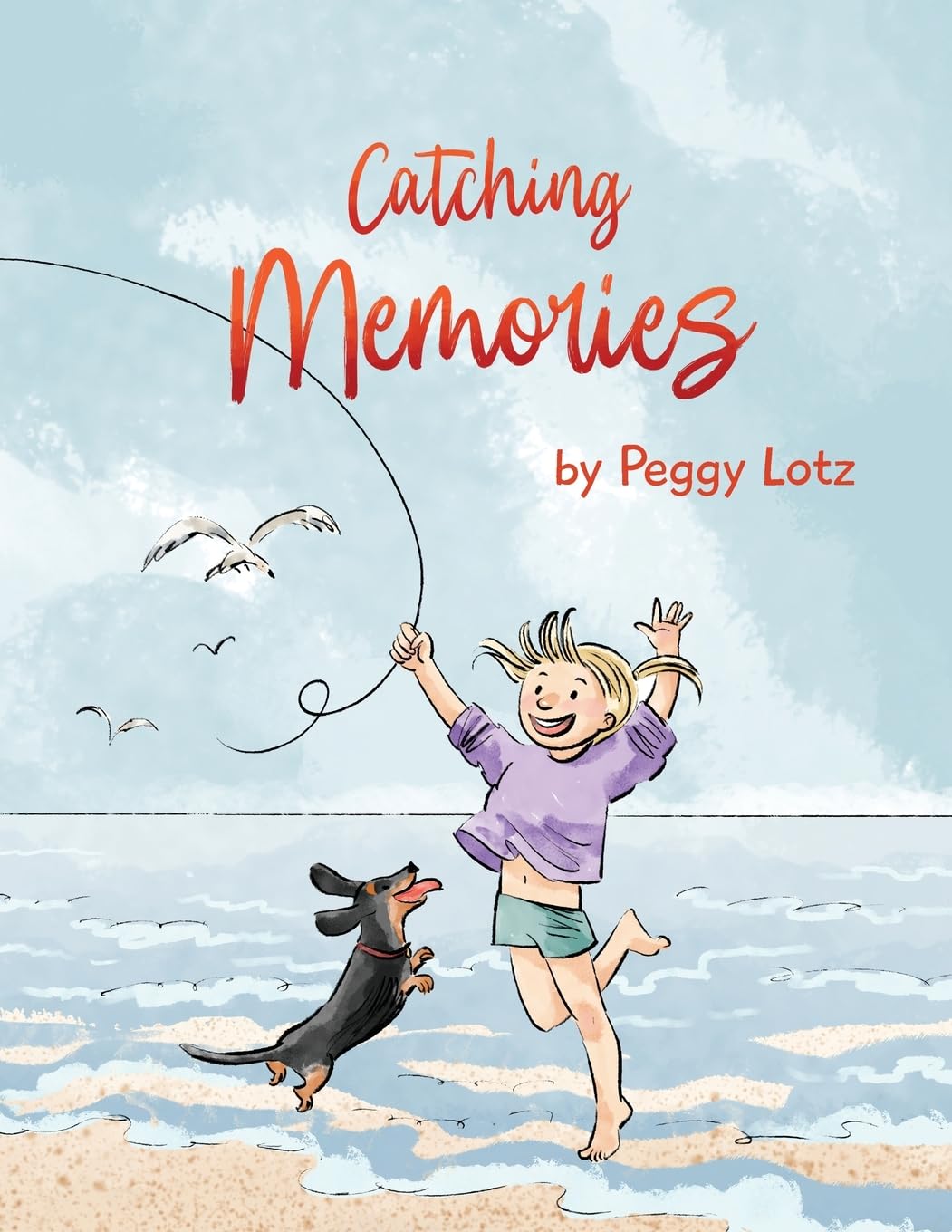
Peggy’s book is titled, “Catching Memories.” It’s about a unique childhood experience she had with our family (with Gayle and Peggy’s favorite brother, John, as key sibling figures), at Arch Cape, a beautiful beach on the Northern Oregon Coast. We spent many weekends at Arch Cape, as it was our maternal grandparents home.

The specific memory Peggy writes about was SO GOOD. I’m not sharing details. You’ll have to pay the big bucks, $14.99 on Amazon, to read the story. Here’s a link. Buy Catching Memories

Peggy just sent me a copy of an INCREDIBLY POSITIVE Falcon Review of her book. The review is great, because the book is great. I’m guessing Peggy did not bite the toe of the reviewer. I say this because right now I’m typing a great review and hoping Peggy will take notice:

“Catching Memories is a fabulous children’s book about a unique family experience, memories, and kindness. Peggy Lotz’s debut children’s book is written with so much love, affection, and grace that you would never suspect she tried to maim her younger brother. The book is so awesome that you’ll want a copy for your children or for yourself or both. Buy it now”

In case Peggy is reading this, I’m trying to make it clear that even though that Falcon Review guy wrote you a great review, I’ve just written and posted a rather fantastic review . . . AND you (Peggy) bit me. This fantastic review should make it clear that I’m better than that Falcon Press guy could ever hope to be . . . because the fact that I’m writing it for someone who bit me speaks to the sort of selfless and forgiving person I am. In summary: My sister bites my toe and I put aside the pain and write her a stellar review. If I haven’t made it obvious yet, I’m campaigning for the position of being Peggy’s favorite brother. Given that I’m her only brother, I have the inside track, but you can’t mess around with favorite brother stuff because one day, just when you think you’re on top of the world, the next minute your big sister might try to gnaw off your big toe with her big teeth.

All I’m saying here (Peggy), is that I’m your favorite brother. Forget about that Falcon Review guy. He’s not your brother. . . let alone your favorite!

In closing, if any of you care about me, please show it by buying a copy of my sister’s book.

Buy Catching Memories

P.S. Here’s the best thing. Peggy says there’s a chance that the marketing plan might involve creating “Gayle, Peggy, and John” dolls. . . which is simply the coolest idea ever.

If you’re curious about the original “Peggy Bit Me” story, just click here: https://johnsommersflanagan.com/2019/01/28/peggy-bit-me/

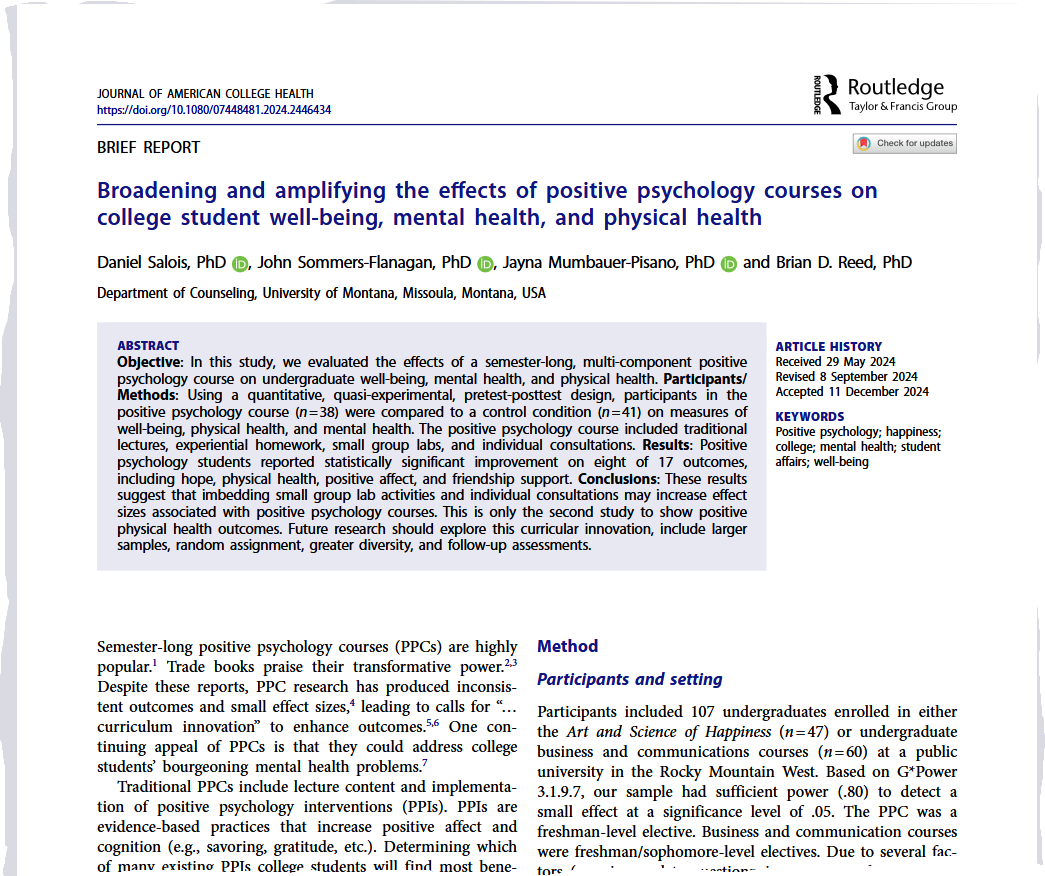
Publication Alert — Broadening and Amplifying the Effects of Positive Psychology Courses on College Student Well-Being, Mental Health, and Physical Health

We have more good news for 2025. At long last, we’ve published a research article based on Dr. Dan Salois’s doctoral dissertation. Congratulations Dan!

This article is part of growing empirical support for our particular approaches to teaching positive psychology, happiness, and how people can live their best lives. As always, I want to emphasize that our approach is NOT about toxic positivity, as we encourage people to deal with the deep conflicts, trauma, and societal issues that cause distress — while also teaching strategies for generating positive affect, joyspotting, and other practices derived from positive psychology.

One of the big takeaways from Dr. Dan’s dissertation is that our happiness class format may produce physical health benefits. Also, it’s important to note that this publication is from early on in our research, and that our later research (currently unpublished) continues to show physical health benefits. Exciting stuff!

Here’s a link to the article. My understanding from the publisher is that only the first 50 clicks on this link can read/view the whole article.
https://www.tandfonline.com/eprint/VXXD3ISCT7EUJ8WAM7UY/full?target=10.1080/07448481.2024.2446434

Banned Books, Critical Race Theory, and My Cold, Dead Hands

Book banning and book burning is an old strategy designed to control information. Stephen King—the famous author and Twitter presence (https://twitter.com/StephenKing)—recommends (I’m paraphrasing here) that everyone rush out and buy and read banned books, because they contain important knowledge.

I’ve been disappointed at efforts by state legislatures, governors, school superintendents, parents, and others who have been involved in book banning, as well as any or all of the above who have suggested that critical race theory (CRT) shouldn’t be taught in colleges and universities (it’s not really taught in any formal or in-depth way in K-12 schools, but even if it were, why not?).

CRT, books, and other sources of knowledge offer perspectives. A couple days ago, I received an email from a professor and student offering me feedback on a paragraph in our counseling theories text. From the student’s perspective, the paragraph felt anti-Semitic. I pulled up the paragraph on my computer, read it, and although I didn’t see it exactly the same way as the student, she had an important point—the passage could be taken in a negative way. I emailed the student and her professor and thanked them for the feedback, noting we’ll change that paragraph in the next edition.

One goal that Rita and I have in writing textbooks is to be inclusive, accessible, and non-racist/non-sexist. Although I’m sure we always fall short of our ultimate goal, in isolation and without feedback from others, we could never even come close to or make progress in accomplishing our inclusiveness goal. We were grateful to receive the feedback. Another goal we have is to keep learning. This experience, and many others, leads me to think that there may be no better way to learn, than to listen to the perspectives of others. Why not? Where’s the benefit in closing our ears and being defensive.

Just to be clear, I’m opposed to banning books; I’m opposed to limiting the teaching of CRT; and I’m opposed to other people trying to control information available to me and others. My best guess is that when other people try to control information, they probably fear the information. Why? I don’t know, but IMHO, putting our collective heads in the sand (this brings to mind the movie, “Don’t Look Up”) is NOT a particularly useful strategy for dealing with fears. 

I teach theories all the time. At the University of Montana, I’ve taught Theories of Counseling and Psychotherapy nearly every fall semester for many years. Rita and I have a textbook on theories of counseling and psychotherapy published by John Wiley & Sons. All the hubbub over CRT has convinced me that I need to commit myself to teaching more CRT concepts in my theories course. Like all theories, I’ll treat it like a theory we can learn from.

Last week we had a visit from a university faculty person from a state where professors are being coerced into not teaching CRT. Hearing him talk about this experience made me wonder how I’d handle it if I was told I shouldn’t teach CRT at UM. Obviously, I don’t know my exact response to that scenario, and I hope it never develops, but my best hypothesis, based on a little personal theorizing, is that I’d get fired or go to jail before I agreed to NOT teach CRT, because it’s a theory, a perspective (and not the only one), from which we should all strive to learn.

I know I’m being overly dramatic, but I strongly believe that learning from the perspectives of others is a good thing. I don’t plan on stopping. To steal (and modify) an old line from the NRA: I’ll give you my banned books and theories when you pry them from my cold, dead hands.

Just saying.