
Tag Archives: Arthur M. Blank

Exploring Your Eudaimonic Belongingness Sweet-Spot at West Creek Ranch

[Moon Rise at West Creek Ranch]

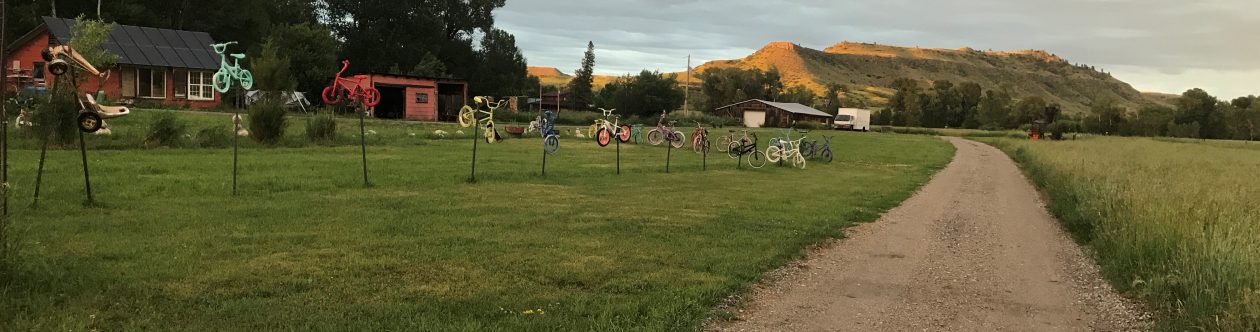
This past week I spent four days at West Creek Ranch, where I was forced to eat gourmet food, do sunrise yoga, experience a ropes course (briefly becoming a “flying squirrel”), watch a reflective horse session, dance away one night, hike in the beautiful Paradise Valley, and hang out, converse, and learn from about 25 very smart/cool/fancy people. Yes, it was a painful and grueling experience—which I did not deserve—but of which I happily partook.

On the first morning, I provided a brief presentation to the group on the concept of belonging, from the perspective of the Montana Happiness Project. Despite having shamefully forgotten to take off my socks during the sunrise morning yoga session, and having anxiety about whether or not I belonged with this incredible group of people, they let me belong. They also laughed at all the right moments during my initial mini-comedy routine, and then engaged completely in a serious reflective activity involving them sharing their eudaimonic belongingness sweet-spots with each other.

If you don’t know what YOUR eudaimonic belongingness sweet-spot is, you’re not alone (because hardly anyone knows what I mean by that particular jumble of words). That’s because, as a university professor, I took the liberty of making that phrase up, while at the same time, noting that it’s derived from some old Aristotelean writings. Yes, that’s what university professors do. Here’s the definition that I half stole and half made up.

That place where the flowering of your greatest (and unique) virtues, gifts, skills, talents, and resources intersect (over time) with the needs of the world [or your community or family].

I hope you take a moment to reflect on that definition and how it is manifest in who you are, and how you are in your relationships with others. If you’re reading this blog post, I suspect that you’re a conscious and sentient entity who makes a positive difference in the lives of others in ways that are uniquely you. Because we can’t and don’t always see ourselves as others see us, in our University of Montana Happiness course, we have an assignment called the Natural Talent Interview designed to help you gain perspective on your own distinct and distinctive positive qualities. You can find info on the Natural Talent Interview here: https://johnsommersflanagan.com/2023/12/26/what-do-you-think-of-me/

And my West Creek presentation powerpoint slides (all nine of them) are here:  

You may have missed the main point of this blog post—which would be easy because I’m writing like a semi-sarcastic and erudite runaway loose association train that’s so busy whistling that it can’t make a point. My main point is GRATITUDE. Big, vast, and immense gratitude. Gratitude for the Arthur M. Blank Family Foundation (AMBFF) and our massively helpful program officers. Gratitude for our retreat facilitators. Gratitude for the staff at West Creek Ranch. Gratitude for the presence of everyone at the gathering. And gratitude for the therapeutic feelings of belonging I had the luxury of ruminating on all week. My experience was so good that I’m still savoring it like whatever you think might be worth savoring and then end up savoring even more than you expected.

Thank you AMBFF and Arthur Blank for your unrelenting generosity and laser-focus on how we can come together as community and make the world a better place.

************

*Note: At the Montana Happiness Project, we do not support toxic positivity. What I mean by that is: (a) no one should ever tell anyone else to cheer up (that’s just offensive and emotionally dismissive), and (b) although we reap benefits from shifting our thinking and emotions in positive directions, we also reap similar benefits from writing and talking about trauma, life challenges, and social injustice. As humans, we are walking dialectics, meaning we grow from exploring the negative as well as the positive in life. We are multitudes, simultaneously learning and growing in many directions.

One Word to Describe Two Days at the Arthur M. Blank Family Foundation (AMBFF) Home Office

Shortly after Beth Brown, Managing Director of Mental Health and Well Being at The Arthur M. Blank Family Foundation (https://blankfoundation.org/) called the meeting to order, she asked us to introduce ourselves and share one word to represent how we were feeling in that moment. 

Having taught my fair share of group counseling and psychotherapy courses at the University of Montana, I immediately recognized Ms. Brown’s icebreaking trickery. The trickery is, while ostensibly asking about the emotional tone of participants, the “one word” question simultaneously evaluates participants’ ability and willingness to comply with group leader requests.

It was a raucous group. People immediately began bending, breaking, and straying from Ms. Brown’s one-word rule. Some participants took 30 words to introduce themselves; others took 50 words to frame the rationale for their one-word choice. One participant (who spoke second, and may or may not have been me), immediately displayed annoying attention-seeking behavior by interjecting an anecdote about the worst icebreaker activity ever in the history of time.

Had Sigmund Freud been a Mental Health and Wellness grantee (and therefore invited to the two-day event), he might have used the word delighted. Not only was the one-word activity intrinsically projective, Freud also once famously quipped,

Words were originally magic, and . . . retain much magical power, even today. With words people can make others blessed, or drive them to despair; by words the teacher transfers . . . knowledge to the pupil; by words the speaker sweeps away the audience and determines its judgments and decisions. Words call forth affects and are the universal means of influencing human beings [n.b., this is not a perfect quote because I engaged in minor editing to make Freud more quippy and less sexist].

I have some magic words to describe the participants. They were smart, fun, funny, dedicated, committed, clever, brilliant, generous, compassionate, empathic, connected, passionate, and cool. During Lyft rides, some of them even engaged with each other as if they were live podcasters. My particular program officer is so kind and generous that I now just think of her as Saint Natalie.

Words were the theme and the tool. On the afternoon of Day One Michael Susong, PR Lead at Intrepid, taught us how to use asset-based, instead of deficit-based words on our websites. His presentation was complemented by a gallery-walk through an adjacent room where life-sized word cloud posters of the words in our websites were set up and numbered; we perused the clouds, absorbing the language and seeking to discern which cloud belonged to which organization. I, of course, quickly found the Montana Happiness Project (MHP) word cloud, primarily because the biggest word was SUICIDE, which may or may not have implied that we (the MHP) have a bit of work to do on using more asset-based language on our website. I also felt jealousy because other organizations had way cooler words, like “Nintendo” and “LBGTQ+” and “Youth of color” and “Belonging.” 

At the close of Day 1, the prevailing descriptive words were “Tired” and “Exhausted” not principally, but partly because this was a group of people who had likely added this retreat into their already too busy lives and consequently were emailing and doing business-related calls during breaks and lunch and on the airplane the day before and possibly into the night.

Looking back at the previous paragraph, I notice I used the word “business” which connotes a particular entrepreneurial feel, which requires a particular explanation. All of the organizations and people in attendance had a shared passion for the business of helping others achieve greater well-being, mental health, and happiness. IMHO, that’s good business. . . which leads me to sharing a few words about the man behind the curtain.

We all convened at the Arthur M. Blank Foundation headquarters for two days because of one man’s business. That man is Arthur M. Blank, co-founder of Home Depot and owner of the Atlanta Falcons, the Atlanta United professional soccer club, and PGA Superstores. But along with his businesses, Arthur Blank has expanded his service mentality into the business of philanthropy. On the evening of the first day, Arthur Blank joined us as we listened to renowned Harvard researcher Robert Waldinger talk about the world’s longest study of Happiness [n.b., in his usual buoyantly optimistic style, Freud once noted that a main goal of psychotherapy is to move patients from neurotic misery, to common unhappiness].

Although I didn’t get a chance to meet Mr. Blank and impress him with my witty repartee, knowledge of icebreakers, or arcane Freudian quotes (I wish I could have told him, “Where id was, there shall ego be!), I did hear him speak. In one long, hyphenated word, I’d describe his message as gracious-supportive-humble-encouraging-empowering. Had Freud been there, he might have just said, “Arthur Blank’s words were magic.”

The Arthur Blank Foundation has given well over $500 million to philanthropic causes. None of this is required. Arthur Blank could take his money and keep it to himself and his family. Instead, he has embraced philanthropy. Arthur Blank also has a book titled “Good Company.” In a word (or maybe 20 words), if I were offering a New York Times Book Review (which will never happen because the NYT always rejects my editorial pieces, and yes, I’m clearly hanging on too tightly to my resentment toward the NYT), I’d describe his book as: A rather surprising treatise on companies doing values-based good work in the world as a part of a larger philosophy/vision of service-oriented capitalism paradoxically infused with egalitarianism in the workplace. In other (or additional) words, I enjoyed, appreciated, and valued the book and its philosophy WAY more than I expected. Now I want to become as wealthy as Arthur Blank so I can join him in contributing to the culture and welfare of places like West Atlanta, South Chicago, North Philly, Livingston Montana, and East Missoula.

In the end, Beth Brown asked us for a final, departing single word. I cleverly used my hyphenated last name as an excuse to say “overwhelmed-hopeful” but I might have just as easily used “connected-inspired” or “challenged-to-do-more-good” or “I’m-on-a-rocket-ship-headed-to-a-city-called-mental-health-and-wellbeing” or, given the fire of inspiration lit under my feet, I could have decided to demonstrate the worst icebreaker of all time, and just spell out my name and feelings with my hip movements.

Thank you, Arthur Blank, thank you to the AMBFF team, and thank you to the grantees. I am humbled by your generosity and vision of greater mental health and wellbeing for all.