Last Thursday and Friday I had a great time hanging out and learning with Montana educators at the annual MFPE Teacher Conference. Over two days we crammed in 16 continuing education hours. Following an initial Thursday morning organizational blip wherein I was sent to the wrong classroom twice and finally found someone in the hall to lead a couple lost teachers and me to the correct location, I discovered a packed classroom, with several teachers seated on the floor. I also discovered an incredibly dedicated, talented, and knowledgeable group of teachers who are immensely engaged in teaching and connecting with Montana students in ways that should humble us all . . . and inspire us to advocate for raising Montana teacher salaries.
On Thursday evening—after a full day of educational inspiration—my computer decided it was finished with the internet. Apparently my Wifi driver turned into toast (the technical term). Being disconnected from the internet (until Sunday evening) had its benefits, but it’s also why I’m only now posting the ppts for Day Two of the conference.
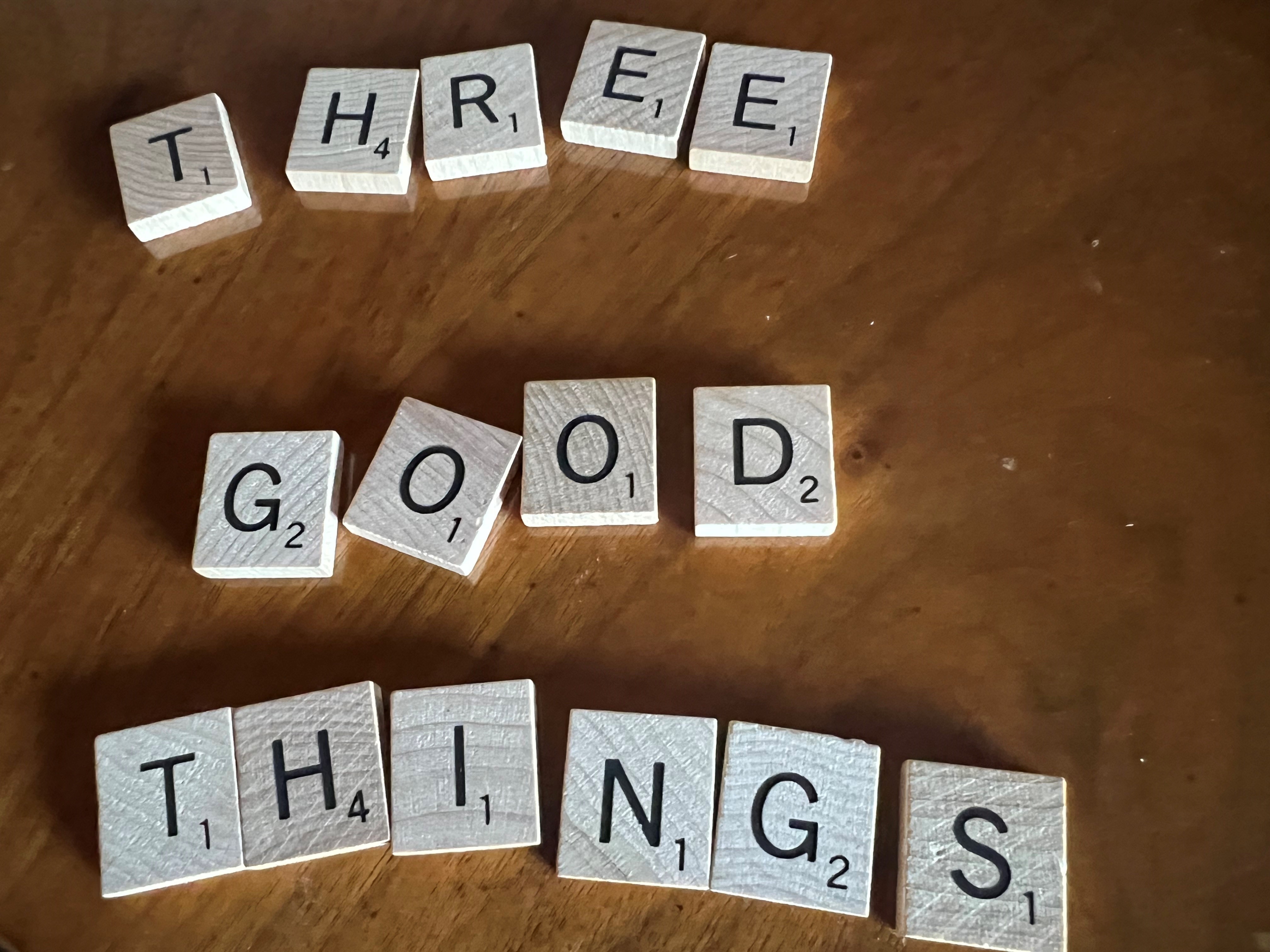
This week, for the Montana Happiness Challenge, we’re encouraging participants to experiment with Martin Seligman’s “Three Good Things” technique. Three good things (TGT) is an evidence-based positive psychology intervention. For example, six months of twice-weekly TGT has been shown to decrease burnout in nurses (Luo et al., 2019) and four weeks of unguided internet-based TGT reduced insomnia in adults (Sato et al., 2022). In Seligman’s (Seligman et al., 2005) original research, TGT had positive effects on mood and depression.
Like everything, TGT is not one-size fits all. You should use it in any way that works for you. You can start with Seligman’s instructions, and riff on it from there. For me, I like it best at 4am, when I wake up and my brain seems preoccupied with depressing things. If you want to listen to me talking about TGT, here’s a 5+ minute video: https://www.youtube.com/watch?v=45fsZMDMPOQ
If you want to read the long and winding version of this happiness activity, I’ve pasted it below the references. If not, just jump right in, try it out, and post your thoughts and reactions on your favorite social media platform.
References
Luo, Y., Li, H., Plummer, V., Cross, W. M., Lam, L., Guo, Y., . . . Zhang, J. (2019). An evaluation of a positive psychological intervention to reduce burnout among nurses. Archives of Psychiatric Nursing, 33(6), 186-191. doi:https://doi.org/10.1016/j.apnu.2019.08.004
Sato, D., Sekizawa, Y., Sutoh, C., Hirano, Y., Okawa, S., Hirose, M., . . . Shimizu, E. (2022). Effectiveness of unguided internet-based cognitive behavioral therapy and the three good things exercise for insomnia: 3-arm randomized controlled trial. Journal of Medical Internet Research, 24(2), 1-17. doi:https://doi.org/10.2196/28747
Seligman, M. E. P., Steen, T. A., Park, N., & Peterson, C. (2005). Positive psychology progress: Empirical validation of interventions. American Psychologist, 60(5), 410-421. doi:https://doi.org/10.1037/0003-066X.60.5.410
The link at the bottom of this post gives you access to powerpoints for day one of our Happiness for Educators course offered at the Montana Federation of Public Employees (MFPE) annual Teachers Conference.
This course is funded through a grant from the Arthur M. Blank Family Foundation (AMBFF). I’m grateful to AMBFF because the funding gives me the opportunity to work with some of the best people on the planet. I say this because my experience with educators in general, and Montana educators in particular, is phenomenal. If you’re an educator, THANK YOU for your incredible and essential service of teaching our youth.
Comments on the ppts. First, they don’t include the short videos that we’ll watch in class. Second, we may or may not get all the way through these slides . . . and that’s okay, because psychological flexibility is a sign of mental health. Third, the ppts for day two will be posted later.
Right now, maybe more than ever, there are plenty of places, spaces, and events in the world that evoke sadness, despair, anxiety, and hopelessness. Speaking for myself, I often feel the tug of despair, despite having so many people and things in my life for which I am grateful.
The purpose of the happy places activity is to expand awareness of places where we experience meaning, safety, support, and happiness. At the same time, the purpose is also to develop awareness of places, people, and contexts, that stimulate negative affect in us, such as anxiety and unhappiness. We want to be aware of how all the many dimensions of our environments influence us.
Although awareness is important, action is equally important. It’s easy to feel trapped by all the negative things happening around us and to us. Sometimes we need to push ourselves to intentionally move out of difficult places and spaces. This movement can happen mentally. As Victor Frankl wrote in his memoir about his concentration camp experiences, people can be wholly oppressed by external forces, and yet still exercise at least some mental freedom.
The happy places activity involves recognizing our power to intentionally move toward thoughts and places that are more pleasant and meaningful. As needed, when you need a break from your heavier work, you can take yourself to happier physical or mental places; you can take yourself to a pleasant mental space, or physically go somewhere—like the beautiful outdoors of Montana. Additionally, when we develop awareness of our unhappy, or unsafe spaces, we can prepare for and develop plans for dealing with those difficult places.
Below the dancing photo, you will find the long version of the happy places activity for this week. I hope you engage with it as you are able. And please, if you feel inspired, share some of what you experience with the rest of us, either here on this blog, or on one of the social media platforms listed below.
As for myself, after having a rather rough weekend, I will be infusing some thoughts and activities around the happy places concept. Good luck to you (and me).
Active Learning Assignment 3 – Three Happy Places
John Sommers-Flanagan
University of Montana
The environment, setting, or context we’re in will directly influence our mood and sense of well-being more often than we think. This is most obvious when we’re in settings or environments that we find aversive.
To start this assignment, reflect on environments, settings, or contexts that you find aversive. For example, you may find cloudy days, rain, smoky skies (or rooms), or the news (or particular news channels) aversive or uncomfortable. Other people might find churches, schools, gyms, or libraries aversive. Your context or environment can also include people. You probably find being with some people easy, and with other people, it’s much less easy.
Often, we label particular environments, contexts, smells, and people as emotionally “triggering.” Naturally, we often feel like avoiding emotionally triggering environments. Sometimes that’s possible. However, if you VALUE something enough (e.g., supporting your loved ones, or being involved in a theatre performance, or camping), you may be VERY WILLING to face and work through anxiety or other situationally-based emotional triggers (e.g., a natural disaster, fear of public speaking, or a bear phobia), to be with the people or do the things that you VALUE. More on this later.
Now, consider the opposite: What environments, settings, contexts, or people do you find pleasurable, comforting, or energizing? In Montana, many of us think of the outdoors, or the natural environment. In fact, researchers report that, in general, more time in the outdoors is linked to increased feelings of well-being and mental health.
The main point of this assignment is for you to explore and increase your awareness of “Your happy places.” Additionally, because we can’t always be in our happy places, we also encourage you to explore, increase your awareness of, and develop a personal coping plan for the situations, contexts, and people that you find triggering. As noted above, sometimes we want to face our fears or emotional triggers. If so, knowing yourself and making a coping plan can help.
After reading and reflecting on the above, contemplate, or write a few words, in response to the following prompts:
List three settings that usually trigger negativity or discomfort in you.
List three settings that usually trigger happiness and wellbeing in you (and be specific). These are your happy places
What can you do to prepare for or cope with challenging settings that usually cause you discomfort? (Other than avoiding them)
What can you do to increase the frequency of time you spend in environments that contribute to your feelings of wellness?
What can you do to create places or spaces in your mind that you can use (anywhere and anytime) to increase your sense of comfort and wellness in the moment?
Yesterday I had the honor of presenting for the Mental Health Academy’s Mental Health Super Summit. My presentation, titled “Interviewing for Happiness: How to Weave Positive Psychology Magic into the Initial Clinical Interview” is still available, along with the other presentations, through this link: https://www.mentalhealthacademy.com.au/summit. There were 24 hours of possible continuing education for an incredibly low cost. Presenters included, Dr. Judith Beck and Dr. Cirecie West-Olatunji Professor, Xavier University of Louisiana, and me! You can access my powerpoints here:
Participating in this event was an honor also because the event is a fundraiser for “Act for Kids,” an Australian charity “that delivers evidence-led professional therapy and support services to children and families who have experienced or are at risk of harm.” Over $110K has already been raised. Here’s the Act for Kids link: https://www.actforkids.com.au/.
In the piece I review some information and make one point that I’d like to share more broadly. Below are several opening paragraphs from the Op-Ed piece.
*Beginning of Excerpt*
Beyond Suicide Prevention: The Montana Happiness Challenge
John Sommers-Flanagan, Ph.D.
All September, organizations and individuals celebrated suicide prevention month, sharing information about suicide and promoting strategies for preventing suicide deaths. Although the information was life-affirming, underneath the messaging lies an unpleasant truth: Broadly speaking, suicide prevention has been failing for over two decades.
In August, the Centers for Disease Control (CDC) released provisional United States suicide data for 2022. The news was bad. An estimated 49,449 Americans died by suicide in 2022—the highest number ever recorded in U.S. history.
The bad news goes far beyond last year. Suicide rates have risen every year for over 20 years, with only two puzzling exceptions. In 2020 and 2021—during the onset of COVID-19, lockdowns, and other national stressors—suicide rates declined; they declined despite the fact that by every other measure Americans were suffering from unprecedented stress, depression, anxiety, and suicidal thinking. Suicide researchers have long noted this odd pattern: higher stress, depression, anxiety, and suicidal thinking do not inevitably translate to more suicides.
If all this seems confusing—20 years of vigorous suicide prevention, and suicide rates steadily rise, while during 2 years of intensive COVID-related individual and public distress, suicide rates go down—it’s only because it is.
In his book, Rethinking suicide, Craig Bryan, a renowned suicide researcher, called suicide “a wicked problem,” noting, “Wicked problems cannot be definitively solved or completely eliminated . . .” In fact, as Bryan and others have described, efforts to eliminate wicked problems sometimes make them worse. The preceding facts don’t indicate suicide prevention doesn’t work . . . and they don’t mean COVID pandemics solve the suicide problem. What they do mean—at minimum—is that suicide prevention doesn’t work for everyone, and we need to collectively think differently about this wicked problem.
Suicide prevention ideology over-focuses on eliminating “bad” or negative thinking and behavior. This conceptualization is contrary to science and common sense. The science says that telling people to stop engaging in unhealthy behaviors usually doesn’t work. When people are judged and told they should change, they often become defensive and more resistant to change. This is human nature.
All this brings me to share one strategy for moving beyond traditional suicide prevention. We should put more energy into growing and nurturing positive and meaningful thoughts and behaviors. People are more likely to change if they’re accepted for who they are, and then invited to try something interesting.
*End of Excerpt*
If you read the preceding and have a reaction, I’d love to hear your thoughts on how, with increasing suicide prevention focus, the suicide deaths keep increasing, and why, during the two worst years of COVID, suicide deaths decreased. Feel free to post on this blog or pop me an email.
This week, for the Montana Happiness Challenge, we’re focusing on adopting a mindset where we look for joy or for what inspires us. Last week I did a day-long training on Suicide Assessment and Treatment with professionals in Canada. At the end of the day, I was inspired that they took a full-day to learn about something so hard and challenging. Similarly, if you got through this whole blog because of your interest in making the world a better place, you inspire me.
If you want to keep up with the Montana Happiness Challenge, here are some clickable options:
Why is it so easy to look for and focus in on that which annoys us . . . and so hard to look for and focus in on that which inspires us?
Nobody really knows the answer. There’s the usual speculation about evolution and potty training, but trying to find out “Why?” life is the way it is, is frustrating, as most 3-year-olds discover when they begin repeatedly asking their caregivers the Why question.
One thing is certain, if we want to focus on joy, inspiration, and small stuff that makes a positive difference, we have to be intentional. The default setting in most of our brains is to look for what’s wrong.
For this week’s Montana Happiness Challenge, we’re we’re encouraging everyone to intermittently and intentionally look for what’s right and good and inspiring. We know there is war, poverty, racism, climate change, and other big and horrible issues out there and we’re not suggesting you put your head in the sand and ignore these important problems. What we are suggesting is that you just direct your attention . . . a little more often . . . in the direction of the positive. #MHPHappinessChallenge #MontanaHappiness #WitnessInspiration
The research on mindsets is so immense that no one even bothers arguing about whether mindsets matter. They do. We all know it. Mindsets influence our performance, our success, and how we feel. That’s the good news.
The bad news is that it’s all-natural to automatically adopt negative mindsets. If you’re in a bad mood or mental state, you’ll find it easier to “see” things consistent with your bad mood.
The human psyche naturally and automatically looks for evidence to confirm what we already believe. At the same time, we tend to overlook, ignore, or dismiss whatever is inconsistent with our existing beliefs. Researchers and writers call this Confirmation bias.
Confirmation bias is everywhere, in everyone, and operating all the time. According to Brittanica.com, the formal definition is: “People’s tendency to process information by looking for, or interpreting, information that is consistent with their existing beliefs. This biased approach to decision making is largely unintentional, and it results in a person ignoring information that is inconsistent with their beliefs.” An example:
If you believe your parents or partner are hyper-critical of you, you will watch and listen for evidence to confirm your belief and be more likely to witness and experience them being critical. You will also tend to overlook or miss out noticing when they’re positive and affirming of you.
This week’s activity involves you intentionally shifting your mindset. Your goal is to look for small things that feel positive. In our University of Montana happiness class, we gave this assignment over Martin Luther King, Jr. weekend and called it: “Witness something inspiring.” We asked students to spend the weekend watching for inspirational moments in real life (not online). Students reported small and glorious outcomes, including:
A friend using good study skills
Watching my dog play in the yard
Seeing my co-worker treat a rude customer with respect
Noticing a high school student chat with a very old woman
Mindset shifting has other names. For example, in her book, Joyful, Ingrid Fetell Lee described “Joyspotting.” Joyspotting is a visual version of orienting yourself to that which brings you joy.
This week, your job is to intentionally watch, listen, and observe for things you find inspirational. If you don’t like the word inspirational, you can switch it out for joyspotting, and head out in search of joy. Although you could do an online search for “Inspirational,” we hope you’ll watch for inspiring or joyful moments in the real world.
What you notice may be small or big. The key point is to put your brain on intentional alert for that which will inspire or stimulate joy. Keep your sensory modalities open to the positive.
One warning: It’s natural to dismiss or disqualify small positive things you notice. You may see someone do something small (like hold open a door) and then quickly dismiss it as “no big deal.” For this week, try to avoid dismissing the small bright spots. Notice them, linger on them, and see what happens.
If you’re into the social media part of this challenge, we hope you’ll share your experiences. Using your favorite social media platform, consider sharing:
What it was like to intentionally watch for inspiration.
A description of what you observed.
Reactions you had to the inspirational event.
Anything else you want to add.
You can do this activity all on your own, or you can do it with a friend, a class, or a community.
Good luck . . . we look forward to your inspirational stories.
I like knowing a little trivia. It’s probably related to wanting to maintain a positive view of myself. If I know a little trivia, maybe that makes me more competent.
Trivia of the day: Hardly any of you know that my friends Mike Bevill, Neil Balholm, Greg Hopkins, and I invented Karaoke in Mike Bevill’s basement back in 1974. Neil had a portable microphone system. We’d plug it in, put on background music, and belt out tunes, as if we were Crosby, Stills, Nash, Young, Bevill, Balhoum, Hopkins, and Sommers. We created a fake band, named ourselves the “Nugget Brothers,” and sang with great enthusiasm, but little talent, along with a variety of pop musicians.
One odd outcome of this was my continued preoccupation with creating fake bands into and after college, despite nearly complete lack of talent. As an example of the awkwardness of youth, I could “fake perform” to large groups, but I was unable to speak up in classes. Weird, I know. My guess is it was safer to publicly perform with no talent that it was to do so in areas where I was serious.
Here’s a photo attesting to my fake band performance legacy.
As a part of the Montana Happiness Challenge, we’ve been encouraging people to share their favorite songs. . . and now we’re taking it to the next step. Please, if you will, share yourself singing a song that makes you happy, or that you find meaningful. Post it on social media and give us a tag or hashtag: #MHPHappinessChallenge or #MontanaHappiness.
You may wonder, other than embarrassment and social media humiliation, what’s the point? The point is that singing is nearly always therapeutic, partly because of what’s happening in the brain. Think about it.
Singing involves movement, creativity, feedback and adjustment, listening, planning, memory, and language. Some researchers emphasize that singing triggers the release of the so-called “feel-good” neurotransmitter dopamine, which is a limited view, because there’s also more serotonin at the synapse, an oxytocin shower, and more or less involvement by 100s of other neurotransmitters, neuromodulators, and brain structures (including, but not limited to the hippocampus, insula, frontal lobe, Wernicke’s region, occipital cortex, and motor cortex). If you want to light up your brain, sing!
For the Montana Happiness Challenge, we highly recommend singing out loud. Although we would love to watch and listen to you singing on social media, if that’s not your thing, go ahead and sing in the shower, while housecleaning, in the car, or anywhere else you can let your joy happen.
One last point. Research on positive emotions indicate that we don’t need to have BIG positive emotions to experience happiness and well-being benefits. What’s important is to weave in many intermittent small positive emotions. IMHO, singing privately or publicly is one way to give yourself frequent positive emotional boosts.
For my part, I’ve recorded three videos on my social media singing. These videos are silly and embarrassing, which I’m completely embracing. I got nervous for each of these videos and didn’t even say all of what I planned to say. Feel free to skip them and/or #neverspeakofthem.
Thanks for reading this. Please share everything you can about the Montana Happiness Project. Our goal is to reach MANY people with free ideas about positive emotions and meaningful happiness.
Today is the official launch of the Montana Happiness Challenge. For the next 20 weeks we’ll be trying to spread happiness from social media into classrooms, kitchens, boardrooms, ballrooms, and everywhere else you’ll help us spread it.
The concept is simple.
Happiness takes work and involves behavior. We’re not JUST talking about “smiley” hedonic happiness; we’re also talking about eudaimonic, meaning-filled happiness.
Today’s activity involves music. You can interpret this and share this in nearly any way you like. You can just post your #Happysong somewhere, or share it with a friend, family, coworker, or classroom. You can also sing. . . and post it on Youtube or Facebook or Insta or wherever you like. You can include our cumbersome hashtags #MHPHappinessChallenge and #MontanaHappiness and Tag us, or just stay quiet. But, if you like, don’t shy away from posting photos of yourself singing, even if they’re slightly embarrassing, like this one.
Below is the full description of the first Happiness Activity. Please engage and experience and experiment as you wish. . . all week long!
Happiness Activity 1 – Music, Mood, and Meaning
John Sommers-Flanagan, Ph.D.
University of Montana
Music in general, and songs in particular, trigger happiness, sadness, other emotions, and life memories. Sometimes our emotional responses to music are all about the music. Other times our emotional responses are about personal emotions and memories that the songs trigger. For example, when I listen to “Joy to the World” by Three Dog Night, I’m transported back to positive memories I had playing 9th grade basketball. The song, “Put the Lime in the Coconut” by Harry Nilsson will forever take me back to a car accident with my sister in 1973. It’s not unusual for us to turn to music for help regulating our emotions, or to deepen particular feelings. The connection between music and mood is so powerful that psychological researchers frequently use music when they want to manipulate the mood of their research participants.
For this assignment, do the following:
Part One: Your Happy Song(s)
Select a song or songs that trigger positive emotions. We’ll call that your #HappySong.
Listen to your happy song once or twice, or whatever it takes to let the song do its work. You can do this with your family or a friend or by yourself. Consider how you might use that song to intentionally elevate your mood.
At minimum, share your #HappySong on social media or with your friends/family. You can just share the name and artist, provide a link to the song.
Because creating music and singing can be especially powerful, consider making a clip of yourself performing your #HappySong.
If you want to get deeper, you can share on your favorite social media platform why that’s a happy song for you or how you use it as a “go-to” happy song when you need an emotional lift, or you can share your personal memories around the song.
Part Two: Your Meaningful Songs
Sometimes music gives us an emotional boost. Other times, it helps us go deeper into challenging emotions or allows us to find meaning in hard times. When I was struggling in graduate school, I would often listen to Paul Simon’s “American Tune” or “Immigrant Song.” I very much resonated with these (and other) lyrics “I don’t know a dream that’s not been shattered, or driven to its knees.” Often the tears would flow. [I love this version, with Simon and Rhiannon Giddens: https://www.youtube.com/watch?v=67pyIglP79U]
For the meaning part of this activity, consider the following:
Share a song that holds meaning for you. This might be a song you listen to when feeling sad or angry or scared. While I was teaching a Happiness Class at the University of Montana, a student shared a beautiful song by Mandoline Orange (now Watchhouse) titled, “Golden Embers” Golden Embers is about the death of the singer’s mother. My mother died not long after I heard this song, and even though the lyrics don’t perfectly fit my experience or my mother, when I listen I think of her and let myself feel the grief I have around the loss of her presence in my life and in the world. You can listen to Golden Embers here: https://www.youtube.com/watch?v=fEt2lf7L13g
As with the Happy Songs above, you can just share the song with your friends/family/colleagues or share it on your favorite social media platform. You can also go into details about why the song is emotionally meaningful for you. Do this is whatever way you find meaningful and share what you’re comfortable sharing.
Obviously, this is a much more vulnerable activity than the Happy Song version . . . and so participate only to the extent that feels okay for you. Also, if you notice others posting their emotionally meaningful songs, please find ways to offer support and respect for their insights and vulnerability.
Thanks for reflecting on how music affects our emotions, life meaning, and quality of life. I hope you’ll stay tuned for our next Happiness Activity coming out Sunday, October 8.
P.S.: for those of you who want to read more about music, mood, and meaning, here’s a recent Washington Post article, compliments of Lillian Martz from the University of Montana:
Back in the day, I was so into person-centered (aka nondirective) listening that I coauthored a 1989 article in the journal Teaching of Psychology titled, “Thou Shalt Not Ask Questions.” The point was that by temporarily eliminating questions from our therapeutic repertoire, we grow more aware of how to listen without using directive methods for facilitating client talk.
I’m still a fan of limiting therapist questions, if only to become more aware of their power. Even in the case of solution-focused or narrative therapies, when questions are the central therapeutic strategy, we should be as person-centered as possible when asking questions.
Below, I’ve included an excerpt of our coverage of listening from the forthcoming 7th edition of Clinical Interviewing. In the early 1990s, along with the first edition of Clinical Interviewing, we described a concept called the listening continuum. The excerpt starts there and then focuses in on what’s likely the most non-directive skill of all, therapeutic silence.
Here’s the excerpt. I hope you enjoy it and find it useful.
The Listening Continuum in Three Parts
Nondirective listening behaviors give clients responsibility for choosing what to talk about. Consistent with person-centered approaches, using nondirective behaviors is like handing your clients the reins to the horse and having them take the lead and choose where to take the session. In contrast, directive listening behaviors (Chapter 5) and directive action behaviors (Chapter 6) are progressively less person-centered. These three categories of listening behaviors (and the corresponding chapters) are globally referred to as the listening continuum. To get a visual sense of the listening continuum, see Table 4.1.
Nondirective Listening Behaviors on the LEFT Edge (Chapter 4)
Directive Listening Behaviors in the MIDDLE (Chapter 5)
Directive Action Behaviors on the RIGHT Edge (Chapter 6)
Attending behaviors or minimal encouragers
Feeling validation
Closed and therapeutic questions
Therapeutic silence
Interpretive reflection of feeling
Psychoeducation or explanation
Paraphrase
Interpretation (classic or reframing)
Suggestion
Clarification
Confrontation
Agreement/disagreement
Reflection of feeling
Immediacy
Giving advice
Summary
Open questions
Approval/disapproval
Urging
The ultimate goal is for you to use behavioral skills along the whole listening continuum. We want you to be able to apply these skills intentionally and with purpose. That way, when you review a video of your session with a supervisor, and your supervisor stops the recording and asks, “What exactly were you doing there?” you can respond with something like this:
I was doing an interpretive reflection of feeling. The reason I chose an interpretive reflection is that I thought the client was ready to explore what might be under their anger.
Trust us; this will be a happy moment for both you and your supervisor.
Hill (2020) organized the three listening continuum categories in terms of their primary purpose:
We hope you still (and will always) remember the Rogerian attitudes and have placed them firmly in the center of your developing therapeutic self. In addition, at this point we hope you understand the two-way nature of communication, the four different types of attending behaviors, and how your listening focus can shift based on a variety of factors, including culture and theoretical orientation.
Next, we begin coverage of technical skills needed to conduct a clinical interview. See Table 4.2 for a summary of nondirective listening behaviors and their usual effects. Having already reviewed attending behaviors, we now move to therapeutic silence.
Therapeutic Silence
Most people feel awkward about silence in social settings. Some researchers have described that therapists-in-training view silence as a “mean” response (Kivlighan & Tibbits, 2012). Despite the angst it can produce, silence can be therapeutic.
Therapeutic silence is defined as well-timed silence that facilitates client talk, respects the client’s emotional space, or provides clients with an opportunity to find their own voice regarding their insights, emotions, or direction. From a Japanese perspective,
Silence gives forgiveness and generosity to human dialogues in our everyday life. Without silence, our conversation tends to easily become too clever. Silence is the place where “shu”… (to sense the feeling of others, and forgive, show mercy, absolve, which represents an act of benevolence and altruism) arises, which Confucius said was the most important human attitude. (Shimoyama, 1989/2012, p. 6; translation by Nagaoka et al., 2013, p. 151)
Table 4.2 Summary of Nondirective Listening Behaviors and Their Usual Effects
Listening Response
Description
Primary Intent/Effect
Attending behaviors
Eye contact, leaning forward, head nods, facial expressions, etc.
Facilitates or inhibits client talk.
Therapeutic silence
Absence of verbal activity
Allows clients to talk. Provides “cooling off ” or introspection time. Allows clinician time to consider next response.
Paraphrase
Reflecting or rephrasing the content of what the client said
Assures clients that you heard them accurately and allows them to hear what they said.
Clarification
Restating a client’s message, preceded or followed by a closed question (e.g., “Do I have that right?”)
Clarifies unclear client statements and verifies the accuracy of what the clinician heard.
Reflection of feeling
Restatement or rephrasing of clearly stated emotion
Enhances clients’ experience of empathy and encourages further emotional expression.
Summary
Brief review of several topics covered during a session
Enhances recall of session content and ties together or integrates themes covered in a session.
Silence also allows clients to reflect on what they just said. Silence after a strong emotional outpouring can be therapeutic and restful. In a practical sense, silence also allows therapists time to intentionally select a response rather than rush into one.
In psychoanalytic psychotherapy, silence facilitates free association. Psychoanalytically oriented therapists use role induction to explain to clients that psychoanalytic therapy involves free expression, followed by occasional therapist comments or interpretations. Explaining therapy or interviewing procedures to clients is always important, but especially so when therapists are using potentially anxiety-provoking techniques, such as silence (Meier & Davis, 2020).
CASE EXAMPLE 4.2: EXPLAIN YOUR SILENCE
While on a psychoanalytically oriented internship, I (John) noticed one supervisor had a disturbing way of using silence during therapy sessions (and in supervision). He would routinely begin sessions without speaking. He sat down, looked at his client (or supervisee), and leaned forward expectantly. His nonverbal behavior was unsettling. He wanted clients and supervisees to free associate and say whatever came to mind, but he didn’t explain, in advance, what he was doing. Consequently, he came across as intimidating and judgmental. The moral of the story: Use role induction—if you don’t explain the purpose of your silence, you risk scaring away clients.
[End of Case Example 4.2]
Examples of How to Talk About Silence
Part of the therapist’s role involves skilled explanations of process and technique. This includes talking about silence. Case Example 4.2 is a good illustration of how therapist and client would have been better served if the therapist had explained why he started his sessions with silence.
Here’s another example of how a clinician might use silence therapeutically:
Katherine (they/them) is conducting a standard clinical intake interview. About 15 minutes into the session the client begins sobbing about a recent romantic relationship break-up. Katherine provides a reflection of feeling and reassurance that it’s okay to cry, saying, “I can see you have sad feelings about the break-up. It’s perfectly okay to honor those feelings in here and take time to cry.” They follow this statement with about 30 seconds of silence.
There are several other ways Katherine could handle this situation. They might prompt the client,
Let’s take a moment to sit with this and notice what emotions you’re feeling and where you’re feeling them in your body.
Or they might explain their purpose more clearly.
Sometimes it’s helpful to sit quietly and just notice what you’re feeling. And sometimes you might have emotional sensations in a particular part of your body. Would you be okay if we take a few moments to be quiet together so you can tune in to your emotions and where you’re feeling them?
In each of these scenarios, Katherine explains, at least briefly, the use of silence. This is crucial because when clinicians are silent, pressure is placed on clients to speak. When silence continues, the pressure mounts, and client anxiety may increase. In the end, clients may view their experience with an excessively silent therapist as aversive, lowering the likelihood of rapport and a second meeting.
Guidelines for Using Silence Therapeutically
Using silence may initially feel uncomfortable. With practice, you’ll increase your comfort level. Consider the following suggestions:
When a client pauses after making a statement or after hearing your paraphrase, let a few seconds pass rather than jumping in verbally. Given an opportunity, clients can move naturally into important material without guidance or urging.
As you’re waiting for your client to resume speaking, tell yourself that this is the client’s time for self-expression, not your time to prove you can be useful.
Try not to get into a rut regarding silence. When silence occurs, sometimes wait for the client to speak next and other times break the silence yourself.
Be cautious with silence if you believe your client is confused, psychotic, or experiencing an acute emotional crisis. Excessive silence and the anxiety it provokes can exacerbate these conditions.
If you feel uncomfortable during silent periods, use attending skills and look expectantly toward clients. This helps them understand it’s their turn to talk.
If clients appear uncomfortable with silence, give them instructions to free associate (e.g., “Just say whatever comes to mind”). Or you can use an empathic reflection (e.g., “It’s hard to decide what to say next”).
Remember, sometimes silence is the most therapeutic response available.
Read the interview by Carl Rogers (Meador & Rogers, 1984). It includes examples of how Rogers handled silence from a person-centered perspective.
Remember to monitor your body and face while being silent. There’s a vast difference between a cold silence and an accepting, warm silence. Much of this difference results from body language and an attitude that welcomes silence.
Use your words to explain the purpose of your silence (e.g., “I’ve been talking quite a lot, so I’m just going to be quiet here for a few minutes so you can have a chance to say whatever you like”). Clients may be either happy or terrified at the chance to speak freely.
The place to click if you want to learn about psychotherapy, counseling, or whatever John SF is thinking about.









 John Sommers-Flanagan