Last week was about emotional journaling. This week, we stick with the power of words and writing and take a dive into an evidence-based therapeutic writing activity called the Best Possible Self.
You all already know about optimism and pessimism.
Some people see the glass half full. Others see the glass half empty. Still others, just drink and savor the water, without getting hung up on how much is in the glass. Obviously, there are many other responses, because some people spill the water, others find a permanent water source, and others skip the water and drink the wine or pop open a beer.
Reducing people to two personality types never works, but that doesn’t stop people from labeling themselves or others as optimists or pessimists. This week’s activity—The Best Possible Self—is an optimism activity. You don’t have to be a so-called optimist to use it. And the good news is, regardless of your labels, the Best Possible Self writing activity is supposed to crank up your sense of optimism. That’s cool, because generally speaking, optimism is a good thing. Here’s what the researchers say about the Best Possible Self (BPS) activity.
[The following is summarized from Layous, Nelson, and Lyubomirsky, 2012]. Writing about your Best Possible Self (also seen as a representation of your goals) shows long-term health benefits, increases life satisfaction, increases positive affect, increases optimism, and improves overall sense of well-being. Laura King, a professor at U of Missouri-Columbia developed the BPS activity.
King’s original BPS study involved college students writing about their Best Possible Selves for 15 minutes a day for two weeks. The process has been validated with populations other than college students. If you want to jump in that deep, go for it. On the other hand, if you want a lighter version, here’s a less committed alternative:
Spend 10 minutes a day for four consecutive days writing a narrative description of your “best possible future self.”
Pick a point in the future – write about what you’ll be doing/thinking then – and these things need to capture a vision of you being “your best” successful self or of having accomplished your life goals.
As with all these activities, monitor your reactions. Maybe you’ll love it and want to keep doing it. Maybe you won’t.
If you feel like it, you can share some of your #writing on social media.
Berkeley’s Greater Good website includes a nice summary of the BPS activity. Here’s a pdf from their website:
Being a counseling and psychotherapy theories buff, I should mention that this fantastic assignment is very similar to the Adlerian “Future Autobiography.” Adler was way ahead of everyone on everything, so I’m not surprised that he was thinking of this first. Undoubtedly, Adler saw the glass half full, sipped and savored his share, and then shared it with his community. We should all be more like Adler.
The following excerpt is from our freshly published textbook, Clinical Interviewing (2024, 7th edition, Wiley).
What Is a Clinical Interview?
Clinical interviewing is a flexible procedure that mental health professionals use to initiate treatment. In 1920, Jean Piaget first used the words “clinical” and “interview” together in a way similar to contemporary practitioners. He believed existing psychiatric interviewing procedures were inadequate for studying cognitive development in children, so he invented a “semi-clinical interview.”
Piaget’s approach was novel. His semi-clinical interview combined tightly standardized interview questions with unstandardized or spontaneous questioning to explore the richness of children’s thinking processes (Elkind, 1964; J. Sommers-Flanagan et al., 2015). Interestingly, the tension between these two different interviewing approaches (i.e., standardized vs. spontaneous) continues today. Psychiatrists and research psychologists primarily use structured, or semi-structured clinical interviewing approaches. Structured clinical interviews involve asking the same questions in the same order with every client. Structured interviews are designed to gather reliable and valid assessment data. Virtually all researchers agree that a structured clinical interview is the best approach for collecting reliable and valid assessment data.
In contrast, clinical practitioners, especially those who embrace post-modern and social justice perspectives, generally use less structure. Unstructured clinical interviews involve a subjective and spontaneous relational experience. These less structured relational experiences are typically used to collaboratively initiate an assessment or counseling process. Murphy and Dillon (2015) articulated the latter (less structured) end of the interviewing spectrum:
We believe that clinical interviewing is—or should be—a conversation that occurs in a relationship characterized by respect and mutuality, by immediacy and warm presence, and by emphasis on strengths and potential. Because clinical interviewing is essentially relational, it requires ongoing attention to how things are said and done, as well as to what is said and done. . . . we believe that clinicians need to work in collaboration with clients . . . (p. 4)
Research-oriented psychologists and psychiatrists who value structured clinical interviews for diagnostic purposes would likely view Murphy and Dillon’s description of this “conversation” as a bane to reliable assessment. In contrast, clinical practitioners often view highly structured diagnostic interviewing procedures as too sterile and impersonal. Perhaps what’s most interesting is that despite these substantial conceptual differences—differences that are sometimes punctuated with passion—structured and unstructured approaches represent legitimate methods for conducting clinical interviews. A clinical interview can be structured, unstructured, or a thoughtful combination of both. (See Chapter 11 for a discussion of clinical interviewing structure.)
Formal definitions of the clinical interview emphasize its two primary functions or goals (J. Sommers-Flanagan, 2016; J. Sommers-Flanagan et al., 2020):
Assessment
Helping (including referrals)
To achieve these goals, all clinical interviews involve the development of a therapeutic relationship or working alliance. Optimally, the therapeutic relationship provides leverage for obtaining valid and reliable assessment data and/or providing effective interventions.
With all this background in mind, we define clinical interviewing as…
a complex, multidimensional, and culturally sensitive interpersonal process that occurs between a professional service provider and client. The primary goals are (a) assessment and (b) helping. To achieve these goals, clinicians may emphasize structured diagnostic questioning, spontaneous talking and listening, or both. Clinicians use information obtained in an initial clinical interview to develop a collaborative case formulation and treatment plan.
Given this definition, students often ask: “What’s the difference between a clinical interview and counseling or psychotherapy?” This is an excellent question that deserves a nuanced response. . . . [to be continued]
When I was teaching social skills to elementary school-aged youth, one boy couldn’t stop talking about himself. Because I wanted the students to be interactive with and interested in each other, I intervened.
“Ask a question about her.”
He nodded, in apparent understanding. Returning to the activity, he followed my instructions (sort of), immediately asking,
“What do you think of me?”
The question, “What do you think of me?” is powerful. We all wonder this, at least occasionally, and perhaps constantly. As I just wrote in a previous blog post, being seen and known by others is a profound experience. Having your strengths and positive qualities reflected back to you by others is a gift: https://johnsommersflanagan.com/2023/12/25/the-gift-of-being-seen/
The Natural Talent Interview requires vulnerability; it’s a challenging and potentially awkward assignment. I recommend it anyway. 😲
Here’s a link to the version of the Natural Talent Interview that we assign in the Happiness Course. Note: It includes a nice description of self-awareness and the Johari Window.
Rylee said there was an internet thing going around about how men should be more like women and start complimenting each other. Then we watched “Rye Lane” (two thumbs up). In the movie, the protagonist male tried out that compliment-another-guy thing; the guy he complimented told him to “Fuck off” and a few other things I won’t repeat.
Maybe compliments don’t translate all that well across genders. But maybe they do.
Years ago, I was doing psychotherapy with a Native American father and his teenage son. To try to help with their strained relationship, I coached the dad on being more authentically positive with his son. During the next session, I had them do a version of the “What’s good about you?” therapy activity.
I asked the son to sit across from his dad and ask, “What’s good about me?” ten times in a row. The only rules were that dad was supposed to give 10 different answers and respond honestly. The boy muttered along with an eye-roll. I felt nervous.
He looked at his dad and asked, “What’s good about me?”
The dad said, “You have a big heart.”
What’s good about me?
“You treat your mom with respect.”
What’s good about me?
“You love your sister.”
What’s good about me?
“You’re my son and I’m proud of you.”
The tears came slowly at first.
What’s good about me?
“You are intelligent”
It was over. They embraced, with the boy sobbing in his father’s arms.
The points: Parents can get so overfocused on providing constructive criticism to their children that their children don’t KNOW the inner strengths their parents see within them. In the preceding example, the teen boy was shocked—in a very positive way—to hear the strengths, skills, and talents that his father saw in him.
This can happen in all relationships. Nearly everyone wants to be seen and known. It’s probably easier to imagine—especially without clear and reassuring evidence—that others see our negative qualities. Our strengths can feel invisible, even to ourselves. It’s often hard to imagine that others notice anything good about us.
Some say that true self-esteem is all about self-evaluation, and not reliant on what others think of us. That’s partly true. But, it’s ridiculous to think that any of us can feel good about ourselves without at least getting occasional feedback about our strengths and positive qualities.
One new thing you can try this holiday season is to give the people you love the gift of seeing their strengths. It can be as simple as noticing and saying something that you think your friend or family member does well, like, “You’re really good at picking out just the right gifts.” Or, “You’re always so much fun to have around.” Or, “You make the best pumpkin pie.”
You can take this deeper if you want by noticing character traits and patterns. “You’re the most honest person I know, and I really value that.” “I love how you pay attention to your grandma. You are such a good person.”
Recognizing and naming the strengths and positive qualities of others is an amazing gift. You’re not just “seeing” people, you’re seeing, acknowledging, and articulating their best qualities. And by naming their best qualities, you’re not just giving them a compliment; you’re nurturing those qualities, and helping them grow.
I’ve taught a different version of this activity for years, and called it the “Natural Talent Interview.” For more on the Natural Talent Interview, which is this week’s Montana Happiness Challenge activity, go to the Montana Happiness Project’s webpage: https://montanahappinessproject.com/natural-talent-interviews
Thanks to BEN ALLAN SMITH of the Missoulian for this fantastic photo!
Now that the University of Montana Grizzly football team won today, and will be going to the FCS Championship game, we can all relax. Of course, I’m joking, but I know some fans (not necessarily me) have lots of trouble relaxing while their favorite team is playing, and many of them (not necessarily me) will be out celebrating, and not at home relaxing. Of course, all that cheering and jeering and beering may not be optimal for our health, but I want to emphasize that just because this week’s happiness challenge activity is “Your favorite relaxation method,” I’m not suggesting that anyone should relax (other than the kickers) when you’re in (or cheering) a double overtime semi-final game.
That said, I hope, at some point during this weekend, everyone takes time to explore and experiment with their favorite relaxation method. As I’ve already noted on social media, relaxation is a viable and evidence-based intervention for several different problems and mental disorders. Indeed, learning relaxation skills—so you can use them when you want to use them—is a very good deal.
In 1975, Herbert Benson of Harvard University published a book titled, The Relaxation Response. Benson wrote that for humans to achieve the relaxation response, they need four components:
A quiet place.
A comfortable position.
A mental device.
A passive attitude.
Benson’s research was pretty phenomenal. When people were able to create a state of relaxation within themselves, they experienced physiological and psychological benefits similar to (but not quite as good as) the benefits of sleep. For this reason, I sometimes refer to the relaxation response as “almost sleep” and recommend it as an in-bed goal for those of us who suffer from insomnia.
The relaxation response involves slowing your respiration and heart rate, with a concomitant reduction of blood pressure. People can achieve the relaxation response via different pathways. . . including, but not limited to methods like deep breathing, visualization, meditation, and self-hypnosis.
For this assignment, your job is to identify and practice your favorite pathway for reducing your heart rated and breathing (aka your relaxation method). The good news is that you don’t really need a quiet place and a comfortable position (although they help, they’re not essential). But you do need a mental device and a passive attitude.
Unfortunately, as it turns out, for some people, the act of trying to relax creates anxiety. This is a puzzling paradox. Why would trying to relax trigger anxiety?
The intent to relax can trigger anxiety in several different ways. For some, if you try to relax, you can also trigger worries about not being able to relax. This is a relatively natural byproduct of self-consciousness. If this is the case for you, take it slowly. Self-awareness can trigger self-consciousness and self-consciousness can trigger anxiety . . . but time and practice can overcome these obstacles.
For others, a history of trauma or physical discomfort can be activated. This is similar to self-consciousness because the turning of your attention to your body inevitably makes you more aware of your body and this awareness can draw you into old, emotionally or physically painful memories. If this is the case for you, again, take it slowly. Also, manage your expectations, and get support as needed. Support could come in the form of specific comforting and soothing cues (even physical cues), an outside support person, or a professional counselor or psychotherapist.
Trauma and anxiety are common human challenges. Although trauma and anxiety can be terribly emotionally disturbing and disruptive, the core treatment for these problems usually involves one or more forms of exposure and can be traced back to Mary Cover Jones. You can read more about Mary Cover Jones and her amazing work on my blog: https://johnsommersflanagan.com/2018/06/04/the-secret-self-regulation-cure-seriously-this-time/
Okay, that’s enough of my jibber-jabbering. Here’s the activity:
Try integrating your favorite relaxation method (no drugs please) into your daily life. You can do it for a minute here and there, or 20 minutes all at once.
Experiment! Try different methods for helping your body achieve a relaxed state.
If you feel inspired, share about your relaxation experiences here, or on social media, or with your friends and family,
I hope you all become fantastic at relaxing . . . at least until the Grizzlies face South Dakota State for the national championship on January 7.
This morning’s weekly missive of “most read” articles from the Journal of the American Medical Association included a study evaluating the effects of high-dose “fluvoxamine and time to sustained recover in outpatients with COVID-19.” My reaction to the title was puzzlement. What could be the rationale for using a serotonin specific reuptake inhibitor for treating COVID-19? I read a bit and discovered there’s an idea and observations that perhaps fluvoxamine can reduce the inflammation response and prevention development of more severe COVID-19.
To summarize, the results were no results. Despite the fact that back in the 1990s some psychiatrists and pharmaceutical companies were campaigning for putting serotonin in the water systems, in fact, serotonin doesn’t really do much. As you know from last week, serotonin-based medications are generally less effective for depression than exercise.
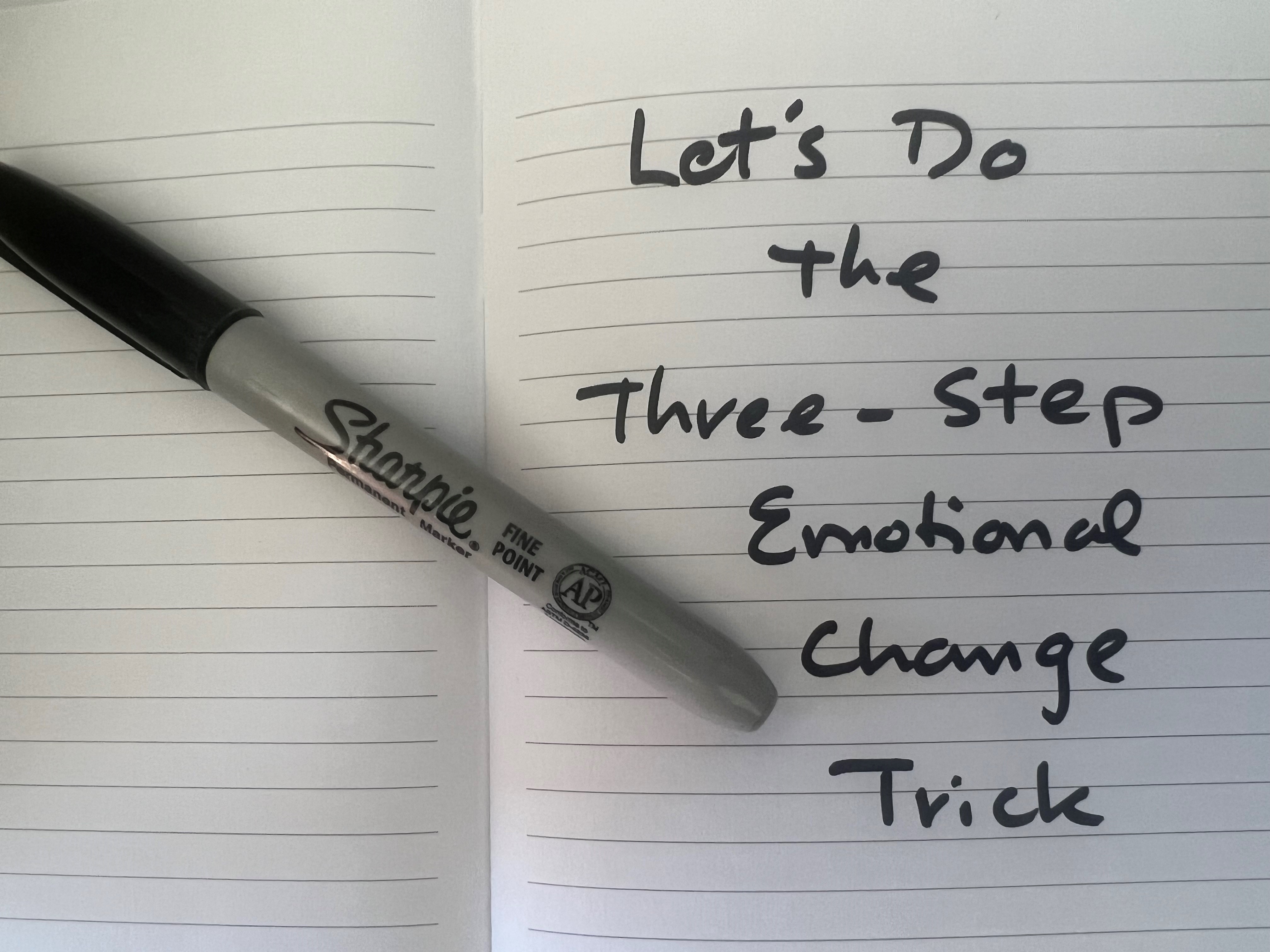
For the happiness challenge this week, we’re touting the effectiveness of my own version of what we should put in the water or in the schools or in families—the Three-Step Emotional Change Trick. Having been in a several month funk over a variety of issues, I find myself returning to the application of the Three-Step Emotional Change Trick in my daily life. Does it always work? Nope. Is it better than feeling like a victim to my unpleasant thoughts and feelings? Yep.
I hope you’ll try this out and follow the instructions to push the process outward by sharing and teaching the three steps. Let’s try to get it into the water system.
Active Learning Assignment 9 – The 3-Step Emotional Change Trick
Almost no one likes toxic positivity. . . which is why I want to emphasize from the start, this week’s activity is NOT toxic positivity.
Back in the 1990s I was in full-time private practice and mostly I got young client referrals. When they entered my office, nearly all the youth were in bad moods. They were unhappy, sad, anxious, angry, and usually unpleasantly irritable. Early on I realized I had to do something to help them change their moods.
An Adlerian psychologist, Harold Mosak, had researched the emotional pushbutton technique. I turned it into a simple, three-step emotional change technique to help young clients deal with their bad moods. I liked the technique so well that I did it in my office, with myself, with parents, during professional workshops, and with classrooms full of elementary, middle, and high school students. Mostly it worked. Sometimes it didn’t.
This week, your assignment is to apply the three-step emotional change trick to yourself and your life. Here’s how it goes.
Introduction
Bad moods are normal. I would ask young clients, “Have you ever been in a bad mood?” All the kids nodded, flipped me off, or said things like, “No duh.”
Then I’d ask, “Have you ever had somebody tell you to cheer up?” Everyone said, “Yes!” and told me how much they hated being told to cheer up. I would agree and commiserate with them on how ridiculous it was for anyone to ever think that saying “Cheer up” would do anything but piss the person off even more. I’d say, “I’ll never tell you to cheer up.* If you’re in a bad mood, I figure you’ve got a good reason to be in a bad mood, and so I’ll just respect your mood.” [*Note to Therapists: This might be the single-most important therapeutic statement in this whole process.]
Then I’d ask. “Have you ever been stuck in a bad mood and have it last longer than you wanted it to?”
Nearly always there was a head nod; I’d join in and admit to the same. “Damn those bad moods. Sometimes they last and last and hang around way longer than they need to. How about I teach you this thing I call the three-step emotional change trick. It’s a way to change your mood, but only when YOU want to change your mood. You get to be the captain of your own emotional ship.”
Emotions are universally challenging. I think that’s why I never had a client refuse to let me teach the three-steps. And that’s why I’m sharing it with you now.
Step one is to feel the feeling. Feelings come around for a reason. We need to notice them, feel them, and contemplate their meaning. The big questions here are: How can you honor and feel your feelings? What can you do to respect your own feelings and listen to the underlying message? I’ve heard many answers. Here are a few. But you can generate your own list.
Frowning or crying if you feel sad
Grimacing and making angry faces into a mirror if you feel angry
Drawing an angry picture
Punching or kicking a pillow (no real violence though)
Going outside and yelling (or screaming into a pillow)
Scribbling on a note pad
Writing a nasty note to someone (but not delivering it)
Using your words, and talking to someone about what you’re feeling
Step two is to think a new thought or do something different. This step is all about intentionally doing or thinking something that might change or improve you mood. The big question here is: What can you think or do that will put you in a better mood?
I discovered that kids and adults have amazing mood-changing strategies. Here’s a sampling:
Tell a funny story (“Yesterday in math, my friend Todd farted”)
Tell a joke (What do you call it when 100 rabbits standing in a row all take one step backwards? A receding hare-line).
Tell a better joke (Why did the ant crawl up the elephant’s leg for the second time? It got pissed off the first time.)
Exercise!
Smile into a mirror
Talk to someone you trust
Put a cat (or a chicken or a duck) on your head
Chew a big wad of gum
I’m sure you get the idea. You know best what might put you in a good mood. When you’re ready, but not before, use your own self-knowledge to move into a better mood.
Step three is to spread the good mood. Moods are contagious. I’d say things like this to my clients:
“Emotions are contagious. Do you know what contagious means? It means you can catch emotions from being around other people who are in bad moods or good moods. Like when you got here. I noticed your mom was in a bad mood too. It made me wonder, did you catch the bad mood from her or did she catch it from you? Anyway, now you seem to be in a better mood. I’m wondering. Do you think you can make your mom “catch” your good mood?”
How do you share good moods? Saying “Cheer up” is off-limits. Here’s a short list of what I’ve heard from kids and adults.
Do someone a favor
Smile
Hold the door for a stranger
Offer a real or virtual hug
Listen to someone
Tell someone, “I love you”
Step four might be the best and most important step in the three-step emotional change trick. With kids, when I move on to step four, they always interrupt:
“Wait. You said there were only three steps!”
“Yes. That’s true. But because emotions are complicated and surprising, the three-step emotional change trick has four steps. The fourth step is for you to teach someone else the three steps.”
I’m a big fan of exercise and movement as a solution for nearly everything. Below is my famous or infamous “Last Dance” video that I filmed after a day when I got beat up pretty bad by all things Moodle, Powerpoint, and Qualtrics. My solution was to Dance it off, which I share with you all despite the fact that this is the sort of thing one should keep private.
I share this video as a challenge to anyone who feels inclined to make their own 1 minute dance-it-off video. Yes please! And share.
[Unless you read this blog regularly] you may be surprised to hear that exercise is more effective in treating depression than antidepressant medications. If so, that’s likely because pharmaceutical companies spend millions every year to tell you their antidepressants are effective. The marketing budget for exercise as a treatment for depression is considerably less.
Movement—along with sleep and a healthy diet—is probably the best way to keep your brain healthy. Nearly all movement helps. In my favorite exercise study on treating depression in youth, preteens and teens who were depressed had a 100% response to cardio (including Jazzercise and Wii) and a 67% response with just stretching. Exercise does so many good things for the brain that it’s hard to track. Also, other than sweat, thirst, and sore muscles, exercise has no real negative side effects—which isn’t the case for medications.
In conclusion, the researchers wrote:
“Compared to antidepressant medication treatment with adolescents, exercise resulted in (a) a faster response rate, (b) a better response rate, (c) fewer relapses (n = 0) at six and 12 month follow-ups, and (d) no side effects or adverse events” (Hughes et al., 2013). One caveat, at the beginning of the study, none of the participants were exercising.
But who were these researchers? Were they anti-drug researchers with an axe to grind?
Nope, and this is my favorite part. The researchers were prestigious academics who mostly do pharmaceutical research. One of them was the guy responsible for the clinical studies that led to FDA approval of Prozac for treating youth with depression. The two biggest names on the study have repeatedly been funded by Eli Lilly, GlaxoSmithKline, Pfizer, and more.
All this leads me to this week’s #MHPHappinessChallenge assignment.
Find your preferred way to move, pair it with your favorite music, and do what the researchers in the Hughes (2013) study did to treat depression. I call this “Dance it off,” because dancing—alone or together—is a fabulous way to make the time fly by while you give your brain a dose of what it’s craving.
Here’s the Hughes et al (2013) study. I’m sharing it because everyone should know about it:
But you don’t have to dance. You can walk, run, skip, or yoga. You can jump rope, do Wii or Jazzercize, kickbox, or just jiggle your body in the kitchen while you’re cooking. If you ride the elevator, take the stairs. If you’re in a chair, dance with whatever parts of your body that will move. Of course, don’t do anything that’s so excessive that you might hurt yourself.
I’m sure you get the point.
And then, if you feel something-maybe a high or a fun new thought or anything that kicks your mood up a notch, savor it, linger, and then share it with us.
As always, thanks for participating in the Montana Happiness Challenge. Let’s dance it off together this week.
Why is it so easy to look for and focus in on that which annoys us . . . and so hard to look for and focus in on that which inspires us?
Nobody really knows the answer. There’s the usual speculation about evolution and potty training, but trying to find out “Why?” life is the way it is, is frustrating, as most 3-year-olds discover when they begin repeatedly asking their caregivers the Why question.
One thing is certain, if we want to focus on joy, inspiration, and small stuff that makes a positive difference, we have to be intentional. The default setting in most of our brains is to look for what’s wrong.
For this week’s Montana Happiness Challenge, we’re we’re encouraging everyone to intermittently and intentionally look for what’s right and good and inspiring. We know there is war, poverty, racism, climate change, and other big and horrible issues out there and we’re not suggesting you put your head in the sand and ignore these important problems. What we are suggesting is that you just direct your attention . . . a little more often . . . in the direction of the positive. #MHPHappinessChallenge #MontanaHappiness #WitnessInspiration
The research on mindsets is so immense that no one even bothers arguing about whether mindsets matter. They do. We all know it. Mindsets influence our performance, our success, and how we feel. That’s the good news.
The bad news is that it’s all-natural to automatically adopt negative mindsets. If you’re in a bad mood or mental state, you’ll find it easier to “see” things consistent with your bad mood.
The human psyche naturally and automatically looks for evidence to confirm what we already believe. At the same time, we tend to overlook, ignore, or dismiss whatever is inconsistent with our existing beliefs. Researchers and writers call this Confirmation bias.
Confirmation bias is everywhere, in everyone, and operating all the time. According to Brittanica.com, the formal definition is: “People’s tendency to process information by looking for, or interpreting, information that is consistent with their existing beliefs. This biased approach to decision making is largely unintentional, and it results in a person ignoring information that is inconsistent with their beliefs.” An example:
If you believe your parents or partner are hyper-critical of you, you will watch and listen for evidence to confirm your belief and be more likely to witness and experience them being critical. You will also tend to overlook or miss out noticing when they’re positive and affirming of you.
This week’s activity involves you intentionally shifting your mindset. Your goal is to look for small things that feel positive. In our University of Montana happiness class, we gave this assignment over Martin Luther King, Jr. weekend and called it: “Witness something inspiring.” We asked students to spend the weekend watching for inspirational moments in real life (not online). Students reported small and glorious outcomes, including:
A friend using good study skills
Watching my dog play in the yard
Seeing my co-worker treat a rude customer with respect
Noticing a high school student chat with a very old woman
Mindset shifting has other names. For example, in her book, Joyful, Ingrid Fetell Lee described “Joyspotting.” Joyspotting is a visual version of orienting yourself to that which brings you joy.
This week, your job is to intentionally watch, listen, and observe for things you find inspirational. If you don’t like the word inspirational, you can switch it out for joyspotting, and head out in search of joy. Although you could do an online search for “Inspirational,” we hope you’ll watch for inspiring or joyful moments in the real world.
What you notice may be small or big. The key point is to put your brain on intentional alert for that which will inspire or stimulate joy. Keep your sensory modalities open to the positive.
One warning: It’s natural to dismiss or disqualify small positive things you notice. You may see someone do something small (like hold open a door) and then quickly dismiss it as “no big deal.” For this week, try to avoid dismissing the small bright spots. Notice them, linger on them, and see what happens.
If you’re into the social media part of this challenge, we hope you’ll share your experiences. Using your favorite social media platform, consider sharing:
What it was like to intentionally watch for inspiration.
A description of what you observed.
Reactions you had to the inspirational event.
Anything else you want to add.
You can do this activity all on your own, or you can do it with a friend, a class, or a community.
Good luck . . . we look forward to your inspirational stories.
I like knowing a little trivia. It’s probably related to wanting to maintain a positive view of myself. If I know a little trivia, maybe that makes me more competent.
Trivia of the day: Hardly any of you know that my friends Mike Bevill, Neil Balholm, Greg Hopkins, and I invented Karaoke in Mike Bevill’s basement back in 1974. Neil had a portable microphone system. We’d plug it in, put on background music, and belt out tunes, as if we were Crosby, Stills, Nash, Young, Bevill, Balhoum, Hopkins, and Sommers. We created a fake band, named ourselves the “Nugget Brothers,” and sang with great enthusiasm, but little talent, along with a variety of pop musicians.
One odd outcome of this was my continued preoccupation with creating fake bands into and after college, despite nearly complete lack of talent. As an example of the awkwardness of youth, I could “fake perform” to large groups, but I was unable to speak up in classes. Weird, I know. My guess is it was safer to publicly perform with no talent that it was to do so in areas where I was serious.
Here’s a photo attesting to my fake band performance legacy.
As a part of the Montana Happiness Challenge, we’ve been encouraging people to share their favorite songs. . . and now we’re taking it to the next step. Please, if you will, share yourself singing a song that makes you happy, or that you find meaningful. Post it on social media and give us a tag or hashtag: #MHPHappinessChallenge or #MontanaHappiness.
You may wonder, other than embarrassment and social media humiliation, what’s the point? The point is that singing is nearly always therapeutic, partly because of what’s happening in the brain. Think about it.
Singing involves movement, creativity, feedback and adjustment, listening, planning, memory, and language. Some researchers emphasize that singing triggers the release of the so-called “feel-good” neurotransmitter dopamine, which is a limited view, because there’s also more serotonin at the synapse, an oxytocin shower, and more or less involvement by 100s of other neurotransmitters, neuromodulators, and brain structures (including, but not limited to the hippocampus, insula, frontal lobe, Wernicke’s region, occipital cortex, and motor cortex). If you want to light up your brain, sing!
For the Montana Happiness Challenge, we highly recommend singing out loud. Although we would love to watch and listen to you singing on social media, if that’s not your thing, go ahead and sing in the shower, while housecleaning, in the car, or anywhere else you can let your joy happen.
One last point. Research on positive emotions indicate that we don’t need to have BIG positive emotions to experience happiness and well-being benefits. What’s important is to weave in many intermittent small positive emotions. IMHO, singing privately or publicly is one way to give yourself frequent positive emotional boosts.
For my part, I’ve recorded three videos on my social media singing. These videos are silly and embarrassing, which I’m completely embracing. I got nervous for each of these videos and didn’t even say all of what I planned to say. Feel free to skip them and/or #neverspeakofthem.
Thanks for reading this. Please share everything you can about the Montana Happiness Project. Our goal is to reach MANY people with free ideas about positive emotions and meaningful happiness.
Back in the day, I was so into person-centered (aka nondirective) listening that I coauthored a 1989 article in the journal Teaching of Psychology titled, “Thou Shalt Not Ask Questions.” The point was that by temporarily eliminating questions from our therapeutic repertoire, we grow more aware of how to listen without using directive methods for facilitating client talk.
I’m still a fan of limiting therapist questions, if only to become more aware of their power. Even in the case of solution-focused or narrative therapies, when questions are the central therapeutic strategy, we should be as person-centered as possible when asking questions.
Below, I’ve included an excerpt of our coverage of listening from the forthcoming 7th edition of Clinical Interviewing. In the early 1990s, along with the first edition of Clinical Interviewing, we described a concept called the listening continuum. The excerpt starts there and then focuses in on what’s likely the most non-directive skill of all, therapeutic silence.
Here’s the excerpt. I hope you enjoy it and find it useful.
The Listening Continuum in Three Parts
Nondirective listening behaviors give clients responsibility for choosing what to talk about. Consistent with person-centered approaches, using nondirective behaviors is like handing your clients the reins to the horse and having them take the lead and choose where to take the session. In contrast, directive listening behaviors (Chapter 5) and directive action behaviors (Chapter 6) are progressively less person-centered. These three categories of listening behaviors (and the corresponding chapters) are globally referred to as the listening continuum. To get a visual sense of the listening continuum, see Table 4.1.
Nondirective Listening Behaviors on the LEFT Edge (Chapter 4)
Directive Listening Behaviors in the MIDDLE (Chapter 5)
Directive Action Behaviors on the RIGHT Edge (Chapter 6)
Attending behaviors or minimal encouragers
Feeling validation
Closed and therapeutic questions
Therapeutic silence
Interpretive reflection of feeling
Psychoeducation or explanation
Paraphrase
Interpretation (classic or reframing)
Suggestion
Clarification
Confrontation
Agreement/disagreement
Reflection of feeling
Immediacy
Giving advice
Summary
Open questions
Approval/disapproval
Urging
The ultimate goal is for you to use behavioral skills along the whole listening continuum. We want you to be able to apply these skills intentionally and with purpose. That way, when you review a video of your session with a supervisor, and your supervisor stops the recording and asks, “What exactly were you doing there?” you can respond with something like this:
I was doing an interpretive reflection of feeling. The reason I chose an interpretive reflection is that I thought the client was ready to explore what might be under their anger.
Trust us; this will be a happy moment for both you and your supervisor.
Hill (2020) organized the three listening continuum categories in terms of their primary purpose:
We hope you still (and will always) remember the Rogerian attitudes and have placed them firmly in the center of your developing therapeutic self. In addition, at this point we hope you understand the two-way nature of communication, the four different types of attending behaviors, and how your listening focus can shift based on a variety of factors, including culture and theoretical orientation.
Next, we begin coverage of technical skills needed to conduct a clinical interview. See Table 4.2 for a summary of nondirective listening behaviors and their usual effects. Having already reviewed attending behaviors, we now move to therapeutic silence.
Therapeutic Silence
Most people feel awkward about silence in social settings. Some researchers have described that therapists-in-training view silence as a “mean” response (Kivlighan & Tibbits, 2012). Despite the angst it can produce, silence can be therapeutic.
Therapeutic silence is defined as well-timed silence that facilitates client talk, respects the client’s emotional space, or provides clients with an opportunity to find their own voice regarding their insights, emotions, or direction. From a Japanese perspective,
Silence gives forgiveness and generosity to human dialogues in our everyday life. Without silence, our conversation tends to easily become too clever. Silence is the place where “shu”… (to sense the feeling of others, and forgive, show mercy, absolve, which represents an act of benevolence and altruism) arises, which Confucius said was the most important human attitude. (Shimoyama, 1989/2012, p. 6; translation by Nagaoka et al., 2013, p. 151)
Table 4.2 Summary of Nondirective Listening Behaviors and Their Usual Effects
Listening Response
Description
Primary Intent/Effect
Attending behaviors
Eye contact, leaning forward, head nods, facial expressions, etc.
Facilitates or inhibits client talk.
Therapeutic silence
Absence of verbal activity
Allows clients to talk. Provides “cooling off ” or introspection time. Allows clinician time to consider next response.
Paraphrase
Reflecting or rephrasing the content of what the client said
Assures clients that you heard them accurately and allows them to hear what they said.
Clarification
Restating a client’s message, preceded or followed by a closed question (e.g., “Do I have that right?”)
Clarifies unclear client statements and verifies the accuracy of what the clinician heard.
Reflection of feeling
Restatement or rephrasing of clearly stated emotion
Enhances clients’ experience of empathy and encourages further emotional expression.
Summary
Brief review of several topics covered during a session
Enhances recall of session content and ties together or integrates themes covered in a session.
Silence also allows clients to reflect on what they just said. Silence after a strong emotional outpouring can be therapeutic and restful. In a practical sense, silence also allows therapists time to intentionally select a response rather than rush into one.
In psychoanalytic psychotherapy, silence facilitates free association. Psychoanalytically oriented therapists use role induction to explain to clients that psychoanalytic therapy involves free expression, followed by occasional therapist comments or interpretations. Explaining therapy or interviewing procedures to clients is always important, but especially so when therapists are using potentially anxiety-provoking techniques, such as silence (Meier & Davis, 2020).
CASE EXAMPLE 4.2: EXPLAIN YOUR SILENCE
While on a psychoanalytically oriented internship, I (John) noticed one supervisor had a disturbing way of using silence during therapy sessions (and in supervision). He would routinely begin sessions without speaking. He sat down, looked at his client (or supervisee), and leaned forward expectantly. His nonverbal behavior was unsettling. He wanted clients and supervisees to free associate and say whatever came to mind, but he didn’t explain, in advance, what he was doing. Consequently, he came across as intimidating and judgmental. The moral of the story: Use role induction—if you don’t explain the purpose of your silence, you risk scaring away clients.
[End of Case Example 4.2]
Examples of How to Talk About Silence
Part of the therapist’s role involves skilled explanations of process and technique. This includes talking about silence. Case Example 4.2 is a good illustration of how therapist and client would have been better served if the therapist had explained why he started his sessions with silence.
Here’s another example of how a clinician might use silence therapeutically:
Katherine (they/them) is conducting a standard clinical intake interview. About 15 minutes into the session the client begins sobbing about a recent romantic relationship break-up. Katherine provides a reflection of feeling and reassurance that it’s okay to cry, saying, “I can see you have sad feelings about the break-up. It’s perfectly okay to honor those feelings in here and take time to cry.” They follow this statement with about 30 seconds of silence.
There are several other ways Katherine could handle this situation. They might prompt the client,
Let’s take a moment to sit with this and notice what emotions you’re feeling and where you’re feeling them in your body.
Or they might explain their purpose more clearly.
Sometimes it’s helpful to sit quietly and just notice what you’re feeling. And sometimes you might have emotional sensations in a particular part of your body. Would you be okay if we take a few moments to be quiet together so you can tune in to your emotions and where you’re feeling them?
In each of these scenarios, Katherine explains, at least briefly, the use of silence. This is crucial because when clinicians are silent, pressure is placed on clients to speak. When silence continues, the pressure mounts, and client anxiety may increase. In the end, clients may view their experience with an excessively silent therapist as aversive, lowering the likelihood of rapport and a second meeting.
Guidelines for Using Silence Therapeutically
Using silence may initially feel uncomfortable. With practice, you’ll increase your comfort level. Consider the following suggestions:
When a client pauses after making a statement or after hearing your paraphrase, let a few seconds pass rather than jumping in verbally. Given an opportunity, clients can move naturally into important material without guidance or urging.
As you’re waiting for your client to resume speaking, tell yourself that this is the client’s time for self-expression, not your time to prove you can be useful.
Try not to get into a rut regarding silence. When silence occurs, sometimes wait for the client to speak next and other times break the silence yourself.
Be cautious with silence if you believe your client is confused, psychotic, or experiencing an acute emotional crisis. Excessive silence and the anxiety it provokes can exacerbate these conditions.
If you feel uncomfortable during silent periods, use attending skills and look expectantly toward clients. This helps them understand it’s their turn to talk.
If clients appear uncomfortable with silence, give them instructions to free associate (e.g., “Just say whatever comes to mind”). Or you can use an empathic reflection (e.g., “It’s hard to decide what to say next”).
Remember, sometimes silence is the most therapeutic response available.
Read the interview by Carl Rogers (Meador & Rogers, 1984). It includes examples of how Rogers handled silence from a person-centered perspective.
Remember to monitor your body and face while being silent. There’s a vast difference between a cold silence and an accepting, warm silence. Much of this difference results from body language and an attitude that welcomes silence.
Use your words to explain the purpose of your silence (e.g., “I’ve been talking quite a lot, so I’m just going to be quiet here for a few minutes so you can have a chance to say whatever you like”). Clients may be either happy or terrified at the chance to speak freely.
The place to click if you want to learn about psychotherapy, counseling, or whatever John SF is thinking about.