I like knowing a little trivia. It’s probably related to wanting to maintain a positive view of myself. If I know a little trivia, maybe that makes me more competent.
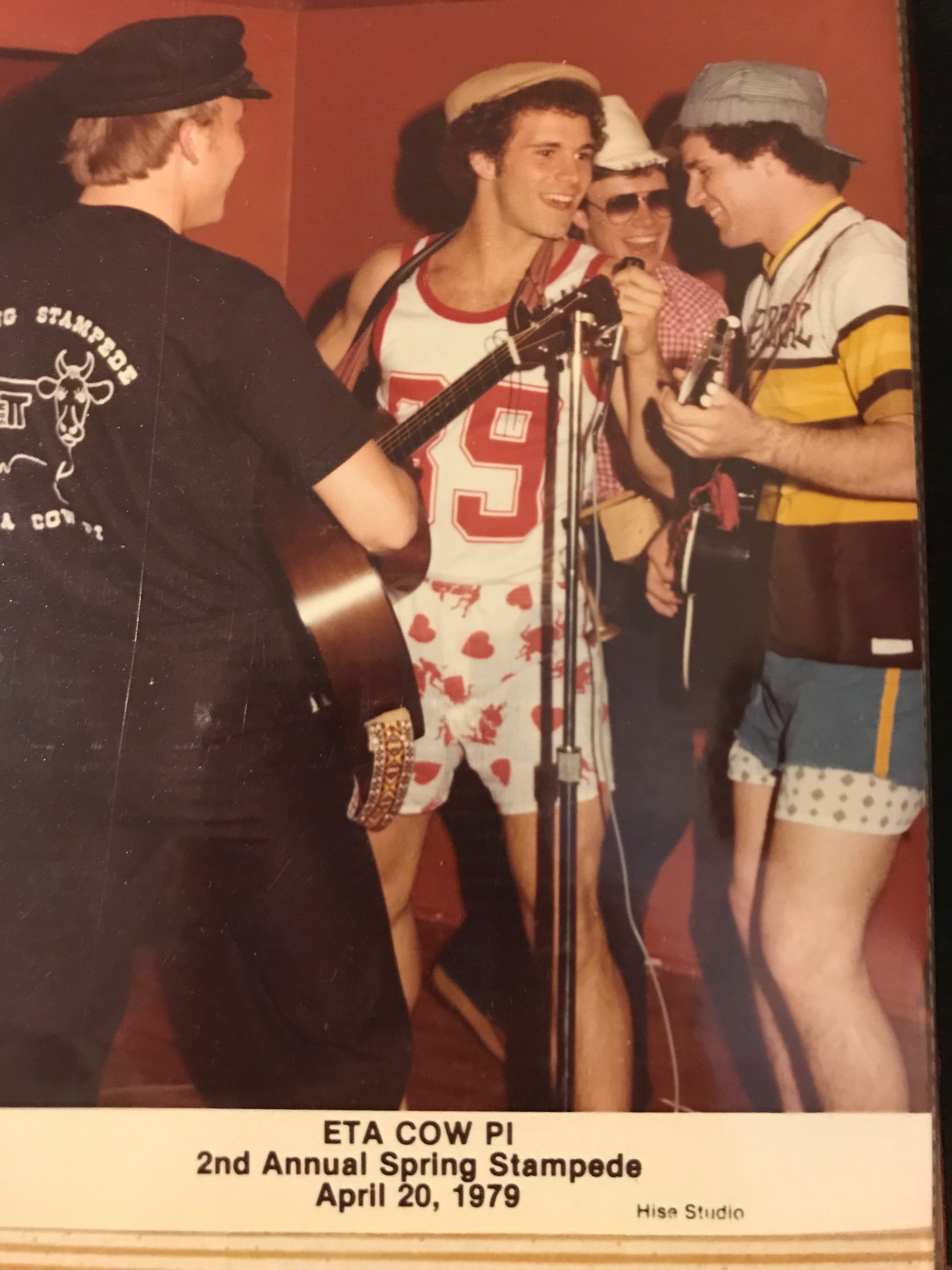
Trivia of the day: Hardly any of you know that my friends Mike Bevill, Neil Balholm, Greg Hopkins, and I invented Karaoke in Mike Bevill’s basement back in 1974. Neil had a portable microphone system. We’d plug it in, put on background music, and belt out tunes, as if we were Crosby, Stills, Nash, Young, Bevill, Balhoum, Hopkins, and Sommers. We created a fake band, named ourselves the “Nugget Brothers,” and sang with great enthusiasm, but little talent, along with a variety of pop musicians.
One odd outcome of this was my continued preoccupation with creating fake bands into and after college, despite nearly complete lack of talent. As an example of the awkwardness of youth, I could “fake perform” to large groups, but I was unable to speak up in classes. Weird, I know. My guess is it was safer to publicly perform with no talent that it was to do so in areas where I was serious.
Here’s a photo attesting to my fake band performance legacy.
As a part of the Montana Happiness Challenge, we’ve been encouraging people to share their favorite songs. . . and now we’re taking it to the next step. Please, if you will, share yourself singing a song that makes you happy, or that you find meaningful. Post it on social media and give us a tag or hashtag: #MHPHappinessChallenge or #MontanaHappiness.
You may wonder, other than embarrassment and social media humiliation, what’s the point? The point is that singing is nearly always therapeutic, partly because of what’s happening in the brain. Think about it.
Singing involves movement, creativity, feedback and adjustment, listening, planning, memory, and language. Some researchers emphasize that singing triggers the release of the so-called “feel-good” neurotransmitter dopamine, which is a limited view, because there’s also more serotonin at the synapse, an oxytocin shower, and more or less involvement by 100s of other neurotransmitters, neuromodulators, and brain structures (including, but not limited to the hippocampus, insula, frontal lobe, Wernicke’s region, occipital cortex, and motor cortex). If you want to light up your brain, sing!
For the Montana Happiness Challenge, we highly recommend singing out loud. Although we would love to watch and listen to you singing on social media, if that’s not your thing, go ahead and sing in the shower, while housecleaning, in the car, or anywhere else you can let your joy happen.
One last point. Research on positive emotions indicate that we don’t need to have BIG positive emotions to experience happiness and well-being benefits. What’s important is to weave in many intermittent small positive emotions. IMHO, singing privately or publicly is one way to give yourself frequent positive emotional boosts.
For my part, I’ve recorded three videos on my social media singing. These videos are silly and embarrassing, which I’m completely embracing. I got nervous for each of these videos and didn’t even say all of what I planned to say. Feel free to skip them and/or #neverspeakofthem.
Thanks for reading this. Please share everything you can about the Montana Happiness Project. Our goal is to reach MANY people with free ideas about positive emotions and meaningful happiness.
Back in the day, I was so into person-centered (aka nondirective) listening that I coauthored a 1989 article in the journal Teaching of Psychology titled, “Thou Shalt Not Ask Questions.” The point was that by temporarily eliminating questions from our therapeutic repertoire, we grow more aware of how to listen without using directive methods for facilitating client talk.
I’m still a fan of limiting therapist questions, if only to become more aware of their power. Even in the case of solution-focused or narrative therapies, when questions are the central therapeutic strategy, we should be as person-centered as possible when asking questions.
Below, I’ve included an excerpt of our coverage of listening from the forthcoming 7th edition of Clinical Interviewing. In the early 1990s, along with the first edition of Clinical Interviewing, we described a concept called the listening continuum. The excerpt starts there and then focuses in on what’s likely the most non-directive skill of all, therapeutic silence.
Here’s the excerpt. I hope you enjoy it and find it useful.
The Listening Continuum in Three Parts
Nondirective listening behaviors give clients responsibility for choosing what to talk about. Consistent with person-centered approaches, using nondirective behaviors is like handing your clients the reins to the horse and having them take the lead and choose where to take the session. In contrast, directive listening behaviors (Chapter 5) and directive action behaviors (Chapter 6) are progressively less person-centered. These three categories of listening behaviors (and the corresponding chapters) are globally referred to as the listening continuum. To get a visual sense of the listening continuum, see Table 4.1.
Nondirective Listening Behaviors on the LEFT Edge (Chapter 4)
Directive Listening Behaviors in the MIDDLE (Chapter 5)
Directive Action Behaviors on the RIGHT Edge (Chapter 6)
Attending behaviors or minimal encouragers
Feeling validation
Closed and therapeutic questions
Therapeutic silence
Interpretive reflection of feeling
Psychoeducation or explanation
Paraphrase
Interpretation (classic or reframing)
Suggestion
Clarification
Confrontation
Agreement/disagreement
Reflection of feeling
Immediacy
Giving advice
Summary
Open questions
Approval/disapproval
Urging
The ultimate goal is for you to use behavioral skills along the whole listening continuum. We want you to be able to apply these skills intentionally and with purpose. That way, when you review a video of your session with a supervisor, and your supervisor stops the recording and asks, “What exactly were you doing there?” you can respond with something like this:
I was doing an interpretive reflection of feeling. The reason I chose an interpretive reflection is that I thought the client was ready to explore what might be under their anger.
Trust us; this will be a happy moment for both you and your supervisor.
Hill (2020) organized the three listening continuum categories in terms of their primary purpose:
We hope you still (and will always) remember the Rogerian attitudes and have placed them firmly in the center of your developing therapeutic self. In addition, at this point we hope you understand the two-way nature of communication, the four different types of attending behaviors, and how your listening focus can shift based on a variety of factors, including culture and theoretical orientation.
Next, we begin coverage of technical skills needed to conduct a clinical interview. See Table 4.2 for a summary of nondirective listening behaviors and their usual effects. Having already reviewed attending behaviors, we now move to therapeutic silence.
Therapeutic Silence
Most people feel awkward about silence in social settings. Some researchers have described that therapists-in-training view silence as a “mean” response (Kivlighan & Tibbits, 2012). Despite the angst it can produce, silence can be therapeutic.
Therapeutic silence is defined as well-timed silence that facilitates client talk, respects the client’s emotional space, or provides clients with an opportunity to find their own voice regarding their insights, emotions, or direction. From a Japanese perspective,
Silence gives forgiveness and generosity to human dialogues in our everyday life. Without silence, our conversation tends to easily become too clever. Silence is the place where “shu”… (to sense the feeling of others, and forgive, show mercy, absolve, which represents an act of benevolence and altruism) arises, which Confucius said was the most important human attitude. (Shimoyama, 1989/2012, p. 6; translation by Nagaoka et al., 2013, p. 151)
Table 4.2 Summary of Nondirective Listening Behaviors and Their Usual Effects
Listening Response
Description
Primary Intent/Effect
Attending behaviors
Eye contact, leaning forward, head nods, facial expressions, etc.
Facilitates or inhibits client talk.
Therapeutic silence
Absence of verbal activity
Allows clients to talk. Provides “cooling off ” or introspection time. Allows clinician time to consider next response.
Paraphrase
Reflecting or rephrasing the content of what the client said
Assures clients that you heard them accurately and allows them to hear what they said.
Clarification
Restating a client’s message, preceded or followed by a closed question (e.g., “Do I have that right?”)
Clarifies unclear client statements and verifies the accuracy of what the clinician heard.
Reflection of feeling
Restatement or rephrasing of clearly stated emotion
Enhances clients’ experience of empathy and encourages further emotional expression.
Summary
Brief review of several topics covered during a session
Enhances recall of session content and ties together or integrates themes covered in a session.
Silence also allows clients to reflect on what they just said. Silence after a strong emotional outpouring can be therapeutic and restful. In a practical sense, silence also allows therapists time to intentionally select a response rather than rush into one.
In psychoanalytic psychotherapy, silence facilitates free association. Psychoanalytically oriented therapists use role induction to explain to clients that psychoanalytic therapy involves free expression, followed by occasional therapist comments or interpretations. Explaining therapy or interviewing procedures to clients is always important, but especially so when therapists are using potentially anxiety-provoking techniques, such as silence (Meier & Davis, 2020).
CASE EXAMPLE 4.2: EXPLAIN YOUR SILENCE
While on a psychoanalytically oriented internship, I (John) noticed one supervisor had a disturbing way of using silence during therapy sessions (and in supervision). He would routinely begin sessions without speaking. He sat down, looked at his client (or supervisee), and leaned forward expectantly. His nonverbal behavior was unsettling. He wanted clients and supervisees to free associate and say whatever came to mind, but he didn’t explain, in advance, what he was doing. Consequently, he came across as intimidating and judgmental. The moral of the story: Use role induction—if you don’t explain the purpose of your silence, you risk scaring away clients.
[End of Case Example 4.2]
Examples of How to Talk About Silence
Part of the therapist’s role involves skilled explanations of process and technique. This includes talking about silence. Case Example 4.2 is a good illustration of how therapist and client would have been better served if the therapist had explained why he started his sessions with silence.
Here’s another example of how a clinician might use silence therapeutically:
Katherine (they/them) is conducting a standard clinical intake interview. About 15 minutes into the session the client begins sobbing about a recent romantic relationship break-up. Katherine provides a reflection of feeling and reassurance that it’s okay to cry, saying, “I can see you have sad feelings about the break-up. It’s perfectly okay to honor those feelings in here and take time to cry.” They follow this statement with about 30 seconds of silence.
There are several other ways Katherine could handle this situation. They might prompt the client,
Let’s take a moment to sit with this and notice what emotions you’re feeling and where you’re feeling them in your body.
Or they might explain their purpose more clearly.
Sometimes it’s helpful to sit quietly and just notice what you’re feeling. And sometimes you might have emotional sensations in a particular part of your body. Would you be okay if we take a few moments to be quiet together so you can tune in to your emotions and where you’re feeling them?
In each of these scenarios, Katherine explains, at least briefly, the use of silence. This is crucial because when clinicians are silent, pressure is placed on clients to speak. When silence continues, the pressure mounts, and client anxiety may increase. In the end, clients may view their experience with an excessively silent therapist as aversive, lowering the likelihood of rapport and a second meeting.
Guidelines for Using Silence Therapeutically
Using silence may initially feel uncomfortable. With practice, you’ll increase your comfort level. Consider the following suggestions:
When a client pauses after making a statement or after hearing your paraphrase, let a few seconds pass rather than jumping in verbally. Given an opportunity, clients can move naturally into important material without guidance or urging.
As you’re waiting for your client to resume speaking, tell yourself that this is the client’s time for self-expression, not your time to prove you can be useful.
Try not to get into a rut regarding silence. When silence occurs, sometimes wait for the client to speak next and other times break the silence yourself.
Be cautious with silence if you believe your client is confused, psychotic, or experiencing an acute emotional crisis. Excessive silence and the anxiety it provokes can exacerbate these conditions.
If you feel uncomfortable during silent periods, use attending skills and look expectantly toward clients. This helps them understand it’s their turn to talk.
If clients appear uncomfortable with silence, give them instructions to free associate (e.g., “Just say whatever comes to mind”). Or you can use an empathic reflection (e.g., “It’s hard to decide what to say next”).
Remember, sometimes silence is the most therapeutic response available.
Read the interview by Carl Rogers (Meador & Rogers, 1984). It includes examples of how Rogers handled silence from a person-centered perspective.
Remember to monitor your body and face while being silent. There’s a vast difference between a cold silence and an accepting, warm silence. Much of this difference results from body language and an attitude that welcomes silence.
Use your words to explain the purpose of your silence (e.g., “I’ve been talking quite a lot, so I’m just going to be quiet here for a few minutes so you can have a chance to say whatever you like”). Clients may be either happy or terrified at the chance to speak freely.
Shortly after Beth Brown, Managing Director of Mental Health and Well Being at The Arthur M. Blank Family Foundation (https://blankfoundation.org/) called the meeting to order, she asked us to introduce ourselves and share one word to represent how we were feeling in that moment.
Having taught my fair share of group counseling and psychotherapy courses at the University of Montana, I immediately recognized Ms. Brown’s icebreaking trickery. The trickery is, while ostensibly asking about the emotional tone of participants, the “one word” question simultaneously evaluates participants’ ability and willingness to comply with group leader requests.
It was a raucous group. People immediately began bending, breaking, and straying from Ms. Brown’s one-word rule. Some participants took 30 words to introduce themselves; others took 50 words to frame the rationale for their one-word choice. One participant (who spoke second, and may or may not have been me), immediately displayed annoying attention-seeking behavior by interjecting an anecdote about the worst icebreaker activity ever in the history of time.
Had Sigmund Freud been a Mental Health and Wellness grantee (and therefore invited to the two-day event), he might have used the word delighted. Not only was the one-word activity intrinsically projective, Freud also once famously quipped,
Words were originally magic, and . . . retain much magical power, even today. With words people can make others blessed, or drive them to despair; by words the teacher transfers . . . knowledge to the pupil; by words the speaker sweeps away the audience and determines its judgments and decisions. Words call forth affects and are the universal means of influencing human beings [n.b., this is not a perfect quote because I engaged in minor editing to make Freud more quippy and less sexist].
I have some magic words to describe the participants. They were smart, fun, funny, dedicated, committed, clever, brilliant, generous, compassionate, empathic, connected, passionate, and cool. During Lyft rides, some of them even engaged with each other as if they were live podcasters. My particular program officer is so kind and generous that I now just think of her as Saint Natalie.
Words were the theme and the tool. On the afternoon of Day One Michael Susong, PR Lead at Intrepid, taught us how to use asset-based, instead of deficit-based words on our websites. His presentation was complemented by a gallery-walk through an adjacent room where life-sized word cloud posters of the words in our websites were set up and numbered; we perused the clouds, absorbing the language and seeking to discern which cloud belonged to which organization. I, of course, quickly found the Montana Happiness Project (MHP) word cloud, primarily because the biggest word was SUICIDE, which may or may not have implied that we (the MHP) have a bit of work to do on using more asset-based language on our website. I also felt jealousy because other organizations had way cooler words, like “Nintendo” and “LBGTQ+” and “Youth of color” and “Belonging.”
At the close of Day 1, the prevailing descriptive words were “Tired” and “Exhausted” not principally, but partly because this was a group of people who had likely added this retreat into their already too busy lives and consequently were emailing and doing business-related calls during breaks and lunch and on the airplane the day before and possibly into the night.
Looking back at the previous paragraph, I notice I used the word “business” which connotes a particular entrepreneurial feel, which requires a particular explanation. All of the organizations and people in attendance had a shared passion for the business of helping others achieve greater well-being, mental health, and happiness. IMHO, that’s good business. . . which leads me to sharing a few words about the man behind the curtain.
We all convened at the Arthur M. Blank Foundation headquarters for two days because of one man’s business. That man is Arthur M. Blank, co-founder of Home Depot and owner of the Atlanta Falcons, the Atlanta United professional soccer club, and PGA Superstores. But along with his businesses, Arthur Blank has expanded his service mentality into the business of philanthropy. On the evening of the first day, Arthur Blank joined us as we listened to renowned Harvard researcher Robert Waldinger talk about the world’s longest study of Happiness [n.b., in his usual buoyantly optimistic style, Freud once noted that a main goal of psychotherapy is to move patients from neurotic misery, to common unhappiness].
Although I didn’t get a chance to meet Mr. Blank and impress him with my witty repartee, knowledge of icebreakers, or arcane Freudian quotes (I wish I could have told him, “Where id was, there shall ego be!), I did hear him speak. In one long, hyphenated word, I’d describe his message as gracious-supportive-humble-encouraging-empowering. Had Freud been there, he might have just said, “Arthur Blank’s words were magic.”
The Arthur Blank Foundation has given well over $500 million to philanthropic causes. None of this is required. Arthur Blank could take his money and keep it to himself and his family. Instead, he has embraced philanthropy. Arthur Blank also has a book titled “Good Company.” In a word (or maybe 20 words), if I were offering a New York Times Book Review (which will never happen because the NYT always rejects my editorial pieces, and yes, I’m clearly hanging on too tightly to my resentment toward the NYT), I’d describe his book as: A rather surprising treatise on companies doing values-based good work in the world as a part of a larger philosophy/vision of service-oriented capitalism paradoxically infused with egalitarianism in the workplace. In other (or additional) words, I enjoyed, appreciated, and valued the book and its philosophy WAY more than I expected. Now I want to become as wealthy as Arthur Blank so I can join him in contributing to the culture and welfare of places like West Atlanta, South Chicago, North Philly, Livingston Montana, and East Missoula.
In the end, Beth Brown asked us for a final, departing single word. I cleverly used my hyphenated last name as an excuse to say “overwhelmed-hopeful” but I might have just as easily used “connected-inspired” or “challenged-to-do-more-good” or “I’m-on-a-rocket-ship-headed-to-a-city-called-mental-health-and-wellbeing” or, given the fire of inspiration lit under my feet, I could have decided to demonstrate the worst icebreaker of all time, and just spell out my name and feelings with my hip movements.
Thank you, Arthur Blank, thank you to the AMBFF team, and thank you to the grantees. I am humbled by your generosity and vision of greater mental health and wellbeing for all.
John Wiley and Sons recently informed me of the excellent and exciting news that the 7th edition of Clinical Interviewing (CI7) has gone to press and will drop in the U.S. on or before September 30. Our wish for this edition is the same as previous editions: To provide research-based, theoretically supported, clinically insightful, and culturally informed education and training on how to conduct basic and advanced clinical interviews.
The Resource
Part of CI7 includes video updates. Most of the updates offer greater representation of culturally diverse counselors and psychotherapists. For example, the video link below features Dr. Devika “Dibya” Choudhuri describing a “grounding” technique that she uses when conducting tele-mental health (aka virtual) clinical interviews, the topic of Chapter 14.
Although you may have your own approaches to facilitating grounding during tele-mental health sessions, I believe Dr. Choudhuri’s idea is innovative and may be a resource that you can add to your toolkit.
Stay tuned, because over the next several weeks I’ll be posting additional fresh new text and video content from CI7.
The Request
Traditionally, publishers ask authors to gather promotional endorsements for new books. This time around, maybe because it’s the 7th edition, neither Wiley nor the absent-minded authors of CI7 thought about gathering endorsements. In the past, we’ve had Derald Wing Sue, John Norcross, Victor Yalom, Pamela Hays, Barbara Herlihy, Allen Ivey, David Jobes, and Marianne and Jerry Corey write short blurbs. Here’s what Derald Wing Sue said about the 6th edition:
The most recent edition of Clinical Interviewing is simply outstanding. It not only provides a complete skeletal outline of the interview process in sequential fashion, but fleshes out numerous suggestions, examples, and guidelines in conducting successful and therapeutic interviews. Well-grounded in the theory, research and practice of clinical relationships, John and Rita Sommers-Flanagan bring to life for readers the real clinical challenges confronting beginning mental health trainees and professionals. Not only do the authors provide a clear and conceptual description of the interview process from beginning to end, but they identify important areas of required mastery (suicide assessment, mental status exams, diagnosis and treatment electronic interviewing, and work with special populations). Especially impressive is the authors’ ability to integrate cultural competence and cultural humility in the interview process. Few texts on interview skills cover so thoroughly the need to attend to cultural dimensions of work with diverse clients. This is an awesome book written in an engaging and interesting manner. I plan to use this text in my own course on advanced professional issues. Kudos to the authors for producing such a valuable text.
―Derald Wing Sue, Ph.D., Professor of Psychology and Education, Teachers College, Columbia University
This time around, we’re less than two weeks from publishing and are without formal endorsements. As a consequence, I’m asking: “Is there ANYBODY out there who has read a portion of the CI7 manuscript or used a previous edition, who would like to share their thoughts about how the book influenced you or how the videos helped with your training?
[I know this last paragraph sounds pathetic. However, if you know me, you probably know my sense of humor, and the “Is there anybody out there?” call is BOTH a sincere request for your input AND me mocking myself for making this request.]
To be completely serious: If you want to share something positive about your experience—from any point in time—with the Clinical Interviewing text, I hope you’ll write a sentence or two or three (you don’t have to write half a page, like Derald Wing Sue) on the particular ways in which you found the book and/or videos meaningful to you.
To share your thoughts on any edition of the text, please post them here on this blog, or send them to me at john.sf@mso.umt.edu.
Thanks very much for considering this request. Please, please, I hope someone “out there” is listening!
I’m taking the opportunity this fine Sunday afternoon to post a blog piece that Rita wrote earlier this week. Oddly, or perhaps not that oddly for those who know her, Rita has an alter-identity that she refers to as “Dr. Bossypants.” In this alternate voice, Rita refers to herself in third person and lets herself be a bit more pedantic than she is in real life.
In this blog post, Dr. Bossypants jumps into the domain of forgiveness and offers up ideas that I found exquisitely interesting and very helpful.
Without further ado, I’d like you to meet, my friend, Dr. Bossypants.
Earlier this summer, as I sifted through page-proofs for the 7th edition of our Clinical Interviewing textbook, my wife and co-author thinned carrots in the garden. Later, while I responded to queries from a Wiley copyeditor in India, she worked on rock art near the river in the July sunshine.
As many of you know, Rita and I have been co-authors for decades. Our first co-written publication appeared as a commentary in the 1986 American Psychologist (volume 41), titled “Ethical considerations for the peace activist psychotherapist.” Cool stuff.
Over the past few years, Rita’s interest in academic writing has waned some, but she’s still helpful, so I don’t mind. I like fresh carrots. The problem is that she’s started a project with a new and far more demanding coauthor. Given the identity of her coauthor, it doesn’t work for me to be jealous. Eight years ago, she started publishing these co-authored works as blogs, posted every Sunday at 9am. When she’s in a good mood, she refers to them as prose poems, prayers, or parables. I won’t mention what she calls them when she’s in a bad mood.
When she and her other co-author are busily writing, I’ve learned it’s best to not interrupt. I’ve also learned—from reading these blogs and listening to her read them to me—about a big omnipresent challenging and empathic entity that changes identities from Black women to dust mites, clouds to cracks in the earth, and flocks of birds to herds of sheep in much less time than the colloquial blink-of-an-eye.
Many of her readers have noted that these meditative word-art pieces are best taken in small doses. David James Duncan, author of The Brother’s K, the River Why, the forthcoming Sun House, and other amazing novels, wrote a blurb about Rita’s work, featured on the back cover:
From paragraph to paragraph, or sometimes sentence to sentence, or even phrase to phrase, Rita Sommers-Flanagan’s visitations leap—with tireless wit and a welcome downpour of surprises—from trenchant, to despairing, to startlingly funny, to furious, to honest to God divine comforts that just carried me to page 90 when I needed to get to work! As you read, you’ll also ride two pendulums I love, from reverence to irreverence back to reverence, and from deep grief to genuine joy back to grief. Most of all I want to say this: No matter what guise Original Source uses for any particular visit, I believe in Rita’s God. I truly do.
As I mentioned on FB, Rita getting a blurb from DJD makes me flat-out jealous. I still remember reading The Brother’s K on an airplane, and having the flight attendant check on me because I was intermittently laughing and crying. . . which speaks to DJD’s immense writing talents. On the other hand, rather than a bitter jealousy, I can bask in Rita’s reflected glory, right? I mean, after all, I’m her other coauthor.
I hope you’ll check out Rita’s book. I AM one of her biggest fans and one of her biggest coauthors: I’m just not the only one.
Like many, I woke up this morning thinking about my father (Max Sommers).
When I saw a photo of him, it made me think about how long it has been since I’ve seen him standing up. For the last 3+ years of his life he was in bed, due to an un-repairable broken hip and severe neuropathy.
Despite being stuck in bed every day, Max stayed upbeat. Every visit—until he died—started with a cheerful greeting and ended with him saying, “I love you” and “big hugs.”
I could never maintain such a sunny disposition. Here’s what I wrote about him back in 2014:
This is the man I can never live up to. But that’s okay. That’s the way it SHOULD be. To have a role model who is really a role model because he is so good and kind and compassionate and smart. Just being around someone like him makes me want to be a better person.
Reflecting on my father’s metaphorical (not literal) big shoes, made me think of Adler’s concept of the inferiority complex. Adler says inferiority is all-natural, because all children experience many years of being inferior to their parents or older siblings. I also had the good luck of having two incredibly competent and capable older sisters. I experienced many years of natural inferiority. That’s probably why, in most situations and most of the time, my first reactions usually involve feeling inferior.
Nowadays, people seem to use the term imposter syndrome instead of inferiority. I like Adler’s terminology and explanations better.
Adler also said the cure to all mental health problems was a thing he called encouragement. Encouragement comes in many forms. When parents and others give their children encouragement, it translates into giving their children the “courage” to face and embrace the challenging tasks of life. Given that Max was and is impossible for me to live up to, I’m especially lucky that he gave me the gift of encouragement. His encouragement (along with my mom’s and sisters’) gave me the courage to face my feelings of inferiority.
Max has been gone for 13 ½ months now. I miss him terribly. I know I’m not the only one feeling sad and grateful on Father’s Day. If you’re feeling the pangs and pains of loss along with me, I wish you as much peace, purpose, and encouragement as you can find.
Hardly anyone with common sense or social skills ever argues about whether or not relationship factors are crucial to effective counseling and psychotherapy. Nevertheless, some scientists are reluctant to put relationship factors on par with counseling and psychotherapy techniques or procedures. IMHO, relationship factors are every bit as essential as so-called empirically-supported treatments.
This post is a pitch. Or it might be a pitch in a post. Either way, I am honored to share with you a hot-off-the-presses new book, titled Relationship Factors in Counseling, by Dr. Kimberly Parrow. Here’s the publisher’s link: https://titles.cognella.com/relationship-factors-in-counseling-9781793578754. The book is also available on Amazon and other booksellers.
Below, I’m pasting the Foreword to this book. Not only am I jazzed about the book, I’m also jazzed about the Foreword. You should read it. It’s really good. You’ll learn about Kimberly Parrow, as well as a bit of trivia about relationship factors that you should definitely know. I haven’t mentioned who wrote the Foreword, but I’m sure you’ll figure it out.
I first met Kimberly Parrow, before she was Dr. Kimberly Parrow, in a letter of recommendation from a psychology professor at the University of Montana. Having read well over 1,000 letters of recommendation over the years, this one imprinted in my brain. The professor wrote something like, “Kimberly Parrow is the real deal. You should admit her to master’s program in clinical mental health counseling. You will never regret it.”
We did (admit her into our master’s program . . . and our doctoral program). And we didn’t (ever regret it).
Kim Parrow was, is, and continues to be one of the most enthusiastic learners I’ve encountered. She walked onto our campus at 44-years-old, as a first-generation college student, having waited with bated breath for the money and opportunity to pursue her college degree. Nine years later she strolled off campus with her bachelor’s, master’s, and doctoral degrees. If we were Notre Dame, we’d call her a triple domer (n.b., that’s what you call people with three degrees from Notre Dame). At the University of Montana, we just call her amazing.
In one of her first doctoral classes, I introduced Kim to the concept of evidence-based relationship factors (EBRFs). She was hooked; hooked in the way that only graduate students get hooked. She was hooked by an idea. So hooked that she immediately wanted more; she wanted to write a journal article on EBRFs (so we did). She wanted to do her dissertation on EBRFs (so she did). She wanted to do extra additional trainings for practicum and internship students on EBRFs (and so she did). Kim’s attraction to EBRFs stemmed from her belief that relationships constitute the core of what’s therapeutic. As we explored EBRFs together, noting all the research supporting the idea that relationships drive counseling and psychotherapy, I came to see that Kim’s judgment was, and continues to be, practically perfect.
I’ve been reading dissertations for 30+ years. I’m embarrassed to say that I find reading most dissertations—even those written by students whom I love—drudgery. But Kim’s dissertation was electric. Page by page, she kept surprising me with new content and new learning; it was more than I expected. Kim had taken the basic knowledge and skills linked to EBRFs, contextualized them within the scientific literature, and then wrote about them in ways that inspired me to keep reading and keep learning. As she wrote more, her writing got better and better, and the content more illuminating.
About a month ago, I was unable to make it to my initial lecture for an advanced counseling theories course. I asked Kim to fill in. She quickly said yes. I offered to pay her. She quickly said no. To stick with the money theme, if I now had a dollar for every time one of my students has, since Kim’s lecture, mentioned Kim Parrow, eyes agog, and referenced the central role of relationship factors in counseling and psychotherapy, I would have many dollars. What I’m trying to say is that Kim is a natural and talented clinician-teacher. That’s a rare version of the real deal her former developmental psychology professor was trying to tell us about.
And now, a few words about this book. Kim has done what most scholars and professionals are unable to do. She has taken theoretical principles, empirical research findings, blended them with her common-sense-salt-of-the-earth style, and created a practical guide for helping counselors and psychotherapists be better. The book is aimed to slide into the educational development of practicum and/or internship students who have learned microskills and are facing their first clients. This particular point in student development is crucial; it’s a time when students sometimes lose their way as they try to make the improbable leap from microskills to counseling and psychotherapy techniques. In making that leap, they often fall prey to the urge to quickly “prove up” and “do something” with clients. In this process, they often abandon their microskills and forget about the therapeutic relationship. Kim’s overall point is this: Don’t forget about the therapeutic relationship because relationship factors are every bit as evidence-based as theory-based or research-based technical strategies. The renowned writer-researcher John C. Norcross put it this way:
Anyone who dispassionately looks at effect sizes can now say that the therapeutic relationship is as powerful, if not more powerful, than the particular treatment method a therapist is using.
The fact that therapeutic relationships are empirically supported makes Kim’s content relevant not only to students early in their clinical development, but also to all of us. Having taught this content with Kim, and to groups of professional counselors, psychologists, and social workers across the United States, I can say without hesitation that the content in this book can and will make all of us better therapists.
Kim covers 10 specific, evidence-based interactive relationship skills. What unique—and possibly the best thing about Kim’s coverage of relationship skills—is that she provides specific, actionable guidance for how to enact these 10 skills. As a preview, the 10 skills include:
Cultural humility
Congruence
Unconditional Positive Regard
Empathic Understanding
The Emotional Bond
Mutual Goal-Setting
Collaborative Therapeutic Tasks
Rupture and Repair
Countertransference Management
Progress Monitoring
In the pages that follow, you will get a taste of Kim Parrow’s relational orientation and a glimpse of the evidence supporting these 10 relationship factors as therapeutic forces that innervate counseling process. You will also experience the magic of a talented clinician-teacher. The magic—or, if you prefer, secret sauce—is Kim’s ability to make these distant intellectual relationship concepts real, practical, and actionable. To help make relationship concepts real, she has engaged several contributers (and herself) to write pedagogical break-out boxes titled, “Developing Your Skills.” Engaging with these skill development activities will, as the neuroscience fans like to say, “Change your brain” and help you develop neural pathways to enhance your relational connections.
As I write about skills and skill development, I’m aware that Carl (and Natalie) Rogers would view the reduction of his core conditions to “skills” as blasphemy. This awareness makes me want to emphasize that Kim “gets” Rogerian core conditions and does not reduce them into simple skills. Instead, she embraces the attitudinal and intentional dimensions of Rogerian core conditions, while simultaneously offering behaviors and words that counselors and psychotherapists can try on in hopes of expressing congruence, unconditional positive regard, and empathy.
I’ve had a few conversations with Derald Wing Sue over the years and he has always emphasized that culture in counseling and psychotherapy shouldn’t be relegated to a separate chapter at the end of the book—as if culture is ever a separate or standalone issue. Reading how Kim handles culture reminded me of Derald Wing Sue’s message. Instead of relegating it to the end, Kim begins with the relationship factor of cultural humility. That makes for a beautiful start. Cultural humility involves, above all else, the adoption of a non-superiority interpersonal stance. . . which is a simple and excellent anti-racist message. But Kim doesn’t stop talking about culture after Chapter 1. She does what Derald Wing Sue recommends: She integrates cultural awareness, knowledge, and skill development into the whole book. This stance—non-superiority and anti-racist—is consistent with Kim’s interpersonal style and is also the right place to start as counselors set about the journey to collaborate and co-create positive outcomes.
One of Kim’s writing goals is to offer ideas and activities that are likely to increase counselor cognitive complexity. You can see that in the two preceding paragraphs. Instead of reducing Rogerian core conditions into skills, she honors how they can become both attitudes and skills. And instead of putting culture into a silo, she spreads seeds of culture through all her chapters.
This book is a remarkable accomplishment. The language, the examples, the science, the skill development activities, and the tone, welcome readers to engage with this book, and bring the material to life. I believe if you read this book and engage in the activities, your counselor self-efficacy will grow.
For anyone who has gotten this far in reading this foreword, I have some reading tips to share. First, read this book with your heart wide open. I say this because this book is about the heart of the counselor or psychotherapist. Second, as you read, keep yourself in relationship with Kim. The book is about relational factors and the details Kim shares will not only help you in your relationships with clients, but, as she often reminded me and other people whom she cornered so she could talk to us about relational factors, these relationship factors are relevant and applicable to all relationships.
Obviously, I respect Dr. Kimberly Parrow and believe she has produced an excellent book. Obviously, I think you should read this book and do as so many of us have already done, learn about evidence-based relationship factors from someone who is a remarkably talented clinician-teacher. To paraphrase what that developmental psychology professor wrote about Kim many years ago, you should accept Kim Parrow into your personal program of learning immediately, and begin learning from her as soon as you can. You will not regret it.
All my best to you in your counseling and psychotherapy work.
I’m into narratives these days, having fallen into the abyss of believing in the social construction of reality. But before you dismiss me as a woo-woo post-modernist, let me say that when I refer to reality, I’m not talking about the molecular composition of the walls in my house. I’m not a magical social constructionist. My walls—and ceilings—are solid realities, regardless of what Richard Bach, my friends, and the media might tell me. When I refer to reality being socially constructed, I’m talking about social reality, mental health labels, the Tooth Fairy, neuro-chemical imbalances, political spin doctoring, and other things people believe in, in the absence of scientific evidence.
My narrative this morning included turning off NPR after less than 60 seconds. Turning off NPR came on the heels of my previous night’s lament of Al Jazeera’s unusually positive coverage of the latest legal indictment of a certain treasonous, lecherous, insurrectionist to whom I will refer to as the former guy (aka TFG), because I’m now refusing to make any further verbal donations to his narrative.
As I lumbered around the kitchen this morning, Rita sarcastically said something like, “You might as well turn on the news to see if NPR is saying anything nice about TFG.” Sadly, within seconds, that’s exactly what we heard. TFG’s voice told us things about, “the indictment” being “totally ridiculous,” and “They’re after you, not me. I’m just standing in the way.”
We never heard a peep about the details of the jeopardy to our national security that TFG has posed and is posing. Neither was there a jot nor a tittle about the nuclear secrets TFG scattered around his various bathrooms, closets, and dining rooms, allegedly making them available to onlookers. We didn’t hear a balanced or fair or representative articulation of the known facts. Nope, we were only provided with socially constructed and obvious lies that as anyone who studies history knows will grow less obvious and more favorable to TFG, the more the local, national, and international news repeat them. . . and repeat them they will.
Seriously, what’s wrong with the media? Why is the media quoting and privileging TFG’s narrative, when his penchant for lying about virtually everything is a known and witnessed fact that requires very little social construction?
Over the years, we’ve given many thousands of dollars to public radio. Today I regret every penny . . . again. The last time I regretted every penny and temporarily stopped giving was back in 2016, when NPR continually let TFG’s voice be front and center over and over on their news broadcasts. All too often I heard his voice on NPR twisting and fabricating reality by saying things like “Crooked Hillary” and “lock her up.” When NPR assigned a nasty conservative woman to cover Hillary’s presidential campaign, big surprise, day after day, she brought up Hillary’s emails, referred to them as a “scandal” and made Hillary sound terrible.
Who writes the news? Who makes decisions to polish up TFG on national news reports, simultaneously flushing the intellectual capacity of the American electorate down the toilet? Who makes the final determination that today and tomorrow and the next day we’ll keep hearing TFG’s voice proclaiming his innocence or using the words witch hunt or insulting his rivals?
We should be ready for a pattern of increasing denial, increasing blame of others, increasing lies, declarations of complete and total innocence, and repeated claims of mistreatment. He will protect and insulate himself from critique and responsibility through active counterattacks, along with alignment, even briefly, with whatever sources of power, control, and dominance he can find. This might mean further alignment with Vladimir Putin, more campaign rallies, and an additional need to gather others around him who will offer only adulation. He will gleefully throw anyone and everyone who betrays him under the bus. As he escalates, his insults toward others will become increasingly demeaning—virtually everyone questioning his superiority will be labeled a dog or disgrace or traitor.
That was from 2018. All this has been predictable, and continues to be predictable.
When I complain privately to NPR, they tell me they work hard to balance the news. Really? Are they balanced because they say so? They can’t be unaware of their misrepresentation of reality through consistent bashing of Biden and over-representation of the voice of TFG. NPR cannot be that obtuse. We need to push them and other news outlets to get it right this time.
We need to hear the news in context. We shouldn’t hear TFG’s voice without also hearing something about the history of his lies, his destruction, his assaulting of women, his defaming whomever he pleases to defame, and the rest of the whole package.
If you want representational, contextual, and historically-informed political news, you should subscribe the Heather Cox Richardson (https://heathercoxrichardson.substack.com/). Or you should check out the fantastic writings of Timothy Snyder, Levin Professor of History at Yale and author of “On Tyranny” (https://timothysnyder.org/). Recently, Snyder wrote:
The job of the executive is to enforce the law. Putting the executive above the law makes nonsense of the Constitution. Does trying a former president make us a banana republic? No, not doing so makes us a banana republic, or really something worse. The moment we say that one person is above the law, we no longer have the rule of law. The moment we no longer have the rule of law, we cease to exist as any kind of republic. . . . In our country, citizens play interesting roles in the judicial branch. For example, they serve on grand juries, such as the one that issued the indictment of Trump on espionage and other charges. This is a process, one to be respected, especially by elected representatives. None of this is political advice. These are just the words of a citizen who cares about the country. The political advice, however, would be this: if you commit yourself now to an anti-constitutional position, you will have a hard time extracting yourself later.
Snyder’s words made me think of the news outlets as TFG’s minions. A minion is a follower or underling of a powerful person, especially an unimportant or servile one. Thinking about minions led me to reconstruct Snyder’s words as a message for TFG’s media minions:
If you commit yourself now to an anti-constitutional narrative from TFG, you will have a hard time extracting yourself later.
Write to your news media. Tell them you want representative, contextual, and factual news. Tell them you don’t want to hear TFG’s voice without also hearing the context and history of his dangerous, self-serving, and anti-patriotic lies. This time around, we don’t want an election narrative controlled by TFG and his minions. . . principally because, we do not want to grow up to be minions, which is precisely the future our news media is marching us toward.
Now that we’ve sent the 7th edition of our Clinical Interviewing textbook to the publisher, I’ve got more time on my hands. So, along with springtime mowing, gardening, weed-eating, NYT games, and hanging upside down in our basement, I did the natural thing that people do when they’ve got extra time: I Googled “What is Clinical Interviewing?”
Along with a few links to our books and videos, I also find lots of new (to me) and interesting information and resources. Cool.
Then I realized I should probably create a blogpost titled, “What is Clinical Interviewing?” because I’m pretty sure I’m not the only one who wants to know the answer to that scintillating question.
Because we’ve already written a ton on this topic, rather than re-invent the wheel, below, I’ve excerpted a couple pages from Chapter 1, where we discuss and define the clinical interview. Here we go . . .
*********************************
Chapter Orientation
Clinical interview is a common phrase used to identify an initial and sometimes ongoing contact between a mental health professional and client. Depending on many factors, this contact includes varying proportions of psychological assessment and biopsychosocial intervention. For many different mental health disciplines, clinical interviewing begins the treatment process. In this chapter we focus on the definition of clinical interviewing, foundational multicultural competencies, and a model for learning how to conduct clinical interviews.
Welcome to the Journey
When we blend our unique talent with service to others, we experience the ecstasy and exultation of our own spirit, which is the ultimate goal of all goals. — Deepak Chopra, The Seven Spiritual Laws for Parents, 1997, p. 23
Imagine you’re face-to-face with your first client. You’ve carefully chosen your clothing. You intentionally arranged the seating, set up the camera, and completed introductory paperwork. In the opening moments of your session, you’re communicating warmth, acceptance, and compassion through your body posture and facial expressions. Now, imagine your client
Immediately offends you with language, gestures, or hateful beliefs
Refuses to talk
Talks so much you can’t get a word in
Asks to leave early
Starts crying
Says you can never understand or be helpful because of ethnic, religious, or sexual differences
Suddenly gets angry (or scared) and storms out
These are all possible client behaviors in a first interview. If one of these scenarios occurs, how will you respond? What will you say? What will you do? Will you be able to have kindness, honesty, and compassion guide your response?
Every client presents unique challenges. Your goals are to establish rapport, build a working alliance, gather information, instill hope, maintain a helpful yet nonjudgmental attitude, identify treatment goals, develop a case formulation, and, if appropriate, provide therapy interventions. You also want to gracefully end the interview on time. And sometimes, you’ll need to do all this with clients who don’t trust you or who don’t want to work with you.
These are no small tasks—which is why it’s important to be patient with yourself. Becoming a competent mental health professional takes time and practice. Being imperfect is natural. You’ll need persistence, an interest in developing your intellect, interpersonal skills, emotional awareness, therapeutic skills, compassion, authenticity, and courage. Due to the ever-evolving nature of this business, you’ll need to be a lifelong learner to stay current and skilled. Despite all these demands, most mental health professionals who practice self-care and stress management are satisfied with their career choice (Bellamy et al., 2019).
The clinical interview is the most fundamental component of mental health training in professional counseling, psychiatry, psychology, and social work (Allen & Becker, 2019; Sommers-Flanagan et al., 2020). The clinical interview is the basic unit of connection between the helper and the person seeking help; it is the beginning of a therapeutic relationship and the cornerstone of psychological assessment; it is also the focus of this book.
This text will help you acquire fundamental and advanced clinical interviewing skills. The chapters guide you through elementary listening skills onward to more advanced, complex professional activities, such as mental status examinations, suicide assessment, and diagnostic interviewing. We enthusiastically welcome you as new colleagues and fellow learners.
For many of you, this text accompanies your first taste of practical, hands-on mental health training experience. For those of you who already possess substantial clinical experience, this book may place your previous experiences in a new or different learning context. Whichever the case, we hope this text challenges you and helps you develop excellent skills for conducting professional clinical interviews.
What Is a Clinical Interview?
VIDEO 1.2**
Clinical interviewing is a flexible procedure that mental health professionals use to initiate treatment. In 1920, Jean Piaget first used the words “clinical” and “interview” together in a way similar to contemporary practitioners. He believed existing psychiatric interviewing procedures were inadequate for studying cognitive development in children, so he invented a “semi-clinical interview.”
Piaget’s approach was novel. His semi-clinical interview combined tightly standardized interview questions with unstandardized or spontaneous questioning to explore the richness of children’s thinking processes (Elkind, 1964; J. Sommers-Flanagan et al., 2015). Interestingly, the tension between these two different interviewing approaches (i.e., standardized vs. spontaneous) continues today. Psychiatrists and research psychologists primarily use structured, or semi-structured clinical interviewing approaches. Structured clinical interviews involve asking the same questions in the same order with every client. Structured interviews are designed to gather reliable and valid assessment data. Virtually all researchers agree that a structured clinical interview is the best approach for collecting reliable and valid assessment data.
In contrast, clinical practitioners, especially those who embrace post-modern and social justice perspectives, generally use less structure. Unstructured clinical interviews involve a subjective and spontaneous relational experience. These less structured relational experiences are typically used to collaboratively initiate an assessment or counseling process. Murphy and Dillon (2015) articulated the latter (less structured) end of the interviewing spectrum:
We believe that clinical interviewing is—or should be—a conversation that occurs in a relationship characterized by respect and mutuality, by immediacy and warm presence, and by emphasis on strengths and potential. Because clinical interviewing is essentially relational, it requires ongoing attention to how things are said and done, as well as to what is said and done. . . . we believe that clinicians need to work in collaboration with clients . . . (p. 4)
Research-oriented psychologists and psychiatrists who value structured clinical interviews for diagnostic purposes would likely view Murphy and Dillon’s description of this “conversation” as a bane to reliable assessment. In contrast, clinical practitioners often view highly structured diagnostic interviewing procedures as too sterile and impersonal. Perhaps what’s most interesting is that despite these substantial conceptual differences—differences that are sometimes punctuated with passion—structured and unstructured approaches represent legitimate methods for conducting clinical interviews. A clinical interview can be structured, unstructured, or a thoughtful combination of both. (See Chapter 11 for a discussion of clinical interviewing structure.)
Formal definitions of the clinical interview emphasize its two primary functions or goals (J. Sommers-Flanagan, 2016; J. Sommers-Flanagan et al., 2020):
Assessment
Helping (including referrals)
To achieve these goals, all clinical interviews involve the development of a therapeutic relationship or working alliance. Optimally, the therapeutic relationship provides leverage for obtaining valid and reliable assessment data and/or providing effective interventions.
With all this background in mind, we define clinical interviewing as…
a complex, multidimensional, and culturally sensitive interpersonal process that occurs between a professional service provider and client. The primary goals are (a) assessment and (b) helping. To achieve these goals, clinicians may emphasize structured diagnostic questioning, spontaneous talking and listening, or both. Clinicians use information obtained in an initial clinical interview to develop a collaborative case formulation and treatment plan.
Given this definition, students often ask: “What’s the difference between a clinical interview and counseling or psychotherapy?” This is an excellent question that deserves a nuanced response.
**********************************
Sorry to leave you hanging with such an exciting question.







 John Sommers-Flanagan