Category Archives: Writing

Paradoxical Intention: Don’t Try This at Home (or maybe don’t try it anywhere)

People want change.

People don’t want change.

As W. R. Miller noted in his treatise on motivational interviewing (MI), ambivalence is nearly always the order of the day. Most people, most of the time, would like to be better and healthier versions of themselves. And, most people, most of the time, resist becoming better and healthier versions of themselves.  Who knew?

Alfred Adler may have been the first modern psychotherapist to write from a non-psychoanalytic perspective about how to work with individuals not interested in changing. What follows is a complex quote from Adler. He’s writing about how to work with a patient who is depressed, but not motivated or willing to change. You may need to read this excerpt several times to track it and appreciate Adler’s method. You may see all those words below and not want to put in the effort. That’s okay. You can stop reading now if you don’t want to gather in the nuance sprinkled into Adler’s indirect suggestion.

After establishing a sympathetic relation, I give suggestions for a change of conduct in two stages. In the first stage my suggestion is “Only do what is agreeable to you.” The patient usually answers, “Nothing is agreeable.” “Then at least,” I respond, “do not exert yourself to do what is disagreeable.” The patient, who has usually been exhorted to do various uncongenial things to remedy this condition, finds a rather flattering novelty in my advice, and may improve in behavior. Later I insinuate the second rule of conduct, saying that “It is much more difficult and I do not know if you can follow it.” After saying this I am silent, and look doubtfully at the patient. In this way I excite his [her/their] curiosity and ensure his attention, and then proceed, “If you could follow this second rule you would be cured in fourteen days. It is—to consider from time to time how you can give another person pleasure. It would very soon enable you to sleep and would chase away all your sad thoughts. You would feel yourself to be useful and worthwhile.”

I receive various replies to my suggestion, but every patient thinks it is too difficult to act upon. If the answer is, “How can I give pleasure to others when I have none myself?” I relieve the prospect by saying, “Then you will need four weeks.” The more transparent response, “Who gives me pleasure?” I counter with what is probably the strongest move in the game, by saying, “Perhaps you had better train yourself a little thus: do not actually do anything to please anyone else, but just think about how you could do it!” (Adler, 1964a, pp. 25–26)

Similar to Adler, Viktor Frankl also wrote about using “anti-suggestion” or paradox. Frankl was keen on this method as a means for treating anxiety, compulsions, and physical symptoms. An excerpt from our theories textbook describing Frankl’s paradoxical intention follows.

***********************************

Paradoxical Intention

. . . In a case example, Frankl discussed using paradox with a bookkeeper who was suffering from chronic writer’s cramp. The man had seen many physicians without improvement; he was in danger of losing his job. Frankl’s approach was to instruct the man to:

Do just the opposite from what he usually had done; namely, instead of trying to write as neatly and legibly as possible, to write with the worst possible scrawl. He was advised to say to himself, “now I will show people what a good scribbler I am!” And at that moment in which he deliberately tried to scribble, he was unable to do so. “I tried to scrawl but simply could not do it,” he said the next day. Within forty-eight hours the patient was in this way freed from his writer’s cramp, and remained free for the observation period after he had been treated. He is a happy man again and fully able to work. (Frankl, 1967, p. 4)

Frankl attributed the success of paradox, in part, to humor. He claimed that paradox allows individuals to place distance between themselves and their situation. New (humorous) perspectives allow clients to let go of symptoms. Frankl considered paradoxically facilitated attitude changes to represent deep and not superficial change.

Given that Frankl emphasized humor as the therapeutic mechanism underlying paradoxical intention, it fits that he would use a joke to explain how paradoxical intention works,

The basic mechanism underlying the technique…perhaps can best be illustrated by a joke which was told to me some years ago: A boy who came to school late excused himself to the teacher on the grounds that the icy streets were so slippery that whenever he moved one step forward he slipped two steps back again. Thereupon the teacher retorted, “Now I have caught you in a lie—if this were true, how did you ever get to school?” Whereupon the boy calmly replied, “I finally turned around and went home!” (Frankl, 1967, pp. 4–5)

Frankl believed paradoxical intention was especially effective for anxiety, compulsions, and physical symptoms. He reported on numerous cases, similar to the man with writer’s cramp, in which a nearly instantaneous cure resulted from the intervention. In addition to ascribing the cure to humor and distancing from the symptom, Frankl emphasized that paradox teaches clients to intentionally exaggerate, rather than avoid, their existential realities.

********************************

I’m writing about paradoxical intention today because of an inspiration from Rita’s blog yesterday. There’s so much ostensible hate, judgment, and certainty in contemporary discourse. That got me thinking about whether a paradoxical approach might be timely and effective. Yesterday, I tried it on myself. Stay tuned, in my next post, I’ll write about how a little paradox worked out for me, and how it might help shift some of the lamentable, polarized arguments happening all around us.  

The Feminist Lab in Counseling and Psychotherapy Theories

Sometimes when I’m talking about feminism in my theories class, I refer to it as the F-word. I feel like I have to do more “selling” of feminist therapy than any other approach. Maybe I’m just imagining it, but I hear rumors like, “I hope we get to skip feminist therapy in the lab” and “How do you practice feminist therapy?”

The answers are: “No, you don’t get to skip feminist therapy” and “Because feminist therapy is technically eclectic, you can practice it nearly any which way you like.” Freedom is another F-word, and there’s plenty of that when you’re being afeminist.

Yesterday, while facilitating a grad lab where the practicing happens, it was fascinating to observe feminist therapy in 10 minute snippets. I heard a beautiful self-disclosure. I heard talk of clothes and bodies and of the wish to be taken seriously. No one mentioned the patriarchy . . . but everyone . . . hopefully . . . got to taste and talk about oppression and hierarchy and the wish to be a free and expansive self.

Someone even talked about farting. Someone else about dancing. Others about uninhibited delight.

Should you be interested in what prompted these interactions, I’m attaching my feminist lab instructions here:

Research is Hard: Procrastination is Easy

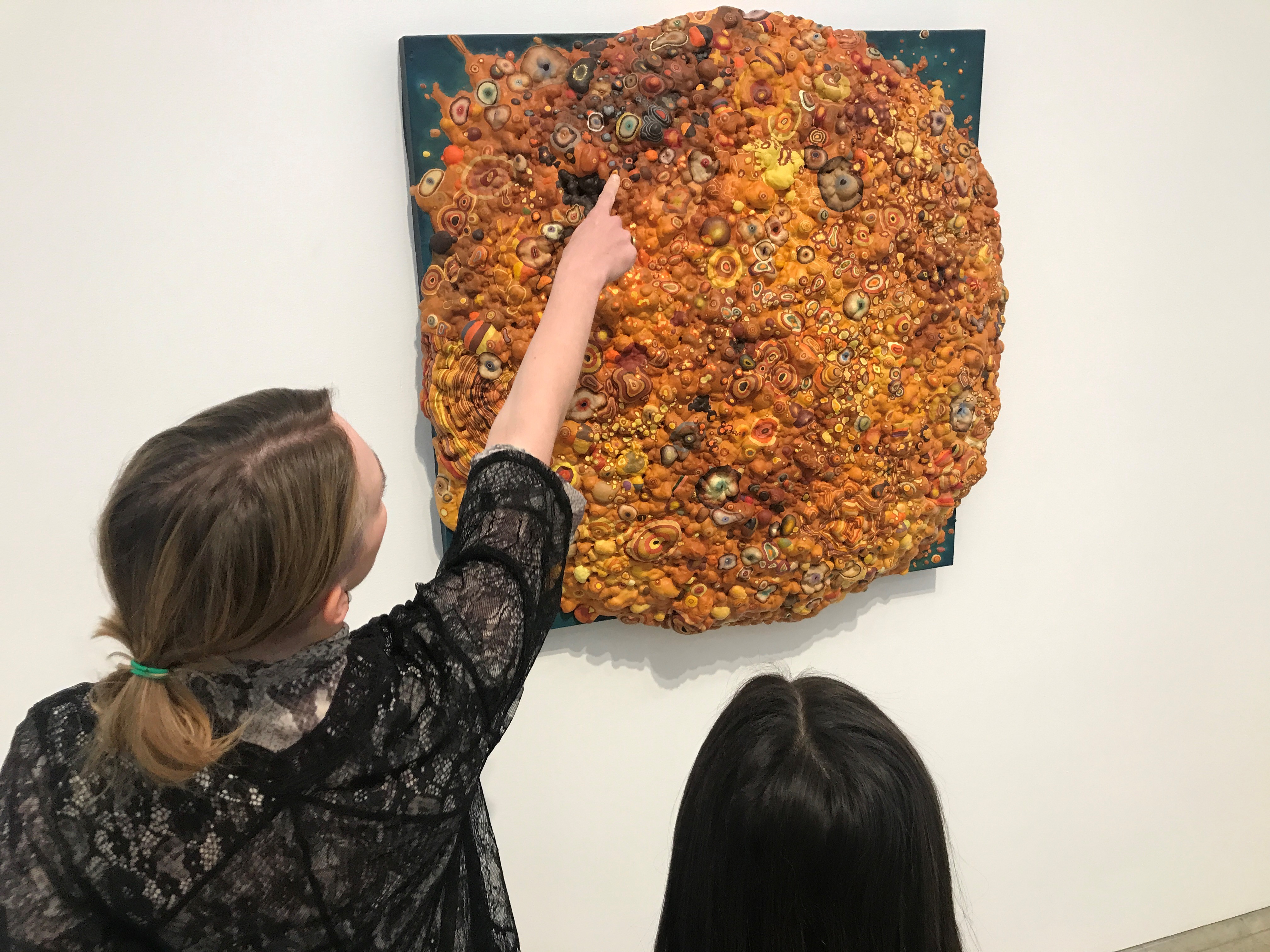
Before and after a quick trip to NYC (see the photo), I’m teaching the research class in our Department of Counseling this year. This leads me to re-affirm a conclusion I reached long ago: Research is hard.

Research is hard for many reasons, not the least of which is that scientific language can look and feel opaque. If you don’t know the terminology, it’s easy to miss the point. Even worse, it’s easy to dismiss the point, just because the language feels different. I do that all the time. When I come upon terminology that I don’t recognize, one of my common responses is to be annoyed at the jargon and consequently dismiss the content. As my sister Peggy might have said, that’s like “throwing the baby out with the bathtub.”  

Teaching research to Master’s students who want to practice counseling and see research as a bothersome requirement is especially hard. It doesn’t help that my mastery of research design and statistics and qualitative methods is limited. Nevertheless, I’ve thrown myself into the teaching of research this semester; that’s a good thing, because it means I’m learning.

This week I shared a series of audio recordings of a woman bereaved by the suicide of her former husband. The content and affect in the recordings are incredible. Together, we all listened to the woman’s voice, intermittently cracking with pain and grief. We listened to each excerpt twice, pulling out meaning units and then building a theory around our observations and the content. More on the results from that in another blog.

During the class before, I got several volunteers, hypnotized them, and then used a single-case design to evaluate whether my hypnotic interventions improved or adversely affected their physical performance on a coin-tossing task. The results? Sort of and maybe. Before that, I gave them fake math quizzes (to evaluate math anxiety). I also used graphology and palmistry to conduct personality assessments and make behavioral and life predictions. I had written the names of four (out of 24 students) who would volunteer for the graphology and palmistry activities, placed them in an envelope, and got ¾ correct. Am I psychic? Nope. But I do know the basic rule of behavioral prediction: The best predictor of future behavior is past behavior.

Today is Friday, which means I don’t have many appointments, which means I’m working on some long overdue research reports. Two different happiness projects are burning a hole in my metaphorical research pocket. The first is a write-up of a short 2.5-hour happiness workshop on counseling students’ health and wellness. As it turns out, compared with the control group, students who completed the happiness workshop immediately and significantly had lower scores on the Center for Epidemiologic Studies Depression scale (p = .006). Even better, after 6-months, up to 81% of the participants believed they were still experiencing benefits from the workshop on at least one outcome variable (i.e., mindfulness). The point of writing this up is to emphasize that even brief workshops on evidence-based happiness interventions can have lasting positive effects on graduate students in counseling.

Given that I’m on the cusp of writing up these workshop results, along with a second study of the outcomes of a semester-long happiness course, I’m stopping here so I can get back to work. Not surprisingly, as I mentioned in the beginning of this blog, research is hard; that means it’s much easier for me to write this blog than it is to force myself to do the work I need to do to get these studies published.

As my sister Peggy used to say, I need to stop procrastinating and “put my shoulder to the grindstone.”

The Efficacy of Antidepressant Medications with Youth: Part II

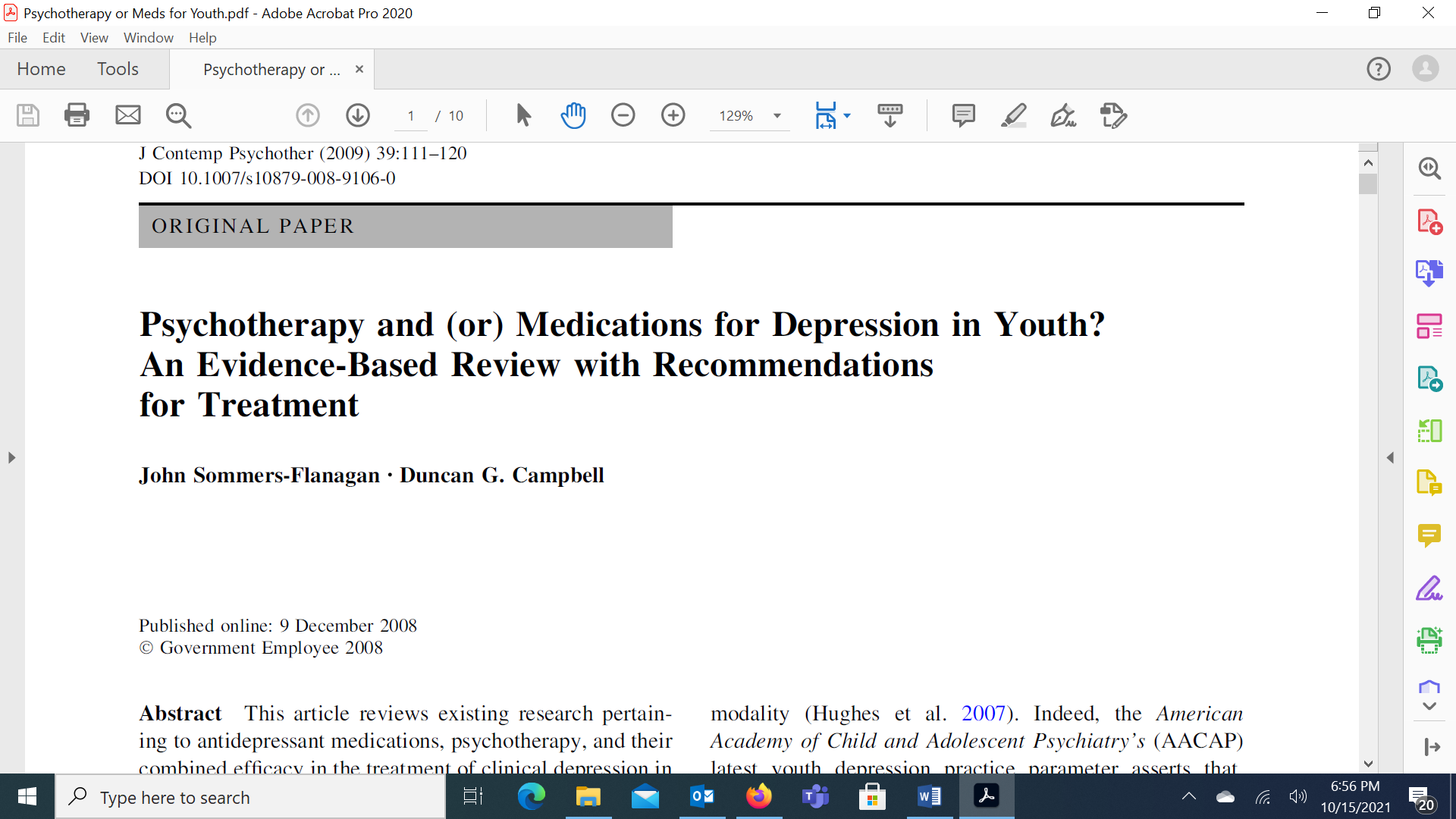
After posting (last Thursday) our 1996 article on the efficacy of antidepressant medications for treating depression in youth, several people have asked if I have updated information. Well, yes, but because I’m old, even my updated research review is old. However, IMHO, it’s still VERY informative.

In 2008, the editor of the Journal of Contemporary Psychotherapy, invited Rita and I to publish an updated review on medication efficacy. Rita opted out, and so I recruited Duncan Campbell, a professor of psychology at the University of Montana, to join me.

Duncan and I discovered some parallels and some differences from our 1996 article. The parallels included the tendency for researchers to do whatever they could to demonstrate medication efficacy. That’s not surprising, because much of the antidepressant medication research is funded by pharmaceutical companies. Another parallel was the tendency for researchers to overstate or misstate or twist some of their conclusions in favor of antidepressants. Here’s the abstract:

Abstract

This article reviews existing research pertaining to antidepressant medications, psychotherapy, and their combined efficacy in the treatment of clinical depression in youth. Based on this review, we recommend that youth depression and its treatment can be readily understood from a social-psycho-bio model. We maintain that this model presents an alternative conceptualization to the dominant biopsychosocial model, which implies the primacy of biological contributors. Further, our review indicates that psychotherapy should be the frontline treatment for youth with depression and that little scientific evidence suggests that combined psychotherapy and medication treatment is more effective than psychotherapy alone. Due primarily to safety issues, selective serotonin reuptake inhibitors should be initiated only in conjunction with psychotherapy and/or supportive monitoring.

The main difference from our 1996 review was that in the late 1990s and early 2000s, there were several SSRI studies where SSRIs were reported as more efficacious than placebo. Overall, we found 6 of 10 reporting efficacy. An excerpt follows:

Our PsychInfo and PubMed database searches and cross- referencing strategies identified 10 published RCTs of SSRI efficacy. In total, these studies compared 1,223 SSRI treated patients to a similar number of placebo controls. Using the researchers’ own efficacy criteria, six studies returned significant results favoring SSRIs over placebo. These included 3 of 4 fluoxetine studies (Emslie et al. 1997, 2002; Simeon et al. 1990; The TADS Team 2004), 1 of 3 paroxetine studies (Berard et al. 2006; Emslie et al. 2006; Keller 2001), 1 of 1 sertraline study (Wagner et al. 2003), and 1 of 1 citalopram study (Wagner et al. 2004).

Despite these pharmaceutical-funded positive outcomes, medication-related side-effects were startling, and the methodological chicanery discouraging. Here’s an excerpt where we take a deep dive into the medication-related side effects and adverse events (N.B., the researchers should be lauded for their honest reporting of these numbers, but not for their “safe and effective” conclusions).

SSRI-related medication safety issues for young patients, in particular, deserve special scrutiny and articulation. For example, Emslie et al. (1997) published the first RCT to claim that fluoxetine is safe and efficacious for treating youth depression. Further inspection, however, uncovers not only methodological problems (such as the fact that psychiatrist ratings provided the sole outcome variable and the possibility that intent-to-treat analyses conferred an advantage for fluoxetine due to a 46% discontinuation rate in the placebo condition), but also, three (6.25%) fluoxetine patients developed manic symptoms, a finding that, when extrapolated, suggests the possibility of 6,250 mania conversions for every 100,000 treated youth.

Similarly, in the much-heralded Treatment of Adolescents with Depression Study (TADS), self-harming and suicidal adverse events occurred among 12% of fluoxetine treated youth and only 5% of Cognitive Behavioral Therapy (CBT) patients. Additionally, psychiatric adverse events were reported for 21% of fluoxetine patients and 1% of CBT patients (March et al. 2006; The TADS Team 2004, 2007). Keller et al. (2001), authors of the only positive paroxetine study, reported similar data regarding SSRI safety. In Keller et al.’s sample, 12% of paroxetine-treated adolescents experienced at least one adverse event, and 6% manifested increased suicidal ideation or behavior. Interestingly, in the TCA and placebo comparison groups, no participants evinced increased suicidality. Nonetheless, Keller et al. claimed paroxetine was safe and effective.

When it came to combination treatment, we found only two studies, one of which made a final recommendation that was nearly the opposite of their findings:

Other than TADS, only one other RCT has evaluated combination SSRI and psychotherapy treatment for youth with depression. Specifically, Melvin et al. (2006) directly compared sertraline, CBT, and their combination. They observed partial remission among 71% of CBT patients, 33% of sertraline patients, and 47% of patients receiving combined treatment. Consistent with previously reviewed research, Sertraline patients evidenced significantly more adverse events and side effects. Surprisingly and in contradiction with their own data, Melvin et al. recommended CBT and sertraline with equal strength.

As I summarize the content from our article, I’m aware that you might conclude that I’m completely against antidepressant medication use. That’s not the case. For me, the take-home points include, (a) SSRI antidepressants appear to be effective for some young people with depression, and (b) at the same time, as a general treatment, the risk of side effects, adverse effects, and minimal treatment effects make SSRIs a bad bet for uniformly positive outcomes, but that doesn’t mean there won’t be any positive outcomes. In the end, for my money—and for the safety of children and adolescents—I’d go with counseling/psychotherapy or exercise as primary treatments for depressive symptoms in youth, both of which have comparable outcomes to SSRIs, with much less risk.

And here’s a link to the whole article:


Your Fall 2021 Counseling and Psychotherapy Theories Resources

Fall semester is quickly approaching. For some of you, it may have already arrived.

This post includes my usual free offer of theories resources. Even though Rita and I have our own Theories textbook, and we would love for you use it, the resources below are free and will work for you regardless of whether you use our textbook. My general philosophy on textbooks is that I’d rather be helpful than try to coerce people to buy books.

Here we go:

  1. To help students explore their theoretical orientations, we’ve got a short https://johnsommersflanagan.com/2019/07/27/whats-your-theoretical-orientation/ and long-form of a Theoretical Orientation Test. https://johnsommersflanagan.com/2021/02/11/the-long-version-of-our-theoretical-orientation-test-which-hogwarts-hat-fits-you-best/ These tests are for exploration purposes . . . and my or may not have good psychometrics (although someone contacted me about doing a psychometric study on the long version, so we shall see about that).
  2. The Instructor’s Resource Manual is linked here. It includes a chapter-by-chapter glossary, as well as other info that might help with your teaching.
  • I’ve got a set of theories lab activities. I tried posting them here, but technology wasn’t helping. If you want them, email me and I’ll send them out as an attachment. john.sf@mso.umt.edu
  • You can access several theories-related counseling demonstration videos through my YouTube page. Also, I’ve posted a bunch of links previously, and you can access them with brief descriptions here: https://johnsommersflanagan.com/2020/03/14/free-video-links-for-online-teaching/ If you want access to the complete set of all of our theories videos, you have to use the text, but the preceding link has several potentially useful videos.

Theories is my favorite course to teach. I hope these resources will help you have a fun, engaging, skills-based, and inclusive theories teaching experience.

If you have feedback, please share here or via email: John.sf@mso.umt.edu

John SF

Gestalt Theory and Spirituality

In our Counseling and Psychotherapy Theories in Context and Practice book, we include short sections on spirituality for each of the major theories. Previously, I’ve posted all the others (just search spirituality on this blog to find them), but discovered this evening that I forgot to post the Gestalt one. Maybe I forgot because it’s especially short and enigmatic . . . meaning, I didn’t find much out there on the crossroads between Gestalt theory and spirituality. If you know of something, please enlighten me!

Here’s the very short excerpt:

Spirituality

Although not always visible or palpable, Gestalt theory and therapy have deep spiritual roots. Laura Perls studied with Martin Buber and had interests in Taoism. Fritz Perls studied Zen Buddhism. Paul Goodman had interests in Taoism, and Gestalt writer, Dave Mann (2010) contended that Goodman’s book, Nature heals, is consistent with his Taoist beliefs about living with nature in accordance with nature. It may be that Gestalt experiments are consistent in style with the Zen Buddhist koan, a puzzle orriddle designed to open Zen novices to deeper levels of consciousness. At the very least, Zen Buddhism and Gestalt therapy share an attitude of acceptance of the now and an exploration of experience.

There are, of course, differences between Gestaltists regarding the role and nature of spirituality in Gestalt theory and practice. For some, the I-Thou connection is where the transcending and spiritual contact happens. Boundaries dissolve and deeper connections and insights blossom. This may have been what led Jesse Thomas (1978) to publish an early Gestalt-spiritual work titled, “The youniverse: Gestalt therapy, non-western religions, and the present age.” Spirituality, from the Gestalt perspective, is both personal and universal (or youniversalJ).

At the other end of the continuum are individuals who don’t see spirituality as warranting a place in Gestalt theory and practice (Mann, 2010). Mann (2010) recommended that Gestalt therapists, like clients, need to decide where they stand on religion and spirituality, recognizing, at the same time, that where they stand may well change. This brings us to perhaps the most famous words Fritz Perls ever wrote, the Gestalt prayer:

I do my thing and you do your thing.

I am not in this world to live up to your expectations,

And you are not in this world to live up to mine.

You are you, and I am I,

and if by chance we find each other, it’s beautiful.

If not, it can’t be helped.

(Perls, Gestalt therapy verbatim, 1969, p. 24)

To Give Away: One Happy Rooster

Yesterday, Rita posted a free rooster to give away on a local Facebook page. She was surprised that no one claimed him. I waxed empathic, “I don’t understand,” I said, “people always want free things. Getting a free rooster would make the right person very happy.”

We’ve been studying happiness, but not the smiley sort of happiness. We’re into Aristotelian eudaimonic happiness (of course we are). You know, the sort of happiness you experience from living your life in ways that honor others and consistent with your deep values. That just might involve high-quality daily interactions with a free rooster. Think about it.

I was so puzzled by not having our rooster snapped up for immediate adoption that I took to the streets. Really, it was just one street. We’re living in Absarokee for the summer; there are streets, but not very many, and I only spent time on one street.

I cleverly wove the rooster opportunity into my banking business. With only two employees left in the bank on a late Friday afternoon, I asked with great cheer, “Would either of you like a free rooster?” They both quickly said “No thanks,” but I got my transaction processed in record time.

Rita was still in the grocery store (we were dividing and conquering our errands). I marched in, offered to carry her beer, and announced, “Hey. Anybody want a free rooster?” The cashiers avoided eye contact. The bagger started talking about his pigs; they made him happy. He didn’t need a rooster. I guess that proves it’s possible to have too much happiness.

Despite repeated rejections, I’m still convinced that our rooster could bring free happiness to someone. In fact, I think our failed transactions are evidence that happiness is in the eye of the beholder. When I was a teenager, our neighbors got a rooster. We woke up every morning to fantasies of murdering the neighbor’s rooster. I started plotting a late-night abduction. After all, roosters are the mother of opportunity. [I know that’s a wrong and terrible butchering of the saying “necessity is the mother of invention,” and I know that butchering must be the wrong word here, but I’m typing fast and consequently it’s impossible for me to suppress or repress my aggression and mother issues when free associating at this pace. Freud would be happy. But then Freud had his own peculiar tastes regarding what made him happy, which is, of course my point.

The famous Peanuts cartoonist, Charles Shulz, wrote a book titled, “Happiness is a warm puppy.” Although warm puppies likely bring happiness for many people, they’re certainly not the recipe for happiness for everyone. If I recall correctly, for Linus, happiness was a warm blanket.

And I can’t stop myself from thinking that, perhaps, for some lucky person out there . . .

. . . happiness is a warm, free, pet rooster.   

If you’re that person, contact me, because right now, for me, happiness is giving away a free pet rooster.

This Month’s Psychotherapy Networker Magazine and the Myth of Infallibility

Hi All,

In this post I’m sharing a link to an article I just had published in Psychotherapy Networker. Although I had hoped it would be the Networker’s “lead article,” instead, they put Shankar Vedantam first? And then a bunch of other people, like David Burns and Martha Manning? Seriously? All jokes aside, the truth is, I’m humbled to be included.

The article—titled “The Myth of Infallibility”—is about my immediate and ongoing emotional reactions to the loss of a client to suicide. I hope the article provides useful information and emotional support for counselors and psychotherapists who have experienced—or will experience—a similar loss.

You can use the following link to bypass the paywall and read the article for free.

https://www.psychotherapynetworker.org/magazine/article/2565/the-myth-of-infallibility/f576ab48-e662-46f0-b122-06ab19d35e28/OIM

Thanks for reading this. Please share the link if you feel so moved. One of my counseling colleagues shared it with all her students, which seemed great to me, mostly because IMHO, we don’t talk much or get formal training on how to cope when or if we have a client who dies by suicide.

Today, I’m especially grateful for all the people in my life who have supported me in one way or another, over so many years.

Thank you and have a great week.

John S-F

Volunteers Needed for This Friday, July 16

This Friday, July 16, Rita and I are doing a professional video shoot in Billings, MT. Due to some minor scheduling changes, we suddenly have openings for two last minute volunteers, who are willing to talk about personal issues in the role of clients. Below, I’ve written a short description of what we need. If you happen to be an open-minded person interested in a little psychological discovery, read on . . . .

John and Rita Sommers-Flanagan, authors of Clinical Interviewing, Tough Kids, Cool Counseling, and other professional books, are doing a video shoot on Friday, July 16. The video content will be used for educational purposes, primarily to accompany textbooks and for training mental health professionals. John and Rita have openings for volunteers to participate in two demonstrations in the afternoon of July 16. Each demonstration will involve about 30 min of on-camera time, with additional time for prepping and debriefing. Volunteers will be paid a one-time stipend of $100. A description of the two demonstrations follow:

  1. John will engage a volunteer in a brief (single-session) nightmare treatment. The volunteer should have a real problem with nightmares. The therapeutic demonstration will focus on coping with nightmares and changing or reducing their frequency and intensity.
  2. Rita will demonstrate how current emotions are linked or related to past emotions. The volunteer should have experience with some problematic emotions in their present-life and be willing to explore past connections to current distressing emotions. Anger, sadness, and anxiety are three emotions that work well for this demonstration.

Volunteers should be open and interested in exploring psychological issues. Potential volunteers (we only need two!) should contact John Sommers-Flanagan ASAP at john.sf@mso.umt.edu

Who’s Afraid of a Little CRT?

Critical Race Theory (CRT) has been in the news lately, especially in Montana. As it turns out, several Montana public officials (you know who you are) appear frightened by CRT. Their response to the idea (not the reality) of CRT being taught anywhere or anytime is to try to ban it, as in make it illegal. It’s like a modern Montana-style prohibition (“Don’t you go out and get caught with a bottle of CRT or we’ll be taking you on down to see the sheriff!”).

All jokes aside (well, not all), I have a couple brief comments and a question.

I’m struck that, in the 21st century, anyone is using the old tried and failed strategies of banning ideas and burning books. Alcohol prohibition seemed rather unsuccessful. . . and we don’t need to know what happened with Romeo and Juliet to understand that, that which is forbidden, takes on a certain sex appeal.

My other main thought is that, just in case anyone was sleeping through science class, Critical Race Theory is a . . . (wait for it) . . . a theory! As with all theories, it’s not a perfect explanation of anything. It’s a working model, a set of ideas, with maybe a few scientific hypotheses. The right response to CRT isn’t to outlaw it—because if CRT is outlawed, then only outlaws will understand CRT. Instead, CRT is great food for thought, discussion, and public and private discourse. Rather than make it illegal, we should be discussing, evaluating, and critiquing its usefulness and validity, rather than acting like studying the presence of systemic racism in American history is blasphemy. If you contemplate the issue, the answer is “Yes, of course” there has been, from the beginning, systemic racism in the U.S. (think Columbus, slavery, Indian Boarding Schools, etc.). However, the fact that systemic racism is an historic and contemporary reality doesn’t make every jot and tittle of CRT true; but certainly it suggests we take it seriously. If not, we risk tempting our children with forbidden fruit or teaching them to be afraid of new ways of thinking. Either way, banning or illegalizing or running like scared rabbits away from CRT does a disservice to our state, our country, and our children.  

My question is whether I should write an Op-Ed piece on this topic. If you think so, let me know. If you think not, tell me I should let it go.